
Update: Via Bree in comments, you can follow the Twitter conversation here.

USA Today quotes anthropologists Hugh Gusterson and Brian Ferguson in a long-ish article tied to the forthcoming publication of a National Defense University (a Pentagon affiliated think tank) report on HTS. Gusterson:
It’s another example of a military program that makes money for a contractor while greatly exaggerating its military utility. The program recruited the human flotsam and jetsam of the discipline and pretended it was recruiting the best. Treating taxpayer money as if it were water, it paid under-qualified 20-something anthropologists more than even Harvard professors. And it treated our ethics code as a nuisance to be ignored.
The article mentions many of the failings of the program, from allegations of sexual harassment and racial discrimination to padded time-sheets and wasted funds. Noting the USA Today article, Zero Anthropology collates a series of documents related to investigations into HTS here.
From Like People You See in a Dream: First Contact in Six Papuan Societies (Stanford, 1991), which is partly about the sometimes violent imposition of ‘peace’ on the peoples of New Guinea. Page 27:
The most visible effect of administration influence was pacification; Papuans could no longer use violence for settling scores and gaining political objectives. Less immediately visible were changes in local economic and political relations that followed upon the introduction of steel, labor recruiting, and a growing dependency on the colonial economy. However, Papuans quickly discovered that there were other, expanded opportunities for pursuing their traditional goals (and developing new ones) under the new regime. New sources of wealth became available, travel could be expanded, ceremonial exchange networks extended, and new directions explored for political and trade alliance. In many situations, the government presence even coincided quite satisfactorily with local Papuan desires, giving weakened groups relief from predation of their enemies, making rare trade goods locally plentiful, and putting nearby people at a trading advantage over their more distant neighbors.

Zero Dark Thirty begins with a statement that it is “Based on Firsthand Accounts of Actual Events.” And then the screen goes black; you hear voices from the World Trade Center only. The theatre is pitch black for minutes. There is no vision.
I went to see Zero Dark Thirty on Saturday. I’ve tried to avoid reading any of the controversy until having an opportunity to see the film (it opened later in Ireland than in the States), though it’s hard when my favorite critic of US power (Greenwald) has made what I am sure are compelling arguments against the film; and my favorite drama queen (Andrew Sullivan) has also been writing about it a lot; I have tried to avoid them both on ‘ZDT’, and so now I have to go back and read a month’s worth of material. Anyway, the film absolutely does position torture as effective in gaining intelligence that led to Osama Bin Laden, which is not a truthful claim despite the film’s opening sentence, and therefore it appears to carry forward the ideology of the ‘war on terror’ as promulgated by Cheney and Co. So the central historical claim of the film appears to be false. Still, according to Andrew O’Hehir at Salon, “Hina Shamsi, the director of the ACLU’s National Security Project, who does not think ‘Zero Dark Thirty’ is pro-torture, has made the especially apt observation that it’s a story about war crimes told from the perspective of the criminals.”
The question that hovers over the film is: what does the ‘perspective’ of the war criminals look like? What does it see? Being a film, what does ZDT show about the war on terror as a ‘way of seeing’? I don’t think the film is triumphalist or a representation of the heroic (pace Naomi Wolf’s over the top take down of the director). While not being an ideological condemnation of the prosecution of the ‘war on terror,’ it seems to me that it does portray the inhumanity, and figuratively the non-humanity, of those prosecuting it through the symbolism of affect (or its absence) it deploys. The symbol is ultimately a kind of killer (affectless) insect. This is what US ‘national security’ has become.
…making connections is essential, and I think the project we’re engaged in here, at some level, is precisely to make some of those connections visible for emergent anthropologies elsewhere. So let me offer one, in the form of a thought on description. A Machine to Make a Future, my Celera Diagnostics book, is a kind of writing degree zero. It is a modernist project where I wanted to be utterly saturated with things I know and to disappear from the text. But in some ways that form of modernism is now traditional – it is hardly new. On the other hand, the project rejoins anthropology by demanding engagement with the unfamiliar. However, whereas no one would ever say to Marilyn Strathern, ‘The fact that you’re making us learn these terms from New Guinea is illegitimate,’ they will say that about SNP [single nucleotide polymorphism]. I don’t know what to do about that except persevere. Why is there such an investment in refusing to be open to the contemporary world?
–Paul Rabinow in conversation with George Marcus, Designs for an Anthropology of the Contemporary, p 50
…connection and disconnection underpin the comparative maneuver that would contrast what seem(s) (the best way to describe) hegemonic Melanesian and Euro-American conceptions of relations. It is a Euro-American move, of course, to find unity in diversity (common brotherhood overcomes differences), but that is all right. There are many contexts in which that might be a good thing to do, and one I have made my own indeed involves constantly returning to Melanesian materials—not just for inspiration, though that is reward enough, but to keep the anthropological accounts of that region contemporary. What happens there (and what happened there) goes on mattering. They are “us” too.
–Marilyn Strathern, ‘What Politics?,’ Common Knowledge, 17:1 (2011), p 124
Rex elsewhere characterized the discussion around what has unfortunately come to be called #AAAfail as “…between thoughtful people who are aware of the complexities of knowledge production, and those who are for psychological reasons strongly committed to identifying themselves as scientists and everyone else as blasphemers” (emphasis added). He further called for empirical description and analysis of the social and cultural dynamics structuring this discussion. Both called to mind Mary Douglas’s ruminations on Durkheim and science, from the preface to the 1975 edition of Implicit Meanings:
Around the beginning of this century Durkheim demonstrated the social factors controlling thought. He demonstrated it for one portion of humanity only, those tribes whose members were united by mechanical solidarity. Somehow he managed to be satisfied that his critique did not apply to modern industrial man or to the findings of science. One may ask why his insights were never fully exploited in philosophical circles… If Durkheim did not push his thoughts on the social determination of knowledge to their full and radical conclusion, the barrier that inhibited him may well have been the same that has stopped others from carrying his programme through. It seems that he cherished two unquestioned assumptions that blocked him. One was that he really believed that primitives were utterly different from us. A week’s fieldwork would have brought correction…[snip] His other assumption allowed him to reserve part of our knowledge from his own sociological theory. This was his belief in objective scientific truth, itself the product of our own kind of society, with its scope for individual diversity of thought. His concern to protect his own cognitive commitment from his own scrutiny prevented him from developing his sociology of knowledge… [snip] Continue reading
Auckland-based anthropologist Susanna Trnka is featured in an online interview about her new book, State of Suffering.
UK anthropologists (and academics) may have spent their holidays poring over, gossiping about, ignoring, or otherwise relating to the release of the results of the 2008 research assessment exercise (RAE). Those of us outside the UK have probably heard of this gargantuan undertaking that aims to assess the quality of research conducted at university departments in view of better distributing funding. I think I first heard of the RAE as a prime example of the ‘audit culture‘ that in many places these days seems to be the guiding ethos of scholarship. Complaints about the RAE, and about audit in general, can be heard far and wide in universities across Europe and elsewhere. Audits often create bureaucracies that are expensive in their own right, they put onerous burdens on already over-worked teachers and scholars, they replace complex forms of assessment with simplified formulae in order to render research ‘legible’ (assessable) to bureaucrats, truly cutting-edge or paradigm-shifting research cannot be ‘seen’ in this setting, and so on. All of these criticisms are voiced by some at the Guardian (among other places). Other emerging complaints include ways that departments can ‘game‘ the system to produce a misleading result. My understanding of the basic procedure is that departments nominate research staff to submit four publications that are then assessed by a peer-lead panel, each publication being given a ranking (roughly, 4 = internationally important, 1 = unimportant anywhere). Departments apparently engage in a calculus of how many and which staff-members to include for assessment, in order to yield the highest result. They may decline to include staff who will not get a high score, or they may hire academic ‘stars’ on unusual contracts, in order to be able to include them. This article details some of the ways this gaming may have occurred in the 2008 exercise.
Below I append the 2008 results for ‘anthropology’ {Cambridge has two results, one for ‘social anthropology,’ the other for ‘biological anthropology’}:
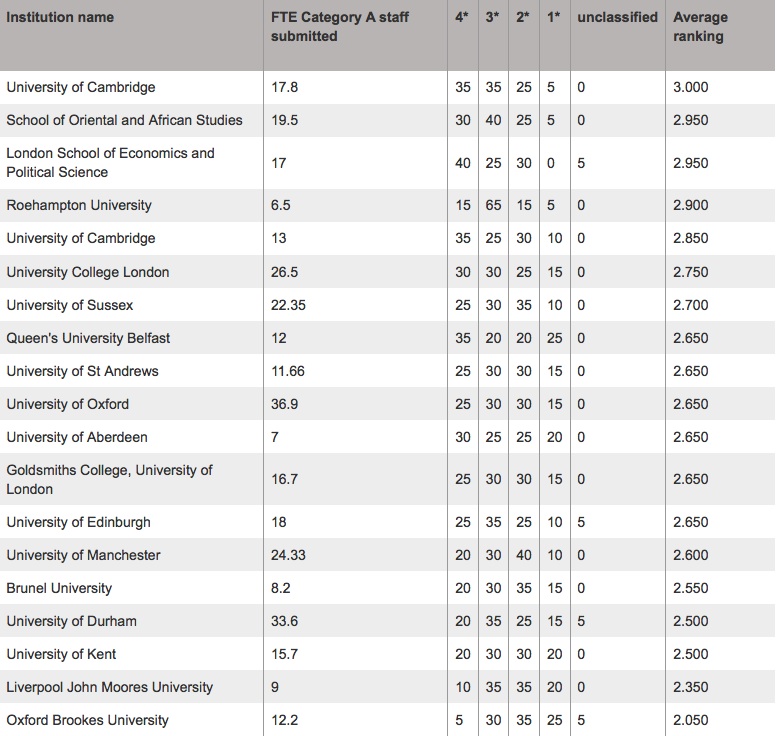
Though I am personally deeply distrustful these sorts of rankings, feeling that that they utterly fail to capture the complex ways in which hierarchies of reputation (which I think are inseperable from putatively objective assessments of quality) are established, they are kind of amusing to talk about. While the results displayed above roughly comport with my sense of the UK social anthropology scene, one result stood out: the low ranking at Manchester. I find it rather shocking that a department with a historical reputation such as Manchester’s should not end up in (even) the top half of the schools being ranked. What’s up with that? Meanwhile, this particular ranking of UK departments to me points up the fact that a similar recent assessment of US departments is nowhere to be found (to my knowledge). The last results from the US National Research Council for anthropology were produced in, when?, 1995? Anyone care to take a stab at a (purely subjective) Top 10 list of US departments? What about a Worldwide Top 10?
USA Today yesterday published a new piece about the human terrain system. The article, which consults familiar experts such as Roberto Gonzalez and Kerry Fosher, would be completely unremarkable except that it reads almost like the last year did not happen. Reporting no new information, the article fails to even mention many alleged weaknesses in the conceptualization and execution of the HTS idea, weaknesses that have been amply reported over the last several months (see for example John Stanton’s articles, linked to by Open Anthropology). If the article contains no new information, and indeed if it ignores much information that has come to light about HTS, it does feature a sidebar with Montgomery McFate doing a familiar song and dance about the program’s virtues. McFate, who skipped the AAA panel she was meant to be on, is still selling the program. She is perhaps also offering an explanation of why HTS has so far proven a failure:
The need for HTS as a capability was recognized in Phase 4 of Iraq and Afghanistan, when the military identified their lack of socio-cultural knowledge as an operational gap. Building HTS during the war was expensive and difficult because we were reacting to a crisis rather than planning ‘left of boom’. Had this capability been developed and implemented during a Phase 0 pre-conflict phase, policy decision-makers and planners in the Pentagon would have had a much richer and more granular baseline knowledge of the societies in which operations were to be conducted, which would have allowed them to develop more effective policies and strategies. Even more important, these senior officials would have potentially had the opportunity to use this knowledge to deter conflict in the first place.
If HTS wisdom had been incorporated during the ‘Phase 0 pre-conflict phase,’ perhaps the conflicts could have been avoided. Is McFate here saying that more ethnographic knowledge would have stopped the wars?
And yet, it seems that the diversity of cultures has rarely appeared to men for what it is: a natural phenomenon, resulting from the direct or indirect relationships between societies. They rather tended to see in it a sort of monstrosity or scandal…
This mode of thought by which the “savages” (or all those one chooses to qualify as such) are rejected outside mankind, is precisely the most marked and characteristic of these very savages themselves… Mankind stops at the frontiers of the tribe, of the linguistic group, and sometimes even of the village, to the extent that a great many of the peoples called primitive call themselves by a name which means “men” (or sometimes — shall we say with more discretion — the “good ones,” the “excellent ones,” the “complete ones,” thus implying that the other tribes, groups, and villages have no part in human virtues or even human nature, but are at the most made up of “bad people,” “nasty people,” “land monkeys,” or “lice eggs.” One often goes so far as to deprive the stranger of this last shred of reality by making him a “ghost” or an “apparition.” Thus curious situations are created in which two interlocutors proceed to cruel exchanges. In the Greater Antilles, some years after the discovery of America, while the Spaniards sent out investigating commissions to ascertain whether or not the natives had a soul, the latter were engaged in the drowning of white prisoners in order to verify, through prolonged watching, whether or not their corpses were subject to putrefaction.
This anecdote, at once baroque and tragic, illustrates well the paradox of cultural relativism (which we will see elsewhere in other forms). It is by the very manner in which one attempts to to establish a discrimination between cultures and customs that one identifies most thoroughly with those one tries to refute. By refusing to see as human those members of humanity who appear as the most “savage” or “barbaric,” one only borrows from them one of their characteristic attitudes. The barbarian is first of all the man who believes in barbarism.
In Culture in Practice, Marshall Sahlins proves himself to be one of the most profound and original anthropologists of our time. In the breadth of his perspective, his immense knowledge, his balanced sense of judgment and his refusal to bow to intellectual fashion, Sahlins is without doubt the wise man of contemporary anthropology.
“Les amoureux fervents et les savants austères
Aiment également, dans leur mûre saison,
Les chats puissants et doux, orgueil de la maison,
Qui comme eux sont frileux et comme eux sédentaires.Amis de la science et de la volupté
Ils cherchent le silence et l’horreur des ténèbres;
L’Erèbe les eût pris pour ses coursiers funèbres,
S’ils pouvaient au servage incliner leur fierté.Ils prennent en songeant les nobles attitudes
Des grands sphinx allongés au fond des solitudes,
Qui semblent s’endormir dans un rêve sans fin;Leurs reins féconds sont pleins d’étincelles magiques,
Et des parcelles d’or, ainsi qu’un sable fin,
Etoilent vaguement leurs prunelles mystiques.— Charles Baudelaire”, see also
On the flight to Nairobi, already Obama buttons and shirts were everywhere. My taxi driver James tells me that today has been declared an impromptu public holiday: civil servants and others will have the day off. Later I learn that the abruptness of this irks some of these servants in Nairobi, because it doesn’t allow them the time properly to plan to be with relatives on this occasion, and disrupts things like administering exams to students! But Obama talk is everywhere: “(words I don’t understand)… Obama <…> Obama <…> Obama <…>” At a cafe, the menu has an insert, featuring a color photograph of the president-elect, the flags of Kenya and the US: “The management and staff at Savanna congratulates Barrack Obama on becoming the Forty Fourth President of the United States of America.”
I arrived in the late evening so I had missed the news of the day. I arrived during a downpour, and raced to the TV once at the motor lodge — cause I wanted to know just how large the victory was. First channel: Tyra. Second channel: Football. Third Channel: Football. Fourth Channel: Al Jazeera! Al Jazeera calls the victory ‘convincing,’ and I see a blue Indiana, and a blue Virginia, and a blue Florida, and I think that Chris Matthew’s famous ‘chill up the leg,’ might have been a chill felt round the world, cause I get goosebumps.
People are talking of course, the bartender hands me a Tusker and wonders if Obama can deliver; in the Luo areas of Kenya things are quite ecstatic… Al Jazeera quickly shifts the discussion to what Obama will be able to deliver and who will govern under him (will, e.g., Robert Gates continue on as Secretary of Defense), and emphasizes that while Obama’s statements on Israel have hewed pretty closely to standard US policy, he is, by virtue of his unique background, capable of ‘talking to more people’ than, by implication, Bush was or just about any US politician would be.
I was still at the Starbucks in Dublin airport when Obama’s speech was broadcast live after the election was called. There was Oprah crying, and Jesse Jackson. An anthropologist friend and I exchange text messages. I note the giant glass walls on the stage. He txts with characteristic brilliance: ‘teardrop guards’. Yes I’m tearing up, especially when — this truly thrilled me — especially when Obama talked to people ‘listening to radios’ in remote parts of the world. I thought to myself, who but Obama on this occasion would bother to remember those folks and to speak to them? This man can be a president of a different order altogether. Perhaps the often jingoist phrase ‘leader of the free world’ might gain new meaning, might be resignified, for a new generation…
(UPDATE: Radio says it is ‘Obama day’ but most people have actually decided to ignore it and go to work anyway.)
May an inconstant disciple dedicate this book which appears in 1958, the year of Émile Durkheim’s centenary, to the memory of the founder of Année Sociologique: that famed workshop where modern anthropology fashioned part of its tools and which we have abandoned, not so much out of disloyalty as out of the sad conviction that the task would prove too much for us.
Epigraph, Structural Anthropology
All games are defined by a set of rules which in practice allow the playing of any number of matches. Ritual, which is also ‘played,’ is on the other hand, like the favoured instance of a game, remembered from among the possible ones becuse it is the only one which results in a particular type of equilibrium between the two sides. The transposition is readily seen in the case of the Gahuku-Gama of New Guinea who have learnt football but who will play, several days running, as many matches as are necessary for both sides to reach the same score (Read, p. 429). This is treating a game as a ritual.