Diamond’s conflation between the necessary and the sufficient grows out of the link between his interest in "history's broadest pattern" (1997: 420) and his determination to develop "human history as a science, on a par with acknowledged historical sciences such as astronomy, geology, and evolutionary biology" (1997: 408).  As he says, his book "attempts to provide a short history of everybody for the last 13,000 years .... [and searches] for ultimate explanations ... [that push] back the chain of historical causation as far as possible" (1997: 9).  Crucial to this search for law like explanations that will generate long chains of causation back to first causes (chains of causation that even link mountain range formation to Yali's quandary) is Diamond's distinction between ultimate and proximate causes.  Ultimate causes are those broadly applicable and pervasive forces, such as guns, germs, and steel.  Diamond is interested in these causes because he thinks they are the ones which really drive history – both past and present.  These ultimate causes shape derivative and more immediate occurrences, such as particular battles, conquests, economic systems.  The effects of these more immediate occurrences, in turn, become proximate causes of yet other events.

Diamond's view of an inevitable and inexorable course of human history, one driven by the operation of ultimate causes over the span of its 13,000-year course, rests (as some of you suggested in earlier postings)  on what seems to us to be an implicit view of human nature.   It is this human nature which, in his vision, keeps ultimate causes active and decisive throughout history.  This is a view of human beings as necessarily leading lives so as to extract maximum advantage over others:  give a guy -- any guy -- half a chance and he will conquer the world;  give a guy a piece of appropriate metal and he will inevitably fashion a sword to cut you down;  give a guy a piece of appropriate metal and he will inevitably fashion a chain to enslave you within the hold of a ship bound for a New World sugar plantation.  In a way that many in the contemporary West find seemingly self-evident --  in a way that does not problematize the way the world works -- Diamond suggests that people everywhere and at all times, if they had sufficient power, would necessarily use it in seeking to maximize their own advantage through the domination of others.  This implicit view of a trans-historical and trans-cultural human nature is consistent with Diamond's explicit rendering of both historical context and cultural perspective as irrelevant.  In fact, Diamond works hard to exclude such perspective and context from his scientific history.

Correspondingly, Diamond describes the rise of mercantilism and capitalism as only "proximate forces" in the course of world history (1997: 10).  From his perspective, mercantilism and capitalism are just epiphenomena -- just passing examples of history's general law.  From our perspective, however, mercantilism and capitalism provide particular historical contexts in which (and in different though related ways) expansionist conquest appears an especially desirable activity -- and one made especially feasible by the availability of guns, germs, and steel.  This is to say, rather than merely proximate causes of lives more fundamentally and inexorably determined, mercantilism and capitalism impel the use of guns, germs, and steel in particular manners for particular ends.

Mercantilism and capitalism have spurred people to be bold -- to go to the ends of the earth if necessary -- in a search for ever greater profits. They have justified the subjugation of the New World as well as parts of Africa.  They have also authorized the creation of lucrative, slave-run plantations in the Caribbean whose profits sustained the lavish lifestyles of the absentee planters and whose sugar sustained (in nutritionally imbalanced sweet tea and treacle-smeared bread) the impoverished lives of the British workers -- those who manufactured the guns, chains, and instruments of torture.

Thus, we see such lives and historical outcomes as made possible by (for instance) guns, germs, and steel but as importantly propelled and shaped by cultural visions of what was worth pursuing and at what cost:  of winning favor from God and King, acquiring gold and silver, attaining certain lifestyles, or achieving national strength.  However, where we see the likes of guns, germs, and steel as necessary but not sufficient causes of such lives, Diamond sees such lives -- apparently all lives -- as inevitably seeking as much conquest and domination as possible.  For Diamond, in other words, the necessary is the sufficient.  To have the power is to express the power;  to have the power to dominate is to use it to dominate in the maximal way possible.  Where we see human activities as propelled and shaped by historically located visions, Diamond sees these activities as determined (presumably) by hard wiring -- as part of the biological nature of the human animal.  In these regards, activities of conquest and domination are simply in the nature of things -- just as, for instance, lions by virtue of their size and armament will inevitably slaughter lambs.

Where  Diamond sees activities of conquest and domination as simply in the nature of things – as the inevitable outcome of human nature. -- Raymond Kelly's recent comprehensive analysis of the origins of human warfare provides a relevant and contrasting view of human nature and of inevitability.  In this critique of the Hobbesian notion that there is a "trinity of interrelationship between human nature, war and the constitution of society" (Kelly, 2000:  121), he writes:
Warfare is an episodic feature of human history and prehistory observed at certain times and places but not others. Moreover, the vast majority of societies in which warfare does occur are characterized by the alteration of war and peace; there are relatively few societies — only about 6 percent — in which warfare is continual and peace almost unknown. It is only in this relatively small percentage of cases that something approaching a Hobbesian social condition of pervasive and unending warfare can be found. It might thus be said that it is “the nature of man” (or humankind) to conclude episodes of armed conflict between neighboring social groups by breaking off hostilities, by truce, and/or by reestablishing peaceful relations (Kelly, 2000: 124).
Kelly concludes:
The human propensity to peacemaking, so strikingly evident from the characteristic alteration between war and peace, is central to the nexus of interrelationships between human nature, war and society — and this bodes well for the future (2000: 161).
It is the case that Yali was poor and that the people of the New World were brutally conquered by representatives of the Old.  It is also the case that those who beat up on other people have the capacity to do so.  But are these facts inevitable by virtue either of the nature of history or the nature of humans?  As Kelly indicates, human beings always are capable of a range of behaviors and they always are capable of engaging with each other and their neighbors in a range of ways.  They might make war, but they also might make peace.  Whether they choose one or the other is powerfully affected by particular historically and culturally located ideas  about  the desirable and the feasible.

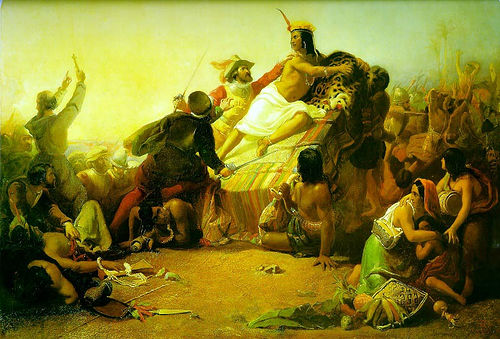
To our position concerning history's rootedness in human culture, rather than in human nature, we would add an emphatic stipulation.  Since it has become clear to anthropologists that cultures contain multiple perspectives about alternatives and how they might be pursued and otherwise dealt with, it follows that human beings have a measure of choice about how to act.  Thus, for instance, from American ideas of the worth of the individual, one can generate political perspectives as diverse as libertarianism and welfare statism, the first position holding that no individual should be interfered with or regulated, the other, that no individual should be neglected or deprived.  The existence of such alternatives means that human beings may, realistically, be held accountable for the choices they make.  We find this stipulation important both in combating Diamond's general world history and in constructing an aspect of Papua New Guinea's more particular one.  Pizarro (for example) had the capacity and resources to behave with remarkable brutality in the New World -- he had both the technology and will to conquer.  But the mere capacity to behave brutally does not absolve him from having done so.  Likewise, Europeans had the resources to treat Yali and other Papua New Guineans with contempt.  But that position should not absolve them from having done so.  Such considerations, we argue, are important in rethinking historical outcomes.  Indeed, the haves may be prompted to do such rethinking themselves by recognizing that the have-nots may already have come to their own conclusions.