Tag Archives: Fieldwork

anthropology + design: nicolas nova.

[This post is part of a two-week series featuring interviews with designers reflecting on anthropology and design.]

NICOLAS NOVA. design researcher. ethnographer.

a-braincomp2

ANTHROPOLOGY + DESIGN.

The word “design” is problematic as it’s often related to furniture and glossy magazines at the local newsstand. And because this term is used in different fields, from engineering to management, you have different professions in which practitioners see themselves as “designers:” architects, engineers, people developing user interfaces for websites or video games, etc. A good way to approach design is to understand what “designers” do: they define the shape and the behavior of artifacts based on their understanding of potential users and the context in which they live or work. Said differently, they materialize “prospective futures.”

In order to speculate about near future possibilities, designers usually need to make their work relevant, useful, or believable by people. This is where the social sciences fit in. Knowledge and methods coming from anthropology–such as ethnography–are used and often repurposed by designers to help make different decisions over the course of a project. Observing people’s routines in a kitchen can inform the design of electric appliances, for instance. Interviewing users with a non-standard way of using their bike can also be curious and lead to new bicycle designs.
Continue reading

anthropology + design.

Savage Minds welcomes guest blogger, Rachel Carmen Ceasar.

Chances are you know nothing about design.

Me neither.

nicolas_objects_big (1)

So when I was introduced to designer Laura Forlano at the Society for Social Studies of Science meeting in Sunny San Diego last fall, my interest in what design could do for anthropology–and vice-versa–was piqued.

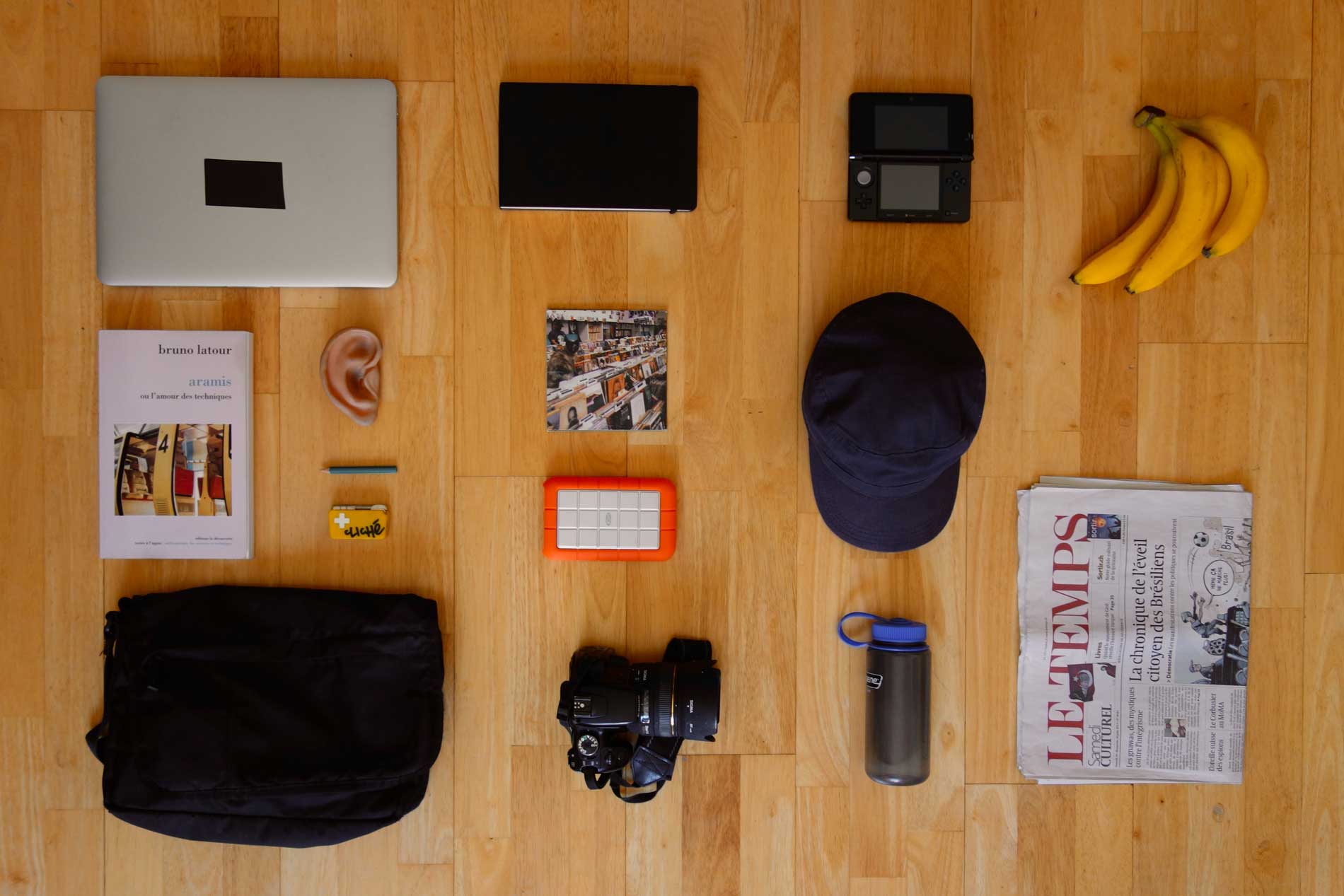
For the next two weeks, I will be running a short series that features interviews with design researchers, ethnographic hackers, and field work makers with their take on anthropology and design. For the first interview, we will be talking with design researcher and ethnographer Nicolas Nova (that’s his toolkit in the photo above).

Rachel Carmen Ceasar (@rceasara) is a doctoral candidate in the Joint Medical Anthropology Program at UC Berkeley and UC San Francisco (California, USA). She writes about the subjective and scientific stakes in exhuming mass graves from the Spanish Civil War and dictatorship in Spain today.

Who’s an archaeologist, and what do we do? A few reflections on Identities and Boundaries in Four-Field Anthropology

[Savage Minds welcomes guest blogger Jane Eva Baxter]

This past year, I had two conference experiences that offered me a chance to reflect on what it means to be an anthropologist/archaeologist in the 21st century.  These experiences allowed me to consider the dynamic shifts in anthropological inquiry that move us beyond historical visions of and for the discipline.  Simultaneously, these encounters got me thinking about identities within anthropology, and how we connect, disconnect, and reconnect to the particular cultures of our own subfields.  Perhaps most interesting, was the realization that boundaries of practice are shifting with a different pace and rhythm than our own identities as anthropologists, or archeologists, or linguists, or…   In other words, these experiences gave me an opportunity to reflect upon a very active set of incongruities around traditional characterizations and boundaries of practice, the realities of what we actually do now as members of a particular anthropological subfield, and the ways we choose to identify ourselves within the incredible diversity of anthropology/anthropologists today. Continue reading

Empathy: A Short Conceptual History and An Anthropological Question

Savage Minds welcomes guest blogger LINDSAY A BELL

In my first post, I proposed that anthropology might be particularly well suited to thinking through the concept of empathy. In North America, “empathy” has come to be a prominent term across the caring arts. In areas ranging from self-help to health care, empathy seems to be something that can and should be cultivated. In 2006, President Obama declared that an “empathy deficit” was more pressing than a federal budgetary deficit. The scale of this claim reflects an increasingly popular view of empathy as producer of solutions to large, complex issues. In his 2010 bestseller Empathic Civilization, American social theorist Jeremy Rifkin argued that “global empathic consciousness” could restore a global economy and solve climate change.

Last weeks’ commentators aptly pointed out that “empathy” has become a gloss for broader concerns. Its implementation from the perspective of those of you working with social workers, health care professionals and so on made it clear that institutionalized empathy is a downloading of problems onto already thinly stretched personnel. As a former pubic schoolteacher, I can agree that it is tempting to dismiss empathy as a smoke screen for troubles of our times. Yet, I keep coming back to anthropology’s shared principles with empathy—specifically perspective taking, withholding judgment, and dwelling with the people we work with. I am not arguing ‘for’ or ‘against’ empathy. Frankly, I am curious. What meanings has this term come to hold in the context of North America, and what very real kinds of ways of relating to Others has empathy been trying to capture but somehow can’t?  Puzzled by the empathy boom, I went to a good friend for insights. As an analytic philosopher specializing in emotions and emotion history, she had a lot to teach me about the crooked conceptual path of the term. She was so generous in sharing what she knows, I thought I’d share what I’d learned here. Continue reading

Lawrence of Arabia as anthropologist

To be honest, I was surprised how much attention Peter O’Toole’s recent passing received. We all knew he was famous, but we also learned this week how deeply he was loved. Many people loved him because he had that one thing that is so hard to find in the entertainment industry today: charisma. But anthropologists loved him for something else: Lawrence of Arabia. Lawrence of Arabia is central to anthropology, and ought to be more even more central than it is. It is about fieldwork, intimacy, impersonation, and colonialism. It puts on display the complexity, ambivalence, and often ugliness that comes with anthropological fieldwork.

Continue reading

Conference Chic, or, How to Dress Like an Anthropologist

By Carole McGranahan with Kate Fischer, Rachel Fleming, Willi Lempert, and Marnie Thomson

Wondering what to wear to the AAAs? We’ve got you covered. For women: throw a few scarves in your suitcase, a suitable range of black clothes, a kick-ass pair of shoes or boots, and some anthropological “flair,” and you should be good to go. Men need to pack their nice jeans, a good buttoned shirt, and the pièce de résistance: a stylish jacket. Unless you’re an archaeologist. Then all you need are jeans.

Anthropologists around the world are packing for the annual American Anthropological Association meetings (“the AAAs”) being held this year in balmy Chicago from November 20-24. What, you might wonder, are they packing? What look do anthropologists go for at the AAAs where thousands of anthropologists gather each year? We’ve turned to our social media networks to find out, posting this question on Twitter and on multiple Facebook accounts to learn just what fashion choices anthropologists are making this week. Continue reading

Made in China: Notes from the CIA Gift Shop

What might an anthropology of the covert look like? I think of the covert as a particular type of secret, one grounded in deception and shadows, and populated by individuals pretending—in part—to be someone other than who they actually are. My current research project is about the CIA as agents of US empire during the Cold War. It is about being invisible, being undercover, and being a legitimate ethnographic subject rather than just a historical or political one. Yet, what sort of ethnography can be written about covert, undercover subjects? How does one humanize the CIA?

I’ve been turning this question over since October 2009 when I found myself at CIA Headquarters. Two weeks before, a mysterious envelope arrived in my on-campus mailbox in the Department of Anthropology at the University of Colorado. The return address read “CIA Fine Arts Commission.” I remember looking around the office to see if this was a joke. The CIA Fine Arts Commission? For real? The CIA had an art department? It didn’t help matters that the envelope looked sort of homemade, as if someone had printed the mailing and return addresses on a home laser printer. Perhaps they had. At any rate, I opened the envelope up in the main anthropology office, thinking it was somehow safer to open it there rather than alone back in my own office.

There was no explosion. Phew. Continue reading

Tools for the field: Digital audio recorders

My digital voice recorder died a slow death this year.  It was a Zoom H2.  I bought it about 5 years ago and used it all last year for fieldwork in Baja.  I think the salt air may have something to do with its death–or maybe a battery leaked, I am not really sure.  There is some greenish crud on the back near the battery compartment, and it has been acting up in all sorts of ways lately–giving error messages, not wanting to shut off, and so on.  It has also been eating batteries like, like, like something really, really hungry for batteries!  My wife has been using it for her interviews and now it’s burning through two AA batteries in about an hour and a half, which is not good.  But the battery life of the H2 has never been great.  That’s been a problem from the start.

So, long story short this means I ended up looking around for a new voice recorder.  Looking back, the H2 was an ok investment.  It had great sound quality, but the user interface was really clunky, and the construction of the unit itself felt pretty shoddy.  It looked and felt pretty cheap to me.  I spent about 250 bucks on that thing and I definitely would not buy another one. Continue reading

Building Intellectual and Professional Bridges

One of the questions we asked in our survey of post-adjuncting anthropologists who are now gainfully employed was ‘what steps did you take to make yourself a desirable job candidate?’ Overwhelmingly, respondents identified publishing as the key thing they did in order to land a tenure track job. Among other common responses were networking (especially in the form of attending more than one conference each year), and being willing to move to an ‘undesirable’ location (which is pretty subjective). For those who ended up being employed in a non-academic job, acquiring new skills was the most important thing respondents identified. And this was the case for some who landed in academic jobs as well – which isn’t something that we often talk about, but, it seems, many people do.

One of the responses I found most interesting was this one (which I’m excerpting a bit):

I’m currently TT in a Department of Sociology, Anthropology & Criminology–but I was hired via the Criminology portion. My ethnographic research was on police, and I was hired as part of a search for someone whose research focused on policing. I don’t know what steps I can say I took to make myself desirable–I feel pretty lucky. I didn’t have any real background in Crim, but my application caught the eye of the search committee just enough for them to imagine the creative possibilities of hiring an anthropologist to teach their policing classes.

Continue reading

Quizzical notes on Zomia

State evasion is over

[Savage Minds welcomes guest bloggers Leif Jonsson, Masao Imamura, and Jacob Hickman, who offer individual takes on some issues raised by James Scott’s The Art of Not Being Governed: An Anarchist History of Upland Southeast Asia (Yale U P, 2009). Kerim’s previous post on the book is here. This post is by Leif.]

James C. Scott’s The Art of Not Being Governed: An Anarchist History of Upland Southeast Asia is an interesting read. If anthropology-readers are used to embarrassment regarding the gaze on tribal peoples, then here is a license to guilt-free gawking: These weren’t tribals but rather freedom-seeking secessionists from the lowlands. There were no real ethnic others, the book suggests. Instead, linguistic and cultural diversity and the profusion of ethnic labels are just markers of state-evading strategies. In my view this is all rather problematic, in that clueless western readers (people ignorant of, say, particular histories, cultures, societies, languages, peoples, or politics in Southeast Asia) are invited to feast on the identities and politics of the Southeast Asian hinterlands without any involvement.

The effect bears some resemblance to the fickle fascination with Indians of the Brazilian Amazon as natural allies of the rainforest, that evaporated once the noble Other was seen as somehow too modern. Scott draws explicitly on the work of Pierre Clastres regarding the Guayaki and other Indians of Latin America, that the Indians had run away from the state and hierarchy and all that. Clastres had been a student of Levi-Strauss, and his early tribalist work was deeply fatalistic regarding the looming disappearance of all indigenous peoples. Clastres’ shift in focus, from pre-contact- to ex-contact peoples does not remove the assumed purity of the tribal slot but instead relocates its source. The tribals aren’t pure because of their cultural- or other essence, but because they ran away from the source of all pollution (the state, with its inequality, taxation, sedentary lifestyles, and other contaminants).

Continue reading

vulnerability

so far, the constitutive goods of ethnography that i’ve talked about have been friendship and (an embodied awareness) of awkwardness. i’d like to see more of us take on vulnerability, because it seems to me that several of the recent mania in our discipline–most notably the hardness (quantitative) envy seen in some quarters, but also seemingly touchy-feely trendy topics like #affect–reveal distancing techniques meant to deny what we’ve known all along: not just that the fieldwork requires considerable vulnerability, but that like any other attempt of carrying experience over into knowledge, findings into academic conversation, the knowledge that we produce is vulnerable at every point it changes places, hands, or media. bruno latour has such vulnerability in mind when he talks of “referential chains” between soil samples and arguments about ecology and, i think, in his conversations of the sociotechnical “factishes” that make us act rightly

this is hardly the place to talk about latour’s arguments–it would make me far too vulnerable than i prefer–but i wonder why, apart from behar’s 1997 the vulnerable observer, we do not spend more time talking about vulnerability, if only to practice a kind of diligence. i don’t mean, by the way, the kind of diligence that has hedged ethnography about with a combination of IRB and rather patronizing ethics codes (not to mention a far too reactionary arguments about both). what i have in mind is more akin to the kind of “hyper and pessimistic activism” foucault talks about in his “genealogy of ethics,” an awareness of the dangers, the vulnerabilities that are part of our trade

Continue reading

Amis Hebrew School (Learning an Endangered Language Part 8)

[This is the 6th 8th1 installment in an ongoing series.]

I'm officially a student again.

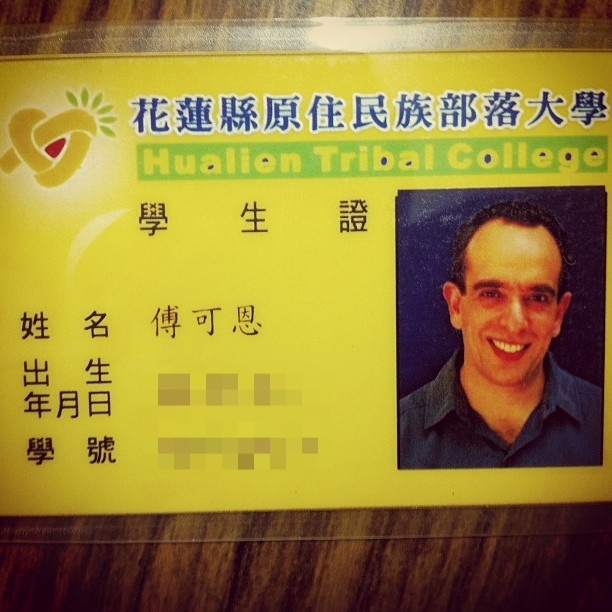
Above is a picture of my student ID from the “Hualien Tribal College.” Actually the official English name on their web page is “Hualien Indigenous Community College” which sounds better to my anthropological ears. Indigenous Community Colleges in Taiwan are not degree granting institutions. Courses tend to be short-term classes focused on indigenous culture, although they offer subjects like documentary filmmaking to help students learn to document their own culture. I’ve enrolled in an eight week course in the Amis language. (At the same time I’m continuing to audit indigenous language classes at my own university.)

While these classes have been great for my research, I still don’t feel I’ve made much progress with my language skills. Unlike DJ, who recently spent half a year living in a village with a large number of old people who still are able to speak Amis, I spend most of my time with young students who have very little competence. But more than that, I’ve come to realize that my research focus on official language revitalization efforts is actually something of a handicap when it comes to language learning. This is what I wanted to write about today.

Continue reading

awkwardness, or wanting dance in a city of joggers

i’m often aware of how awkward i am. this awareness teaches me–those of us who learn kinesthetically might grasp the value of awkwardness more than, say, the value of just talk or vision. still, the sight of joggers in boston reminds me that before habitus became part of the structuralist toolkit, there was just marcel mauss’s chance observation of the nurse’s gait, the vague sense that one had seen that walk before and the moment of recognition. yes, it was in films, the starlet’s walk portrayed by nurse’s legs. was it studied or unconscious, this imitation? learned on the street or from the screen?

living between boston and a’tolan, a body picks up characteristic ways to move and be still that surprise me

Continue reading

friendship (2): friendships precarious or false

friendship in tamen’s sense also might suggest why “culture” is often what my taiwanese friends call a “twilight object,” something constantly in diminishment: associations of friends tend to situate their objects this way. think of the friends of the environment near you. as for culture and its various subsets and stand-ins, these nearly always appear in conditions of endangerment, too; and so, we might begin to ask ourselves whether our interpretive work powerfully connects us to other associations (friends of shellfish, sowalo no ‘amis, or indigenous media to name some to which i belong) who were befriending these objects all along, generally aware of their precarious quality. that does not mean that the type of precarity that these friends see–and that might explain their motives for working with us–is the same as our stance on the befriended.

again, take the environment as an example.

since i’m going in this direction, what about friendship as a type of advocacy, a value that some ethnographers fiercely hold and others just as fiercely question? one of the best statements on friendship in this regard comes from the work of the contemporary ‘amis songwriter, suming rupi. recently, many would-be friends of suming’s hometown have come to stay, all professing their love for the landscape, particularly the view of the pacific ocean. on the whole these would-be friends are well meaning and participate in a type of consumer environmentalism known on taiwan as LOHAS, or lifestyles of health and sustainability. in response, suming has written a song which rejects this love

suming, “don’t say you love me” video 4:50 taiwan ©2012 wonder music

Continue reading

friendship as ethnographic virtue

friendship? I know. it does seem too obvious and perhaps disingenuous for an anthropologist to pose friendship as one of the internal, constitutive goods of ethnographic practice. but that’s the virtue i want to invoke here.

back in chicago, home of the haskell hall totem pole, there was–i wonder if anyone could tell me if it’s still there–a world map around which our administrator affixed fieldwork photographs of students and faculty of the department. back in those snail mail days before social media, this was about all the contact we could get with colleagues in the field. the map looked down from the stairwell up to the mezzanine, but was not without contention: was it part of a strategy of representation that reproduced anthropology’s complicity with colonial discourses? an attempt to employ images of rapport to shore up ethnographic authority? what the critics seemed not to get was that the map actually was a token of our friendships with our colleagues, focused on our common practices of fieldwork and writing.

but, right, critics of the map would likely consider friendship naive. there’s a history i could sketch here, but i’ll just go for the beginning and end points. if malinowski claimed in argonauts that through shared residence and daily activity the ethnographer could at least become “a necessary evil or nuisance, mitigated by donations of tobacco,” the discipline has long since shed the illusions we have of reaching even such a limited state of rapport: take marcus’s typically programmatic 1997 statement that even an assumption of the desirability of rapport had been displaced, with no replacement in sight. that marcus ushered “complicity” onto the runway as the new rapport might relegate friendship to some dusty haberdashery. i even hesitate to call it last season.

curiously, however, i had written about complicity unaware of the marcus article and came to see complicity in a positive light, as a means for sustaining a shared project in conditions of political opposition and entrenchment. because i’ve a book on that subject, i’ll just go back to bronislaw (whew!).

Continue reading