Tag Archives: Ethnography

friendship as ethnographic virtue

friendship? I know. it does seem too obvious and perhaps disingenuous for an anthropologist to pose friendship as one of the internal, constitutive goods of ethnographic practice. but that’s the virtue i want to invoke here.

back in chicago, home of the haskell hall totem pole, there was–i wonder if anyone could tell me if it’s still there–a world map around which our administrator affixed fieldwork photographs of students and faculty of the department. back in those snail mail days before social media, this was about all the contact we could get with colleagues in the field. the map looked down from the stairwell up to the mezzanine, but was not without contention: was it part of a strategy of representation that reproduced anthropology’s complicity with colonial discourses? an attempt to employ images of rapport to shore up ethnographic authority? what the critics seemed not to get was that the map actually was a token of our friendships with our colleagues, focused on our common practices of fieldwork and writing.

but, right, critics of the map would likely consider friendship naive. there’s a history i could sketch here, but i’ll just go for the beginning and end points. if malinowski claimed in argonauts that through shared residence and daily activity the ethnographer could at least become “a necessary evil or nuisance, mitigated by donations of tobacco,” the discipline has long since shed the illusions we have of reaching even such a limited state of rapport: take marcus’s typically programmatic 1997 statement that even an assumption of the desirability of rapport had been displaced, with no replacement in sight. that marcus ushered “complicity” onto the runway as the new rapport might relegate friendship to some dusty haberdashery. i even hesitate to call it last season.

curiously, however, i had written about complicity unaware of the marcus article and came to see complicity in a positive light, as a means for sustaining a shared project in conditions of political opposition and entrenchment. because i’ve a book on that subject, i’ll just go back to bronislaw (whew!).
Continue reading

memos on ethnographic practice

I’m DJ Hatfield, one of the guest bloggers for this month on savage minds. When thinking about possible themes for my blog, I just happened to be reading one of my favorite books on writing, Calvino’s Six memos for the next millennium. Originally, these memos were planned lectures about the values of good writing that Calvino was to give at Harvard; he died before giving the lectures and, indeed, before finishing the work. It might surprise several people who read savage minds that Calvino’s six memos (well, the five that he finished!) are what I turn to when I want to think about my practice as an ethnographic writer. And I think that there is much virtue in the structure of Calvino’s little book: the task he set before himself in 1984 was to describe particular qualities that writing should have if it were to meet the challenges of the next millennium–something that might have been envisioned by the editors of writing culture if a peculiar parricidal impulse hadn’t motivated that work. Of course, as a graduate student, the project of writing culture fit my bill. Now that I have a book and a few articles behind me, it’s Calvino’s project that incites my questions about what we do as ethnographers. What are the values that we would think of as central to the practice, what Macintyre in After Virtue called the “internal goods”–those values that we cultivate as we do our work in the field and out? I’d like to start a conversation on this question. As I am not sure whether what I will discuss will be values in the sense of the ends of our practices or in the sense of what orients them, I’ll leave you to give your preliminary suggestions. My postings on some of these values, plus some discussion of recent work, will appear throughout the month of October. My first internal good: friendship


Passing the 50 yard line of fieldwork

In the beginning, there was all the time in the world.  In the beginning, there were seemingly endless days, weeks, months, and minutes to get this “fieldwork” thing done.  In the beginning, a year seemed like some massive field of Ansel Adams-esque black and white sand dunes that stretched out across a desert landscape with broad horizons unencumbered by…

This is taking too long.

Look, when it comes to my fieldwork, I am running out of time.  To cut to the chase: once I had lots, now I have much less.  If my time was a jar of change, I would start thinking about rolling up the nickels and dimes.  You know what I mean?  I am not thinking about pennies just yet, but those wonderful quarters are gone, my friends.  So things are not frantic or desperate, but it’s time to start coveting what’s left.  The other day it really struck me: several months have passed by, and I am on the downward slide of my being-out-there-in-the-world phase of my dissertation research.  Fast.  Times.

Ya, time flies and all that stuff.  And then you start looking at the number of interviews, meetings, transcriptions, and thousands of other tasks that lay ahead…and you freak out a little.  At least, I do.  Continue reading

Writing Space for Ethnography

[The post below was contributed by guest blogger Ali Kenner, and is part of a series on the relationship between academic precarity and the production of ethnography, introduced here. Read Ali’s prior posts: post 1 — post 2 — post3]

I’m still buzzing over Deepa’s question, posed as a comment at the end of my last post, “why must you write?” I read this question in two ways – 1) why must you write professionally, and 2) why must you write, ethnographically, about yoga and breathing. The question is a great opening into the final week’s prompt, which asks how academic precarity or marginality generates new intellectual possibilities. In my case, knowing that my situation could change, will change, at some point in the next few years, I chose a project that is more long-term. Something I can stay with through various contexts, a project that will travel with me in some form or other. Both yoga and writing (yes, writing) are such projects. Both offset the uncertainty I otherwise experience. Choosing projects that are close to home, and present a host of new and surprising challenges, is part of where I think we’ll also find new intellectual possibilities, and collaborations.

Yet it’s also critical to have the support of institutions, organizations, and colleagues. You’d be crazy to think you can go it alone, and why would you want to anyway? This post starts with the impulse to write as critical, generative practice, and ends with some comments on a roundtable session from the May SCA meeting, a session that speaks to the culture of academic precarity, marginalized work, and how we might support new modes of scholarship.

*           *           *

In my first two years of graduate school, while at the University at Albany, SUNY, I had a fellowship with the New York State Writer’s Institute. At the time, I had not a clue how fortunate I was. I wish I had been taking notes. Diligently. What I would have been writing down is how visiting writers responded in the Q&A sessions that followed their seminars and readings. Invariably, an audience member (or members) would ask the visiting writer about their writing practice, how they worked and got published. Some writers were new authors, reading from their first novel or short story collection. Others were award-winning authors with writing careers that spanned decades. Now, as I just revealed, I did not take notes from this period, but I did manage to pull out a few general threads that I heard consistently over my two-year stretch at the Institute. One response repeated enough for me to hold onto is that it is through the practice and process of writing that ideas, arguments, and stories take shape. Characters come alive in relation to other characters and events. Stories come into being on the page, despite the extent of thinking and planning you do in your head. Ideas, narratives, and arguments might be floating around beforehand, in conversation with others even, but the process of writing translates and transforms them. For ethnographers, writing carves out a space for data, theory, and analysis to converse. For me, writing is a space of play and reflection. And it’s continued writing practice that makes this space, holds this space. These are things we’ve all heard, and felt and know as writers. But I think it bears repeating, again. Continue reading

Making Do

[The post below was contributed by guest blogger Nathan Fisk, and is part of a series on the relationship between academic precarity and the production of ethnography, introduced here. Read Nathan’s prior posts: post 1 — post 2 — post3]

I believe I mentioned in my first post the ways in which I’ve engaged with ethnographic practice in my particular position of precarity, something which I’ve largely avoided talking much about so far. As should be clear for those who have read my earlier posts, I’m not really doing much by way of ethnographic work in my current state of job application scramble/burnout. Although, I suppose I have done a significant amount of participant observation with the feline subjects that share my home, but outside of Facebook I rarely write up my findings. That said, I have had some interesting experiences with ethnographic work during my time as an adjunct – and I think the discussion thus far is pointing towards some interesting implications for ethnographic work in the non-academic world. So, in this post, I want to get at my research experiences as a sometimes ethnographer, adjunct and potential escapee from the academic career track.

As I mentioned previously, I was lucky enough this past spring semester to have the opportunity to develop and teach a course based on my own dissertation work – Youth and Teens Online. I saw it as an opportunity to broaden out my work, moving away from the emphasis on risk and safety, and towards a broader picture of youth life online. The syllabus was filled with central readings that I wanted to return to, and selections from the vast constellation of literature that never quite made it into the frame as I wrote my dissertation. Given that I had to develop a discussion guide for every class session, I read and reread every one with a new post-dissertation perspective – and I had time to do it in a careful, deliberate manner. Better yet, I had to do the reading, and had to think of things to say before each class without fail, regardless of my feelings of post-dissertation fatigue. Continue reading

Workplace Ethnography 101—Interrogating the Unpaid Internship

[The post below was contributed by guest blogger Laurel George, and is part of a series on the relationship between academic precarity and the production of ethnography, introduced here. Read Laurel’s prior posts: post 1 — post 2 — post3]

One paradox of practicing ethnography at the academic sidelines is that often the further one gets from the institutional “center” of the field, the more clarity is needed about the fundamentals of ethnographic method and analysis.  This need to get “back to basics” played out in my market research work in which my colleagues and I often needed to prove what ethnography could offer that consumer-data-gathering methods could not.  Here I offer another example of this paradox as I describe the adjunct teaching I currently engage in outside of an anthropology department.  The course I teach is a non-departmental seminar required of arts and sciences undergraduates who wish to receive academic credit in conjunction with unpaid internships not related to their majors.  For example, if a biology major wants to get credit for interning in the editorial department of a fashion magazine or an English major wants to work at an education non-profit that provides afterschool mentoring to kids, they would enroll in my 2-credit internship seminar and 2-credit fieldwork course.  The vast majority of my students are not anthropology majors and for most of them, my course is their first exposure to ethnographic theories and methods.  Those of us working on the margins of our field often have to take on a ambassadorial role vis a vis the discipline, explaining in clear and basic terms not just what ethnography is but also what ethnography can do.  In what follows, I describe what I hope ethnography can do for my non-major students engaged in unpaid internships.  Along the way, I also briefly interrogate the role of unpaid internships in undergraduate study in the U.S., arguing that they are an increasingly significant piece of the kind of workplace precarity we’ve been discussing throughout this series.

Unpaid internships have been much in the news lately—the intern suing Harper’s Bazaar magazine, unpaid interns toiling behind the scenes of the movie Black Swan, and even unpaid interns (over)working at liberal icon Charlie Rose’s show.  More about unpaid internships per se in a moment, but what, you may be wondering, has this to do with ethnography? A few years ago, I had feelers out for teaching work and started talking to someone who knew of my work with non-profit arts organizations and needed someone to teach an internship seminar in order to meet increased student demand for such a course.  The social sciences have long acknowledged the value of experiential learning, and student placements with non-profit, social service, or public policy organizations have been common.  With this in mind, I happily accepted the offer to teach an undergraduate internship seminar, with most involved (especially me) thinking that I would shepherd students through fieldwork in a range of non-profit and/or public-sector organizations.  What none of us really foresaw was how high the student demand would be for a course that could grant credit in conjunction with internships in for-profit workplaces. Over the several semesters I’ve taught the internship class, about three-quarters of my students’ unpaid internships have been in for-profit settings, most notably entertainment, magazine publishing, fashion, public relations, and banking.  Clearly, neither I nor any other faculty member could claim expertise in all of these industries, so my aim has become to equip students with a way of making sense of their internships beyond their sometimes-fuzzy goals of “networking” and “resume-building.’ Continue reading

Attention Deficit Ethnography

[The post below was contributed by guest blogger Lane DeNicola, and is part of a series on the relationship between academic precarity and the production of ethnography, introduced here. Read Lane’s previous posts: post 1 — post 2 — post 3]

Our final prompt in this series asks about the possible virtues that emerge from the necessities of marginality or academic precarity, the effects on ethnography of such “new intellectual possibilities.”  On the whole I’ve so far stuck with the trajectory I laid out for these posts, engaging with precarity and ethnography first via my experience of living in a London suburb in over the last several years and then on the subway I used to get aroundwhile living there.  In both cases I focused on my own ethnographic practice and experience and particularly on observational practice.  For this final post though I want to shift the focus to the effects on ethnography not “as practiced” but “as taught or learned,” not as observational technique but as representational technique.  The post-millennial relevance of this seems clear, with a number of the conversational threads on SM proceeding from the observation that information technology and digital media are having an expanding range of effects not just in the field of anthropology but in education (that other domain inhabited by so many practicing anthropologists).

My earlier posts also (I note in looking back over them) relied pretty heavily on metaphor and pop culture/sci-fi references, but I can’t think of a good reason to change that now, so: for better and for worse, one of my last opportunities to be social before leaving the UK last month was spent in front of the IMAX screen at the British Film Institute (“the largest film screen in the UK”).  The BFI’s performative apparatus is matched only by the fantastic quality and diversity of films routinely screened there, but this particular outing (with several participating students and other friends) was centered around a pop-culture event with a dash of speculative pseudo-archaeology: Prometheus, Ridley Scott’s prequel to the 1979 film Alien.  Overall the film is pretty awful in largely predictable ways (did I mention this was a 3D screening?), but it serves to illustrate my point here, particularly in a fleeting reference the film makes to Lawrence of Arabia (a quite different film about a quite different type of alien). Continue reading

Decentering Writing

[The post below was contributed by guest blogger Deepa S. Reddy, and is part of a series on the relationship between academic precarity and the production of ethnography, introduced here. Read Deepa’s previous posts: post 1 — post 2 — post3]

Note: updated on 7/26/2012 for clarity.

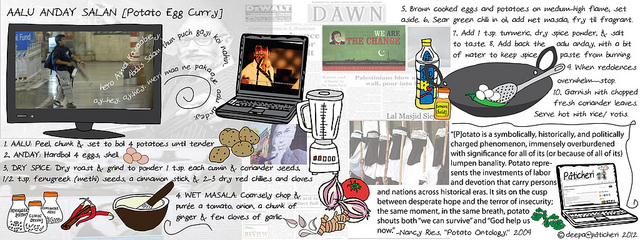
For this final post in our series, I find myself returning to Carole McGranahan’s post from some weeks ago, going through her very useful 9-point schema to describe what makes things ethnographic these days—realizing that whatever the circumstances of ethnographic production, whatever our definitions of ethnography might be, they always presume the centrality of writing. And that is writing in a particular mould, one that satisfies most, if not all, of the criteria enumerated in McGranahan’s post. Specialized, often lengthy, mono-graphs or variants thereof.

aalu anday salanRecipe for Pakistani-style Political Potatoes
[Click on the image for a more readable higher-res version]

Part of me wants to say: But of course, how could it be otherwise? The other part, perhaps handicapped by my present need to cobble together a professional identity while remaking myself in an almost completely new cultural landscape—and finding precious little time to devote to writing, is wondering about ethnographic end-products, and the centrality of conventional writing to the ethnographic enterprise. In this post, therefore, I’d like to think through the prospect of decentering writing [fully aware that writing can’t ever be entirely displaced; that there is an awkwardness to the idea, reflected in this post’s two-ing title]. Continue reading

Fighting Back

[The post below was contributed by guest blogger Nathan Fisk, and is part of a series on the relationship between academic precarity and the production of ethnography, introduced here. Read Nathan’s prior posts: post 1 & post 2]

As my friend and co-blogger Lane responded to my Facebook posts about selling out, “I prefer to think of myself as a virus, any prospective employer as a host. ‘Selling out’ is somewhere in that hazy zone between keeping your host (and yourself) alive and promoting the best environment for others of your species!” It would seem to me that many readers of this blog would agree, even in the most difficult and ethically compromised of research environments. After all, if we – as academically trained anthropologists and ethnographers – do not move to change the kinds of problematic research practices that serve to produce the feeling of “selling out,” it is somewhat unlikely that anyone else will.

Two recent posts here on Savage Minds describe examples of doing that viral work that I think deserve particular mention. First, one of Laurel’s blog posts provided a great discussion of what it’s like to enter into a particular variety of market ethnography. Second, in response to my last post Ben commented on his work as a military ethnographer, and the various pressures and constraints he has faced in such a role. Keeping Lane’s statement in mind, it seems to me that individuals like Laurel, Ben, Gottlieb, and John deserve more attention within academia. As a student, I was rarely exposed to anyone who had chosen to leave academia after finishing their degrees. Thinking back to the process of inviting speakers for colloquia and various departmental events, names of those who had pursued other career trajectories simply never came up. I can only recall one instance in which one such individual – a former graduate of our department turned consultant – came to address us, and even then, there was absolutely no discussion of how or why he came into his new role.

As Gottlieb and John point out, for many, the desire to be connected to the academic community does not simply vanish after taking up careers outside academia. Arguably, we could do much to resist the stigma of selling out, while simultaneously keeping a line out to those who may not hold academic positions, simply through more early doctoral student exposure to graduates who have pursued non-academic careers. In addition to serving to resist the stigma, such exposure would provide Ph.D. students with the professional contact networks they need to more easily find corporate and government work, along with providing a much needed glimpse of potential career routes. There is clearly enough demand for this kind of information, as a number of former academics have made careers for themselves guiding recent grads and struggling academics to non-academic jobs – one such site is actually entitled “Selloutyoursoul.com”. Continue reading

Ethnography’s Sense

[The post below was contributed by guest blogger Ali Kenner, and is part of a series on the relationship between academic precarity and the production of ethnography, introduced here. Read Ali’s prior posts: post 1 & post 2]

In this post I’m going to diverge a bit, writing not about my work for Cultural Anthropology, but about that other project of mine: an ethnography of breathing, and how the breath registers embodied signs of late capitalism (in the contemporary asthma epidemic and U.S. yoga industry). It’s a project grounded in my own yoga practice, a risky set-up, I think, for someone already working on the margins.

Deepa’s weekly prompt asks us about the relationship between form and content in our work. This prompt called to mind the way I position myself to my project, leveraging embodied practice for ethnography. Rereading Carole McGranahan’s post on teaching ethnography, I keep coming back to Ortner’s understanding of ethnography as “the attempt to understand another life world using the self—as much of it as possible—as the instrument of knowing.” Tomie Hahn’s ethnography of dance transmission, Sensational Knowledge (2007), is a powerful example of how body and self become instruments of knowing. Working in the Japanese tradition of nihon buyo, Hahn shows how cultural knowledge is embodied through her own experience and practice of nihon buyo, a practice sustained over three decades. What I find most interesting about Hahn’s work is the way she translates movement and sensation into graspable material for analysis. The argument that culture flows through dance transmission is performed back to readers through Hahn’s own transmission; thick descriptions of sight, sound, and touch.

Hahn also speaks to the challenges and drawbacks of embodied ethnography – studying her own culture, wearing various hats, and negotiating multiple identities. Although my project, and my relationship to it, is quite different from Hahn’s, Sensational Knowledge is an enduring touchstone that inspires my work. It’s important to have one or a few of those in reach.

In the sections that follow I put yoga in conversation with ethnography. In the first section, breathing becomes an instrument of knowing; in the second, I consider how my yoga practice situates me as ethnographer. Continue reading

Annual Identity Crisis

[The post below was contributed by guest blogger Aalok Khandekar, and is part of a series on the relationship between academic precarity and the production of ethnography, introduced here. Read Aalok’s prior posts: post 1 & post 2]

Interdisciplinarity has been another definitive condition of ethnographic production for me. My formal graduate education has been in an interdisciplinary department, I go to conferences that are interdisciplinary in their scope, I teach within contexts that are highly interdisciplinary, and interdisciplinarity has also been an object of inquiry in some of my previous collaborations. Depending on the day and the audience, my (inter)disciplinary affiliations are located somewhere in between the fields of Cultural Anthropology, Science and Technology Studies (STS), and South Asian Studies. And I do not really anticipate not being interdisciplinary in this sense any time in the foreseeable future. For one, I really enjoy working in such spaces. Reading broadly, connecting laterally across a wide range of scholarship is a highly stimulating experience. And too, interdisciplines can be extraordinarily rich sites of intellectual production: they are, after all, the “trading zones”—in all their pidginny messiness (and “busy” talk)—where new knowledges emerge. They are also, as a colleague reminded me recently, the spaces where the disciplinary aspects of disciplines are somewhat less pronounced. Equally also, not being a credentialed anthropologist makes it that much more difficult to imagine myself as part of a traditional anthropology department, in the context of U.S. higher education at least. For better or for worse, the sidelines, for me, are necessarily interdisciplinary.

And indeed, working within the space of STS has been extraordinarily exciting. For someone previously unschooled in the Humanities & Social Sciences, STS provided an excellent space from which to transition into these very different modes of scientific inquiry. It provided a broad introduction to the breadth of humanistic and social scientific inquiry: our graduate coursework was carried out under the supervision of anthropologists, historians, philosophers, political scientists, sociologists, and STSers alike.

STS also offered a set of tools from which to interrogate the epistemologies in which I had been previously schooled: we read and debated how scientific knowledge comes to assume a seemingly universal character, how science travels, and how it can be complicit with various modes of domination. Needless to say, the experience wasn’t always comfortable: what was being deconstructed, after all, was an entire worldview—my own worldview at that. And this was a fraught exercise from the very onset: much like anthropology’s past complicity with colonialism, STS too had its own demons to contend with. The memory of the science wars was all too recent, and appropriation of STS-like critiques towards delegitimizing scientific authority in politically charged contexts (like those of climate change and evolutionary theory) was an ever-present risk. And yet, the tools for putting back together what we had pulled apart weren’t always readily available: the challenge for us, as I have come to understand it, was to formulate critique while also being attuned to the ecologies in which such critique circulated. It was this kind of figuring out, I think, that animated much of my graduate schooling. Continue reading

Dance Lessons: A Comparison of Precarity and Contingency in Contemporary U.S. Choreography and Ethnography

[The post below was contributed by guest blogger Laurel George, and is part of a series on the relationship between academic precarity and the production of ethnography, introduced here. Read Laurel’s prior posts: post 1 & post 2]

In last weeks posts, Deepa and Ali both talked about a professionalized model of fieldwork in which intellectual work happens under certain practical constraints and towards certain ends.  Deepa also pointed to the benefits of doing ethnography on the sidelines, talking about how “parcelable” time working towards someone else’s ends can free up time for other, more reflective work. And in a last week’s post, I, too, talked about the sometimes-sunny side of ethnography-for-hire, as often enabling new forms of creativity and teamwork and as offering clearly-bounded projects, research goals, and timelines that produced results, i.e., got my team and me to write.

Like all of the contributors and commenters in this series, I have a stake in thinking about the possibilities for ethnography and anthropology beyond the traditional forms and institutional contexts of long-term, immersive fieldwork underwritten by graduate fellowships or university tenure-track positions.  But I also believe that as we move on to new ways of imagining ethnography, we must face head-on what we stand to lose as a result of precarity and the increasing trend of the casualization of academic labor.  My research with experimental U.S. choreographers may be a useful backdrop against which to explore the dynamics and effects of job precarity in fields of cultural production.  It has helped me to see how precarity affects not only producers (dancers and choreographers), but how it affects the product itself (the dancing and the choreography).  More dance ethnographic specifics in a bit, but first a look at how the jargon of self-determination and flexibility that often accompanies discussions of contingent positions can disguise power imbalances and modes of domination that precarity engenders. Continue reading

Going Native

[The post below was contributed by guest blogger Deepa S. Reddy, and is part of a series on the relationship between academic precarity and the production of ethnography, introduced here. Read Deepa’s previous posts: post 1 & post 2.]

In my prior post, I argued that a certain set of practical, professional constraints (read: the increasing impossibility of the lengthy immersion fieldwork model) compel us to sell our services as anthropologists (often in some stereotyped sense) piecemeal – holding out in the hope that just participating in such research buys positioning that opens out to truly innovative research questions. In this uniquely inter-disciplinary process, anthropology retains—often actively protects—its exclusivity, even as it hands itself over as a tool of commerce or fashion design or whatever. Sans exclusivity, after all, where would those lucrative professional research opportunities be? What value would I have in a market already over-filled with experts?

Here I want to consider the ways in which the impossibility of imagining fieldwork in the conventional-classical mode prompts also an eschewing of exclusivity on two levels: both in terms of research strategy and in terms of just joining the field.

Traditional fieldwork models turn on the need for mobility: pick yourself up and get someplace; once you’re there, pick yourself up and explore; go where your questions take you; allow your informants to lead you. Such research has little respect for time, which has to flow freely if conversations and relationships are to develop freely—or space. My most successful times in Hyderabad found me all over the city and at home only to rest and write notes. I couldn’t have done any of it as smoothly with family around, for example, as the need to call home, run errands, be present for bedtimes and so on would have fast become burdensome. When I found myself with-job-and-child, my mobility severely curtailed, access to research sites and to materials a critical issue, I needed fieldwork models and research design strategies that were somewhat less immersive, somewhat more forgiving. Finding research projects that could be done close to home and roughly 9-5 became imperative, for one. Continue reading

Making Ethnography Work

[The post below was contributed by guest blogger Ali Kenner, and is part of a series on the relationship between academic precarity and the production of ethnography, introduced here. Read Ali’s previous post here.]

The woman at the table next to me, an older woman with shoulder-length white hair and green-framed glasses, has lost it. “I don’t know where it went. It’s gone. I’m going to start over.” Squinting, she lets out an exasperated sigh and moves her face closer to the screen. The man across from her, who looks about my age, reaches into his plaid shorts for a smartphone – an opportunity to do something. The woman in the green glasses is the director of an organization; the man in plaid shorts is her tech support. They are working to fix a problem with the organization’s website, which seems to be spamming site users. The communication between director and tech support is terrible. I silently hope to myself that this is a relatively new relationship, and not something that’s been going on for very long. Digital projects are complicated enough. The last thing you’ll need is miscommunication.

I observe a version of this scene with some frequency when I work from coffee shops. (And I’d be lying if I said I didn’t find myself in this scene from time to time.) Everyone wants web presence. Not everyone knows what that means, or what it takes to get it. More and more people (who may be directors, assistant administrators, project managers, or business owners) are interfacing with developers, designers, and content management systems. Knowledge gaps and misunderstandings are common between those who want and those who provide web services. There is even a growing field of professionals who facilitate such projects, thus reducing the frustration of getting or building a website. Some days, I wonder if I am part of this growing field. (The answer is, ‘yes, I unexpectedly am.’)

Over the last two years, since we began redesigning CA’s website, I have learned a lot about developers, designers, and the conditions they work in. There is MUCH more to learn. I’m far from expert. I’ve also heard, again and again, that CA’s website is not just a website. It’s a digital archive, a repository of supplemental material, indexes, teaching tools, and, increasingly, essays. The site has over 600 pages. Not only do I manage this beast, I’m also managing its redesign. Continue reading

The Anthropology of Snacks, Widgets, and Pills: What I Learned from Ethnographic Consumer Research

[The post below was contributed by guest blogger Laurel George. It is the second in a series on the relationship between academic precarity and the production of ethnography, introduced here. Read Laurel’s previous post here.]

Anthropology as a discipline and ethnography as a set of practices enjoyed a period of heightened popularity in the world of market research in the U.S. from the mid-1990s through the mid-2000s.  During that time, anthropology was seen as the “next big thing,” a new, improved way of understanding the behaviors and motivations of consumers.  Stories about the special insights that ethnography could bring offer abounded in the popular press, trade journals, and even on NPR’s Motley Fool radio show.  Advertising firms and makers of consumer goods touted ethnography’s ability to offer a more authentic and deeper view of consumer attitudes and practices.  These enhanced understandings, it was promised, would enable ad agencies and product manufacturers to target new markets, develop new products, transform their brand image, and, ultimately, sell more snacks and widgets.  My entry into this landscape was a function of chance; I earned my PhD in cultural anthropology in 2002, during anthropology’s hottest corporate moment. Newly credentialed, on the academic job market, and broke, I was more than a little interested when an anthropologist friend in similar (actually, identical) circumstances told me about a small consumer research firm that was hiring anthropologists to “do ethnographies” on consumer habits. For the next three years on and off,  I worked for this small outfit and, with teams of other anthropologists and videographers, helped produce ethnographic videos and reports on products ranging from snack and convenience foods to appliances to phamaceuticals.  This snapshot of that work is not meant as expose, but rather an account of what ethnography signified and looked like in that context.  It not an entirely negative story. To be sure, much substance can be lost when knowledge is produced under such instrumentalizing constraints and conditions.  But to my surprise, this interlude furnished gains beyond the adjunct-salary-shaming paycheck. I’m still not sure that what my colleagues and I produced were ethnographies per se, but the experience, as I’ll explain, has expanded how I imagine the possibilities of ethnographic research and intellectual collaboration. Continue reading