Partha Chatterjee: Why I Support the Boycott of Israeli Institutions

[Savage Minds is honored to publish this essay by Partha Chatterjee, Professor of Anthropology and Middle Eastern, South Asian, and African Studies at Columbia University, and of the Centre for the Studies of Social Sciences in Calcutta. He is a founding member of the Subaltern Studies Collective.]

Having taught for a lifetime in Indian institutions and, alongside, about two decades in US universities, I have a position on this question that is somewhat unusual from the point of view of most American anthropologists. My political views were formed in the course of growing up in a country that was once the classic colonial possession of the British Empire, achieving its independence in the year of my birth. I grew up with the marks of colonial rule scattered all around me – equestrian statues of colonial governors and generals at street corners, all-white sporting clubs and swimming pools where native youngsters were shooed away by turbaned gatemen, rows of office buildings with names like McKinnon and McKenzie or Jardine and Henderson whose top officers, I was told, were still spotlessly white. I went to an elementary school run by an English couple whose son – I still remember his name, Stephen Hartley – was routinely awarded the top prize by our Indian teachers at every school competition. Ever since, no matter which country I have visited, I have rarely failed to recognize the signs of colonial superiority.

I first came to know about the fate of European Jews in a roundabout way. Sometime in my childhood, I came to hear the phrase notun ihudi – the new Jews. It was probably the title of a movie. It referred, I was told, to people like us, thrown out of our homes in the eastern half of Bengal which had now become part of another country called Pakistan. Both my parents came from there. Once every few months, I would wake up in the morning to find the house full of strangers – relatives from Pakistan who stayed with us for a few days and then moved to a more permanent dwelling. We were, I heard, the new Jews – refugees, forced to make a new life in a strange land. Continue reading

Anthropologists Writing: The Fall 2015 Writers’ Workshop Essay Series

It is my pleasure to announce the fourth (and final) season of our Writers’ Workshop series. Each Monday we will share a new essay reflecting on some aspect of the writing process. We invite you to follow along, and to make these essays part of your weekly writing rituals. This fall we have a fantastic group of contributors:

September 14—Kim Fortun, “To Fieldwork, To Write”

September 21—Daniel Goldstein, “Real Writing”

September 28—Sasha Su-Ling Welland, “List as Form: Literary, Ethnographic, Long, Short, Heavy, Light”

October 12—Paul Tapsell, “The Anthropology of Being (Me)”

October 19—Carole McGranahan, “Anthropology as Theoretical Storytelling”

October 26—Carla Jones, “A Case for Agitation: On Affect and Writing”

November 2—Katerina Teaiwa, “Unscholarly Confessions on Reading”

November 9—Melisa Cahnmann-Taylor, “Ethnographic Poetry and the Leaping Bilingual Mind”

November 16—Ieva Jusionyte, “Writing in and from the Field”

November 23—Gastón Gordillo, “The Ruination of Written Words”

November 30—Bhrigupati Singh, “Writing with Love and Hate”

December 7—Barak Kalir, “Writing as Cognition”

December 14—Stuart McLean, “Frogtopia Revisited, or Anthropology is Art is Frog”

December 23–Sara Gonzalez, “Writing with Community”

Continue reading

Around the Web Digest: Week of August 30

Send along anything interesting to rebecca.nelson.jacobs@gmail.com!

The BBC reports that Chimpanzees and Monkeys Have Entered the Stone Age (by using relatively sophisticated stone tools). More interesting to me is the claim that they recognize the value of cooked food and seem to understand the process of cooking in experiments.

Science Daily writes that archaeologists have linked Mayan environmental alterations to the beginning of the Anthropocene. Clues from Ancient Maya Reveal Lasting Impact on the Environment 

A blog called Stuff Mom Never Told You featured the profiles of 9 Women Who Changed Anthropology, including some I had never heard of myself. As with any list, we can immediately begin questioning who was included or excluded.

Continue reading

Embracing Impostor Syndrome

Cat posing as a meerkat
image source

It seems a fair amount of academics, especially women, suffer from impostor syndrome, “a constant fear of being discovered to be a fraud and a charlatan.” Self-doubt is surely a universal human trait, but we vary in our ability to suppress, ignore, and/or manage such feelings. What is perhaps somewhat unique about impostor syndrome among academics is that “it’s the successful who tend to suffer from it: In order to feel like you’re faking it, you need to have already reached a certain level in your discipline.” As Kate Bahn puts it, it’s “a twisted version of the Socratic paradox—the more you know, the more you feel like you know nothing.” I once calculated that for every book I read I find myself discovering at least ten new books or articles I feel I need to read. That means that if I read a book a week there are about five hundred and twenty new books on my list by the end of the year, each of which feels urgent and essential for my own intellectual development. One’s awareness of the vast body of knowledge we don’t know is actually part of what makes us “experts” but the price we pay for this expertise is a kind of self-doubt. It is always possible that the next book will contain the golden nugget we are searching for.

Continue reading

Anthropologies #21: Is There Hope for an Anthropocene Anthropology?

Up next for this issue we have Todd Sanders and Elizabeth F. Hall. Sanders is an Associate Professor of Anthropology at the University of Toronto. He has written extensively on African and Euro-American knowledge practices, and is currently collaborating with Elizabeth Hall on a project called ‘Knowing Climate Change.’ Hall is a physician-scientist and Research Associate at the Centre for Ethnography at the University of Toronto Scarborough. She trained as a specialist in public health medicine and holds a PhD in epidemiology.  –R.A.

Global climate change is driving anthropologists in opposite directions. Some are enthusiastically adopting “the Anthropocene” – a “gift” from our friends in the natural sciences (Latour 2014) that might enable us to exit, at long last, our Modern world and its Holocene thinking (Hamilton, et al. 2015). The concept potentially dovetails with old and new concerns – networks, rhizomes and relational ontologies; more-than-human socialities; hybrids, nonhumans and the posthuman; multispecies, multinaturalisms and modes of existence – and promises critical purchase over today’s troubled times. For as we enter the Anthropocene, we’ll need new conceptual tools and ways of thinking to understand our new home. The familiar dualisms that have long dogged our discipline and world – Nature and Culture; local and global; Moderns and non-moderns; and so on – are not up to the task. Discard the Modern dualisms. Dwell on the emergent processes of their production. And reimagine worlds as partial and provisional, composed through multiple, heterogeneous entanglements. For many anthropologists, the time is ripe for such an Anthropocene Anthropology. Continue reading

Anthropologies #21: Agricultural Adaptations and their Socio-Political Parameters: Social Responses to Climate Change in Ghana and South Sudan

The next installment for the anthropologies issue on climate change comes from Douglas La Rose. La Rose is the regional coordinator for the Agency for Technical Cooperation and Development (ACTED), a humanitarian organization operating in Northern Bahr al Gazal, Western Bahr al Gazal, and Warrap States in South Sudan. He has previously worked on food security and livelihoods interventions and research projects in Ghana, the Solomon Islands, and Ethiopia. He has a Master’s Degree in Applied Anthropology and lives with his wife and two children on their family farm in the Volta Region of Ghana, West Africa.

Introduction

Climate change disproportionately impacts the most vulnerable people in the world. In the sprawling global region where I have been working over the past decade, Western and Eastern Africa, it is even more biased against the fortunes of people struggling against parching droughts and sweeping floods. The ways that communities respond to these climate extremes are disparate and not established, but certain variables such as conflict and strong political social institutions have a profound influence on the suite within which communities can situate their responses. Communities that live in conflict zones often don’t have the ability to adapt to climate extremes, while communities facing similar problems in relatively peaceful areas with stability and stronger social and political institutions can take certain risks that increase their resilience and adaptability. Continue reading

Anthropologies #21: Annual Review of Anthropology, Climate Change, Anthropocene

To kick off this issue, we begin with Sean Seary’s excellent overview of recent literature about anthropology’s engagement with climate. This review originally appeared on Anthropology Report, has been reproduced here to give us a solid foundation for moving forward. Seary, a recent graduate from Hartwick College, currently lives in Brunswick, Maine. His research interests focus on the convergence of anthropology and climate change. Seary’s work has also been featured on PopAnth. –R.A.

Introduction: Anthropological Interventions

Since the 1960s, global climate and environmental change have been important topics of contemporary scientific research. Growing concerns about climate change have introduced a (relatively) new variable in climate change research: the anthropogenic causes of local-global climate and environmental change. Despite archaeologists providing some of the first research and commentary on climate change–a point that is explored in Daniel Sandweiss and Alice Kelley’s Archaeological Contributions to Climate Change Research: The Archaeological Record as a Paleoclimatic and Paleoenvironmental Archive–the field of climate and environmental change research has been predominantly studied by “natural scientists.” This is where Susan Crate’s Climate and Culture: Anthropology in the Era of Contemporary Climate Change in the 2011 Annual Review of Anthropology intervenes. Crate calls for anthropological engagement with the natural sciences (and vice versa) on global climate change discourse, with the intention of creating new multidisciplinary ethnographies that reflect all the contributors to global environmental change. Continue reading

Around the Web Digest: Week of August 23

Better late than never, I always say, as the semester starts anew and we all either pack our lunchboxes to go back to school or feel that old pull in a job that runs on a different cycle. Help me stay on top of the links by sending me anything you write or discover at rebecca.nelson.jacobs@gmail.com

The Alice Goffman controversy continues to provoke critique and introspection about the nature of ethnographic fieldwork. A recent critique by Paul Campos goes beyond the typical claims that ethnographers are unconcerned with fact-checking to suggest that a small percentage are engaging in wholesale fabrication. Paul Stoller addresses this in his column for HuffPost: In Defense of Ethnography. His basic claim, that ethnography can allow us to delve into the messiness of human experience in a way that fact-checkers cannot, reminds me of the time that a researcher from another discipline came to my field site and was met with evasiveness and equivocation.

This post on Somatosphere links Stoller’s post to the practice of giving pseudonyms and changing identifying information: “Ethnography is not about ‘fact-checking,’ Stoller notes, but rather a weaving of personal and professional interactions into fruitful, if not fruitfully frustrating, entanglements. Acknowledging the precariousness of other people’s lives, a precariousness that the writer often does not share, may mean blending the ‘facts’ to protect people’s identities.” What’s in a Name?

Continue reading

Anthropologies #21: Climate Change Issue (Introduction)

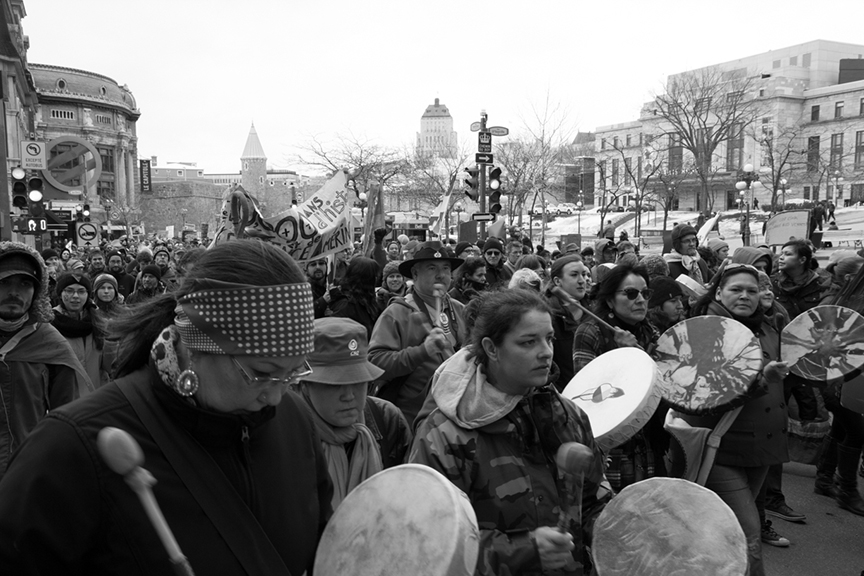
For the latest issue of anthropologies, we’re taking a look at the ever contentious subject of climate change. Over the next week or so, we will be posting individual essays from our contributors. At the end we will post the issue in its entirety. Please share, and feel free to post your thoughts and comments. Here’s the introduction, written by Jeremy Trombley, the co-editor for this issue. You can contact him on Twitter here: @jmtrombley. Thanks Jeremy for all of your help putting this issue together! –R.A.

Photo by Flickr user Erik Jackson. Original caption: “The Act on Climate March in Quebec City, on April 11th, 2015, was led by First Nations to protest governmental inaction on the issue. Main concerns included oil exploitation and transportation by pipeline. My goal with this photograph is to ensure their voices are heard.”

The climate is changing. Oceans are rising, glaciers melting, animals migrating to more hospitable environments, people struggling to understand, resist, and adapt. But solutions seem far off, and many seem reluctant to change their lives to prevent the worst-case scenarios. Even those who are aware and accepting of the science underlying climate change are often unwilling to look the realities in the face – the extent to which the world could be changed, the apparent inevitability of the process, the feedback loops that could escalate climate change beyond even our most dire predictions. Scientists who study the environmental effects of climate change – past, present, and future – struggle to comprehend the extent and intensity of its effects. It can be disheartening, even hopeless, but time moves on and ever-increasing amounts of CO2 are being pumped into the atmosphere on a daily basis. What can be done? What should be done? How do we even begin to answer these questions? This is what the essays in this issue explore from an anthropological lens. Continue reading

Osama Bin Laden, Chelsea Manning, and their anthropologists

Anthropology can turn up in the strangest places. While we often hold up Margaret Mead and… uh… well, mostly Margaret Mead… as examples of public anthropology, our discipline does a lot of important work in times and places few of us would suspect. For instance, take these two recent examples from the media featuring Chelsea Manning and Osama bin Laden:

Most people remember Chelsea Manning (then Bradley) as the person who leaked hundreds of thousands of classified military documents to WikiLeaks. After being imprisoned for the leak, Manning has become an activist and intellectual in her own right, as well as the center of an ongoing struggle to make sure her rights are respected in prison. And in her free time… she reads anthropology.

This according to a New York Post article Manning recently faced the possibility of indefinite solitary confinement because of the items she had in her possession, including a tube of toothpaste and a copy of Biella Coleman’s excellent ethnography Hacker, Hoaxer, Whistleblower, Spy — The Many Faces of Anonymous (creative commons licensed PDF here). You knew anthropology ends up in unusual places — now we know that includes the U.S. Disciplinary Barracks at Fort Leavenworth.

The other anthropologist to make the news recently was Flagg Miller of UC Davis. Miller holds the unique title of being the only person in the world to sit down and listen to all 1,500 cassette tapes in Osama Bin Laden’s personal cassette tape collection.  My favorite part of the BBC’s piece on Miller’s new book, Audacious Ascetic: What the Bin Laden Tapes Reveal About Al-Qa’ida comes when Miller shows the reporter the earliest known recording of Bin Laden from the late 1980s. Recording quality is poor and the reporter asks “But how can you tell it’s Bin Laden?” There’s a short pause and Miller replies “Well… I’ve listened to over a thousand hours of him speaking…” That’s anthropology for you — you work it into your bones, and it’s that lived experience that lets you make the hard calls.

Anthropologists worry constantly that there isn’t enough public anthropology. But how much public anthropology is enough public anthropology? We are reaching all kinds of audiences in all kinds of ways — and with research totally different than the usual white-on-brown village ethnography that people (including us!) imagine that we do. So let’s give ourselves some credit where credit is due and pat ourselves on the back for showing up in unexpected — but important — places.

Toward Living with (not Under) Anthropology, Pt. 2

Savage Minds welcomes guest blogger Takami Delisle. Tak currently works as a medical interpreter for Japanese patients and helps run an organization for anthropology students of color. You can read the first installment of this piece here. She also has her own blog. If you’re interested, please contact her through Twitter @tsd1888.

~~~~~~~~~~~~~~~~~~~~~~~~~~~~~~~~~~~~~~~~~~~~~~~~~~

Toward Living with (not Under) Anthropology

by Takami Delisle

Looking back on those years when I was perpetually in fear of disappointing my professors, I realize that’s when I began to question the whole point of anthropology. I wasn’t alone; there have been many discussions out there about what anthropology can teach us, what we can do with it, and what anthropological knowledge means (e.g., Anthropologies, Issue 1, and Ryan’s open thread on who owns anthropology). Among them I encountered a handful of anthropologists questioning the validity of academic anthropology. I felt vindicated – I too am in disbelief of academic anthropology, because what it seems to be doing is producing its own kind of species of “anthropologists,” claiming that they are the only real, true, and legitimate anthropologists. If the goal of anthropology is to better understand humankind and help make the world an equitable place, now would be a good time for these academic anthropologists to take a good look in their own backyard. Those who are leading the next generations of anthropologists have to learn not to take themselves too seriously, not to be arrogant. They owe mentorship and respect to their students, the future generations of anthropologists, before claiming how righteous, intellectual, and special they are.
Continue reading

Ethnographic Field Data 2: When Not-Sharing is Caring

In my last post, I recommended that we consider archiving and sharing records from our fieldwork. Yet sharing both raw notes and publications can present challenges, as Rex recently covered with the controversy over Alice Goffman’s ‘anonymous’ but easily traced research in Philadelphia, published after she destroyed her fieldnotes.

Kristin Ghodsee similarly writes of the difficulties she encountered as she researched post-Socialist Muslims in Bulgaria—research that caught the interest of both local and American officials. After being detained and interrogated by Bulgarian officials, she decided to drop almost all of the ethnography from her forthcoming work. She describes her encounter with the state in this way:

He then asked me: “Are you responsible for this?”
“Excuse me?” I said, not quite understanding his implication.
“Is your purpose in Bulgaria to encourage these girls to assert their human rights?”
“No,” I stammered, “I’ve been doing this research since 2004, long before this summer.”
“But you know the girls?”
“Some of them.”
“And the people who are teaching them?”
“They are all the subject of my ongoing research. An academic research project.”
“Good,” he said. He nodded and jotted something down on his clipboard. He finally asked me if I had any questions for him.
“Is this interview a normal procedure for Americans applying for long-term residency?”
“No,” he said, matter-of-factly, “It is only for you.”
“Why me?”
“Your topic is interesting to us.” (Ghodsee 2011, p. 180).

As Ghodsee goes on to suggest, sharing the results of our research in any form, published or unpublished, can attract unwanted attention and Continue reading

“Anthropology” in the Snowden Surveillance Archive

A search for “anthropology” in the Snowden Surveillance Archive results in two hits. Both documents were created and presented by the UK GCHQ’s Joint Threat Research Intelligence Group (JTRIG) which sees anthropology as a method with which to “manipulate and control online discourse with extreme tactics of deception and reputation-destruction.” Take a look at the two GCHQ Powerpoints below and see how the surveillance apparatus views your discipline.

The ART of DECEPTION: Training for a New Generation of Online Covert Operations

Psychology: A New Kind of SIGDEV

Around the Web Digest: Week of August 16

Dear readers, either the blogs have been quiet this week or I’m missing some, which you can rectify by sending me links at rebecca.nelson.jacobs@gmail.com.

The most shocking, terrible news in anthropology this week was the Islamic State’s murder of archaeologist Khaled al-Asaad for refusing to reveal the location of artifacts from Palmyra that had been moved for safekeeping. Archaeologist Kristina Killgrove posted a tribute to him on her Forbes blog: Archaeologists Respond to the Murder of Khalel al-Asaad at Ancient Palmyra

An exhibit at the National Geographic Museum uses Indiana Jones as an entry point to dispel myths about archaeology… it even uses the arguably non-canonical fourth installment (#notmyindy) to explore alien astronaut pseudoscience. The Geek Anthropologist’s review: “It Belongs in a Museum”: Indiana Jones and the Adventure of Archaeology Review 

Continue reading