For decades, ephemeral layers at archaeological sites have been the bane of my existence. The moment I read, hear, or have to confront it at an excavation, my soul does a smh. How can we reconstruct anything meaningful in this ephemerality? To be honest, that frustration is simply a privileged standpoint of archaeologists who work in ancient cities, towns, or any mostly permanent settled space – which is where my training and research has focused. Ephemerality is a challenge and requires me to contend with materials and surfaces in a way I am only starting to understand.
Category Archives: Blog post
Writing with Community
[Savage Minds is pleased to publish this essay by guest author Sara Gonzalez as part of our Writers’ Workshop series. Sara is Assistant Professor of Anthropology at the University of Washington, Seattle. She works at the intersection of tribal historic preservation, colonial studies and public history, examining how archaeology can contribute to the capacity of tribal communities to study, manage, and represent their heritage. Her most recent project involves the creation of a community-based field school and training program in tribal historic preservation with the Confederated Tribes of Grand Ronde Community of Oregon’s Tribal Historic Preservation Department. Her recent publications include a co-edited a special issue of the SAA Record, “NAGPRA and the Next Generation of Collaboration,” as well as articles in American Antiquity and in Anthropocene.]
Writing is a responsibility in the academy. Through our writings we enter into dialogues with one another. From undergraduate thesis to dissertation, scholarly articles and monographs, our writing marks the trajectory of our careers. It forms the basis on which our peers and colleagues evaluate the contributions we make to discipline. But writing is more than a job responsibility of an academic. In writing anthropology, and in my case archaeology, there is an added responsibility to scrutinize how the histories we produce are connected to the lives and futures of the communities we study.
The formation of anthropology as a discipline in North America occurred at the same time as European and American governments dispossessed indigenous nations of their homelands. Coinciding with the closing of the Indian Wars in the late 19th century, the Bureau of Ethnology, later renamed the Bureau of American Ethnology, sponsored ethnographic and linguistic research on Native American communities. These “salvage ethnographies” documented the cultural traditions and lifeways of Native American tribes under the presumption that the combination of assimilationist policies and exposure to American lifeways would cause them to vanish entirely. Archaeologists followed suit, recording ancestral sites and collecting artifacts, as well as human remains in their attempt to document the cultural history of tribes. The objects and ancestors uncovered by archaeologists and others—often through dubious means—became specimens of national history; representations of a past that ceased to exist following the arrival of Europeans and their colonization of the continent. Given this colonial history, how can the work of these disciplines be used to disrupt colonial relations in the present? Continue reading
Around the Web Digest: Week of December 13
Dear readers, this post is late and I apologize for nothing. Send me any links for inclusion here at rebecca.nelson.jacobs@gmail.com.
I hope you’ve been enjoying the glow of lights and the stir of familiar songs that seem to be everywhere these days… with the release of Star Wars: The Force Awakens! The AAA blog featured this post using the movie to explore why movies about humans’ relationships with technology are so popular: Our Movies, Ourselves: Reel Life Vis-á-vis “Real Life”
This time of year seems to bring out a reflective streak in blogs. For example, Struggle Forever listed some of the fiction and non-fiction books worth reading from this year: My Favorite Books of 2015
Allegra also produced a list of books based on a reader survey of the most important and influential books for the discipline and beyond. Unsurprisingly, there’s a bias towards the mid-twentieth century classics, but some newer books were also recognized: The 30 Essential Books in Anthropology
Inside the Fukushima Exclusion Zone: Place and Memory after Disaster
Savage Minds welcomes guest blogger Pablo Figueroa. Pablo is an assistant professor in the Center for International Education at Waseda University in Tokyo. In this position, he teaches courses on globalization, leadership, and disasters. His anthropological research is centered on risk communication, citizen participation, and cultural representations of the Fukushima nuclear catastrophe. His most recent publications are two book chapters, Subversion and Nostalgia in Art Photography of the Fukushima Disaster and Nuclear Risk Governance and the Fukushima Triple Disasters: Lessons Unlearned, both forthcoming in 2016.
All images copyright by Pablo Figueroa.
~~~~~~~~~~~~~~~~~~~~~~~~~~~~~~~~~~~~~~~~~~~~~~~~~~~~~~~~~~~~~~~~~~~~~~~~~~
Inside the Fukushima Exclusion Zone: Place and Memory after Disaster
by Pablo Figueroa

FROM BEHIND THE WINDSHIELD of the moving car the landscape looks exuberant, unpolluted. Warm morning sunlight bathes the forest to the side of Tomioka highway, a 69 km stretch of pavement also known as National Road 114 that connects Fukushima with the town of Namie. It’s a Sunday morning and few people can be seen. The feeling of emptiness is vast and real. From time to time, large plastic bags appear along the road, neatly stacked one on top of the other. The orderly layout obliterates a much more messy reality: The bags contain highly radioactive soil that was removed from villages and fields during the so-called “cleanup efforts” following the Fukushima nuclear disaster. Their final destination undecided, the ominous recipients are a painful reminder of what happens when trying to decontaminate the environment after a nuclear catastrophe. You can scrape topsoil and wash the surface with pressure hoses as much as you like but Cesium-137, which has a half-life of 30 years, will keep coming down from hills along with other radioactive isotopes, carried by rain and wind, dispersing in manifold and uncontrollable ways. Continue reading
Frogtopia Revisited, or Anthropology is Art is Frog
[Savage Minds is pleased to publish this essay by guest author Stuart McLean as part of our Writers’ Workshop series. Stuart is Associate Professor of Anthropology at the University of Minnesota. He is the author of The Event and Its Terrors: Ireland, Famine, Modernity (Stanford University Press, 2004). In 2013, together with Anand Pandian, he convened an Advanced Seminar at the School of American Research on Literary Anthropology.]
What if anthropology were to suspend its claims to be a social science, whether of a geisteswissenschaftliche or a positivist variety? What if it were to turn instead to exploring its affinities with art and literature as a mode of engaged creative practice carried forward in a world heterogeneously composed of humans and other-than-humans? I am prompted to reflect on these questions by an encounter from my recent fieldwork.
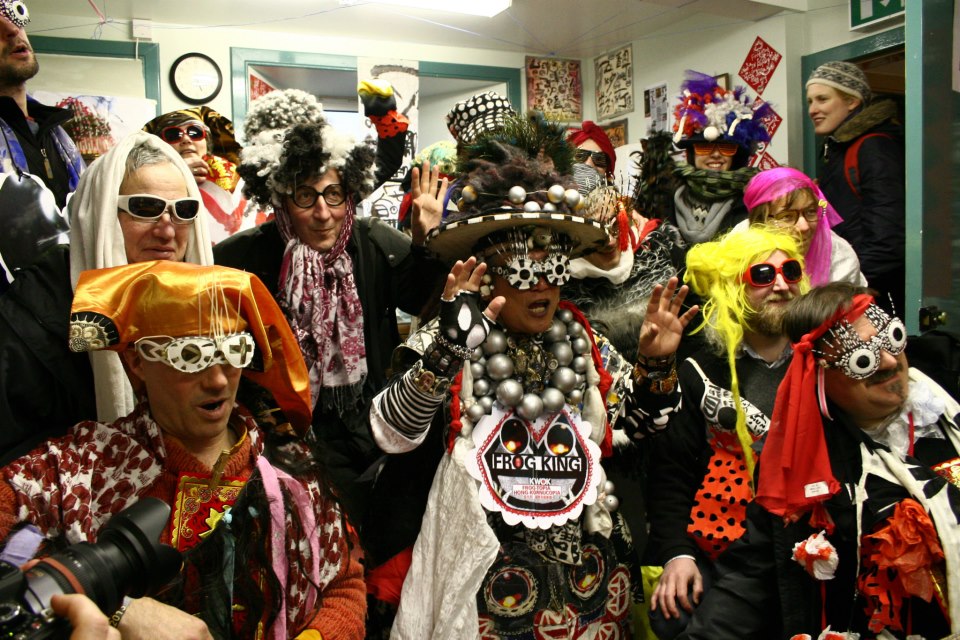
In February 2013, I participated in Frogtopia. At once no place and multiple places, Frogtopia is the creation of Frog King, who in turn is the creation, or the costumed alter ego of Kwok Mang-ho. Born in Guangdong province in 1947 and educated in Hong Kong, where he now lives, Kwok is recognized today as one of the pioneers of multimedia and performance art in China. His output consists of a proliferation of works in a variety of media: video, photography, ink on paper, costumed performance and found materials such as plastic bags. His approach, typically, is to fill his canvases and exhibition and performance spaces with his characteristic motifs, including calligraphy, inflated plastic bags suspended from strings and the frog image that has played an increasingly conspicuous part in his work. Kwok has stated in interviews that he was drawn to the figure of the frog because of its metamorphic life cycle and its capacity to move between land and water. At the same time the image is meant to evoke a range of other associations, its bulging eyes embodying watchfulness and suggesting too a bridge for exchange and communication between Chinese and Western artistic influences and a sail boat for journeying to new places. Continue reading
Around the Web Digest: Week of December 6
The blog harvest was rich again this week at the Savage Minds ranch. Help me find more blogs by sending me links at rebecca.nelson.jacobs@gmail.com.
HuffPost featured this article in which an anthropologist argues that isolating babies in cribs and sleeping 8 continuous hours a night are Western constructions: My Conversation with Co-Sleeping Expert James McKenna
In this National Geographic post, Jason De León discusses some of the findings in his book, The Land of Open Graves: Living and Dying on the Migrant Trail. He argues that migrant deaths at the border have been deliberately caused and normalized in national media: An Anthropologist Unravels the Mysteries of Mexican Migration
In this episode of the Craft podcast, anthropologist Jeffrey Cohen describes some moments of adaptation in his fieldwork in Mexico: Eating Soup (and Grasshoppers) Without a Spoon with Jeffrey Cohen. The interviewer actually asks how to avoid “changing their civilization.”
Writing as Cognition
[Savage Minds is pleased to publish this essay by guest author Barak Kalir as part of our Writers’ Workshop series. Barak is Associate Professor of Anthropology at the University of Amsterdam. He is the author of Latino Migrants in the Jewish State: Undocumented Lives in Israel (Indiana University Press, 2010), and co-editor with Malini Sur of Transnational Flows and Permissive Policies: Ethnographies of Human Mobilities in Asia (University of Chicago Press, 2013). Currently he is working on an ERC funded research project on The Social Life of State Deportation Refugees.]
I will only know what I precisely want to say in this piece once I finish writing it.
This enigmatic sentence is not meant as an alluring opening statement, nor is it a sign for an experimental literary method that I will be employing in this blog. For what it’s worth, this sentence captures my principal insight into the process of writing. It is an insight that I gained after years of experiencing much frustration with writing, after producing endless drafts of the same text, after nights and days spent on trying ‘to get it right’, after struggling not to lose my focus, not to get lost in the texts I tried so hard to write.
Luckily, I do not feel like that any more. But it has been a long ride. Continue reading
Writing with Love and Hate
[Savage Minds is pleased to publish this essay by guest author Bhrigupati Singh as part of our Writers’ Workshop series. Bhrigupati is Assistant Professor of Anthropology at Brown University. His book Poverty and the Quest for Life: Spiritual and Material Striving in Contemporary Rural India (University of Chicago Press, 2015), was awarded the Joseph W. Elder Prize in the Indian Social Sciences. Together with Veena Das, Michael Jackson, and Arthur Kleinman, he is co-editor of The Ground Between: Anthropological Engagements with Philosophy (Duke University Press, 2014).]
Some of our co-bloggers in this forum rightly suggest that reading precedes and accompanies writing. But then they say that young people today, in this era of attention deficits, are losing the art of reading. When I was young, hope I still am, I usually responded quite stubbornly to this kind of admonishing “wisdom”. Maybe our teachers need to be more inspiring. In writing, we may need to rediscover a richer variety of forms. There was a time, for instance, when scholars primarily wrote not in essays, but in a more difficult and older art of texting, namely, aphorisms.
Let’s not underestimate the new forms of attentiveness that are emerging. On Instagram for instance, which to the surprise of discerning readers creates the possibility of stranger sociality based only on a fellowship of images. Continue reading
Thoughts on AAA15, Denver, and a “Rawlsian” Internet.
Like many of you, I am just back (and not nearly caught up) from pop-art obsessed Denver. Another AAA, another 2000-person business meeting. Just finished converting my nametag holder into a duvet cover. Also: the parlimentarian.
Rex captured some high and low points–ever the participant observer. Carole (the local) can pull rank and can correct us, but I just want to say that Rex didn’t spend nearly enough time on 16th street if he thinks there wasn’t high calorie cheap food available. I won’t say “good”, but the calories were in abundance.
I feel I can judge Denver because I grew up visiting my relatives there: Wax Trax records is still going strong, hallelujah, Elitch’s gardens has moved from the old-school high-liability zone of my youth to a chamber of commerce immagined dead zone of high profit near downtown, and the mountains are still, by an order of magnitude, thee most. Despite the current fame Colorado Springs is experiencing—which puts the state squarely back in the violent middle America most anthros were probably expecting, but narrowly escaped given the unfortunate regularity of the madness, Denver is in fact a distinctive American place. It’s not very diverse racially, to be sure, but it is distinctive: in the blocks around the convention center there was a definite mix of white lower class, middle class marijuana tourism, ostentatious 1%-er development, overdressed anthropologist and bearded hipsters on loan from williamsburg/highland park. Also, did I mention the parliamentarian?
NGO-graphies: On Knowledge Production and Contention

The NGOs and Nonprofits Special Interest Group held its second biennial conference before the AAAs last week. It’s designed to give anthropologists and practitioners working in and with NGOs a chance to engage with each other in a more intimate, focused way before diving into the chaos of the AAAs. Entitled “NGOgraphies,” this year’s conference explored the dual meaning of the term, coined by Steven Sampson and Julie Hemment in 2001, which refers both to critical ethnography of NGOs in general and to analysis of the human geography of NGOs in particular. The conference attracted 112 attendees from 13 countries, and session organizers were encouraged to use alternate formats to engage participants, ranging from workshops to roundtables. Rather than a general report on the conference, this post is a reflection on some of the specific conversations and lines of thought the conference generated for me.
When I circulated the call for papers for my roundtable panel “What Is This ‘Local Knowledge’ that Development Organizations Fetishize?” to the NGOs and Nonprofits Interest Group listserv in May, I got the following email in reply:
Dear All,
I might have been interested in participating, but will likely be traveling overseas for humanitarian work at the time. I have worked for international NGOs and aid agencies for 30 years, as I do now. However, I must say that the title of the session troubles me. As a long-time member and leader of such organizations, I have never known our community to “fetishize” local knowledge. I think the term is disrespectful to my colleagues and their work and insights. This seems like some sort of construct or perception of research-based academics.
What really happened on Thanksgiving
(This is the second annual posting of a short, edited snippet of pages 55-66 of Charles Mann’s 1491: New Revelations of the Americas Before Columbus. In it Mann describes the history of Indian-European relations that existed before the arrival of the Mayflower by following the story of a single Indian, Tisquantum, and the role he played in the events leading up to the first Thanksgiving. There reality is — surprise! — a lot messier, entangled, and nasty than the normal story taught in school. If you’re not American, or just wondering what really happened to create this current celebration of over-eating and colonialism, read on! This fair use reproduction is just a small chunk of Mann’s 500+ page book. If you’d like to read more about this topic — I’d recommend buying and reading all of 1491.)
I had learned about Plymouth in school. But it was not until I was poking through the scattered references to Billington [the author’s ancestor] that it occurred to me that my ancestor, like everyone else in the colony, had voluntarily enlisted in a venture that had him arriving in New England without food or shelter six weeks before winter. Not only that, he joined a group that, so far as is known, set off with little idea of where it was heading. In Europe, the Pilgrims had refused to hire the experienced John Smith as a guide, on the theory that they could use the maps in his book. In consequence, as Smith later crowed, the hapless Mayflower spent several frigid weeks scouting around Cape Cod for a good place to land, during which time many colonists became sick and died. Landfall at Patuxet did not end their problems. The colonists had intended to produce their own food, but inexplicably neglected to bring any cows, sheep, mules, or horses. To be sure, the Pilgrims had intended to make most of their livelihood not by farming but by catching fish for export to Britain. But the only fishing gear the Pilgrims brought was useless in New England. Half of the 102 people on the Mayflower made it through the first winter, which to me seemed amazing. How did they survive?
In his history of Plymouth colony, Governor Bradford himself provides one answer: robbing Indian houses and graves. The Mayflower hove to first at Cape Cod. An armed company of Pilgrims staggered out. Eventually they found a deserted Indian habitation. The newcomers—hungry, cold, sick—dug open burial sites and ransackedhomes, looking for underground stashes of food. After two days of nervous work the company hauled ten bushels of maize back to the Mayflower, carrying much of the booty in a big metal kettle the men had also stolen. “And sure it was God’s good providence that we found this corn,” Winslow wrote, “for else we know not how we should have done.”…
Inexperienced in agriculture, the Pilgrims were also not woods-people; indeed, they were so incurious about their environment that Bradford felt obliged to comment in his journal when Francis Billington, my ancestors son, climbed to the top of a tall tree to look around. As Thoreau noted with disgust, the colonists landed at Plymouth on December 16, but it was not until January 8 that one ofthem went as far away as two miles — and even then the traveler was, again, Francis Billington. …
Huddled in their half-built village that first terrible winter, the colonists rarely saw the area’s inhabitants, except for the occasional shower of brass- or claw-tipped arrows. After February, glimpses andsightings became more frequent. Scared, the Pilgrims hauled five small cannons from the Mayflower and emplaced them in a defensive fortification. But after all the anxiety, their first contact with Indianswent surprisingly easily. Within days Tisquantum [and Indian who had previously visited England] came to settle among them. And then they heard his stories.
No record survives of Tisquantum’s first journey across theAtlantic, but arithmetic gives some hint of the conditions in Hunt’s [who had captured Tisquantum] ship. John Smith had arrived with two ships and a crew of forty-five. If the two ships had been of equal size, Hunt would have sailed with a crew of about twenty-two. Because Hunt, Smith’s subordinate, had the smaller of the two vessels, the actual number was surely less.Adding twenty or more captured Indians thus meant that the ship wassailing with at least twice its normal complement. Tisquantum would have been tied or chained, to prevent rebellion, and jammed into whatever dark corner of the hull was available. Presumably he was fed from the ship’s cargo of dried fish. Smith took six weeks to cross theAtlantic to England. There is no reason to think Hunt went faster. The only difference was that he took his ship to Malaga, on Spain’s Mediterranean coast. There he intended to sell all of his cargo, including the human beings.
The Indians’ appearance in this European city surely caused a stir. Not long before, Shakespeare had griped in The Tempest that the populace of the much bigger city of London “would not give a doit [a small coin] to a lame beggar, [but] will lay out ten to see a dead Indian.” Hunt managed to sell only a few of his captives before local Roman Catholic priests seized the rest—the Spanish Church vehemently opposed brutality toward Indians… The priests intended to save both Tisquantum’s body, by preventing his enslavement, and his soul, by converting him to Christianity… In any case,this resourceful man convinced them to let him return home — or, rather, to try to return. He got to London, where he stayed with John Slany, a shipbuilder with investments in Newfoundland. Slany apparently taught Tisquantum English while maintaining him as a curiosityin his townhouse. Meanwhile, Tisquantum persuaded him to arrange for passage to North America on a fishing vessel. He ended up in a tiny British fishing camp on the southern edge of Newfoundland. It was on the same continent as Patuxet [Tisquantim’s home], but between them were a thousand miles of rocky coastline and the Mi’Kmac and Abenaki alliances,which were at war with one another.
Because traversing this unfriendly territory would be difficult, Tisquantum began looking for a ride to Patuxet. He extolled the bounty of New England to Thomas Dermer, one of Smith’s subordinates, who was then staying in the same camp. Dermer, excited by Tisquantum’s promise of easy wealth, contacted Ferdinando Gorges. Gorges, a longtime, slightly dotty enthusiast about the Americas, promised to send over a ship with the men, supplies, and legal papers necessary for Dermer to take a crack at establishing a colony in New England… On May 19, 1619, still accompanied by Tisquantum, he [Dermer] set out for Massachusetts…
What Tisquantum saw on his return home was unimaginable. From southern Maine to Narragansett Bay, the coast was empty – “utterly void,” Dermer reported. What had once been a line of busy communities was now a mass of tumbledown homes and untended fields overrun by blackberries. Scattered among the houses and fields were skeletons bleached by the sun. Slowly Dermer’s crew realized they were sailing along the border of a cemetery two hundred miles long and forty miles deep. Patuxet had been hit [by Western-introduced diseases] with special force. Not a single person remained. Tisquantum’s entire social world had vanished.
Looking for his kinsfolk, he led Dermer on a melancholy march inland. The settlements they passed lay empty to the sky but full of untended dead. Tisquantum’s party finally encountered some survivors, a handful of families in a shattered village. These people sent for Massasoit, who appeared, Dermer wrote, “with a guard of fiftie armed men” — and a captive French sailor, a survivor of the shipwreck on Cape Cod. Massasoit asked Dermer to send back the Frenchman. And then he told Tisquantum what had happened.
One of the French sailors had learned enough Massachusett to inform his captors before dying that God would destroy them for their misdeeds. The Nauset scoffed at the threat. But the Europeans carried a disease, and they bequeathed it to their jailers. Based on accounts of the symptoms, the epidemic was probably of viral hepatitis… Whatever the cause, the results were ruinous. TheIndians “died in heapes as they lay in their houses,” the merchant Thomas Morton observed. In their panic, the healthy fled from the sick, carrying the disease with them to neighboring communities. Behind them remained the dying, “left for crows, kites, and vermin to prey upon.” Beginning in 1616, the pestilence took at least three years to exhaust itself and killed as much as 90 percent of the people in coastal New England. “And the bones and skulls upon the severall places of their habitations made such a spectacle,” Morton wrote,that the Massachusetts woodlands seemed to be “a new-found Golgotha,” the Place of the Skull, where executions took place in Roman Jerusalem.
The religious overtones in Morton’s metaphor are well placed. Neither the Indians nor the Pilgrims had our contemporary understanding of infectious disease. Each believed that sickness reflected the will of celestial forces… Until the sickness Massasoit had directly ruled a community of several thousand and held sway over a confederation of as many as twenty thousand. Now his group was reduced to sixty people and the entire confederation to fewer than a thousand. “The Wampanoag,” wrote Salisbury, the Smith historian, “came to the obvious logical conclusion: ‘their deities had allied against them.’”
The Pilgrims held similar views. Governor Bradford is said to have attributed the plague to “the good hand of God,” which “favored our beginnings” by “sweeping away great multitudes of the natives . . .that he might make room for us.” Indeed, more than fifty of the first colonial villages in New England were located on Indian communities emptied by disease. The epidemic, Gorges said, left the land “without any [people] to disturb or appease our free and peaceable possession thereof, from when we may justly conclude, that GOD made the way to effect his work.”
Much as the Lisbon earthquake of 1755, which killed tens of thousands in one of Europe’s richest cities, prompted spiritual malaise across Europe, the New England epidemic shattered the Wampanoag’s sense that they lived in balance with an intelligible world. On top of that, the massive death toll created a political crisis. Because the hostility between the Wampanoag and the neighboring Narraganset thad restricted contact between them, the disease had not spread to the latter. Massasoit’s people were not only beset by loss, they were in danger of subjugation.
After learning about the epidemic, the distraught Tisquantum first returned with Dermer to southern Maine. Apparently concluding he was never going to meet Rowcraft, Dermer decided in 1620 to make another pass at New England. Tisquantum returned, too, but not with Dermer. Instead he walked home—the long, risky journey he had wanted to avoid… Tisquantum was seized on his journey home, perhaps because of his association with the hated English, and sent to Massasoit as a captive.
As he had before, Tisquantum talked his way out of a jam. This time he extolled the English, filling Massasoit’s ears with tales of their cities, their great numbers, their powerful technology. Tisquantum said, according to a colonist who knew him, that if the sachem “Could make [the] English his Friends then [any] Enemies yt weare to[o]strong for him”—in other words, the Narragansett—“would be Constrained to bowe to him.” The sachem listened without trust. Within a few months, word came that a party of English had set up shop at Patuxet. The Wampanoag observed them suffer through the first punishing winter. Eventually Massasoit concluded that he possibly should ally with them — compared to the Narragansett, they were the lesser of two evils. Still, only when the need for a translator became unavoidable did he allow Tisquantum to meet the Pilgrims.
Massasoit had considerable experience with Europeans—his father had sent Martin Pring on his way seventeen years before. But that was before the epidemic, when Massasoit had the option of expelling them. Now he told the Pilgrims that he was willing to leave them in peace (a bluff, one assumes, since driving them away would have taxed his limited resources). But in return he wanted the colonists’ assistance with the Narragansett.
To the Pilgrims, the Indians’ motives for the deal were obvious. They wanted European technology on their side. In particular, they wanted guns. “He thinks we may be [of] some strength to him,”Winslow said later, “for our pieces [guns] are terrible to them.”
In fact Massasoit had a subtler plan. It is true that European technology dazzled Native Americans on first encounter. But the relative positions of the two sides were closer than commonly believed. Contemporary research suggests that indigenous peoples in New England were not technologically inferior to the British—or, rather, that terms like “superior” and “inferior” do not readily apply to the relationship between Indian and European technology.
Guns are an example. As Chaplin, the Harvard historian, has argued, New England Indians were indeed disconcerted by their first experiences with European guns: the explosion and smoke, the lack of a visible projectile. But the natives soon learned that most of the British were terrible shots, from lack of practice—their guns were little more than noisemakers. Even for a crack shot, a seventeenth-century gun had fewer advantages over a longbow than may be supposed. Colonists in Jamestown taunted the Powhatan in 1607 with a target they believed impervious to an arrow shot. To the colonists’ dismay, an Indian sank an arrow into it a foot deep, “which was strange, being that a Pistoll could not pierce it.” To regain the upper hand, the English set up a target made of steel. This time the archer “burst his arrow all to pieces.” The Indian was “in a great rage”; he realized, one assumes, that the foreigners had cheated. When the Powhatan later captured John Smith, Chaplin notes, Smith broke his pistol rather than reveal to his captors “the awful truth that it could not shoot as far as an arrow could fly.”
At the same time, Europeans were impressed by American technology. The foreigners, coming from a land plagued by famine, were awed by maize, which yields more grain per acre than any other cereal. Indian moccasins were so much more comfortable and water-proof than stiff, moldering English boots that when colonists had to walk for long distances their Indian companions often pitied their discomfort and gave them new footwear. Indian birchbark canoes were faster and more maneuverable than any small European boat. In 1605 three laughing Indians in a canoe literally paddled circles round the lumbering dory paddled by traveler George Weymouth and seven other men. Despite official disapproval, the stunned British eagerly exchanged knives and guns for Indian canoes. Bigger European ships with sails had some advantages. Indians got hold of them through trade and shipwreck, and trained themselves to be excellent sailors. By the time of the epidemic, a rising proportion of the shipping traffic along the New England coast was of indigenous origin.
Reading Massasoit’s motives at this distance is a chancy business. But it seems likely that he did not want to ally with the foreigners primarily for their guns, as they believed. Although the sachem doubtless relished the possibility of additional firepower, he probably wanted more to confront the Narragansett with the unappetizing prospect of attacking one group of English people at the same time that their main trading partners were other English people. Faced with the possibility of disrupting their favored position as middlemen, the Narragansett might think twice before staging an incursion. Massasoit, if this interpretation is correct, was trying to incorporate the Pilgrims into the web of native politics. Not long before Massasoit had expelled foreigners who stayed too long in Wampanoag territory. But with the entire confederation now smaller than one of its former communities, the best option seemed to be allowing the Pilgrims to remain. It was a drastic, even fatal, decision.
Tisquantum worked to prove his value to the Pilgrims. He was so successful that when some anti-British Indians abducted him the colonists sent out a military expedition to get him back. They did not stop to ask themselves why he might be making himself essential, given how difficult it must have been to live in the ghost of his childhood home. In retrospect, the answer seems clear: the alternative to staying in Plymouth was returning to Massasoit and renewed captivity.
Recognizing that the Pilgrims would be unlikely to keep him around forever, Tisquantum decided to gather together the few survivors of Patuxet and reconstitute the old community at a site near Plymouth. More ambitious still, he hoped to use his influence on the English to make this new Patuxet the center of the Wampanoag confederation, thereby stripping the sachemship from Massasoit, who had held him captive. To accomplish these goals, he intended to play the Indians and English against each other.
The scheme was risky, not least because the ever-suspicious Massasoit sent one of his pniese [a warrior-counselor], Hobamok, to Plymouth as a monitor… Sometimes the two men were able to work together, as when Hobamok and Tisquantum helped the Pilgrims negotiate a treaty with the Massachusett to the north. They also helped establish a truce with the Nauset of Cape Cod after Bradford promised to pay back the losses caused by their earlier grave robbing.
By fall the settlers’ situation was secure enough that they held a feast of thanksgiving. Massasoit showed up with ninety people, most of them young men with weapons. The Pilgrim militia responded by marching around and firing their guns in the air in a manner intended to convey menace. Gratified, both sides sat down, ate a lot of food, and complained about the Narragansett. Ecce Thanksgiving.
Getting Free in Cleveland
[Savage Minds is pleased to present the last essay in the series “Making Black Lives Matter: Reflections on the Declaration and the Movement.” In the past week, events have taken place in Minneapolis and Chicago which demonstrate the need for even more fieldnote reporting and analysis of the Black Lives Matter Movement, the impact it is having in this moment of social and political transformation, and the violence these change agents are encountering from police and others. We find ourselves experiencing deja vu–a moment terribly similar to the one we experienced on November 24th last year, when the killer of Michael Brown was not indicted in Ferguson, Missouri and the streets erupted. And yet this moment is slightly different–filled with the energy, hope, persistence, and radical communal love of those that have been consistently fighting against white supremacy, anti-Black racism, and police violence for over 365 days, and are strengthened by the victories they have accomplished during this time. We shall not be moved.
As editors of this series (and another that will be published in Anthropology News early next year), Bianca Williams and Dana-Ain Davis hope that these reflections from the ever-shifting ground of this Movement will inform you, encourage you, challenge you, and move you into action. This last essay is by Lynn Roberts, a professor of Community Health Education in the Program in Urban Public Health at Hunter College. Dr. Roberts’ research examines the intersection of race, class, and gender, and the resulting impact of multiple oppressions on the dating relationships and sexual behaviors of young women and men of color. She writes about her journey to the Movement for Black Lives Convening this past summer, and shines light on the healing process that is integral to the journey of getting free.]
My Journey.
My bus rolled into the Cleveland bus station on Chester Avenue at 2:30 AM on Saturday July 25 for Day 2[1] of the Movement for Black Lives National Convening (a.k.a. M4BL). This was a gathering of 1500 unapologetically Black family members in tremendous need and want of safe space and communion with each other to grieve, heal, and breathe from the days, months, decades, and even centuries of being denied equal protection and remedy from the state violence visited upon the collective body of our kinfolk. In the Newark bus station on Friday evening, I sat riveted by the live-stream of the M4BL Opening Ceremonies and quietly wept as the families of those lost in the distant and recent reign of terror against Black bodies[2] shared fond memories of their loved ones, so we could lift up the beautiful and precious humanity behind the hashtags and viral videos to be reminded: “This Is Why We Fight!” Calling upon the joy of resistance and ditching the pious sanctimony of my early roots in the A.M.E. Zion church[3] I imagined myself rising up out of my waiting room seat in jubilee with my fellow family members as they danced through the aisles, and filled the stage of the Waet Jen Auditorium of Cleveland State University (CSU) to Kendrick Lamar’s hip-hop anthem of blessed assurance that “We Gon’ Be Alright”. Having this virtual connection almost made up for not directly experiencing the beloved community, strategic insights, and healing offered in the 50 workshops and film screenings that took place earlier in the day. Continue reading
What Happened at #AAA2015: The Good, The Bad, and the Bibs
Last week, Denver welcomed about five thousand anthropologists to its Gilded Age (and Gilded Age revival) downtown for the massive anthropological blowout that was the Annual Meeting of the American Anthropological Association. So what were the main trends of the meetings? Well, in no particular order they were:
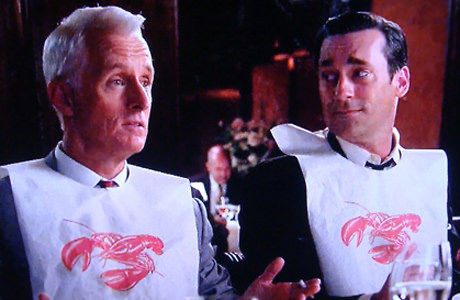
The Bibs: This year’s membership badges were, well, slightly larger and redder than they were in the past. I think that the goal was to reduce plastic waste, since the badges were made of cloth. That was a great goal and I think it was well-achieved, and if bibs are the future then that’s fine with me. But… yeah…
Another feature of the badges was a QR code, which could be used to scan your fellow anthropologists. No one I know actually tried to scan anyone else — most people I talked to feared what they would learn. However, according to AAA material, in the future being labeled with a QR code will enable us to participate in ‘scavenger hunts’. That’s right: scavenger hunts. The mind boggles. Continue reading
The Ruination of Written Words
[Savage Minds is pleased to publish this essay by guest author Gastón Gordillo as part of our Writers’ Workshop series. Gastón is Acting Director of the Peter Wall Institute for Advanced Studies and Professor of Anthropology at the University of British Columbia. A Guggenheim scholar, he is the author, among other books, of Rubble: The Afterlife of Destruction (2014, Duke University Press) and Landscapes of Devils: Tensions of Place and Memory in the Argentinean Chaco (2004, Duke University Press, winner of the AES Sharon Stephens Book Award). He blogs at Space and Politics.]
When the Roman Empire collapsed, numerous libraries and an unknown quantity of books disintegrated with it. Amid a rising Christianity hostile to traces of paganism, the texts of many authors admired in Roman antiquity were turned to dust and the memory of their existence dissolved. Pieces of writing by noted figures such as Cicero or Virgil certainly survived, but the majority of what these men wrote has been lost. This was an epochal moment in the history of writing: an imperial collapse so profound that it physically disintegrated vast amounts of texts, erasing them from human memory.
Some books from ancient Rome were saved from this massive vanishing of written words only because a few copies survived for over a thousand years in the libraries of European monasteries. This survival was often the outcome of pure chance: that is, a set of conjunctural factors somehow allowed those books, and not others, to overcome the wear and tear and ruination of paper and ink by the physical pressures and cuts inflicted on them by the weather and by the living forms attracted to them, primarily insects, mice, and humans. In these monasteries, many ancient books and their words disintegrated after a few centuries, gone forever. But others lingered and were eventually copied by hand again on new and more robust paper, which could withstand atmospheric and bodily pressures for the next two to three centuries. Three hundred years or so later, another monk would grab a manuscript about to disintegrate and copy those words again. Who knows how many amazing books were eaten away by bugs simply because no monk chose to save them from their ruination? One of the books that miraculously survived in a monastery over a millennia of chance encounters with the void was Lucretius’ extraordinary philosophical treatise De rerum natura, The Nature of Things. Continue reading
Return of the Anthro/Zine
Last May I introduced you to Anthropozine, a new undergraduate venue associated with the journal Anthropology Now. The concept behind the zine was to get college students interested in engaging in earnest reflexivity by articulating their personal experience of encountering anthropology. The first issue, themed around the topic of “Food,” was a roaring success thanks to the efforts of our talented writers.
I’m happy to announce that there is now a second issue of the zine to go around! Our parent, Anthropology Now, moved to Taylor & Francis which involved a slight delay in publication, but they have kept us on board. We’re excited to once again provide a place for shorter works by college students. The latest issue is themed around “the Body.” Help us help our students express themselves by sharing this over your social networks and email listservs!
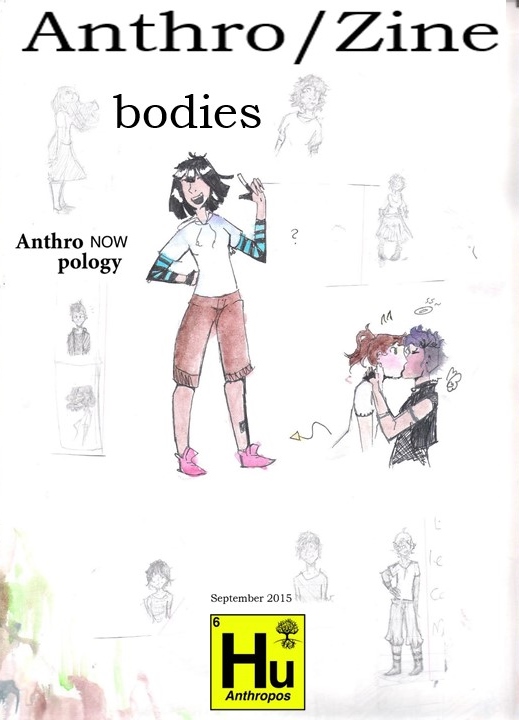
click here to download the PDF
Please visit us at http://anthronow.com/anthrozine where you can download our first two issues and view the submission guidelines. While you’re there check out all the amazing stuff Anthropology Now has to offer too. Continue reading