Category Archives: Blog post

Maha Kumbh Journal during the making of “Kalkimanthankatha – Part 2.

5 Kalkimanthankatha Publicity Photo copy
Still from Kalkimanthankatha.

Saturday, Feb 2, 2013
I think Samuel Beckett’s “Waiting for Godot” works very well in Kumbh. A post-modern text located in a pre-modern universe. The rupture is generated and almost organic to the film. This second Kumbh Mela of the 21st century is an ancient religious gathering gridded in the cartographic imagination of postcolonial town planners. It is a hybrid universe fatefully fluctuating between primordial impulses and rational compulsions. A pre-modern religious imagination controlled, ordered, and confined within the gridded universe of a Cartesian structure. Here faith is restrained by an eccentric postcolonial Foucauldian governmentality. Here religious belief is tightly fastened by the rational state. Here religion is gridlocked by the panopticon regimentation of postcolonial govermentality.

In this universe two men are searching for the tenth avatar of Kalki – the most ambiguous avatar of Vishnu. He is yet to come but he is probably already here. The avatar of Kali Yug. The avatar that will save the world from annihilation. Like Beckett’s Godot, he is here but he does not show up. Why will he show up? For whom will he show up? However instead of waiting, the two men are searching, because they know that he is here. And if he is here he has to come to Kumbh. For Kumbh is the place where all come: it’s a bombed-out, post-colonial, post-partition, post-holocaust refugee-camp of the faithful.

Continue reading

Maha Kumbh Journal during the making of “Kalkimanthankatha – Part 1.

[Savage Minds welcomes guest blogger Ashish Avikunthak]

The early months of 2013 saw one of the largest congregations of mankind in the 21st century transpiring at the confluence of the rivers Ganga and Yamuna in the north Indian town of Allahabad. Maha Kumbh Mela, which happens once every 12 years, is one of the most significant Hindu religious gatherings. Millions of devotees assemble to take a sacred bath at a consecrated spot where the two rivers come together. An estimated 120 million people visited Kumbh over a two-month period including over 30 million on a single day, on 10 February 2013.

I, with a motley group of friends and collaborators, spent more than a month in Kumbh, shooting a feature length film called: “The Churning of Kalki” [Kalkimanthankatha] – in which, following on the footsteps of Samuel Beckett’s “Waiting for Godot”, two actors from Calcutta go in search for Kalki, the tenth and the final avatar of Lord Vishnu. Kalki is the most enigmatic of Vishnu’s Avatars, the one who has already been on earth but has never been found. However, there is an outbreak of a monumental war during their quest. The two actors prepare themselves for this war by reading Chairman Mao-se-Tung’s “Little Red Book”.

These are selected ethnographic journal entries together with photographs taken by my collaborators. Continue reading

Infrastructure as Iron Cage

Weber’s metaphor of the iron cage is one of the most famous in all of sociology. It’s certainly stuck with me: I keep a bookmark in my copy of The Protestant Ethic (Talcott Parsons’ translation) at page 181 so I can always turn to the Iron Cage when I need it. Cos, like, you never know when you need to comment on the relationship between capitalism and the pervasiveness of rationalism.

Let’s pop in for a refresher.

It’s 1905 and Weber’s project is to undermine materialistic explanations for economic change by arguing that Protestant asceticism (self-restraint and the denial of pleasures) and the notion of having a calling (showing devotion to God by attending to worldly matters rather than seeking transcendence) laid the foundations for “modern rational capitalism.”

The Puritan wanted to work in a calling; we are forced to do so. For when asceticism was carried out of monastic cells into everyday life, and began to dominate worldly morality, it did its part in building the tremendous cosmos of the modern economic order. This order is now bound to the technical and economic conditions of machine production which to-day determine the lives of all the individuals who are born into this mechanism, not only those directly concerned with economic acquisition, with irresitible force. Perhaps it will so determine them until the last ton of fossilized coal is burnt. In Baxter’s view the care for external goods should only lie on the shoulders of the “saint like a light cloak, which can be thrown aside at any moment.” But fate decreed that the cloak should become an iron cage.

Since asceticism undertook to remodel the world and to work out its ideals in the world, material goods have gained an increasing and finally an inexorable power over the lives of men as at no previous period in history. To-day the spirit of religious asceticism – whether finally, who knows? – has escaped from the cage. But victorious capitalism, since it rests on mechanical foundations, needs its support no longer. The rosy blush of its laughing heir, the Enlightenment, seems also to be irretrievably fading, and the idea of duty in one’s calling prowls about in our lives like the ghost of dead religious beliefs.

Not ten years after The Protestant Ethic was published, Gregor Samsa awoke to find his soft flesh transformed into the hard carapace of a beetle (see Peter Baehr’s “The Iron Cage and the Shell as Hard as Steel”). Why does rationality behave so irrationally? It is strange when capitalism, which in the contemporary scene so values flexibility and mobility, invents constraints for itself that inhibit the very qualities it thrives on. It can also be more than a little bit funny, if you don’t mind gallows humor.
Continue reading

Sapiens: Good (Maybe Great) But Not Transformational (So Far)

Last week marked the launch of Sapiens, a brand new website bankrolled by the Wenner-Gren Foundation. The unveiling is especially welcome to those of us who think about public anthropology, since it will mean the end of Wenner-Gren’s seemingly endless social media campaign announcing that Sapiens will soon be launched. At last — after receiving five email which announce that Sapiens is not launched yet, and then invite me to click through a link to view a web page announcing that Sapiens is not launched yet — Sapiens has finally launched!

After scrupulously refusing to retweet non-news about the site, I was quit curious to see what final form Sapiens would take. So, is Sapiens worth the hype? Has a new day in public anthropology arrived? Can all other anthropology blogs now End? The short answer is that Sapiens is a major new voice in online anthropology, with a bucketload of skilled staff, quality features, and gorgeous web design. But if the Sapiens staff are hoping to transform how the public understands anthropology, they may be disappointed — this website is just one more voice in an already crowded online space. That said, with funding, legitimation, and editorial freedom from Wenner-Gren, Sapiens could make an impact in an already-crowded field.

Continue reading

Around the Web Digest: Week of January 17

Greetings from the heart of a city ravaged by Snowzilla! Send me anything that should be included here at rebecca.nelson.jacobs@gmail.com.

This Decasia post argues that half-formed, abandoned and unpublished projects represent intellectual work and should be acknowledged more openly in professional circles as part of the process of creating knowledge: Failed Research Ought to Count

The Anxious Anthropologist reflects on the power of dress (in this case, a suit jacket) to claim membership in a community and assert authority, particularly in gendered contexts: The Jacket

Allegra looks back at its most popular posts from the last year: Top 10 (or Thereabout) of 2015

Teaching Culture looks forward to the topics and trends that will preoccupy us in the coming year: 2016: Trends in Teaching, Publishing, and Anthropology

Continue reading

Analog to Digital and Back Again, Part I

By Kathryn Killackey (Killackey Illustration and Design)

Analogue in action.
Analogue in action.

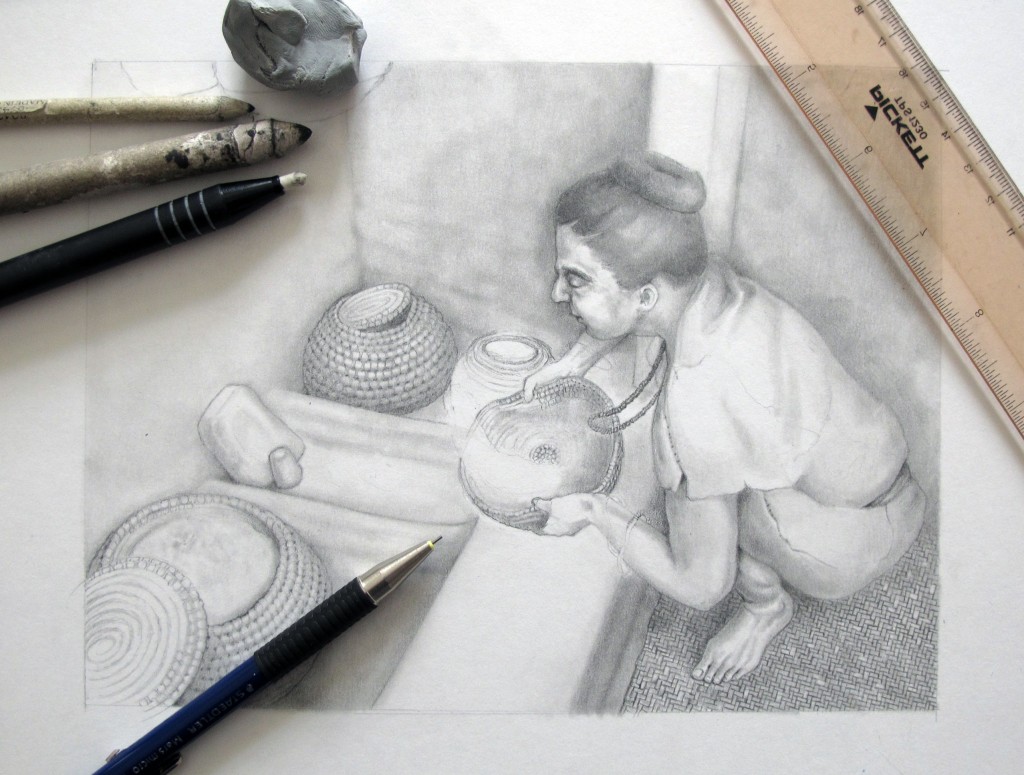
I am an archaeological illustrator and in this post, as part of this month’s analog/digital series, I’d like to discuss my work in relation to analogue and digital media. My job includes recording on-site features, drawing artifacts, and creating reconstruction illustrations of architecture, people, and activities. I also help researchers think through their data and raise new questions during the illustration process. Until recently I would have considered my illustration practice wholly analogue. I feel most comfortable working with pencil, paint, and paper. When I first started producing archaeological illustrations (about 10 years ago), the only digital part of my workflow was at the end, scanning my hand drawn images and cleaning them up in Adobe Photoshop and Illustrator for eventual publication. The image below is an example of this process.

Image2
Reconstruction of red deer antler decorated with wheat from Çatalhöyük by Kathryn Killackey, drawn in graphite and touched up digitally.)

Since then, there has been a gradual creep of the digital into my workflow. I now continually switch back forth between analogue and digital methods when making an illustration. After an initial sketch by hand, I scan the image, then play with the composition digitally, perhaps print it out again and draw on top of my print, scan it again, etc. I continue this back-and-forth until I have a preliminary drawing that I am happy with and that incorporates any comments or corrections from my clients. I’ll then complete the final art in an analogue medium with digital details and final flourishes. This combination of analogue and digital production is fairly straightforward, a skeuomorph of strictly analogue processes.

Continue reading

Farewell, Oona Schmid

No, it’s not the title of a whimsical new Wes Anderson movie, it’s news of changes within the American Anthropological Association’s publishing program. Ed Liebow, the executive director of the AAA (i.e. the big boss) announced in early January that Schmid will be leaving the AAA to become the Director of Publishing at the Association for Psychological Science.

Continue reading

Mixed Exhibits: The best of both worlds?

Post by Laia Pujol-Tost:

Archaeology is mostly about materiality. Its epistemological foundation is based on the relationship between humans and the material culture. Some of this objects, will later be displayed in museums to convey interpretations of the past. Yet, as Yannis Hamilakis and other authors have argued, Archaeology is a modern “science”. As such, it is mostly about the eye, and little about the body. On site, it mostly records and analyses visual, spatial, geometrical features. At the museum, this has meant a universal rule of not touching, and objects are isolated in showcases, for the sake of… mutual protection.

Then came Information and Communication Technologies (before they were called Digital Media), which under the promise of increased accessibility, interaction and engagement, reduced archaeological heritage even more to image and visualization: it had been digitalized; that is, de-materialized and even “de-musealized”. A series of evaluations conducted in museums since the 90s evidenced a conflict between the exhibition and the new media. The main reason being, as Christian Heath and Dirk vom Lehn pointed out, that exhibitions and computers belonged to different communication paradigms.
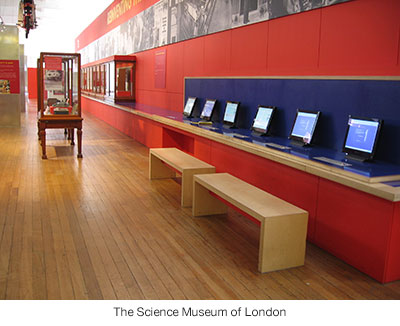
post2-imatge1

Around that time, several studies conducted in different European museums led me to the conclusion that the best way to integrate digital technologies was to stop just placing computers in exhibitions, and instead re-design the interfaces purposefully for such environments. Yet, what happened was the advent of mobile devices.

Meanwhile, some researchers working in the highly interdisciplinary field of Human-Computer Interaction started advocating for more natural ways to interact with computers. As a result, a new field called Tangible or Embodied Interaction arose around the 1990s. In this context, the concept of “Tangible User Interface” was developed. In TUIs, the interface is not anymore a PC but an (everyday) object. This takes advantage of the human capacity to manipulate objects, and allows a better integration with the context of use. Since the 2000s, labs used occasionally the cultural field as test bed; until 2013, when the first EU-funded project specifically devoted to tangible interactive experiences in Cultural Heritage settings was set up.

Now 3D printing has become the hype. As it happened with computers in the previous century, this technology is not new: it has been used in the engineering field for rapid-prototyping since the 1980s. But only recently it has become accessible to markets. Its applications are manifold: engineering, clothing, food, housing, health… But more than that, its implications regarding traditional product design, production and distribution chains are so enormous, that some people already talk about additive manufacturing being the next industrial revolution. The Cultural Heritage field has not been indifferent to this development. For example, the Smithsonian has started the X3D project, aimed at digitalizing and allowing the 3D printing of its collections. In the academic domain, some sessions at the EAA conference dealt with the implications of 3D printed replicas for Archaeology. Finally, the first mixed exhibits have appeared in European museums the last years, used either as mediators, smart replicas, top tables for shared exploration and gaming, or as full-body interactive environments.
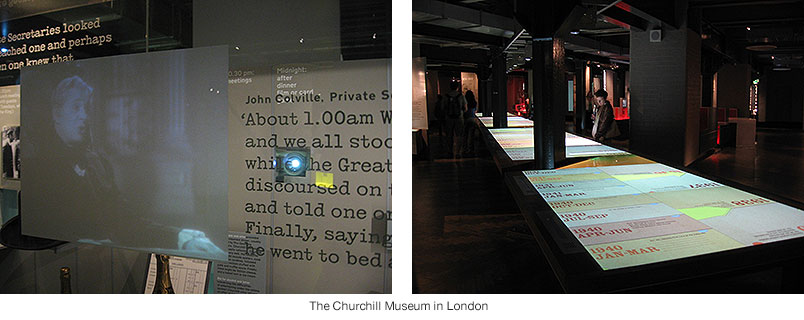
post2-imatge2

I am so excited about it! Does this mean that we may finally close the circle and, after such a long history of “voyeurism”, fully acknowledge materiality and tangibility in the cultural heritage field? It is interesting to note that, as it happened before with interaction or storytelling, we needed the pressure of the digital revolution to (re)discover or finally accept elements that already existed in the museums field. Still, I believe there is a big potential in this area, more than with digital media, and this is exactly what I am starting to investigate now. On the one hand, the specific advantages of smart replicas or tangible exhibits for Cultural Heritage settings. I have adapted Eva Hornecker’s overview of Tangible Interaction to list the following features:

  1. Appreciation of the materiality of the real object.
  2. Direct manipulation instead of just visualization.
  3. Performative action instead of passive gaze.
  4. Natural interaction without added symbolism.
  5. Natural integration in the exhibition environment.
  6. Non-fragmented visibility.
  7. Suitability for exploration in group.
  8. Personalization (especially suitable for children).

On the other hand, I am concerned about the strategies and threats for their adoption in museums. The experience shows that, as costs decrease, the availability and penetration of technologies increase. Still, the problem is designing and maintaining high-tech exhibits. Most museums tend to outsource digital media projects; but this has more often than not proven to be a bittersweet experience in terms of budget, sustainability, end-product, workflow, etc. Institutions are currently implementing different solutions. For example, EU-funded projects emphasize the creation of do-it-yourself authoring tools. Also, the big museums in the USA and Europe give strong support to the creation of their own digital media departments, so that such experiences can be fully developed in-house.

Yet, as we witness again a concern similar to supposed threat posed by the virtual to the brick-and-mortar museum, we first need to complete the unfinished debate around the concept of authenticity in cultural heritage. In my opinion, the problem to be solved is not with smart replicas (which, following Bernard Deloche’s taxonomy, only act as analogical or analytical substitutes), but with the role of originals in the age of information, commodification, and globalization. However, this is a discussion for another time and place.

(Part of this month’s Analog/Digital series, thanks to Savage Minds for hosting!)
The genie is out of the bottle – it’s foolish to think encryption can now be banned

Politicians have turned their sights on encryption once more following terrorist outrages in Paris and San Bernardino, California.

A country that once welcomed encryption, France is now considering outlawing it in the wake of the massacre in its capital. In the US, politicians and law enforcement have made similar demands, as has the British prime minister, David Cameron.

Encryption creates trust. It is the underpinning of the internet, ensuring the privacy of mail, commerce, and transactions of all kinds. End-to-end encryption, where data such as texts, emails, or other messages are encrypted in transit and in storage, and where no third party other than those communicating have the keys to decrypt it, has come under particular criticism.

Certainly it is difficult if not impossible to crack, and poses a serious problem for investigators. But the Paris attacks were not aided by encryption – the attacker’s unencrypted mobile phone, which was found in a bin, led police to their safe house. Abdelhamid Abaaoud, the Belgian-Moroccan ringleader, communicated without encryption.

Continue reading

A Tempest in a Digital Teapot

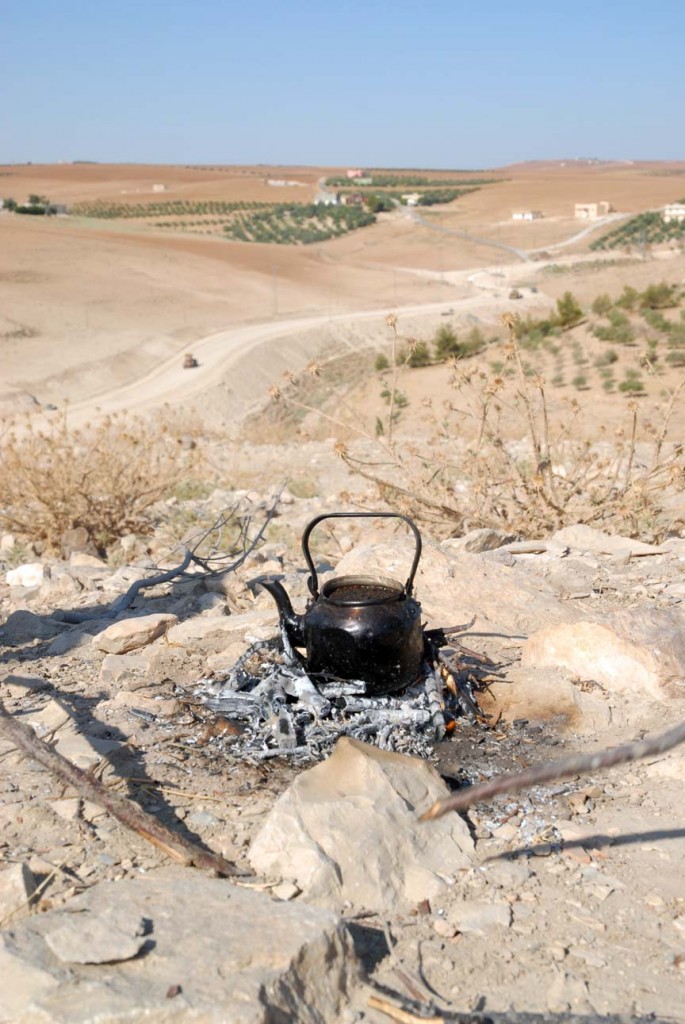
teapot

It was hot, but that was not unusual. We woke up at the first call to prayer to be on site at sunrise. I would trudge through the dimly-lit streets of the village, up to the ancient tell, and sit next to my trench until I had enough light to see my paperwork. The cut limestone went from dull gray, to a rosy pink, then that brief and magical moment called the golden hour, when the archaeology would become clear and beautifully lit and I would rush around trying to take the important photos of the day. Then the light would become hard, white-hot, and often over 100F. By lunchtime all of the crisp angles of the limestone would disappear into a smeary haze, hardly worth bothering with a camera. Photographs of people were impossible too—everyone was dusty, hot, irritable, half in shadow under hats, scarves.

I picked up my camera and climbed out of the Mamluk building I was excavating, on my way down the ancient tell of Dhiban and back up the neighboring tell of the modern town of Dhiban. As I walked between the Byzantine, Roman, Nabatean and Islamic piles of cut stone, a faint trace of smoke made me hesitate, then come off the winding goat path. Two of the Bani Hamida bedouin who worked with us on site were stoking a small fire on the tell. While making fires on the archaeology was certainly not encouraged, the local community had been using the tell to socialize for a long time. I greeted the men and they invited me to sit and have qahwa, a strong, hot, sweet, green coffee served in many of the local hospitality rituals and customs. I refused once, then twice, then looked over my shoulder at the vanishing backs of my fellow archaeologists, on their way to breakfast. Then I accepted a cup. But first, I pulled out my camera and snapped a photo.

Continue reading

David Bowie, Anthropology, and the Pleasure of Difference

I’m hardly the biggest David Bowie fan in the world, but when I heard he had passed away I knew I the news would make waves in social media. What I didn’t know was how big those waves would be. It was amazing to listen to my friends and colleagues who were old enough to remember the Bowie of the 1970s and 1980s speak about what a difference he had made in their lives. What I heard spoke not just about the musician but the man and his ideas, ideas which — yes, I’m going there — are deeply anthropological.

When people talked about Bowie, most of them emphasized the way that he “made the world safe for difference,” to use a phrase from Ruth Benedict. He told them — no, he showed them — that it was ok to be gay, confused, different, and/or changeable. For people growing up before web or mp3s Bowie’s records and casettes were visions of other, more expansive worlds.

Tolerance, pluralism, diversity are not really anthropological values. Rather, they run deep in the societies we live in: anthropology is built on top of them, not the other way around. That’s why we expect the broader societies we live in to heed our calls for social justice — and it’s why we make them. I think anthropology’s preoccupation with difference, like Bowie’s staging of it, speaks to something deeper.

I mean really: Bowie was not really someone who was merely willing to tolerate gender bending, was he? He was someone who explored the pleasures of the new, the unusual, the avant-garde, the possible. If he wrote books instead of songs, how much use would we have for Foucault? How does Guattari really measure up to Ziggy Stardust?

Bowie understood the positive power of difference — its pleasure and importance, and its kinks. He was about blurring boundaries, not sharpening them. I think all of this is something he had in common with anthropologists, who think awareness of difference makes life richer, and who recognize that the story is always more complicated and ambivalent than it first appears.

Bowie was not Ruth Benedict — that concept album, alas, never got made — but his mindset, his habitus, resonates with much of anthropology’s. It’s no surprise: Anthropology was remade by the same baby boom that produced Bowie. In these days when you can listen to songs without cover art or liner notes, there’s a danger of decontextualizing Bowie’s ouevre. So this week, let’s see if we can extend our understanding of Bowie past the 24 hour newscycle and see if we can imagine him as an anthropological thinker. It’s a stretch, and requires imagination. But I think that’s precisely what he would have wanted.

Listening to Physical Geology. PART 2: The ecopoetics of data, a few lessons from Björk

More drinks. This time in the midst of a madding crowd, soon after returning from Krakatau, with an Icelandic artist known as Shopflifter. She was wearing a remarkable head piece she humorously called a ‘brain catcher’. We were at the opening of the Björk show at the Museum of Modern Art and it was too crowded to see anything so I just drank and admired the brain catcher. I went back later to see the show. I went in the quiet before the crush of tourists to put on headphones and hear the biographical poetry that accompanied the material objects. I think the critics, universal in their evisceration of the show, may be a bit like archaeologists unable to see the important data in their spoil heap. The show wasn’t about the questionable directions of MoMA, its director, or contemporary art overall. The work itself, Björk’s work, was about the intimate and sometimes painful entanglement of human biographies and the physical planet. This seems outside of what critics can soundbite or archaeologists and geoscientists can quantify and yet it matters.

An image I took at the universally panned Bjork show at MoMA. I like the way the geological and human are portrayed here and how they intersect visually with the book cover of The Man with the Compound Eyes....
An image I took at the universally panned Bjork show at MoMA. I like the way the geological and human are portrayed here and how they intersect visually with the book cover of The Man with the Compound Eyes in my prior post….

Continue reading

Pixel vs Pigment. The goal of Virtual Reality in Archaeology

Savage Minds welcomes guest blogger Colleen Morgan.

Post by Laia Pujol-Tost.

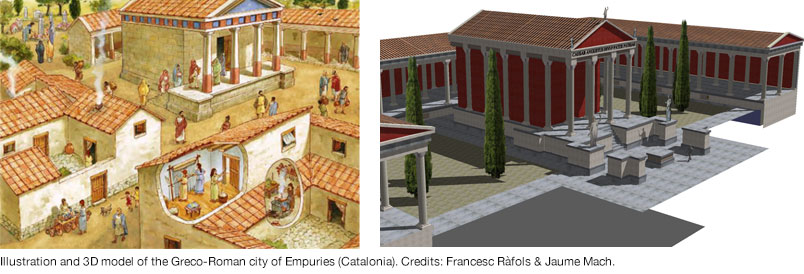
Archaeology has a long tradition of using visual representations to depict the past. For most of its history, images were done by hand and based on artistic skills and conventions. But the last fifteen years, we have witnessed 3D models take over archaeological visualization. It is interesting to note that while hand-drawn depictions tend to show human figures and seem to be associated with scenes of “daily life”, virtual reconstructions mostly show architectural remains and public spaces, usually devoid of people and objects. Yet, authors state that their intention is to represent the past.

grec-1

My field of research is what we now call Virtual Archaeology, but I started investigating when we still talked about “VR applications in Archaeology”. I have seen it become mainstream and evolve; and I wonder why after almost twenty years of technological improvements and theoretical debate, virtual reconstructions are still empty. Especially in comparison with drawings. Do the virtual and the physical have implicitly different goals? Are they subject to different perceptions or expectations by researchers and/or audiences? Have they received different historical influences? Maybe technological capacities still play a role?

Continue reading

Around the Web: Year in Review 2015

It’s been a big year for Savage Minds, so big that the annual blog review didn’t fit in 2015! (Yes, that’s why it was delayed). This year we celebrated our 10th blogiversary with a panel at the AAAs, an executive director’s award, and a rare in-person gathering, which gave us the chance to reflect on our work and how this project has evolved over time.

In this yearly post, we look back on the year in blogging, both for us at Savage Minds and in the anthroblogosphere in general. First, the Minds will share their favorite posts from the year, and then I’ll highlight a few of the posts on other blogs and news sources that struck me as the most important, memorable, or otherwise worth revisiting if you missed them.

Continue reading