Tag Archives: Writing

Authorship and the writer

A now dearly departed friend of mine was a living archive of Iroquoian linguistics. The first hour I sat down with him consisted of me asking questions, him reeling references off the top of his head, and my pencil trying desperately to keep up. To one of his suggestions I responded, “I’ve seen that one, but I had a hard time reading it.” To which he replied, “Well, you should have seen it before I rewrote it for her!”

My first semester in graduate school my Linguistic Field Work professor was asked if there was a difference between an informant and a collaborator. His answer, as I remember it—an informant is someone from whom you gather data, a collaborator is someone who really should be listed as a co-author.* Continue reading

Fiction and familiarity

My impression is that many people read fiction as an escape from their day-to-day. I am not those people. I like to have enough of a non-fictional toehold on a story to be able to judge its verisimilitude. I don’t want to be the reader analog to the millions of people under the impression that the legal system is in any way similar to Law & Order or CSI.

Given my interests and experiences, my toehold criterion seems to leave me with only so many fictional reading options to choose from. But early this spring I came across one short story and one novel fitting it to a T. Continue reading

Reading non-ethnographic non-fiction

In yesterday’s post I discussed my discovery that I have non-ethnographic writing options. In today’s post I touch on the corollary, my discovery that I have non-ethnographic reading options.

What I like in ethnography

My reading of the decade prior to last November consisted almost entirely of anthropological and linguistic literature and of ethnographies and published primary sources when given the choice. During that period I began reading 18th century military journals as sources of data and came to appreciate the way their authors used language, as in the following example from a 1761 journal describing a scene from the area where I spent my youth:

The prospect from some of the Hills pleasant, though not very extensive, occasioned by a circumstance extraordinary enough & perhaps not to be parralled—viz. That go to the highest Mountain you can see yet when on the top of it you see others still higher. This we experienced every Day’s March.

Continue reading

Writing non-ethnographic non-fiction

Savage Minds welcomes guest blogger Matthew Timothy Bradley.

I began graduate coursework at the Indiana University (not the University of Indiana!) Department of Anthropology in August of 2004. I learned an enormous amount about anthropology while I lived in Bloomington. The majority of that learning ended up taking place outside of anthropology courses. Because I was on IU’s anthropological linguistics track I actually took more courses from within the Department of Linguistics than from within the Department of Anthropology. I never once felt deprived of what I had come to the Midwest for, though. Two of my linguistic’s professors had done more fieldwork than 99% of cultural anthropologists you will meet, and any content I might have missed in the classroom was more than made up for by the time I spent hanging around at my advisor’s wonderful research institute.

Despite the fact that I kept learning more and more quickly during my time in Bloomington—maybe because of it, actually—I started struggling more and more to write. Writing has always been a slow and trying process for me. But as graduate school wore on and then afterwards, the relationship between understanding better and writing worse held true. A movie could be made about the special kind of frustration that is gaining ever more esoteric knowledge in conjunction with loosing the ability to express it. Such a film would be, to paraphrase my friend Jon Marcoux, of interest to tens of people. But I digress.

Continue reading

Against Signposting

One of the main techniques by which writers create drama is by withholding information from readers. Unfortunately, it is difficult to use this technique in academic writing due to the nature of the peer review process. I frequently deal with reviewers who demand more “signposting.” They want everything to be revealed up front. No surprises. I resist because I believe that overuse of signposting is one of the main reasons so much of academic writing is so boring. Instead, I interpret these demands as a signal that I haven’t done enough to gain the reader’s trust.

Continue reading

Writing about Bad, Sad, Hard Things

Writing is not always easy. Sometimes the writing flows and sometimes it doesn’t. But writing about things that are emotionally weighty, heavy, and disturbing is a different kind of not easy.

Monday morning I wrote a political asylum report for a victim of political violence in Nepal. Monday afternoon, bombs exploded near the Boston marathon finish line, killing several people, injuring hundreds, and stunning many (including this Massachusetts native, runner, and former Boston resident). The next day, I read about a twenty-year-old Tibetan mother who self-immolated and died in Tibet, and I wrote two more Nepali political asylum reports, one especially gruesome, and then collapsed on the couch, paralyzed in a sort of grief and shock and despair at the bad things human beings do to other human beings.

Writing felt necessary but debilitating. I could only write about the particularly horrific asylum case in short increments, writing a sentence or two, then turning to something that would allow me to breathe freely, breathe in some goodness and hope, and then exhale the horror. Write the horror down. Make sense of the horror for a judge. Or at least try to. Continue reading

Savage Minds welcomes guest blogger Matthew Wolf-Meyer

Back in December, I started a conversation with the staff at Savage Minds about professionalization, particularly in relation to recent Ph.D. recipients who might be on the job market and who might also be adjuncting. While we often collectively bemoan the state of affairs around non-tenure track employment in academia, it seemed to me that very little had actually been written about navigating the waters between graduating, adjuncting and finding a tenure track job. We began with a couple of surveys — one for people who are currently adjuncting and seeking more permanent employment, and another for people who had adjuncted and successfully made the move to a tenure track job or moved into a different form of work. About 50 people responded to each of the surveys (although if you’re so moved, you can fill them out now). Over the next month, I’ll be presenting some of the findings we collected from these surveys and thinking about the kinds of challenges that people face and how they might be overcome. In addition, I’ll be writing some posts about professionalization in anthropology in our current climate — an extension of some of my work on my professionalization blog based on the series I run in the anthropology department at UC Santa Cruz.

My interest in professionalization is based on my own experience, which has been characterized by a persistent need to pull myself up by my bootstraps. I’m now halfway through my fifth year on the tenure track at UCSC, and was previously employed at Wayne State; I was fortunate to enter the job market in 2007, at the height of jobs being offered. I graduated from Oakland University, a little-known liberal arts school is suburban Detroit, with a BA in Literature; taught elementary school for a year in Columbus, OH; went to the University of Liverpool for an MA in Science Fiction Studies; returned to the US for an MA in American Cultural Studies at Bowling Green; and then went on to work on my Ph.D. in Anthropology at the University of Minnesota. By no means do I have an elite background, and I attribute my professional success entirely to robust efforts to professionalize early in my career, a quirky project on sleep in American society, and supportive mentors.

Continue reading

Leisure Class as anthropology class

I don’t ever teach an Intro to Anthropology, a fact for which I wake each day thankful and perform several ritual ablutions and say long meandering prayers to as many culturally specific deities as I can remember. But if I did, I would start with Thorstein Veblen’s The Theory of the Leisure Class. In fact, I might even make it the only text for my awesome four-field anthropology class.

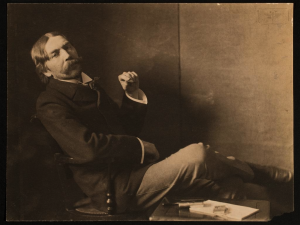
Thorstein Veblen
All you need is love. And one book by Veblen.

Economists think the book belongs to them–or those few evolutionary and/or institutional economists who take the book seriously (Geoffrey Hodgson leads this ragtag bunch of misfits and loyalists yearly into battle). But the book is anything and everything but economics. In fact, the book is a weird and wonderful combination of anthropology, economics, psychology, sociology and speculative phenomenology. One of the reasons people might not grok the fundamental wackiness of this book is Continue reading

vulnerability

so far, the constitutive goods of ethnography that i’ve talked about have been friendship and (an embodied awareness) of awkwardness. i’d like to see more of us take on vulnerability, because it seems to me that several of the recent mania in our discipline–most notably the hardness (quantitative) envy seen in some quarters, but also seemingly touchy-feely trendy topics like #affect–reveal distancing techniques meant to deny what we’ve known all along: not just that the fieldwork requires considerable vulnerability, but that like any other attempt of carrying experience over into knowledge, findings into academic conversation, the knowledge that we produce is vulnerable at every point it changes places, hands, or media. bruno latour has such vulnerability in mind when he talks of “referential chains” between soil samples and arguments about ecology and, i think, in his conversations of the sociotechnical “factishes” that make us act rightly

this is hardly the place to talk about latour’s arguments–it would make me far too vulnerable than i prefer–but i wonder why, apart from behar’s 1997 the vulnerable observer, we do not spend more time talking about vulnerability, if only to practice a kind of diligence. i don’t mean, by the way, the kind of diligence that has hedged ethnography about with a combination of IRB and rather patronizing ethics codes (not to mention a far too reactionary arguments about both). what i have in mind is more akin to the kind of “hyper and pessimistic activism” foucault talks about in his “genealogy of ethics,” an awareness of the dangers, the vulnerabilities that are part of our trade

Continue reading

memos on ethnographic practice

I’m DJ Hatfield, one of the guest bloggers for this month on savage minds. When thinking about possible themes for my blog, I just happened to be reading one of my favorite books on writing, Calvino’s Six memos for the next millennium. Originally, these memos were planned lectures about the values of good writing that Calvino was to give at Harvard; he died before giving the lectures and, indeed, before finishing the work. It might surprise several people who read savage minds that Calvino’s six memos (well, the five that he finished!) are what I turn to when I want to think about my practice as an ethnographic writer. And I think that there is much virtue in the structure of Calvino’s little book: the task he set before himself in 1984 was to describe particular qualities that writing should have if it were to meet the challenges of the next millennium–something that might have been envisioned by the editors of writing culture if a peculiar parricidal impulse hadn’t motivated that work. Of course, as a graduate student, the project of writing culture fit my bill. Now that I have a book and a few articles behind me, it’s Calvino’s project that incites my questions about what we do as ethnographers. What are the values that we would think of as central to the practice, what Macintyre in After Virtue called the “internal goods”–those values that we cultivate as we do our work in the field and out? I’d like to start a conversation on this question. As I am not sure whether what I will discuss will be values in the sense of the ends of our practices or in the sense of what orients them, I’ll leave you to give your preliminary suggestions. My postings on some of these values, plus some discussion of recent work, will appear throughout the month of October. My first internal good: friendship


Writing Space for Ethnography

[The post below was contributed by guest blogger Ali Kenner, and is part of a series on the relationship between academic precarity and the production of ethnography, introduced here. Read Ali’s prior posts: post 1 — post 2 — post3]

I’m still buzzing over Deepa’s question, posed as a comment at the end of my last post, “why must you write?” I read this question in two ways – 1) why must you write professionally, and 2) why must you write, ethnographically, about yoga and breathing. The question is a great opening into the final week’s prompt, which asks how academic precarity or marginality generates new intellectual possibilities. In my case, knowing that my situation could change, will change, at some point in the next few years, I chose a project that is more long-term. Something I can stay with through various contexts, a project that will travel with me in some form or other. Both yoga and writing (yes, writing) are such projects. Both offset the uncertainty I otherwise experience. Choosing projects that are close to home, and present a host of new and surprising challenges, is part of where I think we’ll also find new intellectual possibilities, and collaborations.

Yet it’s also critical to have the support of institutions, organizations, and colleagues. You’d be crazy to think you can go it alone, and why would you want to anyway? This post starts with the impulse to write as critical, generative practice, and ends with some comments on a roundtable session from the May SCA meeting, a session that speaks to the culture of academic precarity, marginalized work, and how we might support new modes of scholarship.

*           *           *

In my first two years of graduate school, while at the University at Albany, SUNY, I had a fellowship with the New York State Writer’s Institute. At the time, I had not a clue how fortunate I was. I wish I had been taking notes. Diligently. What I would have been writing down is how visiting writers responded in the Q&A sessions that followed their seminars and readings. Invariably, an audience member (or members) would ask the visiting writer about their writing practice, how they worked and got published. Some writers were new authors, reading from their first novel or short story collection. Others were award-winning authors with writing careers that spanned decades. Now, as I just revealed, I did not take notes from this period, but I did manage to pull out a few general threads that I heard consistently over my two-year stretch at the Institute. One response repeated enough for me to hold onto is that it is through the practice and process of writing that ideas, arguments, and stories take shape. Characters come alive in relation to other characters and events. Stories come into being on the page, despite the extent of thinking and planning you do in your head. Ideas, narratives, and arguments might be floating around beforehand, in conversation with others even, but the process of writing translates and transforms them. For ethnographers, writing carves out a space for data, theory, and analysis to converse. For me, writing is a space of play and reflection. And it’s continued writing practice that makes this space, holds this space. These are things we’ve all heard, and felt and know as writers. But I think it bears repeating, again. Continue reading

Attention Deficit Ethnography

[The post below was contributed by guest blogger Lane DeNicola, and is part of a series on the relationship between academic precarity and the production of ethnography, introduced here. Read Lane’s previous posts: post 1 — post 2 — post 3]

Our final prompt in this series asks about the possible virtues that emerge from the necessities of marginality or academic precarity, the effects on ethnography of such “new intellectual possibilities.”  On the whole I’ve so far stuck with the trajectory I laid out for these posts, engaging with precarity and ethnography first via my experience of living in a London suburb in over the last several years and then on the subway I used to get aroundwhile living there.  In both cases I focused on my own ethnographic practice and experience and particularly on observational practice.  For this final post though I want to shift the focus to the effects on ethnography not “as practiced” but “as taught or learned,” not as observational technique but as representational technique.  The post-millennial relevance of this seems clear, with a number of the conversational threads on SM proceeding from the observation that information technology and digital media are having an expanding range of effects not just in the field of anthropology but in education (that other domain inhabited by so many practicing anthropologists).

My earlier posts also (I note in looking back over them) relied pretty heavily on metaphor and pop culture/sci-fi references, but I can’t think of a good reason to change that now, so: for better and for worse, one of my last opportunities to be social before leaving the UK last month was spent in front of the IMAX screen at the British Film Institute (“the largest film screen in the UK”).  The BFI’s performative apparatus is matched only by the fantastic quality and diversity of films routinely screened there, but this particular outing (with several participating students and other friends) was centered around a pop-culture event with a dash of speculative pseudo-archaeology: Prometheus, Ridley Scott’s prequel to the 1979 film Alien.  Overall the film is pretty awful in largely predictable ways (did I mention this was a 3D screening?), but it serves to illustrate my point here, particularly in a fleeting reference the film makes to Lawrence of Arabia (a quite different film about a quite different type of alien). Continue reading

Decentering Writing

[The post below was contributed by guest blogger Deepa S. Reddy, and is part of a series on the relationship between academic precarity and the production of ethnography, introduced here. Read Deepa’s previous posts: post 1 — post 2 — post3]

Note: updated on 7/26/2012 for clarity.

For this final post in our series, I find myself returning to Carole McGranahan’s post from some weeks ago, going through her very useful 9-point schema to describe what makes things ethnographic these days—realizing that whatever the circumstances of ethnographic production, whatever our definitions of ethnography might be, they always presume the centrality of writing. And that is writing in a particular mould, one that satisfies most, if not all, of the criteria enumerated in McGranahan’s post. Specialized, often lengthy, mono-graphs or variants thereof.

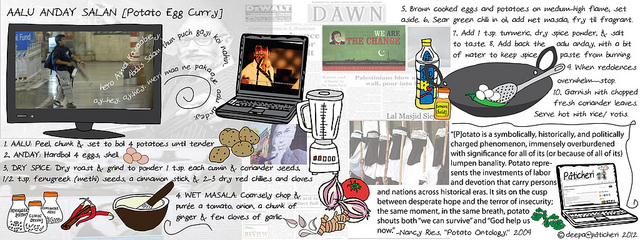
aalu anday salanRecipe for Pakistani-style Political Potatoes
[Click on the image for a more readable higher-res version]

Part of me wants to say: But of course, how could it be otherwise? The other part, perhaps handicapped by my present need to cobble together a professional identity while remaking myself in an almost completely new cultural landscape—and finding precious little time to devote to writing, is wondering about ethnographic end-products, and the centrality of conventional writing to the ethnographic enterprise. In this post, therefore, I’d like to think through the prospect of decentering writing [fully aware that writing can’t ever be entirely displaced; that there is an awkwardness to the idea, reflected in this post’s two-ing title]. Continue reading

What Makes Something Ethnographic?

How do you know when you are reading an ethnography? What makes a book or article ethnographic? This past semester I taught a new undergraduate course titled Reading Ethnography in which the students and I asked these questions as a means of appraising the specificity and content of ethnographic knowledge. Our first challenge was to articulate what the term “ethnographic” meant. What are those qualities that make a piece of scholarship ethnographic rather than simply descriptive or anthropological?

Etymologically, the ethnographic comes from ethnography. Following from its Greek origins, ethnography is the writing of people, of society, of culture: ethnos means “folk/the people” and grapho is “to write.” In noun form, ethnography is no longer tethered just to writing. Instead, it is often used to refer to a type of research; it is not only non-anthropologists who use the term this way. We do it too. We talk about “doing ethnography,” using it as a shorthand for fieldwork, saying ethnography when we mean ethnographic research. Continue reading