Tag Archives: Theory

Anthropological “isms,” post and otherwise.

Explaining Disjunctures and Differences

Between the demolition of the Berlin wall and the fall of the twin towers, ‘globalization’ happened to anthropology. One of the most influential essays of the period (probably because it was ahead of the curve) was Arjun Appadurai’s Disjuncture and Difference in the Global Cultural Economy (originally appeared in 1990, iirc). As an article it is both alluring and infuriating. In it, Appadurai proposes the notion of different sorts of ‘-scapes’, a model which has been tremendously influential but which he (and pretty much everyone else) fails to develop in any real way in any future work. Similarly, Appadurai argues that we need to develop models similar to those based on chaos theory and fractals if we are to undersand the global cultural economy. As a bow to the popular science of the time this was very trendy (Gleick’s Chaos came out in 1988, when the article was being writen, I reckon) but again not something that he has followed up on — although quite a lot of people who work on social networking have done so.

For me, Appadurai is like Mahler — I recognize the genius, I understand why it appeals to some, but at the end of the day all it does is make me queasy (I should say that I am talking about his writing — Appadurai is a very nice guy in person). I began to ask myself: why does this article appeal? Or, more specifically, why did it appeal in the context of the late-80s early-90s?
Continue reading

Still Hearing Anna’s Voice

UN Pic

I am currently working with a group of scholars here in Helsinki on the discourse of global indigeneity or indigenism following the September 2007 adoption of the Declaration on the Rights of Indigenous Peoples by the UN General Assembly. We are reading through some contemporary anthropological and legal literature on the topic, and presenting case studies from our own research. Last week we discussed Cameroon, and in particular the Mbororo. This week we are moving to Indonesia and transformations in adat and tribal identity there. We will be discussing Sami as well. If our cases span the globe, this is because the construct ‘indigenous’ has become more and more persuasive in recent years precisely through linkages that are transnational in nature. How are these linkages sustained culturally and organizationally? What has drawn diverse people(s) together? As Ronald Niezen points out, indigenous activism is in a sense necessarily transnational because it seeks a politics that does not conform to the liberal logic of the nation-state. Reflexive ‘cross-nationality’ is thus a key component of successful indigenous organizing, drawing on national boundaries and cultures of nationality but cutting across them, putting them under erasure, so to speak.

This is one claim that Anna Tsing makes in an essay called ‘Indigenous Voice.’ (No, SM is not becoming an Anna Tsing fan site — I wanted to post this before Kerim’s recent posts, but Kerim’s prodigious blogging can hardly be matched.) Tsing argues that political identities must sustain a public to have effect, and they do this through a ‘voice’ that can be heard:

I track variations in the public articulation of indigeneity in different places. I follow not the ambivalence of ordinary people but the claims of those who set the terms of discussion — for example, activists, community leaders, and public intellectuals. Their claims become influential discursive frames to the extent they can gain both a following and an audience. These frames inform what one might call ‘indigenous voice.’ By voice, I am referring to the genre conventions with which public affirmations of identity are articulated. Because it is the genre convention, not the speaker him or herself, that has power, totally unknown people can speak with this kind of voice; but they must speak in a way that an audience can hear.

One might expect then to read an essay about kinds of speech, an analysis of rhetoric or register, a focus on discourse and text, as well as an essay about the conceptual (discursive, cultural) preconditions that precede and enable transnational recognition. However, Tsing follows this argument with a further thesis: “Cross-National Links Inform Transnational Fora.” What follows are lucid little synopses of different (national) cases and their (cross-national) linkages, each illustrating one axis around which indigenous political organizing gathers. Her first example is the connection between Canadian First Nations activism and New Zealand Maori activism in the 1970s — she boldly claims that this particular transnational axis is the most consequential source of contemporary rhetorics of sovereignty in indigenous movements (cf. Michael Brown in the same volume). Further examples concern ‘pluri-ethnic autonomy’ in the Americas, and environmental stewardship in the Amazon and elsewhere. At each of these sites, people secure political purchase by finding ‘allies’ in other national settings (sometimes the alliance is unreciprocated; some groups, unbeknownst to them, become models for others). This all makes a lot of sense and the essay is not merely celebratory, but points out problems (fissures or ‘friction’) generated along each of Tsing’s comparative poles.

Yet I was still left wondering. Continue reading

Scale Making Revisited

Thanks to everyone who responded to my last post. In response to my queries, I was able to track down some excellent overviews of the human geography literature where the keyword to search for is “politics of scale.” (See especially here and here.)

In that post I failed to link to Rex’s piece from last year, where he wrote:

In fact most of what we anthropologists talk about when we talk about ‘scale making’ is not an investigation of regional or global processes. We do not attempt to discern how many places we will have to travel to to examine these processes. Instead we talk about how people in the localities that we do our fieldwork ‘make scale’.

Having spent the better part of the last few days going over this material, I better understand the distinction Rex was making. Indeed, it seems that the way the term is used by human geographers often suffers from assuming that scale is an ontological category. Rex is more interested in looking at “the imputation of agency to collective subjects versus individual ones.” And I am more interested in the contested ideologies of scale which define the “local” in Taiwan in relation to the Austronesian linguistic sphere versus the Chinese one. Both of these projects relate to the making of scale through social action as opposed to the operation of individuals at pre-defined levels of scale.

However, having already spent some time going over the literature on scale within human geography, I think it would be a mistake to either abandon the term entirely (as Rex seems to suggest) or to ignore its genealogy outside of anthropology (as Tsing chooses to do). As Richard Howitt’s excellent review shows us, we have a lot to learn from the various debates over the use of the term within that discipline. For instance, too great an emphasis on process and human agency might blind us to the very real constraints on scale created by existing corporate, legal, and political institutions. In his sections on “the idea of scale” and “empirical studies of scale” Howitt shows how geographers have struggled with social-constructionist approaches to the concept of scale in ways which seem to anticipate some of the issues anthropologists have tackled in thinking about these issues.

“Scale Making” In My Ear

Two years ago Savage Minds, together with our readers, spent the summer reading Anna Tsing’s book Friction. Although I was somewhat underwhelmed by the book at the time, I have to admit that certain ideas have crawled in my ear and wrapped themselves around my cerebral cortex like a ceti eel. Specifically the notion of “scale making” discourses. At the time I criticized her use of the term for emphasizing vertical relationships over horizontal networks, but for various reasons I won’t go into now, the concept of scale is very useful for thinking about my current research with indigenous communities in India and Taiwan. For this reason I decided to investigate further.

Tsing is not particularly forthcoming about the genealogy of the term , but I’ve recently discovered that Google Scholar is an excellent way to identify the most widely cited source for a particular academic keyword. A search for “‘scale making’ globalization” yielded up two very useful essays. Both from 2000: The first is Sallie Marston’s “The social construction of scale” (Sage subscription or purchase required). And the second is an article by Tsing herself, entitled “The global situation” (Scribd iPaper link).

I’ll discuss Tsing first. I realize I must be one of the few idiots who hasn’t already read this piece – so I apologize to all our erudite readers for whom this reference is obviousness itself. But I want to say how much I loved this article. It is clear, insightful, and critical. It is especially critical of the triumphalist and “charismatic” discourses of globalization which so prevailed in 90s anthropology. It made me a Tsing fan in a way that Friction had not. But while the article elaborates her theory of “scale-making” it still doesn’t give us much of a sense of the genealogy of the term.

For that, I had to turn to Sallie Marston’s workmanlike piece. Marston, a human geographer, is well situated to give us this genealogy since it seems to have first caught on in English within that discipline. She traces it back to the work of Henri Lefebvre (a nice article on Lefebvre by Stanley Aronowitz can be downloaded here) and places special emphasis on the work of Neil Brenner (lots of downloads available there) and Peter Taylor (alas, no downloads). (Taylor is the only name from this article which appears in Tsing’s bibliography from the same year.)

In the last decade it seems that the term has really taken off – and has even begun to be criticized for its various inadequacies. I’m still exploring this literature and trying to figure out how to make use of it in my own work. I’m sure our readers will berate me for overlooking some obvious and important sources in my quest to trace the origins of this particular academic meme – and I look forward to it!

Marxist Economics and Hegelian Philosophy Explained

As I plow through our department’s graduate theory course which moves through Marx, Weber & Durkheim at breakneck speed, I’ve been looking for materials which can help my students get a handle on the material. So I was very happy to find out that Ernest Mandel’s 1967 pamphlet, An Introduction to Marxist Economic Theory, is available online.

I don’t think its possible to make sense of Marx without having a decent grasp of his theory of value. I also think its important to read Marx in his own words – as we require our students to do; but it is helpful to have a clear and concise explanation which doesn’t dumb things down. Mandel’s introduction manages this feat quite admirably.

And since Marxist economics does require some grounding in Hegel, one also needs a primer on Hegel’s philosophy. Here I found the Stanford Encyclopedia of Philosophy entry to be quite lucid. I especially liked the following passage:
Continue reading

Durkheim the Communist

Re-reading Parsons on Durkheim (in The Structure of Social Action), and I liked his description of Durkheim as a “communist rather than a socialist”:

In the sense in which Durkheim uses the terms, communism is a doctrine advocating a rigid control over economic activities by the central organs of the community motivated primarily by a sense of the dangers of uncontrolled economic interests to the higher ends of the community. . . . Since this is an ever-recurring problem of human society in all times and places [he cites Plato’s Republic], communistic ideas are not bound to any particular social situation . . .

Socialism, on the other hand, is a doctrine advocating the fusion of the economic interests with the controlling organs of the community. Applied to the present situation of Western society it is not so much control by the state as fusion with the state. Underlying it is precisely an economic view of society. . . . There is no questioning of the desirability of maximizing wealth as an end – no question of its conflicting with other ends. This is possible because socialists are ethically and philosophically utilitarian individualists.

In response to a letter to the NY Review of Books, Sheldon Wolin elaborates:

[For Durkheim] socialism comes primarily to mean the effort to cope with social disorganization produced by economic individualism. He saw (Saint-Simonian) socialism as “extending to social sciences the method of the positive sciences, out of which sociology has come”; as promoting “religious regeneration”; and as seeking to overcome social disorganization by “connecting economic functions.”

It seems that Durkheim’s views on socialism were somewhat at odds with that professed by the Third Republic. For instance, one source writes that

Although he stressed the importance of socialism in philosophy, law, and history, Emile Durkheim faced opposition from the humanist Faculty of Letters members, who were somewhat afraid that his distinct explanations of legal and moral institutions through reference to purely social causes threatened volition and individual moral duty.

UPDATE: Some more discussion here.

The Sacred Idea of Progress

Finished re-reading of Durkheim’s Elementary Forms (first time I read the Fields translation), and I wanted to write about two passages where Durkheim seemingly critiques aspects of his own argument.

In this passage he points out the sacredness of the notion of progress which so underlies many aspects of his work:

Just as society consecrates men, so it also consecrates things, including ideas. When a belief is shared unanimously by a people, to touch it – that is, to deny or question it – is forbidden, for the reasons already stated. The prohibition against critique is a prohibition like any other and proves that one is face to face with a sacred thing. Even today, great though the freedom we allow one another may be, it would be tantamount to sacrilege for a man wholly to deny progress or to reject the human ideal to which modern societies are attached. (p 215)

And in this passage he touches ever-so-briefly on the question of conflict:

A society is not constituted simply by the mass of individuals who comprise it, the ground they occupy, the things they use, or the movements they make, but above all by the idea it has of itself. And there is no doubt that society sometimes hesitates over the manner in which it must conceive itself. It feels pulled in all directions. When such conflicts break out, they are not between the ideal and the reality but between different ideals, between the ideal of yesterday and that of today, between the ideal that has the authority of tradition and one that is only coming into being. (425)

In the second passage you can see at work the sacred idea of progress he discusses in the first passage. We also see Durkheim talking about conflict, but conflict is seen only in terms of the steady march of modernity, not as something endemic to society or a particular kind of modernity.

At the same time, I think it is important to show that the seeds of such a critique already exist in Durkheim’s own writings. All too often I’ve seen scholars say “so-and-so was wrong about X” and proceed to throw the proverbial baby out with the bath water.

The true paternity of the habitus

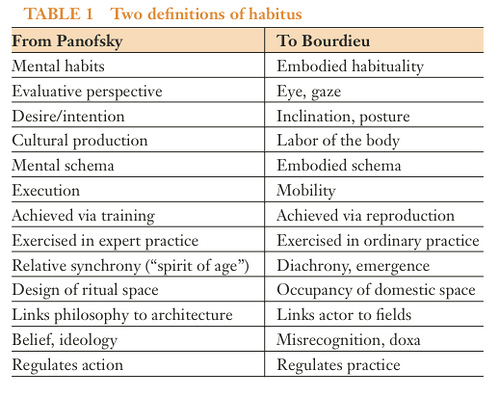
Bill Hanks’ Annual Review essay on Bourdieu is a wonderful overview of Bourdieu’s philosophy of language and the use of Bourdieu’s work in Linguistic anthropology. It also contains something that might be well known, but was news to me: Bourdieu’s theory of the habitus was taken from the art historian Erwin Panofsky. This seems to fly in the face of the traditional genealogy I’m familiar with, which traces his use of the term to Marcel Mauss and Norbert Elias.

Hanks argues that the corporal aspects of Bourdieu’s theory – those that bear a strong resemblance to Elias – were applied later (via the work of Merleau-Ponty), and that his use of the term owes more to Panofsky:

Panofsky defined habitus in terms of “habits of mind” that lay behind Gothic architecture and scholastic philosophy, arguing in effect that cultural production is profoundly shaped by the ways of the thinking of its time… Bourdieu translated Panofsky’s book into French in 1967, and wrote a postface to the French edition, in which he comments on the importance of the art historian’s notion of habitus.

When he rejected the mentalistic notion of the habitus in the seventies, he transposed Panofsky’s language into corporal terms. Here is a chart from the article comparing the terms used by Bourdieu with those of Panofsky:

Bourdieu and Panofsky

I’m inclined to accept this interpretation, if only because I’ve always thought Panofsky is an under-appreciated genius whose works should be read by more than just art historians. Hanks does acknowledge the importance of Durkheim and Mauss, as well as Elias, but doesn’t see them as being particularly important for the genealogy of the habitus as used in Bourdieu’s work.

I don’t know how long it will be up, but someone (not me) has posted the Hanks article to Scribd.

The long historical essay as anthropological theory

As the spring semester approaches my fellow hemisphere mates and I, I am putting the final touches on my ‘theory’ syllabus. I’ll share it with SM soon (the initial draft is not very appetizing), but I thought it would be interesting here to blog about something I will not be teaching — the long historical essay. As I’ve mentioned in past posts, anthropologists have come, for some reason, to ‘do theory’ in the form of the disciplinary history. This includes monograph-length studies, of course, but one particular genre that seems particularly anthropological is the long essay in which anthropologists describe ‘their theory’ or a more general ‘world view’ by constructing a genealogy whose telos they are. So in honor of Christmas — which involves its own teleological understanding of my own tradition — I thought I’d try to make a list here of classic ‘long essays’ in anthropological theory. Let me know if you can think of any more:

Blurred Genres, Clifford Geertz
Theory in Anthropology Since The 60s, Sherry Ortner
“As People Express Their Lives, So They Are…” in the Symbolic Anthropology Reader
Culture and Cultural Analysis as Experimental Systems, Michael Fischer
Anthropos, Edmund Leach
The Use of Anthropology: Critical, Personal, Politics, Dell Hymes

The genre is pretty fuzzy, but I hope this gives readers of these works some sense of what I’m talking about.

I’m not actually assigning any of these essays to my students (they can read them on their own if they want). They are very tricky. Often presentist and self-serving they require very sensitive antenna to read through to get some actual sense of the literature they cover. At the same time working through the motivations of their orchestration of the literature is in itself a good way to get some sense of the scene when the author was writing. But at any rate I think given the limitations of class time it is better to get students to actually read the material rather than read about it. What do you think?

Official 2007 AAAs ‘hot theorist’: Gabriel Tarde

Agamben move over — my money for the ‘high-concept’ theorist to hit the AAA this year (unless I am so far ahead of the fashion trend I am two years ahead of my peers) is Gabriel Tarde, who is not only getting “a conference in his honor”:http://www.tarde-durkheim.net/Conference.htm but also an entire “special number of Economy and Society”:http://www.informaworld.com/smpp/title~content=g782301949~db=all.

On the one hand I applaud the Strathern-Latour axis’s attempt to create a coherent movement by forging a disciplinary history by excavating the loosers of Edwardian theory wars since, on the whole, I have a soft spot in my heart for Edwardian theory wars. On the other hand… Tarde? Don’t you think it’s about time we dusted off someone who could at least write, like Bergson?

Northern Loss: Roz Mortimer’s ‘Invisible’

I have just returned home from a conference at Lancaster University in the UK called “Melancholic States.” The conference was themed around recent attempts to think about contemporary cultural politics and struggles through an analysis of melancholia, drawing principally on Freud’s famous essay “On Mourning and Melancholia.” A number of scholars working in feminist, queer, and postcolonial studies have found Freud’s account–and its contemporary re-working by folks such as David Eng, Judith Butler, and Ranjana Khanna–of unresolved grief or misrecognized loss useful for thinking about the ‘psychic life’ of modern social orders, including those that have emerged through varieties of violence, such as the violence of colonial government or everyday racism, sexism, and homophobia.  Anthropologists need to be aware of the work of these scholars, and others working in this mode, because all of them draw, episodically and selectively, on the work of anthropologists. Anthropologists should also be aware of this work because there are many rich ideas in it worth exploring, refining, and critiquing.

The conference was largely ruled by a ‘cultural studies’ ethos, which meant that many of the papers focused on readings of texts, images, or other cultural artifacts (such as memorials) without much rigorous empirical research. Nevertheless, I found myself learning a lot about current directions in cultural studies and different ways that ‘affect’ is being incorporated into contemporary cultural analysis in potentially productive ways. I hope to write a few more posts about some of the excellent papers I heard.

A highlight of the conference for me was a screening of a film called “Invisible” by the London film-maker Roz Mortimer. The film is an artistic meditation on global pollution, and its case is the discovery of high levels of potentially dangerous chemicals in the mother’s milk of Inuit who live in northern Canada. The film, which features stunning visuals of the frozen north, as well as extended scenes of seal slaughter and touching interviews with Inuit mothers, is not unprovocative. I was hypnotized by its visuals. Yet, in dramatizing its narrative, the film works with certain tropes of indigenous peoples, in particular their putative ‘remoteness’ and their concomitant ‘purity,’ that critiques of ethnographic pastoralism have long called into question. At the same time, however, the film reflexively positions these exoticisms through the visual device of long shots of medieval maps, which represented the barbarous ends of the earth as populated by monsters and other frightening figures. So if the film reproduces a story about the loss of a kind of noble ‘elementary’ or ‘primitive’ existence through the spread of global pollution, it does so by asking the viewer to be explicit about the assumptions of that story. I think the film is ambivalent in this regard and I haven’t completely made up my mind as to what it’s doing; I will be curious to see how it is received. The film is a fascinating text exhibiting many contemporary anxieties: the fear that globalization will result in the loss of cultural diversity, the fear that the environment has been permanently polluted, the fear of loss of biodiversity. The isomorphic equation between the loss of traditions and loss of ‘nature’ is a provocative and fascinating aspect of contemporary zeitgeist. Yet, Mortimer is clear that her intention is not to make an ethnographic film. Below I append its trailer.

<object width=”425″ height=”350″><param name=”movie” value=”http://www.youtube.com/v/xG0Wp47cAZI”></param><param name=”wmode” value=”transparent”></param><embed src=”http://www.youtube.com/v/xG0Wp47cAZI” type=”application/x-shockwave-flash” wmode=”transparent” width=”425″ height=”350″></embed></object>

Radical Hope by Jonathan Lear

On the face of it, “Radical Hope: Ethics In The Face of Cultural Devastation”:http://www.hup.harvard.edu/catalog/LEARAD.html is an impossible book to write and write well. What are the odds that a psychoanalytic take on Aristotle will tell us anything at all worthwhile about the collapse of the Crow lifeworld in the American west in the late nineteenth century? And yet despite the odd choice Jonathan Lear had managed to write a book that will appeal to anthropologists despite the fact that it infringes on what many of us would consider ‘our turf’.

There are three major challenges that Lear has to overcome in Radical Hope. First, Lear has got to actually learn about the Crow. This means learning about history, anthropology, the writing of Crow scholars, and others — a tall order for someone whose previous books have been much more philosophical. Second, the cultural politics of writing about the fate of the Crow are complex, and in this book Lear must strike a respectful and informed (see #1) tone about life on the reservation and the history of the Crow people. Learning just enough about the Crow in order to riff on their history would make Lear the last of a long line of white men who use Indians for their own ends. This is a job that anthropologists are particularly concerned be done well, because we have so often done it badly. Finally, Lear must try to say something new and intelligent about culture change, innovation in tradition, and the crushing psychological aspects of colonization — no easy task given the amount of ink spilled on the topics, and especially given how much of it has been spilled on the American west.

At just under 140 pages, Lear has clearly chosen what I call the ‘Imagined Communities’ route — when writing on a topic that deserves 1,000 pages it is sometimes easier simply to write 100 and make sure they are suggestive. While I know nothing about the Crow, it seems to me that Lear has done an admirable job catching up on the literature, including that of Crow authors, and in being fair to the thoughts and beliefs of Crow people. And he manages to do this despite the fact that, at a basic level, he is after bigger philosophical game than “just” Crow history. Even at points where he drifts off into the philosophical stratosphere to inquire what sort of human soul is suggested by his interpretation of one possible meaning of one report of a nineteenth century Crow autobiography, you do feel that Lear has managed to tether himself as much as possible ‘in the ethnography’ given that his analytic framework is sky-high.

In the end I think Lear has also managed to say something of value. At a certain level anthropologists are used to the idea that radical cultural innovation can still be ‘traditional’ even if its surface forms seem quite different from what has come before provided that the process, rather than the content, of change be ‘traditional’. What is valuable in his account is the way that he describes the ‘radical hope’ that can — must? — be central to this process and how it might be fitted in a larger philosophical anthropology which combines psychoanalysis and Aristotelean virtue ethics. It is this hook up to larger social-theoretic or political-philosophical trends that I found interesting since this sort of material is not usually dealt with by those streams of thought.

The risks of failure for a book like Lear’s were quite high, and I must admit I feel a bit ambivalent recommending the volume whole-heartedly — turning a project that could have been disastrous into a book that is very good is, after all, a different sort of thing from writing a book that is truly great! But this book has many advantages: effortlessly clear prose, its unusual juxtaposition of topics, the speed at which it goes down, and the way it foregrounds the fate of the Crow in a world that is too ready to forget our frontier history. It is good to teach with — perfect for a ‘deep thought’ undergrad honors course, and is great for social sciences who want something a little soulful to ponder. While I have not yet heard the reaction from Crow people themselves, I’d recommend Lear’s book to any anthropologist who wants to read an elegant, thoughtful piece — I’m glad to see that Jonathan Lear has decided to encroach on ‘our’ turf.

What F(l)ags Engender

bush.jpgWould it be unfair to say that this image basically sums up the content of mainstream U.S. politics and culture since “9/11”? Where does this picture fit amidst arguments about the clash of civilizations, the politics of oil, the legality of torture, secularism, multiculturalism, or the exercise of sovereign power? Does the image of George W. Bush as a roided-out Uncle Sam basically iconize the post-millenial U.S. zeitgeist?

I have felt since 9/11 that the U.S. is best understood through the psychology manifested in this image, a psychology dominated by the fragile and wounded ego of a national subject understood as ‘white’ and ‘male.’ I see U.S. politics as dominated by the mentality of the grade school playground, where argument takes the form of “I know you are but what am I?” and the insecure bully goes around whopping on whimps because he is afraid that no one loves him. I see U.S. culture in the last several years as fundamentally authoritarian. It doesn’t take a professor of anthropology to argue that “9/11” has catalyzed a backlash against all that ails the modern white male ego. U.S. culture appears fundamentally motivated by a need to build up and defend the poor, damaged male self after decades of onslaught by the feminists and the gays, the intellectuals, the Europeans, the immigrants, whatever. Though the wound that motivated much of the defensive political posturing and putsches of the last several years resulted from the spectacular humiliation of “9/11,” the abject failure of the Iraq war as a demonstration of U.S. prowess has only deepened the cut. The prospects are frightening.

Countless moments in recent memory have contributed to my gut feeling that the whole U.S. thing can best be explained as a Tough Guy response to the sucker punch on 9/11, but none to me revealed the basic psychology underlying U.S. political ideology better than when Ann Coulter called U.S. presidential candidate John Edwards a fag. Continue reading

The importance of hand waviness

Now that it is the summer I have been catching up on all the things I should have read during the school year, including “Culture and Cultural Analysis as Experimental Systems”:http://www.anthrosource.net/doi/abs/10.1525/can.2007.22.1.1 by Michael Fischer. Despite its very different topic and approach, the essay reminded me of Arjun Appadurai’s important “Disjuncture and Difference in the Global Economy”.

What I thought united them was what I’ve come over the years to call “hand waviness”: a certain breathless quality of argumentation which relies on enthusiasm — rather than, say, evidence — to convince. I seem to remember this to be particularly the case for Appadurai, bits of whose essay might be paraphrased as saying: “gay filipinos are doing karaoke… to Elvis songs… ZOMG EVERYTHING IS FLOWING EVERYWHERE!!1!!” or “hey you know that fractal thing on NPR yesterday about how a butterfly flaps its wings in Tokyo and there’s a storm in Paris? GLOBALIZATION IS JUST LIKE THAT D00D!!!!!”

As a graduate student hand waviness drove me nuts — as ethnography it lacked specificity and as philosophy, it lacked rigor. In retrospect, however, I think Appadurai’s essay probably did a lot of good. As a student I would never have produced work that was suggestive but hazy, but now as a professor with gradaute students I see suggesting but hazy prose as a key way to find ways to connect your intellectual project with that of your students and fellow researchers — fleshing out, as it were, forms community.

So my immediate reaction to Fischer’s piece was that it is a pretty orthodox history of ‘social theory’ (you can take the boy out of Chicago but…) written Fischerian with an enormous amount of “RMA! RNA! DNA! BIOGENETIC CYBORG INSURGENCY!!!11!!” hand waviness tacked on at the end. But in retrospect I think one of the charms of the piece is the way that it creates an project — and a community around it — by creating a vision that is enticing but incomplete.

I know we’ve mentioned this piece on the blog before, but I’d be interested in more discussion on nineties globalization versus oughts experimental systems.

IRBs and the ethnography problem: demarcating ‘research’, locating allies

The point of the November 2006 AE Forum I put together, “Anxious borders between life and work in an age of bureaucratic ethics regulation” (follow the link in Tom Strong’s post introducing me), was to identify the distinctive features of ethnography and of the IRB system (so-called ‘human subjects committees’) that set them up for conflict, and to explore the implications.

Demarcating ‘research’:

A key distinctive feature of ethnographic research is the fact that ethnographers–whether they work in Highland Papua New Guinea or New Jersey–typically embed themselves with their interlocutors: that is, both ideally and often enough in practice, ethnographers live where they work. Anthropologists have long recognized that significant ethical dilemmas derive from the fact that research (ethnographic ‘work’) isn’t demarcated from not-research (the rest of the ethnographer’s ‘life’). But it is a fresh headache on account of intensified IRB oversight. This is because the federal human subjects research regulations (what IRBs are set up to enforce) presume a clear distinction: ‘research’ is, after all, the regulatory object. (I’ll discuss this point in another posting.)

To exaggerate this problem so as to make it more visible, the AE Forum focused discussion on unfunded fieldwork. While ethnographic sociology is typically unfunded–a surprise to most of the anthropologists, I suspect–anthropologists who work “at home” (wherever that may be) also often do so without research grants. This may be especially true of research past the dissertation phase: I’m interested in Savage Minds readers’ experiences. We also focused on the necessarily open-ended, exploratory character of ethnographic discovery practices. While this is also obviously not a new insight, viewed as part of the IRB ‘research’ demarcation problem it helps clarify the distinctiveness of ethnographic work. This is because the federal human subjects research regulations are meant to be applied before ‘research’ begins. The rules are designed for ‘research’ understood as a distinct event, not as an emergent process (as is oftent the case in ethnography, and especially when it’s done at home).

Locating allies:

The focus of the AE Forum was on ethnography in the broadest sense of the term–that is, the research style that anthropology shares with several other fields, notably sociology. This is why I invited Jack Katz (a well known ethnographic sociologist from UCLA who has been doing important critical work in IRBs) to be part of this project.

There’s an important strategic point here. Anthropologists are in the habit of telling themselves that they are the inventors of ethnographic fieldwork and that others who adopt the approach are derivative or in some sense inauthentic. This is just not true. Fieldwork–participant observation particularly–was a co-creation of sociologists and anthropologists, whose methodological histories overlapped heavily during the 19th and early 20th centuries. (I’m happy to say more about this, if anyone is interested; for example, look at Rosalie Wax’s fascinating book, Doing Fieldwork.) While there’s no doubt that fieldwork is positioned differently in present-day anthropology (where it’s the default approach) and sociology (where it’s a marginal or minority approach), I think that recognizing this common history may help anthropologists cultivate allies in their IRB struggles. It’s in our strategic interest to make common cause with ethnographers of all sorts both locally (in our respective institutions, on our local IRBs) and nationally, given the expansion and intensification of ethics regulation.