Tag Archives: Theory

Anthropological “isms,” post and otherwise.

Prototyping Culture: social experimentation

Alberto Corsín and Adolfo Estrella, of the Spanish National Research Council (CSIC), have organized a conference I’m going to called “Prototyping cultures: social experimentation, do-it-yourself science and beta-knowledge.” This is something Adam Fish has written about here, and which is perennially on my mind.

Here is how they orient the problem:

What do a self-managed arts and social squat in downtown Madrid, the monthly Critical Mass cycling assertion movement, or a new media and digital cultural public organisation working at the intersection of art, technology and science, have in common?

All of them, we want to suggest, express novel forms of socio-technical experimentation: precarious and very often temporal entanglements in which an abandoned building is turned into a public and open cultural centre; city streets are parenthetically transformed into bicycle-friendly environments; or the call-for and inclusion of amateurs in the production of cultural and artistic works redefines the terms of institutional expertise. In all of them a certain politics of the urban is enacted; all of them are prototypes of new modes of city life.
Continue reading

Ideological Indoctrination in Macroeconomics

Kevin Drum shares this great quote from Mike Konczal, on ideological indoctrination in a graduate level macroeconomic’s class:

speaking as someone who has taken graduate coursework in “continental philosophy”, and been walked through the big hits of structural anthropology, Hegelian marxism and Freudian feminism, that graduate macroeconomics class was by far the most ideologically indoctrinating class I’ve ever seen. By a mile. There was like two weeks where the class just copied equations that said, if you speak math, “unemployment insurance makes people weak and slothful” over and over again.

Theory Is A Force That Gives Us Meaning

When it comes to theory many anthropologists want to have it both ways: they want to use enough of it so that their ethnographic reportage is not mistaken for journalism, dressing it up in just enough of the latest theoretical stylings to give their work academic legitimation; at the same time, however, they also want to downplay the importance of theory as something they are actually expected to know something about, dismissing as mere tools the very thing which they otherwise wield to defend their academic expertise. It is true that there are some reasonable arguments defending this state of affairs: the end of grand narratives, the loss of authorial authority, discourse is an endless signifying chain, etc. But when anthropologists say that theory is “just a tool” they are evoking this entire body of poststructural theory, while simultaneously refusing to engage with it directly.

Such refusal is understandable. The theory itself often seems hopelessly complex and of little direct use. So why bother? Part of the problem here is that “theory” is itself a very broad category. Certainly there must be some way to set an outer limit on the body of theory with which anthropologists can be reasonably expected to engage? The call for a “mid-range” theory seems to be an effort to do just that, but in fact it does quite the opposite. In attacking the quest for a single grand narrative of social theory, middle-range theory opens up a pandoras box of multiple co-existing theories:

The deductive-nomological ideal, in this view, leads social science astray by implying that science should converge towards complete knowledge of the laws governing an external reality. Quite the contrary, social science has never seen anything like e.g. the theory of relativity, social scientists tend to use the modest label «a theory of»… Constructivists argue that this plurality of theories should not be regretted, more theories will lead to better explanations…

I don’t disagree with the idea of a plurality of theories, I just want to point out that rather than limiting our engagement with theory, mid-range theory actually calls upon us to be conversant with many more theories than before. And this is precisely what has happened in anthropology. Rather than working together on a common anthropological project (although it could be argued that we never really were), anthropologists find themselves drawing on theoretical work in comparative literature, continental philosophy, systems theory, neuropsychology, etc. Is it any wonder we are suffering from theory fatigue?

Although I would not call for a return to the deductive-nomological approach to theory, I do think that we need better tools to help us navigate this increasingly complex terrain. We need to do the hard work of constructing our own theories about the role of theory in the social sciences. The kind of work you see Habermas doing in Knowledge and Human Interests, or Foucault doing in The Order of Things. At some level I don’t think it really matters whether you choose Habermas, Foucault, or someone else as your model for this kind of theoretical map making. I’m perfectly fine with everyone having their own maps. And I also think it’s perfectly OK to discard these maps later on, just as some argue both Habermas and Foucault did in their later work. But if theory is “just a tool” we still need to know which tool to use for the job at hand. For that we need a theory about the relationship of those tools to social science. Understanding the role of theory in producing knowledge makes it easier to read the maps created by other scholars. It allows us to engage with scholars in other disciplines as well as other anthropologists working in very different intellectual traditions than our own.

I also believe that having such a map makes it easier for us to grow, to learn. Not just in the sense of being able to empirically falsify our own theories, although I am of the belief that our theories should be capable of being wrong, but in the sense of being able to refine our maps over time, of knowing what uncharted territory we wish to explore next, and of the joy which comes from serendipitously stumbling upon maps created by other scholars whose approach is similar to our own.

Place Hacking

I rapped with reformed archaeologist Bradley L. Garrett regarding his recent visual ethnographic fieldwork about urban exploration. Here’s what we talked about, all images are his.
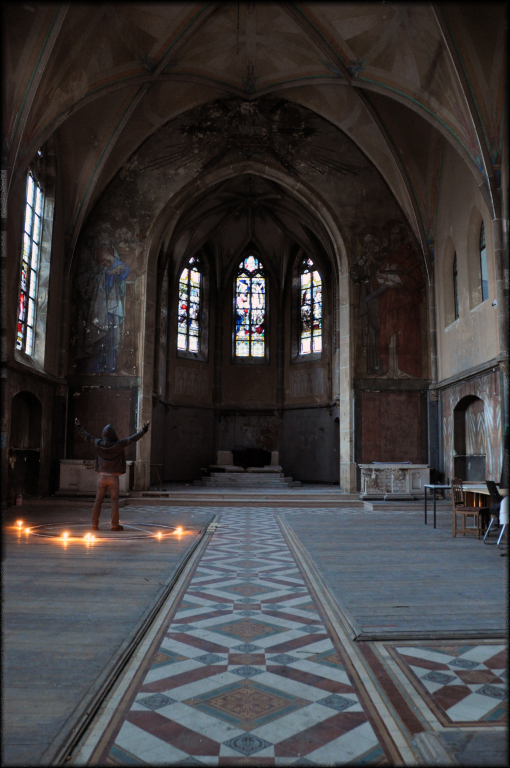
You are making two types of anthropological cinema. The first is  what you are calling a video article, such as in Urban Explorers: Quests of Myth, Mystery and Meaning, and the second is a participatory yet observational documentary on urban spelunking. The first are information-dense and interview-based, the second wandering handheld claustrophobia inducing visual documents. I have to admit the first is as yet too theoretical and the second is almost unwatchable. How are you going to reconcile these two voices, drives, tendencies?

Urban Explorers Quests for Myth, Mystery and Meaning was picked up early in its production by the Blackwell journal Geography Compass and was constructed as a sort of experiment in what visual geography could become (maybe in relation to visual anthropology which has been far more successful). Basically the idea is that it is a film and an academic article, so yes, blind peer reviewed, properly referenced and hopefully theoretical challenging, while at the same time using some visual techniques, such as cutaways, to get the message across in more visceral way. The tendency with urban exploration, because it is such a bodily activity, is that it tends to get undertheorized and overachieved. So I wanted to really sink my claws into it on the first run and try to get the theoretical gears turning around the practice. I think working this way will, in the end, produce a more effective movement and more respect for the practice.

In regard to your second thread there, I realized early on that when I was exploring I had little control over what I was shooting. When you are hiding from security, trying to get over a fence quickly or simply keeping yourself prepared to move fast should the need arise, you can’t have a huge camera on your shoulder and you can’t really shoot with much intention. In that way, it is a lot like citizen journalism in tough situations, shot when you can, however you can. So my footage is what it is, shitty, shaky handycam footage full of missed whispers and images of the back of people’s heads. But I think the nature of footage itself tells a story, it gives you a sense of how physically painful this work is; at times you can see the camera shaking with exhaustion and hear me panting, wrecked. The experience of exploration is sometimes nauseating and frustrating, why shouldn’t the record of it be as well?

As far as reconciling the two voices, I would love to be one of the few filmmakers out there that does not underestimate their audience. These voices are, in the end, the voices of ethnographic research and sometimes bridging the gap between research and life is difficult and painful. Think back to the classic ethnography Learning to Labour where Willis breaks the book into two sections because he can’t reconcile those voices. It still ends up being an evocative tale, perhaps in part because of that admission.

Maybe the strain will give the film something unique, a schizophrenicness that people who live their work will understand. I want this film to be more than entertaining, I want to take viewers on these journeys with us. I want theatres full of cynical intellectuals, confused and inspired students, rogue surrealists who snuck in through the back door and explorers who interrupt the screening by climbing the rigging to protest their misrepresentation. I want the film to inspire thoughtful action and a refuse to water it down intellectually or take out that horrible, shaky vomit inducing footage to that end. Whether or not those two voices are melded well, I intend to be brave enough to admit that they exist.

I was most excited about your research as a spring-board for criticism of deindustrialization in late capitalism. You followed this thread in your MA in underwater archaeology as you looked at the colonial technoscience behind the building of gigantic riverwide dams and their negative impact on Native Americans of California and Washington State. But as an interpretive archaeologist in the traditions of Chris Tilley and Michael Shanks, You seem more concerned with the poetics of place, the subjectivities of memory and memory loss, and the experience of adventure and abandon in abandoned localities. How are you going to discuss the history of the development of these spaces in terms of globalization, late-capitalism, deindustrialization, etc?

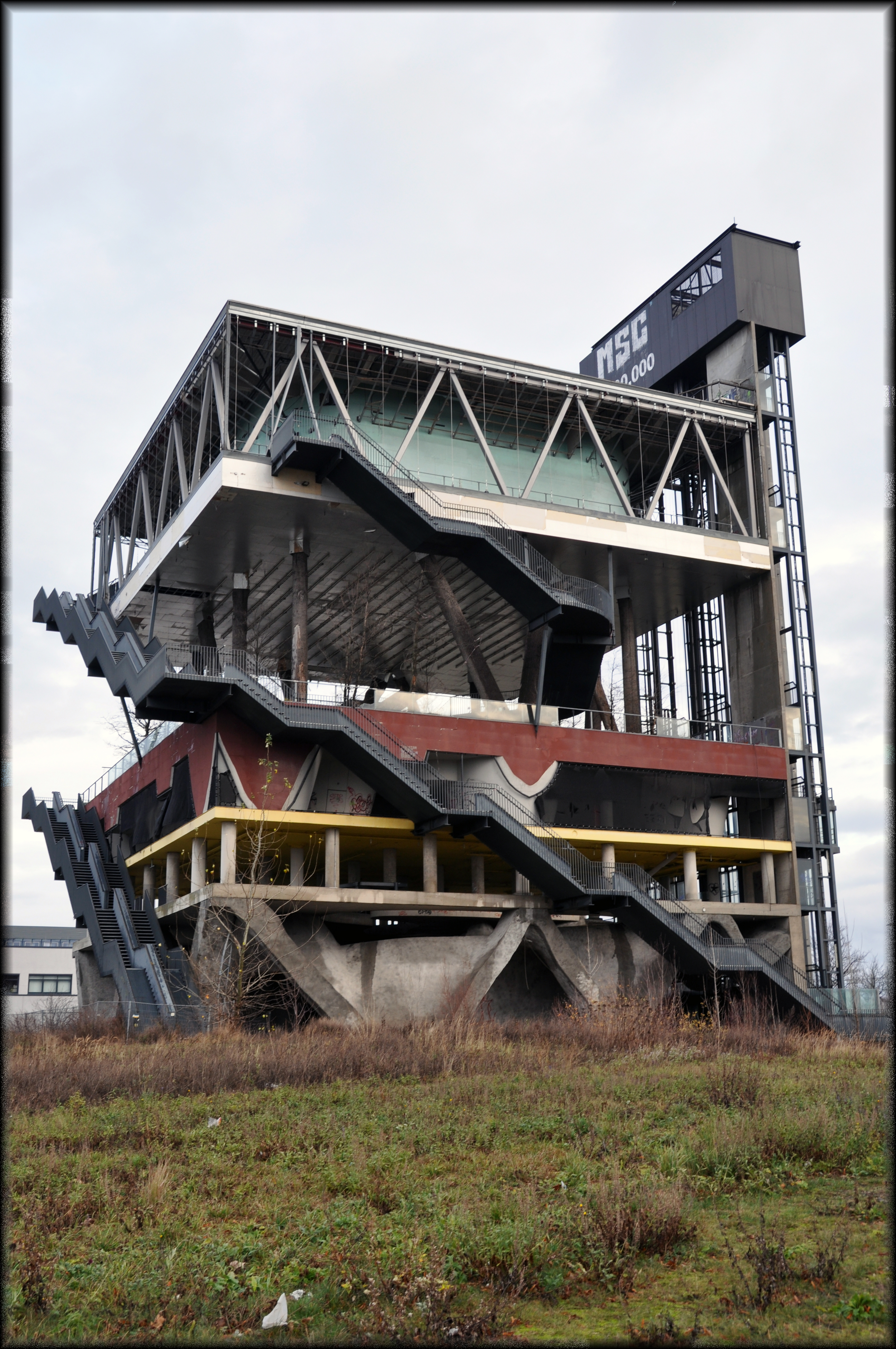
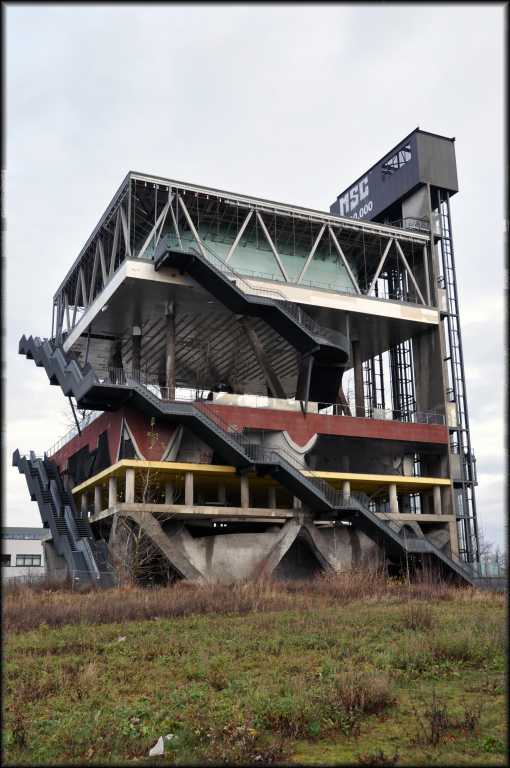
I do think that UrbEx is a wonderful lens for deconstructing the motivations, extravagances and failures of capitalism. A few weeks ago, we took a road trip to Germany to do some urban exploration around Berlin. On the way back, we stopped in Hanover to camp in a ruin that was left behind by the Netherlands government, part of the 2000 World Fair. As we pull up to this derelict building, Winch, one of the explorers on this road trip, says to us “Funny isn’t it? The theme of the 2000 World Fair was ‘a new world arising’, and the only things left behind from it are a few derelict buildings (the other one being a giant yellow structure we dubbed the “Lithuanian Party Box”).

So yeah, I see the failures of capitalism and industrialization all on an almost daily basis and I’ve read some brilliant work that has tried to reason through those issues. A collapse of a building is also a collapse of corporate power structure, of industrial social systems. The failed company town stands vacant, profits drained from the mine, workers dismissed from their homes and lives as a result. We poke the corpse, probing the last remnant of life there, the underpaid security guards left behind to limit insurance lawsuits.
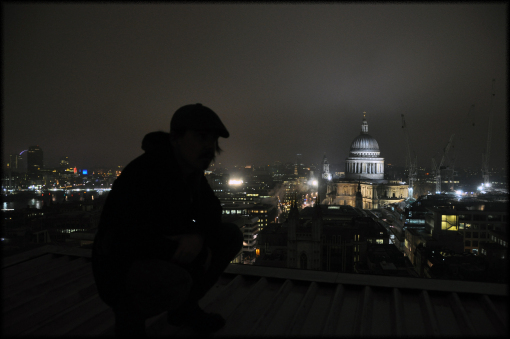
But, as you note, these are not the stories I go looking for necessarily. Geographers like Tim Cresswell, Caitlin DeSilvey, Tim Edensor, even David Harvey and Doreen Massey have written those stories. The stories that I find really enticing are not in the grand narratives but in the fine details. And out comes the archaeologist in me. Going through peoples belongings left behind, old pictures and letters to the family, imaging what lives were like before the industry was picked apart by packets or resource extinction, driving it into bankruptcy or obsoletion.

Walking through derelict mental asylums here in London, imagining the patients pacing the halls, and then visualizing the day that the nurses came in and said, “You have to call someone, find somewhere to go, Thatcher closed us down”. The grand narratives are there yes, they are the script, but I want to know how everyday people were affected, I want to encounter those “other” stories, I want to see the props and the set, not the script. And I think that is best done through experience, walking where they walked, using our geographical, cultural and sociological imaginations. If you look back to my earlier work that you mentioned, you will see that this is what I have always done, working with the local to inform the global, not the other way around. Sustainable change always starts from everyday experience, not governmental policy or cultural norms, just look at the recent failure at COP15 and compare it to what is happening in Iran at about the same time if you want an example of where real change begins. I like the idea of looking at the past to inform the present, not to increase our understanding of the past.

But apparently your informants do not do what they do for political reasons. They do not see their playful labor as a form of resistance. But isn’t one jobs of the anthropologist to aggregate the data and display the possible larger historical and cultural contexts for cultural activities? My argument would be, whether they like it or not their work has political implications.

Okay look, I read de Certeau too, I know that there are political implications in even the most seemingly mundane of practices. Most people, urban explorers included, would agree as well, but find it utterly stressful, and ultimately futile, to try and politicize this playful work every time we go out. So yes, I do see it as my job to be the one who looks past the experiences and starts drawing conclusions about our motivations, passions and actions, even though some of the people I work with find this frustrating. There are a lot of angles you could attempt to do that from.

One might be to look back to Deleuze and Guattari, to their concept of smooth/striated city space, to see urban exploration as a method of melding striations, collapsing the haptic and the optic, bringing deeper meaning to the spectacle. You could see this as a method of taking ourselves off the “grid”, at least temporarily, in an attempt to give ourselves the physical and mental space for freedom of expression. You could also tie this last idea into an existentialist narrative, something about the need to express our intrinsic freedoms, to prove to ourselves, and the world, that the control is in our hands, despite everyone’s constant moaning about how are basic freedoms are constantly being violated. You are the only one who can violate your freedom and we prove day after day that we can get into any place we want to, despite the omnipresence of CCTV, despite their mountains of barbed wire and signage warning of our impending doom should we cross the imaginary boundaries they have established. And we like the game, we don’t want them to stop trying. That is where the politics get really interesting, and where I want to focus most of my thesis. I often think about Nietzsche saying that the truly free spirited will not agitate for the rules to be dropped or even reformed, since it is only by breaking the rules that one realizes their power.

You mentioned the illegality of the activity. In fact, we don’t break into anything. We find creative ways into buildings that allow us to subvert the illusion of spatial exclusion (much like the famous London Mayfair squatters or Da! Art collective that have been in the news recently). As a result, we are in fact breaking no law. Confrontations with security guards are hilarious when you render them inept through superior knowledge of the law they are supposedly paid to enforce, explaining to them calmly that you didn’t break or enter anything and if they touch you it will be considered assault, peacefully walking off site and dancing all the way home. There’s a tactic of the weak for de Certeau.

There is a tradition in anthropology to have key informants. It seems you have a few. There is also a tradition in anthropology of acknowledging the influence we have on our informants. But it also seems that your presence in the urban exploration culture has galvanized the culture itself. Your filmmaking inspired the culture to do more of their cultural thing. It frankly seems that you are creating this culture. The ad-fab adage: ‘make it to break it’ applies I think in your case.


28 Days Later, The Urban Exploration Resource, Ninjalicious and Infiltration existed long before me. What appears to be the “creation” moment of UrbEx is actually just when it went global, with the help of the internet, like so many other movements. The community now consists of tens of thousands of people all over the globe, in countless internet forums, taking millions of pictures of abandoned places and infiltrated spaces every year. I mean, google urban exploration man, you get well over 2 million results. The thing about the movement, and what necessitates my going this deep into it, indeed getting lost in it over the course of my PhD, is that it is still, for the most part, a secret community. We have public forums, private forums, unlisted forums and a lot of people suspicious of technology altogether that not even online involved. Many of the most interesting places explored will never be publically aired; the people who did those explorations will want to keep it local. I think that is one of things that makes this community interesting, its specificity to place and dedication to the practice, without ego-driven expectation of reward. Unlike, ahem, people making ethnographic films.
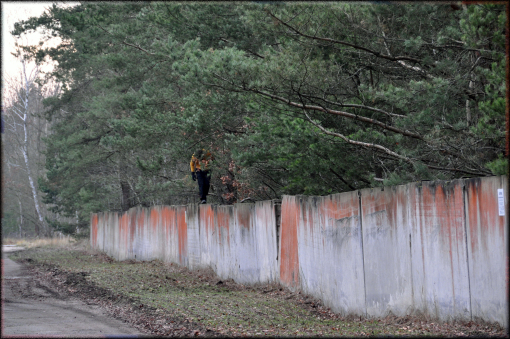
I want to think about serious games and the class of your urban exploring informants. From your documentaries I can see that your informants are all rather technologically-equipped Caucasians with enough leisure time to devote to this past time. The stakes for success or failure in this serious game are not life or death, but pleasure or pain. Now, I know that games are not just ludic past times but impact serious life. But how do you make me the reader or film viewer engage with your work without dismissing it as bourgeois tourism? It seems to me that you have to drop the phenomenology of loss, memory, and dereliction and maximize the issue of deindustrialization.

I have over 40 people involved in my research now, from a range of backgrounds. Women, working class people, people with corporate jobs, individuals from a range of ethnic and cultural backgrounds. When we travel, we meet explorers in every country we go to. This is not a class thing and it is not about leisure time, in fact the majority of the explorers I work with have full time jobs. They just choose to spend their weekends and time off of work exploring landscapes than sitting in front of a television or drinking at the pub. I respect them for that. And to be fair, they tell me I am the bourgeois tourist, the only one getting paid to this. I mean, what is more decadent than getting paid to theorize other people’s existence Adam?

The technology fetish though I won’t deny. Urban exploration seems to be inexorably attached to photography. I can think of a few reasons for this. One is that ruins are simply aesthetically pleasing in a way that takes time to digest. So we walk slowly, we take pictures and meditate on them. These places are also in a state of constant mutation, the natural state of order when human being are not there to regulate it, and since we do not want to impact places, photography becomes a means of halting the mutation. We can freeze it; though we have no intention of stopping or slowing it’s mutation, we don’t want to arrest this decay. This slippage in these places something we can grab, but not something we can hold in place. Thinking back to Shanks and Pearson, to archaeology as theatre, or to David Seamans place-ballets, we have the ability to lock ourselves into a physical courtship with place, a moment in time when body and landscape intermingle. We are in love with the ugly girl in class, the places that was ignored until we pulled out the camera and told them to look sexy. And I would argue that this excitement about encounters with the dereliction of the contemporary past is exactly what will get anthropologists to turn their attention to the industrial era, now largely ignored and under threat of physical erasure in the wake of “deindustialization”, urban “regeneration” and gentrification. Which leads me to my last point, one that it’s easy for an archaeologist to see – we are preserving points in time through photography and video. We are creating historic record.

I recently gave a paper at the Theoretical Archaeology Group (TAG) conference in Durham in a session called reanimating industrial spaces. After my talk, one archaeologist mentioned that she used urban exploration forums frequently to collect information about a site’s passage through time. We are local historians, amateur archaeologists, bodhisattvas of a forgotten past. And we do a damn good job at it! That is not about class, it is about passion for place and a lust for unbridled experience. This is but one expression of prevalent human desire, see it in other urban subversions like skateboarding, parkour, flash mobs and graffiti.

Although I am going on a bit here, let me address your insistence on “deindustrialization”. We don’t want to deindustrialize anything. I love industry, I love industrial ruins. I love construction sites and archaeological ruins equally. I love capitalism and I love laughing at its failures. The same goes for communism. You want to see some real ruined landscapes? Go to a failed communist state; when we were in East Germany, we were almost in tears, there are more ruins than live buildings! The whole thing is like some sick cosmic joke and we are the punchline.
More seriously though, I am concerned that by treating the industrial era as a tainted age, we disrespect those who built and lived that age. Recognize that they were doing their best, just as we are. Again, step away from that big picture and put down that broad-stroke brush, find that those memories on the ground, the years spent on the factory floor, bring tears of joy as often as tears of sadness, just as they do for us. The capitalistic plastic skins on these architectural carcasses begin to peel back, exposed to caustic elements, to reveal a skeleton of rust, cogs, switches, dials, circuit boards and mouldy pieces of paper outlining modes of production, things to remember, forgotten Polaroids and birthday cards to the family. It’s all in there, a little package of life. And when we pass through these places, we tap into those stories and weave them into our own. This is the embodied subjective.

I refused to be ruled by fear; I will only be motivated by positivity and freedom. This is not to say I want to overromanticize the past, but that I want to make the most out of this present that I can. Life should be more than deconstruction and analysis. I can unpack my experiences and feeling about the practice, but more importantly, those experiences are creating, constructing and reinforcing brave personalities, free spirits, databases of knowledge and memory, a collective consciousness of ecstatic phenomenological wonder, of playful work that speaks volumes about culture. Industrial ruins are decaying but they’re not dead, they are landscapes filled with possibilities of wondrous adventure, peripatetic playfulness and artistic potential.

If you fall down a Parisian catacomb tomorrow, never to be seen again, what will 1) scholarship miss 2) the non-academic world miss. Meaning: what is the big contribution of your work?

Look brother if I die and don’t finish these tales of urban exploration, here are the threads, please finish it for me! Urban exploration is about experience, expression, love and creation. It is a rare instance (especially in western society today) of human beings physically going out to challenge space, to challenge control, to assert their rights to place, their rights to the city, their rights to participate in the creation of historic narratives and cultural identities. This topic is vital to our understanding of the contemporary human condition. It is so temporally and politically relevant that it threatens to implode under it’s own philosophical weight. Urban exploration is existentially reactionary, pushing against alienation, suppression, bureaucracy and overregulated existence. But it is also ecstatically playful, and by playfully pushing the boundaries of what is possible, by putting ourselves in potential danger to assert those rights, we live Hunter S. Thompson’s edgework. At play, at work, in danger, loving, bonding, challenging, and laughing, free and unrestrained, we are at our best.

What we are doing is not supposed to be possible. Most people on the anonymous city streets don’t have their gazes honed to see what we see. We are mutants, neo-sapiens. We declare that the idea of no limits to the human imagination is old news. Now we want to know the limits of human imagination physically manifested in resistance to social and cultural norms. We want to know how much bullshit we have been fed. And the sparks that come out of those clashes will give birth to new forms of being, new realms of experience. Those little beautiful demonic creations will live far longer than us.

Maps are an abstraction Adam, they are a utopic representation of nationalistic and ideological power structures which do not have a 1:1 ratio with the earth’s surface. Therefore, as Hakim Bey tells us, we have the opportunity to get into those cracks in the structure and to create Temporary Autonomous Zones of political, social and cultural insurrection. And I use that term consciously. We do not want revolution, we want to create alternative spectacles (following Debord) that are just as superfluous but that, none-the-less, cause re-analysis, confrontation and confusion. We want you to keep hitting the refresh button to see what happens next. If we are successful in realizing our personal visions, our spectacles are composed of more experience and less simulacra than those of the state, nation or culture but are just as stupid.

This is why I call us place hackers. We are the physical manifestation of the internet pirate. We are the TAZ. We have the corporeal skills of thieves amalgamated with minds molded by an internet ethos of taking what we want, when we want it. We don’t care if corporate control exists, but we assert our right to challenge or ignore it. Virtual hacking is cool but place hacking makes it core again, brachiating across scaffolding to get the shot on your Digital SLR that maximizes your flickr stats, raking in the google adsense cash and conforming to a zerowork ethos if we get pro at it. Sleep in ruins, sell your photos of disgusting shit to tourists. Rinse off in a petrol station sink and repeat. We are the nerds that finally walked away from their computers and we are behind that scaffolding covering the building you ignore everyday when you walk by it going to work, we just loved on that place like no one has in 20 years. We are psychotopological terrorists and we will shove that masterlock up your ass.

How could my interests in contemporary corporate space, networked virtual organization, and new media social activism interlace with your work?

I was talking to one of my project participants the other day while walking through a ruin that had closed down in 2003, the “newest” I had ever explored, about what will be explored from the information age. Will we find interest in exploring empty glass postmodern shells of low blue office carpet; will we photograph the little marks in the carpet where the cubicle separators used to be and get all giddy? Will we find old hard drives and hook them up marveling at the novelty of “cables” to see what was on them, infiltrating people’s left behind lives through virtual exploration? Perhaps. Certainly our children will find those places as weirdly exotic as we find the derelict art deco swimming pool. And so the torch will be passed, challenging them to find their own meaning in those remnants. I don’t know if the intersections between the past and the future have yet met in the present. Perhaps that is what we are looking for. Perhaps we could invoke that spectre.



Using Formal Debates in the Classroom

I was wondering if any of our readers have any experience using formal debates in the classroom? I had this crazy idea that I’d have the students in my graduate cultural theory seminar conduct a formal debate in character as the various scholars we are are reading (e.g. Marx, Weber, Durkheim). It seems like it might be a fun experiment, and would help me accomplish one of my goals for the class, which is to get students to try to deal with the texts in their own terms, rather than relying on contemporary critiques. However, I was never on a debating team in school and have very little experience with the rules and practices of formal debates – not to mention using such debates as a teaching tool. Nor have my students. So I was wondering if anyone out there might have some suggestions?

Another motivation for doing this is that I hate survey courses. I love teaching theory, but I prefer to do it around a coherent set of questions motivated by a research topic, or by undertaking a semester-long close-reading of a single scholar’s work. However, the syllabus for this class is set by committee and it isn’t easy to make more than superficial changes in the content (i.e. substituting one book for another on a similar topic, or changing the order of the readings). That means that it the class tends to lurch around from week to week as we jump from one scholar to the next. My thought was that a series of debates like this (one at midterm, and another at finals) might help bring together some of the disparate readings into a more focused discussion. That’s the hope anyway. We’ll see how it turns out in practice!

UPDATE: I should add that one reason for using “formal” debating, with rules, as opposed to other forms of debate/discussion, is that, in my experience, Taiwanese students are extremely reluctant to argue strongly in public for views which differ from those from their peers. This may be true of all students, but in my experience it is much more pronounced here in Taiwan than it was among my students in the US. (Although that may just be because of my own ignorance as to the social norms regarding how such discussions should be conducted.) It is my hope that giving them both roles (a specific scholar we have studied), as well as rules will facilitate a more lively discussion than we might have otherwise.

The Sideways Glance

Tim Ingold’s 2008 Radcliff-Brown lecture “Anthropology is Not Ethnography” has been mentioned on this blog several times since John Postill posted links to both the full text [PDF] and edited versions of the talk. I finally had a chance to sit down and read it and found it thought provoking enough to deserve its own post. In what follows I will first summarize his arguments as I understand them, and then raise some questions which I hope will provoke further discussion in the comments.

First off, the title is somewhat misleading. Ingold’s purpose is not to distinguish anthropology from ethnography, but to criticize the “the idea of a one-way progression from ethnography to anthropology” in which methodological rigor precedes theoretical generalization. The title really should read: “Anthropological reasoning is not inductive, but dialectical.” He wants to challenge the dichotomy which places ethnographic description on the one side and anthropological theorizing on the other.

We can still recognise today the figure of the ‘social theorist’, sunk in his armchair or more likely peering from behind his computer screen, who presumes to be qualified, by virtue of his standing as an intellectual, to pronounce upon the ways of a world with which he involves himself as little as possible, preferring to interrogate the works of others of his kind. At the other extreme is the lowly ‘ethnographic researcher’, tasked with undertaking structured and semi-structured interviews with a selected sample of informants and analysing their contents with an appropriate software package, who is convinced that the data he collects are ethnographic simply because they are qualitative. These figures are the fossils of an outmoded distinction between empirical data collection and abstract theoretical speculation, and I hope we can all agree that there is no room for either in anthropology.

Against this he juxtaposes a view of anthropology as a craft (a view which Rex has elaborated in a series of posts on this blog).

For it is characteristic of craft that both the practitioner’s knowledge of things, and what he does to them, are grounded in intensive, respectful and intimate relations with the tools and materials of his trade. Indeed, anthropologists have long liked to see themselves as craftsmen among social scientists, priding themselves on the quality of their handiwork by contrast to the mass-produced goods of industrial data-processing turned out by sociologists and others.

As I understand it, the emphasis on craftsmanship is an effort to shift the focus from the tools of the trade — qualitative data collection techniques — to the ethnographer herself. The ethnographer is a researcher who has cultivated in herself an “anthropological attitude”:

The endeavour is essentially comparative, but what it compares are not bounded objects or entities but ways of being. It is the constant awareness of alternative ways of being, and of the ever-present possibility of ‘flipping’ from one to another, that defines the anthropological attitude. It lies in what I would call the ‘sideways glance’.

He defines this “sideways glance” as “a practice of observation grounded in participatory dialog.” Through the course of this dialog anthropologists swing back and forth like a pendulum between anthropological theorizing and ethnographic description.

Continue reading

Towards an Ontological Anthropology

I recently read Thinking Through Things: Theorising Artefacts Ethnographically, a volume edited by Amiria Henare, Martin Holbraad, and Sari Wastell. The manifesto of the volume, as presented in the introduction, is:

Rather than dismiss informants’ accounts as imaginative ‘interpretations’ – elaborate metaphorical accounts of a reality that is already given – anthropologists might instead seize on these engagements as opportunities from which novel theoretical understandings can emerge.

The editors, in the introduction, present a methodological framework that would do the job that the they set out for the volume. They first suggest that ethnographers have to do away with a priori distinction between persons and things; even hybridity as a concept would not do, because there is already an implicit ‘presumption of an initial separation.’ Instead, they want to ethnographers to ‘take “things” encountered in the field as they present themselves, rather than immediately assuming that they signify, represent, or stand for something else’.

They have Bruno Latour, Alfred Gell, Marilyn Strathern, Eduardo Vivieros de Castro and Roy Wagner as precursors. What they find most appealing in the works of these authors is the move they have been making from an epistemological anthropology towards an ontological anthropology, and they have been doing this by simply taking the perspective of their informants into account. Only that these authors, they have not taken their informants’ actions into account in order to ‘explain’ them away; they have accepted the categories – or the absence of any categories – that their informants provided, and followed them wherever they led. One central point they make, following from an urge to move from epistemological to ontological studies, is that epistemology provides what they term worldviews – different ways of ‘knowing’ the world, different ‘cultural perspectives’ or ‘beliefs’. They would want studies that are about ‘worlds’  and not ‘worldviews’. The statement on the way this is achieved is long, but I think it deserves to be quoted in full.

We start with the ordinary (representationist/epistemological) assumption that concepts are the site of difference. Then we argue that in order for difference to be taken seriously (as ‘alterity’), the assumption that concepts are ontologically distinct from the things to which they are ordinarily said to ‘refer’ must be discarded. From this follows that alterity can quite properly be thought of as a property of things – things, that is, which are concepts as much as they appear to us as ‘material’ or ‘physical’ entities. Hence the first answer to the incredulous question of where ‘different worlds’ might be, is here, in front of us, in the things themselves (things like powder or – as we’ll see in the contributions to this book – photographs, legal documents, shamanic costumes, cigarettes, and so on). So this is a method of ‘back to the things themselves’ as the phenomenologists had it, but only with the caveat that this is not because the ‘life-world’ of our experience of things has priority over a ‘theoretical attitude’ […] but precisely because our experience of things, if you will, can be conceptual (p 13).

A review of the book by Daniel Miller is available here.

My Interest in Things

Thanks Kerim!

Like Kerim wrote in the post introducing me, my ongoing dissertation is on the trade in second-hand clothing. I am trying to tease out the relations that surround the trade as it moves from the United Kingdom to Nigeria through Benin, and I am trying to deal with the pieces of clothing as what they are wherever they are. This in effect means dealing with what are at some point described as gifts (at least that is how the ‘donors’ of second-hand clothes describe what they drop in clothes banks) at other points as commodities, fundraising tool, a source of livelihood etc. Of course, Appadurai’s Social Life of Things, and Kopytoff’s cultural Biography of Things lend themselves as a framework for approaching things of this nature. The Social Life of Things was a groundbreaking work. Read what James Ferguson wrote about it in a review article:

But following the last decade’s preoccupation in anthropology with production […] on the one hand, and consumption […] on the other, Appadurai’s approach to commodities as “objects in motion” has the feel of a new departure, even while appearing at the same time as a kind of homecoming.

In short, what it did was to put culture back in the analyses of things. Ferguson writes further:

The key claim here is not that things are “social” but that they have lives; the suggestion is that the social dimension of things can be narratively approached through the conventions not only of traditional historical exposition, but through that venerable anthropological device, “life history”.

That was really groundbreaking in so many ways, and thinking about it as I am writing this, I don’t see any reason why that should not be enough for studying the trade in second-hand clothing. Save for the fact that, as a friend noted, writing a doctoral dissertation is as if one were producing an affirmation of ones existence – an affirmation that needs to be underscored by the discovery of something original. In this case, I suppose that it is not as much a desire to discover something original as it is a desire to do as much theoretical exploration as possible (although I know that I would not live up to this expection). There, of course, have to be some more recent anthropological theorising on commodities in particular and things in general so why settle for a framework from 1986?

The product of that question is what I will be blogging about during my period as a Savage Minds guest blogger. I am currently digging into the literature on commodities and things, since I see commodities as a form of things (see Keith Hart’s explication of Marx’s conceptualisation of commodities as resulting from a historical dialectic). I will be sharing and discussing some of the stuffs I read. It is an ongoing process so I welcome suggestions on where to look and what to look at.

Jacques Lacaniki

Most days, the INTERNET depresses me. But sometimes I see things which give me hope. Today, No Subject, the Jacques Lacan Wiki, did that for me. It is remarkably detailed. Of course, I haven’t thought about Lacan for over a decade, so it may actually suck, but if it did it would still be amazing. Enjoy your symptom.

La Revue du M.A.U.S.S.

A little over a year ago I linked to a few pieces which explored Durkheim’s vision of “communism.” I’d like to follow that up with two pieces I found recently which touch on the socialist leanings of his nephew, Mauss . Both are by professors at Goldsmiths, in London. The first, published in In These Times, is by David Graeber, and deals directly with Mauss’ politics:

By all accounts, though, Mauss was never taken completely seriously in his role of heir apparent; a man of extraordinary erudition (he knew at least a dozen languages, including Sanskrit, Maori and classical Arabic), he still, somehow, lacked the gravity expected of a grand professeur. A former amateur boxer, he was a burly man with a playful, rather silly manner, the sort of person always juggling a dozen brilliant ideas rather than building great philosophical systems. He spent his life working on at least five different books (on prayer, on nationalism, on the origins of money, etc.), none of which he ever finished. Still, he succeeded in training a new generation of sociologists and inventing French anthropology more or less single-handedly, as well as in publishing a series of extraordinarily innovative essays, just about each one of which has generated an entirely new body of social theory all by itself.

Mauss was also a revolutionary socialist. From his student days on he was a regular contributor to the left press, and remained most of his life an active member of the French cooperative movement. He founded and for many years helped run a consumer co-op in Paris; and was often sent on missions to make contact with the movement in other countries (for which purpose he spent time in Russia after the revolution). Mauss was not a Marxist, though. His socialism was more in the tradition of Robert Owen or Pierre-Joseph Proudhon: He considered Communists and Social Democrats to be equally misguided in believing that society could be transformed primarily through government action. Rather, the role of government, he felt, was to provide the legal framework for a socialism that had to be built from the ground up, by creating alternative institutions.

Continue reading

Islands of Friction Mashup

This semester I am working on finishing my book manuscript, which deals with issues raised by Anna Tsing and Marshall Sahlins… or rather the same issue… raised by both of them… In taking notes for the second chapter I thought it would be fun to write a blog demonstrating the way that Tsing’s “highly original perspective” (as the back of the book describes it) repeats in just slightly different phraseology what Sahlins argued twenty years earlier. As the notes accumulated, however, I found that the passages formed a continuous narrative, rather than a set of quotes capable of being contrasted. So here is a selection of their work, alternating between Friction and Islands of History. Can you tell the difference? I suspect stylistically they are distinguishable, even though the content is quite similar. I bet if I had a copy of Anahulu to hand I could get the language about capitalism to fit even closer.

Here we go:

“Universals are effective within particular historical conjunctures that give them content and force. We might specify this conjunctural feature of universals in practice by speaking of engagement. Engage universals travel across difference and are charged and changed by their travels. Through friction, universals become practically effective. Yet they can never fulfill their promises of universality. Even in transcending localities, they don’t take over the world. They are limited by the practical necessity of mobilizing adherents. Engaged universals must convince us to pay attention to them. All universals are engaged when considered as practical projects accomplished in a heterogenous world.

In the historical particularity of global connections, domination and discipline come into their own, but not always in the forms laid out by their proponents. The empirical realities in all their particularities can never live up to the myth. In action, people put their concepts and categories into ostensive relations to the world. Having its own properties, the world may then prove intractable. It can well defy the concepts that are indexed to it. Man’s symbolic hubris becomes a great gamble played with empirical realities.

The gamble is that referential action, by placing a priori concepts in correspondence with external objects, will imply some unforseen effects which cannot be ignored. Culture are continually co-produced in the interactions I call “friction”: the awkward, unequal, unstable, and creative qualities of interconnection across difference. We have seen that such “working disagreements” may entail some arrangement of conflicting intentions and interpretations, even as the meaningful relationships so established conflict with established relationships. My goal is to grasp the productive moment of this misunderstanding. Cultural forms are persistent but unpredictable effects of global encounters across difference, and I stress the importance of cross-cultural and long-distance encounters in forming everything we know as culture — a confrontation of cultures affords a privileged occasion for seeing very common types of historical chance en clair. In this generative unfolding, the basic concepts are taken through successive stages of combination and recombination, along the way producing novel and synthetic terms.”

The end of the connoisseur?

I enjoyed Rex’s post about anthropology as connoisseurship, and have been thinking about it a lot. Then today, during the Remixing Anthropology session, Eric Kansa talked about how centralized search services, like Google, are eroding the power and authority of traditional information service providers. He used the tourism industry as an example, highlighting how efforts to control the staging of local culture are undermined by web 2.0 technologies, but I also saw this as a threat to the role of the anthropologist as connoisseur.

Anthropologists traditionally deployed their authority as connoisseurs to shape and contextualize the context within which “we” learned about and encountered “other” cultures. Hell, we even had a role defining how people learned about and encountered anthropological knowledge. But now that carefully cultivated connoisseurship is becoming less and less important as Google algorithms and Web 2.0 recommendation engines become the primary gateways. Sure, to the extent that anthropologists are indexed in Google their authority is still important, but the first hit for a topic might be a corporate site who understand better how to game the system with search engine optimization (SEO).

Of course, it might not be a bad thing if a website run by an indigenous community can outrank anthropologists on google. There is something democratizing about the shift, which allows the producers of culture to outrank the connoisseurs. But, as Eric pointed out, there is something disturbing about the fact that these algorithms are a black box whose rules are determined by a corporate monopoly. How’s wikia search coming along?

Anthropology as connoisseurship

Why don’t we think of anthropology as a form of connoisseurship any more? Is it because the word is simply to embarrassingly difficult to spell? Is it because connoisseurship has been written off in our discipline as exoticizing or objectifying? I personally think that anthropology as a form of connoisseurship is key understanding anthropology’s particularistic, idiographic approach. From Boas’s insistence on the particular to Levi-Strauss’s assimilation of the Boasian impulse to his own art connoisseurship, geeky obsession with the details has been central to our discipline. (I’d even add something about the British culture of quirky amateur enthusiasms that produced “The History and Social Influence of the Potato” but I’m afraid I don’t quite have it pegged). Connoisseurship as a process of cultivation is also about personal transformation — turning into someone who has ‘learned how to look,’ as art history textbook has it.

But somehow along the way I feel this sense of ethnographic connoisseurship has been lost in anthropology — the facts became taken for granted, perhaps, or maybe we just got freaked out about the way the metaphor of connoisseurship assumes we are consumers of art produced artists who are separate (and exploited?) by us. Obsession with the details also does not fly well in an age when what we are supposed to be doing is creating generalizing social science. So perhaps connoisseurship as a model of anthropology has drawbacks both for the politically engaged and the scientifically neutral. Still, I think we should try giving it a run for its money again.

Any takers?

Erin O’Connor on glassblowing

I recently gave a “big thumbs up to Richard Sennett’s book The Craftsman“:/2008/06/24/warcraft-and-the-craftsman-grinding-crafting-and-craft/ and have also been thinking about “anthropology as personal transformation”:/2008/07/28/anthropology-as-personal-transformation/. In his book Sennett gives major kudos to the work of Erin O’Connor, a grad student who is writing on embodied knowledge amongst glassblowers. O’Connor doesn’t appear to be done with her Ph.D. yet, but she has published “two”:http://www3.interscience.wiley.com/journal/117976136/abstract?CRETRY=1&SRETRY=0 “articles”:http://www.springerlink.com/content/b46g746817566x7p/ on how people learn to blow glass (there is also an open access “draft”:http://www.nyu.edu/projects/nylon/nylonoconnor.pdf of another paper as well).

O’Connor’s work is, in my opinion, absolutely fantastic. Although my embodied knowledge mostly comes from the performing arts (where my only ‘tool’ is my body) her mix of personal reflection, close description of glassblowing, and close reading of Polanyi (Michael) and Bourdieu rings very, very true to me. More to the point, however, they are also very much about personal transformation. Although O’Connor interviews people, reports what they say, and describes the glassblowing shope where she works, it is clear that she is exhibit A — the work is above all about what she has learned, how she learned it, and the subjective experience of being caught in the process of creation.
Continue reading

Said and Geertz

Edward Said and Clifford Geertz are not normally considered together as theorists as far as I know, and yet rereading both this semester I was struck by the similarities between them. They wrote at more or less the same time. They were both interested in literature. Neither were ashamed to write well. Despite their differences they seemed to share an tangible but elusive property that we’ve discussed on this blog before — they were both ‘evocative’ or ‘inspiring’.

Both opened up imaginative horizons for those who read them, not the least because they demonstrated the way that abstract theory such as the work of Foucault (Said) or Ricoeur (Geertz) could be applied ‘on the ground’ as it were. At yet at the same time neither of them were expositors of the philosophers who they drew on — they did not dryly draw out what a ‘Ricoeurian’ anthropology must look like in order to earn the ‘Ricoeur’ brand. At the same time, and despite the claims sometimes made of them (Geertz in particular), much of their work did not actually have a complex, articulated logic that articulated with high theory. Throughout the course of both careers, each author picked up different theorists, took bits and pieces that ‘did work’ for them, and moved on — a method of ‘doing theory’ that is perhaps still with us today.

Said and Geertz, I suggest, inspired because what we saw at work was their own personal visions — visions which we could then adopt and use in our own work. They didn’t have methodologies, research programs, formalized findings, they had a style of working with the data which was uniquely their own and yet resonated broadly with us. We could image how each would write if they wrote about ‘our’ topics.

At the same time, both authors are inimitable. Which is not to say that people have not tried. But imitations of Said and Geertz tend not to be successful — you don’t have to do anthropology too long before you run into “X as a cultural system” essay which doesn’t end up saying much at all. And the Saidian variant, “denunciation by numbers”, where the purpose of the analysis is to demonstrate how someone in the world has committed acts from the approved lists of sins (orientalism, denial of coevalness, and so forth) is just as unenlightening.

So in fact I would argue that Said and Geertz have quite a lot in common because they owe much of their intellectual notoriety to a similar structure of research — vague but inspiring, theoretically suggestive, they were masters of evocation whose influence is best felt not in an established program but in their ability to enable scholars to develop their own vision. Of course, they were not only evocative. But for me they are worth considering as a pair and as paradigms of how inspiration can be parlayed into long-lasting influence in a field.