Tag Archives: Race, genetics

Anthropology Against Its Subjects

David Price reports in “Counterpunch” on a 1943 OSS (the precursor to the CIA) document he discovered entitled “Preliminary Report on Japanese Anthropology” , a compilation of anthropological research into racial and/or cultural characteristics of the Japanese that could be “weaponized”. The report verges on the genocidal in its cold, detached consideration of means of destroying the Japanese:

The report considered a series of Japanese physical and cultural characteristics to determine if weapons could be designed to exploit any identifiable unique “racial” features. The study examined Japanese anatomical and structural features, Japanese physiological traits, Japanese susceptibility to diseases, and possible weaknesses in Japanese constitution or “nutritional weaknesses.” The OSS instructed the anthropologists and other advisors to try to conceive ways that any detectable differences could be used in the development of weapons, but they were cautioned to consider this issue “in a-moral and non-ethical terms,” with an understanding that, “if any of the suggestions contained herein are considered for action, all moral and ethical implications will be carefully studied.”

Although Ralph Linton and Harry Shapiro objected to these instructions, others — including Clyde Kluckhohn and Ernest Hooten — embraced the project, examining cultural traits like food production as well as “racial” traits like “inner ears morphologies, taste bud densities, laryngeal musculatures, intestinal lengths, and arterial systems”. In the end, little of use was turned up — a slight proclivity for respiratory infections led the anthropologists involved to recommend using anthrax as a weapon, the importance of rice in the Japanese diet and the short viability of stored rice led to recommendations aimed at the destruction of the agricultural system — and the project seems to have been abandoned. But, Price asks, “what recommendations would have been made if significant characteristics had been isolated”? And more to the point, for me: can anthropologists afford to defer the moral and ethical implications of their (our) work, trusting that such implications will be “carefully studied” by others down the line?

Ancient People: We are All Modern Now

The oldest cliché in the book, guaranteed to be found in any newspaper article or TV show about indigenous peoples, is the moniker “ancient people” (sometimes “ancient tribe” or “ancient tribal people”, etc.)

What is an “ancient people”?

The idea, I suppose, is that their current practices, social structure, and way of life has remained unchanged for centuries. It is a nice fantasy, but it is almost never true. Further investigation invariably reveals a history of constant change. These include changes that come from the dynamics of so-called “traditional” ways of life, including warfare with neighboring groups, the constant invention of new traditions, changes in food supply, and migration to new ecological environs. It also includes exogenous factors, such as invading armies, trade with other groups, colonialism, and incorporation into the global economy. Often these changes (including incorporation into the global economy) happened a century ago. So long ago that the younger generations have never known any other way of life.

In some extreme cases, the group itself might be a product of colonialism. As Mamdani documents in Citizen and Subject, many so-called “tribes” were invented by European’s in order to simplify colonial administration of rural areas. Fluid and even democratic indigenous practices were replaced with the creation of a tribal “chief” answerable only to colonial authorities – a despot.
Continue reading

Golf at Sundown: Segregation in America

Recently the Washington Post reviewed sociologist James Loewen’s Sundown Towns, a new book which looks at the hidden history of towns throughout America which have historically used violence and intimidation to maintain their ethnic homogeneity. For example,

Loewen charts the course of segregation in Wyandotte, Mich.: In the early 1870s, whites there drove out a black barber; in 1881 and 1888, they expelled the town’s black hotel workers; in 1907, four white men beat and robbed a black man at the train station; nine years later, a mob of white townspeople “bombarded” a boardinghouse, driving out all the African Americans and killing one. “In the 1940s,” Loewen writes, “police arrested or warned African Americans for ‘loitering suspiciously in the business district’ or being in the park, and white children stoned African American children in front of Roosevelt High School.” In the early 1950s, a University of Pennsylvania professor who grew up in Wyandotte told him, all the members of a black family who moved into town ended up dead.

Loewen claims to have “personally verified the existence of roughly 1,000 sundown towns between 1890 and 1930,” and estimates that the number could be anywhere between three and fifteen times that number.
Continue reading

Acting Like a Thief

Since I became involved with India’s Denotified Tribes, or DNTs, I’ve been trying to encourage anthropologists to study them. There is have been some good writings about DNTs, but the literature is still relatively sparse. Almost all of it is historical, with very little in the way of contemporary ethnography.

So I’m proud to announce the release of Acting Like a Thief! A short documentary film I shot and co-produced with Shashwati, who did an amazing job editing it.

Acting Like a Thief
We are releasing the film as a free BitTorrent download for all those tech-savvy people (the less tech-savvy can get a DVD for a $50 donation to our next project). I hope that this short piece will help raise awareness about DNTs and maybe even encourage some grad students who are still thinking about what they might like to research for their dissertation. If you think you might like to do such research, please contact me and I can help arrange some introductions.

Native American Ethnic Anxiety Part Two: Black Indians

There is something disturbing about the pleasure the press gleans from observing oppressed people turn on each other. Look! Once they have money they can be just as intolerant as we are! Or, as Wired puts it:

Once paragons of racial inclusion and assimilation, the Native American sovereign nations have done an about-face and systematically pushed out people of African descent. “There’s never been any stigma about intermarriage,” says Stu Phillips, editor of The Seminole Producer, a local newspaper in central Oklahoma. “You’ve got Indians marrying whites, Indians marrying blacks. It was never a problem until they got some money.”

I think the real story here is not so much the natural tendency to draw divisions, no matter how arbitrary, once one has something to defend (land, money, etc.), but just how much effort went into defining these groups as racially distinct in the first place. Even if Native Americans have historically been more tolerant of racial differences than the rest of society, Native American identity has long been closely tied to US Government policies which sought to define racial difference. To his credit, Wired reporter Brendan Koerner does a great job on this, and it is worth quoting in full:
Continue reading

Vanishing Race and the Ethnographic Present

BoingBoing’s Cory Doctorow recently discovered the Library of Congress’ extensive collection of Edward Curtis photographs. Since this means that thousands of people will now be looking at those images, I think it is important to discuss how they were made.

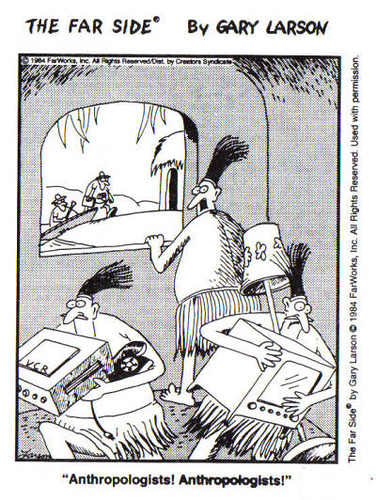
The anthropological term the ethnographic present refers to the artificial construction of a time before contact with European culture, and is best illustrated by this Far Side cartoon:

Anthropologists

Curtis worked very hard to construct such an ethnographic present in his photographs.
Continue reading

Pizarro, Millais, Diamond, and Yali: Our Last Waltz

Below is our last post this time around. It’s been engaging and productive meeting many of you in blogland. Cheers from Fred and Deborah

                                                                                                                                ***

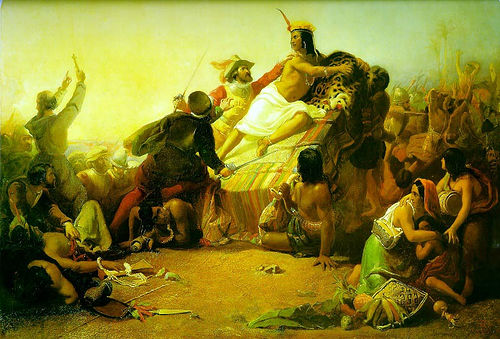
The anthropological view of history we present in Yali’s Question is crucially unlike Diamond’s in its emphasis on what needs to be taken into account. Diamond, less by default than by design, denies significance to cultural differences — to particular, historically located visions of the desirable and the feasible. The dissimilarity in our approaches is clarified by what we make of Diamond’s book cover. This cover reproduces a large oil painting by John Everett Millais (1845) entitled “Pizarro seizing the Inca of Peru.”

display_image

The painting, hanging in London’s Victoria and Albert Museum, is part of a collection (begun in 1852) representing the various, often diverse, aesthetic currents of the Victorian age. In the center, Pizarro, sword in hand, is seizing a darkly handsome, grandly exotic Inca leader from his partially overturned palanquin. On the left are massed Spanish soldiers with a priest holding up a cross for their inspiration. In the right foreground, two Peruvian women and a child are clutching each other in fear. In the right somewhat blurred and darker background, Spanish soldiers are putting Peruvians to the sword. The painting (perhaps anticipating Millais’s later anti-Catholic work) seems directly critical of Spanish conquest. Certainly, this is the perspective of Joseph Kestner, who describes the picture (in the Journal of Pre-Raphaelite Studies) as an “anti-Imperialist canvas during a decade of British expansionism and colonial defense” (1995: 55).

When we look at this painting and think about the place in which it hangs, we reflect on a particular and complex history — on the range of sensibilities and political perspectives that existed within this age dominated by capitalism and empire. However, when we look at this painting as it appears on the cover of Diamond’s book, we find it interesting because of the extent to which it is decontextualized, and we think, misunderstood. Rather than a historically located castigation of Spanish imperialism, it is offered as a synopsis of human history in general — a history of morally neutral conquest through the use of techniques and technologies of physical domination. In other words, from our anthropological perspective, we see Millais’s vision, itself critical of the dominant expansionist perspective of his age, transformed into a model that justifies as well as universalizes expansionism: one used to explain what happened to “everybody for the last 13,000 years” (1997: 9). Such a transformation of Millais’s critique of imperialism strikes us as consistent with Diamond’s position about the irrelevance of cultural and historical contexts in understanding what people do. Indeed, given Diamond’s view of history, the conquest that he (rather mechanistically) entitles “Collision at Cajamarca” (1997: 67), was inevitable. From his perspective, if it wasn’t Pizarro who had seized the Inca of Peru, it would have been some other European at some time.
Continue reading

On Human Nature and Responsibiity

Diamond’s conflation between the necessary and the sufficient grows out of the link between his interest in "history's broadest pattern" (1997: 420) and his determination to develop "human history as a science, on a par with acknowledged historical sciences such as astronomy, geology, and evolutionary biology" (1997: 408).  As he says, his book "attempts to provide a short history of everybody for the last 13,000 years .... [and searches] for ultimate explanations ... [that push] back the chain of historical causation as far as possible" (1997: 9).  Crucial to this search for law like explanations that will generate long chains of causation back to first causes (chains of causation that even link mountain range formation to Yali's quandary) is Diamond's distinction between ultimate and proximate causes.  Ultimate causes are those broadly applicable and pervasive forces, such as guns, germs, and steel.  Diamond is interested in these causes because he thinks they are the ones which really drive history – both past and present.  These ultimate causes shape derivative and more immediate occurrences, such as particular battles, conquests, economic systems.  The effects of these more immediate occurrences, in turn, become proximate causes of yet other events. 

Diamond's view of an inevitable and inexorable course of human history, one driven by the operation of ultimate causes over the span of its 13,000-year course, rests (as some of you suggested in earlier postings)  on what seems to us to be an implicit view of human nature.   It is this human nature which, in his vision, keeps ultimate causes active and decisive throughout history.  This is a view of human beings as necessarily leading lives so as to extract maximum advantage over others:  give a guy -- any guy -- half a chance and he will conquer the world;  give a guy a piece of appropriate metal and he will inevitably fashion a sword to cut you down;  give a guy a piece of appropriate metal and he will inevitably fashion a chain to enslave you within the hold of a ship bound for a New World sugar plantation.  In a way that many in the contemporary West find seemingly self-evident --  in a way that does not problematize the way the world works -- Diamond suggests that people everywhere and at all times, if they had sufficient power, would necessarily use it in seeking to maximize their own advantage through the domination of others.  This implicit view of a trans-historical and trans-cultural human nature is consistent with Diamond's explicit rendering of both historical context and cultural perspective as irrelevant.  In fact, Diamond works hard to exclude such perspective and context from his scientific history. 

Correspondingly, Diamond describes the rise of mercantilism and capitalism as only "proximate forces" in the course of world history (1997: 10).  From his perspective, mercantilism and capitalism are just epiphenomena -- just passing examples of history's general law.  From our perspective, however, mercantilism and capitalism provide particular historical contexts in which (and in different though related ways) expansionist conquest appears an especially desirable activity -- and one made especially feasible by the availability of guns, germs, and steel.  This is to say, rather than merely proximate causes of lives more fundamentally and inexorably determined, mercantilism and capitalism impel the use of guns, germs, and steel in particular manners for particular ends.  

Mercantilism and capitalism have spurred people to be bold -- to go to the ends of the earth if necessary -- in a search for ever greater profits. They have justified the subjugation of the New World as well as parts of Africa.  They have also authorized the creation of lucrative, slave-run plantations in the Caribbean whose profits sustained the lavish lifestyles of the absentee planters and whose sugar sustained (in nutritionally imbalanced sweet tea and treacle-smeared bread) the impoverished lives of the British workers -- those who manufactured the guns, chains, and instruments of torture.

Thus, we see such lives and historical outcomes as made possible by (for instance) guns, germs, and steel but as importantly propelled and shaped by cultural visions of what was worth pursuing and at what cost:  of winning favor from God and King, acquiring gold and silver, attaining certain lifestyles, or achieving national strength.  However, where we see the likes of guns, germs, and steel as necessary but not sufficient causes of such lives, Diamond sees such lives -- apparently all lives -- as inevitably seeking as much conquest and domination as possible.  For Diamond, in other words, the necessary is the sufficient.  To have the power is to express the power;  to have the power to dominate is to use it to dominate in the maximal way possible.  Where we see human activities as propelled and shaped by historically located visions, Diamond sees these activities as determined (presumably) by hard wiring -- as part of the biological nature of the human animal.  In these regards, activities of conquest and domination are simply in the nature of things -- just as, for instance, lions by virtue of their size and armament will inevitably slaughter lambs. 

Where  Diamond sees activities of conquest and domination as simply in the nature of things – as the inevitable outcome of human nature. -- Raymond Kelly's recent comprehensive analysis of the origins of human warfare provides a relevant and contrasting view of human nature and of inevitability.  In this critique of the Hobbesian notion that there is a "trinity of interrelationship between human nature, war and the constitution of society" (Kelly, 2000:  121), he writes:  

Warfare is an episodic feature of human history and prehistory observed at certain times and places but not others. Moreover, the vast majority of societies in which warfare does occur are characterized by the alteration of war and peace; there are relatively few societies — only about 6 percent — in which warfare is continual and peace almost unknown. It is only in this relatively small percentage of cases that something approaching a Hobbesian social condition of pervasive and unending warfare can be found. It might thus be said that it is “the nature of man” (or humankind) to conclude episodes of armed conflict between neighboring social groups by breaking off hostilities, by truce, and/or by reestablishing peaceful relations (Kelly, 2000: 124).

Kelly concludes:

The human propensity to peacemaking, so strikingly evident from the characteristic alteration between war and peace, is central to the nexus of interrelationships between human nature, war and society — and this bodes well for the future (2000: 161).

It is the case that Yali was poor and that the people of the New World were brutally conquered by representatives of the Old.  It is also the case that those who beat up on other people have the capacity to do so.  But are these facts inevitable by virtue either of the nature of history or the nature of humans?  As Kelly indicates, human beings always are capable of a range of behaviors and they always are capable of engaging with each other and their neighbors in a range of ways.  They might make war, but they also might make peace.  Whether they choose one or the other is powerfully affected by particular historically and culturally located ideas  about  the desirable and the feasible. 

To our position concerning history's rootedness in human culture, rather than in human nature, we would add an emphatic stipulation.  Since it has become clear to anthropologists that cultures contain multiple perspectives about alternatives and how they might be pursued and otherwise dealt with, it follows that human beings have a measure of choice about how to act.  Thus, for instance, from American ideas of the worth of the individual, one can generate political perspectives as diverse as libertarianism and welfare statism, the first position holding that no individual should be interfered with or regulated, the other, that no individual should be neglected or deprived.  The existence of such alternatives means that human beings may, realistically, be held accountable for the choices they make.  We find this stipulation important both in combating Diamond's general world history and in constructing an aspect of Papua New Guinea's more particular one.  Pizarro (for example) had the capacity and resources to behave with remarkable brutality in the New World -- he had both the technology and will to conquer.  But the mere capacity to behave brutally does not absolve him from having done so.  Likewise, Europeans had the resources to treat Yali and other Papua New Guineans with contempt.  But that position should not absolve them from having done so.  Such considerations, we argue, are important in rethinking historical outcomes.  Indeed, the haves may be prompted to do such rethinking themselves by recognizing that the have-nots may already have come to their own conclusions.  
Disaster Anthropology

I’ve been keeping my Katrina coverage, which has been more political than anthropological, restricted to my own blog, but I see that antropologi.info has a good post about the anthropology of disaster, and other Katrina-related anthropology reports.

This isn’t a subject I know anything about, but if you have suggestions for a disaster anthropology reading list please leave them in the comments. (Ragout already suggested one such article in the comments to a previous post.)

I did begin collecting some articles about the impact of race and class on both the disaster and the media coverage afterwards. I think this is another area where anthropologists can offer some insights, as geographer Craig E. Colten did on NPR.

UPDATE: Here is Craig Colten’s web page, and his new book: An Unnatural Metropolis: Wresting New Orleans from Nature. From Amazon.com:

Colten shows how every manipulation of the environment made an impact on the city’s social geography as well—often with unequal, adverse consequences for minorities—and how each still requires maintenance and improvement today.

UPDATE: Here is a web site from the SSRC titled, “Understanding Katrina: Perspectives from the Social Sciences.” (Vis Anthropologi.info, where more links can be found.)

Diamond’s Argument about the Haves and Have-Nots

In earlier postings, we suggested that Diamond gets Yali's question wrong.  Whereas Diamond understands Yali to be asking about "things" -- about Western "goods" -- Yali was actually asking about social equality.  Whereas Diamond thinks Yali envied nifty Western stuff, Yali actually resented the not-so-nifty Western condescension that allowed Europeans to deny PNGuineans fundamental worth.  The misunderstanding matters, we think, as more than an issue of factual error.  That Diamond does not stretch his imagination to understand Yali's cultural views is consistent with the history he presents.  This is a history that he believes happened for reasons that we in the contemporary West already believe in.  It is a history that accords with our view of how the world fundamentally works.  Because such a history conveys the perspectives of the "haves," it not only hinges on the (seemingly) self-evident, it also sustains the self-interested. 

Many of you know the 13,000 years of human history that Diamond sets out in response to Yali's question – and so we won’t repeat it here.  In telling this history, readers learn that Yali's circumstances did not reflect any lack either in his intelligence or in that of other PNGuineans (and, of course, we agree).  Rather, we learn that Yali was poor and relatively powerless in his own domain because his ancestors lacked access to the mineral resources, domesticable animals, and the other advantages that allowed some to conquer others.  He was born, in terms of the luck-of-the-environmental draw, on the wrong side of the great geographical divide.  

Yet neither Yali nor most of the other PNGuineans we have known over our years in PNG would be satisfied with the inexorability of Diamond's luck-of-the-draw sort of answer, with the implications of his "that's-just-the-way things-were (and must-be)" sort of response.  Such an answer would strike them as a perverse justification of colonial forms of inequality, part of a story that denied them moral worth in the past, to say nothing of the future.  However, it is just this sort of answer, just this sort of invocation of historical inevitability, that tends to satisfy those who are already the haves.  In this regard, the ideology inherent in Diamond's reasoning goes well beyond the particulars of the history he presents.  This ideology supports the status quo, the interests of the already powerful.   For them, the inevitable and the inexorable are readily synonymous with the interests of the haves over the have-nots.  

More broadly, the ideology inherent in Diamond's reasoning is one we confront as teachers and scholars dealing primarily with the haves.  Students tell us that their parents encourage them to read Diamond's book, finding it invigorating.  The (former) president of Fred's college urged his faculty to read it.  In fact, he sent copies of Guns, Germs, and Steel to members of the faculty as a model of the kind of book he admired.  All over the United States, we learned, deans and presidents of other pricey institutions applaud the book.  At Cornell, it became assigned reading for all freshmen.  Moreover, many institutions pay Diamond generously to summarize his views in person, generally in packed lecture halls.  And, of course, there is his National Geogoraphic series.    We think such educated haves like the book so well because it resonates so much and so easily with their own concerns -- in effect, because it so readily sustains them.  They come away from the book (or lecture, or TV show) feeling pretty good about themselves -- both enlightened and open-minded.  They come away seeing the world without racial prejudice and having learned some important new facts and connections.  Furthermore, and significantly, they come away comfortably convinced that they have their cargo (unlike Yali and his people) for inevitable and impersonal geographic reasons.  No one is to blame for the fact that some people are, and no doubt will continue to be, the haves and that others are, and will continue to be, the have-nots.  Thus, Diamond's history is not only the delineation of an inexorable and inevitable trajectory.  It is, as well, both retrospective and prospective.  His depiction of the past provides a far from disinterested model for understanding the present and for shaping the future.  This is to say, he presents the world as one in which the have-nots, whether in PNG or elsewhere, must (seemingly) forever deal with the haves under conditions of fundamental disadvantage. 

But, what exactly is wrong with the history that Diamond presents?   Didn't the events Diamond relates really happen?  Must a history necessarily be disqualified because it conveys the perspectives and interests of the victors, of the haves?  Isn't Diamond's view simply informed by hard-headed realism about the way the world works?  

We certainly do not deny that certain forms of power had a significant role in effecting the kinds of historical events that Diamond delineates.  Diamond's depiction of the role that guns, germs, and steel played is often plausible.  What we do challenge is his conflation of the necessary with the sufficient.  This is to say, just because guns, germs, and steel were necessary to make certain historical outcomes possible, including those so upsetting to Yali, we do not have to assume that their possession was sufficient to explain these outcomes.  Just because sources of power are available, we cannot conclude that the power will be used for certain ends, or even that it will be used at all.  And, simply because European colonists had the power to pursue their interests at the expense of Yali and other PNGuineans, does not fully explain – or justify –  the ways in which they chose to use this power.  More later…….

On cargo and cults — and Yali’s Question

As we suggested in our first posting, Yali and other PNGuineans became preoccupied with the refusal of many whites to recognize their full human-ness -- to make blacks and whites equal players in the same history.  In their efforts to establish the exchanges on which the elusive equality would be based, many PNGuineans sought, often through magical and ritual means, the European things -- the "cargo" -- that whites so evidently valued.  It would be an error, however, to believe that it was the things alone that interested them.  Rather, with these things, they hoped to become interesting and socially significant (exchange-worthy) to the Europeans.  

In Road Belong Cargo, Lawrence describes the attempts of Yali and his neighbors to acquire this cargo with a definition of what is now known as the cargo cult:  

"It is based on the natives' belief that European goods (cargo) -- ships, aircraft, trade articles, and military equipment -- are not man-made but have to be obtained from a non-human or divine source.  It expresses the followers' dissatisfaction with their status in colonial society, which is to be improved imminently or eventually by the acquisition of new wealth.  It has, therefore, a disruptive influence and is regarded by the .... Australian Administration ... as one of the [its] most serious problems " (1964: 1).

Deeply resenting their inferiority in colonial society, PNGuineans sought for decades to improve their status by gaining access to cargo.  In fact, during Fred's early PNG research in New Britain on the island of Karavar (in 1968 and 1972) local people remained preoccupied with gaining long denied respect from Europeans.  In discussing their contemporary cargo activities (which focused on learning how to place an order such that a small payment would elicit a shipload of manufactured items), they described a history of their efforts to compel Europeans to recognize mutual human-ness.  In particular, they referred to the "dog movement," a series of meetings they held during the 1930's.  The question addressed with perplexity and anger at these meetings was why the Europeans persisted in treating them with contempt -- driving them away, telling them to get out, as if they were unwelcome dogs.  Through obtaining cargo, they sought to win European respect by having that which Europeans so obviously valued.   

Over a considerable period of time, hence, PNGuineans frequently sought to acquire and master the ritual techniques by which Europeans accessed cargo.  Influenced by Yali or other cargo-cult leaders, they tried a combination of recalcitrance and ritual experimentation.  They interrupted and transformed normal routines:  they refused to pay taxes, repudiated the directions of colonial administrators, established alternative governments, wrested theological control from missionaries, and mobilized villages, if not whole regions, in fervent invocation and prophesy.  

Diamond, hence, misunderstands what many PNGuineans desired when he explains the background to Yali's question (about the differences between white and black people).  In Diamond's words:  "whites had arrived, imposed centralized government, and brought material goods whose value New Guineans instantly recognized, ranging from steel axes, matches, and medicines to clothing, soft drinks, and umbrellas.  In New Guinea all these goods were referred to collectively as 'cargo'" (1999: 14).  Because Diamond misunderstands that Yali really was asking less about cargo per se than about colonial relationships between white and black people, he describes the introduction of centralized government as almost parenthetical to the indisputable fact that whites and their goods had arrived.  Thus, he presents local resentment as directed not at the nature and use of concerted colonial power so much as at the differential access to goods.  

We might also note here that in using the term "goods" Diamond implies that such items were inherently desirable -- instantly recognizable as worth acquiring.  In defining cargo as goods, Diamond suggests that local people will do whatever it takes to get such things:  that in their desire for goods, local people are the agents of their own domination.  In so doing, he displaces our attention from the nature of colonial power relations.  These relationships are not vested in the "nature of things."  They are not inevitable because of the instantly recognized value of manufactured items.  Instead, colonial relationships have been forcefully imposed, often to the resentment and resistance of local people.  

PNGuineans such as Yali wanted cargo not because of its inherent and instantly recognizable value, but because of a desire to transform the relations of inequality between whites and blacks that were pervasive in colonialism.  They wanted cargo primarily because they objected to the ways in which the centralized, colonial government used power and, correspondingly, diminished their relative worth.

Indian Groupies, Authenticity, and Ethnic Anxiety

In the past I’ve been critical of Jack Hitt’s writing for the NY Times about language and culture, but his recent magazine article about recently recognized Native American tribes is quite good:

Ethnicity is a tricky thing because it is commonly understood as something fixed and essential rather than what it more likely is: an unarticulated negotiation between what you call yourself and what other people are willing to call you back. Geniusz has lived her life culturally among the Ojibwe and is recognized by them as an Indian. Her easy comfort at calling herself an Indian comes in part because everyone in her area recognizes the essential Indian life she has led. Her physically European features are, in this part of Michigan at least, understood as only marginally curious.

The way the ethnic negotiation works depends on what part of the country you are located in. Native Americans recognize that there exists a kind of spectrum. At one end there are Indians living on a well-established Western reservation in a tribe that is branded as seriously authentic — Hopi, say — where many in the tribe retain the classic Indian physical characteristics. Moving along, you encounter various tribes that have intermarried a lot — like the Ojibwe — yet whose members still feel a powerful sense of authenticity. But once you visit tribes of newcomers, where few members knew their Indian ancestors personally, you begin to sense a clawing anxiety of identity. At the far end are hobbyists, those Indian groupies who hang around powwows, hoping to find a native branch in their family tree. They enjoy wearing the traditional tribal garb and are, as the University of Michigan history professor Philip Deloria titled his book, ”Playing Indian.”

Hitt is careful to point out that the whitening of the Native American population was actively promoted by U.S. government policies:

Some Native Americans carry what is called, awkwardly, a white card, officially known as a C.D.I.B., a Certificate of Degree of Indian Blood. This card certifies a Native American’s ”blood quantum” and can be issued only after a tribe has been cleared by a federal subagency.

The practice of measuring Indian blood dates to the period just after the Civil War when the American government decided to shift its genocide policy against the Indians from elimination at gunpoint to the gentler idea of breeding them out of existence. It wasn’t a new plan. Regarding Indians, Thomas Jefferson wrote that ”the ultimate point of rest and happiness for them is to let our settlements and theirs meet and blend together, to intermix, and become one people.” When this idea was pursued bureaucratically under President Ulysses S. Grant, Americans were introduced to such phrases as ”half breed” and ”full blood” as scientific terms. In a diabolical stroke, the government granted more rewards and privileges the less Indian you were. For instance, when reservation lands were being broken up into individual land grants, full-blooded Indians were ruled ”incompetent” because they didn’t have enough civilized blood in them and their lands were administered for them by proxy agents. On the other hand, the land was given outright to Indians who were half white or three-quarters white. Here was the long-term catch: as Indians married among whites and gained more privileges, their blood fraction would get smaller, so that in time Indians would reproduce themselves out of existence.

Compounding this federal reward for intermarriage was the generally amicable tradition most tribes had of welcoming in outsiders. From the earliest days of European settlement, whites were amicably embraced by Indian tribes. For instance, the leader of the Cherokee Nation during the forced exile of 1838-39 — the Trail of Tears — was John Ross, often described as being seven-eighths Scottish.

Because phenotypic markers of Indianess are so hard to find among some of the newcomers (who seem to have tremendous anxiety about their own whiteness), language has become a crucial marker of authenticity:

Because it is time-consuming and difficult to learn any language, the commitment it takes to attend one of Wendy Geniusz’s camps or to sign on with Fielding’s work or to participate in any of the widespread Native American language revivals weeds out the easy hobbyists and leaves a cohort of Indians whose authenticity — regardless of genealogy or blood quantum — may one day be hard to question.

Finally, it is also interesting to learn about the various levels of of official recognition that are available for Native American tribes:

The Cherokee Tribe of Northeast Alabama is, according to the University of Oklahoma anthropologist Circe Sturm, one of more than 65 state-recognized tribes, most of which have emerged in the last few decades in the Southeast. State recognition is merely one of many legal mechanisms used to legitimate a Native American tribe. They range from the most difficult — federal recognition, which is required for running a casino — to state and local designations and on to unrecognized groups. (The Cherokees alone account for more than 200 of these recently formed unaffiliated tribes.)

And no, it is isn’t about cashing in on casino money, very few of these new groups qualify for casinos, and those who do are very restrictive about who can be a member.

The only quibble I have with the article is the implication that academics used to treat ethnicity as some kind of a fixed quantity but now recognize it as more mutable and negotiated. Anthropologists have understood the mutable nature of ethnic identity at least as far back as Boas. And, although it falls outside the scope of the article, if I were teaching this topic in a class I would want to point out how in South Africa or Brazil the links between race and ethnicity are conceived of quite differently than they are in the United States.

I.Q.

There’s the old joke about the guy looking for his keys under the lamplight because, even though that’s not where he lost his keys, the light’s better there. I feel that way about studies of I.Q.. When critics, like Howard Gardner, object that such measurements fail to capture important aspects of thought, psychometricians reply that concepts like Gardner’s “multiple intelligences” don’t produce the same kind of “stable” test results they get from I.Q. tests, so they need to keep using I.Q.! It strikes me that what we have here is a concept that has been perpetuated in order to legitimate the continued existence of a discipline, and of a testing regime, rather than because it tells us anything important about the mental abilities of those tested.

I’ve been looking at this issue because four of the top political bloggers (Atrios, De Long, Kevin Drum, and Matt Yglesias) have ganged up on Andrew Sullivan for his recent endorsement of the central tenants of The Bell Curve. As a result of all these posts we get a great list of online articles debunking the book, to which I’ve added a few more and grouped them all here for your reference. The critiques vary in whether or not they accept the notion of I.Q.. Some accept it, but claim it isn’t genetic, others accept a genetic component, but deny that this correlates with race, while others (like Howard Gardner and Stephen Jay Gould) are more critical of the very notions of intelligence that are supposedly being measured in the first place.

  • Thomas Sowell’s American Spectator article, in which he discusses the “the work of James R. Flynn, who found substantial increases in mental test performances from one generation to the next in a number of countries around the world.” Findings which disprove any link between genetics and I.Q. (originally linked in this DeLong post, and metioned in Matt’s post as well.)
  • Nicholas Lemann’s debunking in Slate: “What Herrnstein and Murray used to measure IQ is actually a measure of education as well as intelligence.” (also from Matt.)
  • Intelligence: Knowns and Unknowns.” The report by the American Psychological Association which I make fun of above, but which is well worth reading – especially with regard to whether there is any link between intelligence and race. (via Kevin Drum.)
  • Samuel Bowles and Herbert Gintis 2002 paper, “The Inheritance of Inequality” [PDF] which debunks the notion that social inequality is genetic. (via Brad DeLong, who has a summary of the findings.)
  • Howard Gardner’s critique of The Bell Curve in The American Prospect, in which he elaborates on the limitations of I.Q.
  • Two defenses of I.Q.: One by Linda S. Gottfredson in Scientific American, and another by Christopher F. Chabris in Commentary.
  • Responses by Flynn, Gardner, and others to the article by Chabris.
  • Wikipedia pages on The Bell Curve, Race and Intelligence, IQ, the Flynn Effect, Gould’s book, The Mismeasure of Man, and Howard Gardner’s concept of Multiple Intelligences.

The Representation of Aborigines in Taiwanese Baseball

This is the third in a series of Savage Minds posts on sports and ethnic representation. The first was Oneman’s post on ethnic mascots, followed by my earlier post on ethnic soccer clubs in Australia.

This post draws on a 2000 paper (PDF) by Andrew Morris, presented at the conference Remapping Taiwan: Histories and Cultures in the Context of Globalization, as well a more recent (2004) version of Morris’ work, “Baseball, History, the Local and the Global in Taiwan,” which appeared in the book The Minor Arts of Daily Life: Popular Culture in Taiwan.

MapleLeaf

Taiwan was a Japanese colony from 1895 till the end of World War, when the Nationalists (Guomindang, or KMT) took over. Baseball had become popular under Japanese rule, but managed to survive KMT efforts to de-Japanify the country.
Continue reading

Narrating the Nation in Australian Soccer

Oneman’s post “‘Savage’ Mascots Take A Blow” sparked some commentary about European mascots. I think it is useful, in trying to understand the status of European mascots, to look at a country where many Europeans are still not considered “white” in the same way that they are now considered white in the United States. (A number of recent studies have discussed the different process by which Irish [also here] and Jews became “white” Americans.) That country is Australia, and there is an excellent article [AnthroSource link] by Loring M. Danforth entitled: “Is the ‘World Game’ an ‘Ethnic Game’ or an ‘Aussie Game’? Narrating the Nation in Australian Soccer.”

I have to confess a deep aversion to reading anything which cites Homi Bhabha extensively, but Danforth admirably demonstrates that one is not required to emulate Bhabha’s impenetrable prose to deploy his ideas effectively.

Soccer, as opposed to Ruby or “Aussie Rules” football, is still largely considered to be an immigrant sport in Australia. Up until quite recently soccer clubs were, in fact, run entirely along ethnic lines:

This “ethnic club” system, which characterized Australian soccer for so long, was based on the principle of ethnic nationalism according to which individual clubs, like individual nation-states, constituted homogeneous, closed cultural communities whose members were bound together by a common national identity. The owners and administrators of these clubs, like the vast majority of their supporters, were members of a single ethnic group.” Ethnic soccer clubs served as powerful symbols of the diaspora communities they represented. They played important roles in fostering ethnic solidarity and pride in the face of the assimilationist pressures of Australian society. According to its president, George Vasilopoulos, South Melbourne Hellas, one of the most successful soccer clubs in Australia, was formed to “bring together” the Greeks of Melbourne and to provide them with “a home away from home.” The club, he said, is “a clear indication of the progress this community has made. They grew and prospered together”…

A specialist in Greece, Danforth focuses on three clubs which represented deep divisions within the Greeks and Macedonian community over whether or not Macedonia was a part of Greece. “South Melbourne Hellas “was the Greek team, “Preston Makedonia” the pro-Macedonian independence team, and “Heidelberg United Alexander the Great Soccer Club” which was “founded by a group of people from the northwestern part of Greek Macedonia.”

What is particularly interesting, however, is not so much the exporting of the Macedonian conflict to Australian soil, as much as the efforts of the Australian Soccer Federation (now “Football Federation Australia“) to deethnicize the sport in order to make it more profitable. While finally successful, such efforts initially met with tremendous resistance:

The owners of ethnic soccer clubs and leaders of Australia’s ethnic communities vigorously opposed this campaign to “deethnicize” Australian soccer. They attempted to defend the “ethnic club system” by appealing to the ideology of multiculturalism in order to counter the narrative of traditional Australian ethnic nationalism that had been used by soccer officials to abolish the “ethnic clubs.”

Supporters of South Melbourne Hellas and Preston Makedonia were outraged by this campaign to destroy the “ethnic club system.” They called it an “antiethnic” and “undemocratic” plan that insulted members of Australia’s ethnic communities and made a mockery of the government’s multicultural policies. They said it was an example of “ethnic cleansing,” a case of “forced assimilation,” an attempt to put a “foreign face” (an Australian face) on soccer in Australia …

In a more humorous vein, one commentator suggested that if the commissioners of the Australian Soccer Federation really wanted to enhance the popularity of soccer in Australia, they should not stop at mere “cosmetic surgery.” Applying a “Band-aid” to the names of some clubs was not enough. If they were really interested in increasing attendance at soccer matches, commissioners should consider changing their own names (Papasavas and Labozzetta), banning players with ethnic names (Blagojevic and Van Blerk), or even forbidding the consumption of ethnic food (pizza and souvlaki) at all soccer matches …

At the heart of this conflict are competing images of what it means for Australia to be a multicultural nation. Danforth contrasts the dominant narrative which is one of ethnic assimilation, with a competing hybrid narrative. In American ethnic studies these two models are often referred to as the “melting pot” versus the “salad bowl” models of multiculturalism.

Eventually, the ethnic clubs were forced out of the league, and with the 1998 World Cup finals match against Iran, it seemed as if Australia had overcome the ethnic origins of the sport.

It is also ironic that many of the people enthusiastically shouting “Aussie! Aussie!” at the World Cup qualifying match between Australia and Iran would not be identified by themselves or by Anglo-Australians as “Aussies,” but rather as “Europeans,” “ethnics,” or “wogs.” At a fundamental level, they are not members of the very national community whose team they are supporting. Finally, it is ironic that when Greeks and Macedonians wave Greek and Macedonian flags and root for soccer teams named Hellas and Makedonia, their behavior is criticized as un-Australian, but when the same people-speaking the same foreign languages and eating the same ethnic food-wave Australian flags and root for the Socceroos, their behavior is lauded as representing multicultural Australia at its best. It seems that “ethnics become Aussies for a day” when they root for the Australian national team …

In a future post I will discuss representations of Aborigines in Taiwanese baseball.