Tag Archives: Language

The New Persistence of Memory: The Language and Popular Culture in Africa Archive

Some readers here may have seen my review of Johannes Fabian’s recent books, which are linked to a site he co-created with Vincent de Rooij called The Language and Popular Culture in Africa Archive. It’s a great small collection of original texts, translations and commentaries, curated with scholarly care, and representing hard to find and valuable resources. What’s more, even though it is a small-scale project, it was one of the first open access publications in anthropology, and could continue in this fashion if there were interested people.

Fabian wrote to me recently concerned about the future of this archive, highlighting several issues that I think we will all face in the near future:

As you may have noticed in my email signature below the address of our LPCA archive has changed (because of some reorganization at the University of Amsterdam). The old address that appeared in publications so far will get you there for a while but probably not forever. One of the vagaries of presence on the net. Also I say “our” archive because it has been a truly collaborative effort with Vincent de Rooij, a former student and a linguist-cum-anthropologists whose dissertation was about Katanga Swahili. He designed, maintained, and edited the website meticulously. And he did this for almost 10 years without any institutional funding or even academic credit, on his own time. This has become untenable for me but, more importantly, he has turned to other subjects and interests, which is of course entirely legitimate. So the sad news is that LPCA, though it can run, as it were, on autopilot for years as long as it keeps its space on the server, is, if not dead, in suspended animation.

I think such projects are the very lifeblood of anthropology today–far more so than the increasingly sterile walled gardens of the academic journals run by the Publishing Borg and its scholarly society minions. So what should we do to keep them alive:

  1. Volunteers? Is there anyone out there with an interest in and focus on popular culture in Africa, african linguistics or swahili who wants to help? This could be an editorial opportunity as well, since there is both the archive and a Journal associated with the project.
  2. How can we improve it, or make it more 2.0-y and social interneterrific without sacrificing what is already there? What’s the right back-end? The journal (Journal of Language and Popular Culture in Africa) could obviously be ported to Open Journal Systems, if someone wanted to do that, whereas the archive materials might be appropriate for Omeka.
  3. How can we make it more “official”– perhaps by assigning DOI numbers (what would a suitable registration agency be?) and so forth to make it findable as a library resource?
  4. Can we leverage the new “open anthropology cooperative” to find people who are interested and committed?
  5. Other suggestions for Johannes and Vincent as to how to make this project survive and grow?
Learning an Endangered Language (Part 4)

Part 1 | Part 2 | Part 3

Our Spring semester just started here in Taiwan, so I’ll keep this entry short. I just wanted to link two recent studies:

  1. One uses phylogenetic methods to determine that “the origin of the entire Austronesian language family can be dated back to Taiwan around 5,200 years ago, and moved through Island South-East Asia, along New Guinea and into Polynesia.” (More over at Language Log.) I’m not qualified to judge their methodology, but it looks like an important contribution to a long-standing debate over the dispersal of Austronesian languages.

  2. The second link is to the New edition of UNESCO’s Atlas of the World’s Languages in Danger, which brings some good news amidst the bad, stating that “there has been an increase in the number of speakers of several indigenous languages.” (Specifically “Central Aymara and Quechua in Peru, Maori in New Zealand, Guarani in Paraguay and several languages in Canada, the United States and Mexico.”)  Since it is a UNESCO map, it follows UN policy of not recognizing Taiwan as a country, but it does document the dangers faced by Taiwan’s indigenous languages. News of the report led to renewed demands from Aboriginal lawmakers for the preservation of indigenous languages.

UPDATE: Right after posting this I saw a Twitter post [can’t quite bring myself to say “tweet” – but saying “Twitter post” feels like saying “web log” before “blog” gained widespread usage] about a test Wikipedia in the Pazih language. Pazih is a severely endangered language. Its last fluent speaker is Mrs. Pan Jin-yu who was born in 1914.

Learning an Endangered Language (Part 3)

Part 1 | Part 2

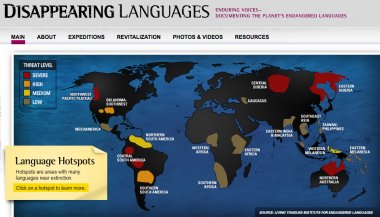
In this installment I want to discuss more about what it means for a language to be called “endangered.” In doing so I will draw on David Crystal’s book Language Death. The picture below is from National Geographic’s Enduring Voices Project:

Enduring Voices Project, Endangered Languages, Map, Facts, Photos, Videos -- National Geographic

There are some reasons for anthropologists to be skeptical about the various discourses surrounding language endangerment (for a good discussion of those see Joseph Errington’s excellent article, “Getting Language Rights: The Rhetorics of Language Endangerment and Loss” as well as my AN editorial, “The metaphor of ‘endangered languages'” [PDF]), but I’ll be putting that aside for this post, focusing instead on some of the issues involved in trying to determine “threat levels” for endangered languages.

When is a language a dead language? When the language can no longer be used for daily conversation. By this definition, having one living speaker is not enough, because she will have no one to speak to. There are some complicating factors, such as languages which have literate or religious traditions, but its good enough for our purposes.

Where things get difficult is determining the other end of the equation. How many speakers does a language need to be “safe”? Continue reading

Learning an Endangered Language (Part 2)

In this post I’d like to elaborate on two issues raised in Part 1 and in the interesting discussion which followed.

The first issue is the tremendous variety of linguistic situations anthropologists find themselves in. By “situation” I also mean to include the language repertoire of the anthropologists themselves. Living and working in East Asia I have many colleagues who conducted fieldwork here in Taiwan. For many of these colleagues it was academic English with which they struggled, having studied abroad for their Ph.D. Americans pursuing advanced graduate degrees here in Taiwan have an easier time, since many of the texts are in English and they can submit their term papers in English. My Taiwanese colleagues were not so lucky and I’m tremendously impressed by their ability to write a Ph.D. dissertation in a foreign language, especially since some of them really struggled with written English.  Yet while some of them claim Hoklo, Hakka, or even an Aborigine language as a “mother tongue,” in many cases their ability to communicate in these languages is sometimes quite limited. This is directly connected to the theme of these posts – the fact that these are endangered languages. I will speak more on that next time, but the reality is that there are very few monolingual speakers of these languages in Taiwan, and one can almost always get by with Taiwanese Mandarin. A lot depends on the context in which one finds oneself, although I imagine that linguistic competence also affects which contexts one ends up in. I might hang out more with 80 year old Amis grandmas if I understood their (often naughty) jokes, but as it is I’m more likely to talk to their grand kids who can’t understand the jokes either.

Zora’s comment on the last post illustrates the nature of this diversity. Zora “did fieldwork in Tonga, in the South Pacific—where, luckily for [her], a history of British colonialism ensured that the intelligentsia spoke English.” She “went to an island in the Ha’apai archipelago” where many young people spoke English, but where (if I understand correctly) much of the older community was monolingual in Tongan, which she learned after a year and a half in the field (plus some tutoring before she had left). Compare that to Taiwan, where the dominant language is not English, but Mandarin Chinese. Although one could conceivably work entirely in the local language spoken at the field site, inability to speak or read Chinese would severely hinder one’s ability to do good quality academic research here. For instance, the textbooks I’ve used for studying both Hoklo and Amis are written in Mandarin. Also, one needs to be able to access scholarship published in Mandarin. (Or at least I should be doing that – I can barely keep up with my English reading list these days…) So while Zora could spend a year and a half learning Tongan, most American or European  scholars who come to Taiwan to do research spend a decade or more learning Chinese, and are at very different levels of progress when they get to the field. (Several colleagues I’ve spoken to who’ve worked in Taiwan or China have confessed to me that they just gave up on literacy and focused on conversational fluency instead.) From what I know about research in Arabic speaking countries the situation is somewhat similar: researchers first learn Classical Arabic, then the local vernacular, and if they have time also try to study a minority language as well, but don’t usually get very far.

This brings me to the second issue, which is that of working in a country with strong diglossia.

Continue reading

Learning an Endangered Language (Part 1)

In Maxwell Owusu’s classic article, “Ethnography of Africa: The Usefulness of the Useless” he criticizes anthropologists for ignoring the importance of local languages. A situation which forced many of the most respected anthropologists to rely on interpreter-informants. He argues that this reliance on interpreters has been a source of error and confusion in the field (he then blames the excesses of structuralism on such inattention to details). As I wrote in my dissertation, “language skills are something that Anthropologists rarely discuss in their ethnographies.” One exception is Stevan Harrell who wrote the following in the introduction Ploughshare Village:

For the first six weeks, I employed an interpreter to translate my Mandarin Chinese into the villagers’ Hokkien [Hoklo] and back again, but when he left to go to college, I interviewed and interacted almost exclusively in the Hokkien language, I started out missing things, but learned fast, out of necessity.

Needless to say, I am not the language learner that Stevan Harrell is. I certainly would not have been able to interact exclusively in Hokkien (a.k.a. Hoklo, Southern Min, Taiwanese…, I prefer using Hoklo) after a short six weeks. But then again, I didn’t have to. A generation separates when Harrell was in the field and when I arrived, and during that time families increasingly chose to speak to their children in Mandarin to better improve their chances in school. The result is that most people my age and younger speak Mandarin better than they do Hoklo. This meant that when I was studying Hoklo, my social network in Taipei was of little use to me, but even when I found older man from Southern Taiwan to act as my tutor, my interest flagged. I was having enough trouble with Mandarin and there just wasn’t a strong enough incentive to struggle with learning another language at the same time.

When I did leave Taipei to go to the field, I found myself in a rural community with speakers of three different local languages: Hoklo, Hakka, and Amis so, of course, Mandarin was the lingua franca. My biggest challenge there was not learning the local languages so much learning the local variety of Mandarin, one which was far different from the bookish standard we had learned in my language program. I was reminded of this recently when I spoke to one of my former teachers. She had arranged for me to give a talk back at my old language school, and was admonishing me not to sound so “local” when talking to their students. After three years struggling to teach in Taiwanese Mandarin, I told her I wasn’t sure I could still speak with the Beijing accent they taught me at school. Code switching between different varieties of Mandarin is just not in my repertoire. (And considering how much I had to unlearn what they taught me at that school, I’m not sure I support their goals, even if I do understand them.)

Athough my Mandarin is still far from perfect, I’ve decided to attempt once again to learn a local language. Not Hoklo this time, but Amis, one of Taiwan’s indigenous languages. In fact, a desire to learn at least one Formosan language was one of the major motivating factors in my decision to come to Taiwan to work. This past semester I finally managed to put aside some time to devote myself to this task, and in the weeks ahead I hope to write more about the difficulties of learning an endangered language.

Candy Goodwin on Teasing

Marjorie Harness “Candy” Goodwin, author of a recent ethnography of girls on a playground, joins our growing pool of Savage Minds “occasional contributors” with the following response to a recent NY Times Magazine article, “In Defense of Teasing.”

Dacher Keltner in his recent article on teasing in the New York Times magazine argues that “in seeking to protect our children from bullying and aggression, we risk depriving them of a most remarkable form of social exchange.” While ritual insult or trash talking among friends (as Labov told us long ago) can serve important functions by communicating complaints about someone in a playful and indirect way, there is often a murky line between ritual and personal insult. As Donna Eder (in her book School Talk) has alerted us, whereas the intent of the actor of a tease may be friendly, a recipient may interpret it as a hurtful insult, and not necessarily show the pain. Jaana Juvonen, my colleague in psychology at UCLA, who has done extensive research on bullying among elementary school and middle school children (see for example her book Peer Harassment in School: The Plight of the Vulnerable and Victimized edited by Juvonen and Sandra Graham, feels that (counter Keltner) there is not any easy way to distinguish teasing from bullying, which includes forms of social aggression.

In my own work among elementary school children (The Hidden Life of Girls) in California over a three-year period I also find that what begins as playful may very quickly become harmful. A working class girl who initiates playful ritual insult sequence (“When you grow up you gonna be working at Pick and Save”) might receive in return from girls in a mostly middle class clique hurtful personal insult, alluding to the target’s status as working class, not being able to afford braces, jobless in the future, rejected by everyone, including the gutters, and without friends. When multiple members of a clique ratify a particular version of reality of this sort that is hurtful we come face to face with forms of everyday micro-aggressions that often go unnoticed in “progressive” schools – schools where there are routine exercises is sorting out blue and brown eyed individuals in exercises that promote notions of fairness to all ethnic groups, but never attention to “the hidden injuries of social class.” The girls I studied routinely excluded a working class African American girl they called a “tag-along” and insulted her to her face so that by the end of sixth grade she was often eating alone on the playground during lunchtime. What may be thought to be teasing by some group members, may be experienced as hurtful by the target. The form of recipient response is critical to how we view an activity as either teasing or bullying.

How (Not) to Signal “Stop”

army.mil-2007-04-11-095526

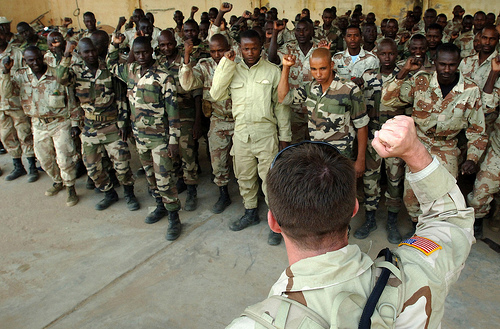
The following is the caption for this photo as it appears on the Defend America military blog:

A soldier from 1st Battalion, 10th Special Forces Group (Airborne) teaches tactical hand signals to Nigerian soldiers from the 322nd Parachute Regiment during exercise Flintlock 2007 in Maradi, Niger, April 4, 2007. The closed-fist signal means “stop.” U.S. Army photo by Petty Officer 1st Class Michael Larson.

Although I had not previously seen a picture of this gesture, I had come across it in my previous investigations into issues of cultural miscommunication and translation in the war in Iraq. It is an example which was often used in news stories about the confusion that could occur at checkpoints, since the Iraqi gesture for stop is with the had open, as in the U.S. Here is a blog post, from a soldier recounting a joke told during a briefing session:

The training opportunities thus far have been sparse, but comical. An Irish sergeant from the Brit Army briefed our unit on IEDs–still the number one killer of coalition troops in theater–as well as various checkpoint protocols:

“The insurgents, they’re sayin’ they blow themselves up fer seventy virgins, aye? Well we in the British Army have a policy to deal with this problem: We send them straight to Allah and keep the virgins for ourselves!”

“The British use this hand signal [closed fist] ‘Stop!’ to control traffic at checkpoints. The Iraqis, they use a similar one, [open hand] ‘Oogaf!’ And then there’s you Americans: [points weapon] ‘Freeze motherfucker!’”

Continue reading

The Myth of Cultural Miscommunication

In discussing the role of anthropologists in the battlefield I’ve argued that what is needed isn’t so much anthropology as common sense. I find it hard to see how the expert opinion of anthropologists will be taken seriously in an organization which fires Arab experts simply because they are gay. If an organization doesn’t take local knowledge seriously, how much help can an anthropologist provide? This short video by Guardian journalist John D McHugh makes clear what I mean.

The video shows what happens when coalition forces attempt to speak to a Pashtun elder. The elder tries to use a story about how it is impossible to stop ants from eating the wheat in order to explain why the community can’t help them, but the translator is either incapable or unwilling to translate the elder’s words. Instead he makes up something completely different which only serves to upset the soldiers and make them angry at the elder for not cooperating.

Now, it is true that an expert who had a deep understanding of Pashtun oral traditions would do a better job of translating between the old man and the forces. But so would a simple literal translation. The elder’s words are not particularly difficult to understand given the reporter’s subtitles, but the soldiers don’t hear that version. (I don’t know if the reporter told them how bad their translator is.)
Continue reading

AAVE is Tangible and Irrefutable Evidence of Difference

Tomorrow I’m teaching my Taiwanese students about Black English, also known as African American Vernacular English (AAVE), or Ebonics. For this I’m using Chapter 9 of Lippi-Green’s book, English with an Accent, which contains her essay, “The Real Trouble with Black English.”

In re-reading the following passage I found myself thinking about the whole Reverend Jeremiah Wright kerfuffle.

in spite of many years of empirical study which is established AAVE as a normally functioning spoken human language, its very existence is often doubted and denied by African and European-Americans alike. The real trouble with black English is not the verbal aspect system which distinguishes it from other varieties of US English, or the rhetorical strategies which draw such a vivid contrast, it is simply this: AAVE is tangible and irrefutable evidence that there is a distinct, healthy, functioning African-American culture which is not white and which does not want to be white. This is a state of affairs which is unacceptable to many. James Baldwin who wrote and spoke so eloquently on the issues at the heart of the racial divide in this country, put it quite simply: “the value [of] a black man is proven by one thing only – his devotion to white people”

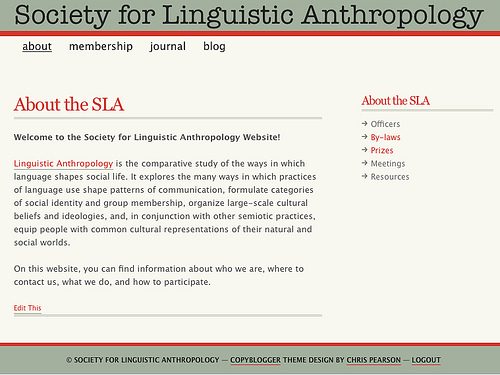
Announcing the redesigned SLA website

When the Society for Linguistic Anthropology was discussing a site redesign, I volunteered to be an advisor. When they started talking about paying thousands of dollars to a web designer who designed static sites which failed to conform to web standards, lacked an easy to use administrative backend and contained no integrated blog or rss feeds, I offered to do the site for free.

Well, you get what you pay for. The new SLA website may not be pretty, but it does have an RSS feed!

Society for Linguistic Anthropology
Continue reading

Rethinking Language and Culture

Edge asked a number of scientists, artists, and intellectuals to answer the question: “What have you changed your mind about?” It is a treasure trove of thought-provoking commentary by some of the leading thinkers of our time. Especially interesting is the large number of scientists who have changed their mind with regard to the very nature of scientific enquiry, although I sensed that the many Evolutionary Psychologists in the survey are noticeably less troubled by the epistemological underpinnings of their research.

Anthropologists are somewhat less well represented here, but there are a few. What caught my eye, however, were two posts about language and the mind. One by Daniel Everett, famed for his research on the Pirahã (see this round-up of discussion over at Language Log), where he discusses his own theory of scientific knowledge. Everett critiques what he calls “homeopathic bias” in science. This is the belief “scientific knowledge is built up bit by little bit as we move cumulatively towards the truth” (discussed in this earlier Savage Minds post). Everett uses the term “bias” because he thinks this incremental view of science biases scholars against non-homeopathic doses of criticism, which they see as “arrogant.” The bias works both ways, both preventing scholars from making big claims for their own research, as well as preventing them from paying attention to research which makes such claims.

Everett says he came to this conclusion because of his own work on the Pirahã:
Continue reading

Greater Blogazonia

Lev Michael has long been an excellent contributor to discussions here on Savage Minds, but I hadn’t noticed that he recently started his own blog. Although for the past few weeks he’s been linking to it in his comments, I hadn’t noticed until I read this post recommending his blog on Language Hat.

Lev is a Ph.D. candidate in the excellent linguistic anthropology program at UT Austin, where he studies “the strategic use of grammatical resources in interaction, language documentation and revitalization, and language politics” in the Peruvian Amazon.

His blog, Greater Blogazonia, already has a bunch of great posts, including thoughts on Unwrapping the Sacred Bundle and this great post about “the unintentionally hilarious situation of white people referring to this indigenous Amazonian group as the ‘white people’.”

I’m really glad to see so many high quality new anthropology blogs popping up. If you’ve started a new one recently, please let us know! And don’t forget to add it to the Academic Blog Wiki. Someday we’ll update our blogroll…

Ivory Tower vs. Real World

In our discussions about anthropologists in the military the term “ivory tower” has come up again and again, as has its antipode, “the real world.” These terms work rhetorically to oppose academic elitism and detachment against the difficult moral choices one must make in everyday life. A couple of things really bother me about the way these words are used:

First, it seems that “the real world” is always invoked when someone feels the need to justify decisions made which will help the elite. The “real world” requires us to support military dictators, cut jobs, pollute the environment, etc. You almost never hear someone talk about how in the “real world” we must build up the institutions of democracy, support unions, or protect our natural resources. Why are these choices less “real”?

Second, the labeling of anthropologists as ivory tower intellectuals is just odd. Most anthropologists I know are very much engaged in the real-world problems of their informants, love nothing more than to be in the field, and many, many, anthropologists are politically active both at home and abroad. It is true that anthropologists tend to shun the role of “public intellectual” and engagement with mainstream US politics, but they are very active in a large variety of other ways.

Third, it is odd that academics are accused of being “ivory tower intellectuals” precisely at the moment that are engaging politically in the US public sphere. To be passive subjects of military policy would be less “ivory tower” than to speak out against it?

Fourth, I always hated the term “the real world.” Of all the jobs I’ve had in my life – and I’ve done a little of everything, from selling ice cream, to bar-tending, etc. – my experience in corporate america was the least “real” of them all. People in management positions were all white and played solitaire on their computer half the day, when they weren’t gossiping, while minority employees worked their asses off answering phones and sweeping the floor. These privileged yuppies had no idea about the world outside their protected suburban enclaves, and yet they are considered as having jobs in the “real world” because they earn more money?

The fact that the real world involves difficult moral judgments should be a reason for serious academic debate about the basis for those judgments, not a reason for silencing that debate.

He Says, She Says

The Guardian is publishing three excerpts from Deborah Cameron’s new book, The Myth of Mars and Venus, a debunking of myths about language and gender. Not a few of these myths are perpetuated by linguistic anthropologists like bestselling author Deborah Tannen, who is very much in Cameron’s cross hairs as she writes this book. Here is how she concludes the second excerpt:

But the research evidence does not support the claims made by Tannen and others about the nature, the causes, and the prevalence of male-female miscommunication. No doubt some conflicts between individual men and women are caused by misunderstanding: the potential for communication to go awry is latent in every exchange between humans, simply because language is not telepathy. But the idea that men and women have a particular problem because they differ systematically in their ways of using language, and that this is the major source of conflict between them, does not stand up to scrutiny.

In the first piece she argues that the literature is biased in favor of research which proves that there is a difference:

In relation to men and women, our most basic stereotypical expectation is simply that they will be different rather than the same. We actively look for differences, and seek out sources that discuss them. Most research studies investigating the behaviour of men and women are designed around the question: is there a difference? And the presumption is usually that there will be. If a study finds a significant difference between male and female subjects, that is considered to be a “positive” finding, and has a good chance of being published. A study that finds no significant differences is less likely to be published.

She includes a chart from one such “negative” study.

While linguistic anthropologists may need to update their course syllabi a bit, I don’t think this is going to have a major impact on the study of language and gender. After all, the very fact that people insist on seeing strong differences where there are none is an important part of the socio-cultural world in which we live. Moreover, these stereotypes about masculine and feminine linguistic styles very much inform our speech practices.
Continue reading

A note on the Eskimo snow thing

I did a satisfying little bibliography crawl recently to track down some references on the wrong-but-ubiquitous idea that ‘Eskimo have 100/354/1,000 words for snow’ which I thought I’d share here for people’s convenience. Most of the work done on this topic comes from Laura Martin’s “‘Eskimo Words for Snow’: A Case Study in the Growth and Decay of an Anthropological Example”:http://links.jstor.org/sici?sici=0002-7294%28198606%292%3A88%3A2%3C418%3A%22WFSAC%3E2.0.CO%3B2-A (aka American Anthropologist, New Series, Vol. 88, No. 2 (Jun., 1986), pp. 418-423). The more accessible and well-known publication is Geoffrey Pullum’s “Great Eskimo Vocabulary Hoax”:http://www.springerlink.com/content/k0h25l886617384u/?p=cbd1112e3d4a4a848723659c1522cf4a&pi=1 (Natural Language and Linguistic Theory 7, 275-281). It’s been published in several other places (you can check out his “publications list”:http://people.ucsc.edu/~pullum/publications.html). The way that some universities are today, though, you may have an easier time getting a PDF off of Springer than tracking “the eponymous paperback”:http://books.google.com/books?vid=ISBN0226685349&id=jp5JCaP_xpIC&pg=PP1&lpg=PP1&ots=50UblijtvM&dq=geoffrey+pullum&sig=Tf-xoYyRCVhcG7BvdzGAC-nIbm8&hl=en. Finally, there is also a brief comment on “Snowing Canonical Texts”:http://links.jstor.org/sici?sici=0002-7294%28198706%292%3A89%3A2%3C443%3ASCT%3E2.0.CO%3B2-P by Stephen O. Murray (American Anthropologist, New Series, Vol. 89, No. 2 (Jun., 1987), pp. 443-444) which comments on Martin’s use of Boas’s original brief mention of snow. Anyway I thought it would be useful to have all this digested here.

The short version — for people who didn’t get the memo — is that the Eskimo do not have 100/354/1,000 words for snow.