Tag Archives: Language

Why Bad Science Happens

Via the Linguistic Anthropology blog, I came across this excellent post by Lauren Squires, entitled “The social life of prescriptivism.” In it, Squires explains to the more positivisticly minded just what social science can contribute to understanding why bad linguistics happens. She brings together several related strains of linguistic anthropology/sociolinguistics research: language attitudes, language ideologies, linguistic awareness, linguistic capital (although she doesn’t call it that), etc.

For those of us trained in linguistic anthropology none of this is new, but I think we tend to forget just how little other people are aware of this research. The linguistics section of most bookstores is one of the smallest, and the anthropological sub-section is usually confined to one or two readers on language and gender. But what struck me about this post is that the same kind of thing could easily be written for any subject where scientists gripe about people not understanding their work, whether it is evolutionary theory or climate change, etc.

Take Richard Dawkins book, The God Delusion for instance. The rational argument against the existence of god has been around a long time, and it hasn’t made much headway for a reason. Those reasons are complex, to be sure, but there is a large literature in anthropology that can help us at least begin to understand the continuing appeal of a divine creator.

The trick is to assume that people say and believe the things they do not simply out of error or ignorance, but because within the world in which they live these beliefs make sense and are actually helpful to them. The very fact that church attendance is so much more a part of people’s lives in the US than in Europe should clue us in to the fact that there are important sociological factors going on here. While American’s may not fair as well in math and science as Europeans, I don’t think that math and science education alone can explain these differences.

UPDATE: I forgot to plug the prescriptivism page on my wiki!

J.I. Staley Prize Winner Announced

Charles L. Briggs and Clara Mantini-Briggs are the winners of this year’s J.I. Staley Prize, for their book Stories in the Time of Cholera: Racial Profiling During a Medical Nightmare.

The book recounts the 1992-1993 cholera outbreak that killed some 500 people, mostly indigenous, in eastern Venezuela’s Orinoco River Delta. The disease had been absent from Latin American for nearly a century. Cholera can kill healthy adults in as little as 12 hours and can make a 15-year-old appear geriatric, Briggs and Mantini-Briggs note in the book, but is prevented easily by the provision of uncontaminated food and water and is easily treated.

… The book draws from hundreds of interviews conducted from 1992-1999 with people from a cross-section of ages, occupations, social positions and degrees of bilingualism in the delta region, and the Venezuelan capital of Caracas. The authors recorded the stories of medical personnel, journalists, families of those killed by cholera, disease survivors, community leaders and government officials, traditional healers, missionaries, and others.

… In November 2006, [Charles] Briggs won the Edward Sapir Book Prize, the highest award in linguistic anthropology for co-authoring [with Richard Bauman], Voices of Modernity: Language Ideologies and the Politics of Inequality

Wartime Anthropological Linguistics

We’ve had a fair bit of discussion, here at Savage Minds, about the role of anthropologists during wartime, an issue which has troubled American anthropologists as far back as Boas. There has also been a lot of discussion as of late about the shortage of Arab speakers in the US military and intelligence community. (The policy on gays in the military makes it unlikely that there will be an American T.E. Lawrence.) So, within this context I’ve been meaning to link to Mark Liberman’s Language Log post on Mary Haas, who had studied with Edward Sapir and gone on to head the Linguistic Society of America.

For Haas, as for most of the other linguists of her generation, the watershed of her career was the onset of the Second World War. In 1940-41, as the United States moved toward entering the war, a cadre of field linguists was recruited to learn and teach the lesser-known languages of the European and Pacific theatres. … Recruited to study Far Eastern languages — and ordered to produce practical handbooks, teaching grammars and vocabularies — were such scholars as William S. Cornyn, who was assigned Burmese; Murray Emeneau, who was channeled into the study of Vietnamese; and Haas, who got Thai. Given the near total lack of teaching materials on Thai in those days, Haas, like Cornyn and Emeneau, had to learn her language from scratch, through direct elicitation from native speakers…

Haas spent 1941-43 at the University of Michigan acquiring a knowledge of Thai phonology and syntax through intensive fieldwork with Thai speakers, one of whom, Heng R. Subhanka, became her second husband. … in 1943 she went to Berkeley where the Army Specialized Training Program had been set up, under the direction of A. L. Kroeber, to teach strategic languages to servicemen.

Liberman, noting without comment the contrast between the eagerness to help with the war effort back then, and the greater suspicion that exists now, wonders whether it was Kroeber himself who organized this effort? (Mark also notes that Kroeber was Ursula K. Le Guin’s father, but fails to mention that he is also from my hometown, Hoboken NJ!)

UPDATE: More here and here.

Ethnography (not) in Translation

As I desperately scramble to prepare my syllabi for the new semester (our winter break falls on the lunar new year), I run into the same problem I’ve dealt with every semester since I began teaching in Taiwan: hardly any ethnographies (or social science textbooks for that matter) are translated into Chinese.

This is not a problem unique to me, the only non-native speaker in the department; all the Taiwanese professors share the same frustration. Almost all of my colleagues are educated in the US or Europe and wrote their dissertations relying heavily on English language sources, almost none of which have been translated. They naturally want to teach using the materials that they are familiar with from their own studies. (At another time I plan to write more about the ways we and our students cope with this situation, such as when students resort to scanning entire chapters, or even books, and running them through machine translation software which spits out pure gibberish. But for now I want to focus on the issue of translation.)

Whether texts are old or new, famous or obscure doesn’t seem to matter. What is translated seems to largely be a matter of the personal whims of the translators. In some cases I’ve been told that the translations which do exist are so bad that student’s prefer to use the English (although I’ve yet to see a student read the English version when a translation is available).
Continue reading

Great Diagrams in the History of Anthropology: Iconism, Ecologism, and the Wild Man

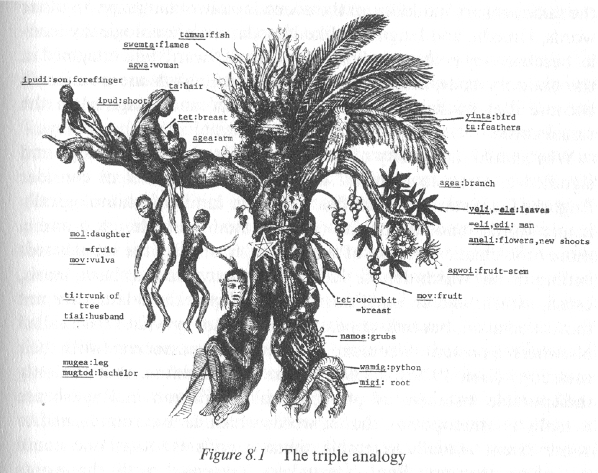
Following previous discussions of semiosilversteinianism and Rex’s suggestion regarding ‘great diagrams,’ I looked up this wild diagram, from perhaps anthropology’s most accomplished sketch artist: Alfred Gell.

Gell

From Gell’s essay, “The Language of the Forest,” which relates phonological iconism to the ‘auditory culture’ and sylvan mode of being of Umeda people in New Guinea. I quote at length:

Phonological iconism […] depends on tracing connections between the sound-substance of individual words and morphemes and their meanings. As a culturally elaborated expressive mode it is probably quite rare, if only because the regular processes of sound-shift which all languages undergo would ensure, other things being equal, that phonologically iconic forms evolved into non-iconic ones after a lapse of time. Only where things are not equal, that is, where there are specific cultural vectors tending to preserve, generalize and intensify expressivity against the countervailing forces of morphological change, should one expect to encounter elaborate phonological iconism as opposed to sporadic onomatopoeia.

Linguistic Anthropology

It is already 2007 here in Taiwan, and what better way to start off the new year than with the announcement of a new anthropology blog!

Welcome to Linguistic Anthropology, a group blog from the members of the Linguistic Anthropology e-mail list (of which I myself am a member – although it is Leila Monaghan who deserves credit for getting this thing off the ground – I had nothing to do with it).

So far the blog sports two excellent posts: one by Chad Nilep on “technology isolation syndrome” (i.e. the medicalization of youth by the BBC), and the other one by Leila about how to teach an introductory course in “sign languages and Deaf culture.”

Video in the Villages

Wired has an article about indigenous media production, based on the 13th Native American Film + Video Festival, organized by the National Museum of the American Indian (NMAI).

The emphasis of the article is on how indigenous media is being used as an organizational tool. This is nothing new for anthropologists, Terence Turner having written about the same phenomenon as early as 1992. This being an article from Wired, I’m surprised that there wasn’t more of a focus on online media. Obviously in many communities it is difficult to access online media, however, activists do often have access to the web and being able to download material and redistribute it offline seems like a reasonable next step (if it isn’t already being done). This is one of the premises of the v2v network. CurrentTV is also interesting, working like Digg in allowing users to vote on which material will get broadcast. Taiwanese Aborigines are already using online media quite extensively, with blog.ohaiya.com and the more wide ranging Docupark wiki also hosting some Aboriginal content.

For anthropologists wishing to teach Turner’s article the Video in the Villages collection is available from DER, and I see that the film festival website links to various distributors for each of the works they presented. The advantage of material screened at festivals and distributed in the US is that it will have English subtitles. The need for subtitling is a big barrier for indigenous activism that seeks to reach a wider audience. One option is dotsub.com which “provides free browser based tools that allow anyone to translate films from one language into countless other languages.”

Those Hostie Quebecers

Following up on our earlier post on linguistic taboos, the Washington Post has a great article about cursing in Quebecois, where it seems that it is religion, not sex or bodily functions which is the basis of much of their vulgarisms.

“Oh, tabernacle!” The man swore in French as a car splashed through a puddle, sending water onto his pants. He could never be quoted in the papers here. It is too profane.

So are other angry oaths that sound innocuous in English: chalice, host, baptism. In French-speaking Quebec, swearing sounds like an inventory being taken at a church.

… The French here also modify the oaths into non-words, depending on the level of politeness desired. The word “bapteme” — baptism — is used as a strong oath, but a modification, “bateche,” is milder. The sacramental wafer, a “host” in English and “hostie” in French, can be watered down to just the sound “sst” in polite company. “Tabernacle” can become just “tabar” to avoid too much offense.

The oaths are so ingrained that one cannot converse fluently without them, said Lapierre. “I teach them in my class.”

More from Language Log.

WT_? Linguistic Taboos

Over at Language Log there has been an ongoing fascination with a particularly anthropological topic: taboos. Specifically, avoidance of taboo words and how the media handles it. For instance: @#$%, f**k, or f_ck, or, even just the letter “f” as in WT_? Not that we have any such fucking compunctions here at Savage Minds.

This post by Arnold Zwicky archives all of the related Language Log posts on the topic.

Anybody interested in this particular taboo word is well advised to read Fairman’s amazing essay on “the legal implications of the word fuck.” Or this motion to dismiss an actual court case based on the constitutionality of the word.

Linguistic taboos are an important part of Chinese speaking societies, although they are usually motivated by concerns about luck rather than politeness (although that too), as is explained by Taiwan’s Government Information Office:

Chinese folk beliefs abound with special do’s and don’ts. Most of these involve special ceremonies and events, and many taboos have to do with puns in the Chinese language. For instance, both the word for “happiness” and the word for “fish” are pronounced yu. On Chinese New Year day, a fish is cooked and set on the table, but not eaten – so that the family will enjoy a full year of fortune.

The web site lists a few examples, but the only major academic treatment of the subject that I’ve managed to find so far is an article written in 1979 which I’ll have to track down in the library since it isn’t available online:

Sung, Margaret. 1979. “Chinese language and culture: a study of homonyms, lucky words and taboos.” Journal of Chinese Linguistics 7.1:15-28.

Savage and Tripping Minds

I just had the extraordinary pleasure of seeing longtime friend and fellow-traveler Richard Doyle give a talk at Rice called “Just Say Yes to the Noosphere.” Rich is the author of On Beyond Living and Wetwares; we met at MIT; his advisor at Berkeley had been Evelyn Fox Keller who had moved to MIT. Rich is a rarity in academia: a kind of contemporary Bateson who insinuates himself into all kinds of interesting research projects; he’s just as willing to run a composition and rhetoric program as he is willing to be the American representative to the International Electrotechnical Commission’s Joint Standards Committee on Bio-Telemetrics. Rich’s talk was about the 20th century history of psychadelics research, and especially, research in unlikely places: like AMPEX, for instance (the inventor of magnetic video-tape), whose engineers experimented with LSD. It’s no secret how widespread the experimentation and research on psychadelics was from about the 1930s into the 1960s. After that, however, hysteria served to associate the research and on psychadelics with 1) drugs 2) bad graphics and 3) pseudo-science and new age mysticism.
Continue reading

Popular Films for Teaching Linguistic Anthropology

I recently queried the Linguistic Anthropology e-mail list, Linganth, for suggestions as to popular films with language related themes. Most professors teaching linguistic anthropology in the United States rely on a few tried-and-true films in their classes: American Tongues, Crosstalk, and a few TV documentaries about animal communication and the evolution of language. Unfortunately, these films don’t really hold up in Taiwan, where watching films is difficult without subtitles and subtitled films are limited to a few famous documentary films and mainstream hollywood fare (including classics). For this reason I wanted to have a good list of mainstream films I might consider for use in my classes.

I was treated with a wealth of materials, including three articles on the subject from the Anthropology News SLA column, written by Mark Peterson (with contributions from the Anthrosource e-mail list), materials from Hal Schiffman’s course “Language and Popular Culture,” and many additional suggestions from list members, which I’ve included below the fold.

One topic which is quite popular with the linguistic anthropologist crowd is Star Trek, so I it is worth mentioning a new documentary film about people who speak Klingon. Unfortunately, I don’t think Star Trek is very popular with my students, who grew up on steady diet of Japanese anime. Perhaps I need to compile a list of linguistically interesting anime?
Continue reading

Cognitive science, meet the angel of history

The New York Times is running “an article”:http://www.nytimes.com/2006/06/27/science/27side.html?r=2&oref=slogin&oref=slogin on a “recent article in _Cognitive Science“:http://www.leaonline.com/doi/abs/10.1207/s15516709cog0000_62 by Nunez and Sweetser which demonstrates that Aymara speakers imagine the past to be in front of them and the future behind them — reversed, in other words, from the spatial metaphors we use in English. The Times article notes “If they are right, this is bigger than anything the 60’s tossed up. Is it possible that human concepts of time can vary this much because of language and culture? And what would it be like to think this way? Do I have the rest of my life behind me? And how can I let bygones be bygones if they’re right in front of me?” Nunez and Sweetser also makes a to-do about the rarity of this pattern, since, it claims that “so far all documented languages appear to share a spatial metaphor mapping future events onto spatial locations in front of Ego and past events onto locations behind Ego.”

Cognitive Science produce attention-grabbing headlines much more frequently than anthropologists, and this article is a prime example of how they manage to do so: ignorance.

Have Nunez and Sweetser actually conducted some sort of exhaustive examination of ‘all documented languages’? No. In fact their citations reveal that they have examined a grand total of seven: English, Wolof, Chagga, Chinese, Japanese, Turkish, and American Sign Language (to be fair one of the articles they site has ‘more cross cultural data’).

If Nunez and Sweetser had looked a little bit further — for example to the Pacific — they would have found that these sorts of metaphors are quite common. Consider:

It is interesting to note that in Hawaiian, the past is referred to as ka wa mamua, or “the time in front or before.” Whereas the future, when thought of at all, is Ka wa mahope, or “the time which comes after or behind.” It is as if the Hawaiian stands firmly in the present, with his back to the future, and his eyes fixed upon the past, seeking historical answers for present-day dilemmas. Such an orientation is to the Hawaiian an eminently practical one, for the future is always unknown, whereas the past is rich in glory and knowledge. – Lilikala Kame’eleihiwa, Native Land, Foreign Desires, p. 22-23

Or this one:

Ka wa mamua and ka wa mahope are the Hawaiian terms for the past and future, respectively. But note that ka wa mamua (past) means the time before, in front, or forward. Ka wa mahope (future) means the time after or behind. These terms do not merely describe time, but the Hawaiians’ orientation to it. We face the past, confidently interpreting the present, cautiously backing into the future, guided by what our ancestors knew and did. -Jon Osorio, Dismembering Lahui p.7

which resonate wonderfully with:

This is how one pictures the angel of history. His face is turned toward the past. Where we perceive a chain of events, he sees one single catastrophe that keeps piling wreckage upon wreckage and hurls it in front of his feet. The angel would like to stay, awaken the dead, and make whole what has been smashed. But a storm is blowing from Paradise; it has got caught in his wings with such violence that the angel can no longer close them. The storm irresistibly propels him into the future to which his back is turned, while the pile of debris before him grows skyward. This storm is what we call progress. -Walter Benjamin

Thus Hawai’ians, like Benjamin’s Angel of History, also imagine the future behind them and the past ahead of them. A friend who studies Babylonian reports something similar. And of course the English term “before” when used spatially does actually mean ‘in front of’ — how many stagings of MacBeth have you seen in which he asks “is this a dagger I see before me, the handle towards my ass?” Timelines typically run from left to right, where the movement from distal to proximal time is analogized to the direction of the motion of the act of writing (in English).

So it would be interesting to see how wide-spread various spatial metaphors of time are both within and across cultures, and I wouldn’t be surprised if — once someone actualy gathered some EVIDENCE — future:past::front:back is a primary and widespread way connecting these dots.

But this article and the coverage of it epitomizes everything that is wrong with cognitive science as a discipline (although, to be fair, there is certainly a lot right with it as well) and how it is received by the press and public. It confirms our popular prejudices by rediscovering Standard Average European cultural categories as ‘universal’ and relegating other cultures to ‘exotic’ and ‘unusual’ status — a move that requires an incredible forgetfulness of human cultural diversity.

No Word for Pollutants

Language Log has a long series of posts on the popular trope that certain societies have “no word for X.” The latest is this gem from The Lexicographer’s Rules:

word_for_pollutants

Langauge Log adds a depressing footnote:

Fiji’s population growth rate is moderate, but the urban and peri-urban growth rate is high, and is clearly outstripping infra-structural planning and development. Thus it is primarily responsible for the important social issues of environmental concern, such as housing, water and sanitation. Direct regulating control of water or air pollution and monitoring are absent. …

If only they had a word for pollutants … they might be able to have some laws to monitor things like this!

For those who don’t wish to read all the Language Log posts on the topic, here is a quote from Geoffrey Pullum that hits the nail on the head:

The late philosopher Jerry Katz maintained that natural languages were inherently without expressive limits: that because of their expressive power and the possibility of paraphrasing when the lexicon provided no short way of making reference to a concept, there were no limits at all on what could be said in a natural language: the set of propositions that could conceivably be expressed in some language or other and the set of English sentence meanings were the same set. It seems very likely to me that Katz was right. But this whole do-they-have-a-word-for-it thing seems to be tacitly predicated on the unargued assumption that he was wrong.

Finally, just in case anyone might be led to blame Whorf for this whole “no word for x” trope. (As Grant Barrett does in his original post.) It really has nothing to do with the Sapir-Whorf hypothesis. Barrett links to this page which says that “neither Sapir or Whorf made it very clear whether they were arguing for strong or weak determinism.” I disagree. I think it is fairly clear that they are arguing for a weak or “facilitating” determinism.

The Real Saussure

In July of this year Oxford University Press will be publishing the English edition of recently discovered notes by Ferdinand de Saussure. These notes are important because they formed the basis for his famous Cours de Linguistique Generale, the founding text of structuralism. This is remarkable, because up till now the authoritative text had been based primarily on the notes of Saussure’s students. These new notes have been available in French for a number of years without any major shake-up in the world of linguistics, but their publication in English will still be an important event. Still, the blurb on the OUP website is laughable for its Batman-esque efforts to drum up excitement:

It is remarkable that for eighty years the understanding of Saussure’s thought has depended on an incomplete and non-definitive text, the sometimes aphoristic formulations of which gave rise to many creative interpretations and arguments for and against Saussure. Did he, or did he not, see language as a-social and a-historical? Did he, or did he not, rule out the study of speech within linguistics? Was he a reductionist? These disputes and many others can now be resolved on the basis of the work now published.

To find out, tune in next week, same Saussure-time, same Saussure-channel ….
Continue reading

First Peoples of Africa?

Now that I teach in a department of “Indigenous Cultures” I have become increasingly concerned with how people come to be defined as “indigenous” and what that means. Most recently, I took a quick look at the question of whether or not people in Africa have effectively claimed the status of “First Peoples” as indigenous peoples elsewhere have done. After all, most Africans are indigenous to the continent, even if there have been internal migrations.

The web site of IPACC, the Indigenous Peoples of Africa Coordinating Committee has this to say:

Today, groups claiming to be ‘indigenous’ in Africa are mostly those who have been living by hunting and gathering or by transhumant (migratory nomadic) pastoralism. These are different peoples who have followed particular trajectories of cultural and economic evolution in specific environmental conditions such as the equatorial rainforests, the Atlas, Hoggar and Tibesti mountain ranges, the Rift Valley and the deserts of the Sahara and the Kalahari.

Some Africans may be offended by the idea that one ethnic group should be called ‘indigenous’ and others not. IPACC recognises that all Africans should enjoy equal rights and respect. All of Africa’s diversity is to be valued. Particular communities, due to historical and environmental circumstances, have found themselves outside the state-system and underrepresented in governance. These ‘first-peoples’ or ‘autochthonous peoples’ have associated themselves with the United Nations’ standards on the rights of indigenous peoples. This is not to deny other Africans their status; it is to emphasise that affirmative recognition is necessary for hunter-gatherers and herding peoples to ensure their survival.

This is clearly a fairly defensive position for what must be a rather controversial topic, yet it seems intuitively obvious that the people who fall within this category do share certain characteristics with other indigenous communities around the world.

However, looking in AnthroSource I found two articles which address these issues, both from a special American Anthropologist issue on Indigenous Rights Movements from 2002:

These articles were much more sanguine about the utility of indigenous identities in the African context. The first article, by Renée Sylvain, highlights one of the problem of place-based rights movements. Those San1 who continue to live in remote segregated homelands share many features with other indigenous communities, but those who have integrated into urban society face a very different set of issues. The author also expresses concern over the essentialized notions of culture that come with identification as an “indigenous” people. The second article, by Dorothy L. Hodgson, looks at hunter-gatherer and pastoralists who find themselves caught between the competing discourses of state sponsors and those of international indigenous rights activist groups, contradictions which were seen by activists as ultimately undermining their political effectiveness.

If anyone has direct experience working with these issues in the African context I’d love to know more.

1 I know, I know, some say that term is now out of favor – but as far as I can tell it is still being used in the South African literature.