Hellz yes National Anthropology Day is ON

The Internetz were atwitter recently with the announcement that 19th February 2015 is officially going to be National Anthropology Day. And yet some people expressed confusion. What is National Anthropology Day? What does it mean? What are we supposed to do? Some questions were quickly answered: If the holiday is generically labeled ‘National’ that must mean ‘They do it in the US’. But others questions persist — why this day, instead of other days? What, concretely, will occur?

The Official National Anthropology Day website provides  some useful handouts, but no deeper contextualization of what the holiday is supposed to be about. This has led some people to grouse that it is a ‘fake holiday’. For this reason I wanted to write this blog post to help people understand why 19 February 2015 is finally getting the attention it deserves.

Continue reading

The Ethnographic Book Trailer?

Movie trailers have been around for decades, and part of the fun of going to the cinema was always the sneak peaks of upcoming movies. With the proliferation of digital software like iMovie, and the ease of uploading just about anything to YouTube, the trailer has migrated from the world of movies over to the book industry. Trade presses regularly create book trailers to promote their new releases even while some authors bemoan the fact that they must now push their written texts using visual media. In her 2013 New Yorker article, “The Awkward Art of Book Trailers,” Rachel Arons recognizes that although book trailers “are often dismal,” there exist instances of genuine creativity.

Should "academic" be added to the standard templates for trailers in iMovie?
Should “academic” be added to the standard templates for trailers in iMovie?

University presses seem to be jumping on the bandwagon, and some now produce trailers for their “cross-over” books. For Ruth Behar’s latest book, Traveling Heavy: A Memoir Between Journeys, Duke University Press released a short trailer featuring the author as she prepares for a trip. For her monograph, We Want What’s Ours: Learning from South Africa’s Land Restitution Program, author Bernadette Atuahene gives a passionate two-minute overview of her argument. Princeton University Press produced a dramatic one-minute trailer for Adrienne Mayor’s book, The Amazons, and a thoughtful two-minute synopsis featuring sociologist Amin Ghaziani discussing his book, There Goes the Gayborhood?.

Continue Reading

Ethnographers as Writers: Consider Endnotes

Most students and scholars learn the disciplinary conventions regarding citation and never think about them again. But citation practices vary widely both between and within disciplines, and once you’re past the dissertation, you have far more flexibility in choosing your own citation style than you think. To be sure, academic journals have their own house styles for articles. The 2009 style guide for all journals of the American Anthropological Association states: “All references must be cited in author-date form; all author-date citations must be referenced,” and the guide provides detailed instructions for how to use the author-date format for e-mails, websites, brochures, and other eclectic materials.

Maybe in-text citations were also easier to include when folks used to write on typewriters.  Footnotes must have been a nightmare!
Maybe in-text citations were also easier to include when folks used to write on typewriters. Footnotes must have been a nightmare!

But where did these conventions originate and how did they come to anthropology? The standard of in-text author-date citation derives from something called the “Harvard style,” which originated in the field of zoology. In 1881, the zoologist Edward Laurens Mark published an important paper on the garden slug wherein he included the first parenthetical author-date citation. This system spread out from zoology to other natural sciences where the author’s name and the date of the publication are the two most important pieces of information. Prior to Mark’s invention of the author-date referencing system, footnotes were sprinkled randomly throughout the text and signaled by asterisks and other printer’s marks. The author-date system streamlined citations and favored brevity and clarity.

Continue reading

From #EbolaBeGone to #BlackLivesMatter: Anthropology, misrecognition, and the racial politics of crisis

[Savage Minds is pleased to publish this essay by Thurka Sangaramoorthy and Adia Benton. Thurka Sangaramoorthy is an assistant professor of anthropology at the University of Maryland. She is the author of Treating AIDS: Politics of Difference, Paradox of Prevention (Rutgers University, 2014). Her work on race, health, and inequality in the US has appeared in Medical Anthropology and Human Organization. Adia Benton is an assistant professor of anthropology at Brown University. She is the author of HIV Exceptionalism: Development through Disease in Sierra Leone (University of Minnesota, 2015). Her writing on the West African Ebola outbreak has appeared in Dissent, The New Inquiry and Cultural Anthropology’s Hot Spots series.]

Almost five months into the epidemic, on August 8, 2014, the World Health Organization (WHO) declared the Ebola outbreak in West Africa a “public health emergency of international concern.” Military and police responses — both international and national — played a crucial role in responses to the epidemic. A few weeks later, on August 20th, the Liberian military quarantined residents of West Point in the capital city of Monrovia without advance warning, essentially cutting them off from food and supplies and causing thousands of residents to clash with troops and riot police. Images surfaced of troops firing live rounds and tear gas and viciously beating back residents who challenged the lockdown. Military-enforced quarantines around entire districts of Sierra Leone and the shift of power from the ministry of health to the ministry of defense were key features of its Ebola response.

Across the Atlantic, on August 9, 2014, 18-year old unarmed Michael Brown was shot to death by police officer Darren Wilson in Ferguson, Missouri. Peaceful protests and civil disorder ensued in the following weeks, prompting the governor to declare a “state of emergency” and call on local police and the National Guard to control protests and maintain curfews. Greater public attention was placed on the increasing militarization of local police forces as the grand jury, which was convened to hear evidence of the circumstances surrounding the death of Michael Brown, reached a decision not to indict Officer Wilson. Continue reading

Ethnographers as Writers: Theory and Data – Part II

So I’m staring at some fieldnotes and trying to sort out the best way to blend my theoretical analysis with my ethnographic data. Where to start? How to find the right balance? Once again, I decided to contact fellow ethnographers to gather insights about their writing processes. Sociologist Olga Shevchenko also struggles with what parts of her fieldnotes to include:

I almost never know in advance which parts of the field notes will go into the text, because it takes me some time, and a lot of writing, to figure out what it is exactly that I am going to argue! With interviews, it’s different. There are some turns of phrase that seem to leap off the page, and these are usually those that capture experience in a fresh or complex way. I also tend to notice when a turn of phase, or a metaphor emerges more than once. When I heard a third person compare their everyday life with living on a volcano, I knew it was going to be in the book in a major way. But it also got me thinking about what this metaphor accomplished, which sent me right back to the field notes. When I can’t find a place in the text for an evocative image or turn of phrase that I hear from a respondent, this causes me great torments!

Coding your fieldnotes the old fashioned way

Like Olga, I now spend a lot of time reading my fieldnotes and deciding what material I want to include before I figure out my core argument, a process sometimes called “grounded theory,” a way of incorporating theoretical insights that emerge organically from the fieldwork. I also search for great quotes or turns of phrase that capture something about the everyday experience of my informants.

Continue Reading

What we’re teaching this semester: Political Anthropology

Almost all academics, and a lot of semi- or non-academics, end up teaching in the course of their careers, but we rarely spend much time talking with others about how we think about course design and broader issues about how courses fit into our lives and the lives of our students. With the semester beginning for several Minds, we thought it would be interesting to talk about the courses we teach and the thought that goes into teaching them. Continue reading

Ethnographers as Writers: Theory and Data – Part I

There's nothing more intimidating than a blank page.
There’s nothing more intimidating than a blank page.

Every ethnographer must find a balance between theory and data. Our fieldwork and our specific case studies render our work original, but this work fails to be scholarly if it lacks dialogue with larger theoretical concerns. When writing the dissertation the literature review section remains de rigueur, but most acquisitions editors demand that this section be exorcised from the eventual book manuscript. This means that the theoretical insights inspired by your participant observation must somehow be woven into the final text so as to elucidate your original ideas without burying the reader under an avalanche of information about what other scholars, studying other cases, have said before you.

The task of integrating theory proves difficult for even the most experienced ethnographers, and different scholars maintain varying opinions on its importance. In a 1999 article, anthropologist Ruth Behar argues that theory for theory’s sake undermines the potential vibrancy of ethnographic writing:

What I do find tiresome is the habit of using whatever theory happens to be fashionable…as a substitute for really engaging the tough questions posed by those whom we encounter on our journeys as ethnographers. When ethnographers working in far corners of the globe are all citing the same two pages from the work of the latest trendy theorist, without reflecting on the politics of how that theory travels, you can be sure they have killed the life in their ethnography.

Continue Reading…

The Politics (and Stories) of Fieldwork in Cuba: Good job, President Obama, but is this just ‘here we go again’?

(This guest post comes to us from Laurie Frederik. Laurie is Associate Professor and Director of the Latin American Studies Center at the University of Maryland, College Park.  She is author of Trumpets in the Mountains: Theatre and the Politics of National Culture in Cuba, Duke University Press, 2012, and has been conducting research in Cienfuegos and Guantánamo provinces since 1997. -Rex )

The promised opening up or “normalizing” of diplomatic relations with Cuba may or may not mean that much will change for researchers, although tourists and commercial entrepreneurs rejoice in its potential.  President Obama’s statement had significant performative value, a declaration more powerful than a promise, perhaps, given the authority of the speaker. It was exciting for those of us who have been struggling to conduct research on the island for many years, and it inspired a flurry of projected “what if” and “when…” scenarios.

As amazing as Obama’s and Raul Castro’s televised statements were, however (their simultaneity is also notable), real policy change probably has a long way to go.  There has been easing of restrictions before.  Does anyone really believe that Obama can do more than Carter or Clinton?  Does this moment simply mean that a new generation of ethnographers has a window of opportunity they must seize before the next clampdown and/or next election?  I think we all feel that after 54 years, it’s about time and that Obama would be the man to do it.  What remains to be seen is how fast, to what degree, and how the changes directly affect those on each side of the Florida straits.

Continue reading

Ethnographers as Writers: Getting Started

Every article, book, or thesis begins with a first word, but getting started feels overwhelming. My worst prose derives from disorganized thinking and writing, and over the years I’ve experimented with different systems to help me get my projects off the ground. When I map out some incremental steps, my projects seem more manageable.

First I ask myself: what do I want (or need) to write? This helps determine the best format for my research results. In some cases the format was predetermined for me – when I was a doctoral student I had to produce a dissertation of a certain minimum length. When I write for a journal, they enforce specific word counts. These days, I have a bit more freedom, but I still struggle to determine if I have a book length argument or if my research is best presented as a series of articles.

Before I write the first sentence, I try to visualize the contours of my project. I once typed up outlines, but now I imagine less formal ways to physically manifest a project. At the outset, I spend hours examining my research, beginning to define the distinct sections or chapters. I need a concrete guide that will help me tackle the writing tasks necessary to get from the first to the last word of the project.

Continue Reading

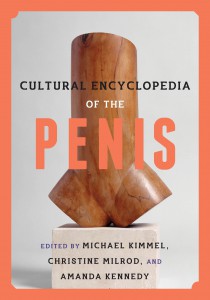
Cultural Encyclopedia of the Penis – [Book Review]

CEP-cover

Cultural Encyclopedia of the Penis
Michael Kimmel, Christine Milrod, and Amanda Kennedy, eds. Lanham: Rowman & Littlefield Publishers, Inc., 2014. 251 pp.

Cultural Encyclopedia of the Penis” is a new publication (October 2014) from Rowman & Littlefield following fast on the heels of its companion “Cultural Encyclopedia of the Breast” which was released in September. I’m told that they’ve been warmly received by anthropologists, as they both sold out rather quickly at the R&L booth at the meeting of the American Anthropological Association this past December in Washington DC. As a budding scholar (ahem) of global masculinities, I thought it would have been silly to not take the opportunity to review Cultural Encyclopedia of the Penis, if not simply for the title and synopsis, definitely because of Michael Kimmel’s involvement. Kimmel, one of three editors (in addition to Christine Milrod and Amanda Kennedy), is one of the more well-known sociological scholars on men and masculinities in America. Of more than a dozen books on the subject, perhaps his best-known is “Guyland: The Perilous World Where Boys become Men,” a book that I would highly recommend for undergraduate- and graduate-level students of Gender Studies. While some of Kimmel’s work is not without some anthropological blindspots (he is not an anthropologist after all), one should be able to approach Cultural Encyclopedia (henceforth, CEP) trusting that a book written by over 90 authors would ultimately deliver on its claim to being “cultural.” It should be noted that this review is written without any knowledge of the content and style of Cultural Encyclopedia of the Breast, which was edited by Merril D. Smith. Continue reading

A Death in the Field

Serendipity confounds me. I spent most of Monday writing the following reflections on the death of a Bulgarian woman, one of my “key informants,” who unexpectedly passed away two weeks ago while I was in Sofia. You can imagine my surprise when I logged on to Savage Minds this morning to post my short tribute to Ana. I encountered Ruth Behar’s beautiful piece on the passing of Esperanza, her comadre in Mexico and the inspiration for Translated Woman. Behar’s essay moved me to tears, and my own purple prose pales in comparison to her poetic rumination on the way an ethnographer’s life can become intertwined with those whose stories we have the privilege to tell. Journalists would say that I’d “been scooped,” since this post evokes many of the same issues and emotions as Behar’s and she is by far the more accomplished writer and anthropologist. But for Ana’s sake, I’ll post this humble essay anyway. The fleeting immortality of the written word is the only gift we ethnographers have to give.

Sveti Sedmochislenitsi church in Sofia, Bulgaria

Getting to know people across the barriers of language, culture, and generations provides one of the greatest joys of ethnographic fieldwork. I dislike the term “informant” because of its negative connotations, especially in the postsocialist context where people once “informed” on each other to the secret police. I prefer the term “fieldwork friends.”

I’ve conducted ethnographic research in Southeastern Europe for eighteen years, and I recognize the difficult power imbalances and the hierarchy of privileges that underpin relationships in the field. My position as an American – first as graduate student, then as professor – provides certain advantages that my fieldwork friends lack. Despite these challenges, I’ve forged close relations with many Bulgarian men and women who’ve shared their lives with me over the years.

Continue Reading

Goodbye, Comadre

[Savage Minds is honored to publish this essay by Ruth Behar. Ruth is the Victor Haim Perera Collegiate Professor of Anthropology at the University of Michigan. She is the author of numerous articles and books including The Vulnerable Observer: Anthropology That Breaks Your Heart (Beacon Press, 1996), An Island Called Home: Returning to Jewish Cuba (Rutgers University Press, 2007), Traveling Heavy: A Memoir In Between Journeys (Duke University Press, 2013), and is co-editor with Deborah Gordon of Women Writing Culture (University of California Press, 1995). Of all her writings, the best known is Translated Woman: Crossing the Border With Esperanza’s Story (Beacon Press, 1993). It is to this book–and to Esperanza–that Ruth returns in the essay below.]

The old year ended and I hadn’t yet said goodbye to Esperanza, my comadre. I just couldn’t believe she was gone.

I knew that the first important thing I needed to do in the new year was to write a farewell letter to her. Now it is Three Kings Day, an appropriate moment to thank her for all the gifts she gave me.

Esperanza and I met on the Day of the Dead in 1983. I was about to turn twenty-seven and all I had to my name was a recent Ph.D. in anthropology. I was living in the town of Mexquitic, in Mexico, fifteen hours from the Laredo border, and trying to decide what to do with my life after a disastrous, humiliating academic job interview. She was fifty-three-years-old, a farmer and street peddler, barely literate. Other women told me to avoid her. She was known to be fiery, rude, and a witch. Continue reading

Ethnographers as Writers: A Light-Hearted Introduction to Academese

Academics are collectively responsible for the production of some of the most obtuse and impenetrable prose in the English language.  Rhetorical fashions come and go, but the penchant for opacity has become a defining feature of contemporary scholarship

We were sitting over the remains of dinner in a Village restaurant when the conversation turned to gender and women’s studies.

“I am an –ism person,” Temma Kaplan, Rutgers historian said to me. “I don’t do –ity.”

I gave her a knowing look.

“It used to be all –isms. Now everything is –ities,” she said.

“But you can’t get a job in women’s studies without working on an –ity.” I said, “–ities are the thing these days.”

She sighed and shrugged.

Academese is the secret code that some scholars use to signal that they are members of the club.  It ensures that no one can really tell whether their ideas are brilliant, bad, or merely mediocre.   This is especially useful when submitting an application to a multidisciplinary search or review committee.  Since academics are so narrowly specialized these days, there are probably only a handful of people in the world who can judge whether a project is truly groundbreaking. 

Learning to write like an academic is difficult. If you don’t want to rely solely on the University of Chicago’s academic sentence generator, you too can learn the subtle art of writing impenetrable prose. It takes time and practice, and not an insubstantial amount of creativity, to produce appropriately complex neologisms for otherwise basic concepts.

Continue Reading

Zora Neale Hurston’s Gifts to Anthropology-Pt 2

Zora and Performance

I am most struck, however, by Zora’s recognition and analysis of the performative nature of Black culture. Years before performance theory was born, Zora Neale Hurston had been there and done that.   We will not find her insights, however, in the traditional scholarly publications. Zora’s discourses on the performative character of Black people are  in essays published in the then groundbreaking anthology, The New Negro edited by Nancy Cunard. There hold a wealth of analysis and interpretation of Negro/Black performativity, and are frequently overlooked.

Many academics today have come to recognize that there is significant intellectual value in having a “public voice” that reaches broader audiences beyond those attracted to our scholarly articles. The Savage Mind blog is a good example of the multiplicity of platforms available to anthropologists to speak their piece outside of the constraints of refereed journal articles.

Zora, like her contemporary Margaret Mead who wrote for RedBook, was a “cultural commentator” or what we call in today’s parlance, a “public intellectual” of the first order. Continue reading

Old Friend, New Contributor

Savage Minds is very happy to welcome long-time “intern” Dick Powis to the ranks of Savage Minds “contributor” (we also call them “Minds”). Dick has been doing a great job all year with the weekly roundups, and he’ll keep doing them until graduate school grinds him down, or we officially launch a search for a new intern. Most people become full-time members of Savage Minds by grabbing our attention with their blogging or guest blogging on the site, but the intern program is a second route, good for people just starting out. (Dick was still in college when he started, although he already had a great anthropology blog.) To be honest, there isn’t really that much difference between being an intern and a full-time member of the blog, except that contributors can take a little more initiative posting “invited posts,” launching special series, and otherwise leveraging the blog into more of a publishing platform than just a place for their personal blog posts. (Interns also have the added responsibility of the weekly and yearly roundups.) Now that he is a contributor, we look forward to seeing Dick taking more of a leadership role here at Savage Minds. Welcome aboard!