Category Archives: Invited post

Fast Writing: Ethnography in the Digital Age

[Savage Minds is pleased to run this essay by guest author Yarimar Bonilla as part of our Writer’s Workshop Series. Yarimar is Assistant Professor of Anthropology and Caribbean Studies at Rutgers University. She is the author of Non-Sovereign Futures: French Caribbean Politics in the Wake of Disenchantment (University of Chicago Press, forthcoming Fall 2015) and has written broadly about social movements, historical imaginaries, and questions of sovereignty in the Caribbean. She is currently a fellow in the History Design Studio at Harvard University where she is working on a digital project entitled “Visualizing Sovereignty.”]

In a recent contribution to this writers’ series, Michael Lambek offered some reflections on the virtues of “slow reading.” In an era of rapid-fire online communication, when images increasingly substitute for text, Lambek argues we would be well served to revel in the quiet interiority and reflective subjectivity made possible by long-form reading.

In this post I would like to think more carefully about this claim and to consider whether we might want to make a similar argument regarding the shifting pace of academic writing. If, as Lambek and others suggest, the temporality of reading has been altered by the digital age, can the same be said for research and writing? How have new digital tools, platforms, and shifts in technological access transformed the temporality of ethnographic writing, and is this something we necessarily wish to slow down? Continue reading
Can’t Get There from Here? Writing Place and Moving Narratives

[Savage Minds is pleased to run this essay by guest author Sarah Besky as part of our Writer’s Workshop Series. Sarah is Assistant Professor in the Department of Anthropology and the School of Natural Resources and Environment and a Postdoctoral Fellow in the Michigan Society of Fellows at the University of Michigan. Starting in Fall 2015, she will be Assistant Professor of Anthropology and International and Public Affairs at Brown University. Sarah specializes in the study of nature, capitalism, and labor in South Asia and the Himalayas. She is the author of The Darjeeling Distinction: Labor and Justice on Fair-Trade Tea Plantations in Darjeeling India (University of California Press, 2014) and other articles on social justice in agriculture and is currently working on a new book project on transparency, financialization, and tea auction reform in Northeast India.]

One of my favorite Saturday Night Live skits is a game show parody called “What’s the Best Way?” The premise is simple: a group of New Englanders jockey to give fast, accurate driving directions. Phil Hartman plays an old man with an airy Downeast Maine drawl; Adam Sandler an electrical contractor from Boston; and Glenn Close an upper-class Connecticut resident. The host, played by Kevin Nealon, asks questions about how to get from one place to another within New England. For example “Who’s got directions from Quincy, Maass to the Jahdan Mahsh department store in Bedford, New Hampshire?” Contestants buzz in, quiz show style, with their directions—directions which are loaded with quirky geographical references, including a “wicked huge Radio Shack” and a fahm that offers a chance to pick fresh Maine blueberries (“but only in the summah”).

I love this skit because it satirizes my own predilection as a native New Englander for giving overly detailed directions that orient the asker to the contours of the road, the colors and shapes of houses, and places that “yous-tah be there” (instead of supposedly conventional things like the number of traffic lights or street names).

But I also find this rather esoteric parody instructive for thinking about how to write place ethnographically. For many anthropologists, navigating fieldsites that are out-of-the way or otherwise marginalized, Phil Hartman’s character’s resigned answer to one directional challenge might ring a little true: Yah caahn’t get theyah from heeyah. Beyond writing about place, how can we use our writing to recall visual, material memories of getting from one place to another (or failing to do so)? Continue reading

University of Toronto: Boundless Exploitation–“Business as Usual” IS the Problem

The following is an invited post by Sarah Williams and Jennifer Gibson.* 

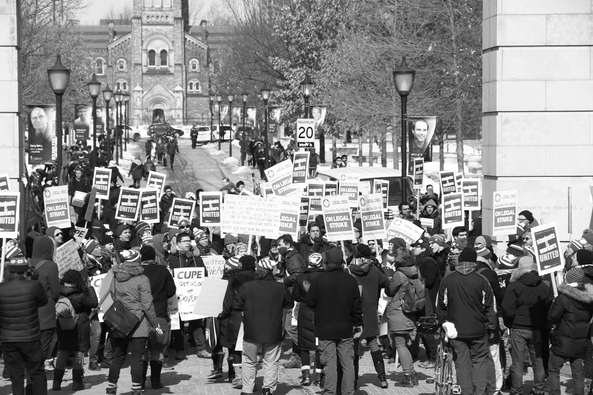
“It’s business as usual at University of Toronto”, the Provost’s messages proclaim. These messages, meant for students and the media, assert that CUPE 3902 Unit 1’s decision to strike has had no impact on undergraduate classes or the daily operations of Canada’s largest university, recently ranked number 20 in the world. This union represents more than 6,000 graduate student employees. The provost’s claims seek to undermine both the value and importance of graduate student labour and justify the administration’s hard line against raising the minimum funding package, stalled at $15,000 per year, to an amount closer to, though not exceeding, Toronto’s version of a poverty line, the “Low Income Cut-Off” (LICO), which is $23,000. However, underneath the calm and unaffected airs of the university administration lies the reality that over 800 undergraduate classes and tutorials are no longer meeting or have been cancelled for the duration of the strike. As finals draw closer, so too does the possibility that students’ graduations may be delayed.

Photo: Daniel Kwan
Photo: Daniel Kwan

At base, the aim articulated by striking CUPE 3902 members is one of structural change to the funding relationship between graduate students and the university. The guaranteed minimum funding package achieved as a direct outcome of this union’s last strike, fifteen years ago, has dramatically diminished in real wage value thanks to the rapidly rising cost of living in one of Canada’s most costly cities, and has not seen any increase to account for inflation since 2008. Meanwhile, tuition––particularly for international students––continues to climb to the maximum rates legal in Ontario ($8,000-20,000––the highest rates in all of Canada). Combined, it is these two issues that have led to the now 21 day standoff between graduate student contract workers and the administration. If any tentative agreement is to achieve ratification, two core demands must be addressed: meaningful increases to the minimum funding package, and significant reductions in post-funded-cohort tuition. Continue reading

Putting on our public face: How can anthropologists get better at it?

The following is an invited post from Erin Taylor. Erin mostly puts on her public face at PopAnth, where she leads a team of editors to provide what John McCreery calls “mentor review.” A firm believer in the responsibility of academic disciplines to disseminate their knowledge, Erin is fond of irritating anthropologists with ideas from economics, and economists with ideas from anthropology. She is also a Research Fellow at the University of Lisbon in Portugal since June 2011, which she describes as “possibly the best career move ever.”

An increasing number of anthropologists recognize the value of making our writing public. We’re improving at both writing and dissemination, but we still have a long way to go. How can we get better at it?

Our reasons for wanting to go public vary. Some of us believe in open access principles. Others feel that disciplinary conversations should take place in the open. Many people use blogs and other Internet-based media to communicate with other anthropologists, and there are increasingly more of us who are interested in outreach to the general public.

However, a lot of our public writing efforts fall short of the mark. We publish without having a clear idea of what audiences we’re aiming for. We struggle to shake off an academic writing style that alienates all but the initiated. We don’t know how to get published on anything other than our own blog or an anthropology website. We lack contacts with journalists, radio producers, and other gatekeepers who can help us disseminate our ideas.

We can do better than this. Continue reading

Karen McCarthy Brown’s Mama Lola, or that Book that Kept Me in Grad School

(Savage Minds is pleased to run this guest column from Gina Athena Ulysse in tribute to Karen McCarthy Brown. Gina is an associate professor of anthropology at Wesleyan University. Born in Haiti, she has lived in the United States for the last thirty years. She is also a poet, performance artist and multi-media artist. Prof U, as her students call her, is the author of Downtown Ladies: Informal Commercial Importers, A Haitian Anthropologist and Self-Making in Jamaica (Chicago 2008). She recently completed Why Haiti Needs New Narratives, a collection of post-quake dispatches, essays and meditations written between 2010-2012. Currently, she is developing VooDooDoll, What if Haiti Were a Woman, a performance-installation project. Her writing has been published in Gastronomica, Souls, and Transition.)

News that Karen McCarthy Brown passed away after years of deteriorating illness reached me earlier this month. I kept it to myself. When more official announcement from Drew University–where she was Professor Emerita of anthropology and sociology of religion—showed up on my Facebook feed this past Sunday, I shared it with the following comment:

Reading Karen’s Mama Lola kept me in grad school. Vodou got a human face from her. A tremendous loss, indeed.

When the first email arrived from UCSB’s Claudine Michel who penned the preface to the third edition of Brown’s award-winning ethnography in 2010, I had a flashback to nearly two decades ago. Continue reading

Writing Archaeology “Alone,” or A Eulogy for a Co-Director

[Savage Minds is pleased to run this essay by guest author Jane Eva Baxter as part of our Writer’s Workshop series. Jane is a historical archaeologist and an Associate Professor of Anthropology at DePaul University in Chicago, IL USA. She is the author of numerous books and articles, including the forthcoming book Childhood and Adolescence in the American Experience (University Press of Florida 2016). You can follow her on twitter @janeevabaxter.]

For the past couple of years, I’ve been suffering from the condition we affectionately know as “writer’s block.” This has not been a generic or widespread condition as much of my writing is progressing as swiftly and smoothly as my job structure allows. This particular writer’s block has been confined to the writing associated with several years of archaeological work I conducted on the island of San Salvador in The Bahamas. The reason for this particular condition is easy to identify: my project co-director simply decided to stop writing.

My co-director and I began planning our research in 2002, and from 2004-2012 we conducted archaeological and historical work investigating transitions in the daily life of the island’s residents. During this time, we co-authored conference papers, site reports, proceedings volume papers, and articles for the Journal of the Bahamas Historical Society. We often co-authored work with our students. We developed curricular materials for the local school, co-authored a popular guide to the historic sites on the island for residents, tourists, and student groups, and created archaeology posters for a small, local museum.

And then, my project co-director stopped writing. At first, this decision to stop writing manifested itself as a waning interest in what had become a rather routinized and comfortable process of co-authorship. Writing plans were disregarded. Deadlines were missed without renegotiation. Discussions about writing ceased. Eventually, he announced he no longer had an interest in publishing scholarly articles, and told me to just go ahead and write everything up on my own. For many, being freed from the bonds of co-authorship might seem liberating, but to me it has been rather paralyzing. It also has given me cause to reflect on the production of archaeological knowledge, and left me to wonder exactly what it means to write without him. Continue reading

Slow Reading

[Savage Minds is pleased to run this essay by guest author Michael Lambek as part of our Writer’s Workshop series. Michael is Professor of Anthropology and Canada Research Chair at the University of Toronto Scarborough. His recent publications include “The Interpretation of Lives or Life as Interpretation: Cohabiting with Spirits in the Malagasy World” (American Ethnologist, 2014 41(3): 491-503) and A Companion to the Anthropology of Religion (edited with Janice Boddy, Wiley-Blackwell), out in paper in fall 2015. The Ethical Condition: Essays on Action, Person, and Value (University of Chicago Press) will also appear in the fall. For the University of Toronto Press, he edits the Anthropological Horizons series in ethnography.]

Instructors on the frontlines report that undergraduate grades are falling into a bimodal distribution rather than the comfortable old bell curve. The majority do poorly, it is said, because they do not know how to write. I suggest the source of the problem lies one step behind writing, in reading.

Writing presupposes reading. To write one has to know how to read and to write well one has to read well. Whether or not we write in order to be read, as Mary Murrell asked in her posting, at the minimum we are our own first readers. We read in order to own our writing, to confirm and assert it is ours, that it is what we want to say and the best way we know how to say it. Even before the copy edit and the proofing, we read what we write; reading is part of the very technique of writing. I am reading these lines as I write them. Continue reading

The Ecology of What We Write

[Savage Minds is pleased to publish this essay by Anand Pandian as part of our Writers’ Workshop series. Anand teaches anthropology at Johns Hopkins University. His books include Reel World: An Anthropology of Creation (Duke University Press and Penguin India, forthcoming this fall), and Ayya’s Accounts: A Ledger of Hope in Modern India (Indiana University Press, 2014), which he wrote with his grandfather.]

One day last summer, a caterpillar dropped from the rim of my desktop monitor. A peculiar little creature—no more than an inch long, clothed in a jacket of wispy white, a jaunty pair of lashes suspended well behind a tiny black head.

The visitation was unexpected. It’s not as though I work in a natural wonderland. The walls of this office are made of painted cinderblock. The window is fixed firmly in place, completely sealed from the outside. Peculiar odors sometimes drift from the vent above my desk, possibly from the labs upstairs.

The caterpillar seemed unhappy with the windowsill, where I placed it for a closer look. So I scooped up the errant traveler and stepped outside the building, wondering, for a moment, whether there was anything more palatable in the turfgrass. Then I went back to writing, back to whatever I could forage for my monitor that day. Continue reading

Why the Peer Review Process Works Even When It Doesn’t

[Savage Minds is pleased to publish this essay by Alan Kaiser as part of our Writers’ Workshop series. Alan is a Professor of Archaeology at the University of Evansville. He has published on issues of Roman culture in Spain, urbanism across the Roman empire, and streets as an organizing principle in Roman cities. He is the author of The Urban Dialogue: An Analysis of the Use of Space in the Roman City of Empúries, Spain (British Archaeological Reports, 2000), Roman Urban Street Networks (Routledge, 2009) and Archaeology, Sexism and Scandal: The Long-Suppressed Story of One Woman’s Discoveries and the Man Who Took Credit for Them (Rowman and Littlefield, 2014).]

Eleven editors and more than two dozen anonymous reviewers rejected my scholarly article. It documented the scandal I had uncovered that David Robinson, famed excavator of the Greek site of Olynthos, had plagiarized the work of his forgotten graduate student, Mary Ellingson. My article clearly made a number of people uncomfortable as there is an unspoken rule among American archaeologists working in Greece that it is bad form to criticize our intellectual ancestors in print. In the end I did get the story published as a book but that was only because I found an editor at Rowman and Littlefield who was a former student of mine and who was determined to help. This would seem to be a case study in the problems with the peer review system but that would be the wrong conclusion; this blog post seeks to prove that peer review works despite the flaws in the system.

Mary Ellingson #1
Continue reading

How a Professional Writer Improved My Academic Writing

[Savage Minds  is pleased to publish this essay by Annie Claus as part of our Writers’ Workshop series. Annie  is assistant professor of anthropology at American University in Washington, D.C. specializing in the social ecology of marine and coastal environments and diverse environmentalisms. She has published work on the impacts of environmental policies on coastal communities, the political ecology of disasters, and conservation social science. Her most recent work analyzes the relationship of Okinawa to Japan through the lens of coral reef conservation.]

I weaseled my way into a writing class as I was finishing my dissertation. Others had advised against taking the course (“just finish your dissertation and worry about its readability later”). But I had been convinced that clear writing reflects clear thinking. If clear thinking emerges through writing with clarity, shouldn’t we all be required to take at least one class about the craft of writing before we inflict our thinking on others?

The professor had taught writing for years and was on the editorial board of The New York Times—a real professional! His (The Pro’s) over-enrolled class was pitched to future journalists but that seemed insignificant to me. I pleaded with The Pro for a spot:

“Anthropologists are also writers, without training or hope. Isn’t it important to make academia a better, more accessible place?”

I argued and implored and won. Continue reading

Finding My Muse While Mourning

[Savage Minds  is pleased to publish this essay by Chelsi West part of our Writers’ Workshop series. Chelsi is a PhD candidate at the University of Texas at Austin. She holds a BA from Millsaps College and an MA from UT. Her research in Albania was funded by J. William Fulbright program, the National Science Foundation, and the International Research and Exchanges Board. She is currently writing her dissertation, tentatively entitled, “Racial Entanglements: Charting Emerging and Shifting Categories of Identity and Belonging in Albania.”]

February is the worst month of the year. I keep repeating these lines in my head as I stare at the blank screen. I struggle to think of anything else to say. The beginning of this month is now becoming some sort of a routine.

My Dad taught me to write in the early morning hours. “When I was your age,” he used tell me, “I went to bed early so that I could wake up around 4 a.m. and do my homework when the house was quiet.” Around age 11 or 12 I began to emulate this practice, though I never quite got a handle on the waking up early part so instead, I just developed late-night writing habits. To this day I usually produce some of my best work between midnight and 5 a.m. When I think about it, my Dad helped me to craft much of my approach to writing. Continue reading

Read More, Write Less

[Savage Minds is pleased to publish this essay by Ruth Behar as part of our Writers’ Workshop series. Ruth is the Victor Haim Perera Collegiate Professor of Anthropology at the University of Michigan. She is the author of numerous articles and books including Translated Woman: Crossing the Border With Esperanza’s Story (Beacon Press, 1993), The Vulnerable Observer: Anthropology That Breaks Your Heart (Beacon Press, 1996), An Island Called Home: Returning to Jewish Cuba (Rutgers University Press, 2007), Traveling Heavy: A Memoir In Between Journeys (Duke University Press, 2013), and is co-editor with Deborah Gordon of Women Writing Culture (University of California Press, 1995).]

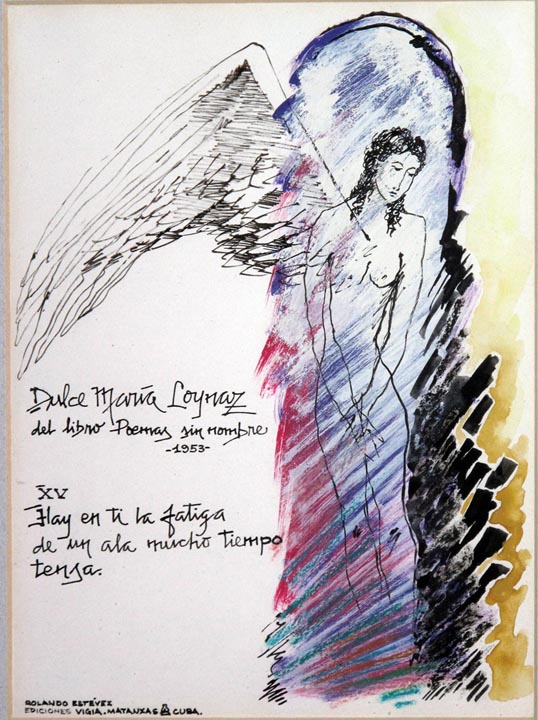
Rolando Estevez painting-Loynaz-Poema XV ala tensa


Years ago, when I started returning to Havana, the city where I was born, I had the good fortune to be welcomed into the home of Cuban poet, Dulce María Loynaz. By then she was in her nineties, frail as a sparrow, nearly blind, and at death’s doorstep, but enormously lucid.

Inspired by her meditative Poemas sin nombre (Poems With No Name), I had written a few poems of my own, and Dulce María had the largeness of heart to ask me to read them aloud to her in the grand salon of her dilapidated mansion. She nodded kindly after each poem and when I finished I thought to ask her, “What advice would you give a writer?” Continue reading

Angry White Buddhists and the Dalai Lama: Appropriation and Politics in the Globalization of Tibetan Buddhism

[Savage Minds is pleased to publish this essay by Ben Joffe. Ben is a PhD candidate at the University of Colorado. He holds a MA from the University of Capetown, and a Wenner-Gren Foundation for Anthropological Research dissertation grant for the project “White Robes, Matted Hair: Tibetan Renouncers, Institutional Authority, and the Mediation of Charisma in Exile.”]

You know that guy. He talks about ‘Tantric yoga’ in casual conversation. Maybe he has dreadlocks. Maybe he’s shaved his head. He’s definitely not had a beverage with regular milk in it for years. He’s probably white and affluent. He’s probably been to India. And he probably wears Buddhist prayer beads as jewelry.

It’s easy enough to compare this stereotype to the ‘serious’ convert to Buddhism, who though they too may talk about Tantra, sport distinctive hairstyles or be white and affluent, seem at least to wear their prayer beads as more than just a fashion statement. Yet, how easy is it to identify where religious conversion begins and cultural appropriation ends? Continue reading

A History of Times We Did Not Laugh

[The following is an invited post by Ritu Gairola Khanduri. Ritu is a cultural anthropologist and historian of India. She is Assistant Professor of Cultural Anthropology at the University of Texas, Arlington. In addition to her research on media, she is currently completing a book on Gandhi and material culture. Research for Caricaturing Culture in India has been supported by the Social Science Research Council, the Fulbright Foundation, the Institute for Historical Research-Mellon Foundation and the Wenner-Gren Foundation’s prestigious Carley Hunt Postdoctoral fellowship.]

These past months have seen carnage of unimaginable magnitude. But none has attracted the outpouring triggered by the Charlie Hebdo killings. What have cartoons got to do with this?

For many, but not most of the world, the experience of freedom is now salient in speech and expression. In this struggle for freedom and rights, and its maintenance, cartoons have become the severest testing ground. We reprimand cartoons. We summon cartoons. We make demands on cartoons.

This generative force of cartoons is at the heart of my book Caricaturing Culture in India: Cartoons and the History in the Modern World.  It is a story of how cartoonists became central to newspapers and politics in India. It is also a history of why cartoons provide a new context for offence and the refusal to laugh.

Continue reading

From #EbolaBeGone to #BlackLivesMatter: Anthropology, misrecognition, and the racial politics of crisis

[Savage Minds is pleased to publish this essay by Thurka Sangaramoorthy and Adia Benton. Thurka Sangaramoorthy is an assistant professor of anthropology at the University of Maryland. She is the author of Treating AIDS: Politics of Difference, Paradox of Prevention (Rutgers University, 2014). Her work on race, health, and inequality in the US has appeared in Medical Anthropology and Human Organization. Adia Benton is an assistant professor of anthropology at Brown University. She is the author of HIV Exceptionalism: Development through Disease in Sierra Leone (University of Minnesota, 2015). Her writing on the West African Ebola outbreak has appeared in Dissent, The New Inquiry and Cultural Anthropology’s Hot Spots series.]

Almost five months into the epidemic, on August 8, 2014, the World Health Organization (WHO) declared the Ebola outbreak in West Africa a “public health emergency of international concern.” Military and police responses — both international and national — played a crucial role in responses to the epidemic. A few weeks later, on August 20th, the Liberian military quarantined residents of West Point in the capital city of Monrovia without advance warning, essentially cutting them off from food and supplies and causing thousands of residents to clash with troops and riot police. Images surfaced of troops firing live rounds and tear gas and viciously beating back residents who challenged the lockdown. Military-enforced quarantines around entire districts of Sierra Leone and the shift of power from the ministry of health to the ministry of defense were key features of its Ebola response.

Across the Atlantic, on August 9, 2014, 18-year old unarmed Michael Brown was shot to death by police officer Darren Wilson in Ferguson, Missouri. Peaceful protests and civil disorder ensued in the following weeks, prompting the governor to declare a “state of emergency” and call on local police and the National Guard to control protests and maintain curfews. Greater public attention was placed on the increasing militarization of local police forces as the grand jury, which was convened to hear evidence of the circumstances surrounding the death of Michael Brown, reached a decision not to indict Officer Wilson. Continue reading