Category Archives: Book review

Breaking Ranks

Since we’ve just entered the 10th year of U.S. military intervention in Afghanistan (well, 10 years this century) it seems a good time to say a few words about Breaking Ranks: Iraq Veterans Speak Out Against The War (University of California Press 2010) co-authored by Matthew Gutmann and Catherine Lutz.

Breaking Ranks recounts, largely through interview excerpts, the stories of six Iraq War veterans who became involved with Iraq Veterans Against the War (IVAW) and other military anti-war organizations and participated in the larger GI Rights Oral History Project. It takes us from their decisions to join the military, through combat, anti-war epiphanies, homecomings, and involvement in anti-war activism.

The patchwork composition of the book reflects the veterans’ attempts to piece together a narrative of their lives defined by the watershed of their experiences in Iraq. While book’s overall structure parses these experiences into a general arc of life—from enlistment, to the shock and fog of war, to political awakening, to struggles with trauma, to activism—it doesn’t smooth over the rough edges of these experiences or impose too clear an order on the muddle of reflexive memories that the soldiers offer.

As the authors note in the introduction, the book is an account of how these six people (five men and one woman; three soldiers, one sailor, one Marine, and one National Guardsman) found their way to a public, anti-war position and of “the striking and original ideas each developed to understand the war and what it meant. Their critiques are not simple matches to those of the civilian antiwar movement or to our own as authors” (8). Thus Breaking Ranks suggest that while it is possible to speak of a single anti-war movement, that singularity subsumes a multiplicity of different meanings and the ones we hear here are not always foregrounded.

Gutmann and Lutz’ Zinn-ian project of documenting the grassroots critiques so often written out of American History is well complemented by their anthropological attention to the little details of daily life (in the military, at war, and after) that aggregate into feelings of frustration and individual acts of political resistance, suggesting the complex and divergent paths through which soldiers come to, as they say, “speak out”.

Thought the text of the book is devoted to six stories, it is also peppered with facts and events that position these very diverse lives within a single post 9/11 historical moment which is also linked, by both the authors and the subjects, to the American legacies of the Vietnam War and its contemporary anti-war motifs.

In their curation of the stories, Gutmann and Lutz also demonstrate the ways that war insinuates itself into civilian life in America, making military service seem like the best possible option for many Americans whose lives are made hard or unstable by the exigencies of family expectations, national pride, poverty, and youth. The Introduction and endnotes are also full of data and resources for further reading about the ‘dark side’ (as Alex Gibney might say) of America’s war in Iraq.

Lately, ‘the good war’ in Afghanistan is consuming more and more of America’s attention and resources and, in the months since Breaking Ranks was released this summer, American combat operations in Iraq have been declared over (again) and the ‘draw-down’ of combat troops and ‘civilian surge’ there have begun. In this context, we can read in Breaking Ranks deeper questions about the different justifications for American military interventions in Afghanistan and Iraq at the level of individual experience and public discourse alike, as well as about the fundamental nature of wars in which nation-states confront non-state entities through the sanctioned, violent acts of their citizens. As our attention, and perhaps attitudes, to America’s two main post-9/11 military operations seems to be shifting, Braking Ranks can help readers think about how things have (and haven’t) changed in military life and policy at home and down range.

In addition to being a powerful documentary record and conversation starter about the Iraq War, Breaking Ranks strikes me as an important, accessible, and eminently teachable book that speaks of the conflicted experiences of soldiers in war, the political failings of America’s doctrine of pre-emptive war, and the contingent evolution of personal conflict into political action. It would be well suited to undergraduate classes on war, trauma, social movements, public or activist anthropology, and—given its format—methods courses that discuss life-story interviews and practices of ethnographic writing.

[A bit of full disclosure: Royalties from Breaking Ranks are being donated to IVAW; an organization with which I did some fieldwork in 2008 and which I’ve personally supported]

The Trashing of Margaret Mead

I recently finished reading The Trashing of Margaret Mead: Anatomy of an anthropological controversy by Paul Shankman. I’m reviewing the book for Anthropological Forum and a full write-up will appear there, but I wanted to take a second to write up my impressions for Savage Minds since I think the book is definitely worth a nod.

Trashing of Margaret Mead is to date the most definitive and thorough analysis of the Mead-Freeman ‘debate’ that has been published so far. Most readers of the blog will be familiar with this debate: After Mead’s death Freemon wrote a scathing critique of her book Coming of Age in Samoa which claimed that she had totally misunderstood Samoa and (to make a long story short) this proved that a more sociobiological version of anthropology was needed. Things got extremely ugly, extremely personal, and extremely well-publicized as some people claimed Mead’s defenders relied on a knee-jerk political correctness, while others claimed the Freeman was an evil lunatic. And then…

Well as it happened the entire affair ground more or less to a halt under an increasingly heavy weight of arguments, counter-arguments, and evaluations. The take-away for most anthropologists was “Mead was right” and the take-away for everyone else was “Mead was wrong”. But it was difficult to see the forest from the trees as the literature surrounding the debate grew and grew.

Paul Shankman’s book is first book which steps back and covers the entire debate, rather than taking part in it. Or at least mostly. The book is half a history of the debate and half an analysis of the claims made in it — i.e. the book attempts to decide whether Freeman or Mead was ‘right’. Shankman, who works in Samoa, was involved in the debate and this work benefits from that involvement. As a result he demonstrates a thorough — really, comprehensive — knowledge of it from an insider’s perspective, and the piece reflects his own position within the debate. But his reflexive tone and mastery of the literature convinces me, at least, that he has written an impartial overview.

Impartial, but not noncommittal. Shankman describes the personal stakes and intimate social networks on both sides of the debate, and is frank in his assessment of how people’s personal commitments and backgrounds influenced their arguments. In addition, a major part of the book deals with the question of who is right about Samoa and this involves making judgments about the scholarly adequacy of Mead and Freeman’s work. As judicious as Shankman is, then, you still get a sense of where he stands.

And where he stands is overwhelmingly against Freeman. Freeman’s bizarre personal life — including his mental breakdown — is documented here in a scholarly monograph by a major press for (as far as I know) the first time. The stories that had been circulating about his atrocious behavior, such as contacting universities and demanding that they revoke the Ph.D.s of his opponents, finally get their full airing. Freeman’s arguments about Mead are shown not to hold very much water, and his own claims about Samoa don’t seem to stand close scholarly scrutiny either. At times one feels the book should be called The Trashing of Derek Freeman. But Shankman’s criticisms never seem vindictive and his discussion of Freeman’s psyche never degenerate into ad hominems — despite how easy it would be to do so. In reality, Freeman’s own worse enemy is himself — or at least himself and a scholar willing to rigorously document his actions.

Shankman is not uncritical of Mead and points out the ways in which Coming of Age reaches conclusions about American life that Mead quite liked but which were not really supported by the Samoan data. Still, it is clear from his book that Mead was basically a decent fieldworker and a careful scholar while Freeman was, frankly, a nutcake.

One of my favorite parts of the book is the middle section that deals with the reception of Coming of Age in Samoa in Samoa. Here Shankman documents how Mead’s book was received and understood both amongst people who read it (not very many) and those who heard of it secondhand (most). Although not exactly a Pacific Island voice (since Shankman is not himself a Pacific Islander) it is great to see the community where Mead worked get some coverage. Most Samoans, apparently, are pretty upset that Mead portrayed them as frisky and promiscuous since Samoa is really a pretty church-going kind of a place. What is nice about Shankman’s book is he demonstrates the difference between Mead’s presentation of the Samoan past, the Samoan past as Samoans imagine it, and as it looks through the lens of the broader scholarly literature. He does more than just report on the book’s reception: he explains the complex patterns that have shaped it.

At some point in the future some scholar may sit down and write an extensive archive-based analysis of the Mead-Freeman debate and all of the participants therein. But until that day comes, Shankman’s book is the closest thing we have to a definitive account of the controversy and, frankly, the more scholarly version might not read as well as The Trashing of Margaret Mead. If you’re interested in getting to the bottom of Mead-Freeman, this is the place to look.

Illustrated Man, #2 — My Neighbors the Yamadas

In this occasional series, Illustrated Man, I will explore the intersection of anthropology and comic books, graphic novels, comic strips, animation, and other manner of popular drawn art.

I was first exposed to the beauty of Studio Ghibli productions back in my dreadlocked college daze, years before I became the father of three girls. I’ve long treasured a secret joy found only in children’s programing and in my free time – back when I had free time – I’d randomly chose selections from the kid’s section of Hollywood Video (a commercial business that rented something called “VHS” — feature films stored on magnetic tape, I know it sounds weird).

This is how I discovered Hayao Miyazaki and the beloved classic, My Neighbor Totoro. A truly transcendent film, a gift to the future. I went on to become a huge Ghibli fan. I’ve seen twelve of their nineteen features (at least according to Wikipedia) and I am now eagerly anticipating the U.S. release of Tales of Earthsea, based on the fantasy series by anthropology scion Ursla K. Le Quin.

In the 1990s, as American popular culture began to take note of Japanese anime and manga Ghibli rose in profile as a preeminent studio. Eventually its stateside distribution would be picked up by Disney under the leadership of superfan, John Lasseter. This has been both a blessing and a curse. Unfortunately this has led to a redubbing of the treasured Totoro, which replaced the original cast with celebrity voices and changed the Japanese soundtrack to one Disney believed was more palatable to American ears. Prior to this Totoro was distributed in the U.S. by low-budget and cult favorite, Troma Entertainment. If at all possible, I encourage you to seek out the earlier Troma dub or, if you have an international DVD player, the Japanese language version with English subtitles. If the fiasco surrounding the Disney release of Jacques Perrin’s Oceans is any indication, it seems likely that Disney has taken creative liberties, intentionally mistranslated, or simply cut some aspects of Japanese culture to appease American audiences.

And yet, Disney produced the American release of Spirited Away, a film many consider to be Miyazaki’s masterpiece and which won an Oscar in 2003 for best animated feature, and, most recently, the early 2010 hit Ponyo. Disney has also sought to capitalize on Ghibli’s back catalog, producing original dubs of older features previously unreleased in the U.S. including the subject of this post, My Neighbors the Yamadas.

Right off the bat, American fans of Japanese popular culture will notice that My Neighbors the Yamadas does not look like an anime film. It has a completely different stylistic feel. In place of anime’s infantile, doe-like eyes and expressive hair on long and lean bodies we get something that appears to be watercolor over ink lines with the aesthetic character of a color comic strip in a Sunday paper.

The Yamadas is not directed by Miyazaki but Isao Takahata, a anime director famous in Japan but relatively less known to American audiences (most notably Roger Ebert championed Takahata’s Grave of the Fireflies, calling it one of the greatest anti-war movies of all time). With the Yamadas, Takahata has created a genuine sleeper hit that is beautiful, sophisticated, and hilarious.

Narratively My Neighbors the Yamadas is a collection of vignettes almost all of which depict events in everyday life from the point of view of different members of the Yamada family. The short sketches are indicative of the material’s origin as a comic strip. There is the father, Takashi, and mother Matsuko. Teenage son Noboru and grade school aged daughter, Nonoko. Shige is the grandmother and Pochi the family dog. As in the previous entry for Illustrated Man on American Splendor, my appreciation of Yamadas stems from its detailed portrayal of the ordinary. Like American Splendor these are “slice of life” sketches and while the gags don’t hit pay dirt every time they come quickly and there’s enough of them so something is going to stick.

The vignettes are strung together in thematic segments, often with ironic titles like “Domestic Goddess” for a series of stories about Matsuko. Her stories center around the labor of being a housewife: doing the laundry, shopping, changing light bulbs, doing the dishes, and getting the house ready for company to visit. “Marriage Yamada Style” features Takashi and Matsuko together, doing little things for one another, annoying each other, eating out, and fighting over the TV set. Like in a musical, realism can suddenly give way to fantasy sequences, like when their epic battle over the remote control turns into this dance number:

My Neighbors the Yamadas is made all the more unique by its use of haiku as a segue between vignettes. Irascible Shige visits an elderly friend in the hospital that seems more like a country club. But when she demands of her friend, “Just what are you in for?” the friend turns to tears and they walk away together in silence. A narrator’s voice reads “No sign of death’s approach in the cicadas’ voices.”

In another scene Noboru takes a phone call from a girl while Matsuko and Shige watch with great interest. After he says goodbye he bounds to his room and turns up the music loud, with shouts of ecstasy he dances on his bed. “The scent of plums on a mountain path. Suddenly dawn.”

Takashi stumbles home late from work and is completely exhausted, everyone is asleep save Matsuko who is watching TV. He demands dinner and without looking up from the TV she informs he can have beancake or a banana. Disgusted he spits out, “Who wants to come home after a hard day’s work to beancake.” And she gets up, “So the banana, then?” He struggles even to get a cigarette to his lips he’s so tired as she fetches his fruit and some tea before sitting down to watch her show. Absentmindedly, Takashi puts the banana in his mouth without peeling it. “Turn toward me. I’m lonely too. The autumn dusk.”

I queried my friend and anthropologist of Japan, Chris Nelson, about the significance of haiku in My Neighbors the Yamadas. To my mind it served to elevate the quotidian events of the Yamadas’ life into something beautiful, equating poetry with the chores of a housewife, the insecurities of a socially awkward teen, the trials of a small child lost in the mall. Additionally, I read it as marking the stories as particularly Japanese as if the haiku was doing some nationalist work too. The original Japanese movie trailers, which come packaged as special features on the Disney DVD make clear that the Yamadas were marketed not only as a typical family, but as a quintessentially Japanese family.

Though he had not yet seen the feature, Chris took a break from archival work in Okinawa to offer this thoughtful reply:

I don’t think that the use of poetry is really marked or unusual in this particular Japanese context. In fact, I was reading your message in a coffee shop after I had been turning the pages in the weekend paper (local, not national). There in the middle were two pages of poems submitted by readers. Most of them have the same kind of seasonal cues that you’ve mentioned. What the poem does is tie the particular event of the story to the season, but also to something more abstract. It works to tie something from daily life to the ineffable. If I were a poet and I was going to write a poem, I would try to do the same thing.

It speaks to connoisseurs of poetry, who get the allusions. It also challenges me to try to say something novel with all of these “already saids.” The Ghibli folks are extending this to cartoons, but there’s also something pleasantly familiar about that to most viewers, who have seen this in lots of conventional TV animations (many made in the visual style of this one). In the case of the animation, it also provides a kind of narrative closure for the story and links a modern animation to older forms of popular performance.

There is much in My Neighbors the Yamadas that an anthropological audience will find pleasantly familiar. The English dub, staring Jim Belushi and Molly Shannon as the dad and mom, is available on Netflix and is totally adorable. I watched it with my seven year olds and they thoroughly enjoyed it. The only thing I could compare it to are the early years of The Simpsons. Those first three seasons when The Simpsons was irreverent and quirky with a sweet, affectionate core that stands in contrast to the wacky, bawdy, and self-referential years that followed. So Yamadas is family friendly, but like the early Simpsons it depicts an imperfect family in a way that will amuse adults, not because of its references to popular culture but because its representation of domestic life are humorous and honest. The Yamada family bickers and can be petty, even passive aggressive, but their faults are all recognizable and realistic.

Like my father told me, “You can pick your nose, but you can’t pick your relatives.” Que sera sera, what will be will be.

Questioning Collapse

In an unfortunately-forgotten bit of 70s academic bloodsport, Marvin Harris and Marshall Sahlins battled it out in the pages of the New York Review of Books over the origin Aztec cannibalism: was it, as Harris argued, something Aztecs were driven to as a result of a protein deficiency? No, Sahlins answered, but even if it was all of the symbolism and institutions surrounding it would still have to be explained as a result of culture, not nutrition. Sahlins’s argument was devastatingly convincing because it explained two phenomenon with a single maneuver: Aztec cannibalism was a result of culture, not nutritional needs, just as Harris’s belief in it was motivated not by facts, but by his own (American) cultural tendency to see human behavior as shaped by biological factors.

A disagreement with similar contours is afoot today. The latest skirmish in the Jared Diamond wars deals not only with issues of scholarly accuracy, but also the cultural/personal motivation of the protagonists as well as the social effects of their arguments. The main protagonists are the authors of Questioning Collapse, an edited volume in which expert scholars take issue with Jared Diamond’s reading of their specialty topics: the Rapa Nui (Easter Island) specialist discusses Diamond’s use of the Rapa Nui data, the Incan specialist discusses Diamond on Pizzaro and Atahualpa, and so forth. The book is critical of Diamond, who has responded with a review in Nature that is none too friendly itself.

The Usual Denunciations are already issuing from Stinky Journalism.org, which mostly focus on how unethical it was for Diamond to write a review of a book that criticized his book without explicitly telling readers the book he was criticizing criticized him. You can check it out if you want, but I think its much more interesting to see how the back and forth between Questioning Collapse and Diamond exemplified some of the issues that played out twenty years earlier in the Sahlins/Harris debate. How do we tack between the social effects of our work and its accuracy? How can we address the cultural underpinnings that motivate an author’s writing without falling back into ad hominem attacks? How well does Collapse stand up to scholarly scrutiny? And how good a job does Questioning Collapse do of reaching out to Diamond’s popular audience? These questions are worth asking — even if you are a little burned out on the Jared Diamond wars.
Continue reading

The Librarian: Quest For The Librarian Franchise

Ok since my original post about Librarian: Quest For The Spear I have had a chance to watch the other two movies in the series, Librarian: Return to King Solomon’s Mine and Librarian: A Verb I Forget Whose Direct Object Is The Judas Chalice.

The first thing I learned in writing my post about the love-hate relationship anthropologists have with popcorn films that misrepresent them is that there are far, far more out there than I knew about — indeed, most of the comments on my post were links or mentions of other movies we definitely won’t like. At some point we will have to get together a proper Visual Anthropology conference — not all that informative, artsy stuff Kerim does — and make up a list of the best of the worst (and vice versa).

Second, although the Librarian franchise looses some star power in its future iterations (no more Kyle Maclachlan) the other two are worth seeing — particularly the third one in the series, Librarian: Something Something Judas Chalice. The second one in the series, ‘King Solomon’s Mines’ definitely is better made than the first one, which means that it realizes its vision more completely. The problem, of course, is that vision. This is the movie where The Librarian Goes To Africa and, let’s face it, it’s practically impossible to write make an adventure movie in Africa that will make an anthropologist happy. The second Librarian film is no exception — the tribal mating dances, black people eating insects for gross-out humor effects, they pretty much manage to fit it all in. Additionally, I sort of don’t feel that Gabrielle Anwar works particularly well as the romantic interest. The tension between her and Noah Wyle (they are both bookworms and so compete to see who is the real archaeologist) is certainly there, but in the inevitable scene where he walks in on her, drunk, half clothed in supposedly ‘traditional’ Masai clothing, and they get it on you don’t really understand why she’s fallen for him if she finds him so annoying (other than the fact that its in the script). Also, to be honest, although I think Anwar is going for ‘lithe’ she just looks emaciated to me, and my first impulse is not to see her as a sex object, but to get some calories into her before she passes out. But maybe that’s just the Jewish mother in me.

The third film in the franchise is remarkably similar to Dracula 2000. I know because I saw it. Why did I see Dracula 2000? Was it because I knew about Gerard Butler before he was big? A pre-Firefly crush or Nathan Fillion or a post-Star Trek crush on Jeri Ryan? No. It was because someone told me Christopher Plummer played Van Helsing, and I got him confused with Crispin Glover, and I thought “damn Crispin Glover is completely nuts and rarely does film any more — I’d love to watch him play Van Helsing.” Anyway both films are set in New Orleans — although the Librarian’s ridiculous use of the city as a massive product placement did more to offset production costs than add ambience to the film. Both play with the idea that Vampires are related to Judas Iscariot (is this a common idea?). But there the similarities end.

The female lead, Stana Katic, is much more appealing than Anwar, and we get to see Bruce Davidson produce another one of his “So wholesome… no wait so CREEPY… no wait so wholesome… no wait so – ” performances. Wyle’s character has really come into its own, and is sort of charming — nonviolent (unlike Indiana Jones), constantly coming up with cerebral and often insanely dangerous ways to get out of trouble. The performance is much more assured and the character more likeable than earlier installations in the series. Even the Russian bad guys are great in that sinister eastern-bloc baddie kind of way that I am almost nostalgic for in this age of Those Who Hate Our Freedoms. Yes that’s right: Russians and Vampries in New Orleans.

So there you have it — two more Popcorn Anthropology films. If anyone out there gets around to seeing them, let me know what you think.

The Burning Man Book

I’ve blogged about Burning Man in the past, and my remarks on what an anthropology of Burning Man might look like have now been made nicely obsolete by the new book Enabling Creative Chaos: The Organization Behind The Burning Man Event by Katherine Chen. This slim volume from University of Chicago Press is, I believe, a revised version of the author’s dissertation, which was based on extensive ethnographic fieldwork with Burning Man organizers.

I have to admit I’m a little ambivalent about the book — on one hand, it is an ethnography. Of Burning Man. On the other hand Chen’s area of specialty is organizational sociology, a field that I’ve always somehow found vaguely dissatisfying (as one sociologist dryly put it to me: “Organizational sociology? The sound of me not caring can be heard from space.”). While I don’t doubt the validity of approaches in this area (they are doubtlessly taken far more seriously by Important People than anthropologists are) I find the approach ethnographically thin, with a tendency to render social reality somewhat diagrammatically, with abstracted authorial voices.

Chen’s book is definitely written in this genre — the book takes as a case study the maturation of Burning Man from its inception to its current state. She treats the event as exemplary of a successful organization that has ‘grown up’ successfully. What she is particularly interested in is the way that Burning Man has blended collectivist practices and bureaucratic ones to find a ‘sweet spot’ which allows the organization to flourish: neither an underorganized anarchy that cannot carry out the complex logistics of the event, nor a soulless machine that kills its corporatizes it to death, Chen paints the Burning Man organizers successful in their search to build an institution that will ‘serve us rather than rule us’, and recommends it as a model to others.

The tone of the book is extremely sober, and the ethnography very careful and, as far as I can tell, competently executed — so although I’m not a fan of the genre (and can’t really appreciate the volume’s significance to scholarship in that are) I can’t take anything away from the book. Given the possible salaciousness of the topic Chen is remarkably restrained (something I’m not sure an anthropologist could manage). The story Chen tells is of organizers wrangling volunteers and planning meetings, not people rolling around naked in the desert. Given the way that she quotes — extensively — real people and uses their real names, it makes sense for Chen to adopt this prudent tone.

The meat of the book on the event’s organization is nice for the counterbalance it provides to ideas that Burning Man is a purely spontaneous event where stuff just happens (an idea that I think has become less and less common over the past ten years that I, at least, have known about the event) but it’s not exactly the sort of thing you’d give to undergraduates to read about ‘the culture of burningman’. I can, however, see it serving as the core of what could be a semester long exploration of the event that relied on other readings, videos, etc.

So if you are interested in how organizations and social movements work, or if you are into Burning Man, Chen’s book is definitely for you. If you’re interested in a ‘way of life of a people’ ethnography you might be a bit disappointed. Still, given the topic and competence with which the book is written I think this is a book anthropologists ought to know about and take a look at.

Librarian: Quest For The Spear

Despite the popularity of the Indiana Jones franchise, we somehow never got a whole genre out of them: we have racks and racks of kung fu and science fiction flicks, but no ‘archaeology adventures’ rack. There are films that draw on Indiana Jones imagery or themes (I’d actually put the last Indiana Jones movie in that category) but we don’t have mediocre genre flicks. Or so I thought until I saw Librarian: Quest For The Spear.

At root, L:QftS is a Noah Wyle vehicle designed to help the cute-as-the-dickens actor keep from getting labeled a one-hit wonder for his role in ER. In practice, the made for TV movie is a sort of comedic hommage to Indiana Jones which is unapologetic about packing every cliché and gag into one package. On the face of it, the cast is incredible. In addition to Wyle and Sonya Walger (who is apparently famous for being in Lost?) it also feature Bob Newhart, Kyle MacLachlan, and Jane Curtin (Kelly Hu and Olympia Dukakis also have small roles). That’s right: Jane Curtin and Kyle MacLachlan.

The plot of the movie is pretty straightforward: perpetually-ABD archaeologist Wyle stumbles on to a job working at a library that houses All Magic Artifacts (think Night At The Museum crossed with the warehouse where they file away the ark at the end of Raiders) presided over by Curtin and Newhart. Something is stolen and sensitive-scholar Wyle and tough-chick bodyguard Walger head to Tibet, the Amazon, etc. in search of it and eventually defeat MacLachlan. At the end there is a catfight between Hu and Walger over who gets to keep Wyle.

The movie is worth watching — despite how much it made me groan I never turned it off. It might even be teachable as an example of things that drive anthropologists crazy. In the end it ends up in a strange double-bind: it clearly aspires to be a cheesily comedic Raiders remake. At the same time, Wyle doesn’t really seem to have too much in the way of comic chops and, let’s face it, its not that funny. As a result the film both succeeds in being a bad remake while also being a genuinely bad remake.

Apparently Quest For The Spear is only the start — they’ve made two more The Librarian:$VERB $CONJUNCTION $MACGUFFIN films that I haven’t seen (they’re in the queue tho). I’d recommend them if you are looking for an excuse to eat popcorn, become mildly outraged at the presentation of your discipline, and enjoy some mind candy at the same time.

Second Skin

So I just watched Second Skin, a documentary — as far as I know, the only documentary — which focuses squarely on the lives of on-line game players. As someone who is writing now on World Of Warcraft I’m always interested to find videos and films about MMOGs which I can teach and which convey to students, who often have not played these games, what life as a gamer is like both in- and out- of game (you can only show Make Love Not Warcraft so many times). Second Skin succeeds admirably, is put out by an Extremely Indy Company (the envelope containing my copy had my address hand-written on it. There is some guy hand mailing these. That is indy), inexpensive (US$18), and true-to-life — I’d really recommend it to anyone who wants to get a picture of these worlds.

At root, the movie follows the stories of three groups of gamers: a group of friends in Fort Wayne who try to manage the transition from slackerdom to being married parents with real lives while also managing the transition from World of Warcraft 1.0 to Burning Crusade; a man who became addicted to the Internet and his relationship with the woman who runs the Internet Addiction Recovery Group he joined and later left (and that woman’s own troubled relationship to her son — transference much?); and a couple who met online, fell in love, and spend the movie trying to keep their real-life relationship going.

Most of the gamers involved play World of Warcraft of Everquest II, and their stories ring very true to anyone who has extensive experience playing these kinds of game. The film makers do an excellent job of demonstrating how meaningful life on line is for people, especially people with sucky real life jobs. At the same time, they show how unfulfilling life on-line can be compared to the actual world. Walking this fine line without demonizing or glorifying the lives of hard-core game players is probably the finest achievement of the film. The portrayal is so true: the rooms strewn with empty soda bottles, people explaining how the ennui of their jobs makes raiding seem better than real life, and of course the numerous protestations that people would stop playing the game is their girlfriend/spouse/job asked them to. Finally, someone who understands the interesting story about MMOGs is not RMT and gold farming, but overweight Americans eating cheese spray and falling asleep at their keyboards trying to level to 70.

The movie has its flaws as well — in an attempt to be scarily complete, it has segments on disabled people who play video games, Chinese gold farmers, game conventions and cosplay, and real life guild meetings. I appreciate just how much was fit into the film, but at times I felt that we lost focus of the main thread of the exposition. This is a particularly big deal for me, because I need a 50 minute cut of this movie to show in class (or even 60 minutes). Remix, anyone?

The film also spends a lot of time flipping back and forth between people and their avatars — which is fun at first, even if it is a pretty established thing to do (‘get it? he’s a Night Elf!’). However after a while one tires of shots of two people walking hand and hand down a beach, and then their two avatars walking hand and hand down an avatar beach. Also, although many of the visuals in the film really help convey the complexities of game mechanics, at times they look strangely fakey to people who really do play a lot of WoW. In the battle of the Machinima, I think the South Park guys win over the Second Skin guys.

These quibbles aside, however, there is no doubt that Second Skin is well worth your time. I’m not a visual anthropology person or a film scholar, but as far as I can tell the movie is not just ethnographically true, but pretty well made — in particular, the Internet Addict and the woman who seek to save him are given plenty of screen time, and as we learn more about each of them we are able to understand the complexity of their relationship, and the ambiguities of ‘Internet Addiction’ (is the Internet addictive or is the guy an addict?) and all with a relatively light authorial hand. In particular at the end the guy looks like Brando in profile. Like the young Brando.

So if it is out in Netflix, or if you have a couple of bucks to spare, or if you have ILL powers, I’d highly recommend this film — if you are looking to learn more about MMOGs, this is the way to do it. If you are an educator looking for something to show students, its also great. Hats off to the guys at Pure West — here’s hoping they’re getting ready to do a sequel on Cataclysm!

How Professors Think

Michèle Lamont’s new volume How Professors Think: Inside the Curious World of Academic Judgment is clearly designed to move: Harvard, the publisher, has put the book out in a small format, priced it down (US$28 hardbound) and printed it on low-quality paper of the sort that mystery and science fiction novels are printed on. And of course there is the punchy title. There are lots of good reasons for them to expect success: Lamont is an institutionally-central sociologist whose brand of cultural sociology ties together French and American approaches, connects with The Latest in Theory, but remains level-headed, accessible, and consistently excellent. Since the book is about professors it has a sort of autoselfpr0n or vanity press feel to it: of course we want to read about ourselves. And in the case of How Professors Think, the topic is one in which we have serious professional and even financial stakes: how are judgments made about our work?

The focus of the book is much more manageable than the broad title suggests. How Professors Think is an ethnography of grant funding committees. Over the course of two years Lamont studied four or five committees (including SSRC), did around 90 interviews, sat in on some panels and watched people rank and evaluate grant applications, got a posse of grad students to code it up in atlas.ti, and then wrote it all up. So How Professors Think isn’t an account of academic mind sets in general or how people read journal work or think about ‘theory’ — its an ethnography of the micropolitics of interactions that go on behind the closed doors when people decide who get funded and who doesn’t.

I am not yet august enough to have served on one of these boards, but I have done equivalent work at the departmental level, and the book strikes me as basically accurate. Indeed, so realistically does it portray this sort of service work that at times I found it as exhausting as actually doing the service, alternating as it does between stiff formality and definitions of ‘excellence’ on the one hand, and the actual all-too-human nature of committee work that goes on on the other. In other words, Lamont appears to have nailed it on the head.

Of course, most people on the planet have not seen this system working in action. Lamont’s description of the interactional achievement of creating standards of ‘excellence’ in academic work will, as she states in the book, be of interest to non-Americans who think our system is a good idea and are changing their to emulate it, all without knowing, sociologically how it works. And it also, as she makes clear, helps correct some portrayals of academic field (read: Bourdieu) which tend to portray academics as economizing fiends in a war of all against all for cultural capital.

But for me, the key audience of this book is graduate students. ATTENTION GRADUATE STUDENTS: READ CHAPTER FIVE OF THIS BOOK. It is the best description yet of what we are looking for in proposals for funding dissertation research. For those of us who went to elite school, we have heard this sort of talk about what good proposals look like — it is part of the oral lore that is passed down from one old boy to the next. There are even a few pieces floating out there — Sydel Silverman’s and Adam Przeworski’s — on what funders look for. But this is the longest, most detailed, and most empirical account of what judges in grant competitions look for when they fund grants. You should do yourself a favor and read the whole book, but if nothing else you’d be a fool not to check out chapter five.

How Professors Think is just one piece of the larger stream of research and publication that Lamont has produced over the past couple of years (her NSF report on qualitative research is also worth checking out), and it is not going to stop coming any time soon — John will be happy to know Andy Abbott has an article in one of her upcoming edited volumes. It is short, easy to read, and nails down very nicely a corner of the world that not everyone has has the opportunity to visit. I’d recommend it if you are interested in the topic.

Methods of Discovery

There is a pretty sizable “academic self-help” literature out of there of books designed to help you learn the “tricks of the trade” or “finish your dissertation in 10 minutes a day” which vary wildly in quality. I just finished Andrew Abbott’s “Methods of Discovery: Heuristics for the Social Sciences”:http://www.amazon.com/Methods-Discovery-Heuristics-Contemporary-Societies/dp/0393978141/ref=sr_1_1?ie=UTF8&qid=1239816410&sr=8-1 which I enjoyed and which is wrapped in a shroud of mystery. With little in the way of an online-preview and a not-too-informative table of contents (what are “search heuristics?”) the book could get overlooked. But at fifteen dollars a pop I think it is worth a look — while I’m not sure how a student learning how to do research would view it, as a professor who does research and teaches I found it very enlightening.

The book is divided into three sections: chapters one and two, which cover the “aims, means, and assumptions of social science research”, a long middle section of chapters three, four, and five, which is about ways to think about research — roughly, “how to have a new idea”. The final two sections form a sort of coda — in chapter six Abbott pushes his own theory of ‘fractal heuristics’ and in the last chapter he talks about more abstract life issues that help one become better at figuring stuff out, like sharing thoughts with colleagues and reading widely.

The book is very clearly written in Abbott’s distinct voice and also very schematic. Thus in his overview of how social science works — which is nice to crib off of in case you hadn’t put a lot of thought into that lately — there are three types of explanations social scientists seek (pragmatic, semantic, and syntactic), four methods of gathering data (ethnography, surveys, record-based analysis, and history), and three scales of cases that are considered (the case-study, small-N, and large-N). As a result its readable and skimmable.

Throughout the book he introduces each of these typologies, then amplifies on them, and then gives examples of papers or books that exemplify them — the result that really lets you get your head around each of them and opens up your imagination through imagining different combinations (what would large-N pragmatic explanation ethnography look like?). As someone with a history of thinking about Chicago Sociology Abbott does not slight ethnography, which is nice for anthropologists.

His discussion of different basic positions in social science is also worthwhile because he actually covers them. Too often books like this tell students that there are ‘schools’ of thought like ‘poststructuralism’ or ‘interpretive’ anthropology, but with a very few execeptions few of these terms designate actual bodies of scholars with an agreed set of principles or methods. Instead these ‘schools’ are a strange mix of disciplinary history and preconceptions about how research is done which typically lack an actual rigorous empirical examination to summarize them. Abbott’s ‘great conflicts in approaches’ might seem experience-distant to some of us (are you an ’emergentist’? A ‘neocontextualist’?) but the categories do actually describe tendencies or modes of thought and are very useful to think through.

The core of the book are the three chapters on how to have new ideas. The goal, for Abbott, is to move from a position where you don’t have anything to say because you are ungrounded, to one where you have a certain ‘comfortable one-sidedness’ and have gotten good at using one position to illuminate data, to recognizing there are other viewpoints out there, to finally being able to generate your own distinct viewpoint by playing other viewpoints against one another. For example, he thus moves from ‘additive’ methods where you use commonplaces or a list of topics to execute a particular research program (feminism is an example: what about a gendered concept of X? What about women in relations to Z?) to generating new ideas through ‘fractal heuristics’ where you play off classical social science standpoints against one another.

Between these two extremes are some useful recommendation in chapters four and five. Behind the unintuitive names are some very good ideas. ‘Search heuristics’, for instance, is a fancy way of saying ‘poaching new ideas from others’: either by making an analogy (Chicago School sociology, for instance, involved making an analogy between biological and social systems and imagining the city as an ecology) or by borrowing a method (what if we used network analysis on people?). ‘Argument heuristics’ is ways to turn ideas on their heads to get a new purchase on them: problematize the obvious, reverse an argument, and so forth.

It is hard to tell whether a book is ‘good to teach’ just because it does intellectual work for you. My point here is just that Abbott’s book is much more down to earth and useful than the scarce preview material might suggest. For people looking for a bit of inspiration or trying to figure out what exactly they are doing in their dissertation, its a useful (and affordable) resource that I’d recommend.

When Species Meet

Chewing on Haraway

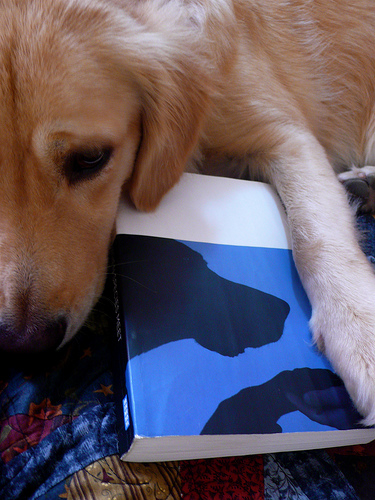
(Inspired by Jonathon Sullivan, I decided to invite my dog, Juno, to write this occasional contribution. Here Juno writes a review of Donna Haraway’s When Species Meet. The review was solicited from Savage Minds by University of Minnesota Press. – K)

I was very happy when my owner decided that we should review this book. Mostly because when he reads a book we can sit together on the couch, which is much more fun than when he sits at his desk surfing the web. I get scratched behind my ear a lot more when we are reading a book.

I also like Haraway. She seems to engage ideas in the same way a dog might play with a dead animal: sniffing it, placing it our mouth, playing with it, rolling on it, barking at it, offering it to our master only to run away with it again. But I could tell my owner was as frustrated by this kind of play as he is when I do it. He likes to play boring, repetitive, games like fetch. He seems to prefer the easy popular style of Patricia McConnell to Haraway’s challenging prose.
Continue reading

More on Coming of Age in Second Life

If you only read one book about virtual worlds, read Julian Dibbell’s My Tiny Life. If you are only going to read two, read Tom Boellstorff’s Coming of Age in Second Life.

Overall, Coming of Age in Second Life (CASL) represents cutting edge anthropology at its best — hip, smart, theoretically sophisticated, and with its head screwed on straight. As far as I am concerned it establishes a new standard for students of virtual worlds in all disciplines, and clears a path for anyone wanting to understand how anthropologists can study virtual worlds. Of course, the book has its shortcomings — mostly, I feel, because cutting edge anthropology has its shortcomings — but there is no doubt that CASL (as I’ll call it) is a seminal work that deserves to be widely read.

Those of us working on virtual worlds have been anticipating Tom Boellstorff’s (TB) book for some time. Second Life (SL) has attracted tons of press in recent years as the virtual world that challenges our notions of what virtual worlds are and how they operate and TB, a mid-career anthropologist with an established (and growing) track record, was exactly the person to study it. Additionally, TB did not publish a lot of his work on SL before the book came out, so I really did not have a sense of what it was like. All of this added up to a spectacular opportunity to fail, but TB rose to the challenge and wrote a book that is worthy of the conjuncture of events in which it was written.

One of the things that is so appealing about CASL is the way that it gets so many things right about virtual worlds. It insists, correctly, that human experience is always mediated by culture and therefore our experience is always ‘virtual’. It insists that interaction in virtual worlds is interaction with other people, not life in some addictive solipsistic fantasy world as some would argue. And above all the book emphasizes the way that plain old participant observation can get us very far in terms of what happens in such a world.

The title of the book is, obviously, a renvoi to Mead’s classic work, and the very sexy dust jacket features an image which harkens back to the picture of the Samoan girl that graced the old AMNH edition of Mead’s book. All of this is more than a clever pun, however – the idea is to draw a parallel between early classics of Pacific ethnography and TB’s book. Just as Mead discovered Samoa for generations of Americans, so TB hopes to discover (and validate) SL, and just as Malinowksi demonstrated the importance of participant observation, so too does TB want to (re)validate its relevance in studying virtual worlds.

It’s smart, although as a Pacificist I have to nitpick a little. Although TB pays homage to this sort of work he doesn’t come across as someone who is super-knowledgeable about the Pacific as an area. He mistakenly claims the River Valley Dani live in Papua New Guinea when in fact they live in Indonesia (his own area of expertise) (p. 70), and I also feel he is too kind to Mead in his (brief) assessment of her work on page 61. I think most Pacific scholars would now argue that Mead was importantly wrong in her description of Samoa, although we would also hasten to add that she was not as wrong about Samoa as Freeman was wrong about her. It is possible to disagree with Mead’s findings without endorsing Freeman’s literal psychosis about her.

But these are quibbles which do not offset the value of the book. Of key interest to me was the second chapter, the ‘literature review’. This kind of thing is not popular with publishers, but I am glad that TB features the extensive and exhaustive literature review that he does. There has been so much written about virtual worlds, games, computer mediated interaction, that it is difficult to find one’s bearing. These problems are augmented by the fact that much of the work done on virtual worlds has been bad and/or based on assumptions very different from those made by anthropologists. For this reason TB’s thorough working through of the literature, often term by term, is absolutely fantastic. It lets him locate himself in scholarly space, it provides a genealogy of research for other scholars to build on, and it allows him to specify his terms of art and what they mean. This chapter alone is incredibly impressive and is almost worth the price of admission.

TB’s chapter on method is more problematic. TB’s research was conducted entirely in SL without tracking down anyone in real life. Personally, I have no problem with such an approach – in my experience people learning to trust self-accounts in virtual worlds is no more or less tricky than learning to trust them in rela life. However, his justification for staying strictly in-game strikes me as fishy. His attempt to demonstrate the validity of such an approach relies on the claim hat SL is a valid and unique world which is not derivative of or secondary to the real world. This seems wrong to me. First, I would argue that virtual worlds are both discrete realms of social action and predicated on the real world (this is why we stop playing SL when we die, but not vice versa).

Secondly, anthropologists have always argued that cultures are not bounded objecs — they are not ‘billiard balls’ and do not have ‘skins’. Understanding ‘the village’ (even the virtual village) requires us understanding the broader context in which it is situated. TB seems to recognize this point implicitly since the real world seeps constantly into his description of SL. When people describe meeting SL friends in real life; when they describe leaving sealed envelopes for their real life spouse with instructions on what to tell their SL spouse is something happened to them; when they describe the way handicapped people can experience liberation in virtual spaces; when they talk about play SL drunk. when they talk about playing as a woman when they are a man in SL — when they do all of these things, they are talking about the membrane between SL and real life and the way they move across it. Understanding these things means understanding how SL is just one of the many, connected worlds in which people create meaning. All of which is not to say that you must track down people in real life to make sure the stories they tell you in SL are true (although it wouldn’t hurt), but merely to say that TB’s ethnographic practice gainsays the theoretical grounding of his method.

The research itself is great — it is readable, it is descriptive, it gives you a sense of what it is like to be in SL, and deals even handedly with exotic topics like SL’s widespread experience with eroticism (you can read chapter 6 for the juicy bits). The book really succeeds as ethnography in the classic sense — it gives you a sense of what people in SL are like, what they are doing there, and the mechanics of the world, including things like working with prims. This, I think, is really an achievement at a time when so many ethnographers float above the facts or somehow assume that the details of people’s lives are not worth reporting on. For anyone who wants to get a sense of what life in SL is like, the book will actually tell you. For people who have spent time in world, I think it will really ring true, which is a real sign of success — when the ‘natives’ find your work boring or your findings obvious, you know you’ve done a good job!

One thing that I appreciated about CASL is the way that it attempts to connect in-game concerns with individuality and creativity to wider cultural trends (although, apparently, it is not believe they are ‘derived’ from them). Pointing out the cultural background of these beliefs, rather than assuming that technology enables some biologically hard-wired drive for all human beings to be Romantic Artists is important. That said, I wished that TB had discussed this in more detail rather than simply referring to SL as an inheritor of ‘Western’ culture. Any approach which sees Torah, the Nichomachean Ethics, Descartes’s Discourse on Method, and the Whole Earth Catalog as all ‘Western’ simply is not nuanced for me. The notion of ‘the West’ here is better deconstructed than criticized (although I do appreciate TB’s criticisms of many ‘Western’ notions). I would have liked to have seen more of a focus on the cultural history of American responses to consumerism and notions of authenticity, since this would have given a more precise understanding of the specific milieu TB is working on… if, that is, we knew for certain that his research subjects were American.
Theoretically, TB develops a distinction between the ‘virtual’ and the ‘actual’ to describe the difference between virtual worlds and what I have been calling the ‘real world’ — its a distinction that works well because it allows one to understand how both the virtual and the actual are both ‘real’. He also develops the Aristotelian notion of ‘techne’ to describe the human capacity to build meaningful worlds. Again, its a serviceable idea, although his road to Aristotle appears to be through Foucault, which obviously is ok but strikes me as a bit eccentric given how many authors have taken up Aristotle in one way or another (Arendt, for instance, would be interesting here). And what of gnosis and phronesis? But at any rate the book is not about Aristotle it is about SL and the virtual/actual distinction and the notion of ‘techne’ are both useful and important contributions to our understanding of virtual worlds.

Throughout the book — particularly in discussion of the term ‘homo cyber’ and ‘virtually human’ — TB generalizes from his ethnography to make more general statements about the human condition and what SL can tell us about it. I can’t take issue with this strategy, since it is how anthropologists ‘do’ theory, but as someone who studies World of Warcraft, the virtual world that is the exact opposite of SL, I felt that many of TB’s conclusions raised the cultural particularities of SL to the status of the general structure of all human activity online. In fact I think that his focus on SL as a valid, self-enclosed world can also be traced back to the fact that the native point of view has seeped into his analysis. Since my natives have a different point of view, I would take issue with this particular seepage (!) but ultimately I think that TB’s generalizations are productive. Present a positive model that can be revised as more data comes in, and frankly it is a sign of his success as a fieldworker that he has been changed by the field in this way.

I said earlier that TB’s book is cutting edge anthropology, and I think this is true. This also means, for me, that it shares the drawbacks of much cutting edge anthropology. It apologizes constantly for its ambition to know and describe the world. Every chapter begins ‘I could have written an entire book about (insert chapter topic), but am only writing a chapter here’. It constantly points out that it does not do enough to describe power and gender relations. One thing that I found particularly disturbing was TB’s inability to acknowledge the power of the book as genre. In his conclusion he writes that

Within the static pages of a book there is no way I can do justice to my adventures within Second Life, or the experiences of the residents who so generously shared their activities and thoughts with me. A book cannot capture the beauty and joy of a virtual world, nor its anger and heartbreak

What can I say, except that I pity TB that he has lived a life devoid of the pleasures that reading can bring? For not only can books capture the joy and heartbreak of virtual worlds (read My Tiny Life to discover this), they have even managed to capture the beauty and anger of the actual world. Ultimately, one of the great tragedies of CASL is that the book wants so hard to emphasize the human power to use technology to create worlds that mater, while simultaneously underestimating the power demonstrated again and again by one of the most tried and true narrative forms of all — the one the author himself uses.

The final section of CASL is entitled “Towards an Anthropology of Virtual Worlds” and that is exactly what this volume is — and important, confident, clear headed volume which may end up founding an entire sub-discipline. The work is not perfect, but even in its imperfections it will spark conversations that will prove fruitful. If you are interested in virtual worlds, the book is a must-have and (if you haven’t read My Tiny Life yet) an immediate must-read. If you are an anthropologist who is interested in important recent work, or simply someone interested in keeping up with what anthropologists are thinking about lately, then I would strongly recommend the volume for summer reading. Tom Boellstorff has produced an important new book on an important new topic.
Using The Force

I just got back from a week-long trip to Australia to attend the annual “Association for the Social Anthropology of Oceania”:http://www.asao.org/ meetings. ASAO has always been my favorite annual conference to go to, with a great atmosphere, an international crowd, and an extremely focused set of ethnographic issues. This year it also provided me an opportunity to think further through the issues of rigor and quality in research that I have been exploring on this blog through the distinction between ‘cultural studies’ and ‘anthropology.’ So far we have discussed these issues as though the problem with cultural studies is that it is not ’empirical’ enough, but I think it is time to take the scare quotes off this term and begin to address Actually Existing cultural studies.

One of my discoveries surfing across Sydney bookstores was “Will Booker’s”:http://fass.kingston.ac.uk/staff/cv.php?staffnum=354 volume “Using The Force: Creativity, Community, and Star Wars Fans”:http://www.amazon.com/Using-Force-Creativity-Community-Updated/dp/0826414664/ref=sr_1_1?ie=UTF8&s=books&qid=1203359849&sr=1-1. This book was perfect for me as an author of Star Wars fan fiction and an adviser of a student working on fan communities. It is a good book and makes me excited to read more of Booker’s other work, but at the same time it is also palpably ‘not anthropology’ to me. Obviously, being ‘not anthropology’ is ‘not a bad thing’ — in fact in some circles I’m sure such a judgment might be considered a compliment! But what struck me about the book was not that it had too much ‘theory’ but that it had ‘too little’
Continue reading

Untaming the Frontier

I had a very pleasant MLK day reading through “Untaming The Frontier in Anthropology, Archaeology, and History”:http://www.uapress.arizona.edu/books/bid1624.htm. The concept of ‘frontier’ is deep background for my own research, and I try to keep my hand in on the work done in this area. However, it has also been a while since I caught up on the topic, so this edited volume was a lot of fun for me — a lot of interesting papers from all over the place (from the Qing to the Inka) and a helpful bibliography as well as a lot of good contributors. I wasn’t aware of the work of editor “Lars Rodseth”:http://www.anthro.utah.edu/people/faculty/lars-rodseth.html but it looks quite good and now I am interested learning more about his work.

The other thing I like about this collection is the approach to social science that it espouses — each author combines a love of the details of their individual cases with an interest in comparison and generalization. Its sorta… Weberian in a pleasant sort of way. Anyway I had fun reading it so maybe you will too.

Steve Pinker gets the memo (sort of)

The cover story of the the August number of the New Republic is a piece by Steven Pinker entitled “Strangled By Roots: The Genealogy Craze in America”:http://www.tnr.com/doc_posts.mhtml?i=20070806&s=pinker080607. Pinker ought to be given credit as an academic who writes for a popular audience, and there is no doubt that his work is easy to read and always has a clear take away message. These days, though, he is venturing further and further afield from his area of expertise and one gets the feeling that he is suddenly encountering brand new intellectual territory. Those of us in the social sciences for whom this is well-worn ground are, of course, happy that he has finally gotten the memo, but disappointed that hasn’t read it very carefully.
Continue reading