A couple of years back Ken Bain wrote What The Best College Teachers Do, a book which was widely read, even by people who don’t normally read books on how to teach. One person who didn’t read it was me. So when Bain’s follow-up What The Best College Students Do came out, I decided to take a look and see what the fuss was all about. I agree strongly with Bain’s argument — I do think college students who follow his advice will be successful — but the book was hardly a home run for me. If you are a college student, then you might care for it more than I did.
Category Archives: Book review
The Warcraft Civilization
Of the three Warcraft ethnographies I wanted to review on SM, William Sims Bainbridge’s The Warcraft Civilization: Social Science in a Virtual World is the most difficult to evaluate. Partially this is because Bainbridge is the only one of the three authors that I don’t know personally. But it is also because his book is so different from the others and, frankly, because I didn’t care for it very much. Writing book reviews is like doing peer review: it requires you to be very fair to your reviewees, but also fair to your audience: the author deserves consideration, and your readers deserve the skinny on the value of a book. When you just don’t like a book, you must try twice as hard to read it with prudent and disinterested eyes to make sure you’re negative opinion is grounded and not just annoyance. So here I go.
Leet Noobs
Before I start talking about the substance of Mark Chen’s Leet Noobs I want to spend a second talking about the business model. The sticker price of the book is US$34.95, which gets you 200 pages, which is really around 175 pages of actual book once the front and back matter and so forth are factored in. The book is a revision of Chen’s dissertation, which you can get for free if you are attached to a university which subscribes to ProQuest. Alternately, you can read at least two chapters of the book for free in open access journals where they’ve been published. Another is available for rent for a day in Games and Culture, for which Sage will charge you US$25. And then there are the short paper presentations on Chen’s incredibly rich website — which includes his comps answers iirc — where you can read shorter pieces which convey the main points that Chen is trying to make in each of his chapters.
What are to make of a mode of scholarship where a book costs ten dollars more than the price to rent one of its chapters, and thirty-five dollars more than free versions of all the chapters? And where are we as an intellectual community where the impetus to publish pushes people to recycle the same material over and over in the name ‘productivity’? What sort of value are publishers adding to Chen’s work that justifies their charging that much money?
I’m not saying there aren’t good answers to these questions. Presenting the same material over and over is a good way to help think it through, and I’m sure that Chen’s finished book benefitted from having the opportunity to have peer reviewers, editors, and conference participants look it over. But still — we live in strange times.
Ok let’s move on to the book itself: Leet Noobs is Chen’s ethnography of a guild in World of Warcraft (WoW). It has a lot in common with Nardi’s book: it studies one or two guilds that the ethnographer lived with, rather than covering ‘the culture’ of ‘a world’. It’s a problem-based ethnography which focuses on particular issues instead of providing a general overview of the lives of WoW players. Both Chen and Nardi lament the way the magic of the virtual world is replaced by a goal-focused stats-and-bars approach. Both volumes are short and clearly written, and at times they have a strong personal voice.
But there are a ton of differences as well. Nardi is a senior scholar with decades of work on technology. Chen is a new Ph.D. Chen is a lifelong gamer who describes himself as hopelessly addicted to video games. Nardi started playing WoW to write the book, while Chen decided to write on WoW because he was playing it. And — check this out — his fieldwork is focused on his guild’s first Ragnaros kill. On an RP server. One chapter is on what happened the first time someone invented threat meters. This old-school approach gives Chen a lot of cred in my book.
Chen also comes out of a different genealogy than Nardi: education. The education people have always been super-early adopters of technology and computers. They have also been on the scene in the virtual world space as well, with authors such as Constance Steinkuehler writing about how people learn online. Chen is part of this movement, and in particular he’s interested in the social and material dimensions of learning — how skilled performance (i.e. downing raid bosses) requires social capital and (as they say in cooking) a mise, an artifactual environment that lets you focus your attention at the task at hand because everything else is set up right. Chen draws on ANT, but also on the psychologists who study distributed cognition and communities of practice.
It’s a great way to approach raiding — the main thing I study in my WoW research — and I found myself nodding in agreement again and again as Chen described in technical terms what every good raider knows: you have to do research, evaluate sources, work with a good team, and get your keybinding and addons set properly. In terms of theoretical contribution, I feel like the work falls more on the side of “adds more evidence to one side of an established debate.” Chen is part of a now-vast movement that demonstrates the importance of video games and learning that is making its opposition look more and more obsolete. It’s a perfectly appropriate level of innovation for a Ph.D., but people looking for an argument that is going to change the world won’t find it in this book. Its further proof of a viewpoint that seems more and more in the ascendance — but you know, it was probably a little more fashion-forward when Chen began his dissertation.
What you will find in the book is a series of extremely detailed case studies that are superbly well done. Many people writing their dissertation get told by their dissertation advisors: “can you prove this theoretical point using the ethnography you have?” It’s actually one of the hardest things to do, especially because no one seems to be able to tell you how to do it, just that it has to be done. But Chen really does it in these chapters: he shows us when, where, and how, threat meters changed the dynamics of his guild (when they discovered aggro radius if you can believe that there was once a time when someone had to figure out what that is), how raids actually go about the work of raiding and even, in one of the chapters than will ring true to WoW players, how guilds explode. These case studies are really clinics in how to do things with ethnography, and they are well worth reading for graduate students.
The case studies are wrapped up in a curious little book. Between chapters are vignettes, often just dressed-up transcripts of chat, which are supposed to provide some flavor of the game world to make you feel like you have ‘been there’. I’m not sure how well these work for nonplayers — I found them boring (but ethnographically accurate). Also, Chen has a strong authorial voice — a very vulnerable observer willing to admit to his own subjective feelings about the game and his successes and failures. I know Mark a little, from years and years ago, so I may be projecting a little bit, but he comes across as a sort of lovable looser: ashamed to admit to enjoying video games so much, wanting to use an informal voice but constantly aware of the genre standards he is violating, and apologetic for forcing the reader to learn so much about actor network theory and its associated jargon. It never gets cloying, but I do think the book would have been more successful if he had just Gone There and unapologetically embraced his inner geek and assumed his reader would be teen along in his passion for his topic.
Chen doesn’t beat around the bush in making his points — in case you missed his clear explanation of them in the opening chapter, there is a bulleted list of them in the conclusion. This, combined with the extremely short discussion of theory in the first and last chapter, makes me feel like that book might have been better left as a series of articles, or else rewritten as a long essay. As someone who read the articles on which the book is based, I felt like I burned through the intro, conclusion, and little interludes pretty quickly.
I suppose it’s to Chen’s credit that he writes so clearly and with such ethnographic focus that he seems to have economized himself out of a monograph — a longer literature review or theoretical elaboration could have been provided a richer book, and of course the whole reason we write books is to have the room to add this sort of work. But I think that wasn’t the game that Chen wanted to play, and his book stands as an admirably detailed collection of case studies of World of Warcraft which is the first major description of how raiders play the game.
My Life as a Night Elf Priest
Well, it’s not too complicated: My Life As A Night Elf Priest by Bonnie Nardi is the best ethnography of World of Warcraft out there. And that’s not likely to change soon.
I have the impression that My Life As A Night Elf Priest didn’t make quite the splash that University of Michigan Press hoped that it would when it was first published. Virtual worlds like World of Warcraft (hereafter, WoW) are exciting and new right, and Nardi was a Night Elf Priest. It’s so fashion forward it should whip cutting-edge types into a thick, rich froth of excitement. But — as far as I can tell — that didn’t happen. But, to Nardi’s credit, that didn’t happen.
You can (and might even want to) divide ethnographers of virtual worlds into two camps: those who study them because they are radically new and inherently interesting, and those who see them as interesting for reasons other than their novelty. Like Nardi, I am firmly in the former group. A glitzy gee-whiz ethnography of an amazing virtual world might have attracted more attention among anthropologists — mostly because they missed the period seven years ago when the rest of the academic community had this particular spasm — but to her credit Nardi has written a careful, intelligent book that avoids hype and moves our understanding of virtual worlds forward.
Nardi has a long background in studying how people interact with technology. If I understand this correctly, people originally studied usability: how people interacted with computers and how you could change computers to make them more usable. Then they realized that what people wanted to use technology for was affected by the form that technology itself took. Nardi was one of the people who took this insight and developed ‘activity theory’, a generalized approach which made action rather than the actors the center of its approach. It’s a bit like actor network theory in that it considers humans and nonhuman equally, and like ANT it articulates slightly with American Pragmatism. But Nardi’s lodestar is Vygotsky, and activity theory has no truck with the bizarre epistemological and ontological exuberances of ANT. It is scientific in its study of action, but it not in a sterile way. Frankly, its a very impressive way to think about the world.
This is the viewpoint that Nardi brings to WoW. And I mean ‘brings it’ in the sense of bring it, babeeee. Nardi’s main claim in her book is that activity theory, expanded by a reading of Dewey’s aesthetic theory, can make sense of what it means to play WoW. In his book Art and Experience Dewey provides an account of art which is tied to Western aesthetic theory but which is not tied to decrepit Victorian theories of the sublime, beautiful, otherworldly, etc. Specifically, he argues that aesthetic experience is the result of a kind of engaged activity in the world that occurs when people’s capacities are challenged but not overwhelmed. Nardi takes this up and argues that playing WoW can be an aesthetic experience — absorbing, pleasurable, and fun. It’s sort of an account of flow tied to a description of human flourishing. Nardi’s exposition of the concept in the second section of the book is detailed but not pedantic. She really uses theory to get to where she needs to go, which is the best way to do it.
In the next section of the book she goes on to show how this framework can be used to move ahead on various debates in virtual worlds. For instance: is WoW addictive? Nardi’s answer is that the ‘addiction’ that we see in video game players is predicted in Dewey, who argues that focusing too much on activity deforms it (in The Craftsman Sennett makes a similar point, btw). Is WoW ‘work’ or ‘play’? This question has dogged the literature on video games for a decade and has always tweaked my anthropological sensibilities since it is so ethnocentric. So its gratifying to see Nardi demonstrate that these culture-bound notions can be replaced by a more general theory. Is WoW a ‘world’? Is there a ‘magic circle’ separating virtual worlds from the actual world? Nardi answers all these questions, often settling or transcending the terms of debate simply through the use of good sense and refusing to let the categories of the debate deform the understanding of the ethnographic data.
Often at SM we worry about whether anthropology is ‘progressing’. People looking for an example of how to progress should read Nardi’s book. She carefully addresses major debates in the literature, explicitly states where they are, and then describes where they should go based on her findings. Its refreshing and profoundly respectful of her fellow WoW-ologists, whom she always manages to find wanting, but in whose work she always finds something of value.
As someone who has played tons of Warcraft, I find Nardi’s account extremely readable and even — in the case of the Hogger strats she quotes — laugh-out-loud funny. She is often personal, describing her wonder at the beauty of the in-game world. She clearly loves the game. But at the same time the book (somehow) manages a very formal and objective tone. Knowing Bonnie as I do I recognize this as rooted in her personality, but some readers might find it dry. It’s certainly not the breathless omgvirtualworld that we see in the work of some authors. So I am not sure how well the ethnography will hold the average reader.
This is a problem-driven monograph, thematically organized. Although there is no doubt that she provides a wealth of information about the game, the thematic organization and objective tone may leave some readers feeling they are not ‘being there’ as they read the ethnography. I wonder in particular how well people who have never played WoW will be able able to follow some of the exposition. I don’t know. YMMV.
There is a lot more to say about Nardi’s book: her feminist vision of WoW as an egalitarian place deformed by the presence of dorky, misogynist geeks, the way Dewey’s democratic theory articulates with her work on community, her choice of research methods, the brief comparative chapter on Chinese WoW players — the list goes on and on. Like all great ethnographies the book continues to provoke thought when you are done reading it. Its quite an accomplishment for what is, after all, a very slender monograph.
In conclusion, I can see how aspects of Nardi’s book might have made it less splash-ful than it ought to have been. But for my money it is one of the best ethnographies of a virtual world out there and, even more importantly, a model of how ethnographic fact and theory should be used to help move a discipline forward. Also did I mention that it is short and cheap and clearly written? I’d recommend you give it a try.
Seagulls Don’t Fly Into the Bush
I recently read on the Pacific Anthropology listserv of the passing of Ali Pomponio, an ethnographer of Papua New Guinea. I only met Ali once, at a conference, but she she cut a bella figure and was pretty hard to forget. Intense and energetic, being caught up her in wake was like suddenly finding yourself in a strange mashup of Moonstruck and Growing Up In New Guinea. She told me her student job was selling used cars — something apparently she told everyone since it figures largely in people’s remembrances of her. She was critical of my contribution at that conference, very critical, but also very enthusiastic about its revision and improvement. She managed to be warm, helpful, incredibly picky, and blunt at the same time. Even though my entire encounter with her lasted all of twenty minutes, she became a bit of a role model for me: she had figured out how to be a healthy, contributing member of the academic community in her own unique way, and people like that are always worth learning from.
One thing that struck me about our meeting was that she appeared to think that she was the total master of all things Papua New Guinea and a very important person in our field. This struck me as odd since I’d never heard of her before, or of anything she’d written. So after our meeting I went back and read her ethnography Seagulls Don’t Fly Into The Bush. After that, I understood why she had such a high opinion of her work, because I now shared it with her.
I don’t know why Seagulls Don’t Fly Into The Bush didn’t become one of the classic ethnographies of the early nineties. Maybe because it was marketed as a teaching ethnography? I mean sure, it has problems: there could be more sign-posting and it has a “you only get it if you already got it” title. But overall the book is superb: it’s clearly and engagingly written, and deals with classic early-nineties concerns with the continuity of tradition as it changes and how modernization/globalization impacts peripheral people. But it also sinks its teeth deep into myth — you can’t get more anthropological then that. And of course the setting, a small island off the coast of New Guinea, is real wind in the palm trees stuff. The book really has it all: tradition and modernity, well-written and not too long. People on this blog often complain that there are no accessible ethnographies, or ask people to list their favorite ones. Well, this one should definitely be on anyone’s list.
Seagulls Don’t Fly Into The Bush costs money to get hold of, but her edited volume Children of Kilibob: Creation, Cosmos, and Culture in Northeastern New Guinea is available open access from Pacific Studies, where it was published as a special issue. Her article in that collection, iirc, eventually became a chapter in her book.
Another common refrain we get on this blog is that anthropology is not ‘making progress’, something we hear about as often as the refrain “should we as a discipline be trying to make progress?” But Ali’s special issue, and the work of many other Melanesianists, demonstrates that we clearly are moving forward in our understanding. Here is a collection of scholars, all working in the same region, who have worked together to put together a synthetic regional picture of a mythic complex that has diffused widely across northern New Guinea. It’s a testament to the strength of our fieldwork tradition and collegiality in PNG studies, and a testament to Ali herself, who was an important part of that tradition.
Book Review — Freedom in Entangled Worlds, by Eben Kirksey
In Freedom in Entangled Worlds, the first book by anthropologist Eben Kirksey, Mellon Fellow and Visiting Assistant Professor at the CUNY Graduate Center, the reader is presented with a history of the merdeka movement in West Papua. This tale of magic, nationalism, and human rights in an “out of the way place” unfolds on a global stage as the author treks from the secret hideouts of guerilla fighters in the highland bush country to the seat of corporate power at BP headquarters in London. Along the way we get a master class in how an academic activist might balance post-structural theory with the kinds of strong knowledge claims that may influence political decision makers.
Indonesia formally incorporated West Papua into its nation in 1969 with the fraudulent Act of Free Choice. Since that time West Papuan leaders have pursued independence, or at least increased autonomy, for their region through many, often contradictory, means. From political engagement with the Indonesian state to pleas made before the international community tribal leaders and educated city dwellers have risked their lives through armed resistance, peaceful protest, and magic pursuing their dreams of freedom. The odds seem insurmountable and the movement itself endures near constant crisis, thus the theme of crisis as a sign of hope runs throughout this short, adventurous ethnography.
In a revealing scene towards the end of the book, Kirksey, finding himself in the halls of Washington power (and the crosshairs of an FBI investigation), forms alliances with other activist organizations such as the East Timor Action Network. Frustrated that his investigation into the murders of some American school teachers outside a Freeport MacMoRan mine is largely being ignored by those in positions of power he learns an important lesson every anthropologist who wishes to speak truth to power must learn.
“Politics isn’t about facts but about stories,” the director of ETAN tells him. “Your story is too complicated.” Continue reading
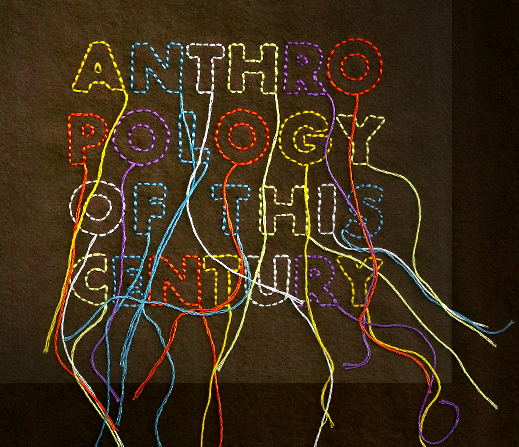
Anthropology of this Century
I had the pleasure of interviewing Charles Stafford, Professor of Anthropology at the London School of Economics, about his new anthropology journal Anthropology of this Century. Click below to read the interview.
Illustrated Man, #6 – Burma Chronicles
Guy Delisle gets around, notably to places most of us don’t go. Pyongyang, perhaps his best known work, is a graphic memoir of his travels in North Korea. An animator by training Delisle was granted a two month work visa to oversee the production of a children’s cartoon in that isolated nation. A similar work situation found Delisle temporarily placed in Shenzhen, China, an experience that was also turned into a travelogue. Comic fans and other curious characters can find previews of these works over at Drawn and Quarterly, he also keeps his own website with a blog in French (the man is Quebecois).
In this installment of Illustrated Man, we turn our attention to Burma Chronicles, Delisle’s most recent foray into the graphic representation of a westerner’s encounter with an Asian culture. Why Burma Chronicles you ask? They shuttered our local Borders Books and I got it on clearance, that’s why. I for one am not thrilled at that company’s implosion (unlike some snarky others). Shit man! I live in a city of 180,000 and now we have one bookstore left, a Barnes and Nobles. Okay, two if you count the used store that specializes in romance novels.
Back to the comic. Guy’s wife, Nadege, is an admin for Medecins Sans Frontières, and she brings them to Rangoon while MSF attempts to reach a remote and stigmatized ethnic group who reside along the border with Thailand. While Nadege is away Guy spends a lot of time caring for their infant son Louis, socializing with the NGO crowd, trying to squeeze in a little work on the side, and making wry observations about everyday life under the military junta.
Illustrated Man, #5 – Journey to Cahokia and Jingle Dancer
Can anthropology be for children? Should anthropology be for children? In this installment of Illustrated Man we turn our attention to two picture books from the juvenile stacks of my local public library.
Books for children can, on occasion, offer a clarity into underlying issues that belies their apparent simplicity. In the introduction to the revised edition of Enjoy Your Symptom, Lacanian philosopher Slavoj Zizek seizes on this:
Whatever the vicissitudes and deformations of Lacan in cultural studies, one should focus on what happens with children in their early age, following the wise Jesuit motto, “Give me a child till he is seven, and afterward you can do with him whatever you want.” So I am tempted to claim that there is hope for us Lacanians as long as American children are massively exposed to Shel Silverstein’s two classic books, The Missing Piece and The Missing Piece Meets the Big O; one is almost embarrassed by the direct way these two books render in naked form the basic matrix of the Lacanian opposition of desire and drive.
I too have felt the profound touch of picture books like Leo Lionni’s treatise on epistemology and the non-translatability of experience, Fish is Fish, or Jon Muth’s tranquil and enlightening, Zen Shorts. Kids’ books are big business and tenure track positions are getting harder to find. Maybe there are some anthropologists out there who want to get in on this genre?
With the AAA’s push for a more “public anthropology” we might consider too the role our discipline can play in K-12 education. I’m not talking about the anthropology of education or an anthropology of children like the work being done by the good people at the CAE, which is in itself fascinating and, of course, vitally important given the politicization of ed discourse in the public sphere. But, imagine instead an anthropology for children. Maybe there’s a CAE person reading this now who can add to our discussion, are there anthropologists out there right now writing to children?
There are a number of kids’ books that brush up against anthropology or that invite one to interject an anthropological spin on things. At my house we have a slew of these “people around the world” type books (all of them gifts), including ones on bread, shoes, houses, and families. The DK Eyewitness series offers beautiful picture books on archaeology, mythology, Indians, classical ancient societies – Egypt, Greece, Rome, the biggies – even evolution and early humans (or as my kids call them “Monkey People”). The archaeologists already got Indiana Jones and Laura Croft. With cool how-to books like this one they need someone to move into Bill Nye territory.
Granted works like the DK series are commercial productions for the kiddie book market. They’ve no doubt got academics serving as consultants or fact checkers, but most of the creative work is done by graphic designers and copy writers who know how to make books that kids want and that parents will buy. That’s why I find the two works I’d like to discuss today so interesting. They are artistic works of scholarship and experience, creatively rendered and engaging to young people. For any anthros wanting to write for children, here are some role models
Continue reading
Fishes versus Haoles Smackdown
Two books came our recently which both deal with the topic of Haoles (white people) in Hawai’i. Both are short, designed to be accessible, and appeal to a broad audience. Both summarize a great deal of recent research done on and in Hawaii, where I live and work, and both adopt an autobiographical tone. Unfamiliar Fishes by humorist Sarah Vowell, is a history of white people in Hawaii from the arrival of the first missionaries in the 1820s (the ‘unfamiliar fishes’ of the title) to the islands’ annexation by the United States seventy years later. Haoles in Hawaii is by Judy Rorher, a graduate of the University of Hawaii who studies the political economics of Haole presence in contemporary Hawaii. I adore Rorher’s earlier, autobiographical writings about growing up Haole in Hawaii, and detest the NPR Ira Glass/David Sedaris Culture Industry out of which Sarah Vowell emerged. As a result I expected to love Rohrer’s book and dislike Vowell’s, but in fact just the opposite happened: I was disappointed by Haoles in Hawaii and now recommend Unfamiliar Fishes to anyone visiting the islands to understand its history. Why my position switched says a lot about how to write for a popular audience, how to communicate expert opinion to nonexperts, and how to make moral judgments in your writing.
Unfamiliar Fishes is a popular history of American colonialism in Hawaii dressed up as a light travel narrative. Vowell builds her historical narrative up out of anecdotes of her own visits to Hawaii to research the book: tourist locations she goes to with her family, interviews she did with local scholars, interesting but not quite topical documents she found in the archives. Although the book is supposedly about New Englanders who traveled to Hawaii to preach the gospel, much of it is actually about Hawaii and Hawaiians itself, with long diversions about different aspects of the culture: hula, kapa, ahupua’a, and so forth. Along the way you also learn a lot of about 19th century American protestantism, of course, but it’s clear that Vowell’s goal is to provide a relatively detailed sketch of Hawaiian culture and history in its own terms, and she succeeds at this goal.
One of the reasons that Vowell is successful is the circles she moved through. Throughout the book she recounts meetings with some of the premier scholars of Hawaiian history and politics, as well as sovereignty activists (who want to secede from the United States, basically) and of course missionary descendants themselves. She quotes from some of the most recent influential books on Hawaiian history (Aloha Betrayed by Noenoe Silva, for example) as well, which indicates that she’s done her homework. In sum,the book’s success is due in large part to the way Vowell has tapped into and reported on a pre-existing community of scholars and the body of work they’ve produced, some of whom are played by Keanu Reeves in the audiobook.
Haoles in Hawaii is even more a summary of local research in our islands. Rohrer worked closely with many of the people that Vowell cites, and her work presents a much more distilled and careful reading of their arguments — indeed, if you are an academic wanted a run-down (complete with citations) of contemporary critical scholarship on Hawaii, this is is the place to come. The topics she deals with are also very topical: lawsuits attempting to demonstrate that a Hawaiian-only school is unconstitutional, and the ongoing debate, fueled largely by white immigrants to Hawaii, about whether the term ‘Haole’ is itself racist — because for many of these people being on the receiving end of a minority identity is a major shock, apparently.
At times, however, Rorher’s book is too closely related to the literature she cites. One of the main audience of Haoles in Hawaii is haoles in Hawaii, and the book clearly wants to help them get a clue about the history that informs the race relations that they encounter when they arrive here. I don’t think Rorher succeeds in doing this in her book. To a certain extent this is because the tone is ‘too academic’. It lacks the autobiographical, vulnerable voice of “Haole Girl”, a genre-bending article of Rohrer’s that I often assign my students and while it is clearly written, it is still identifiable as an academic text.
And this is, really, the biggest issue I have with the book: the critical tone it borrows from ethnic studies, indigenous studies, and critical race theory that she draws on. It is one thing to write for scholars who oppose hegemonic anglo-protestant narratives, but it is another thing to write for an audience of hegemonic anglo-protestants. The book is too full unveilings and critiques to appeal to a readership that is simultaneously audience and target. So while I agree with what Rohrer is saying, I am afraid that her book will turn off haoles who read it, even those who go out on a limb and try to meet her halfway. Issues of style, rather than substance, may keep the message from getting across.
In contrast, Vowell is readable — at time even cloying. As a refugee of the early-oughts blogosphere explosion I recognize Vowell’s post-David Foster Wallace style and, frankly, it drives me nuts (perhaps this is the narcissism of minor differences at work). Additionally, much of the prose seems formulaic. There is a strong tendency, for instance, for every paragraph to end with a droll and incongruous sentence to make sure the reader decides to read the next paragraph. Still, Vowell calls it like she sees it morally, giving the thumbs down both to the terrifyingly close-minded missionary Hiram Bingham even as she condemns King Kalakaua (venerated in Hawaii for his support of traditional cultural activities) as spendthirft who subsidized his sybaritic lifestyle through the opium trade. Vowell’s frankness, and her ability to pain herself as a sympathetic narrative voice, make the normative elements of the book go down pretty easy.
The historical element in both books are strong. In fact, both authors take books that are ostensibly about Haoles and turn it into a history of Hawaii. But again there are differences, notably in terms of evidence. At time Rorher’s book focuses so much on the wrongs done to Hawaiians that the haoles of her title disappear from sight altogether and the books becomes a history of Hawaii. What little evidence she does use take the form of (oldish) newspaper clippings, rehashing the histories of court cases, or some extremely brief analysis of economics indicators — as a result there is little in the way of data bout the lifeworlds of Hawaii and where concepts of haoles (and the actual white people themselves) fit in. It may be that as a short introductory volume the book isn’t suppose to have much in the way of data, but a more skeptical audience would want to see more proof in the pudding.
In contrast, Vowell has done a much better job of historical research than anyone could reasonably expect her to. It’s clear she loves quoting salacious bits from the archives — and in the case of the incredibly repressed Yankees who landed on Hawaii’s shores, it’s not hard to find salacious bits. In fact, Vowell accomplishes most of the work of denouncing the evils of colonialism simply by quoting the colonizers, who were frankly, shockingly brutal people. At times this tendency goes to far. The last third of the book pretty much gives up inserting bits of travelogue into her book and lapses into straight narrative history (think: book report). In fact, towards the end certain pages are mostly cut-and-pastes of legal texts.
In sum, I eventually came to like Vowell’s book because of its level of detail and its unique personal voice. Rohrer’s book will doubtless be taught more often here in Hawaii and probably works better in an academic setting, but it lacks ethnographic thickness and fails to meet skeptical audiences half way. The lesson I take from the two is that it is the how, not the what, of writing that makes it accessible to a broader audience. It is not that certain positions are unacceptable to the public, but rather that ways of conveying them and creating one’s self as an authoritative, trustworthy author are key to getting your message across.
Illustrated Wimmin, #4 – The Essential Dykes to Watch Out For
In this occasional series, Illustrated Man, I will explore the intersection of anthropology and comic books, graphic novels, comic strips, animation, and other manner of popular drawn art.
…
Alison Bechdel crashed the party on American literature’s main stage with Fun Home (2004) a stunning graphic memoir about coming of age, coming out, and discovering her father’s own closeted gay identity. It received rave reviews and was featured at the top of a number of end of the year best book lists and, with the close of the ’00s, reappeared on some best of the decade lists. And rightfully so, there wasn’t a more monumental nonfiction comic book in a decade that will be remembered for an explosion in top notch comic output. There hasn’t been a more significant comic memoir since Maus (1986).
My own encounter with Fun Home began on the Eastern Band Cherokee reservation as I was conducting the ethnographic field research for my dissertation. I was cast in a theatrical production as a soldier in Andrew Jackson’s army and one of my fellow Indian killers was a bohemian epileptic artist named Pat working his way back to Florida from Knoxville. Like Capote’s villain from In Cold Blood he traversed America’s highways with a library in his trunk: Zizek, Baudrillad, and a borrowed copy of Bechdel’s novel.
After I settled in Newport News I discovered Fun Home in the stacks at my public library and got hooked on Bechdel’s beautiful ink lines, hyper-literary self reflection, and slightly neurotic gallows humor. I was anxious to get my hands on more of her work and I soon learned I had a lot of catching up to do. Before achieving celebrity status Bechdel was already a star in the gay and lesbian community for her biweekly strip, Dykes to Watch Out For, first published in 1983. A nearly 400 page retrospective was released in 2008 as The Essential Dykes to Watch Out For.
Marxism, Liquidated
Remember Marxism? It was a current or trend in anthropological theory that began in the mid-sixties and ended in the mid-oughts. Like all schools of thought it has its redoubts and strongholds in certain departments, but it seems to me that on the whole high table anthropological theory has pretty much given up on it. Of course, there are still baby boomer anthropologists who make ritual obeisances in the direction of Marx, and some even believe that their own globalized, frictioned, assemblaged work can somehow be connected meaningfully back to Marx with enough ingenuity and historical reconstruction. But it seems to me that increasingly recent influential ethnographies — particularly those which focus on moneybags himself — seem unaware or uniterested in the paradigm.
Take, for example, Karen Ho’s influential new(ish) book on the culture of wall street, Liquidated. Of the crop of Book That Everyone Mentions At The AAAs Liquidated is really one of the better finds: an actual ethnography, with actual interview data, which takes the time it needs to say something that deserves being said. Of course, the book has its drawbacks: the language could be clearer, redundant repetition of main points could have been cut, and there is a tendency to use words like “explode” and “denaturalize” to describe an activity most of us would call “describing”. Still, it is a solid, real, problem-driven ethnography, which is great.
The strange thing is that despite Ho’s use of the terms like ‘ideology’ and ‘hegemony’ and the obvious appropriateness of the topic, Marx is never really seriously engaged — even to be dismissed — in the book. Ho is, to be sure, critical of her ethnographic subjects — in a sort of amazing way, the entire book is a sustained critique of her informants — but her main point seems to be that we have forgotten what the New Deal was, how it was supposed to work, and how unAmerican it is to securitize corporations. This is a very, very good point about our forgetfulness of history which I think the country would do well to learn. But at the end of the day the fact of the matter is that Ho is surprised, perhaps even shocked, to discover in the course of her fieldwork that companies make money by screwing over their employees. This realization is not just the foundation of a labor theory of value, but the lived experience of the sorts of people who, unlike Ho, didn’t go to places like Stanford and Princeton.
I am sure that this post will draw a lot of comments from angry Marxists arguing that the influence of their master thinker is not dead, and to be honest I’d like to believe that that’s the case — although I’m more of a Weber-Durkheim type than a Marx-Freud type, I think anthropology has lost something important when we forget the history of what, back in the day, used to be called ‘critical anthropology’.
Illustrated Man, #3 – The Stuff of Life
In this occasional series, Illustrated Man, I will explore the intersection of anthropology and comic books, graphic novels, comic strips, animation, and other manner of popular drawn art.
…
A cultural anthropologist, I am frequently called upon to teach biological anthropology. This has always been in the context of introductory level courses: human evolution or general anthropology with an evolution component. After stumbling out of the gate, I have become comfortable wearing the evolution and ecology hat. In particular I find pleasure in arranging the topic of human origins as a narrative. You could say that my approach definitely betrays my bias as one more skilled in the humanistic side of anthropology. Yet I am very cognizant of the fact that many students are drawn to courses like Introduction to Anthropology because it qualifies as a science in their distribution requirements, but does not require math or a lab.
I’m not getting saddled with a blow off class. I’m going to hit ’em hard with evolutionary theory and basic genetics. Evolution I can do because I’ve read Darwin, Dawkins, Gould, and Mayr. But structure and function of DNA isn’t exactly my forte. So I need something challenging for my kids, but not out of my league. That’s why I require The Stuff of Life: A Graphic Guide to Genetics and DNA as supplement to the more usual textbook fare. At just under 150 pages, all illustrated, Stuff can, in an evening or two, easily be digested by anyone who passed high school biology.
There’s also a lot here that will appeal to comic book fans. Author Mark Schultz, writer and illustrator for the venerable Prince Valient strip, brings wit and a snappy pace to otherwise dry material. He did an outstanding interview on NPR Science Friday (which is how I discovered the book) where he talks about the medium of comics and how he approached nonfiction material. Illustrators Zander Cannon and Kevin Cannon are award winners, having taken home two Eisners for their art in Alan Moore’s completely awesome super-hero-crime-procedural Top Ten. Their ink brush lines bring a fun, cartoony look making the book a delight to look at without distracting from the lessons at hand. The book’s greatest strength comes from the aide the Cannon’s art provides to visualizing things like cell division and protein synthesis. Right-brained learners rejoice!
Book Review — Catching Fire, by Richard Wrangham
Savage Minds was invited to review Catching Fire by the publisher, Basic Books. As SM’s resident evolution enthusiast and General Anthropology instructor, I was happy to rise to the occasion.
Throughout contemporary socio-cultural anthropology researchers are again turning to the biological, reexamining the relationship between the human body and the environment. Like some of the best recent anthropology this “new” vein of inquiry can be quite theoretically rigorous with language that appeals primarily to experienced professionals. Inverting this trend is a new book written at the popular level for an educated lay reader from primatologist Richard Wrangham, Catching Fire: How Cooking Made Us Human. Every living thing must eat but humans are unique in that the food we eat is processed and cooked. In the study of diet, anthropology may find a fruitful realm to explore the relationship among the human and animal worlds.
Catching Fire is a book of ideas. It makes a case for its thesis and rallies to its corner evidence from archaeology, human evolution, anatomy, and primatology. It also makes claims that are speculative and without direct evidence. Still the argument is compelling. At the crux of the book is Wrangham’s assertion that cooking kick-started the transition from Homo habilis to Homo erectus. In order for cooking to play the significant role that Wrangham says that it has, human ancestors must have controlled fire by 1.8 million years ago, almost twice as old as the current archaeological evidence. He bases this conclusion by claiming that the morphology of Homo erectus is one that is already largely adapted to the consumption of cooked foods, logically control of fire and thus cooking would have occurred prior to those physical transformations.
Ethnogenesis: A Radical Constructionist Case
I just finished James Scott’s 2009 book, The Art of Not Being Governed: An Anarchist History of Upland Southeast Asia, and I thought I’d take a couple of minutes to introduce the book to those not familiar with it. I quite enjoyed his last book, Seeing Like a State, which I wrote about back in 2007, and this book picks up where that book left off. Whereas Seeing Like a State discussed the strategies by which states exert bureaucratic control over unruly populations, The Art of Not Being Governed looks instead at the strategies people adopt to resist centralized state control. [The title of this post comes from one of the chapters in the book.]
His focus is on Southeast Asia, specifically a region he calls “Zomia” which, to quote Martin Lewis:
denotes the mountainous areas of mainland Southeast Asia, along with adjacent parts of India and China, that have historically resisted incorporation into the states centered in the lowland basins of the larger region.
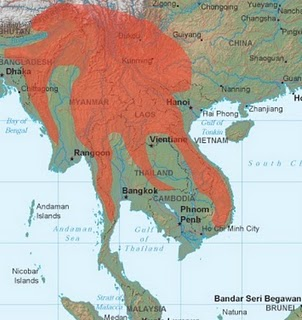
In chapter after chapter he lays out his argument, showing how virtually every aspect of Zomia hill society exists as a means of resisting state authority: If states like the flat plains, people move to the hills to avoid the state. If states like cultivating rice because it concentrates much needed manpower where it can easily be tapped, people adopt shifting cultivation for the very same reason. If states employ writing as a way of keeping track of who’s who, people ditch their books and rely upon easily modified oral genealogies instead. If states like organized religion, people engage in heterodox traditions that defy centralized control. And, perhaps most strikingly, if the state wishes to impose a shared ethnic identity upon its subjects, people choose “tribal” identities as a way of avoiding such ethnic ties.