Are you familiar with the concept of a gift economy? It’s an interesting alternative to the market economy in a lot of less developed cultures. I’ll contribute something and give it to someone, and then out of obligation or generosity that person will give something back to me. The whole culture works on this framework of mutual giving. The thing that binds those communities together and makes the potlatch work is the fact that the community is small enough that people can see each other’s contributions. But once one of these societies gets past a certain point in size the system breaks down. People can no longer see everything that’s going on, and you get freeloaders. When there’s more openness, with everyone being able to express their opinion very quickly, more of the economy starts to operate like a gift economy. It puts the onus on companies and organizations to be more good, more trustworthy. It’s changing the ways that governments work. A more transparent world creates a better-governed world and a fairer world.
All posts by Adam Fish

Digital Media Firms as Cultural Systems
Working with digital media producers for the past few years I’ve begun to confuse their language with my other professional nomenclature, that of an anthropologist. Is this indeed confusion or a result of finally doing my job of seeing broader cultural systems in those practices?
Here’s the deal. Digital media firms using experimental methods with emergent technologies in indeterminate market systems use words that can model the stuff anthropologists care about. I’ll compare terms platform to culture, application to subculture, beta to process, and privacy to power.
Is Platform to Culture as Application is to Subculture?
Google, Facebook, Twitter, and Apple’s iPhone are platforms on which whole networks or galaxies of different social and economic systems flourish. These companies’ platforms are becoming the broadest cultural ecosystems within which all other digital social activity exists.
Like culture there is constraint and agency on the platform. The constraint comes from the terms of service, the affordances of the online architecture, and the rights given by the platform holder. Platforms are almost universally proprietary—privately owned. The overall platform itself cannot be adjusted except by holy command from the CEO. Giving a cut to the CEO, developers can make applications on platforms. The ability to development on the platform is the agency, as is the ability to surf, scam, and surveil on the platform. Developers have the capacity to transform the mechanics of a proximal space of the platform via application programming interfaces (APIs). People come into contact with the app–be it a game, a badge of identity, or a little tool–and their digital social lives are slightly adjusted.
Humble scholars desiring to say something about the platform:culture should begin by studying the practices occurring on apps:subcultures. Zynga—the makers of apps:subcultures Farmville and Mafia Wars, two games on Facebook with millions of gamers, is a more manageable research project with discrete parameters, practices, and ideology, than studying the platform:culture of Facebook or Google head on, which like culture is always in flux.
Culture is Permanently Beta
It isn’t news that culture is not static. Sociologists Neff and Stark studied New York City digital media firms during the Web 1.0 bubble, claiming these companies were in a state of “permanent beta”—never finished and therefore responsive to the chaos of the market and the unforeseen on the technological horizon.
Gmail is an outrageously successful application designed by Google for the Google platform. It has been around for years and it is still in beta. In What Would Google Do? journalist Jeff Jarvis makes the point that Google takes the risk of releasing their products in beta and achieves corporate transparency and greater social activity by letting the user in on the preliminary R&D experience. Is Google a bellwether for larger cultural processes of which platforms and beta releases are quintessential qualities of this emergent cultural system?
“Permanent beta” is an apt anthropological description of historically situated cultural activity. I don’t need to remind anthropologists or SM readers that beta is a description of culture itself that is always in process, historically variable, emergent, etc.
Is Culture Open or Private?
Several overlapping ideologies from the historical development of the internet highlight the importance of collaboration, openness, and transparency as preemptive measures to check the centralization of information power. In all cultural formations, those good things must be vigilantly monitored and fought for. I’d argue that collaboration and openness as corporate principles is new and may suggest that the technological affordances of digital technologies make less openness in social technology less profitable. If richly communicative social practices require open systems, and these digital firms are in the business of digital sociality, it behooves these CEOs to create decentralized and open systems. We see some of this openness and collaborative spirit in Google and Facebook as platforms and beta systems—despite their indifference to corporate transparency and their antagonism against what they see as provincial notions of personal privacy.
So how do the trends towards more personal transparency and less privacy fit into this theory of culture as a digital system? Facebook CEO Mark Zuckerberg really thinks the world will be more communicative and therefore more peaceful and mutually forgiving if only more people were less secretive and more honest about who they are. Protecting and respecting individuals’ private rituals, sentiments, and remarks is a primary objective of anthropological methods. Much important cultural work is done opaquely through symbols, in the depths of kivas, and behind closed doors. Does this sense of culture as a beta platform that is historically agitating towards greater openness and individual transparency give credence to Zuck’s algocratic design for world peace?
One problem with the theory that culture is like a digital system is that this platform:culture is corporately designed. The API may provide developers agency akin to social contracts. The digital firm may be motivated less by profit making and more by mission motives. But doesn’t the fact that the entire ecosystem is proprietary trouble the notion of platform:culture? Nobody owns the protocols—the total realm of possibility within cultural systems—like Zuck does Facebook or Jobs does Apple. Platforms may be like culture but unlike culture you can pull the plug on the platform should it cease to be profitable or fun for the shareholders. And yet, aren’t firms, platforms, and applications populated by people constrained and enabled by the same processes that exist outside of their digital systems?
Crowd-questioning Corporate Ethnographers
We have the honor of interviewing business anthros Grant McCracken and Barry Dornfeld. By we I mean you.
Barry wrote a groundbreaking text in the anthropology of media production: Producing Public Television, Producing Public Culture. Twelve years after its publication, Dornfeld’s book remains the deepest description of television production and the tense conflicts that happen when do-gooder social science meets a ruthless profit motive. If you’ve ever been frustrated with how nonfiction TV networks (Discovery, Nat Geo, Travel, Animal Planet) take our scientific issues and make them into titillating edutainment then this young classic should find itself tattered and dog-eared on your desk. Today he is a corporate anthropologist at the Center for Applied Research.
Grant is the foremost anthropologist theorizing the role of culture in corporate practices. He shows how many corporations struggle along with anthropologists to define culture. Some CEOs get it. Others don’t. In his book Chief Culture Officer, Grant argues that the future of corporate profit–and social relevance–is dependent upon executives being anthropological in their executing. The corporate capitalization of the culture concept is far from politically neutral and Grant seems like one ready to defend his position against any would-be anti-corporate anthro-activist. Grant is presently a member of MIT’s Convergence Culture Consortium.
The theme of this batch of Savage Interviews is corporate anthropology and in the frictionless outsourcing style of multinational corporations we give this job to you. No this is not exploitative labor. I don’t get paid and neither will you. We are creating knowledge and value together, for the discipline, for free, for fun, for the open-source corporation WordPress. So graciously give up your private dreams, ideas, and questions about corporate anthropology just like you do on Facebook. What should I ask these guys? Post your questions as comments below or send them to me as emails. Later listen to the posed and the answered queries.
Savage Interview: Going Corporate with IBM Anthropologist Melissa Cefkin
In my first batch of Savage interviews I am focusing on anthropologists like Simon Sinek working in or with corporations (Barry Dornfeld and Grant McCracken, you out there and willing to talk?). I recently had the pleasure of talking with Melissa Cefkin, IBM anthropologist and editor of the recently published “Ethnography and the Corporate Encounter: Reflections on Research in and of Corporations.”
We talked about what exactly she does, anthropology’s resistance to the corporate encounter, management and new media firms, pre-Internet bust corporate engagement with anthropology, and how students can go corporate. To warm up your mind to these ideas here is a supplemental question and answer you won’t hear on the audio. Here is the interview.
Fish: In many new media firms people are working 50-70 hours a week. One of the reasons I am investigating new media firms is because so much of human social energy is spent building corporations, services, and products. To miss how corporations influence socialization–usually because of anthropologist’s apprehension of multinational corporations–is to severely limit ones anthropological study. Do you agree?
Cefkin: Completely. People may spend 4 or 6 or 10 years in school, but then they carry on to work for another 30 or 40! Clearly a central domain, clearly a significant site for anthropological work. But the rub, I suppose, is in the “study” versus “do something in it/be a part of it”. As we grapple with in our volume (“Ethnography and the Corporate Encounter: Reflections on Research in and of Corporations“), its not just that we are there, but we are there actively.
One of the things I’ve been thinking a lot about is how to ‘perform criticality’, if you like, in ways that aren’t signaled only through a dissenting and oppositional voice (which is, it seems to me, a dominant anthropological trope and one I fall back comfortably myself). Because frankly much of what passes as intended engaged/critical dialogue is not heard. Several months ago I was asked by some young anthropologists about the impact of some recent anthropological works (which I’ll not name, but were in the areas of global markets, corporations, new media, software and the like) on corporations or corporate actors. And I’ll admit that I was taken aback at what seemed to be a belief that such works are actually read by the powers that be in the corporate world. Of course there are exceptions, and I recognize that there are subtle chains of influence beyond the book itself through which such ideas and viewpoints can move, but more often then not, if those kinds of ideas get any airing at all its because there are already anthropologists within those domains who would direct their counter-parts to them.
I am not meaning to be disparaging of those works in any way at all (nor of those eager scholars who believe in the power of ideas!). But the thousands of middle managers I meet aren’t reading this stuff, most CEO’s and their advisors aren’t reading this stuff. Speaking about and being heard are two different things. We know this. Those pursuing a public anthropology know this. Despite how difficult and imperfect it is, for now I’d rather have a seat at the table at the point that there is a chance to reframe the questions being asked and assumptions getting made than to wait until things are done and then oppose them — even though that stance is in many ways, in my view, an easier stance. Putting myself into such contexts and trying to work from within is by no means always successful. But you know what? In some small ways in its own contexts, it often is.
Humanity’s Infancy and Indigenous Digital Media
The study of humanity is in its infancy. Think about it. Most anthropologists can trace their lineage from their advisors back to the originators of the modern discipline in 3-4 generations. I got to Talcott Parsons in three skips. (If you know whom instructed Parsons please help me fill out my family tree). That is 100 or so years. Other important historical events were occurring a little over 100 years ago included the balkanization of indigenous peoples on reservations, like in the American West, for instance. Anthropology is so young. The void of knowledge about our species should be terrifying. This youthfulness is all the more obvious when one looks at a semi-ridiculous reduction of anthropological accounts of indigenous digital media.
Choose an indigenous group, preferably one with a relatively low density of complex technologies in their pre-colonial period. A desert tribe from North America or Australia or Africa or Central Asia works best. Introduce a new technology. Screw the Prime Directive. Around the technology are skeptics, early adopters, sustained innovators, and a break through moment. Tribe splits between fearful elders and ambivalent youth at an important meeting. Anthropologist dutifully records the notes. Compromise. Collaboration. Technology is modified to accommodate concerns. Indigenous people and technologies, both are modified, indigenous group uses new tool for empowerment. It is not what is made but how it is made. Privacy issues solved. Epiphany: tribal content can be adequately communicated and preserved via modifiable new media. A traditional mediated future is envisioned. Publication.
It is easy to be flippant about the story points of this classic tale of ICTs and indigeneity (particularly if you have done that applied research or written that article in one way or another for a few years like myself). But the fact that much more nuanced examples of that story continue as forms of legitimate research throughout the world means it is either as trendy as I tend to be or it is indeed one of the really important anthropological observations of our present. In this incarnation/writing I am going to side with the living.
Seen from the longue duree, this is THAT period of anthropological history. This is the middle of that 40 year period in which we can reasonably talk about one discreet unit, a digital technology, encountering another discreet entity, an indigenous community. An anthropologist is there to record the creative appropriation and postulate on its significance.
Follow me down this wormhole a few hundred years into the future, when anthropology, or its future incarnation, can no longer reasonably talk about an individual with self-identifying, linguistic, or material roots stemming directly from a pre-colonial origin. Cultural hybridity will continue at an ever-increasing rate, and, yes, cultural entities will evolve from hybrids of hybrids into new hybrids for the future anthropologist to name. Disparities in the global peripheries to access to off-the-shelf personal technologies will certainly exist but everyone will be thoroughly inculcated by “smart” mobile devices that will increasingly serve a suite of essential economic, social, and personal services. If you doubt this look into the quickly scaling FrontlineSMS or Samasource. In this future world where personal narratives turnover as quickly as designs for obsolescent hardware—a process compounded by the ubiquity of immersive mobile digital tools—anthropologists will no longer have this nicely polarized (and easy to spoof) story with these deeply historical characters using for the first time carbon fiber coated silicon for acts of empowerment and sovereignty. Nope, such technology will be such a part of most people’s lives that the novelty of indigenous digital media will have worn off. Media anthropology will continue. It just won’t be so charming.
Perhaps this thinking is a result of my transhumanist informants influencing me, but it feels to me that we are entering a period of fast history where the rate of intercultural hybridization and the proliferation of mobile and networked ICTs is hyperactivating cultural schism and re-formation. Looking back at the early 21st century from this near future it is possible to fondly consider the study of indigenous digital media with tenderness. We are living in this fascinating and innocent world where the story of new-media-meeting-old-culture is indeed an important story to tell.
Remix Culture is a Myth
“remix is a myth. Talk to the ISPs. 99% of illegal content is downloaded for consumption only. Barely anyone is remixing illegally.” Andrew Keen (@ajkeen) 7:22 AM Mar 26th
This is a Tweet/quote from the self-confessed Anti-Christ of Silicon Valley. I follow him on Twitter as a gnawing antidote to the breathless Web 2.0 enthusiasm that props up investments in infantilizing social media systems. Infantilization, illiteracy, amateurization these are the apocalyptic results according to Keen of Web 2.0 consumer ‘prod-usage.’ Partner this against the wisdom of the crowds, fan-fiction, citizen journalism, and social production of the Shirkey, Benkler, Jenkins breed of techno-optimism and we’ve got the making of a distorting debate certain to totally miss the ethnographic details of real life practice. By myth I follow sociologist Vincent Mosco in seeing myths as simultaneously both distortions of as well as possibilities for future action.
Despite Keen’s antagonism for antagonism’s sake sometimes he nails the hot air out of the right cyberpole at just the right time. I thought this Tweet about remix culture being a rhetorical device and not a practiced reality was so right on I reTweeted it to Facebook. An exchange amongst fellow Savage Mind Dustin Wax (Oneman) and other Savage readers followed. This is reposted with the A-OK of everyone involved. Thanks to media scholars/anthros Dustin Wax, Kim Christen, and Daniel Taghioff for running with it.
Adam Fish remix is myth. 99% of content is downloaded for consumption. Barely anyone remixes. Remix is not a valid argument for copyleft. TH @ajkeen
Dustin M. Wax That’s cuckoo. That’s like saying macaroni art is myth because 99% of macaroni is eaten. Barely anyone makes macaroni portraits. But edge cases aren’t non-cases.
Adam Fish Yes, remix exists but not in the meaningful volumes to warrant it the legal utility and scholarly attention it receives. Where would H. Jenkins and Larry Lessig be without those few elite tools with the spare money and leisure to remix? By myth I mean a happy distortion and possible lie.
George Grader copyleft is copyright’s annoying little brother?
Kim Christen OMG! thx for saying this Adam, I completely agree that it gets WAY more attention than it warrants!
Dustin M. Wax I might be missing some vital background info here, but I think I disagree. Remix might be just a tiny percentage of potential uses of media, but it has a disproportionate impact on the development of a culture than “plain” consumption. To take a prominent example, Danger Mouse making the “Grey Album” has a greater effect on us than someone else listening to either the “White Album” or the “Black Album”.
I agree that it is a way of interacting with media that is not typical, but I think it attracts more attention, and needs greater protection than “mere” consumption, precisely because it is atypical and disproportionately influential.
Kim Christen Dustin, it may be the anthropologist in me, but how might one actually quantify the “effect” or “impact” that the “Grey Album” has on someone, or even some collective like “music listeners” etc? and how would you quantify that versus some other album or work that is or is not a “remix”?
Dustin M. Wax Kim, it may be the anthropologist in me, but I wouldn’t. I’m the Anti-Quant. That said, the comparison isn’t between remix and non-remix production — I wouldn’t even try to compare the influence of the Grey Album against the influence of the Beatles’ or Jay-Z’s albums. The comparison Adam set up is remix vs. non-remix consumption
The other issue, though, is a concern. How do we apprehend and understand the way that consumers interact with creative media? To be honest, I had the same question in mind when I wrote the comment above, and I decided to ignore it because this is Facebook and I can be stupider here than in real life.
But since you asked, I’d say that we have never adequately theorized the relationship between readers/viewers/listeners and their media. This is actually a major stumbling block for people who want to make the case that, for example, watching porn causes misogyny or playing violent video games causes desensitization to real-life violence (or their counterarguments, e.g. that watching porn helps people express themselves sexually or that playing video games helps people channel aggression in non-hurtful ways).
That said, to my mind, remix culture encourages the creation of new material for interpretation, so that where there was Work X and Work Y in our culture before, now there is Work X, Work Y, and Work Z, the Remix. And since the remix, by positioning disparate works in new relations, encourages different interpretations, it leads to new culture. More semy to get poly on, so to speak. In effect, it multiplies the act of consumption/interpretation simply by being more.
Adam, I apologize for hijacking this thread. Doesn’t mean I’ll stop, but I’ll be appropriately contrite for not stopping 🙂 We should have this discussion at Savage Minds; Facebook’s not exactly a public forum!
Kim Christen hey, Dustin, I see we are fellow banana slugs! all good questions, i still agree with Adam’s original post–or at least the sentiment behind it =)!
Dustin M. Wax Yay banana slugs! You should just agree with me — it’s so much easier 🙂
But my concern is the notion that there are certain parts of our culture that can and should be locked down. From one perspective, all consumption is remixing, since I never hear a song the way you do, and neither of us hears it the way the artist(s) did. We’re always mixing in parts of our own cultural experience and personal history, and always placing everything into relation with the rest of our media experience. The draconian copyright laws we live under now pretend that this isn’t the case, which would be ok (pretend away, doesn’t make it so) except for the fact that they then limit the admittedly small percentage of people who make new media using other media as their medium — which is to say, who concretize, or would concretize, those tacit remixes into new material culture. That’s what bothers me about Adam’s original post, the idea that less restrictive legal frameworks aren’t needed because so few people are restricted by existing ones.
Kim Christen I think you read A LOT more into what Adam posted than I did…however, if you’re interested in my take on remix you can read my article “Gone Digital: Aboriginal Remix and the Cultural Commons” or “Access and Accountability in the Digital Age” –on my blog here: http://www.kimberlychristen.com/?page_id=4
Adam Fish Remix and other bricolage are ancient and rich form of innovation. The few that do it can be influential. Today a not insignificant number of people attach unlicensed music to their Youtube personal videos, but few really make the virtuosic remix of the Grey album or Kirby Dick’s pirated flick This Movie is Not Yet Rated. The influence these rogue artworks have can’t be measured on the subjectivity of the consumer–and that isn’t anthropology but 1960s communication studies. The influence of remix culture is on the possibility for future practices. That is the threat to restrictive copyright laws–the limiting of the realm of imagination and practical possibility. I see and hear this all the time in my work as an video documentarian educator. Every hack who can barely open her Macbook or color correct her camera is suddenly totally worried about the presence of a passing corporate logo or some ambient muzak in her documentary. Right now I am editing a documentary about a hunger strike in the Himalayan mountains. We have old TV news and BBC documentary clips that I am using however I want. When and if this documentary become worth any money, the distributor’s lawyer will work it out.
The point is to make stuff.
In my ethnographic work with user-generated TV network, Current, I have witnessed a network willing to pay for short, mediocre quality documentaries be mostly ignored by all but 200 core producers. The wanted 10,000s, an army of citizen journalists and did everything they could to make it. They failed because of lack of interest and skill. Of those 200 take a guess about the class/education of the viewer-creators. This is not a leveling or democratization of media production.
Remix is important, hybridity is a source of innovation, to do it at all or well takes considerable talent and resources, that only a few elites have. But more sinisterly, copyright laws have colonized the consciousness of would-be producers, creating a culture of fear that limits creativity–it is this that we must overcome.
If you are one of the lucky few compelled or resourced to, make the hybrid artwork.
Daniel Taghioff Adam, I like this. You seem to be critiqueing a very old negative notion of liberal freedom “leave me alone” which is embedded in a lot of very “new” thinking.
Hence the massive emphasis on remix, hybridity etc, since it goes with discourses that emphasise difference and diversity, whilst masking out what we have in common.
This makes it easy to ignore things like…. Healthcare to pick a totally random example. Or socioeconomics to revive a terribly outdated idea (Oh actually you just did that, maybe it is safe to mention it. How about inequality?)
Yes creativity and creative freedom is very important, just look at Apple’s bottom line, but what about the underlying conditions that support (or not) creative or even human agency in general?
This is hardly a new idea, Amartya Sen get there in economics a few decades ago, picking up an stuff even Adam Smith was on about, and yet the cutting edge media / culture debates seem not to have really picked up on this.
This is not to ignore new left critiques of mechanical approaches to socio-economics (class applied as a literal category etc…) but surely given that we live in the most unequal world humans have ever witnessed, this overwhelming emphasis on the particular, the hybrid, the creative, the product-innovative is more than a little bit like looking at the differences in leaf structure in order to ignore that someone owns 90% of the trees and is planning on cutting them all down for an enormous bonfire.
Daniel Taghioff As for copyright, has anyone seriously sat down and run econometrics on which models of creator’s monopoly would lead to the most aggregate benefit to society? Which model would be most progressive, and create incomes where they are most needed also?
I doubt it, because it is an area where the moneyed few are rather at odds with the many. Sure copyright has a role in the general maintenance of wealth, but what role is it best even from an economic perspective? Why is this question so little asked?
Surely qualitative work about how media are used and consumed, and so on could inform that? Why assume that dividing qual and quant is good? Qualies have carved out a niche in Anglo-Saxon academia no, why be so antagonistic?
Savage Interview: ethnographer and entrepreneur theorist Simon Sinek
This winter quarter I had the distinct pleasure of spending several weeks with students talking about corporate globalization and neoliberalism. Students may get an opportunity to think about late capitalism in a more hyped-up and celebratory way in their business or development classes but the anthropological take on capitalism and globalization is that it is patently sinister.

Few disciplines have a less friendly relationship with corporations than anthropology. For many, they are evil incarnate, for some they are a necessary evil, and for others they are a source of gainful employment. The outlook and methods anthropologists share with marketers, branders, and other corporate lackeys compounds anthropologists’ unease with corporations. Few contemporary anthropological projects can afford to ignore the role of capitalism, cognitive colonization, culture industries, consumerism, and corporations in the lives of their informants. Despite the tomes dedicated to the anthropology of capitalism, the variability of values and practices within corporations is rarely documented or theorized. Not without its contradictions and hype, the social values and philanthropic practices of social entrepreneurs seems to be catching on throughout that facet of the corporate world engineered to cater to a politically and ecologically conscious American middle class.
Identifying the parameters of this new species of capitalism would be pretty cool so I thought it important to talk with someone trained as an anthropologist and practiced as a corporate ethnographer who is now an entrepreneur theorist for leaders of elite firms. Simon Sinek is English and grew up in Johannesburg. He got a BA in cultural anthropology from Brandeis University and worked at several top ad agencies, before writing his recent book Start with Why: How Great Leaders Inspire Everyone to Take Action. I met him at a truly evocative talk he gave at Causecast in Santa Monica earlier this month and got him on the phone while he was in Dallas last week. We talked about social entrepreneurship, leadership, the academic anti-corporate bias, Western urban business cultures, human biology and marketing, manipulative versus authentic branding tactics, relevant anthropology, corporate culture as Culture, William Ury, benevolent dictatorships versus consensus driven management practices, and the ethnographic imperative to ask why.
A pretty fierce pull quote: “As an ethnographer we are in search of why but we actually ask what.” Simon Sinek
Here’s the audio for the interview with Simon.
St. Patty’s Day Documentary: Belfast is Still a Divided City
In a recent anthropological lecture at UCLA an unnamed professor stated that colonialism is over, that somehow, somewhere all anti-colonial revolutions succeeded, or all colonials gave up because of cost or frustration. I was in the lecture hall and had already edited my antagonistic response. Here it is. Belfast is Still a Divided City is a documentary I shot and edited in 2008. It was broadcast on cable and satellite network Current TV in US, Ireland, UK, and Italy to 55 million viewers. No it is not observational or ethnographic but yes it is anthropological. Deal with it. Argue. It is surely slanted in favor of the Irish liberation movement. They were the ones who housed, fed, and gave me access. They became my friends. So access goes.
And so it also went in Palestine in 2009. The one’s who returned my rampant calls, emails, and door knocks were not the Israeli rabbis and politicians but the impoverished Palestinians. These shoots in Palestine and Northern Ireland are part of a documentary about divided cities around the world: Belfast, Jerusalem, Nicosia, Mostar, Berlin….LA. Usually the indigenous or minority population is more apt to take the gamble and work with uncredentialed mediamakers like me than the established powers who have mainstream print and TV media. These include the Palestinians in East Jerusalem, the Irish in Northern Ireland, and Latinos in LA. User generated content (UGC) nonfiction media is a weapon of the weak; economics, sanctions, barriers, primetime TV, state racism are the weapons of the strong.
On St. Patty’s Day, school yourself on the indigenous Irish sovereignty movement and the Protestant colonial activities by scoping my short doc.
Current’s blurb goes: “Ten years after the Good Friday Agreement, Northern Ireland maintains a relative calm. Despite a few isolated incidents, the fighting seems to have ended. But has this brought Protestant and Catholic groups closer together? In Belfast the two groups live in neighborhoods that are still physically separated by ‘peace walls.'”
Check it: Belfast is Still a Divided City: 90014381_belfast-is-still-a-city-divided.htm or http://current.com/items/90014381_belfast-is-still-a-city-divided.htm
Jihadi Videos and the Anthropology of Inaccessibility
Anthropologist Roxanne Varzi came to our UCLA working group Culture, Power, and Social Change last week and spoke and showed a courageous and wise reflexive ethnographic film “Plastic Flowers Never Die” on the religio-statist support of martyrdom in Iran. I asked a question about how to theorize the role of digital ‘texts’ in the present era of ubiquitous self-publishing and social broadcasting. I was thinking about jihadi videos that are shot and distributed on online video portals as advertisement, recruitment tools, or celebrations of religio-military success. According to the IntelCenter, jihadi videos can be categorized as operational, hostage, statement, tribute, training, and instructional videos.

Essentially antagonistic with technoprogressive modernity while exploiting the simplicity, freedom, and access that comes with new media, these videos can be described as vanguard, counter, resistant, or subversive to capitalistic modernity while using the forefront of the sociotechnical tools of that capitalist technocracy. Our models of user-generated labor, from Shirkey and Benkler’s celebrations of social production to Terranova’s Marxist perspective on exploitative and ‘free’ labor, might not fit this un-capitalist media production practice. It is going to take a mix of something new to get it. But what?
I asked Varzi about jihadi videos: “These strike me as a rich source of information about a culture that is otherwise inaccessible to anthropologists: jihadi martyrs. How would you go about developing a critical anthropological methodology to reading these video texts?” Correctly but dangerously she stated she wouldn’t do it without an ethnographic component. I thought to myself: Let me get this right. I gotta hang out, like, deeply, with jihadi terrorists? As an anthropologist I cannot make a statement about jihadi video production practices without having first squeezed my way into their schedule and shared a few meetings over tea with my local jihadist? I’d love to, frankly, but I doubt I can network into their cliques. Are we going to let these remarkably reflexive, vocal “weapons of the weak” go unnoticed? If we can’t talk about these videos we are losing our disciplinary focus on subcultural expression and resistance and an opportunity to expand our methodological repertoire.
Jihadi video producers and new media firms, my focus, share little but extreme privacy. The similarities end there, but the problems for the ethnographer of either are identical: gaining access. My subjects are powerful. They have ideas that are worth millions in venture capital. Their lawyers are all about intellectual property. They live comfortable lives. They don’t need my cultural capital. They don’t need me around. Infrequently and for whatever reason, they invite me into their world. The Frontline documentary Behind Taliban Lines is a rare example that follows a single video journalist into the operations of the Taliban attempting to blow up a US convoy. This rarely happens in every context where a researcher wants access. Our own Rex thinks our focus should be on the subtle and not the savage, he’ll be happy to know that anthropologists usually are aren’t gutsy enough to pursue such inaccessible subjects.
What if I couldn’t meet these wealthy entrepreneurs in person? What if they were so private that participant observation was impossible? I would be forced to construct something anthropological through their public representations. Thankfully, my subjects produce a lot of media. They socially broadcast on Facebook and Twitter and have scheduled relations with the public at conferences. (Except for TED, which at $6000 a weekend excludes most.) But with or without ethnography, this project, like a hypothetical investigation of jihadi video producers, needs to happen. If we have to begin-and probably end-with texts, what will we do? We’ll need to first develop an anthropologically specific way of reading these video texts and other public media artifacts.
The time is now to revisit our present anthropological theories about the role of textual studies. Finding its most useful expression in reconstructive indigenous and postcolonial historiographies, texts have long been an essential part of our field. But have we fully fleshed out a spectrum of specific theories for each type of text? I am not interested in adjudicating the validity or truthfulness of this text versus that. Colonial documents, biographies, and census records need to be differentially theorized not as statements of fact or fiction but as culturally situated texts. What I am fishing for is a debate on whether the new digital documents can find a home in contemporary anthropological theory. What differentiates paper-based from Web 2.0 personal documents and text from video? Most importantly, how can we take a culturally distinct but necessarily distant visual text of war and conflict, consider its technical and productive online existence, not defer to speculation on auteur intentionality, be mindful of the artifacts that appear on screen, and extrapolate back to the producer’s culture?
More broadly, we need to ask ourselves how to do an anthropological study of ethnographically inaccessible objects: leadership of corporations, governments, terrorist cells, elite institutions. Anthropologist Jane Weddell’s recent book, The Shadow Elite: How the World’s New Power Brokers Undermine Democracy, Government and the Free Market” is a fine example. Ethical problems abound in all these projects. Just as Nancy Scheper-Hughes prospered, so will the anthropologist of video culture of martyrdom and other inaccessible objects.
Transhumanists, Technolibertarians, and Technoprogressives
Immortality, privatized space travel, organ ‘printing,’ seasteading, geoengineering, DIY human biology, and augmented humanism are some of the futurological imaginaires of a group of elite new media professionals and social entrepreneurs in Los Angeles. The values associated with these interests intersect with the ethics of technoprogressivism, the utopianism of transhumanism, and the social history of technolibertarianism. Transhumanism is an intellectual and cultural movement fastidiously committed to biosocially engineering a utopia absent of poverty, boredom, isolation, class strife, illness–even physical death. A fundamental idea of transhumanism is the singularity, a theoretical future point where accelerating computer-processing speed will lead to ever-increasing scientific innovation. Technoprogressives support the ethical convergence of technological and social change. Technolibertarianism emerges from a bourgeois bohemian ideology to advocate for freedom and individualization of markets, technoscience, and social policies.
Using emergent technologies as profitable as well as political tools, these new media social entrepreneurs make or distribute visual and social media about transformative and experimental natural, biological, physical, and social sciences. Examples of systems they make include for-profit and NGO social platforms for medical providers and patients, documentaries about the science of human longevity, and next generation mobile technologies for philanthropic fundraising. In other cases, new media social entrepreneurs are not the engineers of technology but the early adopters, “social broadcasters,” and popularizers of the philosophy of transhumanism and technoprogressivism. Key examples I research include the technoscience of immortality, the social mediation of health care systems, the privatization of space exploration, ocean terraforming, and the “controlled serendipity” of “social broadcasting.” Based on a mix of ethnographic methods consisting of nonfiction production, conference participation, and virtual and actual socializing this research describes how science, technology, media, and sociality intersect in the futurological imaginaries, professional practices, and political economics of new media social entrepreneurs.
An Anthropology of Values
It takes years of study and practice before one even understands what the hell anthropology is or can become. For example, as a transplant from cinema and media studies to anthropology I’d been doing this ethnographic research on new media makers and I was increasingly confused by what made this work anthropology and not something else. Sure, I questioned my informants about their practices, politics, and class—and I made nonfiction videos with them—but all my conclusions seemed rather topical and antiseptic. It didn’t look at all like anthropology. Late last year I asked an informant who had just been fired from a job what was her biggest success and largest failure at her previous position. The question provoked the mediasmith to tell a detailed story of collaboration, struggle, and ambition and to reflect on the conflicting personal and corporate values. The question got me nearer to ‘culture’ than my questionnaire about class and education. This provoked me to engage more with my informants’ off-work passions, readings, hobbies—in the hopes of identifying core values—and less with the technical aspects of their non-fiction and entrepreneurial business operations. Above are some of my zygote findings.
‘Mutual Friends’ as Culture
I ‘friend’ and ‘follow’ on Facebook and Twitter many of my informants working in the multidisciplinary world of social entrepreneurship. It can be helpful in a number of ways. Personal profile pages on social media sites form databases for the usual information that takes up the first 10 minutes of an interview and from which class assessments can be made (education, current city, hometown city, religion, politics, etc). This is a good resource for anthropologists interested in links between social capital and digital culture, but I want to explore how Facebook’s ‘mutual friends’ groupings are data sets for anthropologists.
So I do this regular ritual on Facebook. I find someone doing something innovative in regards to new media business and philanthropy and immediately request their Facebook friendship and follow them on Twitter. My informants, they tell me, do the same thing. (I got the idea from them). I post links of enlightening new media blogs and sociotechical events that would interest my ‘friends’ of scholars, business people, and activists. I do this to save my links and to give a realtime display of my research questions and investigations. (I started doing this to mimic the practices of my informant friends.) They are doing this, I am doing this and everyone is up-to-date on what interests each other on that particular day. This practice creates a space of intellectual affinity and reflexive transparency. For an anthropological study of voracious polymaths who value innovation and discovery such as new media social entrepreneurs it is essential to stay abreast and also contribute to their intellectual curiosity.
I do this other thing too. I click on the Facebook page of one of my key informants and see the mutual friends we have. With this one key informant, we have 60 mutual friends. There are journalists, documentarians, engineers, marketers, designers, academics, philosophers, and technologists in this web of ‘mutual friends.’ John Postill encouraged us to ask if this is a public, a network, a community, a culture, or a business consortium? In an era of transnationality and affinity cultures such static categories have questionable validity. Artificial categories of ‘mutual friend’ provided by dynamic social media sites might be useful to think with when pondering the boundaries and dimensions of informant’s ‘culture’. What the FB ‘mutual friends’ is is a specific group of people with shared values and practices regarding the theory and use of social media. This praxis is updated and refreshed by the minute, debated and experimented with everyday, and forming actual world actions and communities throughout the year.
I got this NYT blog post (uploaded by my informant with 60 mutual friends) from Nick Bilton, Lead Bits Blogger for the New York Times (one of the individuals in my mutual friends web), who interviewed Maria Popova (who actually didn’t play along and refused to be my Facebook friend, noting she had to maintain a divide between personal and professional ‘friends’) who called this curatorial practice “controlled serendipity.” There is a tendency within this group of new media social entrepreneurs to view Facebook not as a place exclusively for ‘friends’ but where to ‘socially broadcast’ and influence a group of influential people. In this situation ‘friends,’ not expert aggregators, increase in importance as distributors of new news, research, and capitalist venture opportunities. I suspect they use their links to leverage to themselves soft power for future actual world endeavors. While this is interesting anthropologically, my concern is that Facebook Corporation will use their records of peer-to-peer activities to create a search algorithm more personal than Google’s, based not the metrics of links frequencies but on culture: mutual friends, values, interests, practices, and desires. If ethics are your concern please see my previous post exploring the issue of informed consent in research into individuals within socially mediated ‘mutual friends’ circles.
The method I am describing exacerbates the insincerity and impersonal functionalization of social media. It is an exploitation of the system that contributes to its demise. Most of my friends and informants who’ve been on Facebook for about two years each now just peeked over 500 friends–which is about 350 too many ‘real friends’. Facebook is now more a resource and a tool than any quantitative simulation of friendship. Thus Facebook has just entered into the population race that defined Myspace at the same time that LinkIn has emerged as a viable alternative. My hypothesis is that sincerity and the longevity of social media systems are codetermining. And the use of social media I am going to outline here is a sign of growing operationalization and decreasing ‘friendship sincerity’. This tendency might be one of the markers of the demise of Facebook domination (you heard it here first!). By mimicking the social media uses of my informants I am effectively contributing to the system’s evolution and possible failure.
Mining Twitter and Informed Consent
This week ten new media theorists and ethicists attempted to answer a question about the necessity of acquiring informed consent while doing social scientific research about user-participants of social media sites such as Twitter. The line of questioning started at the 2010 ACM Conference on Computer Supported Cooperative Work and spilled out onto Michael Zimmer’s Facebook page. Zimmer considers Tweets private and consent necessary while others disagree. I reproduce the Facebook dialogue in full to make a point I will follow-up on later. Facebook ‘Mutual Friends’ form a cultural grouping unfolding in candid real time experiments. Exchanges like this are instrumental both because they address a serious and misunderstood facet of new media social research and as a sample of a reflective public working out theory in real time. The question regarding the ethics of ‘following’ ones informants is particularly important for someone interested in mixed methods of doing social research. And as social media proliferate, the ethical and utilitarian question of whether to ‘friend’ your informant—and whether the information you then glean from that virtual ‘friendship’ can be considered legitimately collected data—will increasingly be pertinent to anthropologists studying other forms of actual (as compared to virtual) sociality. Zimmer was kind enough to track down the consents of all discussants. My sincere thanks go out the participants for consenting to having your ideas posted here.
Michael Zimmer Do researchers need to get informed consent to follow a Twitter account for research purposes? #cscw2010
Yesterday at 8:40am via Twitter · Comment · Like
Thomas D. Walker Well, Stalker, if the account holder tweets to the general public, then it’d seem like there’s no expectation of privacy so no consent would be necessary.
Yesterday at 9:06am
Michael Zimmer But isn’t my expectation that even though my tweets are public, they’re often lost in a sea of hundreds of tweets among my followers, and I never anticipated someone would archive, mine, and perform research on them?
Yesterday at 9:12am
Thomas D. Walker If you’re comfortable with your anonymity being guaranteed only by virtue of your public tweets being hidden in plain sight among millions of others, then you’d have to realize that some determined person could follow just yours, archive them, and analyze them. I like my privacy, but I don’t worry about walking around a city or campus even though …
See More
Yesterday at 9:19am
Wyatt Ditzler I posed the same question tithe author of a poster next to mine at the iConference. She was analyzing tweets from Maldova. She presented the same argument as Tom. I followed up by asking he I she felt there was an ethical issue with her work, but again the public nature argument was her response.
Yesterday at 9:41am
Nicole Ellison Also depends on how data are being presented – e.g. in aggregate vs specific “quotes” that could easily be traced.
Yesterday at 11:40am
Rebecca Tushnet Many IRBs would say yes, or at least would require you to get a waiver–publicizing the extremes to which IRBs go is my husband’s mission in life. You can check out what he has to say at the Institutional Review Blog, http://www.institutionalreviewblog.com/
Yesterday at 5:09pm
Lorraine Kisselburgh Short answers — IRB application is required. You could request that Informed consent be waived with the argument that you are only analyzing tweets broadcast publicly, and that you de-identify your data to eliminate potential risk to the individual. Note: IRB interpretations vary widely (though they are arms of federal regulations), so this is the midwest R1 likely interpretation. Keep me posted on how you approach!
Yesterday at 8:45pm
Jeremy Hunsinger I would say if it is for research and you are dealing only with publicly available documents, then no, you need no consent. you can run that by the irb and get a waiver, but in the end, you are dealing with publicly available documents… not people, subjects. If you are dealing with subjects and not documents, then you will need irb clearance.
6 hours ago
Siva Vaidhyanathan Tweets are publications. I think it’s absurd to even consider IRB review for anything dealing with things people have published.
3 hours ago
Lorraine Kisselburgh The questions are: 1) Are you conducting research that is intended to be published; 2) Does your research involved human participants; 3) For these human participants, will you gather data through intervention or interaction with the individual; and/or will you gather identifiable private information about them. (45 CFR 46.102(f))
If these 3 …
See More
3 hours ago
Erin Hvizdak Rather than relying on IRB review (and the likely subsequent waiver) and applying existing research ethics guidelines/laws as they are to Internet research, I think it’s important to consider where these guidelines or IRB review might fail, especially in terms of expectation of privacy (does the user fully understand the public nature of their …
See More
2 hours ago
Jeremy Hunsinger If i download all of Michael’s published papers, blog posts, twitter posts and each one he publishes thereafter… are they the same? or different? I’d argue the same, just for different audiences.
about an hour ago
Michael Zimmer What if tomorrow, I decide to take my Tweet stream private. And I delete my blog posts. Does my affirmative action to purge my documents from the “live” web mean that you (researcher) need to treat that previously archived material differently?
about an hour ago
Michael Zimmer @ Siva: Re tweets as publications, does this extend to any utterance? Is public speaking a publication?
about an hour ago
Lorraine Kisselburgh @ Erin. All fine points worthy of discussion, but MZ’s question was pragmatic not philosophical (I think). If you do research that SHOULD have been reviewed by IRB and is NOT, your research program can be shut down, at least at universities that must follow US federal guidelines.
about an hour ago
Lorraine Kisselburgh @ Michael. If the individual changes their intent regarding release of data, then by IRB standards what might previously have been considered publicly available information, then becomes private information, and your collection would likely require BOTH IRB review AND informed consent, b/c the user now has an expectation that their information is protected.
about an hour ago
Jeremy Hunsinger well, tons of people probably have my twitter and facebook data that i made private last month, granted they have little after last month, but before then they have all of it. I would argue that before last month i had no expectation or need of privacy, but after i learned a certain fellow was being somewhat inhospitable with my data i closed it off so he couldn’t easily get it. so… given that they have my old data, can they use it, sure. do they need consent for new data, probably.
about an hour ago
Jeremy Hunsinger However, they could just get my data from company also, and then they would not need my consent, because of the agreement that i have with twitter.
about an hour ago
Lorraine Kisselburgh @ Jeremy1 — Yes, agreed. I didn’t catch the nuance MZ made on whether it changes the status of the previous data. I’d say not, but definitely for all future data.
@ Jeremy2 — Data through 3rd party….IRB will generally request a copy of the terms of agreement between user and 3rd party from whom you are getting the data, making it clear the user agreed to release of information.
about an hour ago
Jeremy Hunsinger Yes, had a big discussion at OIISDP on this jeremy2 topic with Ralph Schroeder and Bernie Hogan, I hold the same position as you there, though Ralph holds a different position, that still requires individual clearance if the data can identify the individual, at least that is my understanding. He was arguing that there is a research ethics above the contract there as i recall. Fun stuff, i’m one of the many co-authors of the aoir guide that Erin mentioned.
about an hour ago
Lorraine Kisselburgh [OMISSION] I agree with Ralph’s higher standards, but was trying to answer the question specific to what IRB requires. Again, this is all dependent upon local interpretations, as IRB committees and chairs still vary quite a bit. [OMISSION] I’ve authored some work on IRB processes for another research area I’m in (Org Com) concerning global and cultural differences in research ethics and practices. [OMISSION]
See More
about an hour ago
Michael Zimmer If there’s one thing I’ve learned in my short time examining this larger area of inquiry, it’s that there is regularly a large gulf between an IRB’s ruleset (and even its mandate) and “ethical” research, per se.
58 minutes ago
Nicole Ellison Michael, Was your original question about whether IRBs would want to approve this data collection (which I’m sure will differ by institution) or whether we think they should have oversight?
52 minutes ago
Lorraine Kisselburgh Well….local interpretations are constantly governed by the philosophical question of what constitutes ethical practices of research. [OMISSION] But practically, IRB is governed most strictly by what federal guidelines require….which do continue to evolve as a result of developing research practices and issues, and at the core attempt to remain true to the principle of ethical standards of research. 52 minutes ago
Jeremy Hunsinger Well there is also a large gulf between what each ethical theory can justify as ethical, and then another gulf between that and what lay-people think is ethical.
52 minutes ago
Siva Vaidhyanathan A publication is fixed in a tangible medium of exchange.
48 minutes ago
Siva Vaidhyanathan IRB processes impede social science, humanities, history, and journalism research and academic freedom when misapplied to adults in public roles or forums. There is no reason why IRB review should be required for oral histories of adults. Rules about anonymity etc. stifle history and journalism. We need a complete overhaul of the system which treats everyone like children.
44 minutes ago
Lorraine Kisselburgh @Thomas and @MZ…..we’ve started another strain I think. First, does publish = public? Are all publications (or utterances) by default for a public audience? And second, once public, can one retract, erase, rewind, or redefine one’s intent? [OMISSION]
Place Hacking
I rapped with reformed archaeologist Bradley L. Garrett regarding his recent visual ethnographic fieldwork about urban exploration. Here’s what we talked about, all images are his.

You are making two types of anthropological cinema. The first is what you are calling a video article, such as in Urban Explorers: Quests of Myth, Mystery and Meaning, and the second is a participatory yet observational documentary on urban spelunking. The first are information-dense and interview-based, the second wandering handheld claustrophobia inducing visual documents. I have to admit the first is as yet too theoretical and the second is almost unwatchable. How are you going to reconcile these two voices, drives, tendencies?
Urban Explorers Quests for Myth, Mystery and Meaning was picked up early in its production by the Blackwell journal Geography Compass and was constructed as a sort of experiment in what visual geography could become (maybe in relation to visual anthropology which has been far more successful). Basically the idea is that it is a film and an academic article, so yes, blind peer reviewed, properly referenced and hopefully theoretical challenging, while at the same time using some visual techniques, such as cutaways, to get the message across in more visceral way. The tendency with urban exploration, because it is such a bodily activity, is that it tends to get undertheorized and overachieved. So I wanted to really sink my claws into it on the first run and try to get the theoretical gears turning around the practice. I think working this way will, in the end, produce a more effective movement and more respect for the practice.













In regard to your second thread there, I realized early on that when I was exploring I had little control over what I was shooting. When you are hiding from security, trying to get over a fence quickly or simply keeping yourself prepared to move fast should the need arise, you can’t have a huge camera on your shoulder and you can’t really shoot with much intention. In that way, it is a lot like citizen journalism in tough situations, shot when you can, however you can. So my footage is what it is, shitty, shaky handycam footage full of missed whispers and images of the back of people’s heads. But I think the nature of footage itself tells a story, it gives you a sense of how physically painful this work is; at times you can see the camera shaking with exhaustion and hear me panting, wrecked. The experience of exploration is sometimes nauseating and frustrating, why shouldn’t the record of it be as well?
As far as reconciling the two voices, I would love to be one of the few filmmakers out there that does not underestimate their audience. These voices are, in the end, the voices of ethnographic research and sometimes bridging the gap between research and life is difficult and painful. Think back to the classic ethnography Learning to Labour where Willis breaks the book into two sections because he can’t reconcile those voices. It still ends up being an evocative tale, perhaps in part because of that admission.
Maybe the strain will give the film something unique, a schizophrenicness that people who live their work will understand. I want this film to be more than entertaining, I want to take viewers on these journeys with us. I want theatres full of cynical intellectuals, confused and inspired students, rogue surrealists who snuck in through the back door and explorers who interrupt the screening by climbing the rigging to protest their misrepresentation. I want the film to inspire thoughtful action and a refuse to water it down intellectually or take out that horrible, shaky vomit inducing footage to that end. Whether or not those two voices are melded well, I intend to be brave enough to admit that they exist.
I was most excited about your research as a spring-board for criticism of deindustrialization in late capitalism. You followed this thread in your MA in underwater archaeology as you looked at the colonial technoscience behind the building of gigantic riverwide dams and their negative impact on Native Americans of California and Washington State. But as an interpretive archaeologist in the traditions of Chris Tilley and Michael Shanks, You seem more concerned with the poetics of place, the subjectivities of memory and memory loss, and the experience of adventure and abandon in abandoned localities. How are you going to discuss the history of the development of these spaces in terms of globalization, late-capitalism, deindustrialization, etc?
I do think that UrbEx is a wonderful lens for deconstructing the motivations, extravagances and failures of capitalism. A few weeks ago, we took a road trip to Germany to do some urban exploration around Berlin. On the way back, we stopped in Hanover to camp in a ruin that was left behind by the Netherlands government, part of the 2000 World Fair. As we pull up to this derelict building, Winch, one of the explorers on this road trip, says to us “Funny isn’t it? The theme of the 2000 World Fair was ‘a new world arising’, and the only things left behind from it are a few derelict buildings (the other one being a giant yellow structure we dubbed the “Lithuanian Party Box”).
So yeah, I see the failures of capitalism and industrialization all on an almost daily basis and I’ve read some brilliant work that has tried to reason through those issues. A collapse of a building is also a collapse of corporate power structure, of industrial social systems. The failed company town stands vacant, profits drained from the mine, workers dismissed from their homes and lives as a result. We poke the corpse, probing the last remnant of life there, the underpaid security guards left behind to limit insurance lawsuits.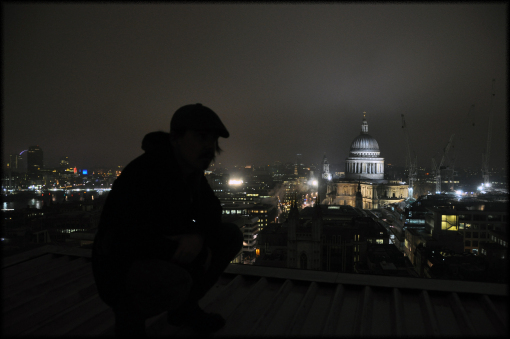
But, as you note, these are not the stories I go looking for necessarily. Geographers like Tim Cresswell, Caitlin DeSilvey, Tim Edensor, even David Harvey and Doreen Massey have written those stories. The stories that I find really enticing are not in the grand narratives but in the fine details. And out comes the archaeologist in me. Going through peoples belongings left behind, old pictures and letters to the family, imaging what lives were like before the industry was picked apart by packets or resource extinction, driving it into bankruptcy or obsoletion.
Walking through derelict mental asylums here in London, imagining the patients pacing the halls, and then visualizing the day that the nurses came in and said, “You have to call someone, find somewhere to go, Thatcher closed us down”. The grand narratives are there yes, they are the script, but I want to know how everyday people were affected, I want to encounter those “other” stories, I want to see the props and the set, not the script. And I think that is best done through experience, walking where they walked, using our geographical, cultural and sociological imaginations. If you look back to my earlier work that you mentioned, you will see that this is what I have always done, working with the local to inform the global, not the other way around. Sustainable change always starts from everyday experience, not governmental policy or cultural norms, just look at the recent failure at COP15 and compare it to what is happening in Iran at about the same time if you want an example of where real change begins. I like the idea of looking at the past to inform the present, not to increase our understanding of the past.
But apparently your informants do not do what they do for political reasons. They do not see their playful labor as a form of resistance. But isn’t one jobs of the anthropologist to aggregate the data and display the possible larger historical and cultural contexts for cultural activities? My argument would be, whether they like it or not their work has political implications.
Okay look, I read de Certeau too, I know that there are political implications in even the most seemingly mundane of practices. Most people, urban explorers included, would agree as well, but find it utterly stressful, and ultimately futile, to try and politicize this playful work every time we go out. So yes, I do see it as my job to be the one who looks past the experiences and starts drawing conclusions about our motivations, passions and actions, even though some of the people I work with find this frustrating. There are a lot of angles you could attempt to do that from.
One might be to look back to Deleuze and Guattari, to their concept of smooth/striated city space, to see urban exploration as a method of melding striations, collapsing the haptic and the optic, bringing deeper meaning to the spectacle. You could see this as a method of taking ourselves off the “grid”, at least temporarily, in an attempt to give ourselves the physical and mental space for freedom of expression. You could also tie this last idea into an existentialist narrative, something about the need to express our intrinsic freedoms, to prove to ourselves, and the world, that the control is in our hands, despite everyone’s constant moaning about how are basic freedoms are constantly being violated. You are the only one who can violate your freedom and we prove day after day that we can get into any place we want to, despite the omnipresence of CCTV, despite their mountains of barbed wire and signage warning of our impending doom should we cross the imaginary boundaries they have established. And we like the game, we don’t want them to stop trying. That is where the politics get really interesting, and where I want to focus most of my thesis. I often think about Nietzsche saying that the truly free spirited will not agitate for the rules to be dropped or even reformed, since it is only by breaking the rules that one realizes their power.

You mentioned the illegality of the activity. In fact, we don’t break into anything. We find creative ways into buildings that allow us to subvert the illusion of spatial exclusion (much like the famous London Mayfair squatters or Da! Art collective that have been in the news recently). As a result, we are in fact breaking no law. Confrontations with security guards are hilarious when you render them inept through superior knowledge of the law they are supposedly paid to enforce, explaining to them calmly that you didn’t break or enter anything and if they touch you it will be considered assault, peacefully walking off site and dancing all the way home. There’s a tactic of the weak for de Certeau.
There is a tradition in anthropology to have key informants. It seems you have a few. There is also a tradition in anthropology of acknowledging the influence we have on our informants. But it also seems that your presence in the urban exploration culture has galvanized the culture itself. Your filmmaking inspired the culture to do more of their cultural thing. It frankly seems that you are creating this culture. The ad-fab adage: ‘make it to break it’ applies I think in your case.
28 Days Later, The Urban Exploration Resource, Ninjalicious and Infiltration existed long before me. What appears to be the “creation” moment of UrbEx is actually just when it went global, with the help of the internet, like so many other movements. The community now consists of tens of thousands of people all over the globe, in countless internet forums, taking millions of pictures of abandoned places and infiltrated spaces every year. I mean, google urban exploration man, you get well over 2 million results. The thing about the movement, and what necessitates my going this deep into it, indeed getting lost in it over the course of my PhD, is that it is still, for the most part, a secret community. We have public forums, private forums, unlisted forums and a lot of people suspicious of technology altogether that not even online involved. Many of the most interesting places explored will never be publically aired; the people who did those explorations will want to keep it local. I think that is one of things that makes this community interesting, its specificity to place and dedication to the practice, without ego-driven expectation of reward. Unlike, ahem, people making ethnographic films.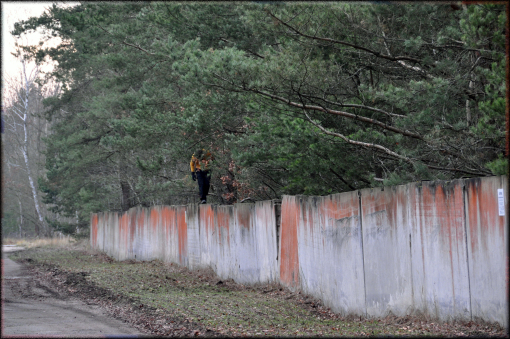
I want to think about serious games and the class of your urban exploring informants. From your documentaries I can see that your informants are all rather technologically-equipped Caucasians with enough leisure time to devote to this past time. The stakes for success or failure in this serious game are not life or death, but pleasure or pain. Now, I know that games are not just ludic past times but impact serious life. But how do you make me the reader or film viewer engage with your work without dismissing it as bourgeois tourism? It seems to me that you have to drop the phenomenology of loss, memory, and dereliction and maximize the issue of deindustrialization.
I have over 40 people involved in my research now, from a range of backgrounds. Women, working class people, people with corporate jobs, individuals from a range of ethnic and cultural backgrounds. When we travel, we meet explorers in every country we go to. This is not a class thing and it is not about leisure time, in fact the majority of the explorers I work with have full time jobs. They just choose to spend their weekends and time off of work exploring landscapes than sitting in front of a television or drinking at the pub. I respect them for that. And to be fair, they tell me I am the bourgeois tourist, the only one getting paid to this. I mean, what is more decadent than getting paid to theorize other people’s existence Adam?
The technology fetish though I won’t deny. Urban exploration seems to be inexorably attached to photography. I can think of a few reasons for this. One is that ruins are simply aesthetically pleasing in a way that takes time to digest. So we walk slowly, we take pictures and meditate on them. These places are also in a state of constant mutation, the natural state of order when human being are not there to regulate it, and since we do not want to impact places, photography becomes a means of halting the mutation. We can freeze it; though we have no intention of stopping or slowing it’s mutation, we don’t want to arrest this decay. This slippage in these places something we can grab, but not something we can hold in place. Thinking back to Shanks and Pearson, to archaeology as theatre, or to David Seamans place-ballets, we have the ability to lock ourselves into a physical courtship with place, a moment in time when body and landscape intermingle. We are in love with the ugly girl in class, the places that was ignored until we pulled out the camera and told them to look sexy. And I would argue that this excitement about encounters with the dereliction of the contemporary past is exactly what will get anthropologists to turn their attention to the industrial era, now largely ignored and under threat of physical erasure in the wake of “deindustialization”, urban “regeneration” and gentrification. Which leads me to my last point, one that it’s easy for an archaeologist to see – we are preserving points in time through photography and video. We are creating historic record.
I recently gave a paper at the Theoretical Archaeology Group (TAG) conference in Durham in a session called reanimating industrial spaces. After my talk, one archaeologist mentioned that she used urban exploration forums frequently to collect information about a site’s passage through time. We are local historians, amateur archaeologists, bodhisattvas of a forgotten past. And we do a damn good job at it! That is not about class, it is about passion for place and a lust for unbridled experience. This is but one expression of prevalent human desire, see it in other urban subversions like skateboarding, parkour, flash mobs and graffiti.
Although I am going on a bit here, let me address your insistence on “deindustrialization”. We don’t want to deindustrialize anything. I love industry, I love industrial ruins. I love construction sites and archaeological ruins equally. I love capitalism and I love laughing at its failures. The same goes for communism. You want to see some real ruined landscapes? Go to a failed communist state; when we were in East Germany, we were almost in tears, there are more ruins than live buildings! The whole thing is like some sick cosmic joke and we are the punchline.
More seriously though, I am concerned that by treating the industrial era as a tainted age, we disrespect those who built and lived that age. Recognize that they were doing their best, just as we are. Again, step away from that big picture and put down that broad-stroke brush, find that those memories on the ground, the years spent on the factory floor, bring tears of joy as often as tears of sadness, just as they do for us. The capitalistic plastic skins on these architectural carcasses begin to peel back, exposed to caustic elements, to reveal a skeleton of rust, cogs, switches, dials, circuit boards and mouldy pieces of paper outlining modes of production, things to remember, forgotten Polaroids and birthday cards to the family. It’s all in there, a little package of life. And when we pass through these places, we tap into those stories and weave them into our own. This is the embodied subjective.
I refused to be ruled by fear; I will only be motivated by positivity and freedom. This is not to say I want to overromanticize the past, but that I want to make the most out of this present that I can. Life should be more than deconstruction and analysis. I can unpack my experiences and feeling about the practice, but more importantly, those experiences are creating, constructing and reinforcing brave personalities, free spirits, databases of knowledge and memory, a collective consciousness of ecstatic phenomenological wonder, of playful work that speaks volumes about culture. Industrial ruins are decaying but they’re not dead, they are landscapes filled with possibilities of wondrous adventure, peripatetic playfulness and artistic potential.
If you fall down a Parisian catacomb tomorrow, never to be seen again, what will 1) scholarship miss 2) the non-academic world miss. Meaning: what is the big contribution of your work?
Look brother if I die and don’t finish these tales of urban exploration, here are the threads, please finish it for me! Urban exploration is about experience, expression, love and creation. It is a rare instance (especially in western society today) of human beings physically going out to challenge space, to challenge control, to assert their rights to place, their rights to the city, their rights to participate in the creation of historic narratives and cultural identities. This topic is vital to our understanding of the contemporary human condition. It is so temporally and politically relevant that it threatens to implode under it’s own philosophical weight. Urban exploration is existentially reactionary, pushing against alienation, suppression, bureaucracy and overregulated existence. But it is also ecstatically playful, and by playfully pushing the boundaries of what is possible, by putting ourselves in potential danger to assert those rights, we live Hunter S. Thompson’s edgework. At play, at work, in danger, loving, bonding, challenging, and laughing, free and unrestrained, we are at our best.
What we are doing is not supposed to be possible. Most people on the anonymous city streets don’t have their gazes honed to see what we see. We are mutants, neo-sapiens. We declare that the idea of no limits to the human imagination is old news. Now we want to know the limits of human imagination physically manifested in resistance to social and cultural norms. We want to know how much bullshit we have been fed. And the sparks that come out of those clashes will give birth to new forms of being, new realms of experience. Those little beautiful demonic creations will live far longer than us.
Maps are an abstraction Adam, they are a utopic representation of nationalistic and ideological power structures which do not have a 1:1 ratio with the earth’s surface. Therefore, as Hakim Bey tells us, we have the opportunity to get into those cracks in the structure and to create Temporary Autonomous Zones of political, social and cultural insurrection. And I use that term consciously. We do not want revolution, we want to create alternative spectacles (following Debord) that are just as superfluous but that, none-the-less, cause re-analysis, confrontation and confusion. We want you to keep hitting the refresh button to see what happens next. If we are successful in realizing our personal visions, our spectacles are composed of more experience and less simulacra than those of the state, nation or culture but are just as stupid.
This is why I call us place hackers. We are the physical manifestation of the internet pirate. We are the TAZ. We have the corporeal skills of thieves amalgamated with minds molded by an internet ethos of taking what we want, when we want it. We don’t care if corporate control exists, but we assert our right to challenge or ignore it. Virtual hacking is cool but place hacking makes it core again, brachiating across scaffolding to get the shot on your Digital SLR that maximizes your flickr stats, raking in the google adsense cash and conforming to a zerowork ethos if we get pro at it. Sleep in ruins, sell your photos of disgusting shit to tourists. Rinse off in a petrol station sink and repeat. We are the nerds that finally walked away from their computers and we are behind that scaffolding covering the building you ignore everyday when you walk by it going to work, we just loved on that place like no one has in 20 years. We are psychotopological terrorists and we will shove that masterlock up your ass.
How could my interests in contemporary corporate space, networked virtual organization, and new media social activism interlace with your work?
I was talking to one of my project participants the other day while walking through a ruin that had closed down in 2003, the “newest” I had ever explored, about what will be explored from the information age. Will we find interest in exploring empty glass postmodern shells of low blue office carpet; will we photograph the little marks in the carpet where the cubicle separators used to be and get all giddy? Will we find old hard drives and hook them up marveling at the novelty of “cables” to see what was on them, infiltrating people’s left behind lives through virtual exploration? Perhaps. Certainly our children will find those places as weirdly exotic as we find the derelict art deco swimming pool. And so the torch will be passed, challenging them to find their own meaning in those remnants. I don’t know if the intersections between the past and the future have yet met in the present. Perhaps that is what we are looking for. Perhaps we could invoke that spectre.
‘Life at the Googleplex’: Corporate Culture, Transparency, and Propaganda
How the hell am I going to get access to study these uber-elite media companies? In my desperation to find ethnographic facts about ‘corporate culture’ at the new media conglomerated behemoths I am viewing these reflexive industrial videos Google and its subsidiary YouTube upload about themselves. What are these things? Part recruitment propaganda to solicit CVs from the world’s top engineers, part PR-campaign to provide proof of its post-China ‘do no evil’ mantra, part braggadocios chest bump and back slap these videos must have some information that can provide evidence for the ‘real’ internal values and dynamics that influence the 20,000 employees and the 100s of millions of networked people that use their digital tools daily.
<object width=”425″ height=”344″><param name=”movie” value=”http://www.youtube.com/v/eFeLKXbnxxg&hl=en_US&fs=1&”></param><param name=”allowFullScreen” value=”true”></param><param name=”allowscriptaccess” value=”always”></param><embed src=”http://www.youtube.com/v/eFeLKXbnxxg&hl=en_US&fs=1&” type=”application/x-shockwave-flash” allowscriptaccess=”always” allowfullscreen=”true” width=”425″ height=”344″></embed></object>
But before I begin this bite-sized Youtube videothon I want to query if anthropological tools exist for such research. First, how would an anthropologist contextualize and categorize these videos? Reflexive, check. Industrial, check. Commercial, probably. They are not viewer-created but they have the amateur aesthetic. Textual studies of reflexive and industrial media and websites in anthropology is under-developed. In that historic genre, ‘ethnographic film,’ there were calls for greater reflexivity. And there are ethnographic investigations into the social life of social media. Patricia Lang, danah boyd, Heather Horst, and Mimi Ito can be consulted for this. And I am sure that there are numerous anthropological studies of race/class/gender as exhibited on Youtube. Alexandra Juhasz and Michael Wesch use YouTube as a pedagogical tech. But as far as I am aware, nobody has thought to look at how governments, corporations, and other institutions self-visualize a public persona. Secondly, who has analyzed the particular limitations and possibilities of this new platform for cultural expression? There is more cultural material on YouTube than in anywhere in the world. We must be able to incorporate this data.
<object width=”425″ height=”344″><param name=”movie” value=”http://www.youtube.com/v/VzMPV3YEI_8&hl=en_US&fs=1&”></param><param name=”allowFullScreen” value=”true”></param><param name=”allowscriptaccess” value=”always”></param><embed src=”http://www.youtube.com/v/VzMPV3YEI_8&hl=en_US&fs=1&” type=”application/x-shockwave-flash” allowscriptaccess=”always” allowfullscreen=”true” width=”425″ height=”344″></embed></object>
The first order of analysis would be to use a political economic widget to find out what they hope to get out of this video. Usually, saying something about increasing profit and consumption is enough here. The second order would be to use textual analysis to look for accidental data points. Start with the simple realization that you are seeing into the company, notice the use of space, of the personalization of cubicles, etc. Thirdly, mix these two approaches, political economy and cultural studies, to read the subtle cues and beyond the avowed interview revelations. Pretend you have ethnographic free-reign, knowing that would always be partial even with clearance. As partial and incomplete as these video documents are a conjunctive approach will be necessary. My girlfriend suggested to me that a corporation’s IPO documents are usually remarkably honest and revealing. Also high-tech investment firms/websites such as Techcrunch keep publically available data on acquisitions, investments, and other reflexive materials. Ken Auletta’s book, Googled: The End of the World as we Know It, is incredibly revealing about Google corporate culture but is based on only a few interviews with Page, Brin, and a number with CEO Eric Schmidt. My point is that much can be done with little if the right tools are used.
<object width=”425″ height=”344″><param name=”movie” value=”http://www.youtube.com/v/aOZhbOhEunY&hl=en_US&fs=1&”></param><param name=”allowFullScreen” value=”true”></param><param name=”allowscriptaccess” value=”always”></param><embed src=”http://www.youtube.com/v/aOZhbOhEunY&hl=en_US&fs=1&” type=”application/x-shockwave-flash” allowscriptaccess=”always” allowfullscreen=”true” width=”425″ height=”344″></embed></object>
The take-away nugget is that the internet provides tools and reasons for greater corporate transparency. Some corporations answer these calls to use the web to exhibit their tax records and to incorporate users/viewers/participants into internal and external regimes of governance and profit-generation. Other corporations expose their chain of production and distribution and how it misses layovers in child labor farms or despotic regimes and ecological disasters. This is all quite wonderful. But along with greater awareness and transparency is also greater capacity for manipulation of the veneer of transparency. So we must be vigilant in our textual readings of corporate transparency practices and perceive beyond the public persona to the numerous motives, values, and metrics for success that corporations deploy. We must figure out sophisticated techniques to study these powerful institutions. Textual study of the secondary and third order of values encoded in publically available online documents is one way. Even if new media corporations isn’t your anthropological fetish, it is certain that some strangely useful video about your fieldsite or subject exists on Youtube and you are going to have to explain your justifications for using it in your research. I invite us to co-develop these tools.
Accounting for Social Entrepreneurs
With anthropology leaning its trendy shoulder onto social media and new economy corporations one would think the two trends would come together around a case study of software social entrepreneurs. A profitable avenue open to anthropological investigation would be their accounting practices—how they measure more-than-profit earnings.
This research is in the emergent field of ethonomics–the discipline of defining and prioritization motivations within creative industries. Ethonomics, the guiding principle behind social capitalism, evolved capitalism, moral marketeering, and venture philanthropy, is possible with digital economies of scale, flexible labor, social media networks, user-generated content, transformations in corporate management, and a deep sense of moral universalism. Each of the two words of the last point, moral and universalism, is open to a cultural critique on the grounds of its anti-cultural relativity and also how accounting is performed on a corporate imaginaire of morality. Where would an anthropologist begin to study how para-economic value is accounted for in an adroitly late-capitalistic corporate context?
With many social entrepreneurs trudging along well below profit margins what really defines success in these emergent corporations? I should but I am not going to go into ”blended value accounting,” the theory developed by social entrepreneurship theorist Alex Nicholls of Said Business School at Oxford, but it is enough to say that metrics are being developed within the UK to measure success of social enterprises. What can anthropology contribute that business theory cannot? What are the varieties of quantitative and qualitative accounting within this genus of social entrepreneur? How do the ideal versus the actual, the observed versus the reflexively practiced, accountings of success vary? Is this visionary production or vaporware? Is philanthropic hype used to pump up the employees, to headhunt for the best activist entrepreneurs of the future? Is it just corporate greenwashing or an authentic re-direction of the corporate mission on the post-global recession Earth? I go big about social entrepreneurs as a general anthropological category to describe the simultaneity of market and mission motivation. As cultural producers and consumers we are all social entrepreneurs.
With our libraries full of histories of capitalism and critical accounts of post-colonial development there is certainly a place for anthropology in this debate. The leading edge of the classification of social entrepreneurs in business is Zahra et al. (2009) who developed three types of social entrepreneur: Social Bricoleur, Social Constructionist, and Social Engineer. This article builds off of business writing from the 1930s and 1940s and never once mentions the internet and the epochal shifts its created within philanthropy. What follows is my typology of social entrepreneurs (SE).
This typology of social entrepreneurs include these seven categories of those who make profits while philanthropically providing materials, services, foundations, virtual services, information, or cultural spaces. Here it goes. These include material social entrepreneurs or (MSEs) that provide shelter, food, medicine, or clothing. An organization like Tom’s Shoes, who for every pair purchased gives one pair to an unshod person in the developing world, is an example of an innovative MSE. Material SEs gifts things. Invisible Children’s Mend project (you cynical visual anthropologists see video into here) provides the resources for impoverished people to make objects with markets in the West. Mend is a service social entrepreneur (SSE). Current TV, a media corporation started by Al Gore with the goals of democratizing media production and providing the space for dialogue about democracy, is an example of an SSE. Another SSE is Witness, a non-profit that trains videographers in conflict zones. Whole Foods is a SSE because it caters to conscious consumerism. Service SEs do not provide funds or things but distribution, markets, and practices. In its most dynamic form SSEs provides skills for self-empowerment. Foundation social entrepreneurs (FSE) are major corporations’ charitable foundations. Google’s google.org and Ford Motor’s Ford Foundation are examples of FSE. The Ford Foundation grants more than $16 billion for the promotion of democracy and the reduction of global injustice. Google.org has provided over $100 million for global health, clean energy, and IT development. Omidyar Network, founded by eBay creators, is a FSE and invests in VSEs like Creative Commons and CSEs like Linden Labs. Brave New Films, a political media production and distribution company, is an example of an information social entrepreneur (ISE). Information SEs focus on making or aggregating advocacy media. Unlike Witness, Brave New Films does not teach production practices. A virtual social entrepreneur (VSE) is Causecast, a non-profit/for-profit internet hybrid that provides digital tools for cause advocacy. Virtual SEs provide freedoms and platforms. They include the non-profit organization kiva.org, which uses the internet to administer microfinance loans, as well as Creative Commons and Mozilla, which are profitable practice and theory organizations advocating for liberty, innovation, and the internet. Like Brave New Films, Causecast is responsible for an online information network that connects political publics, but Causecast provides tools. Digital social entrepreneur (DSEs) consists of those corporations that are for-profit but provide social media that can be used for political organizing. The political engagement of DSE can be intended or unintended consequences of for-profit activities. Linden Labs, founders of Second Life, Facebook, and Google’s YouTube subsidiary are examples of DSEs. The communities of film activists that meet on their sites make Current TV a DSE as well as a SSE.