All posts by Adam Fish

Adam Fish

I am a cultural anthropologist and media studies scholar currently teaching and researching in the Sociology Department at Lancaster University, UK. I investigate media technologies, digital finance, and network activism. @mediacultures

Performing Technical Affiliation

By Patricia G. Lange, USC

There’s a new sociological variable in town, one which I call performing technical affiliation. Technically speaking, it is not a new way of thinking about identity. For many years, perhaps millennia, people have enacted aspects of identity by interacting with and through technologized objects, forms of knowledge and related practices and values. Nevertheless, technical affiliation is not recognized on the same level of analytical importance as are traditional variables—such as class, sex, gender, ethnicity, and social race—that are most often cited in anthropological studies of sociality. It is time that technical affiliations are brought more systematically into analyses of identity and negotiations of the self.

Continue reading

Social Media: From Meaning to Presence

by Jenny Cool, USC

I sometimes joke that I’ve been working in new media so long I can’t believe we still call it that. But longitude is no laughing matter in an age of time-space compression: and the persistence of novelty no accident. Yet, there is much to be gleaned from histories of the new. At least that’s what I contend in taking up Adam’s invitation to post about my 10-year study of Cyborganic, an influential group of early web geeks—producer-consumers of new forms, social imaginaries, and practices of networked communication and techno-sociality. Cyborganic spored and faded away by 2003, yet many of the genres, imaginaries, and practices that emerged out of this milieu (San Francisco’s South of Market area in the 1990s) have since become predominant on the Internet. Cyborganic members brought Wired magazine online; led the open source Apache project; and created dozens of Internet firms and projects, from bOING bOING to Craig’s List and Twitter. Continue reading

On Waxing Nostalgic about Ordinary Video

by Patricia G. Lange, USC

How do you define “ordinary” video makers? Given that online video is being generated at phenomenal rates (YouTube 2010), it is not surprising that studies are tackling previously ignored sets of everyday video practices. A number of important and insightful studies have been concerned with a special kind of the everyday, that which focuses on the so-called “ordinary” video maker. Such a figure is often ostensibly defined as a non-professional in the film industry. They have neither been trained nor are participating in mainstream film production or critique.

The focus on the ordinary video maker is initially a logical one, given that many researchers would like to understand how people learn to make videos, why they share them, and how everyday video impacts online attention economies in comparison to professional works. It some quarters, the focus on the “ordinary” is a reaction to what some see as well-covered fandom studies that focus on advanced amateurs producing cool stuff. However, it is time to re-examine what is meant by the “ordinary” and to consider how such a mythic figure threatens to reify the binary between the novice and the professional that grass-roots video making has long had the potential to challenge. It is time to explore lenses, such as collective nostalgia, that appeal to many different types of video makers. Researching generational or cultural forms of nostalgia and its influence on video making could provide a wealth of insight into the cultural desires and practices of particular social groups.

Continue reading

On the Front Lines in Wisconsin

by Gwen Kelly

Last Monday, February 14th, having heard a preview of the budget proposals to come, the Teaching Assistants Association (TAA) of the University of Wisconsin, Madison decided to try a different sort of tack in protest. Perhaps one that had never been tried before. They organized a campaign to get thousands of undergraduate and graduate students to sign valentines, big cards with hearts on them, saying “I <3 UW. Governor Walker, Don’t Break My Heart” (image below). It was a great idea, or at least it seemed so at the time, when we didn’t realize just how uncompromising Governor Scott Walker was going to turn out to be.  It goes to show how naive we were.  We knew something bad was coming, but we didn’t know how bad it would be.

Continue reading

Fleeting Togetherness in Smart Elevator

A guest post by Jenny Cool cool@usc.edu

The elevators I encountered at the 2010 AAAs were for me a kind of ethnographic readymade: those redolent objects and gestures through which “the social world seems more evident…than in the whole concatenation of our beliefs and institutions” (to cop a phrase from David MacDougall, 1999: 3). No doubt many of you made your own observations of the lifts at the Sheraton New Orleans. Hervé Varenne’s post “On an education into elevators” touches on some of the same phenomena I do in describing “impromptu conversations” that broke out in and around these elevators. And others have written more generally on “the anthropology of elevators” (Leslie, D’Costa) Like Varenne, I focus on the social and discursive learning I participant-observed riding the vertical rails at the AAAs.

Here were people negotiating a radically new interface—not alone at their keyboards or mobile devices—but in a pubic place, surrounded by fellow meeting goers. It was a rare opportunity to watch the encounter in a social setting quite unlike others I’d experienced in my research of computer-mediated communication and control. Continue reading

Internet Ethnographers’ Guest Blogs

We have two USC post-doc ethnographers of internet culture coming your way in the next month or so, Jenny Cool and Patricia Lange.

Dr. Cool is a postdoctoral research fellow at USC’s Center for Visual Anthropology. She conducted dissertation field research on the social imaginaries and practices of media production and consumption in Cyborganic, “an influential early Web community.” I hope she will do a post on this fascinating work after exploring the fleeting togetherness in smart elevators.

Dr. Lange is a Postdoctoral Fellow at USC’s School of Cinematic Arts studying the semiotics of video production, sharing, and reception on YouTube and in the video blogging community.

Give them a Savage welcome!

Geographies of Internet Cultures

I study internet video firms and so participant observation means being stationed for a good amount of time at a firm’s office. Upon a recent request to do just that, a founder of a firm wrote, “the key problem is that we do NOT have a ‘site’… you can come to NYC but half the days there is almost no one here. Potentially a better approach is to have you do a ‘virtual’ site.” A company not having a site, as well as the supposed duality of the actual and the virtual, are common ideas within the digital technology world. And yet, opposed to what many internet gurus and entrepreneurs prophesize, place remains an essential component of the personal and business lives of internet workers.

Where the firm is located and under what territorial government the businesses operate are essential problems for internet firms. Yahoo and Google resist then capitulate to China’s censorship.  Governments threaten ISPs, search engines, and credit card companies; they indict foreign file sharing companies. International internet standards impact internet traffic across the globe. The new buzz phrase in the business, “cloud computing,” requires warehouses full of harddrives to be located near sources of cheap electricity and in tax havens. “Choose a country” links, language differences, bandwidth distribution, and geographical identification technology remind user of their nation-state while online.

The importance of place is no surprise to an anthropologist searching for a fieldsite at which to observe how the internet works. Anthropologists of internet production cultures model the cosmopolitan lives of their subjects. We are in place, traveling between and working within major metropolises where the highest density of venture capital and creative workers exist. While, at the same time, we are “anywhere”–using mobile phones and social networks to remain “in the loop.”

I am writing a piece on place in anthropological internet studies for Anthropology News, what am I missing?

Cultural Contradictions of Net Neutrality

“Free, open, keep one web,” World Wide Web inventor Sir Tim Berners-Lee’s is heard provoking us in the 15 second video above.

How can you champion anything that has the totalizing vibe to it as Berners-Lee’s One Web thing? Doesn’t it sound like One Web=One World=First World? Isn’t this One Web pitch a commercial for the global hegemony of Silicon Valley made technologies, standards, and corporations? Wouldn’t a greater diversity of broadband and wifi options be more advantageous to cultural diversity than merely One? The controversial and slightly ridiculous claim I will make now is that the tiering or diversification of the internet, such as we saw yesterday at the FCC, might foreshadow the fragmentation of the One Web into many ethnic and linguistic webs in the future.

Continue reading

What’s behind YouTube and Mechanical Turk?

This is the second provocation on the theme of digital labor from me and Ramesh Srinivasan. To warm up, check out Saskia Sassen at last year’s Internet as Playground and Factory as she warns us about how financial logicians uses networked technologies to manipulate human ingenuity:

Free Use as Free Labor on YouTube

YouTube, subsidiary of Google, serves as a notable example of how a company creates value through free, user-contributed labor. User-producers upload content to YouTube for free and are given the opportunity to freely use Google’s immense, proprietary data centers (commonly called the “cloud”). Adding content, commenting, tagging, and even browsing all add value to the corporate product, though the amount of user investment and creative immersion differs in each of these cases. In the process, content creators facilitate Google’s ability to place targeted advertisements. These advertising schemes are monetized via the billion+ views YouTube receives per week. Commenting, tagging, and browsing are more passive forms of labor, as each adds to YouTube’s ability to build a social space that users will continuously return to, and optimize algorithms that allow for more efficient retrieval and browsing.

Continue reading

Digital Labor

My colleague Ramesh Srinivasan and I just submitted an article to a journal in which we analyze social entrepreneurs’ digital labor practices. The argument we are making is that one needs to focus on (1) organizational missions, cultures and histories, (2) the nature of the labor (its level of creativity or its invocation of routinized, uncreative time-motion studies!) and the level of agency for workers to choose this labor versus various alternatives, and (3) the level of capitalization of the labor, notably who profits and to what extent from the contributed work. Our case studies, Samasource, a digital labor firm that brings digital work to developing world populations, including refugees and women, and Current TV, a cable network that self describes as “democratizing” documentary production, maintain an interplay between for/non-profit and social empowerment/exploitation. Instead of waiting the 4 months for reviews, or 8 months for publication we’d love some real time feedback on some of the more illustrative examples and concerns that drive this research. (I’ll be presenting this analysis at the American Anthropological Association meeting on Friday at 5 if you prefer embodied engagement).

Continue reading

Why Thin Is Still In

Here is a guest blog by Ashley Mears, Assistant Professor of Sociology at Boston University:

Why Thin is Still In

In her new documentary, Picture Me, Columbia University student Sara Ziff chronicles her 4-year rise and exit through the fashion modeling industry, zooming her personal camcorder onto supposedly systemic abuses—sexual, economic, and emotional—suffered by fashion models.  Among the many complaints launched in the film is an aesthetic that prizes uniformly young, white, and extremely thin bodies measuring 34-24-34” (bust-waist-hips) and at least 5’10” in height.  It’s an aesthetic that many of the models themselves have a tough time embodying, pushing some into drastic diets of juice-soaked cotton balls, cocaine use, and bulimia—in my own interviews with models I discovered similar, but not very common, practices of Adderall and laxative abuse.  It’s also an aesthetic that has weathered a tough media storm of criticism, set off in 2005 with the anorexia-related deaths of several Latin American models, and which culminated in the 2006 ban of models in Madrid Fashion Week with excessively low Body Mass Indexes (BMI).  And yet, as a cursory glance at the Spring 2011 catwalks will reveal, thin is still in.  In fact, bodies remain as gaunt, young, and pale as they did five years ago, and it’s entirely likely that in another five years, despite whatever dust Picture Me manages to kick up, models will look more or less the same as they do now. Continue reading

The Pioneer Age of Internet Video (2005-2009)

There is a touch-screen internet networked television mounted on a wall in a middle class living room. You turn it on with a touch and rows of applications organized as colorful little boxes are revealed. You are familiar with the choices because they are the same as what is displayed on your mobile phone. In this apparent cornucopia of choices are hundreds of apps to click to watch CBS dramas, New York Times video segments, CNET interview programs, Mashable tweetfeeds, and CNN live broadcasts. Or you can rent a movie from Apple’s iTV, Google TV, Amazon, or YouTube Rentals suggested to you based on your shopping preferences as gathered from your GPS ambulations. You want to show your friend a funny video that was recommended to you earlier in the day so you click on the YouTube Partners app and it appears on the screen.

You crave a different meme, something old school, circa around 2009. You could go to the YouTube Classics app, but strangely your favorite video never made it to 100 million views and so wasn’t promoted to YouTube Classics. Your television system is connected to the internet but the public internet browser app is buried in the systems folder on your networked TV. Besides, if you could find the browser app you can’t find a keyboard to type out search terms. You drop the idea of following a personal impulse and go with what you can see through the window of the professionally curated suite of applications.

This description of a limited and safe television viewing experience of the future is meant to evoke a feeling that the limitless content and freedom that we associate with internet video is quickly being truncated by the hardware and software engineers in cahoots with the content app designers to make a much more safe, convenient, and professional internet. This is quite easy to see in the world of internet video—once the land of the most subversive, graphic, and comic content possible—is now being overhauled by professionals producing, curating, optimizing, and streaming ‘quality’ videos to homes on proprietary hardware. Many of us interested in the democratization of media, the absence of conglomerate consolidation, the presence of “generative” digital tools, video activism, and indigenous media should be concerned by these trends. This era will be seen as the historical pioneering era of internet video idealism (2005-2009).

Earlier this month, in re-introducing Apple’s internet connected TV set top box, the iTV, Steve Jobs claimed that people want “Hollywood movies and TV shows…they don’t want amateur hour.” What Jobs is saying is that we are entering a new era of professionalism—gone is the wild Darwinian kingdom of video memes, the meritocracy of the rabble rousers, the open platforms equally prioritizing the talented poor as well as the rich. Jobs has never been one to parrot the ‘democratization of media’ ideal. Never one championing collective design or the wisdom of the crowd (if only to fanatically buy his hardware), Jobs firmly believes in the auteur, the singular virtuosity of the genius designer, engineer, and director to make a professionally superior object of art and function. The upcoming golden age of ‘quality’ professional content will be ruled by Jobs and his ilk at HBO, Pixar, Hulu, LG, and Vizio.

Jobs’ vision is but one example showing that the pioneer age of the free and open culture of internet video is ending. Current TV, from 2005-2008, aired 30% user-generated documentaries and produced a cable television network that modeled democracy. Today they are taking pitches only from top Hollywood TV producers. The YouTube Partner’s program, like the very talented Next New Networks—the talent agents for Obama Girl and Auto-Tune the News—culls the ripest and most viral video producers from YouTube and optimizes them for the attachment of profitable commercials. Once pruned and preened, these YouTube cybercelebrities are promoted on the hottest real estate on the internet, YouTube’s frontpage, making 6-figures for themselves while finally making YouTube profitable.

Subcultural activities going mainstream is nothing new, the radical 60s cable guerilla television crew, TVTV, went from making ironic investigations into the 1972 Republican and Democratic conventions to making regular puff pieces for broadcast. World of Wonder, the queerest television company in Hollywood, has been bringing the sexual and gender underground to mainstream cable television for decades. For examples, see my documentary on World of Wonder.

But it is the first example regarding IPTV—internet-based direct to consumer ‘television’ such as Apple’s iTV—that will bring only the best of internet video to the home that most concerns me. The professional domestication of internet video in the home, I fear, will forever wipe out the memory of the wicked and subversive video memes of the YouTube past. With it will go the very ethos of participatory video culture. My colleagues in the Open Video movement can collectively design the hell out of open video apps, editing systems, protocols, and videos standards but no one using these free and open source video systems will be seen if proprietary IPTV covers both software and hardware, internet and television, in both the home and the office.

The process I am describing can best be articulated as a historical process of professionalization. The wild world of amateur video—its production, promotion, and distribution procedures—is moving from the realm of prototyping, beta-testing, and experimentation to expert production, algorithmic optimization, and alpha release five years after its debut on YouTube and Current TV. This professionalization is a historical result of 5 years of industrial development, individual trial and error, and profit-focused talent agencies and creative thinktanks. It is also a product of the historical convergence of the internet and television hardware, as well as the corporate consolidation of content and software around the idea of the app—a professionally designed hardware/software/content peephole into a small fraction of the internet. More anthropological however is the historical transformation of the subculture into the culture. This has been happening forever and is the engine of popular culture and we shouldn’t be so hip and retro as to bemoan it. But we should be concerned with the loss of that realm of artistic and political potential encoded in the free and open internet. The “golden age” to follow this pioneering phase will be as innovative as the golden age of television as we welcome the equivalent of I Love Lucy, Friends, and Lost and along with it the return to spectatorism, canned laughter, and the proliferation of middle class values.

EPIC: Ethnographic Praxis in Corporations

One of the most vigilant members of the SM community, John McCreery (PhD Cornell, 1973), just returned from EPIC, Ethnographic Praxis in Corporations, a conference which took place August 29th-September 1, 2010 in downtown Tokyo with this guest blogger report. It was a local event for John who has lived in Japan since 1980. John is a pioneer in the creative application of anthropological training in corporate contexts having first worked as a copywriter and creative director for Hakuhodo Inc. (1983-1996) and later becoming a Partner and Vice-President of The Word Works, Ltd. (www.wordworks.jp). Kochira koso, John, for this excellent look at EPIC. –AF

An EPIC Experience by John McCreery

All is not well in the world of EPIC, Ethnographic Praxis in Corporations. That said, there is much to envy and admire. Having struggled over the last fifteen years to establish ethnography as an essential component in the corporate research toolkit, participants in EPIC 2010, held this week in Tokyo, confront an environment in which economic recession has slashed budgets and shortened projects, while acceptance has led to routinization, erosion of perceived value, and the threat of deskilling. Above all, corporate ethnography, like the survey and focus group, is threatened by the rise of analytics that draw on the Internet for near real-time access to changes in user behavior. There is, however, a notable lack of panic and despair in the EPIC community. These are, after all, people who have faced tough times before and created new roles for themselves.

Continue reading

Indigenous Theories of Published Informants

As anthropologists we research compact and ornate cultural practices that can scale up to something larger. Our informants usually aren’t aware of how their statements and practices reflect larger issues evident in broad social theories and histories—if they did than the world wouldn’t have anthropologists. They are often surprised to discover how meaningful their lives are upon reading our interpretations and manuscripts. That is, all subjects except those who have already done the literary and library work needed to contextualize their lives and passions within larger theoretical and historical trajectories. These informant-authors, in effect, know who they are–or at least who they would like to be. Anthropologists have studied text-makers–scientists, journalists, and governmental scribes–and their texts can be obliquely read as reflexive documents. Rarer still are anthropological accounts of living subjects constructing autobiographical, political, or social scientific texts. These well-published informants present a problem and opportunity that needs exploration.

It is wonderful to have hyper-literate informants, collaborators, and subjects who write and publish books, articles, and blogs and make films, documentaries, television programs, and online videos. In the history of anthropology, however, this is rarely the case and because of this paucity anthropologists are at pains to construct theories that are native to the informant. I do not envy the anthropologist who must contextualize their subjects’ interviews and practices in terms of theories and theorists that are not a part of the subject’s worldview. Using French literary and poststructural theory to describe nonliterate tribal practices seems profoundly unanthropological and yet such practices proliferate in academic journalis at an astounding rate. We need to interpret local actions and performances with the aid of indigenous theory somehow devised from observations and pronouncements of subjects. For instance, in The Gay Archipelago: Sexuality and Nation in Indonesia, Tom Boellstorff identifies a local indigenous theory of the self emerging from island life in Indonesia and uses it to guide the contextualization of his gay and lesbi informants. My job is certainly easier than Tom’s because self-publishing subjects provide so much more already contextualized information with which to construct a local theory of identity and community. My informant’s published social scientific work does much of the nuanced labor of theory building for me. The citations and name-drops in their texts make explicit the forbearers, influences, and heroes an anthropologist would archaeologically extract and artificially graft onto the informant in later chapters of extrapolation and upward scaling.

What are the rare opportunities and theoretical complexities associated with doing ethnographic investigation into subjects’ lives that are already reflexively situated in autobiographical texts?

The problems include the fact that the informant/authors offer autobiographical documents about their lives in richly theoretical prose that threatens to trump the work of the anthropologist. Without the reflexive published documents the anthropologist’s primary job is to proceed to first order contextualization–what was the cultural context of this practice? What is this practice like in a comparative sense to other proximal native practices? The opportunities for the anthropologist working with this citation-rich autobiographical literature is to take the level of extrapolation and abstraction one-step further. With bibliography dense self-authored accounts, the first tier theorizing is sufficiently complete–they tell you where they are coming from–leaving the second level of extrapolation open to answering questions like: within the field of all possible indigenous theories why did the subject gravitate towards these influences? How does this native epistemology compare to others in similar–or more daringly–dissimilar contexts? Anthropologists working without self-textualizing subjects surely can get to this second tier of extrapolation but it is more difficult and the conclusions made in that ethereal space are more tenuous.

All anthropologists work with edited documents. This includes interviews which are themselves performed edits of quickly self-truncated statements. These edits–oral, performative, or textual–makes for excellent granular units of data. But at the fieldwork stage, anthropologists need more data not less, we need less self-awareness and self-censorship and more roguish personalities, off-the-cuff actions, and improvisational performances. We need the backstage along with the front stage. Self-editing is a social fact of life but such highly edited texts cut out several important phases that would have been instructive if observed–the subject’s first impressions; selective shuffling, ordering, and prioritizing of issues; the gathering of supportive sources and examples–these are all in the data rich realm of practices and negotiations around which subjectivity and the social self are framed and performed. For example, a ghost writer is writing a book for one of my informants and I want to get the transcripts, edits, and feedback in this process to see how they are contextualized by themselves and the ghost writer for a perceived and corporately constituted audience. Finely edited books, combed over by agents, managers, editors, and colleagues do not furnish such raw data.

To what degree should we be critical about how these authors prefer to textually edit themselves into particular subjectivities? Contradicting or challenge author’s stated affiliations and origins is a practice in literary studies for revising the preferred automatic claims of dead authors but like stamping non-indigenous theory on indigenous data this too is quite unanthropological. The safe route is to step off from this first tier of reflexive theorizing into a higher level of abstraction. The more dangerous path is to read the authors cited by the informant and develop a still deeper sense of indigenous theory–this is going textually native–revealing where the informant glossed over contradictions and leaned on over-simplifications in arriving at their particular framing of the self. Using this critical textual reading of reflexive indigenous theory the jump into the second tier can be made along with the informant’s peers and mentors.

TV Free Burning Man

Next week as many as 50,000 people will inhabit Black Rock City, a temporary metropole constructed by volunteers for a week of personal expression and community celebration on the barren alkaline plains of a Nevada desert a half-days drive from Silicon Valley. This is Burning Man, a radically participatory event where a lot of people who labor in the digital creative industries work out collaborative utopias that make their way–the theory goes–into the social networking software and platforms they make and ask us to populate with our creative surplus, communal energy, and visually expressive humanity. The techno-culture historian Fred Turner states that Burning Man is a ‘sociotechnical commons’—the cultural infrastructure for the digital media industries of California. This is an attempt to document how and why Burning Man is a “proof of concept,” “beta test,” and practical experiment for the engineering of networked publics.

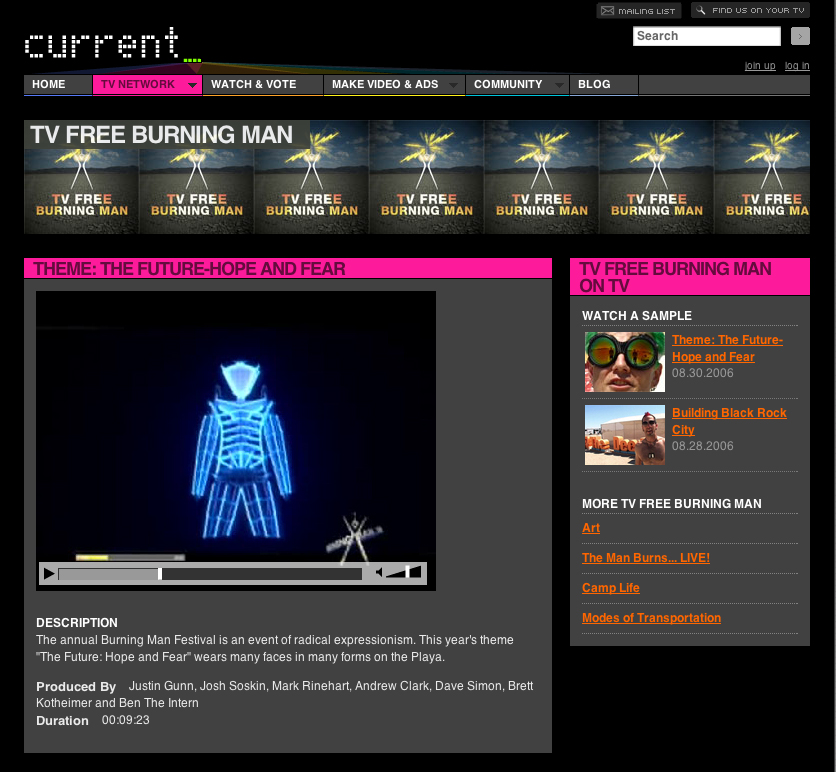
Here is the example. Burning Man influenced three projects to democratize media production initiated by Al Gore’s user-generated and citizen journalism cable network Current TV. Examples include Current’s Viewer Created Content (VC2) program, their social media website current.com, and TV Free Burning Man. Much like Burning Man, each project is an attempt to draw knowledge from the crowd and transform spectators into active producers. My observation is that Burning Man and Current’s emphasis on user-production business models is hemmed in by the looming pressures of capitalism.
Current is an example of what I call digital social entrepreneurship. It is a new media start-up and TV network deeply guided by both a mission and the market. At origin, so these firms go, the mission takes precedent over the market. As time goes by the market supersedes the mission. Current launched in 2005 with the mission to democratize media production and to provide a platform for others to discuss the future of democracy as well as view the cornucopia of voices that make democracy a dynamic guide for governance. Considering the tenuous state of democracies around the world, the consolidation of media systems by multinationals, the broadbanding of sectors of the globe, and the usability of graphic interfaces and professional grade video recorders the attempt to democratize media in 2005 was timely and prescient.

Current’s first idea about content producers was not to crowdsource content through the VC2 program. They didn’t intend to mine the producing audience for TV-caliber video submissions. Current originally planned to hire 20-30 digital correspondents to travel the world making content. A Current employee related to me how the programming executives, fresh from recent excursions to Burning Man in the early 2000s, used the open participatory model of Burning Man to argue against the exclusivity of the digital correspondent model by asking, “like Burning Man, why wouldn’t we let everybody in who wants to participate?” That spirit carried into the creation the VC2, a project to empower any amateur documentary producer to make content for television. This was the impetus behind the first user-generated television network.

From 2005-2008 Current’s website was www.current.tv. It was a space dedicated to VC2 producers to upload and critique short documentaries. In 2008, upper management decided that this was too elitist and they wanted more traffic so they put together a group of marketers, engineers, and creative executives to envision the new website, current.com. One of those creative executives, Justin Gunn, went into the first meeting to brainstorm current.com and

…hung up a map of Burning Man and I took an astronomy magazine and cut out pictures of stars and star clusters, and galaxies and galaxy clusters, and superclusters really beautiful Hubble imagery and positioned it around the  Burning Man map and I looked at [my colleagues] and said, ‘that is what we are going to make.’ And they said,’ what is that?’ And I said, ‘OK, work with me here. We are going to start with the organizational principle of Burning Man, it is a very light, lean organization. I could be wrong here but there is something like 12 full-time employees around the year everything else is all volunteer labor. But they build the structure, they set the rules, they define the parameters and then they invite anyone, anyone to come and do whatever they want as long as they stay within the confines, abide by the rules, and follow the predetermined parameters—they can do whatever they want.’…You start with an organization principle, a framework, here is how this thing works, here is the lattice, but it is empty, we will do a few key things, and we will invite anybody in as long as they abide by the rules and play within the framework, they can build whatever they want. So the constellations and star clusters were meant to represent constellations of information.

Using celestially graphic metaphors for the digitally engaged public they hoped to network together Gunn sought to inspire his co-workers to make a system as open and empty–and as charged with possibility–as the desert of Black Rock before the gates of Burning Man swing wide.

Using their shared interests in participatory community, self expression, and technology as a platform for dialogue–as well as their proximal offices mere blocks from each other in the Silicon Valley outpost of SoMa in San Francisco– producers at Current and organizers of Burning Man began to scheme about a more dynamic relationship. TV Free Burning Man was a result. Combining professional and amateur field production with a televisual aesthetic of first person documentaries and tone poems, the for profit mass media television firm Current produced content live from the playa for four years, 2005-2008. Considering Burning Man’s imperative to avoid all forms of commercialization and the strict media permitting process to even use a still camera at Burning Man, TV Free Burning Man is a testament to the shared ideals and aesthetics of Current and Burning Man.

——————————–
I’ve attempted to link an outrageous event to important technological and economic digital systems used by billions of humans. The goal is to see how internet practices in virtual spaces are coconstituted by actual world practices in material spaces. Savage Mind writer Rex coolly said CEO Mark Zuckerberg’s goal with Facebook is to “scaffold” sociality–strap supportive beams to the human-to-human communication network that presently exists or might not exist without the structured arena. Rex has it right. Social media and social events, like the virtual and the actual, are coconstructed. And yet, something still trumps this transcendence of body-mind duality.

The commercial imperative looms over the users of corporately-made social media just as the end of the week at Black Rock City haunts the freedom-accustomed Burner. In a series of moves, Current has increasingly pulled back from their mission to democratize media production. In a tense economy and with venture capitalist money running thin, Current has moved to capitalize on its major asset, its cable license, through abandoning the VC2 program and relying on traditional professional programming.

Burning Man, on the other hand, remains a valiant, excessive, and privileged materialization of the ideal sociality coded into and by internet culture. Last year around this time I wrote about the emerging tourism industry in Black Rock City, But for now, the Black Rock Foundation does a tremendous job with a skeleton staff, grants art funds to hundreds of artists, and facilitates a relatively commercial free environment. As a non-profit with a seasonal ecstatic event, Burning Man has an easier job than Current of retaining its mission, a for-profit firm in a fiercely competitive TV market responsible for 24 hours of programming 365 days a year.

Openness, liberation, transparency, relativity, democracy, trust, non-privacy, and collaboration are the shared origin myths of the activists and planners of the internet and Burning Man. These ideals are coded into digital architecture in Silicon Valley and other areas around the Black Rock Desert and distributed for free use throughout the world. These digital social systems and event organizations are molded by their missions and driven by the necessity to optimize the growth of their organizations. Every ideal has a shelf life cut short usually by the profit necessity. The compromises to the mission that commercialization requires are the instances to monitor when adjudicating the sustainability of the social entrepreneurship model.