
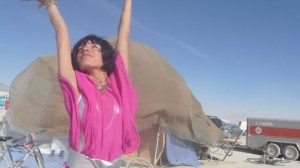
The Burning Man Decompression parties are this weekend in LA and around the country, exactly one month from the ending of BM which is usually the first weekend free from unpacking and cleaning out the playa dust from all permeable fabrics and crannies. Perhaps such a party is necessary to remind oneself of the virtuousness of the event, otherwise cynical ideas about the sheer costs and the political economy of BM begin to plague the mind. For me, this is triggered by a memory of something a cashier at Home Depot in Reno said to me. I was buying two-dozen rebar stakes to secure the giant tent I designed and sewed for my girlfriend, sister, and best friend. The cashier recognized that I was going to BM and said, “not seeing as many of you as we usually do coming through this store, seems like more and more people are joining camps instead of making their own.” When I got to BM, I began to notice how many large camps are aggregates of strangers who basically Paypal-ed for community inclusion, the production of someone else’s art project, and a varying degree of life sustaining materials. This is what I am calling, “pay to play” (P2P). An emerging tourism industry in Black Rock City. I note this not to complain but to isolate instances of capitalistic intrusion in aggressively nonmarket communities.
BM is designed to resist the atomization of capitalist society. The theme this year was Evolution and I wonder if all social organization fall prey to convenience and evolve into reflections of capitalism. The impossible dust storms, the absence of cash money or commodities, the gifting economy (not bartering, but giving), the impetus to participate and play all work to destabilize the alienation and isolation of late-capitalist society. But as a free-range and malleable event I wonder if capitalism can be kept at the gate. BM is expensive: at $300 ticket, $200 gas, $200 food/water—it is easily over a G per person. It can be done cheaper, but those who do it cheap tend to mooch and/or not have the material resources to abide by the simple principles of BM: self-reliance, gifting, and radical expressivity.
It is difficult not to size-up the costs (and therefore the class) of the large-scale, privately-funded artworks and architecture. I was appreciative of the gifts of drink, food, leisurely rest spots, and free music and trinkets but with each gift I became more conscious that I was receiving from people wealthy enough to blow $10,000 on an extraordinarily philanthropic week. One camp included several dozen people who all flew from NYC, each couple had a massive RV, an AC-bedazzled igloo, their own private outhouse, hot water shower, and chauffeured artcar. I’d like to think I am alone with this burdensome class and capitalism consciousness—a personal by-product of anthropological training—in the supposedly declassed environment but I am not. From its inception Burners have hypothesized about how and when capitalism will infect and disease this experience. Critics of BM have called it weekend warriorship for the dot.commer, others have mined the contradiction between the immense carbon footprint and BM’s ecological subculture, others have highlighted the temporality of the autonomous zone, but the most ardent argue that the sheer costs and auto-dependency make it elitist and basically vapid. I tend to see it as a place and opportunity to experiment with improved forms of kin-bonding, environmental awareness, and social spatiality so it is important that my little tribe remain autonomous and self-reliant from the pay to play crews.
Traditionally, a small coterie would go to BM and have a great time in their humble camp, upon returning more friends and family would be encouraged to go next year, the camp would grow and with it a need for a communal bank to collectively pay for shared shelter, food, water, parties, gifts, etc. As the years go by some of these camps, driven by ambitious community organizers and artists, began to advertise to strangers via social networks for spots in their camp for a fee which might be anywhere from $50 for a daily shower or a nightly ride on a mutant vehicle to over $3000 for a deluxe tent, AC-fitted RVs, prepared gourmet food, and elite taxi services. For those electing to jump into these ready-made camps preparing for BM is as easy as online shopping for a travel package. This is becoming more the tradition and less the exception. It appears to be a semi-corporate work-around of the problem of decommodification.
BM’s original voluntary culture is analogous to the nonmarket social production of community and art that we currently see proliferating in social media. People make and give for the joy of making and gifting. Yochai Benkler, a social media and business professor at Harvard, champions this nonmarket social production but also recognizes the two threats to voluntary social production as being concentration and commercialization. My worry is that strangulating control is emerging in the trend of concentrating economic power into these specific camps.
With extreme heat and tornadoes that carry dust into eyes and down throats—and no provided water, shelter, food, or garbage cans BM forces clans to be self-reliant. But how one’s self-reliance is performed codes class positionality. When the accommodations are really swanky the difficult environment of dust storms and heat waves are made so irrelevant that the individual doesn’t ever face the ego-defying challenge of living for a brief brilliant week without the trappings of post-industrial society. Self-reliance is achieved through a credit card, community is achieved through shopping affinities, radical expression is found in buying-into someone else’s art project—these individuals are interpellated by capitalism and spectators of other’s creative expression—the only two unacceptable qualities for individuals at BM. To their credit, the big camp dons do acquire enough surplus funding to provide more gifts, shelter, and fun to more people. Also, it might be that population aggregation and consolidation is an urban historical fact and the tools of capitalization (surplus banking and strategic Potlatch-like re-deployment of resources) are useful in such high urban populations. Perhaps. But the emerging tourist industry at Black Rock City also gives convenient excuses for a bevy of investors to spectate through the windows of their provided RVs.
 py to oblige Stelter’s creativity and I’ll accept the flattery with the imitation. Today, I will continue the analysis of this crisis in the direction of looking at the relationship between individual and institutional cultural capital.