Tag Archives: Websites

Anthropology Job Search Via RSS!

Stop the presses! The AAA web site has discovered RSS feeds! And they’ve implemented them in a very useful place: job search results.

To get the RSS feeds you have to first go to the AAA Job Control Center, perform a search, then click on the RSS icon at the bottom. If you do an advanced search you need to create a “search agent” which will ask for an e-mail address (if you don’t want e-mail enter a dummy address). However, after creating the agent you have the option to “run agent” and the resulting search results will show the RSS link.

Two notes: The RSS icon is not, itself, an RSS link – but it takes you to a page which will provide you one for that search. Also, the resulting feeds all have the exact same title, so you will need to rename them in your feed reader. Still, this is a great quality of life improvement for me.

Social Anthropology Playlist

Michael Herzfeld, at Harvard University, has put his syllabus for Introduction to Social Anthropology online as an H2O Playlist.

What is an H2O playlist? Here is how H2O (a project of the Berkman Center) describes it:

H2O playlists are more than just a cool, sleek technology — they represent a new way of thinking about education online. An H2O Playlist is a series of links to books, articles, and other materials that collectively explore an idea or set the stage for a course, discussion, or current event.

H2O Playlists make it easy to:

  • transform traditional syllabi into interactive, global learning tools
  • share the reading lists of world-renowned scholars, organizations, and cultural leaders
  • let interested people subscribe to playlist updates and stay current on their fields
  • promote an exchange of ideas and expertise among professors, students, and researchers
  • communicate and aggregate knowledge — online and offline.

So, go on … check out existing playlists or create your own. You can also read our philosophy behind building this technology.

Sort of like a wiki or CiteULike, but somehow different. I’ll have to play with it some more before figuring out if it is truly “not suck,” but if it is easier for people to use than CiteULike and wikis it could be a good thing.

Found via Phil Bradley’s amazing “I want to …” list, which I discovered via Ishbaddidle.

UPDATE: Very strange, there doesn’t seem to be any interface to import/export from standard bibliographic formats. So, thumbs down for now. But it is still in beta so hopefully this is on their list of things to add before the final release.

Don’t be afraid of the Wiki!

There was some discussion, following Rex’s post on Wikipedia, as to whether or not people were ignorant or lazy in failing to edit Wikipedia articles. Since the examples Rex gave were of people who actually figured out enough of the technology to edit the “Talk” page, laziness seemed like the more likely option. However, I do think that learning a new user interface (and sub-culture) can be very intimidating. So I was very glad to see this excellent tutorial: How to contribute to Wikipedia.

I especially like this quote from Wikipedia’s own introduction:

Don’t be afraid to edit pages on Wikipedia—anyone can edit, and we encourage users to be bold…but don’t be reckless! Find something that can be improved, either in content, grammar or formatting, then fix it. Worried about breaking Wikipedia? Don’t be: it can always be fixed or improved later. So go ahead, edit an article and help make Wikipedia the best source of information on the Internet!

One criticism, however: I think that one of the major hurdles people have with using Wikipedia is that they don’t realize that there is a built-in “undo” function, or that you can even compare edits over time to see what has changed. A really good tutorial should explain how this works as well, since I think it would make people feel more comfortable contributing.

Routledge copyright FUD rant

First, let me say that Routledge is to be congratulated for devising such an “ingeniously insouciant cover”:http://www.routledge.com/common/jackets/weblarge/041526/0415267498.jpg for their new ‘Routledge Classics’ edition of The Gift (for some reason I also find the cover of the Jung volume compelling in an inarticulate way). But I must say I’m pretty dismayed to see what happens when I try to ‘read more’ about the book. If you click on it you are taken to a “‘country of origin'”:https://ecommerce.tandf.co.uk/catalogue/DirectLink.asp?ResourceCentre=ROUTCLASSICS&ContinentSelected=0&CountrySelected=0&USSelected=0&ChangeCountry=0&search_text=041526748X&SearchGroup=PRISBN&results_order=ByTitle&domregion=us&Referrer=routledge-classics page where you must give them your physical location before they will show you anything about any of the books. Why? According to Routledge,

As a publisher we take copyright issues very seriously. Not all of our publications are available in all territories, and in addition we undertake to distribute other publishers [sic] product in some (but not all) territories. We use your location to ensure that we only display products which are available for purchase in your area.

The idea that copyright issues dictate you telling a website where you are from is just simply ridiculous. Copyright law is (newsflash) harmonized within the United States, so there is no need for me to tell Routledge where I’m from. Second, no one is violating any copyright law anywhere when they buy books in print abroad and have them shipped over to their house (although I admit, ianal, and there may be some weird ‘distribution’ thing going on. But I doubt it).

Routledge wants 1) metrics metrics metrics and 2) to get you to the right part of their ecommerce website. It is perfectly understandable that they should want both of these things. My point is not some Politech-like libertarian one about web privacy. My point is simply that Routledge is simply making information about their books 1 click farther away than it needs to be — in my case it was, as Richard Attenborough might put it, A Click Too Far. It’s also lamentable that copyright is the new liability when it comes to excuses that people turn to when they decide to do (or not do) something. Drives me up the wall I tell ya.

Ok, I’m done. Thanks for listening. I feel much better.

Wild Thoughts

It’s time now for another installation of “Wild Thoughts” (previously and unimaginatively entitled  Updates and Shorts ), in which I catch up on all the stories I’ve been saving for a “future post” which never seems to get written.  First, some updates:

  • In Party Like it’s 1954 I described the loyalty oath requirement recently imposed on adjuncts in my school.  After a lightning-round of research on the Constitutionality and legality of the oath, and after communicating with a Faculty Senate member, I decided to sign the oath and pursue the fight once I’d secured my job.  I’ve learned of an unsuccessful legal challenge that was mounted by a full-time faculty member some time ago, and am hoping to get more information from him.
  • The Meskwaki adoption case I described as “settled” in my earlier updates post has encountered new complications. The motehr in the original case, who after being disallowed by the tribal government to allow her newborn son to be adopted by a non-Indian couple outside of the community, has turned the child over to Human Services after being involved in a drug-related arrest and herself testing positive for marijuana and drug use.  
  • Meanwhile, in the world of establishing ethnicity through DNA testing , the LA Times adds some context to the Wired piece mentioned by Kerim earlier.  What’s intriguing to me about the turn to DNA testing is that it essentially substitutes the uncertainty of competing sociocultural claims with the uncertainty of scientific claims — DNA testing has, so far, not come one whit closer to establishing ethnicity than the methods it replaces, but has become preferred for its air of scientificity.  What will be interesting is when the Pakistanis get wind of all this and start applying for tribal enrollment (Pakistanis often come up as “Native American” with current DNA testing methods).

And now for some things completely different:
Continue reading

Acting Like a Thief

Since I became involved with India’s Denotified Tribes, or DNTs, I’ve been trying to encourage anthropologists to study them. There is have been some good writings about DNTs, but the literature is still relatively sparse. Almost all of it is historical, with very little in the way of contemporary ethnography.

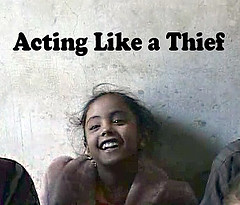
So I’m proud to announce the release of Acting Like a Thief! A short documentary film I shot and co-produced with Shashwati, who did an amazing job editing it.

Acting Like a Thief
We are releasing the film as a free BitTorrent download for all those tech-savvy people (the less tech-savvy can get a DVD for a $50 donation to our next project). I hope that this short piece will help raise awareness about DNTs and maybe even encourage some grad students who are still thinking about what they might like to research for their dissertation. If you think you might like to do such research, please contact me and I can help arrange some introductions.

Is Wikipedia being destroyed by its own success?

A lot of people have argued that the Wikipedia suffers from credibility problems, will never be taken as seriously as a closed encyclopedia, and so on and so forth. As an enthusiastic participant with 107 pages on my watchlist I’ve always considered this sort of talk based either on ignorance or envy, but recently I’ve noticed a trend on wikipedia’s anthropology-related pages which indicates that the Wikipedia does face a challenge to its legitimacy — albeit not the ones that the critics might imagine.

One of the many pages that I watch is the entry on “Julian Steward”:http://en.wikipedia.org/wiki/Julian_Steward — in fact, I wrote most of the current entry. Recently someone left this comment on the “talk page”:http://en.wikipedia.org/wiki/Talk:Julian_Steward for the entry:

According to what can only be called as the authoritative biography of Steward by Virginia Kerns (2003 University of Illinois Press), much of the information in this entry is incorrect. Please remove it until a new one can be added. It does no service to anyone to promote incorrect information. For example, beginning with the first sentence, Steward was not born into a family of devote Christian Scientists. His mother converted to Christian Science when Steward was 9 years old. This event seemed to precipitate his parents’ divorce and motivated much of his work against religion (Kerns 2003: 19-26). Kerns’ book corrects many inconsistencies, errors, and impossibilities in Shimkin (1964), Manners (1973), and Murphy (1977, 1981).

I’ve known for some time Kerns’s biography of Steward (I mentioned it “here”:/2005/05/26/evolutionary-biographies/) but I haven’t read it because there isn’t a copy on O’ahu, its too expensive for me to buy, and I haven’t gotten around to ILLing it yet. Sp I do agree with the anonymous commentor — if Kerns says I’m wrong, then I’m wrong. The problem is that this person complained about the content of this article as if it wasn’t in their power to change the contents of the wikipedia. It is one thing to bitch and moan about the low quality of the Encyclopedia Brittanica’s articles (compare Sol Tax’s entry on Boas in the EB to the “wikipedia version”:http://en.wikipedia.org/wiki/Franz_Boas) — you can’t do anything about what’s in that book. But not the Wikipedia — if you don’t like what you read, you should edit the page yourself!

This isn’t an isolated incident. At one point I attempted to make the entry on the “Sapir-Whorf Hypothesis”:http://en.wikipedia.org/wiki/Sapir-Whorf_hypothesis be less suck. This involved doing some historical background on the way Boas’s research paradigm emerged out of a Neokantian background. The result was the following anonymous note in the talk page:

“Sensuous intuition” is not noumenal reality. The very fact that pure sensation constitutes intuitions indicates for Kant that for reality even to be perceived, it must be filtered through the pure intutions of space and time. Whatever “reality is in flux” means, if anything, intuition is not entirely in flux because it’s already been converted into empirical intuition by the mind. The application of the categories is not the first instance of synthesis. Second, the categories are universal to anything possessing reason. The application of space, time, and the categories to raw sense data does not make a subjective experience but an objective one, with patterns that can be recognized by anyone. Someone needs to read his Kant.

Now, in my defense the entry tried to summarize important aspects of Neokantianism in a few sentences intended to be intelligible to people interested in Sapir and Whorf, and this comment seems to miss this fact. However, it is clear that whoever wrote this is more familiar with Kant then I am, and I wish that they had actually edited the entry. Instead, they merely complained on the talk page and didn’t change a word.

People with expertise, in other words, are reading the wikipedia but are not contributing to it. Why? It’s hard to say — after all, how far can you get with a sample size of 2? However, there is another (completely anecdotal) trend that I’ve noticed as well. Have you checked out the talk pages for “anthropology”:http://en.wikipedia.org/wiki/Talk:Anthropology or “culture”:http://en.wikipedia.org/wiki/Culture? The discussions stretch on about the legitimacy of anthropology as a discipline, the coherence of the culture concept, and include lots of reuqests for information. What they rarely result in is any actual change to the article — indeed, a lot of the time the topic isn’t even about how the page might be improved.

While this is all very anecdotal, I’ll take a completely unsubstantiated stab at predicting what it might augur for the Wikipedia’s future: these two things suggest to me that Wikipedia is facing a challenge that results not from its lack of legitimacy, but from the fact that it is being taken too seriously. More and more people read and rely on the wikipedia, and the flip side of this growing authoritativeness is that people do not feel they can mess with it themselves. It seems to me that talk pages are beginning to become places where virtual communities are sprining up to discuss the article, not to help write it.

The solution? Why not head on over to the Wikipedia today and search for your favorite anthropologist — write a quick entry about them, or improve the entry that already exists. The best way to keep them from taking punk rock away from the kids is to keep on playing it, loud.
Roll your own Anthropology Search Engine

Today I tried out a new search engine that lets you list up to 25 sites and then search just those sites using Yahoo! search. It is called Rollyo.com, and you can search a whole bunch of anthropology related web sites by going to this link.

I really like the idea. The site, however, has some limitations. For instance, you can’t only search a specific portion of a site, you have to search the entire domain. That means if someone has a blog hosted on their university web servers, you have to include the entire university in your search. Still, I think we will soon see more of this kind of thing. Some sites already let you search your blogroll, but those tend to only search the most recent posts – sites like this let you search everything that has been indexed in a large search engine over the years. I can also imagine setting up custom searches that just look at sites related to your research topic, or a class you are teaching. It is important to remember that not everyone has the same skills when it comes to finding information on the web, and this will enable the more sophisticated web-researchers help those who are less adept.

While I’m at it, I should also mention that Savage Minds is at the top of the Technorati list of anthropology related blogs! We are also near the top when using Google’s new blogsearch engine to look for “anthropology.”

PS: The sites I added to the current Rollyo search are just for testing, as the site improves I will try to create more focused lists – perhaps for each subfield. Or you could do that yourself and post the link to the comments!

Micronesia in the house

The “Micronesian Journal of History and Social Science”:http://marshall.csu.edu.au/MJHSS/ is a scholarly journal focusing on (you guessed it) Micronesia and social scientific approaches to it. It is entirely digital, and the full contents are downloadable off the net. So if you are looking for material on Micronesia (which can be difficult to find if you don’t live in Honolulu, the unofficial capital of Micronesia) then look no further. While I am not a Micronesianist, I do see a couple of names I recognize in the tables of contents, so I’d say this journal is worth a look. The “thrashing of Bravo For The Marshallese“:http://marshall.csu.edu.au/MJHSS/Issue2005/MJHSS2005_109.pdf is interesting, for instance, since I’ve heard very good things about this book from other sources.

A response to Timothy Burke

We appreciate that Timothy Burke in his blog, “Easily Distracted,”:http://weblogs.swarthmore.edu/burke/ has taken seriously our posts about Yali and Diamond on “Savageminds.” He does not give us the opportunity of responding to him directly, and so we will do so here. We’re afraid that those of you who have not read his blog may have to do so to make full sense of what we are saying. But, we also think that most will be able to make some sense of it all.

The “we” in the “West” mentioned in our posts (and mentioned again by Burke in his response to us on this blog) refers primarily to the sort of audience that many of us – at least as teachers of anthropology – encounter in our students, in their parents, and in many non-academic readers who ask us our opinion of the book. (We make this clear, we think.) Our speculation (and it is such) that Diamond’s book resonates with this audience because they are socio-economically the “haves” is designed to encourage readers who did like Diamond to think more about what appealed to them about his argument – and, in so doing, perhaps become interested in thinking about our more general critique. We don’t know how inclusive this “we” is, but certainly Diamond’s views of human nature and the inevitability of conquest are widely held. (We will say more about these views in our next post on Savageminds.)

We try not to depict Yali or other Papua New Guineans in an essentialized fashion. We do make clear in the book from which our posts are excerpted (especially in our discussion of Ramu Sugar Limited, a sugar plantation which is our primary ethnographic focus) that PNGuineans are thoroughly caught up in history and are not all alike – but differ considerably according to cultural group as well as social class. In addition, we discuss the fact that they engage with each other and with Europeans in a range of ways, including both gift exchange and commodity transactions. That being said, what we find in Yali — as well as in cargo-cult practitioners with whom we have worked, in the PNGuineans we have lived with in urban squatter settlements as well as those in affluent suburbs — is an abiding concern with establishing worth relative to others, including with Europeans. Indeed, one of the real problems for those of the PNG middle class is figuring out how to accumulate wealth without alienating – certainly without humiliating – kinsmen and other PNGuineans. They know that (unatoned for) slights will never be forgotten.

As anthropologists, we do work hard to understand the perspectives of others – as well as trying to get clear about our own. Our desire to comprehend Yali’s understanding of the world (and we do recognize that Yali’s experiences were complex) is itself historically rooted as is anthropology more generally. And, we do try to present our political perspective as explicitly as possible, in full recognition that it too is historically rooted. But we don’t see this as, in itself, precluding a serious effort to get Yali’s question right.

And this leads us to issues in representation. Who represents whom, with what right, and with what accuracy? Yali’s question may, as Timothy Burke says, be his – but what is Yali asking? How do we understand it? Does it need interpretation, contextualization, translation? How should we listen to Yali and to other PNGuineans – as well as to a much larger number of historically located others? And this returns us to the first point of Burke’s critique – that Yali is just Diamond’s literary device. We agree that he is, but find it a telling device. That Diamond got Yali’s question wrong is consistent with Diamond’s lack of concern with listening to what differently located people say – with trying to find out what they think is going on, what they think the point of life is. And this is because Diamond thinks he already knows what human nature and history are all about.

Anthro Daily Widget

The American Museum of Natural History’s Anthropology Division has been very busy vamping up their web site. Among the many things they’ve been doing is scanning in images of the half a million objects in their collection. So far 125,000 of these images are available online.

Unfortunately, their web designer insists on using awful javascript pop-ups on nearly every link in the site. I could barely use the site without first installing this greasemonkey script for Firefox which re-writes all the pop-up scripts to direct links. (Note to developers: Leave it up to the user whether or not to open a link in a new window! And please test your site on browsers which enable pop-up blocking, like Firefox.)

On the plus side, they have written this neat widget that works with Mac OS X 10.4.

Anthro Daily is a Dashboard widget that presents a different object every day from the ethnographic collections of the Anthropology Division of the American Museum of Natural History. The widget updates daily and links to the Anthropology Division’s website where you can research our comprehensive collections database.

Academic Commons: Suck or not suck?

“Academic Commons”:http://www.academiccommons.org/ is a new “online forum for investigating and defining the role that technology can play in liberal arts education.” Just looking at it (and the whuffie of the person who supplied me the link) I am not sure whether it is suck or not suck. However, it is heartening that they have an “interview with Jerry Graff”:http://www.academiccommons.org/commons/interview/graff above the fold on their front page — the same guy whose book I “recently whole heartedly endorsed”:/2005/08/17/the-grim-smile/.

I’m going to pull a Cory Doctorow on this one and post the link after having looked at it for mere femtoseconds. So you tell me — suck or not suck?

Anticipation

Nomadic Thoughts is a blog with a mission: “to document the thoughts and experiences of a new graduate student.” And today Will is off on that journey:

The long-awaited weekend has finally arrived. After months of researching, planning, testing, applying, and accepting I’m finally off to graduate school in the morning. I feel now what I think I should have felt before I left for freshman year of undergraduate: anticipation for something bigger coupled with just enough nervousness to keep me excited about the whole thing.

I wish Will the best of luck, and I look forward to following his adventures through grad school. Although not so much the crushing disappointment part…

To be fair, Will seems quite well aware of the realities of post-graduate education. But still, the transition to grad school was tough for me, as it was for most of the people I know (although some now deny it), hopefully having some support from the blogsphere will help!

I’d also like to point out another new anthropology blog, Its All Just A Ride, by John, an anthro undergrad with an interest in “religion and political economy in East Asia” (as he told me by e-mail). John is starting his senior year. Maybe he’ll soon blogging about graduate school as well?

Is there anything you wish someone had told you when you started graduate school? Or when you began applying for graduate schools?