Tag Archives: Websites

SSRC asks: Is Race ‘Real’? (with update)

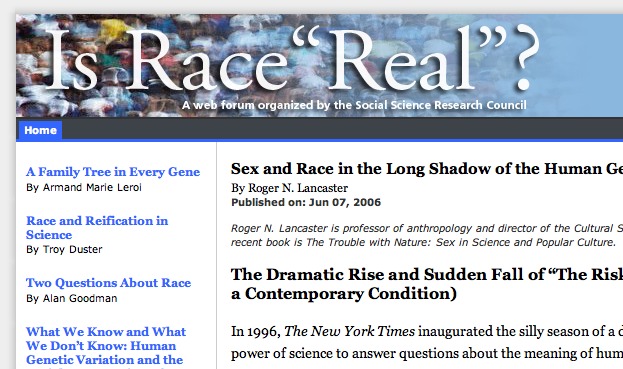
Complementing the AAA’s website devoted to contemporary anthropological thinking on racessrcrace.jpeg, the SSRC has its own much more academic website devoted to looking at recent developments in scholarship. The site says it is the ‘online companion’ to the three part PBS documentary, ‘Race – the Power of an Illusion.‘ Thus, most of the articles, including pieces by AAA President Alan Goodman and anthropologist Roger Lancaster, argue persuasively that race is a consequential cultural construct, not a natural fact. (Interestingly, this puts them somewhat at odds with what I understand Ian Hacking to have recently argued.) I especially like the Lancaster piece published on the website. Lancaster, like Susan McKinnon, sees an ‘elective affinity’ between neoliberal market ideology and ‘bioreductive’ explanations that understand present social and political circumstance as simply the expression of a fundamentally unchanging human nature encoded in genes. He writes:
…the rise of genomania seems inextricable from the long decline of public sociology (and of public intellectuals generally). This decline began in the Nixon years: It first took form as conservative discontent with penal and welfare policies informed by sociological expertise. Highly publicized attacks on public intellectuals like Margaret Mead fed this process, which accelerated throughout the Reagan/Bush years and has yet to be reversed.

This morning, I happened across an interestingly complementary piece in Anthropology Today by Tim Ingold (‘The trouble with “evolutionary biology”‘ — you have to have a subscription) attacking recent neo-Drawinian attacks on sociocultural anthropology. Lancaster & Co. I think show nicely what Mary Douglas and other anthropologists have been arguing for a long time: that appeals to the putatively ‘natural’ ordering of human affairs are actually ideological statements designed to de-politicize social life as ‘we’ know it.

(Update 27.06.2007:  Coincidentally, yesterday’s New York Times features an article by Nicholas Wade, who especially provokes Lancaster’s ire:  “If scientific racialism now enjoys respectability in the serious public sphere, this development owes much to the labors of a single New York Times science reporter, Nicholas Wade.”)
World Council of Anthropological Associations

Stumbling around the anthrosphere, I accidentally discovered that there is a World Council of Anthropological Associations:

The World Council of Anthropological Associations (WCAA) is a network of national and international associations that aims to promote worldwide communication and cooperation in anthropology. Its primary objectives are: to promote the discipline of anthropology in an international context; to promote cooperation and the sharing of information among world anthropologists; to promote jointly organized events of scientific debate and cooperation in research activities and dissemination of anthropological knowledge.

Judging from their website it doesn’t seem like they have done much since their founding in 2005, although a few new members have recently joined. But I’m glad to know that they exist! From their charter it seems as if they would be natural supporters of Open Access. They could do a lot to promote “worldwide communication and cooperation in anthropology” if they simply added an rss feed for their website and updated the news section a little more often. I’m all for a more global anthropology!

WorldCat Identities

I’m really enjoying the “Identities” page on WorldCat. As you might remember, back in 2003 the library service opened up its records to the web (previously only those at subscribing libraries could see the results). I never noticed it before, but their Identities service pulls together lots of useful information about well known people, such as what the most popular works about them are, names of related people, etc.

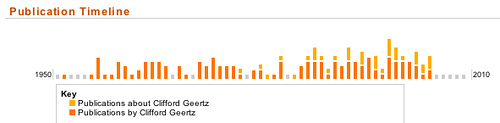
I really like the “publication timeline” which shows how many works by and about the author were published in each year (also differentiating between works they published while living and posthumous publications). Here is the chart for Clifford Geertz:

Publication Timeline for Geertz (via WolrdCat)

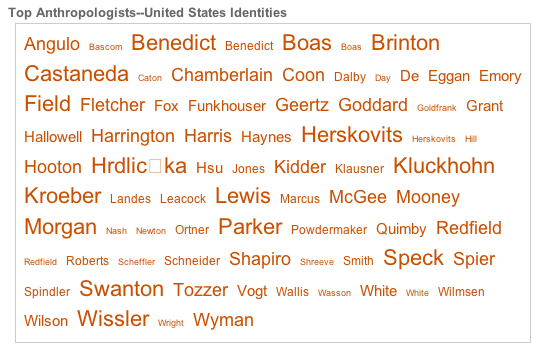
And here is their tag-cloud for the top American anthropologists by number of holdings in libraries:

Top Anthropologists-USA (worldcat)

The service is still in beta, but as it grows I can see it being an excellent supplement to Google Books and Wikipedia, especially for getting a handle on a new author you might never have heard of.

For your reference, here are the pages for Lévi-Strauss and Franz Boas. (It would be nice to see a cleaner permalink structure for linking to individual entries.)

(Thanks to Ilya for letting me know about Identities. He also links to this blog entry by one of the developers.)

Shouts out

The anthropological noosphere has been steadily expanding these past couple of years, and I just wanted to take this opportunity to drop the names of two recent blogs that have been on my radar recently — “Culture Matters”:http://culturematters.wordpress.com/ and “A World Among Worlds”:http://aworldamongworlds.wordpress.com/.

Culture Matters is an ‘applied anthropology’ blog from Macquarie Uni in Australia — its one of the few blogs I can think of that are explicitly department based. In particular, its the home of “Greg Downey”:http://culturematters.wordpress.com/contributors/greg-downey/, who has switched from “Capoeira”:http://www.amazon.com/Learning-Capoeira-Lessons-Cunning-Afro-Brazilian/dp/0195176979/ref=pd_bbs_sr_1/104-2154244-4865563?ie=UTF8&s=books&qid=1177826153&sr=8-1 to “capitalism”:http://www.amazon.com/Frontiers-Capital-Ethnographic-Reflections-Economy/dp/0822337398/ref=sr_1_5/104-2154244-4865563?ie=UTF8&s=books&qid=1177826153&sr=8-5. It has the whole applied anthro, consultancy, value-added thang going on.

A World Among Worlds is a blog set up undergraduate anthropology types at American University. I hesitate to say that it’s quite good “for undergraduates” not because its not good, but because by now I think they are sick of being reminded of the fact that they are undergraduates. So I’d encourage everyone to check them out as well.

Online anthro tutorial

One of the email lists I am on recently publicized “Internet Anthropologist”:http://www.vts.intute.ac.uk/acl/tutorial?sid=924460&op=preview&manifestid=198&itemid= an online tutorial designed to teach people about how to research anthropology online. In general I’m very skeptical about these resources since the tools and sites that you use to do research online are always changing, and the people who put them together are not, in my humble opinion, very good at actually doing research. A (very) quick look at Internet Anthropologist, however, makes me think that it is a cut above the usual online tutorials. The “Intute”:http://www.vts.intute.ac.uk/ platform that it is based on looks interesting, and while the tutorial itself is really basic, some people need to be told “There is such a thing as the American Anthropological Association, and it has a website.”

Of course I was a bit miffed that Savage Minds didn’t make the cut of ‘popular blogs about anthropology’ but I’m sure they’ll come around eventually… 🙂

Take a look and let me know what you think.

SfAA Podcasts

Jen Cardew has set up a website where you can download podcasts of sessions from this year’s SfAA meeting. Only a few are up so far, but more will be posted as they become available. Great work Jen!

It is worth noting that she did this using WordPress.com‘s free blog hosting – showing just how easy it is to set something like this up these days. There isn’t any need to wait for the AAA in order to set up a properly functioning website for your conference!

Another STS wiki

Many of you already know about “the bomb STS wiki”:http://en.stswiki.org/wiki/Main_Page at UVA but I recently came across another bomb wiki — the “UC STS Wiki”:http://symptom.ucdavis.edu/stsnet/index.php/Main_Page. It has a “terrifying number of facinating syllabi”:http://symptom.ucdavis.edu/stsnet/index.php/Syllabi including one on “the work of Marilyn Strathern”:http://symptom.ucdavis.edu/stsnet/index.php/Ethnographies_of_Relation:Readings_in_the_work_of_Marilyn_Strathern by Cori Hayden which is — wait for it — the _bomb.

Ethnographic Database Project

From the Savage Minds mailbag:

Ethnographic Database Project launched!

The Ethnographic Database Project (EDP) is a web-based tool for the collection of comparative ethnographic data. The EDP enables anthropologists to enter information about their field research using a set of standard codes developed for cross-cultural application; the codes relate to a society’s organization, kinship and marriage practices, subsistence economy, and pattern of sexual division of labor. The EDP is in the form of a web-based questionnaire, which can be accessed from any computer connected to the internet.

The EDP aims to complement widely-used comparative ethnographic datasets such as the Ethnographic Atlas and the Standard Cross-Cultural Sample by: (i) obtaining data directly from anthropologists who conducted field research in the societies of interest, (ii) using standard codes developed for cross-cultural application for all societies, (iii) expanding the range of societies for which coded ethnographic data are available.

The first stage of the EDP includes societies speaking Indo-European languages, which are underrepresented in the existing ethnographic databases. We welcome contributions from researchers who have conducted fieldwork in societies speaking these languages.

Visit the EDP website at http://www.ucl.ac.uk/~ucsalfo/EDP to read more about this project, to view a sample version of the EDP, and to find out how to contribute. Please forward this link to anyone who may be interested in this project!

It seems like an ambitious project, but my advice for anyone doing something like this is to get some sample data up on your site before going public. I find it very hard, looking at the site, to imagine how it will work.

Also, I’ve never been a big fan of coded ethnographic data, being more of a full-text search type myself. Why not just have people blog their fieldnotes and code it with Technorati tags of their own design?

I’m curious what our readers think. Do you use coded data? Would something like this be useful to you?

UPDATE: Although there isn’t sample data, there is a sample form where you can see what it would be like to enter data. It seems totally inappropriate to my own research. There are questions about “animal husbandry” but nothing about income, educational attainment, or anything appropriate to the 21st century.

Anthropology (and archaeology) on Citizendium

As many of you may know by now, “Citizendium”:http://www.citizendium.org/about.html is now live. The site aims to be like Wikipedia but with ‘quality control’ — it uses a quasi-hierarchical role structure and asks its authors provide CVs and other proof of their expertise. So if you have been interested in writing open access encyclopedia articles about anthropology but have found the politicking of Wikipedia distracting, then Citizendium may be for you.

I personally am somewhat ambivalent about Citizendium. I’ve written many Wikipedia articles myself, and have been lurking on the Citizendium mailing lists since they were started. I know that many Wikipedians think that the Wikipedia’s social and editorial policies simply don’t do the job they should. At the same time, many also think that Citizendium is an elitist program destined to fail. Personally, I think: the more pedias, the more better.

At the moment the anthropology offerings on Citizendium are pretty sparse — check out the “entry on anthropology itself”:http://en.citizendium.org/wiki/Anthropology if you don’t believe me — and they could use some more help. So consider “signing up”:http://en.citizendium.org/wiki/Citizendium_Pilot:How_to_get_started_with_the_Citizendium_pilot and helping make our work as anthropologists more open to the public.

PSA: nytimes.com free for me, maybe free for you too

A brief public service announcement:

The New York Times is opening up access permanently to TimesSelect to all students and faculty who have .edu e-mail addresses beginning on March 13.

Not true open access, but still good news for anyone at an educational institution. It works for international .edu domains as well (i.e. .edu.tw).

To register for your free account, go here.

More Friday Funnies: Occupational Hazards

The Onion has a story I think we can all identify with: Archaeologist Tired Of Unearthing Unspeakable Ancient Evils. Like Edward Whitson, the interviewee, I find lightning-breathing ocelots to be one of the recurring annoyances of anthropological fieldwork.

“All I wanted to do was study the settlement’s remarkably well-preserved kiln,” said the 58-year-old Whitson, carefully recoiling the rope he had just used to clamber out of a pit filled with giant rats. “I didn’t want to be chased by yet another accursed manifestation of an ancient god-king’s wrath.”

mike wesch rocks the video essay

As if former guest blogger Mike Wesch didn’t have enough to do, teaching enormous classes, creating world simulations and so forth, he’s also created this video (thanks Kim for the heads up). My first thought was, wow, that’s annoying music… 🙂 but immediately afterwards I realized that this is a stunning example of a video essay–an explanation of digital text and yes, web 2.0, which is far more demonstrative than any written explanation I have ever read. It takes that time-honored injunction “show me, don’t tell me” to a whole new level. Bravo Mike! (oh, and watch carefully for the SM plug)

And the anthropologists went two by two…

I’ve been relatively silent on SM recently partially because I’ve been hard at work on another project that involves far more intimate knowledge of WordPress than any mortal and fully employed academic should ever have, namely The ARC: The Anthropology of the Contemporary Research Collaboratory. Some may recall previous mentions (1,2) on SM. ARC was started about two years ago by Paul Rabinow, Stephen Collier and Andrew Lakoff as an experiment on collaborative “concept work” in anthropology. This latest transformation represents not only significant progress in the work of the people involved, but a transformation of the infrastructure of collaboration and discussion, which will hopefully allow for a much wider array of people to participate.

Among the things that have been occurring in ARC are an ongoing discussion on “concept work” and the ideas of conceptual labor and a “laboratory” in the human science. George Marcus, James Faubion, and Rebecca Lemov have all contributed to this discussion as it has unfolded. In addition, the projects within the orbit of ARC have settled into a few different areas: a project on “Vital Systems Secuirty” looking at the genealogy of contemporary approaches to critical infrastructure protection, homeland security, syndromic surveillance and other such developments; a project comparing developments in synthetic biology and nanotechnology, primarily around ethics and ontology; and an ongoing discussion on biopower, biopolitics and their continued transformations in anthropology and elsewhere; and an experimental lab/seminar at UC Berkeley focused on concept work and graduate pedagogy. Continue reading

Cultural Anthropology 2.0

The first issue of Cultural Anthropology under the editorship of Kim and Mike Fortun is out, and I am a willing participant in the media blitz. The first issue has a few articles that look great (although, as we already know, you need to be a AAA member to access them). One is an article on memory in Sierra Leone–articulating nicely with an article in Sunday’s New York Times Magazine on child soldiers–I’d love to see her reading of the use of memory in that autobiography. An article by Ilana Feldman on Human Rights in Palestine and an article by Michael M.J. Fischer revisiting culture.

As I am on the editorial board of CA, I’ve been privy to some of the discussions about what Kim and Mike want to do with CA. Continue reading

The AAA Race and Human Variation website is up

We’ve mentioned this site “before”:/2006/06/20/race-and-human-variation-website-is-up/ but now the AAA’s Race and Human Variation website is fully armed and operational, featuring a “blog”:http://www.understandingrace.org/cs/blogs/race/ as well as many other spiffy features. It is hard to tell who exactly the people blogging are (although you can read all about their “copyright”:http://www.understandingrace.org/about/copyright.html of the material on the site). The site is geared to non-academics, and has great interactive features like quizzes, interactive timelines, and games. It also has a lot of resources for educators, including “downloadable papers”:http://www.understandingrace.org/resources/papers_author.html and an “annotated bibliography”:http://www.understandingrace.org/resources/pdf/annotated_bibliography.pdf (PDF link). It looks like the site is powered by “Community Server”:http://communityserver.org/. I’m excited by the website and will certainly find ways to integrate it into my teaching. The “Who Is White”:http://www.understandingrace.org/lived/who_is/index.html flash quiz could certainly be paired with “All Look Same”:http://www.alllooksame.com/.