Tag Archives: Technology

Marriage Today

I have been intending to keep my kinship course moving between contemporary concerns and classic theory. We have been carefully tracking kinship theory from its beginnings in Morgan (19th century) to its apotheosis in a text dedicated to him (Lévi-Strauss’s Elementary Structures). A question remains: How does this stuff relate to debates in the world today?

Our reading this week spotlights concerns that feminist anthropologists have articulated in relation to gender and especially gender inequality. Today, debates the world over swirl around relations between men and women in neoliberal (yep!) and/or postcolonial contexts. For example, ‘kinship’ or ‘domestic relations’ are often seen to be the locus classicus of ‘tradition’ in rapidly modernizing societies. New found freedoms for women often run up against calls to maintain tradition in particular ways, calls that are not infrequently resisted by those who are subject to them. How are women ideologically positioned (often) as embodying tradition?  What do they say about that?

I am highlighting two themes for going forward:

1) “Choice” / “Agency”

Lévi-Strauss’s analysis of alliance challenges ‘enlightenment’ or ‘liberal’ views of the human subject: Is the subject a person who is author of his/her own actions, as one who ‘owns’ oneself? The challenge presented by prescriptive marriage systems for those of us raised in Euro-American cultures is precisely to imagine a version of humanity in which the exercise of agency is not necessarily equated with ‘choice.’ Do people make their social worlds (author them) or are they made by those worlds?

2) “Nature” / “Substance”

Lineage theory relates ‘natural’ relations (genealogy) to political structure. Putatively ancestral relations give form to political disputes and their resolution. In large part, lineage theory was motivated by the attempt to find state-like regulative functions in societies without states. Can this theory and its interests be re-applied to our understandings of government in places like Europe or North America? Segmentation can be abstracted to talk about alliances between political units in broad contexts. More concrete, perhaps, are the ways in which familial metaphors and notions of ancestry give form to the imagination of ‘nations.’ One can think about lineage theory in the context of nationalism and ethnicity for example (and see Horowitz or Lakoff).

These issues come together in contemporary debates about reproductive technologies and reproductive rights. Finland is presently debating legal limits on artificial insemination. To whom should this technology be made available? Single women? Lesbian couples? How are debates about its legality framed? I suggest that ‘nature’ and ‘marriage’ as they are conceived and critiqued in anthropological kinship theory can be brought to bear on these questions. Debates about alternative family forms often rest on notions of what is naturally human, spiraling nature from the question of bodily relations of particular (as modified by technology) kinds up into the domain of the putative structures that allow for the emergence of ‘culture’ (or Culture).

Separately, I am sure that I wasn’t the only one who noticed the recent New York Times piece on minghun marriages in China. Here we have questions of tradition, gender norms, and religious practice played out in an ‘exotic’ context. A link is here.
The ‘modernity of kinship’ (cf. the modernity of witchcraft) is found in debates about ‘ghost marriages.’ Society is reordered. But are the ancestors?
Ask our readers: How do you take reading notes?

The erudition of our readers (and my fellow bloggers) often astounds me. Some people may simply have good memories, but I don’t. I rely on my notes. So I’m curious: how do you take notes?

Over the years I’ve come up with my own system of taking reading notes which works for me, but it is very labor intensive: When reading a book I use small removable stickies to mark sections of text I think are important, then, after I’m done reading, I go back and type the relevant sections into my computer. Sometimes I copy verbatim, other times I just write the page number and make parenthetical comments, and sometimes I do a mix of the two.

This system works because I’m a fast typer, although when writing my dissertation at the New York Public Library I noticed a man who used the same system using the hunt-and-peck method of typing, one finger at a time …

But the real secret to this system is putting all my notes inside software that lets me do full-text search of my own notes. Some people use very structured data, and prefer software that lets them code each note with keywords, etc. but, personally, I’ve found that full-text is better, allowing me to make connections I might not otherwise have noticed.

Since I started teaching, however, my system has been hard to keep up. For one thing, I simply don’t have the time to review my readings so carefully and type them up. Also, I am trying hard to read more Chinese language texts, but the difficulty I face in taking notes often prevents me from getting very far. So I just ordered the IRISPen scanner with Chinese OCR support. It hasn’t come yet, but I hope that when it does it will help me overcome both problems, and return to using the note-taking system I’m comfortable with. I’ve long ago learned that new gadgets rarely live up to the hype, but as I prepare my lecture notes for class tomorrow I find myself wishing I’d ordered it much earlier!

(NOTE: IRIS offers an IRISPen Express with Chinese OCR support via their online store, even though their web page only lists the much more expensive “Executive” version as offering Chinese OCR support. Since I haven’t used the product yet, I can’t vouch for it, although I’ve heard good things from other users.)

UPDATE: Fifty ways to take notes online.

UPDATE: My IRISPen came. I posted my initial reactions here.

E-learning and Collaboration with Free Web Tools

Here’s a quick and dirty way to get your course online using free web tools:

  • Upload your syllabus to writely.com and make it public.
  • Upload your course documents to a folder on box.net and share the folder.
  • Create a discussion group for your class on Google Groups.
  • Post your class list to Google Spreadsheets (although you might want to keep that private).
  • Create a unique del.icio.us tag for URLs you want to share with your class.

I’ve noticed that most people do just about everything in either Word or Excel. These tools let you move that data online without having to change a thing. Once online you can continue to edit it online, share it publicly, or privately share it with a group of collaborators. I find myself using Writely and Google Spreadsheets more and more for any kind of task that would have previously required mailing the same document back and forth several times. Having tried about a dozen different services for running online discussions (such as forums, Yahoo Groups, etc.) I finally settled on Google Groups as the one that is easiest to use for both teachers and students. And Box.net seems like the easiest way to share documents for download. I just wish there was something to make it just as easy for students to submit their homework online.

Del.icio.us is the odd one out. Although I find it very easy to use and now can’t live without it, I’ve not been very successful at getting other people to understand how to use it, or why they might wish to do so. Not sure why that is…

UPDATE: One of my biggest problems doing a course syllabus is moving things around and then remembering which week is which date. I just figured out that Google Spreadsheets lets you do formulas in the date field! That means you can take the starting week and then just add 7 for each week. This way, even if you move things around the dates will still be correct! From now on I’m doing my course outline in a spreadsheet!

UPDATE: The new beta version of Google Groups adds a bunch of great new features.

UPDATE: Google has now merged Writely and Spreadsheets into “Google Docs” and has created a special web page for educators explaining the educational uses of a wide variety of Google products.

Hidden World: Visiting The British Colonial Archives

Our research trip to England was my first time doing archival research with primary documents. I’ve read a fair number of excellent articles about working with visual archives (Alan Sekula’s 1986, “The Body and the Archive” being the most famous), but I was still surprised to discover how awkward the process actually is. Visiting any archive usually requires some kind of advanced appointment for which you have to describe your project and tell the archivist which of their materials you intend to look at. This requires advanced knowledge about the nature of the archives and what materials they have – all well and good if you can simply hop on the web and search their archives for yourself, but quite difficult with visual archives.

Many visual archives are offline. One place we visited had a two inch thick sheaf of handwritten notes about their photographs. Two others had computerized databases, but you can only access those databases if you are physically sitting in front of the computer in their office – something that they don’t normally let anyone do. That’s right, unless you are lucky (as I was in one case), you aren’t even allowed to use the database yourself! But I’m jumping ahead of myself – we haven’t even gotten in the door yet. We are still in the Catch-22 position of telling the archivist what materials we want to use without really knowing what materials they have. You might be able to find some kind of broad statement about the nature of their collection, and if you say something vague about the connection between your research and this collection the archivist will do a search themselves before setting up an appointment. Of course, having been vague, it will be a vague search, and they will tell you that they don’t have anything and you probably shouldn’t come. And they are probably correct because some archives charge a lot of money to get in and access the collection. That’s because an archivist will have to help you get out and put away any material you ask to see. Fees can range from $30 to $100 a day, or even higher for some film archives.

In our case we are looking for images of a group of people who went by many different ethnic names with many different spellings: Bhat, Bhantu, Sansi, Sansees, Kanjars, Kanjar-bhat, Adodias, etc. all refer to basically the same ethnic group. Even worse, they might simply be listed as “street performers”, “convicts,” or “vagrants” depending on the context in which their image was taken. As nomads they could also have been just about anywhere in South Asia. And with many archives the pictures are probably not individually labeled at all, but are simply in a big box of photos according to who took it: the name of a missionary, missionary society, or colonial official, etc. So good luck telling the archivist which keywords you want to use. What we wanted was the archivist to explain to us the nature of the collection and how it was organized so that we could zero in on potentially useful documents and spend our time in the most efficient manner possible. What the archivists wanted, on the other hand, was for you to already know which of their pictures you wanted to use. Of course, once we explained everything, they were usually quite helpful, but it did take a while to convince them that we weren’t wasting everyone’s time.
Continue reading

(Non)infection as a Social Relation

This summer marked the passing of a birthday of sorts, the 25th anniversary of the first identification of AIDS in the United States. Although there is conclusive and still-emerging evidence that people died of AIDS at least as early as the mid-twentieth-century in Africa, it was the appearance of a rare form of pneumonia in otherwise healthy young men in Los Angeles that began to concern the U.S. Centers for Disease Control in 1981. National attention focused on “AIDS at 25,” as for example on the cover of Newsweek.

In San Francisco’s legendary Castro neighborhood, year 25 of the epidemic was recognized by community organizers with a banner mounted on the side of a Bank of America building at the corner of 18th and Castro. (The same site became a make-shift memorial to Princess Diana when she died; it was also the site of a little noticed memorial to both Jacques Derrida and Rodney Dangerfield the week that they died.) Organizers created large papier mache flowers that drooped over the Castro for a week or so. But though the gay community was ‘officially’ remembering this tragic event in its history, no one I know in my clique of thirtysomething denizens of the gay ghetto actually talked about it. The flowers just hung there and then went away.

HIV/AIDS is in the public eye again, in part because of the 2006 international AIDS conference in Toronto, which just ended. Reports from the conference indicate that the big ‘Double Bill’ session, featuring two of the world’s most famous and powerful men — Bill Gates and Bill Clinton — was standing room only. News is hopeful: antiretroviral drugs have dramatically transformed the disease from a terminal syndrome to something like a manageable chronic illness. These drugs reduce fatality, they can reduce infection, and they are very expensive. Massive funding will be needed to get these medications to the people in poor places who badly need them, and these include parts of the United States. Controversy swirls around whether or not U.S. initiatives aimed at Africa are constrained by the moralistic and inefficacious imperatives of the Bush regime. The consensus appears to be that because the means to hasten an end to the epidemic are now available, there is now a collective moral burden to make these means available to those whose lives they could save.

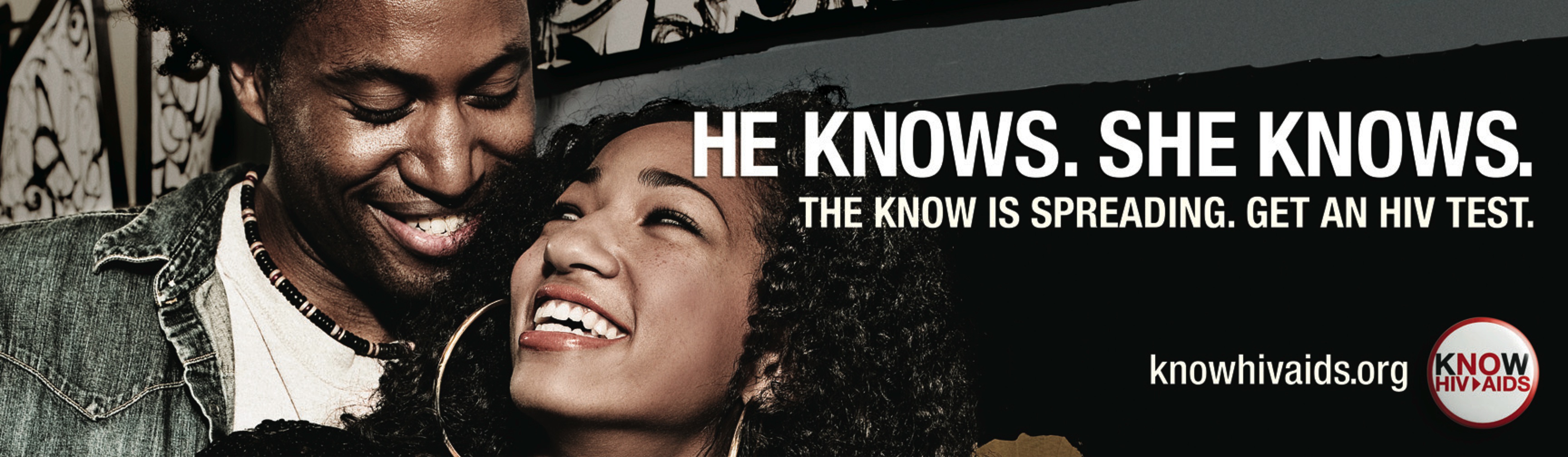
Meanwhile, in the United States, recent developments in HIV, law, and public health may be of interest to social anthropologists, especially those who work at the interstices of government, public health, medical technologies, and kinship. Reasons are manifold (AIDS disproportionately affects marginalized people, policy sometimes depends on knowledge of sexual practices and social networks that ethnographic methods uniquely reveal, the epidemic of its very nature mobilizes complex inter-connected/sometimes fractious social relations of vastly different orders [between sex partners, between ‘North’ and ‘South’]). I am am presently trying to think through some aspects of HIV/AIDS from a social perspective. I am interested in how different kinds of persons and publics are summoned by HIV. An example:He Knows

This image is from a pervasive social marketing campaign in the United States. You can see it, and similar ads, on the sides of buses or trams, in subway stations, on billboards, all over major urban areas. This year, I noticed several of these advertisements in San Francisco that were timed to coincide with National HIV Testing day. Here is an abundantly happy couple: attractive, apparently quite in love. The ‘know’ — knowledge of HIV status — the campaign assures us, is ‘spreading,’ to my mind an unfortunate metaphor in the context of an epidemic. Who is hailed in this call to gain self-knowledge? What indeed does this couple know? What is implied about the relationship between them? What does the advertisement ask its viewers to do? What does it promise them?

In upcoming posts, I will hazard an analysis of some current U.S. HIV prevention strategies, paying attention especially to ways that they construct ‘the public’ and its good. Recent emphasis on individual HIV testing, combined with legal decisions that criminalize the transmission of HIV between persons (and that problematize the status of one’s self-knowledge in the context of HIV), raise vital questions about individual agency and community responsibility. A provocation: suppose the person who responds to the “Know HIV/AIDS // No HIV/AIDS campaign” tests positive for HIV. How will this advertisement and ones like it frame the experience, its meanings, its psychological effects, its social entailments?

In an era in which biomedical interpellation is a pervasive and over-riding fact of life, the means and meanings of medical testing bear ethnographic inspection and social reflection.

Junking the Nature/Culture Divide

That our possessions encode and elicit our identities as persons seems both a commonplace and a fancy observation. For example: notions of ‘taste’ and ‘style,’ in the U.S., Japan, or wherever, reflexively link up practices of adornment and comportment with expressions of self. I love reading fashion blogs for the way they analyze self-presentation through clothing, often with refined understandings of cultural history. Slate compiles several excellent ‘street style’ blogs, many of which are urban micro-ethnographies of what people are up to in places like London or Helsinki. This on-going satire and serious critique of celebrity fashion contains some of the sharpest writing and analysis I have read, whilst also being super funny. Where contemporary usages of ‘style’ seem to me to emphasize creativity and individual expression, ‘taste’ points to perduring differences of a structural sort, most obviously those of class. Could you call these categories a metapragmatics of dress?

Clothing is easy. Here’s another easy one: pharmaceuticals. It’s not that hard to find examples of cultural projects that re-create materially what we human beings are. Pharmaceutical projects and products redefine the horizons of possible human being. Docility in body, docility in mind: fascinating new work is uncovering means through which mood is medicalized and controlled in consequential ways. And the corporate appetite for research subjects demands careful tracking and attention even as we read today that in the U.S. a federal panel is recommending a relaxation of regulations concerning the use of prisoners in pharmaceutical testing.

Accounts of the intermediation of the material and the symbolic or the corporeal and the social can include the lighthearted (tracking the category of ‘formal shorts’ over time) or something a bit more serious (noting disparities in access to life-changing drugs whilst criticizing a medical model that would reduce people to their molecular components). Current critical attention to ‘biopolitics,’ to the social processes and effects of science, to emergent digital worlds, and the like is exploding. We’ve grown accustomed to the claim that ‘nature’ has been superceded as either a symbolic construct grounding human affairs or the ‘world’ in itself ‘before’ our activity on it. Again, these notions can be given robust philosophical genealogies, or they can be illustrated with the rather obvious. Global warming grabs the headlines, but it’s worth remembering that the entire biosphere was also transformed by the atomic testing programs of states like the U.S. over the course of the twentieth century.

After all, we all inhabit worlds that contain and evince the traces of human activity in the past. And I don’t just mean the accumulated junk in my apartment. A visitor to highland New Guinea might be chagrined to learn that the grasslands of its valleys are largely anthropogenic. But once you realize that those valleys also contain traces of the radioactive activity of states on the other side of the planet, scaled observation (my apartment, a valley in New Guinea, the whole atmosphere) is rendered almost irrelevant because nature/culture encompasses all of them. Even Peter Day’s Global Business program today reflects on how people are nothing if not creatures who remake themselves via ‘the tool’ — whether the tool is a grass fire to clear land for gardening or a personal fabrication device.

Economists and anthropologists on video game violence

Academic bloodsport has been on my mind this week since I have been reading the Charlot/Valeri debate that raged briefly in the pages of Pacific Studies in the late 1980s. It is without at doubt the Ultimate Fighting Championship of debates about Hawai’ian Sacrifice, partially because of the intensity with which it is fought (Valeri, in finest Francophone style, accuses of Charlot of managing to miss “not only the forest, but the trees as well”), partially because of its incredible erudition, and partially because it is, as far as I know, the only major academic debate about Hawai’ian sacrifice to date.

The Charlot/Valeri debate is totally unavailable electronically and so I have no link to it here. However, if you are interested in one academic cutting the work of another into very small pieces I hardily reccomend “Edward Castronova’s smackdown”:http://terranova.blogs.com/terra_nova/2006/07/review_of_carne.html#more of “Carnagey’s work on video game violence”:http://www.public.iastate.edu/~vasser/pubs/06CAB.pdf, which features zingers like “the bugbear of statistical significance is loose among poorly-grounded fields, among which one must now, on the basis of their acceptance of this paper, sorrowfully include experimental social psychology.”
Continue reading

Rice U. Press: Scholarly monographs go digital

My own Rice University has re-launched its failed academic press as an “all-digital” publishing concern. It uses the Connexions system that I mentioned earlier and it will function as a regular peer-reviewed press. I think the details of licensing and price will be worked out as it develops, probably in response to what authors say they want. I do know that they intend to use Qoop.com to produce print-on-demand works– so it isn’t in fact “all-digital”–it’s just that it won’t use any conventional book-printing infrastructure.

This might be a good opportunity for anyone in search of a press–especially for dissertations or books that mightn’t have so mammoth an audience. Or, perhaps, for books that should be re-published, orphaned works or others that need a new hearing. Rex, here’s your chance to edit the complete works of Max Gluckman…

Did you mean “matrilineal”?

I was recently proofreading a paper for a Taiwanese colleague and since I don’t trust my own spelling I ran it through the spell checker. Word underlined every instance of “patrilineal” in red and helpfully suggested “matrilineal” … Hey, at least its a kinship term. I’ve seen worse.

Still, it reminded me of a project I’ve been meaning to start for a while: I’d like to compile a list of common words used in the social sciences which aren’t in the default MS Word dictionary. Everyone could then download this list and add it as a custom dictionary. Many of you probably have your own existing custom dictionaries (I lost mine somewhere along the line), and you might be able to help us get started by uploading that to the new wiki page I’ve set up for this project: the Anthropology Word List.

Don’t feel a need to limit yourself to kinship terms, all the latest isms and post-structuralist jargon should be added to the list. If we are going to have to use words like “hybridities” at least we should spell them correctly!

Grand Theft Auto music survey

A former acquaintance, Kiri Miller, is conducting “a study at the University of Alberta on radio stations in Grand Theft Auto”:http://www.ualberta.ca/~kmmiller/gtasurvey.html. If you’ve ever played GTA and listened to the radio, please spread the word about the survey and fill it out yourself!

A Greased Up Platypus for Anthrosource-Google Synergy

Last year I wrote a hint about using Google to search Anthrosource. I’ve found using Google often yields faster and better results if I’m looking for a specific article. However, I find it frustrating that half of the Google results link to the citation page, while the other half link directly to the PDF (all the links say they link to the PDF, but that simply isn’t the case).

Because I want my metadata, I prefer links to the citation page. So, in order to ensure that all the Google results consistently link to the citation page, I’ve whipped up a Greasemonkey script using the greasemonkey-for-dummies tool Platypus.

Geeky stuff, to be sure, but perhaps it will be useful for some of you. If you are running Greasemonkey, you can install the script here. It should be easy enough to change it to make all the links go to the PDF file instead, if you prefer it that way. My hope is that my meager efforts will inspire someone to write a much better script which gives you multiple links for each of the search results: to the citation, the PDF, and the bibtex file …

Tips and tricks on recording stuff

One of the things that I wish I got more tutelage on in graduate school was audio recording — it’s actually a pretty major part of what we do in the field and yet hanging mics, recording outdoors, and manging your audio files (or, as we used to call them back in the day, ‘casette tapes’) is an underexplored art in many graduate schools. A lot of this stuff gets discussed in the blogosphere but there’s no central place to keep track of it all, and product reviews of consumer electronics are often written by people who do something very different from what we do.

So when I was Googling around trying to find out what ‘coming across the transom’ literally meant, I was gratified to stumble across “transom.org”:http://www.transom.org/, a web auxillary for the NPR juggernaut. The middlebrow enthusiasm of public radio drives me nuts sometimes — I particularly hate Prarie Home Companion’s WASPy self-satisfaction — but transom.org is actually a wonderful resource for anthropologists. It’s “tools”:http://www.transom.org/tools/ section has great, useful reviews of digital recorders and mixers as well as just plain good advice on how to interview someone. While I still think everyone should read Learning How To Ask instead of just assume that interviewing is the same in cultures all over the world, I think that this site reflects a concern with craft that journalists have and which makes them such close cousins of anthropologists in certain respects.

Traditional Knowledge Digital Library

India’s anti bio-piracy initiative has garnered a lot of press recently. Here is the BBC:

In a quiet government office in the Indian capital, Delhi, some 100 doctors are hunched over computers poring over ancient medical texts and keying in information.

… The ambitious $2m project, christened Traditional Knowledge Digital Library, will roll out an encyclopaedia of the country’s traditional medicine in five languages – English, French, German, Japanese and Spanish – in an effort to stop people from claiming them as their own and patenting them.

You can access a demo of the TKDL here, but I think you need to work at a patent office to register. The concept of bio-piracy is explained in detail on this page, along with several examples. Here is the BBC’s summary:
Continue reading

Ambient Findability in Polynesia: a rant

As a pathetic hacker fanboy I try to at least keep up with the worldview of the digerati. I find this work interesting not just because I secretely want to be a sysadmin, but because people who work with technology are eclectic thinkers who often think big thoughts outside the box. And while they rarely read anthropology they do have a strong intuitive sense for the culture concept — they recognize that human beings have some biological givens which cannot be resisted (need for sleep and its repression figures strongly here) but at the same time they recognize that there is something arbitrary and conventional the needs that good design fulfill. My most recent foray into what might be called (after the publisher) the “O’Reilly Ethos” was “Peter Morville’s”:http://argus-acia.com/bios/morville.html “Ambient Findability”:http://www.oreilly.com/catalog/ambient/, which seemed to me to be the best ‘big picture’ book that’s come out recently.

The problem with a book named ‘ambient findability’ is that it is in danger of being meme long, and once you’ve read the title you don’t need to read the rest of the book. Even the slim 179 pages of the book suggests that the author had trouble filling it out. Now there is certainly a lot of superb stuff in the book. The last third — which actually discusses information architecture and how people find stuff online — is fascinating and I recommend it heartily. The rest of the book attempts to locate this discussion in a wider account of how humans and animals dwell in and navigate through the world. The problems with this part of the book are hard to overlook. The breathless, Cluetrain-style prose (e.g. “We’re surely headed in the general direction of ambient findability. So strap on your seatbelts, power up your smartphones, and prepare for turbulence. Beyond this place, there be dragons. Or is it streets paved with silicon?”) is derivative and tired. And it doesn’t help that much of what it promises is a rehash of SmartMob hype that is already looking as prescient as late-80s promises of VR helmets and headgloves. But what really got me was a passage on Polynesia which not only upset me as someone who lives in this region, but because of the way it reveals how much of human wayfinding Morville should have noticed given his topic.

In the section “human wayfinding in natural habitats” Morville writes that “today… [the] ability to ‘read’ the natural environment has been lost” and a a result we “marvel at the mysterious skills of our ancestors, such as the Polynesians who navigated open ocean voyages without instruments.” Luckily for us (he writes) he writes, “ethnographers often provide a glimpse into the past by studying indigenous, living societies that have preserved their ancient culture and tradition.” He then goes on to quote someone quoting Raymond Firth’s account of spatial orientation in Tikopia where “the islanders use the expressions inland or seaward for all kinds of spatial reference… Firth reports overhearing one man say to another: ‘there is a spot of mud on your seaward cheek’.” Morville concludes that “only a very small island would support the particular system employed by the Tikopians.”

There is so much that is wrong with this passage I don’t even know where to start.
Continue reading

How to make downloading a PDF as easy as ripping an iTunes Song

We live in a wondrous era for electronic information. If you have a few thousand songs sitting on your hard drive there are all kinds of programs which will help you organize and catalog your information automatically. Software can identify the song and automatically add information about the song title, the artist, album, etc. There is even software that can automatically download the cover art for each album. When I take pictures with my digital camera it automatically saves extra information about the date I took the picture, what camera I used, and even the aperture and other settings. But there is one kind of information that remains in the dark ages: academic texts.

While songs and photos are rich in computer-readable metadata, most PDF files contain very little. You are lucky if you can even click inside the PDF file to copy and paste the article title. So, while there are many programs that will let you keep track of your PDF files in the same way that iTunes or iPhoto keeps track music and photos (my favorite is Bookends), one still has to open up the PDF, read the information, and then manually type it in to the database.

That you can open a PDF and read the data is a big difference between PDF files and other kinds of media. Not all songs have their title as the chorus. But precisely because of this, much less effort has gone into making it easy to automate the entering of such data into databases. Some academic websites will let you download citation data – but if the file is already sitting on your hard drive you can’t always figure out what database it came from. And this is another part of the problem with PDF metadata: the fact that there are so many different academic search engines, none of which is exhaustive.

So what is the solution?
Continue reading