Tag Archives: Technology

It’s a book! Two Bits

So I have an announcement: I have written, and published, A Book. I know that Savage Minds readers harbor the suspicion that we are all just doing this gig until someone pulls the curtain back and we have to dust off our barista aprons and work for a living, but I am actually in this for the long haul… The book is called Two Bits: The Cultural Significance of Free Software, and it is produced by the punkrockingest press ever, Duke University Press. It is now available for purchase, for download and for derivation and remixing. Two Bits Cover

I am extremely happy to finally be able to announce its arrival. I’m also happy to announce that it is part of a series edited by Michael M.J. Fischer and Joe Dumit called “Experimental Futures” of which Jeff Juris’ excellent book Networking Futures: The Movements against Corporate Globalization is also a part. And as well to thank HASTAC for helping out in its publication and in marketing it as well.

Two Bits has taken a long time, and it’s a better book for that. In some ways, it is untimely: the moment of Free Software is over– both the media and many of the scholars who focused so much attention on it starting in about 2000 seem to have moved on to some other next big thing. This is a shame, but predictable given the drive for novelty and for being first in academia. But I think (and I will throw modesty to the wind here) that anthropology has a tack on such things that is slower, more coherent, and more concerned with a certain precision in charting historical changes. I like to think that the book isn’t only about free software, but an anthropology of knowledge circulation more generally, and I hope that it interests even those who are too cool for old school.

Obviously I hope that others think the same thing, and I expect people to read it in light of the current peak of interest in web 2.0, social networking and internet celebrities, or whatever, which might be usefully re-thought through the lens of Free Software. And maybe it might just convince a few people, scholars especially, that the moment of Free Software is definitely not over, and that there is some really incredible scholarship out there by people like Gabriella Coleman, Matt Ratto, Shay David, Casey O’Donell, Jelena Karanovic, Anita Chan, Samir Chopra and Scott Dexter, Jenny Cool, Allison Fish, David Hakken and Karl Hakken, Jeff Juris (my labelmate!), Bernhard Krieger, Karim Lakhani, James Leach, Siobhan O’Mahoney, Greg Vetter and many others on these topics. Like the scholarship emerging on gaming (with Rex representing), that on Free Software constitutes a major locus of scholarly concern and questioning that should be the basis for understanding much of the recent past and near future.

Having been through the process of publishing a book, like oneman, I wish we could publish our books faster, and try to merge some of the timely but ill-considered insight of the blog-form with the deliberate and peer-reviewed caution of the book-form… but I’m nonetheless a committed modernist in that I think the book-form has a quality that no other form of communication has, and it has taken centuries for that quality to develop. Nonetheless, nothing lasts forever, and since this is a book about software, there are a few special things that I want readers to know about this book:
Continue reading

What Is This Thing Called "Edupunk"?

A new sensation is sweeping the nation. English adjuncts with mohawks are rockin’ their classrooms, web 2.0-style! Scrappy science teachers are banging together online learning systems in their garages! Gothic literature professors are turning to Wikipedia for inspiration! It’s a new day…

OK, maybe it’s not that exciting. What’s really happening is that professors and teachers are getting fed up with the limitations and corporate-overlordness of commercial learning software like Blackboard and WebCampus — and in a web 2.0 world, there are plenty of options for the fed up. With a click of the mouse and a sweep of the browser, it’s easy as Pi to cobble together your own online learning system — one with far more to offer both students and faculty than the tools schools are laying out big bucks for.

The Chronicle brought the… movement? news? thingy? … to mainstream attention, but their contribution is just a fillip on the work of professors and teachers all over the nation who have been thinking long and hard about how to bring learning to the web — and in doing so, to their students.

Let me say right here, for the record, I don’t buy all this “digital generation” nonsense. We’ve got a way to go before that happens. When I no longer have to teach my students how to Google unfamiliar terms or how to add an attachment to an email, then I might well believe that they are comfortably native in the online world; for now, the most I can say is that what I see as an important set of tools, they seem to see as a big box of toys, toys they’re happy to play with as long as it’s the same toy everyone else has.

But that doesn’t mean the Internet isn’t important — in fact, I think it makes it more incumbent on us, as educators, to show the amazing power of the Internet for more than just gossiping about your friends and breaking up with your lovers.

So What IS It?!

OK, edupunk. Basically, what you’ve got is a nascent movement by educators inspired by the DIY-ness of punk music (and fashion, design, writing, etc.) to step outside the walled garden provided by their institutions. Some are turning to wikis, others to blogging, still others to user-generated content, Google maps, and all manner of mashups. The occasionally savage Michael Wesch is a good example, though I don’t know if he considers himself “edupunk” — but it’s nt particularly punk to worry about labels, so who cares?

Edupunk is also a political statement. Scratch that — it’s a collection of political statements, and sometimes isn’t a political statement at all. Stephen Downes sums it up nicely:

Edupunk, it seems, takes old-school Progressive educational tactics–hands-on learning that starts with the learner’s interests–and makes them relevant to today’s digital age, sometimes by forgoing digital technologies entirely.

My own entry into edupunk (though I didn’t think of it as such at the time, and if you don’t count Savage Minds, which seems animated by the same principles even if it’s not explicitly an instructional tool) came about last summer when I decided to implement blogging in my “Gender, Race, and Class” course. For years, I’d been requiring a weekly response paper, an ungraded assignment that asked students to record their thoughts on the readings. This has been by far my most successful assignment — I could easily forego tests and essays, if not for the fact that a class of ungraded assignments probably wouldn’t give much incentive to master the material. But it galled me that the conversation these papers represented was just between each individual student and myself. I wanted their fellow students to benefit from their wide range of experience, thinking, and opinion.

So what’s a professor to do? As any patient IT department employee will tell you, “WebCampus (or Blackboard) offers a variety of interactive features including bulletin boards to facilitate virtual conversations in the blah blah blah. ” I’m sure they offer a really swell product, but a) the commercial classroom management systems offer a standard that students will never use again after their graduation, and b) they exist behind the university’s paywall. If my students have something to say, they might as well be saying it to the world, not just to the students in their class whose registration bill is current.

As far as I’m concerned, teaching students to engage with the world around them is crucial, both morally and pedagogically. (And, you’ll say, “politically”. So be it.) WebCampus and Blackboard don’t offer that; they offer a way to standardize education and, by extension, students.

So I built a blog. On Drupal, if you must know. And I required students to post their responses for the world to see, and to comment on each other’s posts. That second requirement is, of course, my hat-tip to totalitarianist authority; I knew that organic conversation was unlikely to develop — because they’re not “digital natives”!

That summer session went great, and the blog played a big role in that. In the fall, I tried again, this time with two classes, one blog. It didn’t work as well. I couldn’t stay on top of it, posts got shorter and shorter and less and less thoughtful, interaction was forced, there were too many students talking at once. I’ll need to rethink it before I try again — but it was definitely worth the effort.

What’s the point?

A lot of professors are fed up. They’re fed up with the commodification of education, they’re fed up with being straight-jacketed in their teaching because the school paid good money for an expensive system and they’d damn well better use it, they’re fed up by the increasing emphasis on education as workplace training instead of citizen (or even human) training, and they’re fed up with the apparent inability of administrators to do anything with a positive educational effect.

And, frankly, we’re fed up with failing. No matter what grade you teach, whether that’s 3rd grade or upper-division uni, you’re getting classes, semester after semester, that are unprepared for grade-appropriate education. It’s a tough thing to decide how many of your students you’re never going to reach; a lot of us will try anything in the hopes that we can reduce that number to zero. Blogging, twittering, mashing up data, wiki-ing, and other web-enabled activities allow us to offer the kind of hands-on work that we know can have an effect — much more, anyway, than assigning a multiple-choice quiz through Blackboard!

I’m only skimming the surface here. bavatuesdays is doing a good job of keeping up to date on edupunk’s emergence (the link is to all posts tagged “edupunk”; pay special attention to The Glass Bees); a new Wikipedia entry will likely evolve as more is known about this newly discovered “tribe” of educators; and Leslie Madsen-Brooks offers a good overview of the meanings attached to “edupunk” so far at Blogher.


New Tools: Sophie and Apture

Just a random couple of notes on two tools that I’ve looked at recently.

1) Mary Murrell points out that the Institute for the Future of the Book has released Sophie 1.0 and has announced a competition for a workshop at the institute for multimedia literacy at USC. Sophie is a multi-media authoring tool– a bit like Macromedia Director, for those who can remember that far back into the last millenium, but much much better. It’s open source, it has a very nice interface that allows for rapid construction of multi-page documents which can incorporate sound, video and images. It has a timeline for creating time-based presentations and it handles most of the main formats without trouble. It does take a bit of energy to learn, but it could be used to create really rich presentations or documents. It’s kind of the perfect in-between-film-and-text tool. The only shortcoming is that it produces its own file format which requires the sophie reader (also free, and available on mac-windows-linux) to read a book produced in sophie. This means that docs can’t be easily displayed on the web, but requires the viewer to download and install a piece of software. Better for presentations than stand-alone docs, I guess. However, it looks like one could export the time -based stuff to a movie format, and the text-based stuff to a pdf, so it’s not that bad.

2) On the extremely cool, but maddening side is Apture. Apture is an amazingly clever add-on to a web-site that allows beautifully clever links that pop-up and move the window around and allow you to quickly add photos and video to any site. It’s hard to explain (go play with the the demo). The down side is that this is 1) so NOT free and open source software, and as far as I can tell a direct route into allowing apture to basically display whatever it wants on your site, in order to get this functionality (it uses a remote application server that essentially serves content on top of your site, so it’s a bit like an annotation service); and 2) it ruins the “view source” aspect of the web by overlaying content that cannot be easily investigated, as one can with normal content displayed in a browser. Apture is hardly the main culprit here, but they are part of a trend towards the obfuscation of web technologies, towards a re-closing of the source so that it becomes harder and harder for individuals to teach themselves such new tools. Indeed, Apture is not intended to be learned and re-used by anyone except at the interface level, unlike the wealth of tools (HTML, PHP, perl, python, ruby) that we have come to expect as part of our information environment. This makes me sad and mad. I wish they could see the light 🙂

Three New Tools

It seems that new productivity tools come out faster than we can keep up with them, but I’ve recently started using three new ones which I think are worth taking a moment of your time to investigate. All three have changed how I work:

  • Jott is a service which works over the phone (sorry, US phone numbers only right now). You call the Jott phone number, record a short message, and then it is transcribed by both computers and humans before being emailed to you, one of your contacts, or various web services which interact with Jott. A recording of your original message is included, so you can figure out what went wrong when there’s a mistake. (It’s pretty accurate, but not pefect. “Ad hoc became “add a hawk” in my last Jott. They encourage you to spell out unusual names.) Even though I’m in Taiwan, my internet phone is registered in the US, so I use this all the time. Its great when I’m lying down reading a book and want to transcribe a short passage or make a note to myself.
  • Evernote is a way to make sure your notes are with you wherever you are. It syncs your notes between your desktop computer (they have clients for Mac and Windows), the website, and even your mobile phone (via a Windows Mobile client, or an experimental IMAP interface for the iPhone). It also clips web pages and even recognizes handwriting, but I’m just happy to have my notes with me wherever I go. Oh, and you can send your Jotts to Evernote for note-taking bliss. (Evernote is currently in closed beta, but I have three invites left, and hopefully those three can share their invites once mine are gone.)
  • Sente is a Mac OS X only application for keeping track of your references and PDF files. Nothing new there, EndNote and Bookends do the same thing just as well. In fact, Bookends was my favorite until recently, but Sente’s new “links” feature is amazingly useful so I’m giving it a try for the paper I’m writing. Download a citation from AnthroSource to Sente and it will see the link to the AnthroSource website, which it shows in the main panel. Click on the link to download the PDF file and its automatically downloaded, renamed, and attached to your reference! If there’s an ISBN number for a book you can see the Amazon and Google Books web pages for that book. And so on. Watch a short video showing this in action. (I should also mention Zotero, a free plugin for Firefox which can pull bibliographic metadata from numerous websites, organize PDFs and make bibliographies. Zotero can’t quite compete with stand-alone apps just yet, but its free and catching up quick.)

On Frictionless Scale-Making

I was actually thinking along very similar lines to CKelty [PDF] when I began looking at the literature on scale-making this week. In the world of the internet scale-making is all about scalability, about the ability to go from a website which can handle a few hundred users to one which can handle millions. Google recently launched a new service, App Engine, based around the promise that you’ll have Google behind you if your application takes off and needs to scale.

The reason I was thinking along these lines is that I recently finished Clay Shirky’s book Here Comes Everybody. Shirky argues that one of the defining features of the internet (once it has become a ubiquitous and prosaic part of our lives) is that it reduces the barriers to collaboration and collective action. But while the ridiculously easy group formation fostered by the internet makes it easy to form a group, the very fact of scale no longer serves as an index of group-strength. He gives this example from Howard Dean’s presidential campaign:

because Meetup makes it easier to gather the faithful, it confused people into thinking that they were seeing an increase in Dean support, rather than a decrease in the hassle of of organizing groups — the 2003 Dean Meetup simply brought out a much larger percentage of Dean supporters than would have shown up previously. We’ve seen this sort of effect before, as when written correspondence on letterhead stopped being a sign of a solvent company, thanks to the desktop-publishing revolution.

Continue reading

Online Collaborative Kinship

I’ve been playing around with Geni.com. Its a social-networking site (like Facebook) built up around kinship. When you add a (living) relative you can also invite them to join your family network and they can contribute to the family tree. You can also add non-kin “friends” if you like.

I was thinking that this could be a very useful tool for some anthropologists – at least those working with English speaking web-savvy subjects. It could also perhaps be used to develop intellectual genealogies of the kind CKelty was talking about earlier.

I imagine that some kinship information, especially from non-European societies, might be hard to fit into the templates used by Geni.com. They do have some flexibility (for “domestic partners” for instance), but you are not able to define your own kinship terms, and you’re stuck with pink and blue blobs to mark binary gender identities. You can adjust your own privacy settings, but I’m not very clear how that works if another member of your family tree chooses settings different from your own. Still, I think it really shows how Web2.0 tools could be useful for not only collecting data, but also building an online community around the data collection process.

UPDATE: Turns out you can turn off the pink and blue coloring if you like.

Peer Review Round-up, yee haw.

I want to point people to a couple of things related to the intersection of peer review and open access. The first is a recent round-table discussion held at the Center for Studies of Higher Education at UC Berkeley, which brought together a great group of people including Don Kennedy, the editor of Science and Mark Rose (author of Authors and Owners) among others. The minutes are available (link) and they include a number of interesting proposals and diagnoses of the main problems facing scholarly publishing today, including some sharp observations about the financial realities of publishing peer-reviewed work and creative ideas for publishing monographs.

The other, a bit late, but still ongoing is that Noah Wardrip-Fruin over at Grant Text Auto, is experimenting with blog-based, serialized, community peer review. Noah’s book, Expressive Processing (one of a increasingly large number of texts laying claim to the field of “software studies”), is serialized for commentary using comment press (hip hip hooray!) and is being conducted along side “standard” peer review with MIT Press. I think this is a great idea whose time has definitely come, for a couple of reasons. One is that I’m more and more fond of the idea that peer review is best done by communities of people who are not anonymous. Pseudonymy might be a good idea (i.e., I don’t care who “IreadBooks69” is at Amazon but I know that s/he writes great reviews). The other is that community is a just generally a good idea. If the people commenting on Noah’s book feel as though they are contributing, are part of something, and that they get credit for it, or perhaps even get an immediate response, then that beats the heck out of the anonymous, forgotten black hole I routinely send my reviews into. I only hope Noah writes some kind of white paper-ish thing highlighting what works and what doesn’t so that people can repeat the experience.

knolcats: i’m in ur pedia, innovatin ur ass

It its never-ending bid to own every inch of your brain, Google has just announced the beginning of its competitor project to Wikipedia. You knew this was coming. You did really, because every time you search for something, you get a Wikipedia page, right? You thought Google wouldn’t notice… There have been some short posts by Esther and Henry at Crooked Timber, and all of us want to hear what Siva will say, since he’s made it his new project to worry about precisely this.

For my part, I find it to be an interesting confirmation that something has changed with respect to innovation on the internet. While it is comforting to suggest that innovation takes place democratically on the Internet because any little guy with an innovation can suddenly become huge and all of a sudden capture billions of eyeballs, or whatever, its pretty clear that Google is turning out to be to the Internet what IBM was to mainframes and Microsoft was to PCs. Which is to say, a monopolist. Only it’s in a totally unregulated environment, where the de facto ideology is that we live in a world of unconstrained free competition; we fool ourselves that this isn’t a monopoly because their tag line is “don’t be evil.”

But in reality, Google didn’t innovate here. There are a bunch of projects that have done what google is proposing to do with “knols” but they don’t have the massive resources and direct access to the most valuable data available that Google has (for instance, my own Rice Universities Connexions project has addressed exactly the issues Google claims that no one else has addressed). But for most net observers, anyone who says “we did that before google did” is just sour grapes… and in an era and an environment in which the intellectual property system is so drastically and so completely broken, it’s impossible to use IP rights to adjudicate who might actually deserve recognition for an idea. The best you can do is assume that if they are 1) bought by Google or 2) bought by Microsoft, they must have had a good idea, and some good lawyers. So I’m not sure how I feel about the new frontier; on the one hand, I, for one, welcome our new knowledge-ecology overlords, on the other hand, it feels to me like we’re on a primrose path towards the Wal-Martization of the Internet, with candy rainbow-colored everything. Or maybe I should just take the blue pill, and stay here, forever.

Archival Possibilities

There has been some discussion on SM concerning the possibilities and implications of digital technologies in relation to indigenous communities, most notably when Michael Brown was a guest blogger. I mentioned in my first post that the reason I was in Tennant Creek over the last two months was to install a digital archive in the Nyinkka Nyunyu Art and Culture Centre in town. I’ll just give a brief overview of the project and then discuss the possibilities I see growing from these types of projects.

The Mukurtu Wumpurrarni-kari archive was developed collaboratively over the last two years by myself, Warumungu community members, Craig Dietrich, Tim Dietrich (software developers) and Chris Cooney (designer). Mukurtu means ‘dilly bag’ in Warumungu. Dilly bags were used as safe keeping places for sacred materials. The archive is thus a “safe keeping place.”

The gist of the project is this: Warumungu community members wanted a way to manage the digital materials they received from a number of sources—mainly researchers, teachers and missionaries who had once worked in the community. How could they store, organize, distribute, and allow access to these images based on the Warumungu cultural protocols that surround viewing and distribution of images and the associated knowledge that goes with them?

Over two years of consultation, we developed a browser-based digital archive (using a MySQL database and PHP scripting language, the archive runs locally on an iMac in a MAMP web environment—Mac OSX, Apache, MySQL, PHP—for those techies out there) using the cultural protocols to drive the technology. That is, the information architecture of the system was driven by the specific Warumungu cultural protocols for the viewing, distribution, and reproduction of images. There is a detailed summary concerning the functionality of the Mukurtu Wumpurrarni-kari Archive on my blog.

Over the last few years of development I have met several people involved in similar projects—mainly in Australia (I’d love to know about others). Finally having Mukurtu installed in Tennant Creek though gave us the opportunity to 1) think of ways to develop it further in the context of Nyinkka Nyunyu as an art and culture centre and 2) reach out to others to find ways to improve and share what we have. We have begun to develop a framework for a flexible system that would allow other communities to customize the system to fit their own cultural protocols–what we need now are more developers! Although at present most of the content in Mukurtu is from personal collections, the goal is to now reach out to museums and begin a process of virtual repatriation of Warumungu cultural materials. The South Australian Museum and the Museum of Victoria have already loaned physical objects to Nyinkka Nyunyu for their museum space. These objects are displayed at Nyinkka Nyunyu and are accompanied by Warumungu narration.

The local archive allows for thousands more objects to be virtually repatriated at a fraction of the cost. Mukurtu allows for the content to be curated by individuals in the community. People can tag the content with restrictions, add multiple stories and recollections, and sort it by culturally relevant categories. People can also print images or burn CDs and thus allow the images to circulate more widely to others who live on outstations or in other areas. In fact, one of the top priorities in Mukurtu’s development was that it needed to allow people to take things with them, printing and burning were necessary to ensure circulation of the materials.

Digital archives—powered by Indigenous protocols and intellectual property systems—have the potential to create a mutually beneficial relationship between the institutions that hold Indigenous materials and the communities to whom they belong. Even if one thought that all objects should be repatriated, most Indigenous communities don’t have the money or facilities to store the objects properly. Many communities want museums to keep their objects safe—they want a voice in the way they are displayed and curated. Digital projects can provide one avenue for Indigenous curation. One great example of this is the Virtual Museum Canada project. The Canadian government has funded many First Nations web based museum projects (see the Dane Wajich project by the Doig River First Nations community).

There is potential, then, for digital archives and other web-based projects (that take seriously and integrate Indigenous protocols) to reanimate the terrain of museum display, curation, and information management and to establish collaborative development projects between technologists, anthropologists and communities. Local archives, “safe keeping places,” that use Indigenous cultural protocols to define access and distribution parameters should not be read as closing down the commons or sealing off information. Instead, these projects give us a way to interrogate the limits of commons-like narratives about information or information freedom. They give us a way to redefine access and control apart from big business models. They allow us to examine different modes of information distribution and reproduction and the ways in which these systems maintain and create knowledge through their specific protocols. These archives are as much about production as they are preservation—in these cases the two are intertwined. Can these systems also inform the larger debate about access to information in relation to digital technologies? They seem poised to do so.

RMAP has a posse (and so does NPS)

I am delighted to have just recently discovered that the Australian National University’s “Resource Management in the Asia Pacific”:http://rspas.anu.edu.au/rmap/ program has started a new “RMAP blog”:http://rspas.anu.edu.au/blogs/rmap. I have tremendous respect for the people at RMAP — and their research is absolutely central to my own project. Most particularly, their post on “social mapping and Human Terrain Systems”:http://rspas.anu.edu.au/blogs/rmap/2007/10/20/social-mapping-and-human-terrain-systems/ points out something I have long thought (and worried) about but have not said explicitly: that social mapping projects that grow up around mining projects are similar to the programs now being developed by the military in Afghanistan.

In both cases large bureaucratically organized institutions plant themselves in fluid contexts, which often results in a solidification of previous kinships practices. Thus, for instance, the “Culture and Conflict Studies”:http://www.nps.edu/Programs/CCS/index.html department at the “Naval Postgraduate School”:http://www.nps.edu/Home.aspx. And sure enough, the CCS has “tribal genealogies”:http://www.nps.edu/Programs/CCS/FamilyTrees.html that look remarkably similar to the genealogical reports that are often created in the wake of mining and hydrocarbon projects in Papua New Guinea.

We also have sites like “Iraqht”:http://iraqht.blogspot.com/ which posts links to “articles on tribal warfare”:http://www.smallwarsjournal.com/documents/coinandiwinatribalsociety.pdf (hosted by Small Wars Journal, the site on track to become the ‘Gene Expression’ of 2008!) which are similar in genre to the social mapping reports that deal with all the time in my research.

In my dissertation I focused on company-community relations. For the books I am expanding to a trichotomy of state, community, and company. Perhaps I should rebrand myself to include the military as well?

Tribes or diasporas?

I recently read a piece at Gamasutra entitled “The Academics Speak Out: Is There Life After Worlds of Warcraft”:http://www.gamasutra.com/view/feature/1675/the_academics_speak_is_there_life_.php. It features both wiley veterams such as Henry Jenkins and Edward Castronova and up-and-comers like Florence Chee and Jeff McNeill attempting to predict the future of MMOGs. Your mileage may vary on this piece — a lot of the answers are variations on “who knows?” — but I was struck that two of the five authors described gamers as being organized into “tribes”. Although Chee at least credits the idea of a “retribalization” of gamers to McLuhan, I was struck that this term was used, since it has such a long and troublesome genealogy in kinship studies.

What struck me as more sensible was Jenkins’s description of MMOG players as a “diasporic community” — a much more interesting image. We’ve known users of a computer network aren’t in the same place at the same time, but I never thought about comparing Warcraft with, say, Samoa, and my living room as, say, Auckland. But perhaps someone has already drawn out these metaphorical associations more clearly?

The Transhuman Barry Bonds

With Barry Bonds of the San Francisco Giants becoming the new Major League Baseball home run king, sports was again featured in unlikely news outlets such as PBS’s The News Hour with Jim Lehrer. While his athletic achievement is remarkable enough, it is Barry Bonds’ off-field issues that made this story an especially controversial one. Hank Aaron’s passing of Babe Ruth was contentious in 1974 because of race issues – an African-American man surpassing a hallowed record of a white man. Barry Bonds issue came to the forefront of debates because of his alleged use of performance enhancing drugs.

To recap the story: After a federal investigation of BALCO (Bay Area Laboratory Co-operative) in 2003, the owner Victor Conte and a trainer Greg Anderson were accused of providing illegal performance-enhancing drugs to a number of professional athletes. This led to a widespread investigation, including a congressional inquiry, on the use of performance-enhancing drugs by baseball players. Drug scandals from the Olympics, cycling, and soccer had long been a recognized problem, with testing of athletes starting in the 1960s. But with the advent of a number of new technologies, made visible by the number of American sport icons alleged to have used performance-enhancing drugs and the growing epidemic of doping among American college and high school athletes, doping became a major social issue in America, and Barry Bonds became the symbol of such unethical and illegal practices.

The development and use of performance-enhancing drugs, like the issue of genetically-modified organisms in agriculture, shows how science has become an integral aspect of culture, deeply embedded in our politics, creating the hybridity described by Bruno Latour. Both the use of biochemical inputs to improve human physiological performances and genetic manipulation in agriculture have long been a part of history – humans have been breeding plants and animals for certain characteristics for millennia. Here is where I think Latour’s description of the futility of what he defines as modernity – keeping separate the two practices of translation and purification (from We Have Never Been Modern) – has great explanatory power. This instability has created the social problems of performance enhancing drugs – the sanctity of what is considered fully natural, athletic prowess, should neither be contaminated (made hybrid) by either science nor capitalism – but of course, this cannot be the case, and reality has a way of infiltrating our cultural imaginations.

What I think is an interesting implication of the issue of performance-enhancing drugs is how it makes us question again what it means to be human. Are contemporary athletes the embodiment of cybersubjectivity? Perhaps a more telling case would be the struggle of South Africa’s Oscar Pistorius to become an Olympic sprinter. Pistorius has been a double-amputee (below the knee) since he was 11 months old. To run, he uses special prosthetics made of carbon fiber, and has easily won international competitions for disabled athletes; his times in the 100 m., 200m., and 400 m. are quite competitive, almost reaching the Olympic qualifying times for men. The IAAF, the world governing body for track and field, has placed limits on the use of technological enhancements (such as performance enhancing drugs), but they have allowed other technological enhancements to be used for training (such as the use of tents designed to simulate high-altitude conditions). The IAAF has yet to rule on his case. Athletes seem to be a highly visible embodiment of the transhuman or posthuman, making such issues more tangible than Blade Runner or Commander Data could.

Mapping Friction

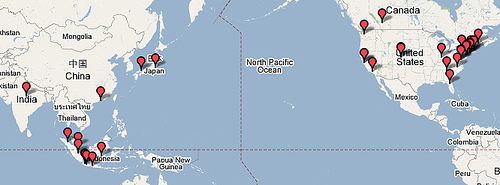
I recently noticed that Google Books has a cool new feature where (for some books) it will show you a map of places named in the book. I thought it would be good to test it out on a book about globalization, and so I tried Anna Tsing’s Friction, which we discussed last summer. Sure enough, they have a great map of places mentioned in the book:

friction-map

On the Google Book page you can click on the red tabs and get a relevant excerpt from the book. I think this is a really nifty feature. One can always look up place names in a book’s index, but it is another thing to see them on a map. The service is still a little rough around the edges (most of the US locations mark publishers listed in the bibliography), but I think it has a lot of potential to turn into a truly useful tool for scholars.

Anthro theory timeline

In my Copious Free Time I’ve been playing around with The SIMILE Project’s excellent open-source tool timeline  — its very easy to use (although I haven’t used it much so far) and so I knocked up a flashy ‘web2.0’ time line of books written by anthropologists in the 1970s — you can see the very rough anthro theory timeline here. I think its incredibly cool and that we should fill in All Relevant Dates going back to League of the Iroquois. But then again that just might be me. So… how would you populate it?

WorldCat Identities

I’m really enjoying the “Identities” page on WorldCat. As you might remember, back in 2003 the library service opened up its records to the web (previously only those at subscribing libraries could see the results). I never noticed it before, but their Identities service pulls together lots of useful information about well known people, such as what the most popular works about them are, names of related people, etc.

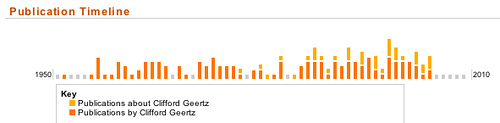
I really like the “publication timeline” which shows how many works by and about the author were published in each year (also differentiating between works they published while living and posthumous publications). Here is the chart for Clifford Geertz:

Publication Timeline for Geertz (via WolrdCat)

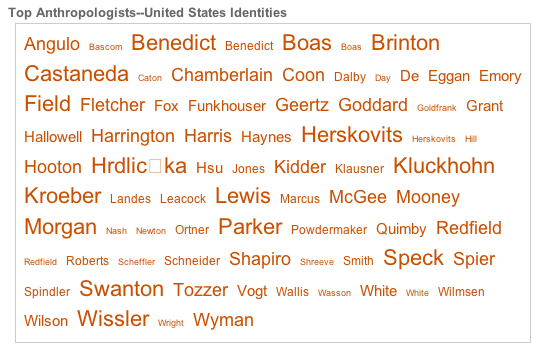
And here is their tag-cloud for the top American anthropologists by number of holdings in libraries:

Top Anthropologists-USA (worldcat)

The service is still in beta, but as it grows I can see it being an excellent supplement to Google Books and Wikipedia, especially for getting a handle on a new author you might never have heard of.

For your reference, here are the pages for Lévi-Strauss and Franz Boas. (It would be nice to see a cleaner permalink structure for linking to individual entries.)

(Thanks to Ilya for letting me know about Identities. He also links to this blog entry by one of the developers.)