Tag Archives: Public Anthropology

“Now you have two problems…”: On mandating Open Acess

Originally posted at Open Access Anthropology

I recently wrote a piece for Anthropology News which mentioned among other things that regardless of the AAA’s position, official or unofficial, about Open Access, it’s nonetheless happening in all kinds of ways. Now it’s happening in one more way that the AAA will have to deal with. Viz. Harvard’s recent announcement that it is mandating that faculty give Harvard permission to archive all of their publications, regardless of the AAA’s or Wiley Blackwell’s internal policies on Open Access.

What this means initially for the AAA and WB is that if any AAA journal want to publish an article by Harvard faculty, they need to do one of three things: 1) allow it to be open access 2) refuse to publish it or 3) convince the faculty member to request a waiver from Harvard. Now in some ways this is nothing new: author agreements for AAA publications already allow self-archiving, so there will no need to choose 2 or 3, unless WB decides to change that policy down the line (so this kind of policy is actually good insurance). In other ways, this is a significant step forward for OA because it reverses the role of inertia: instead of faculty defaulting to closed access, they now default to open access, which is in their interests, instead of contrary to them.

Now this policy can be mis-interpreted in a number of different ways (all of which Peter Suber has collected and responded to), but the basic fact is that this is almost the best possible policy for everyone. It functions by mandating permission–Harvard retains a non-exclusive right to everything its faculty publish, and therefore can choose to (and will) make it available in an Open Access repository open to anyone. Continue reading

Doing Anthropology

This is a great little video about current research by three anthropologists in MIT’s anthropology department. It’s a great answer to “so what the hell is anthropology?” because it shows anthropologists Actually Doing Fieldwork. Shocking that…
Every department should make one I think…

Update: The video is made by Chris Boebel
Update Update:
Creative Commons License
This work is licensed under a Creative Commons Attribution-Noncommercial-No Derivative Works 3.0 United States License.

Maurer & Boellstorff respond to Focus on the Family

The gay blog Box Turtle Bulletin responded to an article at Focus on the Family’s ‘Citizenlink’ claiming anthropological consensus as to the definition of a family: “A family is a unit that draws from the two types of humanity, male and female… Those two parts of humanity join together, create new life and they both cooperate in the legitimization of the child, if you will, and the development of the child.” BTB’s Daniel Gonzalezs contacted Maurer for a response from an ‘actual anthropologist’:

Since its beginnings as a scientific discipline in the 19th century, anthropology has documented the historical and cultural variability of marriage and family forms. From ghost marriages to “female husbands” to polyandry, polygamy and cousin marriage, the cultures of the world exhibit incredible diversity in how they manage the universal problems of cultural transmission and the reproduction and care of the next generation. Indeed, Lewis Henry Morgan, one of the field’s forefathers, documented hundreds of distinct kinship arrangements. For over a hundred years, anthropologists have continually surprised themselves and other Western observers with the diversity of family and marriage arrangements deemed sacred, valuable, and morally necessary for the reproduction of society. The American Anthropological Association, the oldest and largest professional organization for anthropologists, affirms this diversity and noted its support for gay marriage in 2004-05. In fact, the Association requires academic recruiters who advertise with its service to state whether they provide benefits to same-sex partners and whether they forbid discrimination on the basis of sexual orientation and gender identity. It does this because the scientific evidence is on its side: there is not now, and there never has been, one single definition of marriage. Marriage may be universal; but what counts as marriage is not. The current American political debate is thus quite parochial when seen from the point of view of 10,000 years of human history.

For more information: American Anthropological Association; on the gay marriage debate, see this link.

Bill Maurer
Professor and Chair
Department of Anthropology, University of California, Irvine
and
President, Association for Political and Legal Anthropology

Tom Boellstorff
Associate Professor
Department of Anthropology, University of California, Irvine
Editor-in-Chief, American Anthropologist, and
Former co-Chair, Society of Lesbian and Gay Anthropologists

AAA, Will you be my Valentine?

Dear Savage Minds,

Rex’s recent post about the recent set of articles in Anthropology News raises a question I’ve started to take more seriously: switch or fight? By which I mean: the more I deal with the AAA, especially the component dealing with publications, promotion and public policy, the more I am disheartened by the state of affairs. I agreed to write a piece for this month’s Anthropology News because Stacy Lathrop, who has done yeoman’s (yeowoman’s?) work trying to change things at AN, and Jason Cross urged me to express in AN some of the things that have been a constant topic here on Savage Minds. I think this is a worthy goal, because AN serves a different audience than the blogosphere, and despite the remarkable reach this blog has managed to attain, there are still lots and lots of working anthropologists who have no effing clue about these issues, and the only way it might penetrate is to go through the official organ (sorry, valentines day brings out the worst in me).

The relationship started really well. The idea was to release the pieces under a Creative Commons license, along with the launch of the new AAA site. Jason and I urged the AAA publications staff to release the articles with fanfare and openly so as to instigate a discussion. We thought it would be great to use something like the Institute for the Future of the Book’s Comment Press software to allow people to do what Rex did… respond in detail to the arguments of the authors. I offered to set it up, I offered to host it, I offered to maintain it, I offered to eat any costs. In the end, we got neither the license nor the discussion. To be fair, the “negotiations” did result in a promise to keep the articles openly available after March 1, and there is a link at the bottom that says: “What are your thoughts? Share your comments here.” February 14th, and there are three comments, one of them from Jason Cross and one a trackback, two if you count this one.

So this is not only a failure of Open Access, its a profound failure of leadership and a failure to create dialogue. I still believe that publishing in AN reached a larger audience. And I still believe that we need to rescue the AAA from itself, and I’ve agreed to try to do that by serving on committees and even running for a position in the Spring (w00t. vote for me.). But more and more I’m hearing people say something like: do we really need the AAA? Can’t we start something ourselves? Can’t we secede from the AAA? Granted, no one is saying this in public, but I’m hearing it. A lot. So if this special focus on OA was a safety valve, someone turned it the wrong direction in my case.

So I’m not sure where to go in this relationship. The AAA does a lot for me. It puts a roof over my head once a year, and it gives me a line on my cv. Sometimes I even think it loves me… but I really can’t be sure anymore… what should I do?

Signed,
Confused in Cambridge…

Plagiarism and the Counter Insurgency Manual

Following on Strong’s investigations into the suspect ethical issues surrounding the human subjects protection, a new article by David Price posted at Counterpunch adds fuel to our ever growing bonfire of the venalities here at Savage Minds. Price’s jauntily written expose reveals the extensive plagiarism of the Petraus’ Counterinsurgency Manual.
CounterInsurgency Manual
The piece has a rather long list of compared passages that demonstrate more or less word for word cutting and pasting of a sort that makes even my most dim-witted undergraduate plagiarists look crafty. The implication drawn by Price is that McFate and Kilcullen are also at fault given their contributions, as well as the University of Chicago Press whose rapid publication of the Counter-Insurgency manual as a kind of coffee-table-cum-9/11 report offering was accomplished in about 6 months, a “blitzkrieg requiring a serious focus of will.”

A feature of the article that bears more discussion here, is the way in which Price points to the Counter-insurgency manual as a piece of PR designed to calm growing domestic concern about the disastrous course of the Iraq war. To my mind, if it is true that all this focus on anthropology is primarily a PR game, then the accusations of unethical research and scholarship hold less weight. If it is PR, then it seems we should not be taking it seriously, and holding it to standards designed for real scholarly research seems pedantic. However if the accusations of unethical research practices and scholarship are to stick, than are we not being asked to give the whole HTS circus more credit than it deserves? How can we have this cake and eat it too, wonders me.

Ivory Tower vs. Real World

In our discussions about anthropologists in the military the term “ivory tower” has come up again and again, as has its antipode, “the real world.” These terms work rhetorically to oppose academic elitism and detachment against the difficult moral choices one must make in everyday life. A couple of things really bother me about the way these words are used:

First, it seems that “the real world” is always invoked when someone feels the need to justify decisions made which will help the elite. The “real world” requires us to support military dictators, cut jobs, pollute the environment, etc. You almost never hear someone talk about how in the “real world” we must build up the institutions of democracy, support unions, or protect our natural resources. Why are these choices less “real”?

Second, the labeling of anthropologists as ivory tower intellectuals is just odd. Most anthropologists I know are very much engaged in the real-world problems of their informants, love nothing more than to be in the field, and many, many, anthropologists are politically active both at home and abroad. It is true that anthropologists tend to shun the role of “public intellectual” and engagement with mainstream US politics, but they are very active in a large variety of other ways.

Third, it is odd that academics are accused of being “ivory tower intellectuals” precisely at the moment that are engaging politically in the US public sphere. To be passive subjects of military policy would be less “ivory tower” than to speak out against it?

Fourth, I always hated the term “the real world.” Of all the jobs I’ve had in my life – and I’ve done a little of everything, from selling ice cream, to bar-tending, etc. – my experience in corporate america was the least “real” of them all. People in management positions were all white and played solitaire on their computer half the day, when they weren’t gossiping, while minority employees worked their asses off answering phones and sweeping the floor. These privileged yuppies had no idea about the world outside their protected suburban enclaves, and yet they are considered as having jobs in the “real world” because they earn more money?

The fact that the real world involves difficult moral judgments should be a reason for serious academic debate about the basis for those judgments, not a reason for silencing that debate.

Depressed? It Might Be Anthropological

If all this talk of anthropologists either ‘collaborating with’ or ‘consulting for’ the military has got you down, you’re not alone. But there are places you can go, like these two websites:

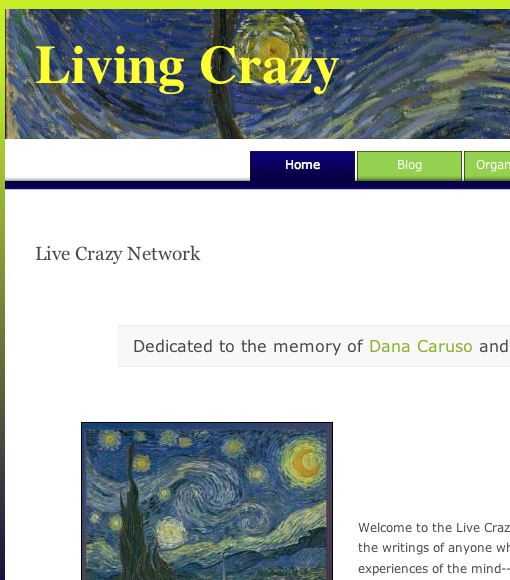
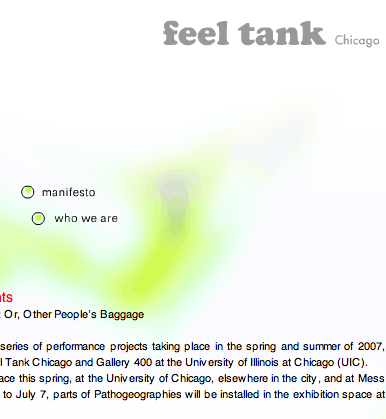
livecrazy.jpgfeeltank.jpg

LiveCrazy.org is the website for the ‘Live Crazy Network,’ a nonprofit organization assembling the creative work of people who think about mood in contemporary social life. It was founded by anthropologist Emily Martin, whose new book is called Bipolar Expeditions. Martin conducted years of ethnographic work in the US on the growing science and industry of mood (and putative disorders thereof).

According to Wikipedia, Feel Tank Chicago is “a group composed of activists, artists, and academics that engages both in critical research and political activism.” The group stages happenings of various kinds that are tinged with feeling as well as with political critique, suggesting that affect could itself comprise such a critique. I connect the group in my own mental map of intellectual constellations with a set of interests that concern many scholars at the University of Chicago, in particular their interest in the way in which new publics emerge through and as forms of affect.

I think recent interest in mood or affect is not unconnected to other recent critiques of the platonic virtualism that sometimes characterizes cultural analysis in either a structuralist or a hermeneutic mode. For example, very powerful work has been attending to the materiality of meaningful practice (see especially the work of Webb Keane), building on the insight that meaning must take material form of some kind and so actually looking at that form lends greater precision and power to our understanding of how meaning happens. I think the turn toward affect performs a similar move as a kind of critique of pure semiology, insofar as it wishes to make visible the constitutive ’emotional’ or ‘irrational’ strands that are always a part of cultural worlds.

Anthropologists of the World, Unite!

Apropos of the recent discussion of anthropology’s use in torture and other military action, I received notice this morning of an effort launched by several anthros (including David Price, Hugh Gusterson, and Catherine Lutz) to encourage the development of an ethical anthropology and to oppose anthro’s participation in counter-insurgency. Here’s the relevant part of the email:

The Department of Defense and allied agencies are mobilizing anthropologists for interventions in the Middle East and beyond. It is likely that larger, more permanent initiatives are in the works.

Over the last several weeks, we have created an ad hoc group, the Network of Concerned Anthropologists, with the objective of promoting an ethical anthropology. Working together, we have drafted a pledge of non-participation in counter-insurgency, which we have organized as a petition (see attachment). We invite you to become a part of this effort by taking the following steps:

  1. Download and print the attached pledge (in .pdf format) [. Ask your colleagues to sign the pledge, and promptly send it to us via regular mail. Our address is Network of Concerned Anthropologists, c/o Dept. of Anthropology, George Mason University, 4400 University Drive, MS 3G5, Fairfax, VA 22030 (USA). If it is more convenient, email a .pdf copy of collected signatures and send it to us at concerned.anthropologists@gmail.com.
  2. Forward this message to your colleagues, and encourage them to sign.
  3. Join our network by emailing us at concerned.anthropologists@gmail.com. Be sure to include your name, title, and affiliation. We will add you to our email list.
  4. Visit our web site at http://concerned.anthropologists.googlepages.com/home for more information and updates.

Email us at concerned.anthropologists@gmail.com if you would like more information or if you have questions.

Sincerely yours,
Network of Concerned Anthropologists

Catherine Besteman
Andrew Bickford
Greg Feldman
Roberto Gonzalez
Hugh Gusterson
Gustaaf Houtman
Kanhong Lin
Catherine Lutz
David Price
David Vine

Cultural Dynamics in Interrogation: The FBI At Guantanamo

It is easy – commonplace – for anthropologists to have an opinion on “the war” and to think that our opinions are worth hearing. But those opinions are more informed, nuanced, and will carry further if they are shaped by the close, yet open-minded, encounters with ground level realities, and practice, whose importance we, and our disciplinary forbears, have worked so hard to promote.” – p. 327 in Keith Brown and Catherine Lutz, “Grunt Lit: The participant observers of empire.” AE 34:2, 322-328.

For Brown and Lutz, the autobiographical accounts of soldiers provide a window into the messy and chaotic instantiation of empire in war, and are worth submitting to what Lutz calls “[the] discipline’s standard tropes of person-centered, contextualized understanding” (Lutz 2006 in AE, 33:4, p. 593). Along these lines, the interrogation records of the GWOT should be subject to the same ethnographic scrutiny. If nothing else, they reveal that (to paraphrase Clausewitz) interrogation is the extension of war by other means, as a complex ideological conflict is waged discursively in the context of the prison interrogation room.

To make this point, I’ll share a very abbreviated draft of article I’m writing, for which I draw on a subset of roughly 500 pages of documents dealing with FBI interrogation at Guantanamo Bay, Cuba, between February 2002 and July 2004. Within this collection, there are approximately fifty FBI “transcriptions” (which are perhaps better described as summaries of interviews, “interview” being FBI parlance for interrogation). Because many are heavily redacted, it can be hard to discern where one interview ends and another begins. Reading these is akin to listening to a radio broadcast between bursts of heavy static, or watching a movie interrupted by sporadic blackouts. Although the interview transcriptions do use proper names, identifying information is always redacted; and for convenience, I am following FBI convention in referring to the parties as “interviewers” and “detainees.” I use a bracketed ellipsis to denote redactions […], and I quotations to the official document number so that interested readers can look up the source material (e.g., 4042).

Redactions notwithstanding, this collection provides fascinating insight into the manifold ways in which “culture” makes its presence felt. As Robert Rubinstein points out in his forthcoming book, Peacekeeping Under Fire: Culture and Intervention (Paradigm 2008), culture operates at many levels in UN peacekeeping efforts. He identifies three interlocking cultural dynamics that shape the trajectory of these operations: interactions between peacekeepers and local populations; interactions between participating local and national bureaucracies; and in a meta-sense, as international perceptions of “peacekeeping” evolve politically and institutionally.

Similarly, cultural dynamics operate at multiple levels in interrogation. At its most basic, interrogation aims to get specific information for specific purpose: for example, to develop a criminal case, obtain a confession, or provide “actionable intelligence” that can be used in tactical decision-making. That interviewers are seeking such information is apparent when detainees are asked to explain their presence at an Al Qaeda training camp, or shown photos of other detainees and asked to identify co-conspirators (e.g., 3904). However, far more is going on in these FBI interviews than attempts to elicit specific facts from recalcitrant detainees. In the interrogation encounter, detainees and interviewers look at each other across the table and, with the help of a translator (who is always silent in the transcriptions), they dive into a discursive exchange that reaches far beyond the confines of the interrogation room.

For example, interviewer-detainee exchanges shed light on the dynamics of guard-prisoner interactions in detention operations at Guantánamo. Often, the detainees complain to the interviewers about mistreatment by military police: roughing up prisoners, insulting detainees, and disrespecting the Koran are all sore points among the detainee population. But the weak have weapons: in one interview, a detainee gives the interviewers advice for how guards should comport themselves in front of the detainees – and in doing so, hints at vibrant hidden transcript, in which the projection of state power, embodied in the masculine form of the military police guard, is undermined by a simple technology:

Detainees see the guards as babies, especially the “big American guards that fill the doorway.” This is because the guards are supposed to be strong, yet they walk around with a “camel” (a backpack water storage device with a drinking tube attached) on their back sucking on a tube of water all of the time. A strong man is able to go without water for long periods of time. (The detainee) suggested that the water be kept out of sight of the prisoners and have the guards walk to where the water is kept. (3913)

Secondly, the records illustrate how detainees under interrogation challenge the official transcript of GWOT internment with complex counter-narratives about such topics as the war in Afghanistan (e.g., 3906), jihad and September 11 (e.g., 3899, 4080, 3845, 3844, 3850), American imperialism and foreign policy (e.g., 3918-21, 3912, 3913, 3916, 3925, 3842, 3861, 4086), and the fact that the detention operation at Guantanamo violates legal rights guaranteed by the US Constitution (3924). Along the way, the detainees also share their views on Christianity (e.g., 3906), Israel and Judaism (e.g., 4026), popular culture and sexuality (e.g., 3921), proper treatment of the Koran (e.g., 4803, 4024) and privacy of the body and shame (e.g., 3836, 3854, 4061). Sadly, there are also numerous descriptions of physical abuse, mostly beatings, particularly when the detainees are initially arrested either by Northern Alliance (e.g., 3903) or US troops (e.g., 3892).

But just as the detainees challenge the official discourse of the GWOT, we can see the FBI interviewers developing their own counter-narratives of Islam for the purpose of convincing the detainees that they should share what they know about Al Qaeda, terrorism, 9/11, and the Taliban. The manipulation is psychological, playing heavily on old-fashioned self-interest, but is arguably cultural, too, insofar as the manipulation draws on a framework of religious beliefs. For example, in one transcription (4033-4034), the interviewing agents show the interviewee a movie and photographs of people dying in New York and Washington on 9/11. As they do so, they invoke a narrative of Islam that questions the theological basis for mass violence, then point out that the detainee had become involved with a group of people who “…(abused and maligned) the religion, and will feel God’s wrath and anger on judgment day. […] appeared visibly shaken by this realization.” The interviewer then offers the detainee a chance for absolution through cooperating with the FBI. He warns the detainee that his fellows are “out to save their own butt,” and tells him the window of opportunity is closing. The technique, it seems, is emotionally powerful, as illustrated in a surprisingly poignant closing paragraph:

At the conclusion of the interview, the interview team wished […] luck and that God may accept his prayers. After exiting the room, the interview team witnessed […] with his head down on his hands on the table in front of him… […] was crying and sobbing with the tears falling down on the table when he lifted his head” (4033-4034).

Whether or not this individual eventually gave the FBI team what it wanted is not clear.

By now it should be apparent that interrogation does not necessarily involve the forcible elicitation of “facts”. In these transcriptions, interrogation is revealed as a complicated communicative exchange in which participants share, gather, construct, and deploy knowledge as they provoke and/or resist an alien Other. As Alfred McCoy points out (2006), FBI interrogation strategies strongly emphasize rapport-building over coercion; and we can see FBI agents putting this ethos into practice in the interrogations they conduct. The resulting knowledge that emerges in these exchanges is often profoundly cultural, but not necessarily anthropological. Moreover, the headers on these transcriptions indicate that they were shared among the agencies involved in Guantanamo (DHS, DoD, and FBI) and as such, are likely source material for interrogators and intelligence analysts constructing their own model of the Arab/Islamic Other.

This raises another question about culture; namely, the problem of institutional culture and interagency power struggles as three major government bureaucracies – the FBI, DHS and the Department of Defense – each implement their own strategies for eliciting information from detainees. In particular, DoD interviewers frequently take a much more forceful approach to interrogation, something that FBI agents – and indeed, many DoD personnel – find troubling. And that’s the teaser for my next post.

Some general thoughts about anthropology, interrogation, and torture

A few months ago, in a November 2006 post reflecting on the twin Gonzalez-Lin resolutions against the war in Iraq and the use of anthropological knowledge in torture, Rex asked whether anthropologists might be in danger of generating more heat than light. I’ve asked myself the same question. Ever since Sy Hersh published his three-part series on Abu Ghraib in 2004, anthropologists have been worried about the involvement of their counterparts in torture, or the use of ethnographic information in torture. But aside from a lot of people quoting Sy Hersh, over and over and over again, I’ve come across no corroborating evidence of a link between anthropology and Abu Ghraib – or even in plain old GWOT interrogation, for that matter.

As I discuss in an upcoming short piece in Anthropology News (likely to be published in October), I wrote Hersh a letter and asked him to comment on the link between Patai and torture. He actually called me back in July to tell me that he doesn’t think that Patai’s book played a role in Abu Ghraib (yes, you read that right). When I told him that anthropologists took his claims in “The Gray Zone” very much to heart, and that we’d even put forth resolution against the use of anthropological knowledge in torture, Hersh seemed genuinely surprised, and pointed out that he’d never actually written any such thing. Which, strictly speaking, is true. Read the piece here.

So here’s my plea: don’t point to Hersh as evidence of ethnographically informed torture, and when people do point to Hersh’s article as evidence of such, question whether or not there’s anything to corroborate the claim. If you want to go the extra mile, then dig into the documents yourself. There’s plenty of documentation out there that supports research into the problem of ethnographically informed torture. Several organizations, including the Center for Public Integrity, the University of Minnesota Human Rights Library, and the ACLU all maintain extensive electronic archives of FOIA’d documents around interrogation and detention operations involving the DoD, the intelligence community, and the FBI. In 4000-plus pages of reading, I’ve seen no evidence of anthropologists being involved in torture or interrogation. In fact, I’d have to characterize anthropology as conspicuously absent from detention and interrogation operations.

But that doesn’t mean culture isn’t important. Indeed, the Global War on Terrorism constitutes a cultural encounter of some kind – we just haven’t figured out what, precisely, that means. There’s an opportunity for excellent critique, but making our critique relevant requires some new thinking about our own “sources and methods,” to borrow a term from the intelligence community.

In this regard, I liked Keith Brown and Catherine Lutz’s recent article on “grunt lit,” in which they describe soldiers as the “participant-observers of empire” (2007). They argue that anthropologists should pay more attention to soldiers’ memoirs as a window into the confusing and contradictory microdynamics of empire. In doing so, we might learn a lot about the instantiation of empire and the shifting identity of the American nation-state in the post-Cold war, post 9-11 era.

I’ve come to think of the thousands of pages of memos, emails, depositions, forms, reports in the FOIA collections as the electronic precipitates of the Global War on Terrorism. As such, they offer a glimpse into the nature of American empire – which is, among other things, a bewildering conundrum of personnel, agencies, policies, procedures, acronyms, directives, rosters, and the like. In detention and interrogation operations, this Gordian knot of bureaucracy is unleashed on enemy combatants and prisoners of war, most of whom seem to hail from Arabic-speaking regions of Central Asia and the Middle East.

This is where anthropology comes in, but not as instrumentally or formally as many anthropologists seem to have assumed. It’s not that the military-intelligence-security apparatchik systematically sought anthropologists (or even ethnography) to play the role of cultural seer in interrogation. Rather, what’s anthropologically interesting is the way that people within the bureaucracy are actively engaged in making sense of an alien Other, and in doing so, are formulating their own theories and understandings about what makes this Other tick. Moreover, there’s evidence that the Other is engaged in reciprocal effort vis-a-vis guards and interrogators. As such, interrogation itself constitutes a sociocultural encounter of an astoundingly complicated kind. I’ll be writing more about this topic for my next post, using a couple of examples from a collection of FBI observations about detainee treatment at Guantanamo, and talking a bit about Robert Rubinstein’s ideas about culture in peacekeeping operations in a forthcoming book of his.

Introducing Myself

Hello everyone, and thanks to Savage Minds for the nice introduction and the chance to blog about my experience reading government documents about interrogation and torture in the Global War on Terrorism. I desperately need the outlet – it’s been a strange and somewhat lonely experience, simply because I don’t know of any other anthropologists who’ve done the same. (If you have, I’d love to hear from you.)

Before I go any further, let me issue the disclaimer: Chris noted that I work at Sandia National Laboratories – I was at Los Alamos National Laboratories for 6 years, too – but absolutely nothing I write on this blog has anything to do with Los Alamos, the Department of Energy, Sandia National Labs, Lockheed Martin, or anyone who signs my paycheck. In my day job, I pursue fairly technical work among computer scientists and mathematicians, but I won’t be writing about that. Instead, I’ll be blogging about my personal obsession with torture and interrogation. I only point this out because I was criticized as something of a shill for national security community(mostly on the basis of my institutional affiliation, I think) when I wrote a short editorial about Patai and torture in Anthropology Today. So I want to make it very clear that no one is paying me to dig through FOIA’d interrogation documents. This is my own thing, and I pursue it purely for my own interest, and on my own time, and with my own resources, because I find it fascinating, and because the more torture documents I read, the more I’ve come to believe that interrogation and torture are ethnographic problems worth our collective attention. I mean, this stuff is really interesting.

So, now that that’s out of the way, you might be wondering why anyone would spend their weekends downloading, reading, and taking notes on PDFs of poorly scanned, redacted, jumbled, jargon-and-acronym filled government documents. It all started in 2006, when I was asked to lead a roundtable discussion on anthropology and ethics at the inaugural Ethics in Intelligence conference in Springfield, VA. I wanted something more recent than the usual Project Camelot-Vietnam-Franz Boas stories, so I chose the Raphael Patai/sexual humiliation/Abu Ghraib story as a case study to illustrate why anthropologists tend to be hostile to military and intelligence activities. I knew I’d probably have some experienced intelligence and military personnel at the table, so I figured it was a good idea to have more material than just Hersh’s article.

And that’s how this all began. In searching for articles that might shed more light on how Patai’s book had been used in Abu Ghraib, I came across plenty of people citing Hersh. However, I couldn’t find any independent accounts that corroborated his allegations about Patai’s book being linked to torture. Since then, I’ve thought long and hard (obsessively) about torture, anthropology, politics, war, interrogation, critique, and culture, and – as I noted above – it’s been a long, strange, often depressing trip. I am working on a couple of articles about these topics, but in the meantime, I’ll be blogging sporadically about some of the more interesting materials I’ve come across. So – more to come.

More on War

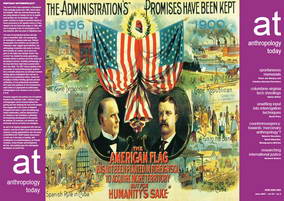
Readers of SM who have followed the many discussions here about the role of anthropologists and anthropological knowledge in war (including the Iraq war) will be especially interested in the June 2007 issue of Anthropology Today.

at0706.jpg

The Editors write: “Everyone supports non-partisan use of academic research for ‘humanity’s sake’. However, since anthropologists cannot research without first gaining and then retaining the trust of the peoples they engage with in the course of fieldwork throughout the world, in open and willing long-lasting relationships, partisan deployment of our research in war constitutes a potentially life-threatening development for the peoples we befriend, for ourselves, our students, our profession and for our family and colleagues. As part of an ongoing engagement with how our research, and that of other social and behavioural sciences, is being appropriated in war, this issue of ANTHROPOLOGY TODAY features discussions on their use in two areas of warfare, with contributions on counterinsurgency, by Roberto González, David Kilcullen and Montgomery McFate, and unwitting input into interrogation techniques, by David Price.”

The Fate of McFate: Anthropology’s Relationship with the Military Revisited

Back in January, Matthew Stannard at the SF Chronicle, having come across my SM piece Anthropologists as Counter-Insurgents, contacted me about doing an interview for an upcoming profile on Montgomery McFate, the advocate for anthropology in the military whose work I was responding to. The piece is now online, entitled Montgomery McFate’s Mission: Can one anthropologist possibly steer the course in Iraq?. I’m not quite ready to revisit this topic — I’m up to my neck in grading and other work, with the semester’s end a week-and-a-half away, but I thought I’d mention it now while I put together some further thoughts on the matter. It’s a fairly good article, even though I’m only quoted once (Stannard apparently has not been taught the maxim that the more quotes of me a paper has, the better it is). Interestingly, though the interview ranged all over, I’m quoted more in my capacity as historian of anthropology than in my — I think more relevant — role as anthropological ethicist.

Anthropology (and archaeology) on Citizendium

As many of you may know by now, “Citizendium”:http://www.citizendium.org/about.html is now live. The site aims to be like Wikipedia but with ‘quality control’ — it uses a quasi-hierarchical role structure and asks its authors provide CVs and other proof of their expertise. So if you have been interested in writing open access encyclopedia articles about anthropology but have found the politicking of Wikipedia distracting, then Citizendium may be for you.

I personally am somewhat ambivalent about Citizendium. I’ve written many Wikipedia articles myself, and have been lurking on the Citizendium mailing lists since they were started. I know that many Wikipedians think that the Wikipedia’s social and editorial policies simply don’t do the job they should. At the same time, many also think that Citizendium is an elitist program destined to fail. Personally, I think: the more pedias, the more better.

At the moment the anthropology offerings on Citizendium are pretty sparse — check out the “entry on anthropology itself”:http://en.citizendium.org/wiki/Anthropology if you don’t believe me — and they could use some more help. So consider “signing up”:http://en.citizendium.org/wiki/Citizendium_Pilot:How_to_get_started_with_the_Citizendium_pilot and helping make our work as anthropologists more open to the public.

More Friday Funnies: Occupational Hazards

The Onion has a story I think we can all identify with: Archaeologist Tired Of Unearthing Unspeakable Ancient Evils. Like Edward Whitson, the interviewee, I find lightning-breathing ocelots to be one of the recurring annoyances of anthropological fieldwork.

“All I wanted to do was study the settlement’s remarkably well-preserved kiln,” said the 58-year-old Whitson, carefully recoiling the rope he had just used to clamber out of a pit filled with giant rats. “I didn’t want to be chased by yet another accursed manifestation of an ancient god-king’s wrath.”