Tag Archives: Public Anthropology

Janice Harper and the Public Intellectual

My good friend Eric Ross (author of the classic The Malthus Factor; check out his awesome essay in my book Anthropology at the Dawn of the Cold War) wrote a lengthy analysis of the Janice Harper affair in the Porcupine, his online political analysis magazine, focusing on the University’s shoddy record with female professors and the age-old fix public intellectuals find themselves in again and again.

Why Janice Harper? Largely, I think, because she is a woman who happened to believe in real gender equality in an especially backward university setting. But, Lesley Sharp also implicitly predicted what would happen when she wrote, in her review, that “Harper pulls no punches.” The critical research that Janice has done on unpopular subjects is the hallmark of her intellectual integrity, of what we need most from academics.

Read the whole thing at The Porcupine – and while you’re there, check out the rest of the material on offer from Eric and his stable of radical-leaning writers.

Engaged Anthropology and Academic Freedom

“Is it not amazing that in this day and age, serious scholars get death threats?” asks Notre Dame anthropologist Cynthia Mahmood in a shocking, graphic, account of how she “was assaulted, beaten and raped by a gang of hired thugs or rogue police in a north central Indian state during fieldwork in 1992.” I’ve heard many stories of death threats from academics in India who study the “wrong” topics, but this is the first account I’ve read of actual violence. Mahmood mentions some other scholars who have been threatened:

Wendy Doniger, Paul Courtright and David White have also been among those academics who have been targeted by the Hindu right because of their intellectual work on the religion. Doniger, a senior scholar of the Hindu tradition, regularly receives death threats; a letter-writing campaign tried to prevent another young scholar’s tenure at Rice University.

Certainly India needs to do more to preserve academic freedom, including ensuring that “that other actors [besides the state and the university], including the media, political parties and the citizenry do not by their actions undermine academic freedom.” And, as the example from Rice University shows, this issue is not confined to India. The US needs to protect academics from coordinated attacks of the sort William I. Robinson is facing from the ADL.

YouTube EDU

Google just announced a new YouTube “channel” for academic lectures, talks, and interviews: YouTube EDU. Although there aren’t a lot of anthropology videos, there are some if you look. Also recently announced is Academic Earth, a general hub for the same kind of thing. These sites join already existing online repositories: Free Online Courses from Great Universities, TED, Fora.tv, and iTunes University. These sites seem to miss some great video podcasts by individual academics who have gone edupunk and upload their videos directly to the web without university support, and they are all rather light on anthropology, but still, there is a lot of great stuff out there and it seems to just keep getting better.

Emily Martin on Anthropology Now!

Emily Martin has generously sent this brief history of how Anthropology Now started… Please be civil.

AnthroNow LogoI am pleased to see that there has been such quick and interested reaction to the launch of Anthropology Now. I wanted to write with a brief history of the long effort that has brought us here. I am speaking from my (spotty) memory here, and some details may be missing. We began as a committee of the AES in 1998 when I was president, Susan Harding was president elect, and Ida Susser was Councillor. The AES has kept us as an active committee ever since, which explains how we were included in the AAA program this year.

Our efforts to find a publisher stretched over 10 years. Ida Susser, Susan Harding and I organized approaches to (among others) Duke University Press, the University of California Press, the University of Chicago Press, Blackwells, Sage, and Palgrave. In each case we asked an anthropologist who had an existing (and positive) relationship with the press to make the pitch. All these presses turned us down except Palgrave. We got close with Palgrave only to be stymied by a change in administration and journal publication policies. We stayed in close touch with the AAA through successive presidents and the committee on scientific communication, but we never imagined that the AAA could fund this venture. They have consistently promised (and followed through on) in kind contributions and exchanges.

The very first year of our existence, Dean Birkenkamp, in a former professional capacity, found us and expressed his support and commitment. Thereafter he attended just about every annual meeting we had at the AAA meetings. He shared advice, kept up our morale, and pledged every possible effort to help us, for which we remain immensely grateful. It was only after he founded Paradigm Publishers and made it a commercial success that it became realistic for him to become our publisher. Given the depth and consistency of his interest and support, I do hope Paradigm makes some profit from Anthropology Now. Giving away 1000 copies (maybe more) of the first issue and mailing out countless full color brochures is an investment we hope the press will be able to recover. They are accepting the reality of years of losses on this venture, a move for which we are extremely grateful.

During the years before we had a publisher, our strategy was first to form an Editorial Board (much as you see it today) and second to post a “sample issue” on the web, which predates and only partially overlaps with what you see today. We owe the contributors to that sample issue and of course the additional contributors to the current issue a vote of thanks.

We also made efforts to raise grant support. When Leslie Aiello became president of Wenner-Gren, one of her mandates was to raise the public awareness of anthropology as a discipline: what is it that we do and what can we contribute to public debate and understanding? She agreed with our assessment of the need for a print magazine and a web presence. The financial support we have from Wenner-Gren will be crucial in the continued growth of the project.

We look forward to taking the web site to the next level and hope to continue to get good suggestions (and participation) from the readers of Savage Minds. For the moment, feel free to join us on the open Facebook group for Anthropology Now.
Teh Savage Minds Awards Ceremony

With less than a week to go until the start of the AAA, and no time to properly pull this off, I hereby announce that we will be annoucing the winners of the 1st annual Savage Minds Awarding of teh Excellents Contest on Saturday evening at 6pm in the lobby of the Hilton. ( We’ll also make sure to announce where the party is at that point). Which means it’s time to VOTE!!!

I will be there with a bell and a whistle, or some other noise maker like a cute little girl, to draw attention to my stupid antics, at which point I will announcingly annouce the nominees and winners in three categories:

1) Most Excellent Anthropology Blog (Vote Here)
2) Most Excellent Open Access Journal in Anthropology(Vote Here)
3) Most Excellent Uncategorizable Digital Thing-a-ma-job for Anthropology (Vote Here)

As you will have noticed, the category I wanted to award something to–that of best OA article is gone. I will instead recite an impromtu Eulogy for the absense of Open Access research in our discipline. Or maybe not.

Prizes will range from signed and numbered copies of print-outs of Savage Minds posts (suitable for Framing!) to cases of Artic Man Deoderant to valuable caches of cowrie shells and dried beans.

A NOTE on the voting: I decided to use Mako Hill’s awesome Selectricity Tool. It allows you to calculate the vote in all kinds of ways so we can conceivably have many winners depending on how we count ! What better way to encourage cultural relativism! Go and Vote! Tell your friends.
Continue reading

Support Khalidi – Buy the Iron Cage

I think this is a great suggestion. I haven’t read any work by Khalidi, except this bilious, anti-Semitic, incitement to violence, even-handed assessment of the prospects for peace in Israel which was published in the Nation last May. But I am outraged and disturbed by the way Obama’s association with Khalidi has been used by the McCain campaign:

Despite the fact that a foreign policy organization chaired by Mr. McCain gave more than $850,000 to Khalidi’s Center for Palestine Research and Studies. Despite the fact that Khalidi is himself a semite, born in NY, with a “moral commitment to peace and justice in the Middle East.” Despite all this, the McCain campaign seems intent on pursuing this new McCarthyism.

For this reason I am endorsing supporting an idea I read about on Crooked Timber: that academics should show their support of Khalidi by buying his book, The Iron Cage: The Story of the Palestinian Struggle for Statehood. As Henry Farrell says:

It doesn’t take much in the way of prophetic insight to predict that we are going to be seeing a lot more of this kind of innuendo from disgusting slime-purveyors like Daniel Pipes if Obama wins – one of the lessons of the Clinton years is that when the nastier elements of the right are losing elections, they start trying to turn the culture war back up to 11. It would be nice to get a head start on the pushback.

Now if only I can get Mike Goldfarb to call me an anti-semite to sell my book! (Hmmm, I guess I need to write a book first …)

Free Webisodes of Pacific History and Archaeology

If you want to learn more about the Pacific then you are in luck — the Hawai’i State department of education has recently put together two locally-produced programs available on the web for free. “Stories to Tell”:http://wetserver.net/teleschool/pages/programs/program_home.jsp?programid=16&programpageid=29&programpagetype=programpages is a documentary about the little-known Pacific campaign during the American Civil war and focuses on Yankee whaling ships sunk by the Confederate navy in Micronesia in the 1860s. Its a fascinating story that helps remind us just how globalized our world has been, and how long the Pacific has been entangled in geopolitics.

The second show, “Pacific Clues”:http://wetserver.net/teleschool/pages/programs/program_home.jsp?programid=16&programpageid=30&programpagetype=programpages discusses the archaeology of the Pacific, with a special focus on Polynesia. The “first episode”:http://www.teleschool.k12.hi.us/tlc/IR_CR_PC_1.html features Terry Hunt discussing the destruction of Rapa Nui’s (Easter Island) environment, and his own interpretation of what led to its downfall. Terry’s objections to authors such as Jared Diamond’s interpretation of Rapa Nui’s history is well known, and now you can watch the man explain it in person.

All of these shows are available for free, as a series of 20 minute web episodes — so far only a few episodes are up, but as the season progresses more will be available. They’re meant for kids, so they are a great opportunity for you and your little ones to curl up together in front of a glowing LCD screen. But of course they’re great for people of all ages — especially people who want to know more about what the experts really think about the Pacific, but don’t want to read a bunch of scholarly articles.

The 1st Annual Savage Minds Awarding of teh Excellents

With about a month to go until the AAA conference in San Francisco, it’s time to start thinking about taking things seriously for once. The recent announcement by the AAA that they’ve gone open access has made me think that we need a little more focus on open access in the present, a little more recognition for those who support OA, and maybe just a little bit more fun at this year’s conference so that maybe we can start thinking again about why we do this and why we might go to a Really Expensive Meeting
every year.

Ergo, I am hereby inaugurating an independent awards show to be performed at the AAA. I’m willing to organize it this year, if others are willing to help out (please!?). Nothing too extravagant or long, I’m thinking a guerrilla ceremony in the lobby. I’ll need people to hold the signs, act as paparazzi, maybe a little musical act before and after… and especially: NOMINATIONS. Post them here, or email me (ckelty at ucla etc ). I’m not sure what the prizes will be yet, but they will be good, I promise.

These are the categories I’ve come up with so far:

  1. most excellent (and second most excellent) open access article in anthropology or associated disciplines, 2007-8. open access = green, gold, self-archived or institutional repository.

  2. most excellent open access teaching materials 2007-8. Syllabus, teaching materials, assessment ideas, technologies or tools, ideas for teaching.

  3. most excellent idea for making anthropology public.

  4. most (or least?) excellent new theoretical fad.

  5. most excellent anthropology blog (SM recuses itself, naturally).

  6. most excellent business plan idea for the AAA.

  7. most excellent award category not listed here.

The Ultimate Public, Applied Anthropologist

When it comes to application and publicity, anthropologists are in a bit of a bind. On the one hand they want to be ‘applied’ (typically: implement their left-populist agenda) and ‘public’ (be found fascinating by a wide readership). At the same time, they fear collaboration with sources of power (curtailing implementation options) and don’t want their work to be considered exotic, titillating, or otherwise interesting to the public. Walking the line between accessibility and exoticism, engagement and cooptation, can be tricky.

And then there is “Bella Ellwood-Clayton, sexual anthropologist”:http://www.drbella.com.au/. Ellwood-Clayton got written up “some time ago at Antropologi.info”:http://www.antropologi.info/blog/anthropology/anthropology.php?p=2836&more=1&c=1&tb=1&pb=1 because her work is open access. But I think the site, and her career, might take the prize as the most public, applied anthropologist that I’ve seen in quite some time.

She “treks through mud and sleeps with pigs to discover traditional tattooing practices in the jungle”:http://www.drbella.com.au/film.html. She “writes poetry”:http://www.drbella.com.au/poems.html. She is “multiply-orgasmic”:http://www.drbella.com.au/Articles/25AUG06ThebigO.pdf (link to PDF of a relationship column — sfw). And of course she also “publishes about cell phones”:http://www.drbella.com.au/anthro.html.

I am not quite sure what I think of Ellwood-Clayton’s website, or the way that she is spinning her career. But I have to admit that in an era when anthropologists spend more time arguing about what they can do to become relevant than becoming relevant, it is sort of refreshing to see someone hanging out their shingle in a highly… shall we say… unambivalent way. Carrie Bradshaw, move over.

Are there ‘uncontacted tribes’? The short answer: No.

As some of you know, one of my areas of expertise is first contact in the highlands of Papua New Guinea, and in the course of my fieldwork I was lucky enough to speak with a few of the people who remembered the first couple of Australian patrols into the area where I worked in Papua New Guinea. So although I am critical of exoticised stories of ‘first contact’ I do think in certain situations using the term ‘uncontacted’ or ‘first contact’ is appropriate.

But not all situations, and especially not the case of “lost tribe that wasn’t” which our own Jay Sosa “mentioned on SM”:/2008/06/29/around-the-web-19/ recently. This topic was also covered on my colleague “Jamon Halvaksz’s blog”:http://politicsofnature.wordpress.com/2008/06/24/not-so-lost-tribes/. A member of Survival International then left a comment on Jamon’s blog defending the article (see this “press release”:http://www.survival-international.org/campaigns/uncontactedtribes and their own “blog entry”:http://www.survival-international.org/blog/2008/06/23/lost-uncontacted-tribe-knew-exactly-where-they-were/) and directing readers to their “page on uncontacted tribes”:http://www.survival-international.org/campaigns/uncontactedtribes.

So what do anthropologists who specialize in first contact say? Are there ‘uncontacted tribes’? The short answer is ‘no’, and while I appreciate SI’s work on behalf of ‘tribal’ people, I find it disappointing to find that they still use this sort of language. Any one who reads the material on their web page will see that by ‘uncontacted’ they actually man ‘frequently in contact with, and victimized by, outsiders’. Let’s take a look at the evidence from SI’s website.
Continue reading

Be a Public Intellectual, Win a Book Contract

From Public Anthropology:

the University of California Press in association with the Center for a Public Anthropology will begin sponsoring in 2008 two annual competitions focused on drawing anthropologists to address major public problems and broad audiences. Both competitions will award book contracts at an early stage in the research/writing process in order to influence a manuscript’s subject and style. The hope is that authors, knowing they have a book contract in hand, will prove willing to speak about major public concerns in ways that non-academics find valuable.

One competition will focus on mid-career professionals. …. The second competition focuses on graduate students preparing to conduct fieldwork.

Follow the link for more information.

China Cancels IAES

I mentioned back in February that I was excited to be attending this year’s IUAES conference in Kunming, China. I even arranged a Savage Minds party for the event, which had 10 confirmed guests and 22 “maybes.” So I’m very sorry to hear that the Chinese government has decided that anthropologists pose a security threat during the summer Olympics (which are being held in Beijing, 1,200 miles away), and canceled the event for fear of protests.

China is on the lookout for protesters seeking to disrupt the Beijing Olympics in the name of Tibet, press freedom, or religious rights.

Now anthropologists and ethnologists, academics who study human development, appear to have been added to the list.

Without giving a specific explanation, Chinese organizers have pulled the plug on July’s world congress of the International Union of Anthropological and Ethnological Sciences, the latest in a slew of events to be canceled or postponed ahead of the games in August.

“I’m not very happy with it,” Union Secretary-General Peter J.M. Nas said by telephone from his office at the University of Leiden in the Netherlands. “And I hope still that they will listen to our arguments.”

Although distant from Beijing, Kunming is home to many minorities and, as the article says: “China is extremely sensitive to critiques of its policies toward minority ethnic groups and their languages, even more so since anti-government protests broke out in the Tibetan capital of Lhasa and spread to other Tibetan areas in March.”

UPDATE: A blog post from the Chronicle:

On Tuesday the association’s Chinese affiliate wrote to the group’s international executive committee, saying that it had “encountered complex difficulties hard to resolve in its preparation work recently, which makes it impossible for us to hold the congress at the time originally planned.”

The executive committee has rejected the idea of a postponement, but it has not yet received a reply from its Chinese colleagues. “We still have no concrete information about the results of our plea not to postpone the congress,” wrote the association’s president, Luis Alberto Vargas, a professor of physical anthropology at the National Autonomous University of Mexico, in an e-mail message to The Chronicle today.

Mr. Vargas and other members of the executive committee declined to comment further, citing the delicacy of the situation.

UPDATE: From an article in the Chronicle: “Ms. Harrison, who is a member of the association’s international executive board, said that the conference might be postponed for a full year.”

AnthroVisions

anthrovisions

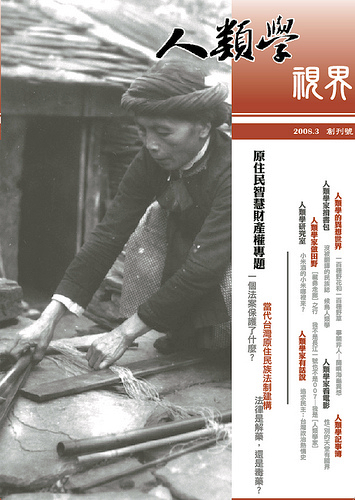
Lately there has been some discussion here on Savage Minds about what an Anthropology magazine for a general audience might look like. There has also been some discussion about how the anthropological blogsphere seemingly perpetuates the hegemony of Euro-American academia. So I’m very happy to announce the first issue of AnthroVisions – a Chinese language magazine about contemporary Taiwanese anthropology, aimed at a broad audience.

In many ways it is the kind of magazine Rex imagines:

What we don’t have is a “it’s great to be an anthropologist! Here are the latest discoveries from anthropology! Learn more about how to do anthropology here!”

I’m a member of the editorial board, but the real work has mostly been done by Pei-yi Guo 郭佩宜 and Shao-hua Liu 劉紹華 at the Institute of Ethnology, Academia Sinica, who deserve credit for all their hard work getting this thing off the ground. I also pleased that my Savage Minds post about the lack of ethnographies in Chinese was translated into Chinese and included [PDF] in this issue.

Anthropology in Public

In connection with this debate at SM, I noticed these observations at Open Anthropology:

I wonder if much of what we as anthropologists engaged in blogging are in fact engaging in is public anthropology, or simply anthropology in public. I will not be naming names, and take the charge that I am criticizing a “straw man”, to avoid any unnecessary skirmishes (I have enough battles on my hands already)–from what I have seen, most anthropology bloggers are in fact writing for an audience of anthropologists online, and the discussions, even when vibrant, retain a private quality. Sometimes the posts that are published fit in with narrow professional concerns that they could only be of very limited interest to a wider audience, apart from members of that audience who are curious to gain insights into academic professionalisms. We are not generally communicating anthropology to non-anthropologists, or drawing on non-anthropological blogs in our own conversations, or producing an anthropology that is less self-consciously anthropological because it is too immersed in the give and take of a public debate to pause and ask aloud: “I wonder what Ralph Linton would have said about this?” Some of us seem to be too busy trying to impress professional, even senior colleagues, as if blogging were a shortcut to professional prestige previously gained through print publications, knowing the “right people” and having the “right pedigree”, and lots of hand shaking at conferences. The tone of assessments can resemble that found in the comments of anonymous peer reviewers in print journals, that is, sometimes rather elitist and haughty: “overly simplistic”, “spurious argument”, “specious”, “outmoded dichotomy”, not a good way to invite dialogue. In other words, it’s as if “work” has followed me “home” when I read some of the blogs, when in my case I often seek a break, a refuge, and a space for doing something different, or something that goes against the norms of the workplace. Otherwise, the question I would be directing to myself is: what’s the point of blogging when there’s beer and television?

Well, as noted here, there may be no divide between beer and blogging. And blogs are the new TV: on demand, interactive! Yet, I wonder if any of us here at SM recognize ourselves in Maximillian’s description? Two responses. Yes!: This online world is so open, dynamic, multi-media-ed, polyvocal, synthetic, syncretic, hybrid, assembled, contemporary – in short, so very 2.0 – it seems like anything is possible, and anthropological discourse could work in this environment in inventive new ways and draw in whole new audiences. On the other hand, readers of Anna Tsing are people too, we are a public. Do we not count? Does all writing on the web have to be snappy and quick, tilted toward a general audience? Maximillian has captured something here, to be sure, but what I notice often elsewhere on many anthroblogs is simply collation of interesting articles about, say, hormones and risk taking, from the New York Times. Newsflash: we are all reading the New York Times online. We all saw that article. One thing I like about SM’s sometimes arcane discourse is precisely that it remains rooted in literatures that I find fascinating and that I frankly don’t really see discussed elsewhere on the web (could be my own fault though).

Anthropological Authority and the Marriage Debate

Box Turtle Bulletin, the blog that previously published a letter from Bill Maurer and Tom Boellstorff responding to a statement from Focus on the Family that there is anthropological consensus as to the definition of marriage, is currently hosting a debate about the matter. Patrick Chapman has posted a lengthy response to a ‘white paper‘ by Focus on the Family’s Director of Family Formation Studies Greg Stanton. It’s a fascinating debate to me not necessarily because I am interested in definitions of marriage (though I am) but because of the way that anthropology is invoked by both sides as having authority on the subject. As Chapman writes: “What is particularly important with Stanton’s report is the recognition that anthropologists are the experts when it comes to understanding and defining marriage.” Anthropologists: Do not despair! Someone still cares what we have to say. Anthropologists are seen to have the last word on human nature and therefore as potentially having knowledge that could settle debate on the topic. The typical ‘pro’ gay marriage stance in relation to anthropology is to emphasize the diversity of world cultures and to emphasize that human nature exists in and as this diversity or adaptability. The typical ‘anti’ gay marriage stance emphasizes the fact that nothing quite like gay marriage has really been seen before in the ‘anthropological record.’ To me what’s interesting is how a moral question appears to be disguised in these debates as a ‘scientific’ one, and therefore the real nature of the conflict gets displaced. If in fact some tribe somewhere had/has a custom literally called ‘gay marriage,’ where two men or two women and their families celebrate their union through ritual and exchange, do we imagine that that would convince Focus on the Family of the validity of the institution? I actually think that these arguments are, at the core, about the moral legitimacy of modernity — and I think our very own Oneman has brilliantly guided discussion on this matter previously here at SM.