Tag Archives: Popular Culture

Viagra soup: a photo essay

In an earlier post, I wondered: Why are there a dozen local brands of sildenafil (the generic name for what’s in Viagra) available in Egyptian pharmacies, and only one brand of emergency contraceptive pill (ECP)? I’m not sure that I have a wholly convincing answer to this question, but I’ll lay out some parts of the puzzle. Jump in with a comment if you have other ideas.

Some Egyptian brands of sildenafil: Viagra, Virecta, Erec, Kemagra, Vigorama, Phragra, and Vigorex

Local brands of sildenafil available in Egypt, including: Viagra, Virecta, Erec, Kemagra, Vigorama, Vigoran, Phragra, and Vigorex. Photo by Lisa Wynn

First, Americans might think of erectile dysfunction drugs (EDDs) as somewhat shameful (think about mocking attitudes towards Bob Dole’s decision to do Viagra ads), but they have a more positive connotation in Egypt. Two reasons:

  1. As I’ve written elsewhere, in Egypt these drugs seem to be associated as much with the promise of exuberant, excessive sexuality rather than a shameful lack of erection. Maybe it would be more accurate to call them erection enhancement drugs rather than erectile dysfunction drugs. Continue reading

Arctic Masculinity

The other day I went to the store to buy some deodorant and a new toothbrush. I do not buy these sorts of things often because 1) tooth brushes do not wear out that often and 2) like many people in Hawai’i I but things like deodorant, razors, rice, toilet paper etc. in bulk because of how much they cost. All of which is to say that I basically had little to no agenda re: the style and substance of the items I would be buying except that they would be cheap and make sure I held to the standards of first-world academic hygiene.

When I got to the store I was a little surprised to see how the market in scented men’s deodorant had changed since the last time I had purchased a shrink-wrapped twelve pack at Costco: all of the edgy body sprays with the “buy and wear this product and women will want you to rape them” ad campaigns had gained a scary amount of market share. They were also incredibly expensive. Since I was not looking to spend a lot of money to reinforce my sense of my sexual potency I gave them a pass.

The other options were what got me. Marketers have, somewhere, somehow, decided what men want to smell like. That smell, apparently, is ‘arctic’. There were various scents ranging from ‘artic blast’ to ‘avalanche’ to ‘blizzard’ — all having to do with unstoppable, low-temperature movement.

But that’s not all. The toothbrushes were also divided along gendered lines, with various pink and pastel colors for women and for men a variety of light blues. Was this the typical pink-blue gendering of infants expanded to oral hygeine? No, the packaging around the toothbrush informed me, it was not a powder-blue toothbrush, it was an arctic toothbrush.

Clearly we are dealing with specific system of meaning that comprehends the visible spectrum, gender performances, and scent. The system is clearly arbitrary and conventional: how did that chemical deodorant smell come to be associated with a geographical area? And how can a toothbrush, which has little to no scent, be ‘arctic’ at all? Is this simply the pink-blue distinction updated and reframed to be acceptably masculine? Is there something about nurturance/hygiene that goes back to the American male childhood which is still coded blue? I’d be interested in hearing what other people think about this.

Transhumanism vs. Anthropology

In my ongoing quixotic attempt to highlight places where anthropology should be and isn’t, I thought I would bring up the issue of transhumanism, once more with feeling.
Over the years of being a participant-observer amongst geeks, I’ve repeatedly found myself amongst transhumanists. I’ve even written about it a bit, though only as a kind of limit case for certain understandings of history. The only good scholarly work on transhumanism I know of is by Richard Doyle (which is to be distinguished from scholarly work BY transhumanists, which is actually remarkably common if you cast a wide net). I’m a bit gun-shy from trying to engage experimental philosophers, but I’ve often wondered why there is so little interest from anthropologists in this brand of scientific-cum-theological thinking—or vice versa. It seems to me that crap like Ray Kurzweil’s The Singularity is Near is pretty bad press for this group—worse in any case than Ted William’s freezing his head, which is just the kind of creepy shit the press loves. There are a lot of interesting variations on transhumanism, from your basic immortality by downloading consciousness onto silicon, to more probable concerns with alteration of the human body through drugs, surgery, or bionic additions. This is just to say that like any ism, it’s pretty hard to pin down.

So I was happy to see that a publication I had never heard of before— “The Global Spiral: A Publication of the Metanexis Institute”— has published a series of articles by scholars in science studies, philosophy and literature (Andy Pickering, Don Ihde, Katherine Hayles and others) about transhumanism (volume 9, Issue 3). Unfortunately, they are all pretty un-anthropological in their approach, preferring to criticize transhumanism rather than engage it. I know why… extreme versions of transhumanism can be pretty unctuous, raising specters of race-purity, eugenics, bad technological determinism etc. However, I for one am pretty surprised by the continued growth of this “movement” (what makes it a movement?) and lately, I’ve started to think that it might well move into a more mainstream light as there are people like Nick Bostrom (an Oxford Ph.D.) and the Institute for Ethics and Emerging Technologies gaining attention and authority… Wait a minute, ethics and emerging technologies? Isn’t that what I study?!? Quick, freeze my head!
Continue reading

Capturing the Moment vs. Glamour in Wedding Photography

I am always suspect about NY Times reported “trends,” because I’ve found that if a trend is reported in the Times it is either confined to a handful of people in Brooklyn, or the trend was already over two years before the NY Times reporters found out about it. Nonetheless, I read with some interest about the latest trend: “marriage-minded men … conspiring with photographers who … lurk in crowds, behind bushes and in the darkened recesses of restaurants to capture the delighted, unposed reaction of the fiancée-in-the-making” as they are proposed to.

proposal photographs

This interests me because of the contrast with Taiwanese Bridal Photography 婚紗照, which I wrote a brief post last year when the phenomenon was covered in the Washington Post. In Bonnie Adrian’s book Framing the Bride, she talks about the importance of glamor in these photos. Taiwanese wedding photos are produced like a fashion shoot, with expensive lighting, numerous costume changes, etc. When they are printed they might even feature overlaid text, just as you would see in a glossy magazine.

wedding photo shoot

This focus on elaborate glamor photography contrasts with what the increasing use of “photojournalistic realism” in American wedding photography pointed out by the Times. You can explore the differences on flickr: here is a search for photos in the “proposal” cluster, and here is a rather typical set of Taiwanese wedding photos (more here).

Former Savage Minds guest blogger, Michael Wesch was quoted in the NY Times for this article, where he comments about how students feel the need to post such photos on Facebook, because “It’s almost like if it’s not on Facebook, it didn’t happen.” Of course, the second the article came out, Mike couldn’t help but post it to his Facebook profile …

Pop Anthropology: The Reverse

Is there an upsurge in pop culture representations of both anthropologists and anthropological topics taking place right now? A little ‘buzz’ around our discipline? Is anthropology hot–or not? Exhibit A: The Nanny Diaries. Scarlett Johansson plays a recent anthropology graduate who dreams of becoming an anthropologist (imagine!). Exhibit B: National Geographic’s Taboo, a program that promises to help us “understand seemingly shocking practices from around the world.” Exhibit C: “Meet the Natives,” a three-part documentary airing on British TV, about a group of Vanuatu men brought to the UK as “reverse anthropologists.” There is a lot to say individually about these different representations of anthropological themes in pop culture, and examples can be multiplied — I’m hoping SM’s enormous readership will provide further examples in comments. I think these ‘texts’ mostly play on the conceit of reflexive defamiliarization or ironic self-otherization. The putative “we” of the audience is invited to see itself as odd, as exotic, even as savage. This is perhaps merely a mainstreaming of a possibility inherent in the structure of anthropological knowledge, which has always promised to expose one’s own cultural conceits as arbitrary constructions. Yet, I suspect that many of these programs and pop culture texts thereby allow certain damaging stereotypes about other cultures to circulate by putting them in ironic quotation marks. I’m curious what people think about this stuff. Is there something a little different about newer iterations of pop culture “primitives” vis-a-vis older ones (e.g., the figure of the primitive in 20th century art)? What do you guys think? For discussion, Exhibit D: “Fierce People,” a new film:

<object width=”425″ height=”350″><param name=”movie” value=”http://www.youtube.com/v/CuUFkNVmE_Y”></param><param name=”wmode” value=”transparent”></param><embed src=”http://www.youtube.com/v/CuUFkNVmE_Y” type=”application/x-shockwave-flash” wmode=”transparent” width=”425″ height=”350″></embed></object>

Interview with an anthropologist

Elise Edwards is Assistant Professor of Anthropology at Butler University in Indiana. Her research interests include issues of gender, sexuality, and national identity in Japan, particularly as they are articulated and disciplined through technologies of sports, recreation, and physical education. She is currently working on a book about soccer, corporate sport, and national identity construction in Japan in the late 1990s and into the present, which is tentatively titled Fields for the Future: Soccer, Nation, and Citizens in Japan at the Turn of the 21st Century. Elise played for three seasons in Japan’s women’s professional L-League in the mid-1990s, and continues to be involved with the sport, serving as the goalkeeping coach for Butler University’s varsity women’s team.

Fuji. One of the reasons I study sports is that in both China and the United States, I’ve found that everyone has something to say about sports – not always positive, which makes it more interesting – and it’s a good way to get a conversation going. Plus, as a teacher, it’s a good way to grab students’ interest and get them to think more critically about their own culture. What motivated you to study sports?

Elise: You’re right, almost everyone has something to say about sports, even if it’s simply that they “hate them,” which is a response that can actually lead to some very productive conversations if that person is willing to expand upon what it is that they hate about sports.

My own interest in studying sports stemmed first and foremost from my own experiences as an athlete. I played a variety of different sports – volleyball, basketball, softball, and soccer – throughout most of my childhood and on into high school. I ended up playing soccer in college for Division I program. In many ways, sports was what I knew best, but not really in any kind of critical, or analytical sense…although now that I think about it, from early on, but only at a rather basic level, I was aware that sport played an important role in structuring gender relations, and that it was both reflective and reaffirming of normative ideas about sexuality. I think that most girls who are labeled “tom boys” – or, boys who are called “sissies” because they skate – are well aware of some of the powerful ways that sports impose meanings on bodies and help maintain a particular gendered order. Personally, I think I felt both frustrated and empowered by various cultural meanings attached to sport, and that long before I began my graduate research I was curious about why and how sport worked the way it did. In addition, I think that some of my early childhood questions about why only boys were supposed to play certain sports, or girls were supposed to be “naturally” better at others fueled my early interest; and, the fact that many people continue to think that way inspires me to continue to teach about the history and anthropology of sport, and to do my research.

I guess I got derailed a little bit with my answer above. Despite my general interests in sports, I did not plan on working on sport issues, and definitely didn’t imagine doing fieldwork on women’s soccer in Japan, before I entered into graduate school. After I finished my undergraduate degree, I actually played soccer for the professional women’s league in Japan that is one of the main focuses of my current work. I spent three seasons with a team in the Tokyo area that was sponsored by what was one of the largest securities firms in the world at that time. The experience was amazing and definitely cemented my conviction that I wanted to go to graduate school to learn more Japanese and a lot more about Japanese history and culture. When I returned to the states to begin my graduate work, my advisor strongly encouraged me to do fieldwork on the league. I’m embarrassed to admit that the idea had never crossed my mind before that point – what can I say, I was young and naive – but I knew it was an excellent one as soon as she said it.

As soon as I began seriously studying sport, my interests rapidly broadened and deepened. I was fascinated, for instance by the ways that physical education and sports were used in the late19th and early twentieth centuries by the newly formed Japanese Meiji state to train new dispositions and forms of discipline that would serve the needs of the rapidly modernizing and industrializing country. Or, the fact that up until the final days of WWII, sports and physical fitness initiatives were central parts of government programs aimed at cultivating male bodies to become strong and regimented soldiers, and female bodies to become strong reproductive vessels that could produce plenty more soldiers for future years. I am fascinated by the ways that the women’s volleyball team that won gold in the 1964 Tokyo Olympics, as well as other teams, were drawn into broader cultural discourses ranging from how to reconcile the pain and suffering endured over more than a decade of wartime hardship, to how to explain the double digit GNP growth and new affluence the country was experiencing in the 1960s and ‘70s. And, arguably, I’m most fascinated (since this is the focus of my own research) by the cultural role of soccer in Japan in the 1990s as a medium through which various commentators – including plenty of sports journalists, coaches, and players – waged debates about the kinds of citizens needed to help Japan overcome its serious recession and make Japan competitive in the “new global market.” It should be added, that many of those same people also saw soccer as the ideal means of training those new “global citizens.”

Fuji:. But Japan already seems so global, what with all the technology, exporting of Japanese culture through Pokemon and anime, and exporting of Japanese people as tourists and businesspeople. Is there something about soccer that makes it seem like a more appropriate medium to making Japanese feel global?

Elise: Well, of course, Japan already is global, and in fact, has been global for quite a long time, in the sense that it has interacted and traded with regions and nations around the world for centuries. I think contemporary commentators’ assertions of the “newness” of current globalization stem from two facts: 1) the common but inaccurate belief held by many in Japan that until recently (literally the last couple decades) the country has been incredibly insular and ethnically homogeneous; and 2) despite the fact that Japan was part of global networks and flows for many centuries, in just the past couple decades the nature of those interactions has changed quite dramatically due to the communicative power of the internet, the liberalization of international financial markets, and so on.

Of course, ultimately, whether Japan – or, the world – is more global is a question worthy of debate, but for my purposes the most important thing is that policymakers, journalists, coaches, and others have felt like it is, and that they point to soccer as both resulting from, and being emblematic of this new global system. Many have drawn comparisons between baseball and soccer, with baseball and its militaristic-style training symbolizing the hardworking, group-oriented, and hyper-disciplined Japan of the past, and soccer representing the rapidly changing, foreign derived, and more individualistic post-industrial economy and culture of the present. In this overdrawn binary, baseball is marked as the “national” or “domestic” sport, in contrast to the “international” game of soccer. This is rather ironic since the two sports were actually both introduced to Japan in the early 1870s. (Of course, baseball, as some of these commentators have pointed out, has no equivalent to soccer’s World Cup Tournament, making it less of a “global sport.”) Other writers have suggested that the skills required of soccer players on the field – as individual decision makers in a complicated web, or network, of 21 other players – are exactly the skills required of workers in the new 21st century economy. Of course, for many soccer represents things other than globalization and its requisite dispositions; players, fans, and plenty of sports writers have characterized soccer as embodying a new found individuality and a spirit of change in the country. In 1993, the year the J-League launched, I remember a forty-year old female friend gesticulating wildly as she explained how these young soccer players expressed the freedom and rebelliousness of youth culture in a way not found in baseball. In her opinion, it was wonderful – to watch and for Japan.

Fuji: Back to your point about gender. One of the common complaints against Title IX is that equal opportunity can never really be attained because men are more interested in sports than women, and there will always be more men than women wanting to play varsity sports. Do you think that’s really true?

Elise: I’m always annoyed when I hear this kind of argument against the legislation. To suggest that men are simply more interested in sports is to mistakenly suggest that this is somehow a natural quality of the male sex and deny the cultural forces behind that interest. I think this is the kind of the question that is easiest for me to comment on from a personal perspective as a player and a coach. I’ve worked with female and male athletes for years, and I’ve never seen anything that’s made me believe that either sex inherently likes sports more than the other. Why they play sports and what they get out of them do at times appear to be different, but this I’m quite sure can be attributed to the power of culture.


Staying invisible

Update 8/15: According to the New York Times, NBA referee Tim Donaghy plead guilty to two felony gambling counts.
There is a maxim among sports referees that the best officiated game is one where no one notices the referees.

Unfortunately for the NBA, the referees have become very visible due to the recent federal investigation of Tim Donaghy, a veteran NBA referee. Donaghy is being investigated for possible tampering of games that he officiated and gambled on; the FBI is also investigating the connections between Donaghy and organized crime, according to various newspaper reports. For the NBA, this follows a report in May of an academic study of NBA officials that concluded racial bias, where white referees called fouls at a greater rate against black players than against white players. This quantitative study was based on public data gathered from box scores, and according to the researchers Justin Wolfers (U. Pennsylvania) and Joseph Price (Cornell), accounted for fouls based on specific positions and status of players (following the commonly held belief that superstars are not charged with as many fouls as average players). Of all the recent scandals in sports, many analysts believe that this officiating/gambling scandal is possibly the most serious of them all (such as doping or off-field crime issues). This is because the issue of fairness, of the level playing field, is vital to the integrity of sports for their fans. Sports fans may recognize other inequalities in competition – some professional teams or universities may have more money than others and can attract better athletes – but outright manipulation by sports administrators crosses the line. On any given playing field or court, referees are the most visible of these guardians on fairness, which makes staying invisible a very delicate situation. Sporting events such as the Olympics or World Cup soccer as spectacles have been widely studied to show how they serve as a social forum for the negotiation and performance of a wide variety of processes such as identity, nationalism, and modernity. There has been less research, however, on the hidden actors and bureaucratic organizations that structure such spectacles.

By examining sports through a focus on the “third team on the field,” I can deconstruct how the performance of sporting events as spectacles are shaped by the sport bureaucracy through: 1) the management, adjudication, and enforcement of game and administrative rules; 2) the social networks built through the training and education of referees shape; 3) the bureaucratic hierarchy and the assignment of particular referees to sporting events. Much of this data was gathered through my own activity as a men’s lacrosse official, at the college, high school, and youth level.

First, there are the rules themselves – these are constructed at the national or international level through meticulous negotiation by league and team officials (with some input by the referees themselves). Rule books read and look like legal documents, with its arcane definitions and simultaneously specific yet vague description of what constitutes a foul. On the field, observing fouls as they are described in rule books is difficult, and individual judgment often comes into play. In the end, however, an official can be technically correct in his or her call, but wrong – this is because of the importance of something referred to as “game management.” As I have gained experience as an official, I have accumulated a number of such incidents – but one good example of game management can be found in this article by Ric Bucher, where the call made by the single woman NBA referee (of approximately 62 referees) is broken down in detail. Game management means calling fouls in such a way that keeps the game under control. This may mean either ignoring or enforcing a rule to send a signal to both teams that they must behave properly. This issue of game management is clearly a case where the wider context is taken into account, resulting perhaps in a more subjective interpretation by referees that in the end makes for a fair and controlled game.

Because game management comes with experience, seniority matters; officiating crews have someone designated as the “crew chief” who sets the tone for his/her crew before the game. Pre-game meetings by officials are thus important in coordinating the judgment and interpretations of the officiating crew; NCAA men’s lacrosse officials, for example, must show up at the game site two hours prior to the start of a game. So the assignment of officials and the designation of the crew chief strongly shapes the conduct of games. This is why the social networks of referees, developed through referee training and past officiating, is an important factor shaping the conduct of a game. This is also one of the allegations made against Donaghy, in that he supposedly tipped off gambling rings as to the composition of officiating crews prior to their official announcement even to teams. This is also a factor neglected by Wolfers and Price (at least in the full study and addendum made available by the New York Times). Crew composition does matter, but the crew chief who sets the parameters for game management matters even more. This system is reinforced by a series of careful post-game evaluations conducted by officials within the hierarchy of sports referees, establishing a disciplinary mechanism that is largely exercised through the assignment of referees.

What I am suggesting is that there is a systematic “misrecognition” in sports, where people see objectivity as the rule, instead of fairness. Being fair is not necessarily an outcome of objectivity. Most coaches, in fact, recognize this, and do not really demand “objectivity” from their referees; instead, they want consistency. I think sports fans would acknowledge that fairness is perhaps more important than technical correctness. The study of referees also brings out the supposedly invisible strands of power that shape the conduct of a cultural event. Like STS studies that have pointed to the role of peer and grant reviewers (such as Bourdieu’s work), supposedly objective structures adhere to a wider institutional purpose, and in ways that are not necessarily for ulterior motives or morally wrong.

The Transhuman Barry Bonds

With Barry Bonds of the San Francisco Giants becoming the new Major League Baseball home run king, sports was again featured in unlikely news outlets such as PBS’s The News Hour with Jim Lehrer. While his athletic achievement is remarkable enough, it is Barry Bonds’ off-field issues that made this story an especially controversial one. Hank Aaron’s passing of Babe Ruth was contentious in 1974 because of race issues – an African-American man surpassing a hallowed record of a white man. Barry Bonds issue came to the forefront of debates because of his alleged use of performance enhancing drugs.

To recap the story: After a federal investigation of BALCO (Bay Area Laboratory Co-operative) in 2003, the owner Victor Conte and a trainer Greg Anderson were accused of providing illegal performance-enhancing drugs to a number of professional athletes. This led to a widespread investigation, including a congressional inquiry, on the use of performance-enhancing drugs by baseball players. Drug scandals from the Olympics, cycling, and soccer had long been a recognized problem, with testing of athletes starting in the 1960s. But with the advent of a number of new technologies, made visible by the number of American sport icons alleged to have used performance-enhancing drugs and the growing epidemic of doping among American college and high school athletes, doping became a major social issue in America, and Barry Bonds became the symbol of such unethical and illegal practices.

The development and use of performance-enhancing drugs, like the issue of genetically-modified organisms in agriculture, shows how science has become an integral aspect of culture, deeply embedded in our politics, creating the hybridity described by Bruno Latour. Both the use of biochemical inputs to improve human physiological performances and genetic manipulation in agriculture have long been a part of history – humans have been breeding plants and animals for certain characteristics for millennia. Here is where I think Latour’s description of the futility of what he defines as modernity – keeping separate the two practices of translation and purification (from We Have Never Been Modern) – has great explanatory power. This instability has created the social problems of performance enhancing drugs – the sanctity of what is considered fully natural, athletic prowess, should neither be contaminated (made hybrid) by either science nor capitalism – but of course, this cannot be the case, and reality has a way of infiltrating our cultural imaginations.

What I think is an interesting implication of the issue of performance-enhancing drugs is how it makes us question again what it means to be human. Are contemporary athletes the embodiment of cybersubjectivity? Perhaps a more telling case would be the struggle of South Africa’s Oscar Pistorius to become an Olympic sprinter. Pistorius has been a double-amputee (below the knee) since he was 11 months old. To run, he uses special prosthetics made of carbon fiber, and has easily won international competitions for disabled athletes; his times in the 100 m., 200m., and 400 m. are quite competitive, almost reaching the Olympic qualifying times for men. The IAAF, the world governing body for track and field, has placed limits on the use of technological enhancements (such as performance enhancing drugs), but they have allowed other technological enhancements to be used for training (such as the use of tents designed to simulate high-altitude conditions). The IAAF has yet to rule on his case. Athletes seem to be a highly visible embodiment of the transhuman or posthuman, making such issues more tangible than Blade Runner or Commander Data could.

Sports as Embodied Culture

With the centrality of athletes’ bodies in competition, sports provide a unique perspective in understanding what Susan Brownell refers to as body culture, “a broad term that includes daily practices of health, hygiene, fitness, beauty, dress and decoration, as well as gestures, postures, manners, ways of speaking and eating, … the way these practices are trained into the body, the way the body is publicly displayed, and the lifestyle that is expressed in that display” (from Susan Brownell’s 1995 book
Training the Body for China Sports in the Moral Order of the People’s Republic
, pp.10-11). In her ethnographic study of Chinese women track and field athletes, Brownell develops the concept of body culture by combining Pierre Bourdieu’s idea of habitus and Michel Foucault’s concept of disciplinary technologies together, showing how objective structures such as the nation-state and everyday practices inscribe a particular cultural discipline onto the bodies of Chinese women. Western political and social leaders from the late 19th and early 20th century such as Theodore Roosevelt and Sir Robert Baden-Powell (founder of scouting) understood how sports could be used to instill a particular set of values on citizens, presenting sports as essential to building character for citizens of a vibrant civilization in what has been called “muscular Christianity.” Sports were an integral part of the “civilizing mission” of Westerners in their efforts to transform non-Western societies into colonial subjects. Of course such efforts could be turned on its head, as the other made sports their own. I’m sure this is a familiar theme — what would introductory anthropology classes be like without the classic film Trobriand Cricket? At a more theoretical level, Arjun Appadurai makes this precise argument about Indian cricket as well.
I think looking at sports as embodied culture is particularly useful in two areas – gender and childhood/education. Children have become a particular target for cultural politics, as competing groups seek to implement their visions of the future by shaping education and other childhood experiences (for more on this, see the volumes edited by Sharon Stephens or Nancy Sheperer-Hughes; I have written an essay on children myself in a study of Kentucky Fried Chicken in Beijing, and a full-length ethnography on Chinese children has been written by Charles Stafford). Pierre Bourdieu emphasized the role of sports in education as a specific site for the imprinting of political philosophies through embodied culture in France. The importance of college sports in the United States, an athletic system that is quite different from university-level education in other societies, has also been the subject of intense study and debate. Noel Dyck therefore concludes that parents and local communities invest significant time and money in childhood sports because of the rationale that sports are essential in instilling cultural values deemed positive such as high self-esteem, hard work, team play, and playing by the rules.
In terms of gender, the implications of sports in defining masculinity and femininity are clear; but different studies have reached surprising conclusions. In the United States, sports and gender issues are also highly politicized, largely because of debates over Title IX, a federal law requiring equal opportunities for boys and girls in educational institutions, including school sports (and of course, there is the continuing legacy of Bobby Riggs and Billie Jean King). There are so many works out there on women and sports; one that I would recommend is Laura Spielvogel’s Working Out in Japan.
From my own work, I am making a case that Sherry Ortner’s classic dictum “female is to male as nature is to culture” should be reversed in our contemporary globalized environment of commodification and consumption. I am sure I do not need to fully summarize Ortner’s classic work, but I would like to point out that her argument is based on three lines of argument: 1) a woman’s body and its function (especially reproduction) place her closer to nature; 2) a woman’s social roles are of a lower order of culture than a man’s; and 3) a woman’s traditional social roles creates a psychological structure that is seen as closer to nature. Without going into the messy ethnographic data (OK, I am still editing all of that), looking at sports in popular culture today reveals that the reverse seems to hold today. First, the emphasis on athleticism as a measure of masculinity (size, speed, agility, dexterity) makes men’s bodies and its functions more important, and closer to nature (think of the media coverage on sports injury reports). Second, this emphasis on sports and athleticism stresses the more natural aspect of masculinity, instead of the more cultural aspects of femininity; the growing gender imbalance in American higher education, as well as the wider culture of anti-intellectualism, is an outgrowth of this. Think of the more widely held meaning of academic, as in “it’s only academic” (a useless, after-the-fact exercise). Third, this makes men rely on psychological perspectives that are seen as more natural, instinctive, aggressive. I would like to take this argument further into a theoretical exploration of the cultural underpinnings of globalization. I believe that a Hayekian free market ideology rewards such gender roles, and helps to explain why men are increasingly judged by their bodies. I obviously have a lot to work to do to make such an argument, but that’s at least where my thinking is headed. As an aside, this same argument can be made through an analysis of Harry Potter, focusing on the three main protagonists: Harry, Ron, and Hermione!

Sports and Identity

missing image
Sorry, the image “iraq_asian_cup_celebrations_bag130.jpg” is missing.

Iraqi people wave their flags during celebrations after the Iraq soccer team won the Asian Cup, in streets of the Shiite holy city of Karbala, 80 kilometers (50 miles) south of Baghdad, Iraq, Sunday, July 29, 2007. (AP Photo via Yahoo)

In a true sports story that seems like a script to a Hollywood movie, the Iraqi Men’s soccer team beat Saudi Arabia in the finals of the Asian Cup on July 29th in Jakarta, with the winning goal in the 71st minute headed in by the Sunni team captain from Kirkuk, off a corner kick by Kurd teammate from Mosul. The Iraqi team was as diverse as anything Disney could think of, with Sunnis, Shi’ites, and Kurds mixed in together under a Brazilian coach. Political leaders throughout the world all had something to say about one of the few instances of good news coming from Iraq; even General David Petreus, commander of American forces in Iraq, took the time to celebrate.

Can sports triumph over politics? Or is it yet another arena to be politicized. The ability of sports to bring together a social group is not just the main message of movies like Remember the Titans or The Mighty Ducks; it is also a main point in many of the anthropological studies of sports. There are a number of good reviews of the anthropological literature on sports. In no particular order, I would recommend Noel Dyck’s introduction to a 2000 edited volume entitled Games, Sports, and Cultures, Kendall Blanchard’s 1995 book The Anthropology of Sport (more like a textbook), or Thomas Carter’s 2002 article in Identities. There are numerous ethnographies that also have a good introduction to the field, including those written by Susan Brownell, Alan Klein, Eduardo Archetti, and Joseph Alter (to name only a few). There are many good ethnographies and edited volumes on all the major global sports such as soccer, baseball, track and field, and basketball, as well as interesting studies on more regional sports.

Much of the contemporary study of sports (especially in European circles) is based upon the seminal work of Norbert Elias, who approached sports as a necessary product of modernity by what he refers to as “the civilizing process.” From Elias’s perspective, a key component of sports is the bureaucratic control of violence through the establishment of rules and organizations that enforce them. Elias further added that sports, as an element of leisure, are an outcome of industrialization, in that work becomes increasingly differentiated from leisure in a dialectical manner. Work in modern societies imposes a rigorous restraint on individuals, increasing a sense of alienation that, according to Elias, is relieved by the “quest for excitement” in leisure (think of Victor Turner’s communitas). Sports are therefore a necessary part of modernity that provides society with a mimetic excitement that gives individuals a liberating, cathartic experience within the iron cage of modern life. Sports, however, must have the same kind of restraints as wider society for society to maintain its cohesion; they are a part of the Weberian process of rationalization. The anthropological literature on sports can be roughly divided into different topical categories, and later this week I will discuss some of them.

Sports and Identity. Sports are presented as a key cultural arena in which a multiplicity of identities (such as ethnicity, nationalism, gender, or class) are created, performed, and essentialized. Sports provide people with bodily means to differentiate themselves from others latitudinally or hierarchically (see Jeremy MacClancy’s edited volume). The connection between sports and identity is most visible in various public spectacles such as the Olympic Games or World Cup Soccer. These studies have showed how sports serve as a double-edged sword – like the example of Jackie Robinson breaking the racial barrier in baseball, sports can both divide and unify, flatten or exacerbate differences. Pierre Bourdieu has an interesting set of articles that lay out a program for the study of sports, especially as a means of understanding social class dynamics.

Nation-states are heavily involved in the use of sports for unifying diverse cultures and communities within its borders (think of the recent victory by the Iraqi men’s soccer team in the Asian Cup), and through its patronage can transform sports into a political arena. In a study of Indian wrestlers, Joseph Alter, for example, demonstrates how wrestling spread an ideology that on the one hand is critical of the Hindu caste system through its interpretation of the body, but on the other hand is critical of the social conditions created by the modern Indian state. In some of these studies, the successes and failures of individual athletes in competition are social projections of regional and national pride and can help integrate diverse societies through an imagined community generated by athletes and teams that physically represent the nation.

Paradoxically, sports also provides a way to transgress national boundaries by re-drawing boundaries based upon the shared practices of a particular sport. Alan Klein’s 1997 ethnographic study of a binational professional baseball team demonstrates not only the possibilities of this transgression, but also its limits. Again, the recent triumph of the Iraqi national team — composed of Shiites, Sunnis, and Kurds — brought fans out into the streets to celebrate the victory, a celebration later marred by renewed violence. And the Sunni team captain who scored the winning goal stayed in Syria while the rest of team returned to Iraq because of the threat of violence precisely for his brining a little joy to Iraqis; not quite a good Hollywood ending.

Why studying sports matters

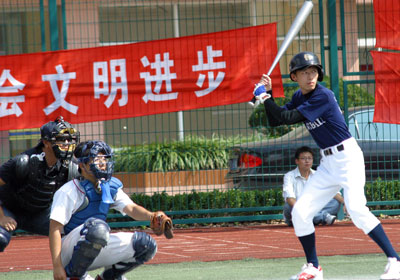
Baseball in Shanghai, 2006

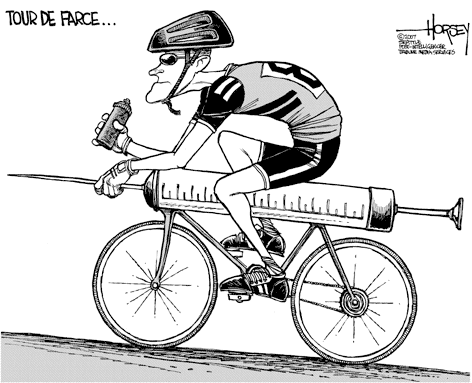
Sports has been in the news lately, but not just in the sports section of newspapers, sports talk radio, or ESPN. Instead, sports have increasingly been covered by legal reporters and mainstream journalists because of the numerous scandals that have plagued both professional and amateur sports. The most recent scandals have hit all the major professional sports (and not only in the United States). To summarize, Major League Baseball is plagued by allegations of illegal steroid and other drug use (symbolized by Barry Bonds’ alleged use of performance enhancing drugs in his pursuit of the home run record); the NFL (American football) is dealing with all sorts of off-field criminal activities (most recently the Atlanta Falcon’s star quarterback Michael Vick’s involvement in dogfighting); and perhaps most problematic of all is the NBA’s referee scandal, where a referee has been accused of conspiracy to fix NBA games for gambling rings. The Tour de France, still reeling from last year’s champion’s violation of drug policies, had its pre-race favorite and the front runner during the race both pulled out of competition because of more doping allegations.

On August 1st, even The Diane Rehm show, a public radio call-in show that usually covers news, politics, the arts and literature, dedicated a show to the numerous scandals in sports. Wider society, or at least the reporters who have access to the airwaves, seem to be in great angst over the epidemic of unlawful and unethical practices of our sports heroes. Explaining why there is such concern over these scandals, Sally Jenkins of the Washington Posts, said:

“We tend to assign responsibility for protecting our ethics and our concepts of virtue to athletes, more than any other figures in our culture. We don’t ask the same of actors, singers, we don’t even ask it frankly right now of our Attorney General. We actually ask athletes to protect our values to a certain extent. … Kids take messages from these people, they’re not taking messages from the Attorney General of the United States when it comes to playing with the truth. With all three of these things going on at the same time, have we allowed values in our games to deteriorate? Yes, we have, we have become a permissive society and that’s reflected in our games.”

Anthropologist Jeremy MacClancy of Oxford Brookes University makes a similar point in the introduction to his 1996 volume Sports, Identity, and Ethnicity, in that sports are a cultural arena that not only reflects society, but also, through its particular disciplining and idealization of the human body in agonistic competition, reflects on society. Anthropologists have long studied sports, dating at least as far back as James Mooney’s 1890 study of Cherokee lacrosse (the sport that I played in college and continue to be involved in as a college and high school referee and head coach of a college club team) published in the American Anthropologist. Yet the anthropological study of sports, as many of the specialists in this field have pointed out, has been peripheral as field in the past for two major reasons: the dismissal by academics of the value in studying popular culture and the historical focus of anthropology on the “primitive” (only “moderns” play sports, at least according to classical definitions of sports such as the one by Norbert Elias: “contests involving bodily strength or skills of a non-military type [with] rules constraining the contestants … aimed at reducing the risk of physical injury to a minimum”).But things have changed in anthropology, as they have in sports. We anthropologists often seem to be obsessed with popular culture, looking at everything from Japanese Hip-Hop to Second Life. Now more than ever, the study of sports as popular culture by anthropologists is crucial to understanding all the major issues in social relations and cultural meanings that we grapple with, such as power, gender, and identity. For example, in a recent article in City and Society, anthropologist Thomas Carter of the University of Brighton has argued that sports as a public spectacle has become a major feature marking the emergence of global cities. More importantly, our students, colleagues, and neighbors are all talking about sports; to stay relevant, we need to keep up our end of the conversation.

In the posts that follow, I will discuss some recent studies by anthropologists on sports, including some of my own work, that demonstrate the wide array of issues that can be fruitfully explored by using sports as a lens.