Tag Archives: Pedagogy

Anthropology in the classroom.

Ain’t No Making It – the Manga

I’m teaching a course on the anthropology of education this semester. Ostensibly it is actually titled “Aboriginal Education” but because the classic educational ethnographies focus on class, race, and gender in the US and England the course ends up being much wider in scope than the title would suggest. Last year I tried using Willis’ Learning to Labor but the British context and colloquialisms were just too difficult for my students who are more familiar with American language and culture, so this semester I switched to Ain’t No Making It which has a lot of cursing, but is actually much easier to read.

In practice, the students here take turns reading the English materials, each group presenting and summarizing that weeks reading for the rest of the class before I lecture on it. It is a strategy that nearly all the teachers here use since less than one percent of all academic texts seem to exist in Chinese translations (anthropology even less) and the English level of most of the students is simply not up to doing the amount of reading one would expect of native speakers. It isn’t an ideal solution, but it works well enough for the higher level classes.

The language barrier is a problem, but with teaching undergraduates an even bigger issue for me is the lack of a shared set of cultural references. Even in the US (where I had once been described as “cool” in multiple student evaluations) I had started to fall behind in the age of video games, never having played WoW (Rex, on the other hand…). Here Manga are a big part of student life. I love classic American graphic novels, but I can’t keep up with the endless amounts of Manga which the students consume on a daily basis. All the restaurants near campus have walls lined with Manga for the students to read during their meals.

Fortunately, when students do their presentations well, they are able to make the connections I can’t make. In presenting MacLeod’s “Hallway Hangers” the students gave each member his own Manga-esqe avatar. I find particularly interesting the trouble the students had in portraying the one African-American member of the group, Booboo, as there are very few blacks in the Mangas they read. You can clearly see that he is drawn in a completely different style (perhaps by a different student? – I forgot to ask) than the rest of the gang. It is interesting because even when Manga characters are meant to be Asian, they are often drawn with Caucasian features, thus any attempt at depicting marked racial features requires deviating from the stylistic norms. Although this is not a problem for the best artists in the tradition, it clearly stumped my students. (UPDATE: I forgot to mention that the other avatar on the bottom left is meant to depict someone of mixed heritage.)
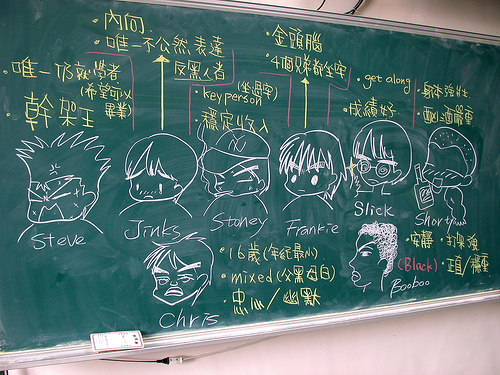
Hallway Hangers

The whole exercise made me wonder if there wasn’t a market in re-writing classic ethnographies as manga? It would certainly do a tremendous amount to popularize anthropology. I’ve always been a big fan of the “Introducing …” and the “… for Beginners” illustrated books, but with the emphasis on storytelling in many modern ethnographies perhaps some of them would be particularly well suited for manga editions?

Online anthro tutorial

One of the email lists I am on recently publicized “Internet Anthropologist”:http://www.vts.intute.ac.uk/acl/tutorial?sid=924460&op=preview&manifestid=198&itemid= an online tutorial designed to teach people about how to research anthropology online. In general I’m very skeptical about these resources since the tools and sites that you use to do research online are always changing, and the people who put them together are not, in my humble opinion, very good at actually doing research. A (very) quick look at Internet Anthropologist, however, makes me think that it is a cut above the usual online tutorials. The “Intute”:http://www.vts.intute.ac.uk/ platform that it is based on looks interesting, and while the tutorial itself is really basic, some people need to be told “There is such a thing as the American Anthropological Association, and it has a website.”

Of course I was a bit miffed that Savage Minds didn’t make the cut of ‘popular blogs about anthropology’ but I’m sure they’ll come around eventually… 🙂

Take a look and let me know what you think.

A note on the Eskimo snow thing

I did a satisfying little bibliography crawl recently to track down some references on the wrong-but-ubiquitous idea that ‘Eskimo have 100/354/1,000 words for snow’ which I thought I’d share here for people’s convenience. Most of the work done on this topic comes from Laura Martin’s “‘Eskimo Words for Snow’: A Case Study in the Growth and Decay of an Anthropological Example”:http://links.jstor.org/sici?sici=0002-7294%28198606%292%3A88%3A2%3C418%3A%22WFSAC%3E2.0.CO%3B2-A (aka American Anthropologist, New Series, Vol. 88, No. 2 (Jun., 1986), pp. 418-423). The more accessible and well-known publication is Geoffrey Pullum’s “Great Eskimo Vocabulary Hoax”:http://www.springerlink.com/content/k0h25l886617384u/?p=cbd1112e3d4a4a848723659c1522cf4a&pi=1 (Natural Language and Linguistic Theory 7, 275-281). It’s been published in several other places (you can check out his “publications list”:http://people.ucsc.edu/~pullum/publications.html). The way that some universities are today, though, you may have an easier time getting a PDF off of Springer than tracking “the eponymous paperback”:http://books.google.com/books?vid=ISBN0226685349&id=jp5JCaP_xpIC&pg=PP1&lpg=PP1&ots=50UblijtvM&dq=geoffrey+pullum&sig=Tf-xoYyRCVhcG7BvdzGAC-nIbm8&hl=en. Finally, there is also a brief comment on “Snowing Canonical Texts”:http://links.jstor.org/sici?sici=0002-7294%28198706%292%3A89%3A2%3C443%3ASCT%3E2.0.CO%3B2-P by Stephen O. Murray (American Anthropologist, New Series, Vol. 89, No. 2 (Jun., 1987), pp. 443-444) which comments on Martin’s use of Boas’s original brief mention of snow. Anyway I thought it would be useful to have all this digested here.

The short version — for people who didn’t get the memo — is that the Eskimo do not have 100/354/1,000 words for snow.

History of anthropology, anthropological theory, and Just Plain Theory

One of my jobs in my department is to create a new “theory course” for cultural anthropologists to supplement the core course that we currently have but that doesn’t cover the “hot theorists” that students want to read but which we can’t cram into the one semester of theory we currently offer. As a result I’ve been thinking a lot about what it means to teach “anthropological theory”

Recently I’ve been thinking about theory for a different reason — I picked up a copy of the second volume of The Essential Edmund Leach which features a long final essay which is the closest that the mercurial Leach ever came to sketching out his ‘big picture’ of what anthropology is and ought to be. The essay was disappointing to me. It’s not surprising that a fox doesn’t do very good at playing the hedgehog, but what I didn’t like about the essay was the partial and even distorted way that it addressed the history of anthropological theory.

One thing that I’ve been thinking lately as I’ve thought about both Leach and my own attempts to create a ‘theory syllabus’ revolves around the difference between what I might call ‘history of anthropology’, ‘anthropological theory’, and ‘theory’ in a plain sense.
Continue reading →

Another STS wiki

Many of you already know about “the bomb STS wiki”:http://en.stswiki.org/wiki/Main_Page at UVA but I recently came across another bomb wiki — the “UC STS Wiki”:http://symptom.ucdavis.edu/stsnet/index.php/Main_Page. It has a “terrifying number of facinating syllabi”:http://symptom.ucdavis.edu/stsnet/index.php/Syllabi including one on “the work of Marilyn Strathern”:http://symptom.ucdavis.edu/stsnet/index.php/Ethnographies_of_Relation:Readings_in_the_work_of_Marilyn_Strathern by Cori Hayden which is — wait for it — the _bomb.

Science Studies is Anthropology

I’ve just come off of a week long visit with Bruno Latour. He came to Rice as the “NEH Distinguished Visiting Scholar” and gave a public lecture, three seminars, screened a video about his recent art exhibit and participated in three classes (two in anthropology, one in architecture), in addition to dinners, lunches, talks with undergraduates and graduate students, trips to the mall, and a tour of Houston. In short, we got our money’s worth. It reconfirmed for me my sense that Latour is a gentleman and a fantastic teacher; his curiosity is boundless, as is his ability to converse, in depth, with an astonishing range of people–from scientists to lawyers to evangelicals to architects to philosophers to American historians to undergraduates to the wine buyers at Specs (The World’s Largest Liquor Store, about which Bruno said of its immense and varied selection from all over the world “Now I understand relativism. You know, you aren’t supposed to be that open-minded”). The only people he seemed unable to connect with were the French, which is not entirely ironic. He is a fantastic teacher– better at clarfying his ideas in person than in print–and incredibly patient with questions and the inevitable attacks that come based on his reputation (one colleague asked if he felt responsible for the Holocaust– I think this was meant to be “provocative” rather than puerile).
Continue reading →

Making Better Students

Some time ago, I asked how we could help our students make up for the widely-lamented lack of studying skills — and just plain living-as-a-student skills — they bring to college with them. Since then, I’ve been thinking more and more about this problem, as I’ve grappled with some of the deficiencies and ineptnesses that seem to be breeding like rabbits among my students. Over the break, I decided that I needed to commit myself to bringing some of the studying and learning skills that those of us who have achieved higher degrees have picked up along the way, making explicit things like how to write a research paper but also how to organize one’s time or how to learn leadership.

One result of this is a new site I put together during the intersession, entitled Being Better Students. The basic idea is to collect (and, occasionally, author) good, solid, and doable tips for students — things that they can read and immediately go and do to help them wrap their heads around what should be very high demands on their time and energies. Now that I’ve started to accumulate a decent amount of material, I’d like to invite Savage Minds readers (and writers) to have a look and let me know what you think — and especially let me know what works for you or your students. I’d be happy to accept guest posts, or to repost information sent privately, or whatever, so long as it’s practical and useful.

Hopefully, the site will help encourage professors to take on some of their own students’ short-comings — I’ve gotten a little tired of colleagues telling me that I had to work around these problems instead of helping my students face them down. Hopefully, too, there will be information from time to time that’s new to some of us “students-for-life” — it’s never too late in your academic career to become a better student!

SM syllabus roundup

For most of us, the spring semester is now firmly underway, and this means that we are all being held to the vague and airy promises of ‘preparing class materials’ that we made over break now that there are actually students in our classrooms. As a result I thought it might be nice to start what may become a tradition here at SM — sharing the syllabi of the regular bloggers at this site to let you know what we are up to. And so, without further ado, I give unto you:

“The Relevance of Anthropology for Contemporary Problems”:http://www.box.net/public/okg7yfpmq4 (Rex)

“Ethnography of the State”:http://www.box.net/public/23p17mqvmd (Rex)

“Contemporary Anthropological Theory”:http://www.box.net/public/qhnrm1hqgz (Strong)

“People and Culture of the World”:http://www.box.net/public/qodr2kakus (Oneman)

“Introduction to Cultural Anthropology”:http://www.box.net/public/i7tclumhqn (Oneman)

“Gender, Race, and Class”:http://www.box.net/public/xkmsmmfj4y (Oneman)

“Public Spheres and Public Cultures”:http://smatter.rice.edu/320/ (Kelty)

“Adivasi Studies”:http://wiki.oxus.net/wiki/Multimedia (Kerim)

“Multimedia Ethnography”:http://wiki.oxus.net/wiki/Multimedia (Kerim)

“Language and Society”:http://wiki.oxus.net/wiki/Language (Kerim)

I like these classes not only because they all look so interesting but also because they give you a sense of where we as a blog are coming from — we have two large state universities, a private school, and two universities outside the US (in Finland and Taiwan). There are also a range of classes here — everything from Anthropology 101 to advanced graduate seminars. Some of us are using wikis and blogs to teach, while others rely only on chairs, tables, and a good book. If you’ve just started teaching, maybe you could send us links to your syllabi in the comments of this post so that our readers could have a wider sense of what is being read in the discipline.

A good syllabus (or two)

After some clicking around I ran across Joe Tobin’s website at Occidental College. His syllabi for “Introd Anthro”:http://faculty.oxy.edu/tobin/100/2.html and Occidental’s “Senior Seminar in Anthropology”:http://faculty.oxy.edu/tobin/anth490f03/ are both interesting. The intro course features a lot of LeGuin and Vonnegut (LeGuin bein an anthropological descendant and Vonnegut being a drop-out of my own alma mater’s anthro program). The senior seminar offers a lot of old favorites as well as some other nice pieces that I can tell work artfully with the other bits of the syllabi.

Highly Recommended: Daughter from Danang

During my recent trip to the AAA meetings in San Jose, I scheduled a viewing of the documentary Daughter from Danang during my usual kinship lecture time. The film tells the story of a young Tennessee woman who travels to Danang, Vietnam, to be reunited with her birth mother. Heidi had been evacuated in the denouement of the Vietnam conflict because, as the daughter of an American GI and a Vietnamese woman, she faced a life of possibly violent discrimination. The film tells the story of ‘Operation Babylift,’ which sought to evacuate nearly 2000 children of American GIs. It is an incredibly vivid and moving portrait of families riven apart by war, of the complex forms of belonging engendered by the enmeshing of personal and national destinies, of the problem of cultural difference within kin relations. The film tacks between attention to the American context and the Vietnamese one, and so offers contrasting perspectives on each. Race, kinship, nationality and other forms of identity appear performative in the context of transnational adoption even as they also run up against the putative importance of natal/natural ties. What makes the film especially effective, and indeed heart-wrenching, is the immediacy with which these concerns are brought to life in the story of this young woman’s sense of longing, loss, and dashed expectations. Although I think it is a text that demands careful handling, I think it is in some respects an ideal documentary for teaching purposes, whether the subject is kinship or simply cultural difference.

Call for Help: Case Study Recommendations

If I haven’t seemed like my normally garrulous self lately, it’s because what with teaching 5 classes, editing a book, and writing a dissertation, I’ve been a little low on though-juice. Because one can never have too much to worry about, though, I’ve taken on a new class for the Spring, People and Culture of the World, which is what it sounds like (this is at the community college level, by the way). Since I wasn’t actually told about this until the Spring catalog came out (said my chair, “Oh, didn’t I tell you?”) I’m under a lot of pressure to get book orders in. I’ve got a textbook selected (John Bodley’s Cultural Anthropology: Tribes, States, and the Global System, though I’m also trying to get a review copy of Core Concepts in Cultural Anthropology to use when I teach the class again) but I could use some help selecting a couple of short(-ish?) case studies — 2 or 3 books around 150 pages to supplement the shorter cultural descriptions in Bodley’s book. I’d like one of these to deal with a Muslim culture, especially (though not necessarily) if it deals with gender; then I’m thinking either a foraging people or South Pacific horticultural group, and maybe a minority subculture in a polycultural industrial state. Since I don’t really have time to go through the full process of requesting a dozen or so exam copies to review, waiting for them to arrive, and carefully evaluating them, I’m hoping that the collective wisdom of the Savage Minds collective can point me in the right direction — at least to help me narrow my choices down so I don’t waste time on outdated, unteachable, or poorly written ethnographies.

So how about it — any suggestions? Also, as long as we’re on the topic, what do you think of these kinds of works, you know: those short books clearly intended for introductory-level classes? What other sorts of books do you think might be appropriate for this sort of class? And how do you go about evaluating texts for your classes (if you’re a teacher of some sort, that is)? What are you looking for, and how do you know when you found it?

The Barth Solution

It’s like the Bourne Supremacy, but without Matt Damon.

I was recently emailing back and forth to one of my colleagues in my department about how to put together the reading lists for grad students taking their comps (or quals or whatever you want to call it). There was a bit of confusion at one point about whether we were talking about Roland Barthes or Frederik Barth. This then led to a discussion of their relative merits and we ended up hitting upon a solution to the arduous process of having students compose their reading lists and then have one professor insist Foucault ought be on it, another insist that Foucault not be allowed but V. Gordon Childe is a must, and so forth: Simply make the Complete Works of Frederik Barth the single mandatory reading list for all graduate students.

Of course this was supposed to be funny, but the more I thought about it the more sense it made. Think of the range of ethnography that you’d get: Afghanistan, Bali, Papua New Guinea, Europe. And while Barth’s intellectual trajectory is not incoherent, he has managed to embrace several different moments in anthropological theory. And he’s a clear writer.

So there you have it: The Barth Solution — try it today!

Some Hard Truths About College

When I started teaching, I had a somewhat idealistic view of my students. I thought that if I respected their adulthood — that is, accomodated their autonomy by keeping rule-making to a minimum — they would respond as, well, as adults. So, for instance, I made it clear that attendance was not a requirement and did not keep roll. The (predictable) result: low attendance. After quite a bit over half of my students failed their mid-term, I realized that I’d made a terrible mistake, and now, despite my distaste for the necessity of the task, I take roll and include attendance as a part of the final grade (usually about 5%).

What went wrong, aside from my own inexperience and naivitĂ©? In the three years since I first stepped into a classroom as a teacher and not a student, I’ve come to realize that most of my students simply have not been informed of what it means to be a college student. Some view it as an extension of high school, expecting me to be an authority figure and punisher of wrong-doing, and resenting the situation just like they did in high school; others follow a similar line, seeing college as high school without any authorityfigures, so they can do whatever they want. Very few of my students have seemed to have much of a sense of what real learning — the kind of life-long commitment to the development of their minds that college kicks off — entails, nor do they have very real understandings of what the expectations of college learning are. Continue reading →

Helsinki at Night…

…glows with neon lights. Many of the grand buildings in Helsinki have spectacular and dramatic night-time lighting schemes — neon, light projected under eves, corporate insignia in bright back-lighting. This makes sense: as one of the world’s most northern capitals, Helsinki spends much of the year in the dark.

I have been madly preparing for my first seminars/lectures. Issues emerge.

1) Everyone here has told me quite explicitly that Finnish students do not talk in class. This is cited as an example of the generally ‘taciturn’ nature of Finns. I’m told that one is not to take the silence personally. I’m inclined to think that student silence will schismogenetically elicit gregarious extroversion on my part (complementarily, of course). Everyone advises me to let the silence linger; I tell myself, ‘Mimic your therapist.’

2) Syllabus as branding exercise. What should a syllabus actually look like? What should it say? Syllabus conventions of course vary between individual teachers and between institutions. One of my undergraduate teachers often simply handed out a list of books and told us we were expected to own them. Other teachers have poured voluminous amounts of bibliographic information into them; their syllabi are like indices of a subject area. How much ‘framing’ should a syllabus engage in, viz. themes and questions about particular areas, to focus discussion? I wish to remain open to student interests, inquiries, imagination; at the same time, there are things I want them to learn. A delicate balance I suppose. Right now I feel aware that the syllabus will be one of the first things students encounter about my teaching. I consider first impresssions.

3) Grading. Again, teachers have vastly different strategies with regard to explicitness in grading standards. Some syllabi seem almost like human subjects consent forms in that their primary purpose is to be as explicit as possible about how students will be assessed in order to foreclose ‘litigation’ concerning grades later on. And others are silent on the subject. Which way is best?

There are other issues of course. These concerns are of course ones that all teachers face — yet, they are for me right now heightened by the fact that I have never taught in a European university before. Academic convention and expectation is as culturally-varied as are kinship systems. I look at the enterprise as a learning endeavor.

So I prepare this morning for my class on “Kinship Today.” In fact, Savage Minds gave me the idea to open discussion in the class with controversy: adoption at the interface of indigenous tradition and liberal governance. I have structured the course around classic readings leading up to a focused exploration of the question of ‘gay kinship/marriage’ in the West. Kinship studies have always been about ways in which social orders ensure their own reproductive continuity. Adoption controversies not infrequently swirl around the question of how particular styles of life, unique identities, are sustained both collectively (as in the case of ‘indigenous’ folks in the US, Australia, or other settler states) and personally (as in the case of individuals adopted trans-nationally). Kinship, and its study, is about social organization through time; it has always also been about the state. The search for jural norms in ‘other’ places guided investigations into kinship quite explicitly. We know that Morgan’s interest in kinship was stimulated by his investigations concerning Iroquois land rights. So what looks like a contemporary sort of kinship question (adoption disputes today) in fact has a genealogy that goes back to kinship’s very ‘invention.’ I make the further point: what’s interesting about gay kinship vis-a-vis these time honored anthropological questions is precisely the extent to which it throws mechanisms of social reproduction, continuity through time, into question; gay kin are comprised of, in a famous phrase, ‘families we choose.’

So! Onward into some classic investigations.

Putting the meth back in Methods

I’m teaching fieldwork methods this fall, for the third time. As some who know me by my works might well suspect, this is unusual because I have never been trained in so-called fieldwork methods in anthropology. I was raised by anthropologists, but also by historians and sociologists, an engineer and one architect who worked for DARPA; so this is an odd role for me. I’m looking for other experimenters to compare and contrast with. If you teach methods, especially this fall, or you know someone who is trying to experiment with this kind of class, I’d love to know about it.

My class is structured roughly around the idea of the architecture studio–students are expected to work together, but on individual projects, and to present regularly and receive criticism from other students. I think of it as more fieldwork tactics than fieldwork strategy (or fieldwork techniques rather than fieldwork design), because I don’t expect students to actually do an ethnographic project in a single (albeit unfairly long) semester. Nonetheless I think students can learn a lot by trying out various things (observations, notes, interviews, audio, video, archives and public sources, transcriptions and codings and annotations, and collaborative writing and so on). I usually have them end the semester with a mini-AAA panel, in which students are responsible both for presenting their own research, and for actually writing something about a classmate’s project as well.

I am avowedly obscurantist about this class, because I don’t want it to be mistaken for a qualitative methods class that deals with inference, small-N issues and other problems of generalizability and representativeness. These are valid concerns for those who want to do qualitative survey research, but they don’t do justice to the difficulty of treating ethnographic fieldwork as an epistemological encounter. I teach ethnography as if it were a tool for testing and re-framing concepts and methods–not only for collecting data. I would much rather challenge students to come in with some familiar anthropological canard and use the ethnographic encounter to de-canardize it (to coin a term) by turning it into a concept that allows students to communicate across diverse topics, sites, areas, or problems. If students can figure that out, then I let them worry about N.