Tag Archives: Pedagogy

Anthropology in the classroom.

Useful syllabi on virtual worlds and technology

Random cruising around the IntarWeb today I tumbled over two interesting sources for syllabi on virtual worlds and the IntarWeb itself. First, Tom Boellstorff has syllabi on “Culture in Virtual Worlds”:http://www.anthro.uci.edu/faculty_bios/boellstorff/Syllabus-S09%20froshsem.doc and “Culture Power Cyberspace”:http://www.anthro.uci.edu/faculty_bios/boellstorff/Syllabus-Cul-Pow-Cyb-Win-09.doc on his department website. You’ve read the ethnography, now vicariously take the course! Seriously, though, its great for Tom to share these syllabi — circulating syllabi is key to building community and scholarship about topics.

Also, as some of you may know, Polity Press has a series of small introductory readers on blogging, hacking etc. But there is more to it than just that — they have a “website”:http://www.polity.co.uk/digitalmediaandsociety/ that looks like a sort of mini-online community, complete with blog and, yes, “syllabi”:http://www.polity.co.uk/digitalmediaandsociety/syllabi.aspx and “reading resources”:http://www.polity.co.uk/digitalmediaandsociety/resources.aspx. I can’t tell if its a community designed to promote a book series of a book series to promote a community. Its an interesting hybrid of a bunch of different models: group blog, academic book series, “online supplements for your textbooks”, etc.

Books For Methods

As some readers may know I’ve been thinking about how to teach the “Ethnographic Research Methods” course that I’ll be teaching in the fall. Our textbook orders are now in and so I thought I’d share with you what I’ve decided to use — hopefully in the fall I can let you know how it went.

My goal in this course is really to focus on methods — on what, specifically, you do during fieldwork. I want to give students some tools so that they do not feel lost at sea when they arrive in the field. I want the tools to be hands-on, and not too specialized, since they will have to work in a variety of research conditions. Finally, while I don’t want to force students into a scientistic conception of fieldwork and methods if they have a more humanistic sense of what they are about, I at least want to give them the skills to Go There if they want to.

So, here is what I’ve ordered from the bookstore.

Analyzing Social Settings (Lofland, et al): I’ve mentioned this one before. It’s a symbolic-interactiony textbook. Frankly I think it is too expensive for its slender volume, but as a one-volume overview of the research process its the least of all possible evils. First, the bibliography is extensive and full of interesting case studies — so its a good place for students to start to explore their own ideas about fieldwork. It also has an opening chapter on how your own personal life leads you on to your research topic, which is a really important (and often undiscussed) thing to bring up. Finally, a major part of research as the authors describe it is ‘focusing’ research — moving beyond being ‘in’ the field and formulating some concrete ways to ‘do’ fieldwork. So yeah, a small light piece to take into the field.

Writing Ethnographic Fieldnotes (Emerson, et al): Another ethnographic sociology book (notice the pattern here?). This is an industry-standard book that is very hands-on in describing how to write fieldnotes. It is also inexpensive, which is nice for students. Again, the focus is not critiquing the theory of fieldnotes, or discussions by people about how they feel on the inside about their fieldnotes. The issue is how to take them.

Learning From Strangers (Weiss): I think this has got to be the most common book on interviewing out there, and is used by a bintillion different disciplines and professions. Inexpensive, very hands on, includes examples of consent forms, interview guides, and even coded interviews. It has a lot of stuff that is not so central for anthropology (or the type I do anyway) or reflection on the complex dynamic of intersubejctivity when you interview but… screw it. It gives you a basic overview. And using this book means that students will be able to discuss interviewing intelligbly with people in other disciplines.

Doing Qualitative Research On Your Computer (Hahn): Ok. Coding fieldnotes is the area where anthropologists have Issues. Coding is often described as a special technique with special software, etc. This turns off anthropologists who are skeptical of the Power of Science, and even those who might be interested in gaining some coding chops get the sense that it requires special (read: expensive) software and extra training. A lot of the Anselm-Strauss inspired approaches feature textbooks that are in there 39th edition, have been over-edited, and can be vague and mystical.

I am betting on this book because 1) it teaches students that coding is a simple technical act, not a comple and intimidating methodological one 2) anything that will get people to read and parse their fieldnotes is a good thing 3) I forget that not all students can just figure out computers the way I can 4) the book come with templates for access and excel that will work for any office software, and tells you how to use them.

This is a new and pretty unusual book (there are a lot of instructions like “left click and choose’add table'”) but I am hoping it will help get students past issues of software choice, etc. etc. and get them to read their fieldnotes.

There are some usual books I’m skipping here — the ginormous Bernard volume on anthropological research methods (which now costs US$100!), Briggs’s excellent Learning How To Ask (which we will read), and some others. So it is an experiment, and I’d be interested in getting some feedback.

Links on pedagogy and after

I am totally blown away by the quality of “Dartmouth’s Academic Skills Center”:http://www.dartmouth.edu/~acskills/. Typically these sort of teaching and learning centers seem to be staffed by people who have not experienced tons of academic success themselves and have reams and reams of well-meaning but essentially-contentless material. The Dartmouth site, in contrast, has “links to genuinely useful pages”:http://www.dartmouth.edu/~acskills/success/ which include handouts on “time management”:http://www.dartmouth.edu/~acskills/success/time.html, “reading effectively”:http://www.dartmouth.edu/~acskills/success/reading.html, and yes, even “alcohol and sleep”:http://www.dartmouth.edu/~acskills/success/stress.html. They even have “videos”:http://www.dartmouth.edu/~acskills/videos/index.html on these topics which are cheesy and incredibly slow-paced for those of us whose idea of a good time is watching tankspot videos on YouTube but hey, they’re trying, right?

But what happens after you take a normal person and turn her into an anthropologist? The “Center for Innovation and Research in Graduate Education”:http://depts.washington.edu/cirgeweb/ issued a report a while back on “where anthropology Ph.D.s are five years after they finish”:http://depts.washington.edu/cirgeweb/c/wp-content/uploads/2008/03/anthro-final-03-11-08.pdf. The report has gotten some circulation before but I link it again here because it is the only study I can think of — outside of some cursory statistics from the AAA — about what happens to grad students when they finish.

The answer mirrors my intuitions pretty much: they adjunct for a couple of years, and then get academic jobs — although often not in anthropology departments. And of course they also go on to find jobs in other areas. What they don’t do, according to the report, is starve in an alley somewhere. This is a good reminder since sometimes the stories we tell ourselves of the hardships of grad students are really terrible and while terrible things do happen the entire thing is not, so far, as glum as we sometimes make it out.

Good Field Methods Syllabi

In Fall 2009 I’ll be teaching a graduate level course on field methods. I’m very excited because it is, in many ways, the class that I’ve always wished I’d taken. At the same time, putting together a syllabus is daunting because I don’t have many examples. As a result I’ve been trying to figure out what worked for me in the course of my won self-education, and to look for some good syllabi on the topic. So far two have really stood out for me, so I thought I’d share them here:

Michèle Lamont’s Qualitative Research Methods syllabus
This is a more ‘sciencey’ take from ethnographic sociology

Loïc Wacquant and Nancy Shepher-Hughes Ethnography Inside Out syllabus
More ‘touchy-feely’ and reflexive take.

Does anyone have any additional syllabi they like or want to share?

Are we causality crazy?

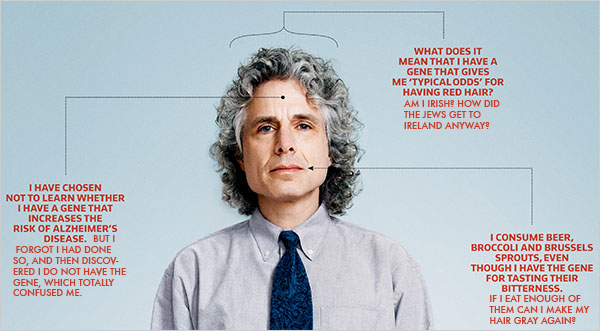
update: I forgot to post my amended picture:

11genome-600

Steven Pinker’s latest apology for behavioral genetics is in this weekend’s NYT Magazine. There are two things to pay attention to. 1) he’s right about personal genome sequencing: regardless of whether it’s correct, or the results can be properly interpreted for people, people are going to do it, and for all kinds of reasons, good and bad, and this is in itself something that will change behavior–call it proximate causality for individual behaviors. And the comparison with astrology, sorcery and other forms of readouts about your fate should probably be taken more seriously, especially by anthropologists, rather than used as a dismissal of genetic essentialism or determinism. 2) genetics seems to have become so confused with heritability that the claims about “what genes cause” have become incoherent; scales are routinely mixed up, which is what results in the manic fantasizing about why we conserve one gene or another (“gene so-and-so is correlated with baldness, therefore baldness must have conferred an advantage on our distant ancestors by serving as an effective way to deflect light before mirrors were invented” etc). As a result, our ability to argue about the roles that distant causality play versus those that proximate causality play have been compromised. Oh, and one other thing, There is no mention at all of epigenetics… is that deliberate, I wonder, or does it represent troubling ignorance on Pinker’s part?

and btw, I will note that our category for genetics at SM is “Race, genetics” which (and I’m not blaming anyone here) is interesting.

Media Anthropology and Pedagogy

Anand Pandian, assistant Professor at Johns Hopkins, shared the site for his Fall Semester undergrad course on The Anthropology of Media. The syllabus is comprehensive and tight. Students were asked to do a semester project on some aspect of the media, and the range of projects runs the gamut from the predictable (facebook) to the intriguing (Industrial Mix Tape: Baltimore’s Diverse Music Scene) to the kitchy (The Indian Chuck Norris).

I asked him why the projects look the way they do (I was thinking, what’s up with the 1990s web vernacular aesthetic?). The answer is illuminating, because it reflects how challenging it is to do a class like this and make students focus on the anthropology and not on the media. I don’t believe that this generation is any more digitally equipped than the last, and I hate it when journalists assume that it is (as they frequently do, given the number of requests I get to do interviews about how new media are causing children to evolve into large-thumbed, ADHD-addled, hacker-loving codemonkeys). In reality, some students have mad skillz, others have none. Focusing a class (of 50+ students) on the issues and asking them to produce a “new media” project that does not automatically activate different creative skills is challenging, so I was surprised by what Pandian’s class web site looked like. Of course, some students wanted to break out of the constraints (which results in some internal-link bizareness in some cases) I think it’s a measure of success, and it demonstrates one way to produce comparability in this medium.

Of course, one way to really get students thinking about the effects of media is to have them explore all the challenges, ins and outs of media production, but then the trade-off is that you risk running a course in web-production, rather than one in anthropology. In any case, an excellent case of experimentation.

The gap between taste and achievement

One of the links that has been making the rounds of academic email lists lately is a series of Youtube videos of Ira Glass talking about the art of telling stories. I have a love/hate relationship with Ira Glass and This American Life, but in the “third video in the series”:http://www.youtube.com/watch?v=-hidvElQ0xE&feature=related he says something that is really profound and something that has really made me think about how I advise my students.

In the video Glass points out that people who are just beginning to write (or do work of any kind, I reckon) experience a gap between what they know is good, and what they are capable of. They can see what quality work is — they have a sense of it and a passion for it that motivates them to create, and yet at the same time they feel that their own capabilities are insufficient to make work that meets their own standards. Glass urges people to develop their skills so that they can close that gap, and he urges them to do it by producing tremendous amounts of material, forcing them to hone their skills through repeated practice. To make people feel better, he emphasizes that he is incredibly successful and has closed the gap, and that it took him years and years to do so, so we should not be freaked out if it takes us a while.

The situation that Glass describes is totally true and I see it in my students — particularly my graduate students — all the time. His tip to work work work is also spot on — Greg Costikyan once told me “you have to throw the first million words away”, which is great advice. And Glass’s willingness to demonstrate that if he can do it then anyone can adds ‘story’ to his argument and makes it more compelling.

I recently began giving Glass’s speech to my students because they find it tremendously reassuring. But then I stopped giving it because I think it is actually a lie. Who in the world actually ever manages to close that gap? In my experience, and the experience of everyone I’ve ever talked to, people’s ability to produce good work develops over time, but so does the scope of their ambitions and the precision of their standards.

A less comforting truth is this: people who do mediocre work have some mixture of low standards, low energy, unambitious goals, and a high opinion of their abilities. People who do good work have high standards, work hard, stay hungry, and are all too aware of what the work demands and what they are capable of. Doing good work, doing it healthily, and over the course of an entire career, is not about closing the gap between taste and achievement, it is about keeping it open, and managing that gap in a healthy and productive way.

I am sure that if we were to actually watch Ira Glass at work we would not see him breezing into the studio, effortlessly tossing out perfectly honed pieces, and then knocking off at eleven for an early lunch, cocktails, and golf. I bet he sweats — a lot. And I bet he loves doing it.

Telling students that it will get better is easy — it makes them feel better, and it makes us feel better to convince others that we are stronger than we really are. But the truth is that the gap between taste and achievement doesn’t go away, the scale on which it operates increases, and the ease with which we manage it lessens. Less comfortable, but the truth — and what students deserve.

What Is This Thing Called "Edupunk"?

A new sensation is sweeping the nation. English adjuncts with mohawks are rockin’ their classrooms, web 2.0-style! Scrappy science teachers are banging together online learning systems in their garages! Gothic literature professors are turning to Wikipedia for inspiration! It’s a new day…

OK, maybe it’s not that exciting. What’s really happening is that professors and teachers are getting fed up with the limitations and corporate-overlordness of commercial learning software like Blackboard and WebCampus — and in a web 2.0 world, there are plenty of options for the fed up. With a click of the mouse and a sweep of the browser, it’s easy as Pi to cobble together your own online learning system — one with far more to offer both students and faculty than the tools schools are laying out big bucks for.

The Chronicle brought the… movement? news? thingy? … to mainstream attention, but their contribution is just a fillip on the work of professors and teachers all over the nation who have been thinking long and hard about how to bring learning to the web — and in doing so, to their students.

Let me say right here, for the record, I don’t buy all this “digital generation” nonsense. We’ve got a way to go before that happens. When I no longer have to teach my students how to Google unfamiliar terms or how to add an attachment to an email, then I might well believe that they are comfortably native in the online world; for now, the most I can say is that what I see as an important set of tools, they seem to see as a big box of toys, toys they’re happy to play with as long as it’s the same toy everyone else has.

But that doesn’t mean the Internet isn’t important — in fact, I think it makes it more incumbent on us, as educators, to show the amazing power of the Internet for more than just gossiping about your friends and breaking up with your lovers.

So What IS It?!

OK, edupunk. Basically, what you’ve got is a nascent movement by educators inspired by the DIY-ness of punk music (and fashion, design, writing, etc.) to step outside the walled garden provided by their institutions. Some are turning to wikis, others to blogging, still others to user-generated content, Google maps, and all manner of mashups. The occasionally savage Michael Wesch is a good example, though I don’t know if he considers himself “edupunk” — but it’s nt particularly punk to worry about labels, so who cares?

Edupunk is also a political statement. Scratch that — it’s a collection of political statements, and sometimes isn’t a political statement at all. Stephen Downes sums it up nicely:

Edupunk, it seems, takes old-school Progressive educational tactics–hands-on learning that starts with the learner’s interests–and makes them relevant to today’s digital age, sometimes by forgoing digital technologies entirely.

My own entry into edupunk (though I didn’t think of it as such at the time, and if you don’t count Savage Minds, which seems animated by the same principles even if it’s not explicitly an instructional tool) came about last summer when I decided to implement blogging in my “Gender, Race, and Class” course. For years, I’d been requiring a weekly response paper, an ungraded assignment that asked students to record their thoughts on the readings. This has been by far my most successful assignment — I could easily forego tests and essays, if not for the fact that a class of ungraded assignments probably wouldn’t give much incentive to master the material. But it galled me that the conversation these papers represented was just between each individual student and myself. I wanted their fellow students to benefit from their wide range of experience, thinking, and opinion.

So what’s a professor to do? As any patient IT department employee will tell you, “WebCampus (or Blackboard) offers a variety of interactive features including bulletin boards to facilitate virtual conversations in the blah blah blah. ” I’m sure they offer a really swell product, but a) the commercial classroom management systems offer a standard that students will never use again after their graduation, and b) they exist behind the university’s paywall. If my students have something to say, they might as well be saying it to the world, not just to the students in their class whose registration bill is current.

As far as I’m concerned, teaching students to engage with the world around them is crucial, both morally and pedagogically. (And, you’ll say, “politically”. So be it.) WebCampus and Blackboard don’t offer that; they offer a way to standardize education and, by extension, students.

So I built a blog. On Drupal, if you must know. And I required students to post their responses for the world to see, and to comment on each other’s posts. That second requirement is, of course, my hat-tip to totalitarianist authority; I knew that organic conversation was unlikely to develop — because they’re not “digital natives”!

That summer session went great, and the blog played a big role in that. In the fall, I tried again, this time with two classes, one blog. It didn’t work as well. I couldn’t stay on top of it, posts got shorter and shorter and less and less thoughtful, interaction was forced, there were too many students talking at once. I’ll need to rethink it before I try again — but it was definitely worth the effort.

What’s the point?

A lot of professors are fed up. They’re fed up with the commodification of education, they’re fed up with being straight-jacketed in their teaching because the school paid good money for an expensive system and they’d damn well better use it, they’re fed up by the increasing emphasis on education as workplace training instead of citizen (or even human) training, and they’re fed up with the apparent inability of administrators to do anything with a positive educational effect.

And, frankly, we’re fed up with failing. No matter what grade you teach, whether that’s 3rd grade or upper-division uni, you’re getting classes, semester after semester, that are unprepared for grade-appropriate education. It’s a tough thing to decide how many of your students you’re never going to reach; a lot of us will try anything in the hopes that we can reduce that number to zero. Blogging, twittering, mashing up data, wiki-ing, and other web-enabled activities allow us to offer the kind of hands-on work that we know can have an effect — much more, anyway, than assigning a multiple-choice quiz through Blackboard!

I’m only skimming the surface here. bavatuesdays is doing a good job of keeping up to date on edupunk’s emergence (the link is to all posts tagged “edupunk”; pay special attention to The Glass Bees); a new Wikipedia entry will likely evolve as more is known about this newly discovered “tribe” of educators; and Leslie Madsen-Brooks offers a good overview of the meanings attached to “edupunk” so far at Blogher.
Fieldwork aphorisms

Those kernels of wisdom imparted to students leaving for the field. These are often conveyed in the hallway, or on the phone, or in office hours, from mentor to student; they seem most frequently to circulate after the formal presentation of a research proposal. And I think they often have much more impact than the sophisticated advice transmitted through ‘official’ channels. Sometimes they are very telling. Two off the top of my head:

‘Don’t eat unwashed lettuce.’ (Marilyn Strathern actually published a piece under this title in that symposium that Rena put together on IRB issues in Æ™.)

‘Never refuse an invitation.’ (This is attached to Chicago I believe {apparently, a few of our readers live, or have lived, there}.)

As concerns the relationship between anthropologist and informant, these two pieces of advice would seem to be diametrically opposed: one cautioning distance, the other refusing it. Anyway, recently a student here was presenting his final research proposal concerning Istanbul and modernity, and we staff were giving advice. Afterward, I realized that I had forgotten to tell him my new idea. The idea occurred to me, actually, in Bangalore International Airport: “Note the titles for sale in the business section of the airport bookstore.”

Gramsci alert!

This one is going out to all the Gramsci fans out there — I’ve never been a fan, or even understood the appeal of — this thinker, but nevertheless I am teaching him soon in my graduate theory class. SO… if you have to assign people 75 pages of Gramsci (or Raymond William, since most of what people think of as ‘Gramsci’ is ‘Raymond Williams interpreting Gramsci’) what would it be? This is really out of my speciality.

tyvm!

Is ‘The Wire’ Our Best Ethnographic Text on the U.S. Today?

Who needs real life? My boyfriend and I have been working our way through the first four seasons of the U.S. television show The Wire, and I have concluded that it may be the best ethnography we have of contemporary American society. Who needs ‘real life’ when fiction, a TV show no less, does a better job of representing US culture(s) than many social science texts? Ostensibly a cop show about drugs and crime in Baltimore, the show illustrates in (sometimes puzzling) detail the culture of urban life: the language the show uses, from drug slang to white Baltimore dialect (see also Hairspray), alone is worthy of note. Exhibiting exquisite sensitivity to local culture, the show also makes an ‘argument’ about how structural inequality is reproduced. The most amazing thing about it is that it dares to be about poor people and poverty – topics which, John Edwards notwithstanding, seem to be verboten in American public culture. Class consciousness vanished from US TV sets sometime around the period when Roseanne was canceled. But The Wire shows the effects of the post-industrial transformation of the US economy in minute detail by finding connections between corner drug dealers, police officers concerned to produce promising crime stats, politicians hungry for acclaim, dock workers just trying to make it, developers moving into abandoned urban zones, and so on. In fact, I think the show is so good that one could structure a course around it. You could augment episodes with social science in a really captivating way. Potential texts/authors could include: David Harvey (naturally) on urban spaces, Carol Stack on kinship, Phillippe Bourgeois on drug dealing and masculinity, Douglas Foley on reproduction of class relations in education systems, Hortense Powdermaker on race and history, and so on. Any ideas out there on other texts that could be paired with The Wire?

The Wire in part draws its dramatic and ethnographic force from the fact that some of its most captivating characters are played by people performing versions of themselves. Here is an interview snippet with Felicia ‘Snoop’ Pearson, who plays a character named after herself:

My spring syllabi

Spring semester is underway over here in my neck of the woods so I thought I would share my syllabi:

“Political Anthropology”:http://socialsciences.people.hawaii.edu/esyllabi/get_esyllabi.cfm?esyllabi=5e9db0ca-7592-418c-807c-90a4c35c6cae
This is a ‘anthropology of recognition’ class that combines liberal political theory with studies of social organization and how anthropology makes its object.

“Theory in Anthropology”:http://socialsciences.people.hawaii.edu/esyllabi/get_esyllabi.cfm?esyllabi=e71604d3-9aeb-40fe-85eb-26d516f3d265
A history of anthropological theory from 1964-2005. Designing this one just about killed me.

Thoughts? Does my college’s insanely obscure URL structure actually lead to a PDF for you people? Let me know.

Pace layering as research method

Last semester one of the strategies I unconsciously use to read crystallized in my mind when I discovered the concept of ‘pace-layering’ in Peter Morville’s book Ambient Findability. Morville gets the idea from Stewart Brand who (according to Morville) emphasizes that way that different ‘layers’ of things move at different speeds. In the case of a building, for instance, the stuff within it may change daily, while the site it’s located on changes in the longue duree of geological time and paint, building, and furniture all run on a clock that is somewhere in between (think Braudel here folks). Morville was interested in using this concept to resolve the debate (which now seems decades old) between advocates of folksonomies and more traditional library cataloging methods. Folksonomies are good for building connections between content quickly, he says, while the structured taxonomies of catalogers work better but take longer. It’s an ingenious resolution to the problem.

When it comes to being a scholar I find the concept of ‘pace-layering’ to be a useful way to imagine how academics discover, read, and archive information (‘books). Too often we tend to dichotomize our reading practices into ‘real reading’ and skimming. Even when we recognize the difference between different degrees of reading, we tend to stigmatize reading practices along the same continuum, with all other sorts of readings compromised forms of ‘real reading’ rather than just ‘different’ forms of reading. Some people — but not all! — would say that real reading is rereading. These are the people who read Plato year after year after year and claim that they ‘really started to understand it’ after the first decade or so of rereading.

I personally totally embrace pace layering. At times I am ‘on top’ of things in a ‘boing boing’ or ‘slashdot’ kind of way — scanning hundreds of RSS feeds to see which ‘imprint’ on my attention, browsing through tables of contents of journals, and immersing myself in ephemera and quick scans. Sometimes I only have an hour to ‘spend with a book’ or (more often) only want an hour’s worth of understanding of a book. At book stores I judge books by their covers (an important professionalization skill, and Strong points out).

At other times I believe in being ‘on the bottom’ of things. This is particularly true of stuff in my research speciality. There is no substitute for a close read of work that you really consider to be central to your research project. A serious encounter with Levinas requires serious amounts of time.

That said, imagining reading in terms of pace-layering helps bring some reflexivity to the research process. For instance, you might say: “screw it, I’m reading Levinas for beginners — I don’t want to have a deep engagement with Levinas at the moment.” Part of pace layering is understanding how your diet of information is tied in with your intellectual project, and what your priorities are.
Continue reading

Syllabi-o-rama!

Many SM readers are headed inexorably for the first day of classes of the fall semester, but for those of us at the University of Hawai’i classes have already started. I’m teaching two classes this semester and thought I would share the syllabi with people. If others have their syllabi online it would be great to have links to them in the comment section — and I’m sure the other Minds will chime in with their syllabi as well, when the time comes.

So enjoy! This semester I’m teaching

“The Anthropology of Virtual Worlds”:http://socialsciences.people.hawaii.edu/esyllabi/get_esyllabi.cfm?esyllabi=88eac772-d7cc-4aea-b178-333a392c6da3

and

“First Contact and Its Aftermath in Highlands Papua New Guinea”:http://socialsciences.people.hawaii.edu/esyllabi/get_esyllabi.cfm?esyllabi=7cf59c4a-a5fc-434f-ae46-f0910eb536fb

No More Discipline Issues in MY Classroom!

This is wrong on so many levels: Nevada has authorized the public university system — two of whose schools I teach in — to train professors and enlist them as “reserve police officers” to respond in case a VA Tech-style shooting breaks out here. Now, I’ve known a few police officers in my time — it’s a full-time discipline requiring an awful lot of on-the-ground experience to be able to make the kind of snap decisions that are demanded of real security work. Security expert Bruce Schneier has pointed out that the best security comes from trained experts that recognize and act on situations that feel “hinky” — not pulling aside every dark-skinned person in the airport, but pulling aside the handful of people who act slightly “off”. Developing this kind of sense, and then recognizing what it means and how to respond to it, takes experience and a certain mindset — which the Board of Regents apparently feels can be developed next to a 4-4 courseload, committee service, office hours, research, professional development, course development, and so on. They must be drinking the Horowitz Juice — that strange brew that convinces people that full-time profs (and adjuncts like me who carry a full-time, or more than full-time, courseload) are only working 15 hours a week and have plenty of time to devote to learning to be security experts on top of teaching.

It’s an insult to both professors and police officers, especially since we all know that the training Nevada’s “reserve police officers” receive isn’t going to be anything like what I’ve described above — neither time nor money are available for anything like that. Instead, I’ll lay odds that the “extensive training” will consist of an hour or two of basic firearm safety and police procedure (e.g. how to make an arrest and detain someone until the real police arrive) and a time requirement in a firing range. In effect, this policy will provide a ready source of guns on campus, under the protection of poorly-trained non-experts who are more at home with the intricacies of 17th century poetry or the esoterica of subatomic physics than with the demands of real security.

This is offered as an alternative, of course, to real policing, real governance, which would require either passing a new tax to increase police forces (which was voted down in referendums during the last couple elections; I should note that Nevada doesn’t have a state personal or corporate income tax) or increasing the gaming tax that casinos pay and which accounts for about a third of the state’s tax revenues (which of course the casinos that own Nevada would never stand still for). In other words, the state is offering up a classic example of what Schneier calls “security theater” in place of, you know, security.

And I’ll bet it’s coming soon to your state…