Tag Archives: North America

What Does Jewish Rock Look Like?

A couple months ago, my then-girlfriend and I were surfing channels and happened to light upon Gene Simmons’ reality show. It was the end of the episode, and Simmons was lecturing a young band about something or other.

“He seems really smart,” my ex said, somewhat surprised.

“Of course he does,” I half-jokingly replied. “He’s Jewish.”

She was surprised to hear that The Tongued One was Jewish. Pressing my case, I continued: “Of course, most of your major rock stars are Jewish.” Continue reading

A Thin Hypothesis About Fat People

Ampersand at Alas, a Blog takes on some recent research about obesity and dieting, shredding to pieces some of the myths that persist about the health effects of being fat. Despite all the efforts of the diet industry — a $30 billion a year industry according to NAAFA (the National Association to Advance Fat Acceptance), making it bigger than Hollywood, pro sports, even porn — clinical research repeatedly shows no benefit from dieting (except in specific cases such as diabetes). What’s more, losing weight — any amount of weight, at any time in your life — significantly increases the likelihood of death. In fact, it appears that “healthy” people actually have a higher mortality rate than “unhealthy” fat people — that is, people with lower BMIs (body mass indexes) are more likely to die than even people who are significantly overweight!
Continue reading

Buffer Races and Castelike Minorities

Fareed Zakaria’s recent Washington Post editorial on immigration has rightly been praised for its clarity.

Compared with every other country in the world, America does immigration superbly. Do we really want to junk that for the French approach?

The only criticism I’ve seen of Zakaria is that he conflates German guest workers with second or third generation France citizens of foreign descent. (See Moorish Girl for more on “immigrants” vs. “citizens.”) But I think there is a deeper problem here. The reason immigrants tend to do well in America is not because America is a more welcoming society, but because we already have a permanent racial underclass in our African American population! (And, to some extent, Latinos and Native Americans as well.)

America’s recent immigrants serve a useful purpose, deflecting attention away from one of the core conflicts in our society. American immigration policy in recent years has favored middle class Asian immigrants. Their arrival conflates the black/white dichotomy that led to so much social unrest in the 1960s. This can be seen in the area of Affirmative Action policies where it has been widely remarked that those who would benefit most from their termination would not be White Americans, but the children of Asian immigrants!

Popular in Marxist academic circles, the concept of Asian immigrants to the US acting as a “buffer race” has never made it to the mainstream. I would argue that part of the reason for this lies in the intrenched logic of American “multiculturalism.” According to the dominant narrative, America is a “salad” (no longer a “melting pot”) in which each culture adds its own unique flavor to the mix. This narrative hides the very different histories of America’s various ethnic minorities.

In their celebrated essay, “Black students and the burden of ‘acting White.'” (1986, Urban Review 18(3), 176-203) Ogbu and Fordham suggest a tripartite classification for thinking about America’s ethnic minorities:

In order to account for this variability, we have suggtsted that minority groups should be classified into three types: autonomous minorities, who are minorities primarily in a numerical sense; immigrant minorities, who came to America more or less voluntarily with the expectation of improving their economic, political, and social status; and subordinate or castelike minorities, who were involuntarily and permanently incorporated into American society through slavery or conquest. Black Americans are an example par excellence of castelike minorities because they were brought to America as slaves and after’ emancipation were relegated to menial status’ through legal and extralegal devices… American Indians, Mexican Americans, and Native Hawaiians share, to some extent, features of castelike minorities.

What it means to be a “castlike minority” can be understood by looking at our prison population (more here):

Since 1989 and for the first time in national history, African Americans make up a majority of those entering prison each year. Indeed, in four short decades, the ethnic composition of the U.S. inmate population has reversed, turning over from 70 percent white at mid-century to nearly 70 percent black and Latino today, although ethnic patterns of criminal activity have not fundamentally changed during that period.

While South Asian immigrants may never become white in the same way that Jewish and Irish immigrants did (Fareed Zakaria has commented that TV ratings drop whenever he appears on a talk show), I would argue that the reason immigration has “worked so well” in America is that immigrants usefully distract us from the real racial issues in this country, while for many European countries, immigrants are the racial underclass.
Community Consent

Yesterday, William Hipwell gave a talk at my department about “Research Ethics and Aboriginal Peoples.” I won’t go into the details, but the emphasis was on the importance of informed consent. I was reminded of our recent discussion on SM about “anthropology and the IRB” and, indeed, some of those issues came up in discussion. The point I raised, however, was slightly different and came from my recent work in India. The issue there is that while we have the full consent of those we are working directly with in the film, the concept of “community” and who has the power to provide consent on behalf of the community (as opposed to individuals) is one of the things at stake.

The group we are working with are reformers who are challenging the old system of community governance. One of the processes we filmed was the establishment of a new form of self-government that aims to more democratically represent the needs of the community. However, there are still several competing traditional councils, or panchayats, that have significant power in the community. The group we worked with was reluctant to go to those groups for permission because their activities were challenging the authority of the panchayat and some panchayat members were actively seeking to hinder those activities.

At the same time, discussions within the group of reformers revealed that there was some concern that failure to secure community-wide consent could result in blow-back. Already two members of the group have been arrested for violent crimes on the basis of false testimony provided by their opponents within the community, and everyone was nervous.
Continue reading

DC Scandal in Indian Country

Wampum has been detailing the greater significance of the Abramoff scandal, tying it to the decade-old disgrace of the Cobell affair. Elouise Cobell is a Blackfoot banker who brought a class action suit against the Dept. of Interior for a century-plus of mismanagement of trust funds owed Indians for the use of tribal lands. By her reckoning, the Bureau of Indian Affairs (BIA) owes Indian peoples over $150 billion. The ruling in Cobell v. Norton held that because many of the documents needed to do a full accounting at the BIA had been destroyed (many at the order of Secretary of the Interior Gail Norton), it would be necessary to audit the companies that had profited from the use of tribal lands — mostly timber, mining, and oil companies. In the meantime, the BIA has been essentially mothballed, it’s already small budget going primarily to legal costs and accounting fees.

Which is how I indirectly ran into the Cobell affair. Soon after I arrived in Iowa to do research on the Meskwaki Settlement, the tribal council was overthrown following its refusal to recognize a recall election. Not much was different when I stopped in to the tribal offices to visit the tribal historian, John Buffalo — the only outward sign that anything was happening was a handful of men sitting around a campfire burning just outside the main entrance. Buffalo filled me in on what was going on, telling me that the supporters of the new council were occupying the building until they could get a ruling from the BIA recognizing the recall and authorizing a new election. According to the news, the occupiers were armed, with rifle-wielding Meskwaki prowling the rooftop, but in my visits, I never saw anyone with a gun, and I was never questioned or even given a second glance as I entered and left the building.
Continue reading

Wild Thoughts: Gender Edition

Welcome to the third installment of Wild Thoughts, your sporadic round-up of whatever I haven’t found time to flesh out into a full post. I haven’t been as active as I’d like the last month or so, not least because I’ve been preparing a new class (at a new school) in Women’s Studies. Entitled “Gender, Race, and Class”, the course meets two separate general ed. requirements, so it is quite popular across the spectrum of students. In preparing for the class, I’ve been collecting quite a few stories that deal with gender (as well as race and class, of course, but those will have to wait — or you can just follow Karen Brodkin’s assertion that race, class, and gender are always imbrecated and consider that these links necessarily deal with race and class because they deal with gender). In the interest of clearing my Firefox tabs, and as a follow-up of sorts to Kerim’s recent post, I present the Gender Edition:

  • The Deputy Prime Minister of the Chechen Republic, Ramzan Kadyrov, has proposed legalizing polygamy (he means polygyny), a suggestion that has been endorsed by the Deputy Speaker of the Russian Duma, who plans to introduce legislation to legalize multiple marriages across Russia. The reasoning behind these suggestions should be familiar to anthropologists: the ongoing conflict in Chechnya has decimated the male population and left millions of women widowed or unmarried, with no available, unmarried men to take on the job of supporting these “surplus” women — a textbook case, really. Left unquestioned, of course, are the various factors that leave unmarried women without adequate resources to survive — for example, the dismantling of the Soviet-era system that, whatever its faults, integrated men and women somewhat equally into the labor force, affording unmarried women some degree of autonomy. At work, too, may be a kind of population panic, as increasing numbers of women flee Russia for work — often sex work — in Western Europe or North America.
  • Continue reading

Archaeologist Kidnapped in Iraq

Susanne Osthoff, a German archaeologist who has worked since the invasion to document looted and damaged sites in Iraq, and to deliver humanitarian aid for a German relief agency, has been kidnapped, along with her driver. After warnings 6 months ago from American forces that she may be in danger, Osthoff left Iraq, but recently returned to travel to Isin, a site she had worked on before the invasion. Germany currently has no troops operating in Iraq, and Osthoff is the first German national attacked in this way. There is more information aboutthe kidnapping here and here; Saving Antiquities For Everyone (SAFE), with whom Osthoff was working, has a petition/show of support that you can sign onto (in left-hand column).

Golf at Sundown: Segregation in America

Recently the Washington Post reviewed sociologist James Loewen’s Sundown Towns, a new book which looks at the hidden history of towns throughout America which have historically used violence and intimidation to maintain their ethnic homogeneity. For example,

Loewen charts the course of segregation in Wyandotte, Mich.: In the early 1870s, whites there drove out a black barber; in 1881 and 1888, they expelled the town’s black hotel workers; in 1907, four white men beat and robbed a black man at the train station; nine years later, a mob of white townspeople “bombarded” a boardinghouse, driving out all the African Americans and killing one. “In the 1940s,” Loewen writes, “police arrested or warned African Americans for ‘loitering suspiciously in the business district’ or being in the park, and white children stoned African American children in front of Roosevelt High School.” In the early 1950s, a University of Pennsylvania professor who grew up in Wyandotte told him, all the members of a black family who moved into town ended up dead.

Loewen claims to have “personally verified the existence of roughly 1,000 sundown towns between 1890 and 1930,” and estimates that the number could be anywhere between three and fifteen times that number.
Continue reading

Jews, Israel, and Anti-Semitism

Dennis Prager, a Jewish columnist and talk-show host, blames the university for instilling anti-Semitism in today’s Jewish students — and, along the way, destroying both Judaism and America. "How’s that work?" I hear you ask. Well, Prager doesn’t say directly, but those of us who have been smacked with the working end of the "anti-Zionism = anti-Semitism" argument can basically work it out. See, universities teach something called "critical thinking skills" which, when applied to contemporary Israeli policies, tends to make Israel look like less of a hero among nations and more like just another state playing geopolitical games in order to maintain and extend its hegemony. Since this sort of "extension of state power" runs counter to a) Americans’ basic ideology of independence and freedom, and b) well-founded Jewish concerns about the risks of powerful states and their use of power, a lot of Jewish-American students come to develop a distrust of Israel, even a distaste for its politics.

That’s the easy part, though — to get from there to anti-Semitism you have to follow a very particular train of thought. First, you have to agree that a criticism of Israeli policies is akin to a criticism of Israel as a nation. Then you have to accept that Israel is not only the best but the only possible realization of Zionism, so that to oppose Israel is to oppose Zionism. And finally, you have to believe that Zionism is not only the best but the only possible manifestation of Judaism, so that to be anti-Zionist is to be anti-Semitic. Each of these assumptions is questionable, but Prager depends on all three to make his case. Here’s the money quote from Prager’s article:

Yet universities have become society’s primary breeding ground for hatred of Israel. This hatred is often so intense that the college campus has become a haven for people who use anti-Zionism to mask their anti-Semitism. Moreover, anti-Zionism itself is a form of anti-Semitism, even if some Jews share it. Why? Because anti-Zionism is not simply criticism of Israel, which is as legitimate as criticism of any country. Anti-Zionism means that Israel as a Jewish state has no right to exist. And when a person argues that only one country in the world is unworthy of existence — and that happens to be the one Jewish country in the world — one is engaged in anti-Semitism, whether personally anti-Semitic or not.

The first assumption, that non-support of Israel’s policies implies non-support of Israel’s "right to exist" (a much-bandied but not particularly well-grounded "right", it should be noted), is easily disposed of. After all, dozens of Israeli "refuseniks" (soldiers and officers who have refused to particpate in actions against Palestinains) have challenged Israel’s policies, ostensibly without denying their own right to exist. A large and growing contingent of Israeli leftists and pacifists, including groups such as Women in Black and New Profile have challenged their government’s actions and policies, again without apparently calling for an end to the Jewish state. For many Jewish liberals in the US and elsewhere, Israel’s Jewishness (or lack thereof) is no excuse for policies that would be condemned if enacted by any other nation.

Continue reading

Forecast: Media Cloudy over Spanish Harlem

Although a tireless advocate of using new technologies in Anthropology, I’m careful to encourage those technologies which employ open standards and avoid requiring proprietary technologies. That way you can be reasonably sure that your information won’t be tied up in some technology that will eventually be defunct. This is why I am rather critical of a project I discovered browsing the schedule of the 2005 Margaret Mead Festival which starts today. (The festival site itself uses an annoying Flash interface. Ugh!)

The project is DIALelebarrrio, which describes itself as an effort to “create an ’embedded’ documentary in the streets of Spanish Harlem” by “creating a ‘media cloud’ over the neighborhood.” What is a “media cloud“?

[It] is a metatphor for a specific location-based source of digital information. DIALelbarrio wanted to create the image of a cloud full of stories, music, images and video, unique to the culture of Spanish Harlem, that hovers over the neighborhood and can only be accessed when physically in the area.

Continue reading

Science vs. science

In a recent post I suggested that those promoting traditional forms of knowledge should not seek to claim scientific legitimacy, but instead should generally educate people better about the basis of scientific knowledge, thus displacing the exalted status we give to Science (with a capital “S”). These ideas are approached from a very different angle in an intriguing post by labor activist and prolific blogger Nathan Newman, who in a recent post about the Scopes trial points out that the actual history and context of the trial was somewhat different than the theatrical version we get from Inherit the Wind.

It turns out that, although populist presidential candidate William Jennings Bryan conflated the two and brought religion into the equation as well, much of his anger was actually directed at eugenics, not evolution:
Continue reading

Aboriginal Science

Both Lorenz and Tad have linked to this article about “two University of Victoria researchers are changing how science is taught in B.C. schools.”

I laud the efforts to show the value of traditional Aboriginal forms of knowledge discussed in this article, but I cringe when I hear them use the term “science” in order to legitimate such knowledge.

“The big, central questions here are what is science, and is aboriginal knowledge science?” says Snively. “We’re saying it is science, and that every culture has its own science. Right now, there’s a complete blank—traditional knowledge is not only devalued, for most teachers it doesn’t exist.”

When I last mentioned Meera Nanda’s criticism of “Vedic Science” in a comment here, Oneman replied that Nanda’s criticism was flawed because she was attacking Vedic science on the same political grounds that its defenders supported it. Fair enough. However, I think that the political issues here are important. Moreover, I think that there are good grounds for arguing that science is not anything we want it to be.
Continue reading

Native American Ethnic Anxiety Part Two: Black Indians

There is something disturbing about the pleasure the press gleans from observing oppressed people turn on each other. Look! Once they have money they can be just as intolerant as we are! Or, as Wired puts it:

Once paragons of racial inclusion and assimilation, the Native American sovereign nations have done an about-face and systematically pushed out people of African descent. “There’s never been any stigma about intermarriage,” says Stu Phillips, editor of The Seminole Producer, a local newspaper in central Oklahoma. “You’ve got Indians marrying whites, Indians marrying blacks. It was never a problem until they got some money.”

I think the real story here is not so much the natural tendency to draw divisions, no matter how arbitrary, once one has something to defend (land, money, etc.), but just how much effort went into defining these groups as racially distinct in the first place. Even if Native Americans have historically been more tolerant of racial differences than the rest of society, Native American identity has long been closely tied to US Government policies which sought to define racial difference. To his credit, Wired reporter Brendan Koerner does a great job on this, and it is worth quoting in full:
Continue reading

Brief Weberiana

I recently ran across the article “Remnants of Romanticism: Max Weber in Oklahoma and Indian Territory”:http://jcs.sagepub.com/cgi/content/abstract/5/1/53 which is a nice little piece of scholarship on two things that I usually don’t think of together — Max Weber and Native North America. Let he who has ears hear.

Vanishing Race and the Ethnographic Present

BoingBoing’s Cory Doctorow recently discovered the Library of Congress’ extensive collection of Edward Curtis photographs. Since this means that thousands of people will now be looking at those images, I think it is important to discuss how they were made.

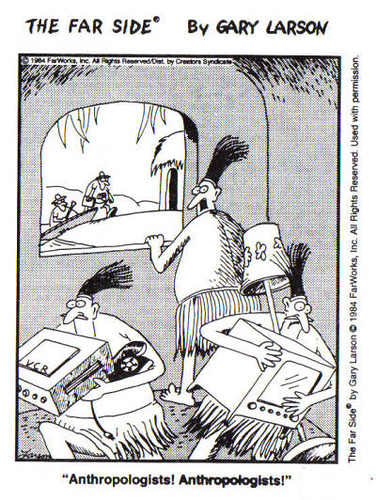
The anthropological term the ethnographic present refers to the artificial construction of a time before contact with European culture, and is best illustrated by this Far Side cartoon:

Anthropologists

Curtis worked very hard to construct such an ethnographic present in his photographs.
Continue reading