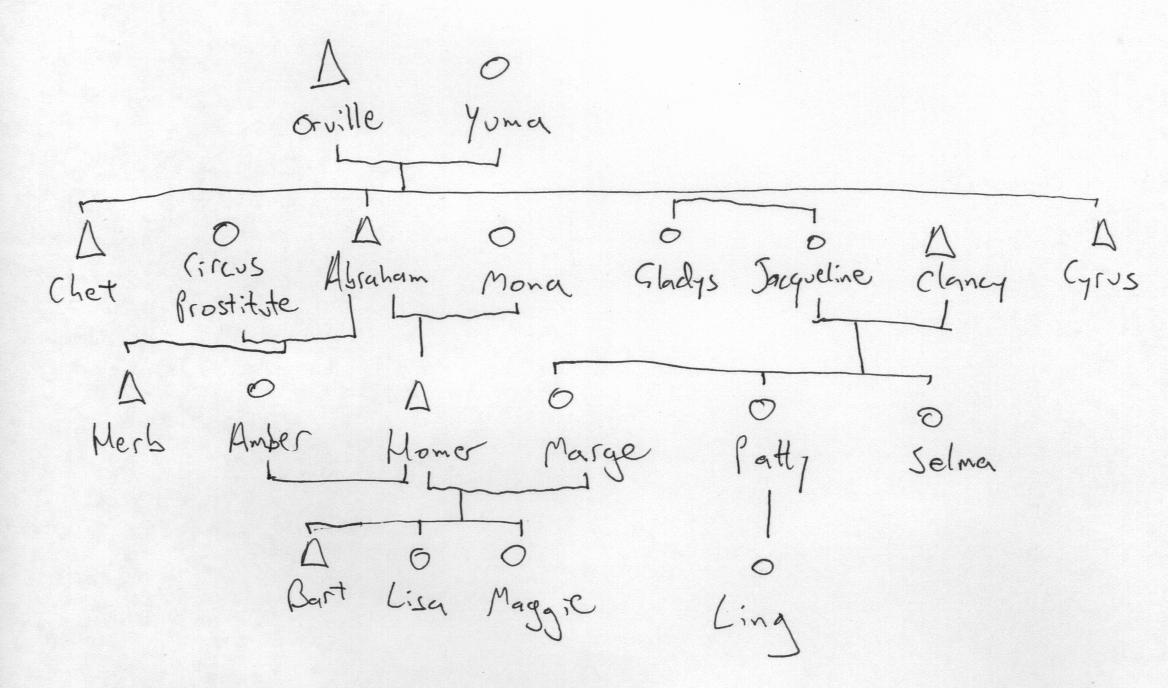
In honor of Mother’s Day this year I’m sharing notes from a lecture I give in my Introduction to Anthropology course. Kinship, I tell them, is the kernel of the discipline. Families are at the center of our lives, they make us who we are. So its interesting to note that in different cultures people have different ideas about who counts as family, what their roles ought to be within the collective, and what sorts of rights and obligations they ought to have over one another.
We spend some time doing kinship diagrams. I show them my family and lead them through exercises where they chart their own families. Such diagrams are passe I guess, but for me they hold quirky charm not unlike the lost art of diagramming sentences. I can throw them up pretty quickly on a white board and we use them in class to help visualize social relationships.
Students find patrilineal descent, which flows from fathers to offspring, to be somewhat intuitive. After all they behave in a similar way to our tradition of passing down surnames and students can anticipate how patrilineality might coincide with a a socio-economic system that favors powerful fathers and husbands. But matilineal descent which flows from mothers to offspring are strange to them, its illogic manifest most clearly in the responsibilities for discipline granted to resource providers such as uncles and brothers, with weaker bonds ascribed to biological fathers.
Matrilineality seems exotic to students, but in fact some examples of it can easily be found in one of the most ancient charter documents of “Western Civilization.” Bereishit (Genesis), the first book of the Torah (Old Testament).
I don’t know if you’ve ever just sat down and read a whole lot of the Bible. My knowledge of it is fairly limited. I am familiar with Genesis which is distinguished by its engaging mythic narratives that rewards rereading. These incredibly evocative and powerful stories caught the imagination of underground cartoonist R.Crumb and inspired him to complete a fully illustrated Book of Genesis. The Crumb illustrations, thick and fleshy, help out to humanize the characters especially for people who aren’t already familiar with the stories.
Now granted, what I’m about to do is not the usual way one reads Genesis. I’m only doing this in order to make some points about matrilineality, not to claim some sort of religious insight.
Continue reading →