Tag Archives: Ethnography

Hackers, Hippies, and the Techno-Spiritualities of Silicon Valley

I had the pleasure of hanging out with Dutch anthropologist Dorien Zandbergen (PhD, Anthropology, Leiden University) in Sweden in October at an ESF Research Conference and learning about her fascinating research into the convergence of new age spirituality and new media discourses in and around Silicon Valley. I loved the idea of a Dutch anthropologist studying me and my friends in the eco-chic Burning Man hipster scene so I asked her to riff off of a few questions for this blog. Zandbergen talked about liminality, technoscience, the California ideology, ‘multiplicit style,’ secularization, studying sideways, liberalism, internet culture, ‘pronoia’, open-endedness, emergence, the neoliberal ideal of the autonomous self, the confluence of hackers and hippies in San Francisco, the usual…

(AF) What is New Edge and how did you conduct your fieldwork?

(DZ) The term New Edge fuses the notions ‘New Age’ and ‘edgy’, as in ‘edgy technologies’. In the late 1980s, founder of the ‘cyberpunk’ magazine Mondo 2000, Ken Goffman, used the term to refer both to the overlaps and the incompatibilities between the spiritual worldview of ‘New Agers’ and the ‘geeky’ worldview of the scientists and hackers of the San Francisco Bay Area. Such interactions were articulated in the overlapping scenes of Virtual Reality development, electronic dance, computer hacking and cyberpunk fiction. I borrowed the term New Edge to study the genealogy of cultural cross-overs between – simply put – the ‘hippies’ and the ‘hackers’ of the Bay Area, beginning with the 1960s and tracing it to the current (2008) moment. Continue reading

American Democracy?

Many scholars, activists, pundits, and even a few politicians agree that American democracy is in trouble. Many reasons are given–the raw punch of money in elections, a distracted, apathetic, or misinformed population, the absence of civic education, the specter of blind patriotism, the penal threat and painful reality of police brutality. The signs of collapsing democracy are obvious: the debt ceiling debacle, the recent Supercommittee failure, Citizen United v Federal Elections Commission, a US Congress with 9% approval ratings. Our Occupy mobilizations, and our “deeply democratic” (Appadurai 2001) methodology of the General Assembly inspired as it is by the anthropological knowledge translated through our colleague David Graeber, are reactions to the failure of the present incarnation of American democracy while exclaiming our desire, voice to voice, for a more humane social democracy.

Non-fiction information, knowledge, and “the news” are essential for citizens to make wise decisions regarding the future of a democratic state. The right to media is a human right and a public resource for democratic communication. But the media is a finite resource, limited in radio, television, and the internet and limited by the amount of subjective mental bandwidth we can personally process. In the United States this media resource was allocated by the state to corporations. These America corporations were given the right and responsibility to use the “airwaves.” Part of the bargain the government struck with these companies was that they could make massive profits if they worked in the public interest by informing and educating the citizens. This responsibility they have slowly neglected and we are today left with fiction parading as fact on television news. Citizen involvement in this corporately consolidated public sphere was promised but subtly ignored. The abused or misused power of corporate media is a significant reason why democracy is failing.

Deep Democracy or Digital Democracy?
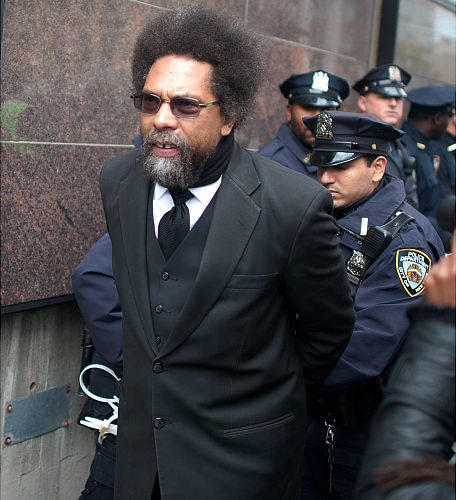
Deep Democracy or Digital Democracy? Dr. West arrested on October 21, 2011.

Continue reading

The Public Sphere of Occupy Wall Street

I keep returning to the public sphere as Habermas originally described it as I think about progressive political movements of today: Occupy Wall Street and its global dimensions, Anonymous and its more theatrical and political wing LulzSec, and progressive and independent cable television news network Current. Internet activism, television news punditry, and street-based social movements each work together implicitly or explicitly to constitute a larger public sphere. As scholars we need to resist the temptation of excluding one form of resistance as being inconsequential to social justice or to analysis and instead see all three as working together in a media ecology.

Continue reading

Anthropologist Bites Dog

I recently had an opportunity to watch José Padilha’s “Secrets of the Tribe” which purports to put “the field of anthropology… under the magnifying glass in [a] fiery investigation of the seminal research on Yanomamö Indians.” This film has been a big success at festivals, screening at Sundance, Hotdocs, etc. and has also been shown on HBO and the BBC, making it one of the most successful recent films about anthropology, yet it seems to have gotten scant attention from anthropologists.

What attention it has gotten has largely been positive, such as this glowing review in CounterPunch, or this blog post by Louis Proyect. A review in VAR was slightly more critical, but not by much. Still, the following comment from Stephen Broomer’s review gets to the heart of the matter:

Padilha’s contribution to this debate is confined within the limits of documentary form. Secrets of the Tribe is a narrative-driven documentary, and as such it privileges dramatic contrast over the reinforcement of facts or proof.

Indeed, I would go much further. The film struck me as little more than tabloid journalism, reveling in salacious scandals, academic cat fights, and conspiracy theories in the name of discussing research ethics and scientific methodology. It reminded me of one of those local news stories where a reporter exclaims how shocked he is to discover that there is prostitution in his city while the camera indulges in digitally blurred closeups of exposed female flesh.

In comparing this film to tabloid journalism I don’t mean to impute Padilha’s motives. Padilha is clearly someone who cares deeply about Brazil’s indigenous population. He also deserves credit for actually interviewing Yanomami for the film. But Padilha is not an anthropologist. As one review put it: “A student of math and physics, Padilha turned to filmmaking after a brief, unsatisfying career in banking.” (He is most famous for “Bus 174” about a hijacked bus in Rio.) For this reason he seems unable to meaningfully engage with contemporary debates about fieldwork practices or the nature of anthropological research.

I don’t really know which bothered me more: the lumping together of pedophilia accusations against Jacques Lizot and Kenneth Good with Patrick Tierney’s accusations against James Neel and Napoleon Chagnon, the fact that the film completely ignored Tim Asch even as it relies extensively on his footage, or the way it presented anthropological epistemology as a simplistic choice between the hard-science of sociobiology on the one hand and mushy-headed cultural relativism on the other.

What really upsets me is that these are serious issues, which warrant serious discussion. By simplifying the scientific debates and lumping them together with pedophilia accusations, the film missed a unique opportunity to make an important contribution to the popular understanding of anthropology. Too bad.

Ethnocharette: The Post-It Note as technology

EthnocharetteJust received news of this experiment at UC Irvine: Ethnocharette. Keith Murphy and George Marcus have documented a process of exploring a text (Robert DesJarlais’ Shelter Blues) through a studio-style design process. The website details the process and the results.  It’s always a bit hard to understand exactly how this kind of process works for people or how it’s different from a seminar discussion, for instance, or the creation of “reading responses,” but given the smiling people in the photographs, it looks like it worked. Having spent my fair share of time struggling with new media technologies from wikis to blogs to collaborative editing, there is something nice about exploring the limits of a very simple tool: post-it notes. I’ll try this out in my classes this year I think…

Eco-Chic Burning Man Hipsters

That curious identity politic that mixes neo-primitive fashion, ecological coolness, spiritual openness, upper middle class ambition, multiculturalism, and conscious consumerism can be coalesced under the moniker eco-chic–an elite contradictory expression of social justice and neoliberalism. It will be explored in the conference EcoChic: Connecting Ethical, Sustainable and Elite Consumption, put on by the European Science Foundation in October. The conference organizers see this expressive culture accurately in its rich contradictions. Eco-chic “is both the product of and a move against globalization processes. It is a set of practices, an ideological frame and a marketing strategy.” If you’ve spent anytime in Shoreditch, Haight, Williamsburg, or Silverlake you’ve got some experience with these hip, trendy elites. Ramesh calls them “Burning Man Hipsters.” I’ve been studying new media producers in America and eco-chic describes an important cultural incarnation of these knowledge producer’s value set. As far as anthropology is concerned, meta-categories such as eco-chic, liberalism, or transhumanism that cross cultural boundaries while remaining bound by class, challenge our discipline to revisit totalizing notions such as “culture” and “tribe.”

Eco-chic, like many other socio-cultural manifestations of neoliberalism is rife with contradiction. The fundamental contradiction being that it is a social justice movement within consumer capitalism. The producers of eco-chic goods and experiences are structured by capitalism’s profit motive. Likewise consumers of eco-chic goods and experiences are motivated by ideals that try to transcend or correct the ecological or deleterious human impacts of capitalism. Thus both producer and consumer of eco-chic are caught in a contradiction between their social justice drives and their suspension in the logic of neoliberalism. Eco chic events such as Burning Man and television networks such as Al Gore’s Current TV also express the fundamental contradiction between the social and the entrepreneurial in social entrepreneurialism. How do the contradictions within eco-chic represent themselves in American West Coast’s cultural expressions such as Burning Man and Current TV? Continue reading

Netroots, America, and Progressivism

Honestly, I did not know what a “progressive” really was until working the videocamera for Free Speech TV at the 2011 Netroots Nation conference in Minneapolis lat month. I thought a progressive was just another name for a Democrat or a liberal. I was wrong.

It is corny to admit it but what I discovered was a worldview and mode of political action that aligned with my own belief system as a person and an anthropologist. The core concept of progressivism is progress–that culture changes through time because of the actions of vision-driven groups and individuals. Now, how much agency individuals actually have to enact cultural change is a hotly debated topic in both political and academic circles but few disagree that “a small group of thoughtful people could change the world. Indeed, it’s the only thing that ever has” as it was that activist anthropologist, Margaret Mead, who said that most famous of hummus container quotes.

Progressive philosophy is aligned with the base theory of cultural anthropology, that is: culture is not a static or conservative thing that we need to stabilize at some nostalgic and unrealistic moment but rather a dynamic process. Progressives want to direct that process towards a more inclusive future. Progressives are not hung-up on retaining or reverting to an antique sense of ethnic, gendered, or national purity. They don’t romanticize some false sense of the securities of 1950s Americana. However, as I will describe below, The American Dream as a concept was a focal point for progressives at Netroots Nation this year. Continue reading

Information Imperialism?

By the end of the year the US State department will spend $70 million on stealth communications technologies to enable activists to communicate beyond the reach of dictators according to a recent NYT article. Prototypes include a suitcase capable of quickly blanketing a region with a free wifi network, bluetooth devices that can silently share data, software that protects the anonymity of Chinese users, independent cellphone networks in Afghanistan, and underground buried cell phones on the border of North Korea for desperate phone calls to “freedom.” These are political tools deployed to promote the agenda of one nation over that of another. How should we address information imperialism? The use of networked communications tools to subvert so-called regimes exposes a proclivity for digital intervention that likely also includes digital literacy projects to provoke revolutionary actions, propaganda campaigns to make celebrities out of bloggers, and covert code warfare. Let’s review the spectrum of information interventions to ascertain the ways and hows of information imperialism. Continue reading

MIT Profs Explain What They Do

MIT Tech TV

Thoughts on Fieldwork From Three Research Sites

Cultural Anthropology is a social science that explores how people understand – and act in – the world. But what, exactly, is it that Cultural Anthropologists do? How do they approach their research? In this short film, three members of MIT’s Anthropology Department, Stefan Helmreich, Erica James, and Heather Paxson, talk about their current work and the process of doing fieldwork.

Critical Pessimism & Media Reform Movements

The American satellite television network Free Speech TV asked me to write up a blurb for their monthly newsletter about my participatory/observatory trip with them to the National Conference on Media Reform in Boston. This is my attempt at what Henry Jenkins calls “critical pessimism”–an “exaggeration” that “frighten readers into taking action” to stop media consolidation, exclusion, and the absence of televisual diversity.

Free Speech TV at the National Conference on Media Reform

From its inception in 1995, Free Speech TV’s goal has been to infiltrate and subvert the vapid, shrill and corporately controlled American television newscape with challenging and unheard voices. Fast forward to 2011, and in the age of viral videos, social media and ubiquitous computing, the same issues persist.

An excellent young pro-freedom-of-speech organization, Free Press, called all media activists to Boston for the National Conference on Media Reform (NCMR), April 8-10, to celebrate independent media and incubate strategies to fight the tide of corporate personhood, monopolization in communication industries, and the denial of access to the public airwaves.

These are issues FSTV has long fought, first with VHS tapes of radical documentaries shipped to community access stations throughout the nation, then through satellite carriage in 30 million homes, and now via live internet video and direct dialogues with the audience through social media.

FSTV was at NCMR in full force, covering live panels on everything from the role of social media in North African revolutions to media’s sexualization of women; developing strategic relationships with print, radio, internet and television collaborators; interviewing luminaries like FCC Commissioner Copps; and inspiring the delegates by opening up the otherwise closed and corporatized satellite television world to the voices of media activists fighting for access and diversity during a frankly terrifying period in American media freedom.

One question haunted the many stages, daises and dialogues at the NCMR: Is the open, decentralized, accessible and diverse internet – by which media production, citizen journalism and community collaboration have been recently democratized – becoming closed, centralized and homogenous as it begins to look and feel more like the elite-controlled cable television system?

For example, while we were in the conference, the House voted to block the FCC from protecting our right to access an open Internet. The mergers of Comcast and NBC-Universal and AT&T/T-Mobile loomed behind every passionate oration. And yet FSTV was there to document when FCC Commissioner Copps took the stage stating he would resist the denial of network neutrality and such monopolizing mergers.

Internationally, examples of the power and problems of the internet exist. The Egypt-based Facebook group “We are all Khaled Said” had 80,000 members, many who amassed at Tahrir Square on January 26, instigating a wave of democratization that began in Tunisia – also fueled by social media – and hopefully continuing to Libya. Two days later, however, the Mubarak regime was able effectively to hit a “kill switch” on the internet and target activists using Facebook for arrest, an activity that worked against the desires of the repressive regime. At the NCMR, Democracy Now! reporter Sharif Abdel Kouddous said,  “Facebook was down … so they hit the streets. It had the reverse desire and effect that the government wanted to happen.”

In 2010, Reporters Without Borders compiled a list of 13 internet enemies – countries that suppress free speech online. The U.S. wasn’t on the list, but U.S. companies Amazon, Paypal, Mastercard, Visa and Apple were pressured to cut digital and financial support for whistleblowing WikiLeaks. The point is obvious: A vigilant press aided by an open, uncensored and unprivatized internet are necessary yet threatened and are the focus of FSTV’s coverage at NCMR.

FSTV embodies that ancient movement of ordinary people taking back power from entrenched elites. Today, every issue, from class inequality to ecological justice – is a media issue. However, our media sources, from journalists to internet and television delivery systems, are being co-opted by monopolizing corporations and lobbyists. As an independent, open and interactive television network, FSTV is an antidote to the problems facing free speech and democracy as more media power is centralized in fewer hands. Thankfully, as we found out in Boston, FSTV is not alone in this dangerous and difficult operation of media liberation.


Jenkins hyperbolically describes “critical pessimists” as people who “opt out of media altogether and live in the woods, eating acorns and lizards and reading only books published on recycled paper by small alternative presses”. This is a false exaggeration of a movement that is providing a necessary check on corporate power and mindfully working for greater civic, community, and citizen involvement in media production.

Participation, Collaboration, and Mergers

I work at UCLA’s Part.Public.Part.Lab where we investigate new modes of co-production and participation facilitated by networked technologies. Internet-enabled citizen journalism such as Current TV, public science like PatientsLikeMe, and free and open software development like Wikipedia are key foci. In the lab I investigate the vitality or closure of a moment of freedom and openness within cable television, news production, and internet video when the amateur and the alternative disrupted the professional and the mainstream. What are the promises and perils of social justice video in the age of internet/television convergence? Will internet video become as inaccessible, vapid, and homogenous as cable television? In our recent paper, Birds of the Internet: Towards a field guide to the organization and governance of participation, we draft a guide to identify two species flourishing in the internet ecology: what we call “formal social enterprises,” which include firms and non-profits, as well as the “organized publics” the enterprises foster or from which they emerge. These two types share a vertical or inverted relationship, power comes down from visionary CEOs and charismatic NGO directors to provoke rabid social media production, or a viable movement foments amongst grassroots makers that percolates upwards towards the formation of semi-elitist institutions. In light of this research and with a discreet fieldwork experience to think through I would like to clarify and address three types of social interaction: participation, collaboration, and mergers. Continue reading

What Type of Collaborator Are You?

It took me a long time, and a lot of experience, before I realized that I’m better at some kinds of fieldwork situations than others. I don’t know if there is any way to bypass this process of self-discovery, but I do think it might help those just starting out on their first research projects to be aware of the complex ways in which their own personalities interact with those of their research subjects – and how this can impact the quality of their fieldwork. I think it is important because anthropologists have a tendency to justify these choices as theoretical or political decisions, but I believe that often temperament alone may be the deciding factor.

Personally, I find I do better work when my research subjects are people who have a kind of critical consciousness which allows them to function as real collaborators in the investigation process. This isn’t a question of education or class. I’ve worked with people from poor communities who, as a result of years of activism, were much more articulate and critical of their own situation than fairly middle-class school teachers with master’s degrees. Nor is it a question of having similar politics to my research subjects, although I find that can help. Much more important is that sense that my subjects are themselves invested in the research process.

Good research requires spending a tremendous amount of time with your subjects and making significant demands on their time as well. There are all kinds of claims people make for the superiority of one research methodology over another, but I think it often comes down to who we feel comfortable working with – and what kinds of people feel comfortable working with us. Of course, there are often cases where we must do research with unsympathetic subjects, and that’s an important skill to have, but I think there are very few ethnographers who can do good work without the benefit of some kind of bond with their informants. You don’t have to like them, but you do have to be able to work with them – and working with them means much more than just having them tolerate your presence.

Social Media: From Meaning to Presence

by Jenny Cool, USC

I sometimes joke that I’ve been working in new media so long I can’t believe we still call it that. But longitude is no laughing matter in an age of time-space compression: and the persistence of novelty no accident. Yet, there is much to be gleaned from histories of the new. At least that’s what I contend in taking up Adam’s invitation to post about my 10-year study of Cyborganic, an influential group of early web geeks—producer-consumers of new forms, social imaginaries, and practices of networked communication and techno-sociality. Cyborganic spored and faded away by 2003, yet many of the genres, imaginaries, and practices that emerged out of this milieu (San Francisco’s South of Market area in the 1990s) have since become predominant on the Internet. Cyborganic members brought Wired magazine online; led the open source Apache project; and created dozens of Internet firms and projects, from bOING bOING to Craig’s List and Twitter. Continue reading

Power in Plain Sight, or, why studying up is actually not as difficult as you might think

Studying up is no longer rare in anthropology—in fact, it seems to me that it was never really as rare as anthropology’s self-understanding makes it out to be. Despite this there continue to be a series of questions that are regularly posed about studying up, questions concerning the difficulties of access; concerning the relationship between anthropologist and an informant that, by virtue of the typical anthropologists’ political leanings, she might not be particularly sympathetic with; and concerning the ability of powerful people to obscure, distort, or limit access to information. In my research for Bloomberg’s New York, I encountered a situation that made me think that these sorts of questions are misconceived and based on mistaken premises.

Unsurprisingly, and as is true of any ethnographic project, my direct access to different groups and individuals involved in the Bloomberg administration and in the debates over the development of the far west side ultimately proved to be highly uneven. This unevenness was a result of two factors–my own preexisting networks and difficulty of gaining access to certain powerful people.

Having attended graduate school in planning in NYC, I knew people involved in many different aspects of development politics in NYC. For instance, one good friend worked for the Community Board that represented the far west side, and through him I was able to gain access to and contacts within the various organizations and groups that opposed the administration’s plans for the far west side. I also knew several relatively junior planners working for the city government, who over beers and in the backs of hearing chambers and community halls were able to give me their appraisal of what was happening. While they were occasionally guarded, they tended to be pretty open, a product of both their relatively junior status–they didn’t have a huge amount at stake–and our previous relationship. And as with my friend in the opposition, they were able to make introductions to higher level policy makers and officials.

I also got access to city officials and elites of various sorts in the most typical of ethnographic fashions–by hanging around enough that I became another of the usual crowd that showed up at events related to the Hudson Yards plan (i.e.,the administration’s plans for the far west side). Once I was an established presence, starting up an informal conversation or asking for a more formal interview, even with relatively high-level officials, was not so difficult.

My own social and cultural characteristics played a role as well. As a relatively clean-cut white man from a relatively privileged background, I had enough familiarity with the trappings of power and enough exposure to wealthy and powerful people to feel relatively comfortable conversing with them and to adjust my self-presentation as the situation demanded. Again, there’s nothing particularly unique about this; anthropologists’ identities (and their manipulation) have always had a crucial impact on the shape of their fieldwork.

There was a point at which direct access became a major problem, and that was with the people at the very top levels of the administration. For example, I never was able to interview Mayor Bloomberg or the Deputy Mayor in charge of redevelopment, Daniel Doctoroff. I sent numerous letters, tried to exploit all the channels I could to get at  these two, and to other high level officials, but ultimately I was only able to get a sit-down interview with one very high-level official in the administration, and that only after he had left the administration and after I was no longer a graduate student but a professor.

However, that interview was very instructive. This official was exteremely frank with me. An ex-financier, he was completely dismissive of politicians and politics in general. He spoke openly and unselfconsciously about the need for city government to both act like a business and provide support for businesses. He made it clear that he thought that people like him were essential to both the city’s economic future and its proper governance.

In short, he made it clear to me that the conclusion I was reaching from analyzing the public actions and speech of these elites was basically a differently worded version of same story these elites were telling about themselves, albeit in a different vocabulary and with an (obviously) very different political interpretation than my own. I was beginning to see that the Bloomberg administration’s approach to governance, far from being the product of one eclectic businessman’s personal predilections and experience, was a class project, a claim to hegemony on the part of what I call in the book the city’s “postindustrial elite.” Now a member of that elite was frankly telling me that it was absolutely necssary that business elites run the city government, for it was their skills and talents that best fit the situation faced by a post-9/11 NYC faced with budget problems and fierce interurban competition. “The city needed us,” he told me. What was to me (to use crude terms) a play for capitalist hegemony in the city was to him a new commitment to public service and an effort to give back. What from my critical perspective seemed majorly problematic if not downright objectionable, from his perspective seemed an absolute and obvious necessity.

There is a sense–which I shared at the beginning of my research–that as people who share some important cultural and social characteristics with (professionalized, highly educated, relatively well-off) anthropologists, powerful and wealthy people in a place like NYC might be expected to have some some degree of reflexivity, if not self-doubt about what it is they are up to. This is not what I found. While the elites I spoke with were intelligent, thoughtful, and truly committed to what they saw as the best interests of NYC, they displayed very little doubt that they were doing the right thing, and that their critics were motivated primarily by personal/psychological factors–fear of the future, small-mindedness, greed, NIMBYism, etc–rather than by legitimate differences in political ideology, economic interest, urban identity, and so on. While there were efforts to dissemble, to obscure, to and distort the details of policy (would that piece of the project require public funding? Had there never been a plan for an alternative site for the west side Olympic stadium?) when it came to the big picture, elites were open, clear, and certain about what it was they were doing.

I think that there’s a also sense that the powerful are hiding something–that studying up is an opportunity to sweep away the curtain obscuring the working of power and see what’s really going on. But in fact, in my experience, power generally operates in plain sight. This is because the powerful operate in a world that is almost completely self-justified, thus rendering obscuration and dishonesty unnecessary. What is crucial to the ethnographic and anthropological study of power is not gaining access to its secret workings, but to understand the terms and production of its self-justification. In a sense this renders what is commonly held to be a central task of ethnography–“to undercover the hidden principles of a way of life,” to paraphrase an undergraduate text I recently taught–moot. It also makes studying up a far less difficult task than you might think.
Crazy-Ass Ethnography

Here is a question for the SM community that I’ll turn into a bit of an ‘open thread’: I’m teaching a large intro course in the fall complete (as regular readers may remember) with a textbook and a few intro ethnographies. Most of the ethnographies I’ll be teaching deal with pretty standard stuff — Hawai’i, college life, etc. I feel like the course may be missing an ‘exotic’ or ‘weird’ ethnography which… is what I’m supposed to be doing, right? So: can anyone recommend a short, easy ethnography that is on some totally crazy-ass subject that will blow students’ minds? Please note that out here in Hawai’i at lot of people are Asian so The Spirit Catches You And You Fall Down and other ethnographies of that ilk will strike students as being ‘close to home’ and not ‘exotic’. Maybe something from Africa or Latin America, which are not really on the radar over here?

p.s. I’m officially burned out on The Sambia and don’t have the strength to battle through In Search of Respect. So no recs for those, please.