Tag Archives: Culture Notes

Anthropology of the Spirit

As is well known, during the past couple of decades the anthropology of the body has been very big in the discipline. AAAs sessions organized around this theme reliably signalled prestigious institutional affiliations, funky eyewear, and willfully peculiar shoes that manage silently to show up other choices of footwear as hopelessly plebeian. Were there, across this time, AAA sessions devoted to the anthropology of the spirit, it is not impossible to suppose they were marked by para-academic institutional affiliations, ethnic apparel of indeterminate origin, applause at odd moments, and a general air of obstreperous befuddlement.

My impression is that things have now changed, mostly in response to the rise of discourses of “spirituality” (be they fundamentalist or New Age) in the contemporary context. In class today I gave a “Magic, Science, and Religion” lecture that I self-consciously designed to not risk trodding on any pious/conservative toes, only to have a heated dispute break out in the western quadrant of the lecture hall about the relationship of neopaganism and Wicca to science. It wouldn’t give me so much pause if it weren’t the second time in my short teaching career it has happened; the first being in an intro anthro course when a scheduled “discussion of witchcraft” was taken by some students to mean a discussion of witchcraft: black, white, and how to tell the difference. What I felt, in both contexts, was utterly unprepared to do anything with the turn of events other than to ask that we bracket the debate and return to “what anthropology has to say about this topic”.

At any rate, I’ve found myself pondering the fact that one of the most appealing aspects of the “anthropology of the body” framework is that it enjoins a kind of critical engagement that includes the critical-engager: everybody’s got a body, and it is surprising and interesting to learn about how the taken-for-grantedness of that body is historically/socially/culturally constructed. But not everybody has a spirit. Certainly the critical literature with which I am familiar more or less moves from the stance “people who think they have spirits do so in the following historically/socially/culturally constructed ways”.

The most inclusive stance possible within this framework is a kind of agnostic addendum: “people who think they have spirits (and maybe they do) do so…”

I don’t know. It feels like a problem but maybe it’s just yet another sign that I belong in the “obstreperous befuddlement” rather than the “cool shoes” camp of the discipline.

Wild Thoughts: Gender Edition

Welcome to the third installment of Wild Thoughts, your sporadic round-up of whatever I haven’t found time to flesh out into a full post. I haven’t been as active as I’d like the last month or so, not least because I’ve been preparing a new class (at a new school) in Women’s Studies. Entitled “Gender, Race, and Class”, the course meets two separate general ed. requirements, so it is quite popular across the spectrum of students. In preparing for the class, I’ve been collecting quite a few stories that deal with gender (as well as race and class, of course, but those will have to wait — or you can just follow Karen Brodkin’s assertion that race, class, and gender are always imbrecated and consider that these links necessarily deal with race and class because they deal with gender). In the interest of clearing my Firefox tabs, and as a follow-up of sorts to Kerim’s recent post, I present the Gender Edition:

  • The Deputy Prime Minister of the Chechen Republic, Ramzan Kadyrov, has proposed legalizing polygamy (he means polygyny), a suggestion that has been endorsed by the Deputy Speaker of the Russian Duma, who plans to introduce legislation to legalize multiple marriages across Russia. The reasoning behind these suggestions should be familiar to anthropologists: the ongoing conflict in Chechnya has decimated the male population and left millions of women widowed or unmarried, with no available, unmarried men to take on the job of supporting these “surplus” women — a textbook case, really. Left unquestioned, of course, are the various factors that leave unmarried women without adequate resources to survive — for example, the dismantling of the Soviet-era system that, whatever its faults, integrated men and women somewhat equally into the labor force, affording unmarried women some degree of autonomy. At work, too, may be a kind of population panic, as increasing numbers of women flee Russia for work — often sex work — in Western Europe or North America.
  • Continue reading

“Boy Trouble”

In an effort to fan the flames of acrimony and recrimination that burn so brightly in the comment section of this blog, I thought I’d post a link to an article in The New Republic about “poor performance by males in school”:http://www.tnr.com/doc.mhtml?i=20060123&s=whitmire012306. It begins:

It’s been a year since Harvard President Larry Summers uttered some unfortunate speculations about why so few women hold elite professorships in the sciences… Since that odd January day, Summers has been rebuked with a faculty no-confidence vote, untold talk-show hosts have weighed in, and 936 stories about the controversy have appeared in newspapers and magazines (according to LexisNexis)… Compare that with what happened after the U.S. Department of Education, also about a year ago, released a 100-plus-page report weighing academic progress by gender. The results were bracing. Nearly every chart told the same story. Boys are over 50 percent more likely than girls to repeat grades in elementary school, one-third more likely to drop out of high school, and twice as likely to be identified with a learning disability. The response? Near-total silence.

The classes that I teach are overwhelmingly female. Teaching for a predominantly female audience made me at least aware of gender bias in my teaching, and has led me to switch the default gender of all the examples I use in class. There are obviously nongenetic explanations for attendance in my class, most of which have to do with how required courses work and what sorts of people are attacted to which major. But apparently the gender imbalance in colleges and universities across the United States is widening. I wonder how long it will take for this to get picked up as a “video games are destroying our children” story?

Intelligent Design Syllabus

With new developments in the Pennsylvania Intelligent Design trial I thought SM readers might want to rise above the hue and cry of contemporary debate to a more lofty, philosophical plane. Martin Roth, a philosophy professor at Knox College, has recently “taught a course on Intelligent Design”:http://www.knox.edu/x11236.xml which is remarkably well-balanced and thorough. Of course I may be biased because I went to high school with Martin, but I think this syllabus will be of interest to any academic who is interested in the Intelligent Design debate. Savage Minds has “the syllabus available for free download”:/wp-content/image-upload/RothIntelligentDesignSyllabus.doc. Check it out.

Sex: It’s What’s for Dinner

The connection between eating and having sex is a fairly obvious one. Many of the words we use to describe sexual desire (hunger, voracious appetite) and sex acts themselves (eating out, munching), and even various body parts (my favorite: “the split knish”) refer to food — an obvious parallel given the importance of the mouth to both eating and sex. The connection is deeper than just slang, though — Edmund Leach noted in 1964 that the way we categorize the animals we eat and the way we categorize potential sex partners are parallel as well (at least in mid-century Britain): women and animals that live in the home (sisters, dogs) are off-limits for eating and/or sex; animals and women that live outside the domestic sphere (cattle and other animals that roam more or less freely, neighbors) are potential sex and marriage partners; and the truly exotic, those living entirely outside of the familiar world altogether (emu, Africans — from a British perspective) are neither food nor sex partners. Among the Arapesh and Adelam peoples studied by Margaret Mead (1935), a man could eat neither one’s own yams and pigs nor one’s own mother and sister, while:

Other people’s mothers
Other people’s sisters
Other people’s pigs
Other people’s yams which they have piled up
You may eat (Mead: 78).

With such a thin line between eating and “eating”, it seems unsurprising that some people would seek to combine the two more explicitly. Enter the cann-fetish (some explicit langauge, probably not worksafe) — cannibal fetishism (or cannibalism fetish). While many of us are familiar with the case of Armin Meiwes, the German man convicted recently of killing and eating a partner he met and coordinated the killing with over the Internet, Meiwes represents an extreme distortion of what is becoming a significant, if small, fetish community. For the most part, cann-fetishists stop short of actually eating or hurting anyone, rather endulging in a rather elaborate pretend-feast involving trussing the “meal” (generally a willing female, who is bound and whose various orifices will be poked, prodded, and filled with various trimmings and cooking implements), coating her (or, apparently far more rarely, him) with oil, butter, honey, and other basting substances, and “cooking” her in a make-believe oven.
Continue reading

The Hasidic Reggae of Matisyahu

This is the first in a hopefully ongoing series of Savage Minds posts about music I and my fellow SM’ers care about. The subject is, loosely speaking, “world music”, with all the ambiguities and troubling exoticisms that phrase implies. My hope is merely that, given the wide range of music that we as anthropologists are likely to come across (and, perhaps, be somewhat more receptive to than the average listener), we can expose some of our readers to music they might not otherwise have heard of.

My first entry comes from the “unlikely bedfellows” category: Matisyahu, the Hasidic Jew with the mighty dub reggae sound. Born in 1979 to a secular Jewish family in Pennsylvania and migratory throughout his childhood, Matisyahu joined the Chabad Lubavitchers at age 19 following a trip to Israel and a couple years of soul-searching. A Phish and Grateful Dead follower in his teen years, Matisyahu brought a jam-band sensibility to his religious expression, finding in dub reggae — with its already-existing religious imagery (Zion, Babylon, lost tribes, etc.) and message of peace — a way to be Jewish.

Today Matisyahu lives in Crown Heights, a crossroads of traditions and aesthetics in the heart of Brooklyn. His music represents the other side of the anxieties that fueled the riots in 1991, cutting across musical and spiritual traditions with an ease which has won him fans across the racial spectrum — and on both sides of the Atlantic. The image of this mensch, in his black suit, full beard, and fedora (sans sidelocks — which are not shared by all Hasidim, especially those of Russian descent) , belting out rhymes can be jarring, at first (this video clip includes excerpts from his live performances) — most of us think of Hasidim as a kind of urban Amish, not as beatboxing jammers. But the spiritual exhortations of Matisyahu follow easily from the mysticism and joyful prayer of the Hasidic tradition, and music has ever been part of the celebration of life that is central to the Jewish tradition.

For a taste of Matisyahu’s music, you can download the following MP3s from JDub Records, Matisyahu’s label:

Warrior (Laswell Dub)
King Without a Crown (live)
Heights (live)

Or listen to the whole album Matisyahu Live at Stubbs at the album’s homepage.

When Monogamy Isn’t Monogamous

Every time I teach the section on marriage in my Intro to Anthro class, I inevitably face the same question. The book lists four types of marriage: monogamy, polygyny, polyandry, and group marriage. and someone always asks “What about swingers?” (Of course, I live and teach in Vegas…) The question points to a limitation of the concept of marriage not just for anthropological understanding but even within our own everyday usage.

Writers Em and Lo confront these limitations in their current New York Magazine piece The New Monogamy, addressing the kinds of open relationships that some married couples are evolving in order to both maintain their commitment to each other and manage their attractions to other people. Em and Lo’s “new monogamists” represent a new twist on the more well-established swinger scene, combining professional lifestyles, post-feminism, and a modern psychotherapeutic understanding of sex, relationships, and the self in an attempt to navigate the pitfalls of tradtional marriage in a society increasingly ill-equipped for long-term exclusive bonding.

Continue reading

I’m not an anthropologist, but I play one on TV

The anthropological grapevine reports that the Discovery Channel is looking for anthropologists or other people interested in foreign cultures (but not “in a tourist or host/reporter way”) for a new TV show and have started posting flyers around UCLA:

Discovery Channel is looking for a host for a TV pilot about
immersion in other cultures.

“We’re seeking a male and female (late 20s – late 30s), any ethnicity, with a background/education/experience in anthropology, sociology, archaeology, or similar studies. Ideally this person has overseas expedition experience/interaction with other cultures. Must be outgoing, adventurous, low maintenance, TV attractive, have a real thirst for learning about other cultures (mostly third world), yet NOT in a tourists way or host/reporter on “the scene.” It is likely, the man and woman would both immerse themselves in other cultures, and see in part how their experiences differ because of gender.

The time commitment will be rather intensive and extensive so must be able to be out of the country weeks, if not a couple of months on, end depending on if this television pilot goes to series. Flyers are posted on the boards for how to submit audition tapes.

Unfortunately there were no instructions on how to submit audition tapes for people who do not live in Los Angeles, which is a pity since I am sure that most if not all of SM’s regular readership are “TV attractive.”

For a while I thought about the possibility of subsidizing field research by taking endorsements — you know, walking around my fieldsite like a nascar racer covered in ads for my sponsor. However this looks like a much better way to fund research — what could sound more hip than a field project which had “a reflexive research methodology with a strong multimedia component”?

What You Really Really Want

Unlike the Spice Girls, I do not often ask my audience what they want, what they really really want. I think of myself as my students’ personal trainer, except I help them develop minds — rather than buns — of steel. I have many colleagues in Hawai’i and abroad who worry that education is becoming ‘commodified’ and that people increasingly think of paying for an education as being similar to buying a new Camaro. While they worry about students demanding ‘customer satisfaction’ the largest issue in education I’ve run across today is an emphasis on credentialing rather than educating. Students that I encounter at universities across the US are less worried about achieving a state of satisfaction than earning an A, and approach classes more worried about the cultivation of their transcript than their sensibilities. Obviously, trying to get a great grade in a course is not exactly orthogonal to learning anything, but the shift in emphasis does sometimes make my job harder.

This is why I like the image of the personal trainer — it helps people understand what they are getting for their money: an opportunity to undergo a personal transformation which they may or may not take advantage of. It also helps underline another aspect of the teacher-student relationship which I believe quite strongly in despite the prevailing egalitarianism of our times: students do not know what they want or need out of an education — that is why they need us to guide them through it. Like Dante or Luke Skywalker, they need old guys in robes to guide them and unleash their potential.

That’s why I was struck by 37 Signals’s “recent blog entry”:http://37signals.com/svn/archives2/people_dont_know_how_to_ask_for_what_they_really_want.php. As designers of websites and other things, they note that

Nobody knows what they really want before they get it. Not consumers, not conference goers, not programmers, and certainly not clients. Delivering greatness requires you to let go of the safety in mediocrity where you just do as you’re told.

For people working in the private sector, this is quite an insight. But my general feeling is: duh. I am reminded of the shift that has occurred in restaurant menus over the past couple of decades. Today menus are elaborate paeons to the food diners are about to consume. But traditionally the menus at America’s great restaurants had menus that read ‘five courses of fish in different sauces.’ They didn’t elaborate, because the chef was clearly more capable of deciding what you ought to eat then you were. The client, after all, waits on the souffle — not the other way around.

The wonderful thing about 37 Signals’s entry is that it helps to remind educators fearful of creeping consumerism that people who Get It — and 37 Signals is an outstanding company that does Get It — come to understand what they do as similar to education. This is, of course, the exact opposite of the trend that educators fear. Contrary to Hannah Arendt’s disparaging remarks about academics’ fear of anything not inherently mediocre (which are, unfortunately, not entirely off the mark), this is a case where people who excel at what they do have come to an understanding that is in line with, not opposed to, the ideals of the academy.

Ghost Dancing in the New Millenium

Via BoingBoing comes Paul Saffo’s article on “The Ghost Dances” of the modern world. Using the historical Ghost Dance as a template, Saffo explores the myriad movements rising on all sides of the political and technological spectrum attempting to wrest control of people’s lives and communities from forces that have grown out of local control.

[It’s] dark history has made the Ghost Dance an anthropological shorthand for any millennial movement preaching a rejection of alien novelties and a return to traditional ways. The Ghost Dance is very much alive today. The global rise of religious fundamentalism is pure Ghost Dance, be it Islamic fundamentalists pining for a return to the Caliphate, Jewish fundamentalists battling moderate secularism, or Christian fundamentalists preaching an imminent Second Coming. The current opposition to evolutionary theory is an indelible example of the Ghost Dancing phenomenon. From this opposition has arisen “creation science,” a deeply contradictory belief system that attempts to use scientific method to discredit scientific theory to prove the literal truth of the Biblical version of creation.

Although I might question the device of an “anthropological shorthand” that generalizes and dehistoricizes a very specific complex of ideas — especially when anthropologists already have a general name for such movements (“revitalization movements”) — I think there is something useful in Saffo’s comparison, notably his recognition that such movements are never about a pure “return to the past” but are, rather, an attempt to “rescue” the past and re-deploy it to create a more satisfying present and future.

The Ghost Dance and it’s political-spiritual cousins are distinctly modern phenomena, in both their goals and their methodologies. As Saffo writes, “Embracing coveted portions of what one opposes in the service of returning an old order is a signature of the Ghost Dance.” Thus we have nuclear technology, the Internet, and the modern transportation system drafted into service in the interest of restoring the social order — even when the desired social order is Muhammad in Medina, the Jerusalem of the Second Temple, pre-contact North America, or even the New Primitivists’ pre-agricultural nomadism. Rather than rejecting modernity outright, these movements often accept the best aspects of modernity (though the definition of which aspects are “best” can vary widely) while rejecting the aspects that minimize individual human dignity (itself a very “modern” idea) or threaten the possibility of community/communion/communitas. That advancing the interests of the individual while protecting the sense of collective identity are often contradictory is only one of many contradictions that not only shape but motivate the modern Ghost Dancer.

The downside of Saffo’s comparison is that it tends to limit our responses. The original Ghost Dance was a response to very real pressures faced by American Indians at the end of the 19th century — yet the implications of the movement were threatening enough to the social order of the day that the Dance was banned and ultimately the movement destroyed, with much new suffering and bloodshed in the process. The labelling of modern reviatalization movements suggests only two avenues of response: either we destroy them, as we did in the late 1800s, or we watch them fade away. Today’s Ghost Dancers have vastly more leverage than the Native Americans of the American frontier — a handful of men with box cutters can embroil the entire world in conflict. The idea that we can destroy every instance of resistance to a growing techno-political world order is foolish — especially when more and more of us are finding ourselves on the other side of the techno-political divide. Without addressing the concerns underlying these movements, it seems unlikely that they will fade away, either — new movements will pop up as other movements run out of steam, because the alternative for most people is simply too grisly to endure for long. So far, the threat posed by the most extreme and most heavily armed of the modern Ghost Dancers has made any consideration of the issues they are responding to seem impossible, even treasonous, making it likely that these movements will continue to exist.

In a Durkheimian sense, though, perhaps the existence of Ghost Dancers is a necessary part of modernity itself, acting as a check on the worst excesses of the modern regime. For the average person in today’s world, these movements form the boundaries of human expression, lighthouses and buoys marking out the rocky coasts and allowing the rest of us to tack a more or less safe route through dangerous waters. Like Durkheim’s suicides, it may be that society produces its own discontents — that they are, indeed, the most modern among us.

Meditations on The Brothers Grimm

I saw Terry Gilliam’s fairy-tale fantasy The Brothers Grimm over the weekend. As a big fan of Gilliam’s movies, I liked it, but while I plan to reference the film here, this is not going to be a straight-forward review. Rather, the film got me thinking about the historical Grimms and their relation to anthropology, and it is this I plan to write about, mediated by Gilliam’s vision and my own spotty memory of the Grimms’ work and lives. That said, if you haven’t seen the movie and plan to, you may want to skip this post for awhile (though it’s hard to imagine what I could give away about a movie you should already know begins “once upon a time” and ends “and they lived happily ever after”).

The Brothers Grimm is a highly fantasized story inspired loosely by, rather than based on, the lives of folklorists Jacob and Wilhelm Grimm. Set at the end of the 18th century, in French-occupied Germany, Gilliam’s Brothers Grimm are a pair of hucksters who use their scholarly knowledge of Germanic folktales to fleece superstitious peasants by combating the witches, trolls, and other bogeymen that haunt their villages. Captured by the French for their fraudulent activities, they are condemned to die — unless they can solve the real mystery of young girls (including Little Red Riding Hood and Hansel’s sister Gretel) disappearing from a Bavarian village under their captor’s command. Order is wanted, and the Brothers Grimm are assigned to establish it.

The real Brothers Grimm were not, so far as we know, hucksters. Neither were they collectors of children’s literature, despite the status of their work today. Rather, the Grimms were linguists and scholars attempting to document and construct a Germanic national literature, and through it, a German national consciousness — what Boas would later call their Volksgeist. Remember that, before 1871, Germany had no existence as a unified nation-state; to the contrary, it was a loose collection of kingdoms, duchies, baronies, and papal electorates, almost coincidentally geographically co-terminous and only theoretically unified by a shared language.

Continue reading

Pizarro, Millais, Diamond, and Yali: Our Last Waltz

Below is our last post this time around. It’s been engaging and productive meeting many of you in blogland. Cheers from Fred and Deborah

                                                                                                                                ***

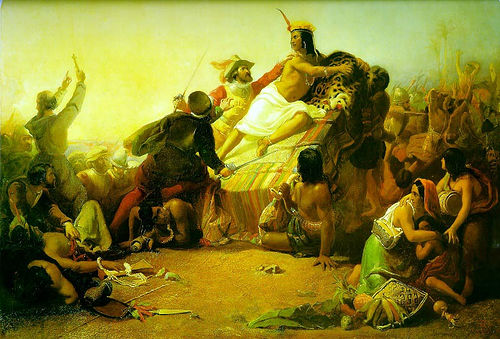
The anthropological view of history we present in Yali’s Question is crucially unlike Diamond’s in its emphasis on what needs to be taken into account. Diamond, less by default than by design, denies significance to cultural differences — to particular, historically located visions of the desirable and the feasible. The dissimilarity in our approaches is clarified by what we make of Diamond’s book cover. This cover reproduces a large oil painting by John Everett Millais (1845) entitled “Pizarro seizing the Inca of Peru.”

display_image

The painting, hanging in London’s Victoria and Albert Museum, is part of a collection (begun in 1852) representing the various, often diverse, aesthetic currents of the Victorian age. In the center, Pizarro, sword in hand, is seizing a darkly handsome, grandly exotic Inca leader from his partially overturned palanquin. On the left are massed Spanish soldiers with a priest holding up a cross for their inspiration. In the right foreground, two Peruvian women and a child are clutching each other in fear. In the right somewhat blurred and darker background, Spanish soldiers are putting Peruvians to the sword. The painting (perhaps anticipating Millais’s later anti-Catholic work) seems directly critical of Spanish conquest. Certainly, this is the perspective of Joseph Kestner, who describes the picture (in the Journal of Pre-Raphaelite Studies) as an “anti-Imperialist canvas during a decade of British expansionism and colonial defense” (1995: 55).

When we look at this painting and think about the place in which it hangs, we reflect on a particular and complex history — on the range of sensibilities and political perspectives that existed within this age dominated by capitalism and empire. However, when we look at this painting as it appears on the cover of Diamond’s book, we find it interesting because of the extent to which it is decontextualized, and we think, misunderstood. Rather than a historically located castigation of Spanish imperialism, it is offered as a synopsis of human history in general — a history of morally neutral conquest through the use of techniques and technologies of physical domination. In other words, from our anthropological perspective, we see Millais’s vision, itself critical of the dominant expansionist perspective of his age, transformed into a model that justifies as well as universalizes expansionism: one used to explain what happened to “everybody for the last 13,000 years” (1997: 9). Such a transformation of Millais’s critique of imperialism strikes us as consistent with Diamond’s position about the irrelevance of cultural and historical contexts in understanding what people do. Indeed, given Diamond’s view of history, the conquest that he (rather mechanistically) entitles “Collision at Cajamarca” (1997: 67), was inevitable. From his perspective, if it wasn’t Pizarro who had seized the Inca of Peru, it would have been some other European at some time.
Continue reading

On Human Nature and Responsibiity

Diamond’s conflation between the necessary and the sufficient grows out of the link between his interest in "history's broadest pattern" (1997: 420) and his determination to develop "human history as a science, on a par with acknowledged historical sciences such as astronomy, geology, and evolutionary biology" (1997: 408).  As he says, his book "attempts to provide a short history of everybody for the last 13,000 years .... [and searches] for ultimate explanations ... [that push] back the chain of historical causation as far as possible" (1997: 9).  Crucial to this search for law like explanations that will generate long chains of causation back to first causes (chains of causation that even link mountain range formation to Yali's quandary) is Diamond's distinction between ultimate and proximate causes.  Ultimate causes are those broadly applicable and pervasive forces, such as guns, germs, and steel.  Diamond is interested in these causes because he thinks they are the ones which really drive history – both past and present.  These ultimate causes shape derivative and more immediate occurrences, such as particular battles, conquests, economic systems.  The effects of these more immediate occurrences, in turn, become proximate causes of yet other events. 

Diamond's view of an inevitable and inexorable course of human history, one driven by the operation of ultimate causes over the span of its 13,000-year course, rests (as some of you suggested in earlier postings)  on what seems to us to be an implicit view of human nature.   It is this human nature which, in his vision, keeps ultimate causes active and decisive throughout history.  This is a view of human beings as necessarily leading lives so as to extract maximum advantage over others:  give a guy -- any guy -- half a chance and he will conquer the world;  give a guy a piece of appropriate metal and he will inevitably fashion a sword to cut you down;  give a guy a piece of appropriate metal and he will inevitably fashion a chain to enslave you within the hold of a ship bound for a New World sugar plantation.  In a way that many in the contemporary West find seemingly self-evident --  in a way that does not problematize the way the world works -- Diamond suggests that people everywhere and at all times, if they had sufficient power, would necessarily use it in seeking to maximize their own advantage through the domination of others.  This implicit view of a trans-historical and trans-cultural human nature is consistent with Diamond's explicit rendering of both historical context and cultural perspective as irrelevant.  In fact, Diamond works hard to exclude such perspective and context from his scientific history. 

Correspondingly, Diamond describes the rise of mercantilism and capitalism as only "proximate forces" in the course of world history (1997: 10).  From his perspective, mercantilism and capitalism are just epiphenomena -- just passing examples of history's general law.  From our perspective, however, mercantilism and capitalism provide particular historical contexts in which (and in different though related ways) expansionist conquest appears an especially desirable activity -- and one made especially feasible by the availability of guns, germs, and steel.  This is to say, rather than merely proximate causes of lives more fundamentally and inexorably determined, mercantilism and capitalism impel the use of guns, germs, and steel in particular manners for particular ends.  

Mercantilism and capitalism have spurred people to be bold -- to go to the ends of the earth if necessary -- in a search for ever greater profits. They have justified the subjugation of the New World as well as parts of Africa.  They have also authorized the creation of lucrative, slave-run plantations in the Caribbean whose profits sustained the lavish lifestyles of the absentee planters and whose sugar sustained (in nutritionally imbalanced sweet tea and treacle-smeared bread) the impoverished lives of the British workers -- those who manufactured the guns, chains, and instruments of torture.

Thus, we see such lives and historical outcomes as made possible by (for instance) guns, germs, and steel but as importantly propelled and shaped by cultural visions of what was worth pursuing and at what cost:  of winning favor from God and King, acquiring gold and silver, attaining certain lifestyles, or achieving national strength.  However, where we see the likes of guns, germs, and steel as necessary but not sufficient causes of such lives, Diamond sees such lives -- apparently all lives -- as inevitably seeking as much conquest and domination as possible.  For Diamond, in other words, the necessary is the sufficient.  To have the power is to express the power;  to have the power to dominate is to use it to dominate in the maximal way possible.  Where we see human activities as propelled and shaped by historically located visions, Diamond sees these activities as determined (presumably) by hard wiring -- as part of the biological nature of the human animal.  In these regards, activities of conquest and domination are simply in the nature of things -- just as, for instance, lions by virtue of their size and armament will inevitably slaughter lambs. 

Where  Diamond sees activities of conquest and domination as simply in the nature of things – as the inevitable outcome of human nature. -- Raymond Kelly's recent comprehensive analysis of the origins of human warfare provides a relevant and contrasting view of human nature and of inevitability.  In this critique of the Hobbesian notion that there is a "trinity of interrelationship between human nature, war and the constitution of society" (Kelly, 2000:  121), he writes:  

Warfare is an episodic feature of human history and prehistory observed at certain times and places but not others. Moreover, the vast majority of societies in which warfare does occur are characterized by the alteration of war and peace; there are relatively few societies — only about 6 percent — in which warfare is continual and peace almost unknown. It is only in this relatively small percentage of cases that something approaching a Hobbesian social condition of pervasive and unending warfare can be found. It might thus be said that it is “the nature of man” (or humankind) to conclude episodes of armed conflict between neighboring social groups by breaking off hostilities, by truce, and/or by reestablishing peaceful relations (Kelly, 2000: 124).

Kelly concludes:

The human propensity to peacemaking, so strikingly evident from the characteristic alteration between war and peace, is central to the nexus of interrelationships between human nature, war and society — and this bodes well for the future (2000: 161).

It is the case that Yali was poor and that the people of the New World were brutally conquered by representatives of the Old.  It is also the case that those who beat up on other people have the capacity to do so.  But are these facts inevitable by virtue either of the nature of history or the nature of humans?  As Kelly indicates, human beings always are capable of a range of behaviors and they always are capable of engaging with each other and their neighbors in a range of ways.  They might make war, but they also might make peace.  Whether they choose one or the other is powerfully affected by particular historically and culturally located ideas  about  the desirable and the feasible. 

To our position concerning history's rootedness in human culture, rather than in human nature, we would add an emphatic stipulation.  Since it has become clear to anthropologists that cultures contain multiple perspectives about alternatives and how they might be pursued and otherwise dealt with, it follows that human beings have a measure of choice about how to act.  Thus, for instance, from American ideas of the worth of the individual, one can generate political perspectives as diverse as libertarianism and welfare statism, the first position holding that no individual should be interfered with or regulated, the other, that no individual should be neglected or deprived.  The existence of such alternatives means that human beings may, realistically, be held accountable for the choices they make.  We find this stipulation important both in combating Diamond's general world history and in constructing an aspect of Papua New Guinea's more particular one.  Pizarro (for example) had the capacity and resources to behave with remarkable brutality in the New World -- he had both the technology and will to conquer.  But the mere capacity to behave brutally does not absolve him from having done so.  Likewise, Europeans had the resources to treat Yali and other Papua New Guineans with contempt.  But that position should not absolve them from having done so.  Such considerations, we argue, are important in rethinking historical outcomes.  Indeed, the haves may be prompted to do such rethinking themselves by recognizing that the have-nots may already have come to their own conclusions.  
Diamond’s Argument about the Haves and Have-Nots

In earlier postings, we suggested that Diamond gets Yali's question wrong.  Whereas Diamond understands Yali to be asking about "things" -- about Western "goods" -- Yali was actually asking about social equality.  Whereas Diamond thinks Yali envied nifty Western stuff, Yali actually resented the not-so-nifty Western condescension that allowed Europeans to deny PNGuineans fundamental worth.  The misunderstanding matters, we think, as more than an issue of factual error.  That Diamond does not stretch his imagination to understand Yali's cultural views is consistent with the history he presents.  This is a history that he believes happened for reasons that we in the contemporary West already believe in.  It is a history that accords with our view of how the world fundamentally works.  Because such a history conveys the perspectives of the "haves," it not only hinges on the (seemingly) self-evident, it also sustains the self-interested. 

Many of you know the 13,000 years of human history that Diamond sets out in response to Yali's question – and so we won’t repeat it here.  In telling this history, readers learn that Yali's circumstances did not reflect any lack either in his intelligence or in that of other PNGuineans (and, of course, we agree).  Rather, we learn that Yali was poor and relatively powerless in his own domain because his ancestors lacked access to the mineral resources, domesticable animals, and the other advantages that allowed some to conquer others.  He was born, in terms of the luck-of-the-environmental draw, on the wrong side of the great geographical divide.  

Yet neither Yali nor most of the other PNGuineans we have known over our years in PNG would be satisfied with the inexorability of Diamond's luck-of-the-draw sort of answer, with the implications of his "that's-just-the-way things-were (and must-be)" sort of response.  Such an answer would strike them as a perverse justification of colonial forms of inequality, part of a story that denied them moral worth in the past, to say nothing of the future.  However, it is just this sort of answer, just this sort of invocation of historical inevitability, that tends to satisfy those who are already the haves.  In this regard, the ideology inherent in Diamond's reasoning goes well beyond the particulars of the history he presents.  This ideology supports the status quo, the interests of the already powerful.   For them, the inevitable and the inexorable are readily synonymous with the interests of the haves over the have-nots.  

More broadly, the ideology inherent in Diamond's reasoning is one we confront as teachers and scholars dealing primarily with the haves.  Students tell us that their parents encourage them to read Diamond's book, finding it invigorating.  The (former) president of Fred's college urged his faculty to read it.  In fact, he sent copies of Guns, Germs, and Steel to members of the faculty as a model of the kind of book he admired.  All over the United States, we learned, deans and presidents of other pricey institutions applaud the book.  At Cornell, it became assigned reading for all freshmen.  Moreover, many institutions pay Diamond generously to summarize his views in person, generally in packed lecture halls.  And, of course, there is his National Geogoraphic series.    We think such educated haves like the book so well because it resonates so much and so easily with their own concerns -- in effect, because it so readily sustains them.  They come away from the book (or lecture, or TV show) feeling pretty good about themselves -- both enlightened and open-minded.  They come away seeing the world without racial prejudice and having learned some important new facts and connections.  Furthermore, and significantly, they come away comfortably convinced that they have their cargo (unlike Yali and his people) for inevitable and impersonal geographic reasons.  No one is to blame for the fact that some people are, and no doubt will continue to be, the haves and that others are, and will continue to be, the have-nots.  Thus, Diamond's history is not only the delineation of an inexorable and inevitable trajectory.  It is, as well, both retrospective and prospective.  His depiction of the past provides a far from disinterested model for understanding the present and for shaping the future.  This is to say, he presents the world as one in which the have-nots, whether in PNG or elsewhere, must (seemingly) forever deal with the haves under conditions of fundamental disadvantage. 

But, what exactly is wrong with the history that Diamond presents?   Didn't the events Diamond relates really happen?  Must a history necessarily be disqualified because it conveys the perspectives and interests of the victors, of the haves?  Isn't Diamond's view simply informed by hard-headed realism about the way the world works?  

We certainly do not deny that certain forms of power had a significant role in effecting the kinds of historical events that Diamond delineates.  Diamond's depiction of the role that guns, germs, and steel played is often plausible.  What we do challenge is his conflation of the necessary with the sufficient.  This is to say, just because guns, germs, and steel were necessary to make certain historical outcomes possible, including those so upsetting to Yali, we do not have to assume that their possession was sufficient to explain these outcomes.  Just because sources of power are available, we cannot conclude that the power will be used for certain ends, or even that it will be used at all.  And, simply because European colonists had the power to pursue their interests at the expense of Yali and other PNGuineans, does not fully explain – or justify –  the ways in which they chose to use this power.  More later…….

On cargo and cults — and Yali’s Question

As we suggested in our first posting, Yali and other PNGuineans became preoccupied with the refusal of many whites to recognize their full human-ness -- to make blacks and whites equal players in the same history.  In their efforts to establish the exchanges on which the elusive equality would be based, many PNGuineans sought, often through magical and ritual means, the European things -- the "cargo" -- that whites so evidently valued.  It would be an error, however, to believe that it was the things alone that interested them.  Rather, with these things, they hoped to become interesting and socially significant (exchange-worthy) to the Europeans.  

In Road Belong Cargo, Lawrence describes the attempts of Yali and his neighbors to acquire this cargo with a definition of what is now known as the cargo cult:  

"It is based on the natives' belief that European goods (cargo) -- ships, aircraft, trade articles, and military equipment -- are not man-made but have to be obtained from a non-human or divine source.  It expresses the followers' dissatisfaction with their status in colonial society, which is to be improved imminently or eventually by the acquisition of new wealth.  It has, therefore, a disruptive influence and is regarded by the .... Australian Administration ... as one of the [its] most serious problems " (1964: 1).

Deeply resenting their inferiority in colonial society, PNGuineans sought for decades to improve their status by gaining access to cargo.  In fact, during Fred's early PNG research in New Britain on the island of Karavar (in 1968 and 1972) local people remained preoccupied with gaining long denied respect from Europeans.  In discussing their contemporary cargo activities (which focused on learning how to place an order such that a small payment would elicit a shipload of manufactured items), they described a history of their efforts to compel Europeans to recognize mutual human-ness.  In particular, they referred to the "dog movement," a series of meetings they held during the 1930's.  The question addressed with perplexity and anger at these meetings was why the Europeans persisted in treating them with contempt -- driving them away, telling them to get out, as if they were unwelcome dogs.  Through obtaining cargo, they sought to win European respect by having that which Europeans so obviously valued.   

Over a considerable period of time, hence, PNGuineans frequently sought to acquire and master the ritual techniques by which Europeans accessed cargo.  Influenced by Yali or other cargo-cult leaders, they tried a combination of recalcitrance and ritual experimentation.  They interrupted and transformed normal routines:  they refused to pay taxes, repudiated the directions of colonial administrators, established alternative governments, wrested theological control from missionaries, and mobilized villages, if not whole regions, in fervent invocation and prophesy.  

Diamond, hence, misunderstands what many PNGuineans desired when he explains the background to Yali's question (about the differences between white and black people).  In Diamond's words:  "whites had arrived, imposed centralized government, and brought material goods whose value New Guineans instantly recognized, ranging from steel axes, matches, and medicines to clothing, soft drinks, and umbrellas.  In New Guinea all these goods were referred to collectively as 'cargo'" (1999: 14).  Because Diamond misunderstands that Yali really was asking less about cargo per se than about colonial relationships between white and black people, he describes the introduction of centralized government as almost parenthetical to the indisputable fact that whites and their goods had arrived.  Thus, he presents local resentment as directed not at the nature and use of concerted colonial power so much as at the differential access to goods.  

We might also note here that in using the term "goods" Diamond implies that such items were inherently desirable -- instantly recognizable as worth acquiring.  In defining cargo as goods, Diamond suggests that local people will do whatever it takes to get such things:  that in their desire for goods, local people are the agents of their own domination.  In so doing, he displaces our attention from the nature of colonial power relations.  These relationships are not vested in the "nature of things."  They are not inevitable because of the instantly recognized value of manufactured items.  Instead, colonial relationships have been forcefully imposed, often to the resentment and resistance of local people.  

PNGuineans such as Yali wanted cargo not because of its inherent and instantly recognizable value, but because of a desire to transform the relations of inequality between whites and blacks that were pervasive in colonialism.  They wanted cargo primarily because they objected to the ways in which the centralized, colonial government used power and, correspondingly, diminished their relative worth.