I keep returning to the public sphere as Habermas originally described it as I think about progressive political movements of today: Occupy Wall Street and its global dimensions, Anonymous and its more theatrical and political wing LulzSec, and progressive and independent cable television news network Current. Internet activism, television news punditry, and street-based social movements each work together implicitly or explicitly to constitute a larger public sphere. As scholars we need to resist the temptation of excluding one form of resistance as being inconsequential to social justice or to analysis and instead see all three as working together in a media ecology.
Tag Archives: activism
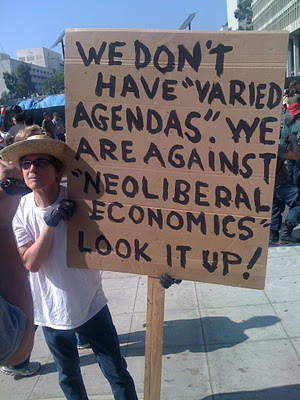
Academia and #OWS: An open thread
There have been a couple of good posts online about the links between anthropology and the Occupy Wall Street protests. See, in particular, these links:
- Why We Protest
- David Graeber: anthropologist, anarchist, financial analyst*
- Anthropology and Occupy Wall Street
- “Similar to the Third World debt crisis” – David Graeber on ‘Occupy Wall Street’
As many of these posts make a lot of David Graeber’s contribution, I also recommend reading Aaron Bady’s post “Intellectual Roots of Wall St. Protest Lie in Academe” where Graeber responds to the attempts by the Chronicle of Higher Education to paint him as a “leader” of a leaderless movement.
Anyway, reading all this I was thinking back to how important universities were to the protest movements of the 60s, and the few “teach ins” I attended as an observer during the buildup to the US invasion of Afghanistan, and I was wondering if there weren’t more stories to be told here? What’s happening on college campuses in the US? Are there teach ins about economic inequality? Is #OWS affecting class discussion? Research topics? Campus politics? Consider this an open thread on the links between #OWS and academia.
UPDATES:
Forget Steve Jobs
I can’t stand this tech bubble blowing hagiography that has gone down since Jobs’s retirement as Apple’s CEO. Tech rag Gigaom founder Om Malik found out and cried: “It is incredibly hard for me to write right now. To me, like many of you, it is an incredibly emotional moment. I cannot look at Twitter, and through the mist in my eyes, I am having a tough time focusing on the screen of this computer.” Wired just an hour ago posted an article consisting of fawning billionaires dreamily revisiting touching Him. Come on Om, just take my hand, you can look at Twitter! So much for the illusion of journalist impartiality. Malik’s sentiment is serious though. He is one of the many who’ve gotten rich on selling the illusion of Jobs as a visionary auteur. Silicon Valley, ever the retailers of vaporware–technology that facilitates experiences we neither need nor want nor, often, come to market–needs fantasy as much as Hollywood need the illusion of celebrity to prop ups its market domination in the selling of stardust.
Jobs is an excellent example of the way a social imaginaire comes into form through corporate performance. Philosopher Charles Taylor calls social imaginaires “the way people ‘imagine’ their social surroundings, and this is often…carried in images, stories, and legends.” This notion goes back to Sahlins’s “charter myths,” B. Anderson’s “imagined communities,” and Ortner’s “serious games.” Social imaginaires are internalized and form a range of practical responses not unlike Bourdieu’s “habitus.” Anthropologists are good at recognizing the mental hardware that drive action. This may be a product of our emphasis on para-biological motivation (“culture”) as well as our methodologies. Look at the emphasis on narrative in the works of Richard Sennet and Paul Rabinow, both investigating the new economies of technology through subjective stories about work and its meaning.
Anthropologist Chris Kelty, influenced by Taylor, carried the imaginaire into the world of technology with his notion of the “moral-technical imaginaire” which is a cultural situated and persuasive moral philosophy attached to the use of both open and proprietary systems. Patrice Flichy in his book Internet Imaginaire uses the work of Paul Ricœur to show how utopian and ideological discourse are two poles of a technological imaginaire. The original euphoria of a technology is utopian, as that fades, the imaginaire is mobilized to hide or mask the ideological and dominating potential of the technological assemblage. More recently, sociologist Thomas Streeter, discusses how “romantic” imaginaires of ruggedly individual hackers, inventors, countercultural tramps, and psychedelic engineers helped to encourage the federal funding and venture capital that built the infrastructure of the internet. Finally, the most accessible of these accounts of internet imaginaires is the work of Vincent Mosco who simply refers to the myth of technological transcendence with the idea of the “digital sublime.” The transhumanist movement is ripe for such an analysis.
Continue reading
Eco-Chic Burning Man Hipsters
That curious identity politic that mixes neo-primitive fashion, ecological coolness, spiritual openness, upper middle class ambition, multiculturalism, and conscious consumerism can be coalesced under the moniker eco-chic–an elite contradictory expression of social justice and neoliberalism. It will be explored in the conference Eco–Chic: Connecting Ethical, Sustainable and Elite Consumption, put on by the European Science Foundation in October. The conference organizers see this expressive culture accurately in its rich contradictions. Eco-chic “is both the product of and a move against globalization processes. It is a set of practices, an ideological frame and a marketing strategy.” If you’ve spent anytime in Shoreditch, Haight, Williamsburg, or Silverlake you’ve got some experience with these hip, trendy elites. Ramesh calls them “Burning Man Hipsters.” I’ve been studying new media producers in America and eco-chic describes an important cultural incarnation of these knowledge producer’s value set. As far as anthropology is concerned, meta-categories such as eco-chic, liberalism, or transhumanism that cross cultural boundaries while remaining bound by class, challenge our discipline to revisit totalizing notions such as “culture” and “tribe.”
Eco-chic, like many other socio-cultural manifestations of neoliberalism is rife with contradiction. The fundamental contradiction being that it is a social justice movement within consumer capitalism. The producers of eco-chic goods and experiences are structured by capitalism’s profit motive. Likewise consumers of eco-chic goods and experiences are motivated by ideals that try to transcend or correct the ecological or deleterious human impacts of capitalism. Thus both producer and consumer of eco-chic are caught in a contradiction between their social justice drives and their suspension in the logic of neoliberalism. Eco chic events such as Burning Man and television networks such as Al Gore’s Current TV also express the fundamental contradiction between the social and the entrepreneurial in social entrepreneurialism. How do the contradictions within eco-chic represent themselves in American West Coast’s cultural expressions such as Burning Man and Current TV? Continue reading
Netroots, America, and Progressivism
Honestly, I did not know what a “progressive” really was until working the videocamera for Free Speech TV at the 2011 Netroots Nation conference in Minneapolis lat month. I thought a progressive was just another name for a Democrat or a liberal. I was wrong.
It is corny to admit it but what I discovered was a worldview and mode of political action that aligned with my own belief system as a person and an anthropologist. The core concept of progressivism is progress–that culture changes through time because of the actions of vision-driven groups and individuals. Now, how much agency individuals actually have to enact cultural change is a hotly debated topic in both political and academic circles but few disagree that “a small group of thoughtful people could change the world. Indeed, it’s the only thing that ever has” as it was that activist anthropologist, Margaret Mead, who said that most famous of hummus container quotes.
Progressive philosophy is aligned with the base theory of cultural anthropology, that is: culture is not a static or conservative thing that we need to stabilize at some nostalgic and unrealistic moment but rather a dynamic process. Progressives want to direct that process towards a more inclusive future. Progressives are not hung-up on retaining or reverting to an antique sense of ethnic, gendered, or national purity. They don’t romanticize some false sense of the securities of 1950s Americana. However, as I will describe below, The American Dream as a concept was a focal point for progressives at Netroots Nation this year. Continue reading
Regarding Japan Part 2: Affective Loops and Toxic Tastings
Eleven weeks have passed since the earthquake and tsunami hit northeastern Japan. Although bodies are still being found amidst the wreckage, the rest of the world has long since moved on. The media waves of shock, horror, heroism, heartbreak, and heart-warm continue to push and pull us through a relentless series of events: from Libya to Tuscaloosa, Kate and William to Bin Laden, Donald Trump to Strauss-Kahn.
The affective loop is dizzying as it moves us between distant places and local homes, political upheavals and natural disasters, raging storms and individual stories, the serious and the absurd. Unable to catch my breath between blows or steady myself according to some sense of scale, I feel like so much has happened since the tsunami struck. And yet, I don’t know what to make of any of it. Are we just bracing ourselves for the next thing?
In an April article entitled “The Half-life of Disaster” Brian Massumi discusses how this media cycle leads us into a perpetual state of foreboding that brings together natural, economic and political threat perception in a configuration that fuels what Naomi Klein termed “disaster capitalism”. The horror is never resolved or replaced; rather, it is archived, infinitely accessible over the Internet. Cast into the web of other events, the unendurable tragedy of a particular event dissipates, or as Massumi says, “it decays”. In today’s catastrophic mediashpere, observes Massumi, the half-life of disaster is at most two weeks. Continue reading