Thinking through the untranslatable

(Savage Minds is pleased to post this essay by guest author Kevin Carrico as part of our Writer’s Workshop series. Kevin is a postdoctoral fellow at the University of Oklahoma’s Institute for US-China Issues, having completed his PhD in Sociocultural Anthropology at Cornell University in 2013. His research focuses upon the implications of Han nationalism for ethnic relations in China. He is a contributor to Cultural Anthropology’s special issue on Self-Immolation as Protest in Tibet, and his translation of Tsering Woeser’s Self-immolation in Tibet is forthcoming from Verso Press in 2015.)

I recently finished translating a book, Tsering Woeser’s Self-Immolation in Tibet (Immolation au Tibet, la honte du monde), in a project that combines the two main components of my career path thus far: translation and anthropology. Prior to my graduate work, I was a translator of Chinese and French documents in Shanghai. And now as an anthropologist, I still engage in the occasional translation of texts that I consider uniquely insightful. This brief essay is an attempt to think through the relationship between these two activities via my recent work on self-immolation in Tibet. Continue reading
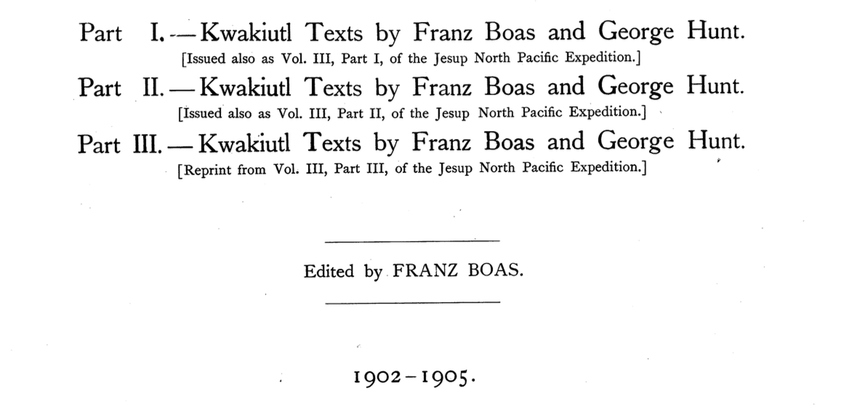
Boas and the Monolingualism of the Other

Kwakiutl texts

In my last post on Bauman and Briggs Voices of Modernity I explored their argument that Boas’s notion of culture makes it seem like a prison house from which only the trained anthropologist is capable of escaping. In doing so, however, I only really presented half of their argument. The book has two interrelated themes: One is a Foucauldian genealogy of the concepts of science, culture, race, language, and nation (as seen through the rise of folklore studies). The other is a Latourian exploration of the construction of folklore as a science. This is done by exploring how oral traditions were turned into texts, and thus evidence of traditional culture (however that was defined). Aubrey, Blair, the Grimm brothers, and Schoolcraft were each faced with hybrid oral texts whose own modernity (as contemporary documents) belied their perceived scientific value as authentic remnants of ancient cultures. For this reason the texts underwent tremendous alterations, if not outright fabrication, by these scholars in order to make them suitable for their own purposes. The book traces how these processes of entextualization were shaped by each scholar’s concepts of science, culture, race, language, and nation.

So where does Boas fit into all of this? Continue reading

Anthropology: It’s still white public space–An interview with Karen Brodkin (Part I)

The following is an interview with Karen Brodkin, Professor Emeritus in the UCLA anthropology Department.

Ryan Anderson:  You co-wrote an article back in 2011 with Sandra Morgen and Janis Hutchinson about anthropology as “white public space” (AWPS).  What’s your assessment of the state of anthropology three years later?  If you could add an “update” to this article, what would it be?

Karen Brodkin: The short answer is that anthropology is still white public space, especially in the consistently different ways that white and racialized minority anthropologists see race and racism in anthropology departments and universities. This is my reading of results of the 2013 online survey of the AAA membership (more on that in a minute). What I’ll do here is summarize the findings of the article, and then survey findings that buttress, complicate or contradict them.

AWPS was based on a survey of about 100 anthropologists of color about how they experienced anthropology. We used “white public space,” to sum up attitudes and organizational patterns that told anthropologists of color that they and their ideas were not real anthropology.

The 2013 survey (referred to hereafter as TFRR) was developed by the Task force on Race and Racism appointed by AAA president Leith Mullings (full disclosure, Raymond Codrington and I were its co-chairs). More than 15% of the membership, 1500 people, mostly white, took it. Half were faculty. We reported findings to the AAA Exec Board June 2014. Continue reading

Anthropology Fluxx

I’m a big tabletop gamer and my wife has supernatural card playing abilities inherited from her mother. When our schedules synch up and we have a night off together we’re liable to put away a couple of bottles of wine playing Ticket to Ride after the kids go to bed. In my search for new games I happened upon the Fluxx series and now we’re hopeless addicts. I conceived this anthropology themed version of Fluxx in the haze of summer. It was printed and beta tested in the fall. Now I’m bringing it to the AAA’s. If anyone wants to play, hit me up!

Fluxx is a humorous card game of winning tricks that is very chaotic because the rules of the game are constantly changing. So there is a fair amount of luck involved, but the more you play the game skill can become involved as you learn how to navigate around the obstacles that randomly pop up along the way. Obviously you can get them on Amazon, they also carry them at Barnes & Noble and Target so run out and get a pack if this sounds like fun to you. There’s a bunch of titles in the series and they’re all great in their own way, but the best one to play with little kids is Monster Fluxx.

The core game concepts go like this. You have a draw pile, a discard pile, cards in your hand, and Keepers which are (green) cards played on the table in front of you. The object of the game is to match Keepers to (pink) Goals. There are also (blue) Action cards which give you different advantages and allow you to change the rules or attack your opponents. There are (purple) Surprise cards that you can play whether or not it is your turn. Finally there are (yellow) New Rule cards which define how each turn is played. The New Rule cards dictate how many cards you draw, how many cards you can play in a turn, how many Keepers you can have in front of you, and how many cards you can hold in your hand. There are lots of other weird things along the way that I’m skipping over for the sake of brevity.
Continue reading

When life hands you a coffee plantation, make espresso

I started a new article recently on the life and thought of Bernard Narokobi, one of Papua New Guinea’s most influential thinkers. The paper grew out of my book, which has a significant section on Narokobi at the end. Expanding the material in the book into a whole article has involved digging deep, deep into the stacks and has gotten me thinking about what a funny thing research is, and what its goals are. I look at it this way: When life hands you a coffee plantation, make espresso.

Life is, after all, like a huge coffee plantation — perhaps one left fallow and running wild — and our articles about it are like espresso: distilled, highly processed condensations of the real thing.

Continue reading

Risk and Blame in L’Aquila

Savage Minds welcomes guest blogger Elizabeth Angell.

Yesterday an Italian appeals court reversed the convictions of all but one of seven scientists and experts charged with involuntary manslaughter for failing to provide adequate warning before the 2009 L’Aquila earthquake.  (The conviction of Bernardo De Bernardinis, former deputy head of Italy’s Civil Protection Department, was partially upheld, but his sentence was reduced to two years instead of six.1) As an anthropologist studying disaster and risk, I’m doubly interested in the L’Aquila story, both as an example of the search for accountability in the aftermath of disaster, and for what it tells us about the ways knowledge, particularly knowledge about risk, circulates between expert communities of scientists and officials and broader publics.

Continue reading

Boas and the Culture of Racism

The question is not that Boas was wrong about culture. It is rather that he told anthropologists that they are the only ones who are right.

This quote is from the conclusion to the penultimate chapter of Bauman and Briggs’ award-winning book Voices of Modernity. The book employs a Foucauldian genealogical approach to trace the development of folklore studies from its roots in the Scottish Enlightenment, through its development under German Romanticism, ending up with Boas and the birth of anthropology. In doing so the book focuses on a number of interrelated ideas about culture, language, and modernity as well as methodological issues in the creation of texts from oral traditions. When they awarded the book with the Edward Sapir Book Prize the Society for Linguistic Anthropology wrote:

Bauman and Briggs argue that contemporary efforts to make schemes of social inequality based on race, gender, class and nationality seem compelling and legitimate, rely on deeply rooted ideas about language and tradition. Showing how critics of modernity unwittingly reproduce these foundational fictions, they suggest new strategies for challenging the undemocratic influence of these voices of modernity.

While these themes run throughout their book, they sometimes seem to have only historical importance. After all, scholars like Herder or the Grimm brothers are associated with the rise of nationalism and so there doesn’t seem much that is “unwitting” in their reproduction of these ideologies. It is only in the penultimate chapter on Boas, a scholar known for his critiques of racism and nationalism, that the relevance of these earlier scholars (and the importance of the genealogical method) really becomes clear to the reader. In this genealogy Boas is “ego,” but before this chapter he has been absent from the story.

Continue reading

On Ethnographic Unknowability

(Savage Minds is pleased to post this essay by guest author Catherine Besteman as part of our Writer’s Workshop series. Catherine is Francis F. Bartlett and Ruth K. Bartlett Professor of Anthropology at Colby College. She is author of numerous books and articles, including Unraveling Somalia: Race, Violence, and the Legacy of Slavery (University of Pennsylvania Press, 1999), Transforming Cape Town (University of California Press, 2008), and co-edited with Hugh Gusterson, Why America’s Top Pundits Are Wrong: Anthropologists Talk Back (University of California Press, 2005) and The Insure American (University of California Press, 2009). Her most recent book Making Refuge: Somali Bantu Refugees and Lewiston, Maine is forthcoming from Duke University Press.)

What if I told you to write what you don’t know?

I ask this because I find the oft-offered advice to “write what you know” both alarming and silencing. Isn’t ethnography at least partially about unknowability? If we acknowledge that textual recording is a form of fixing knowledge, how does one write what one doesn’t know? How can our writing play on the edge between knowing and not knowing, refusing to fix the unknown by writing it into existence? Exploring this playful and vexing tension in ethnographic writing is my current preoccupation.

A story might help illuminate my query. Continue reading

The kids from other neighborhoods

Halloween is a big deal in my house. Honestly it wasn’t anything I cared much about until I had kids. Having kids makes all the holidays more fun! Things really got out of control when we moved to Hilton Village, the “destination neighborhood” for trick or treaters in Newport News, Virginia.

People come from all over town to bring their kids to our neighborhood for Halloween. When folks move here I warn them: It’s like a street carnival! When we lived on a side street I’d go through 300-400 pieces of candy. We had a friendly rivalry with the retired couple across the street for most outrageous yard. A holiday I never cared about became one of the highlights of the year.

After my wife earned tenure and we bought a bigger house on Main that really upped the ante. It’s the first house on the right as you come into the neighborhood, making it ground zero for the Halloween onslaught. We are literally the gateway to the neighborhood. This year the party fell on a Friday, that only encouraged more folks to come out and stay longer. Last week I gave out 30 lbs of candy, 100 glow sticks, 200 stickers. It was a mob scene.

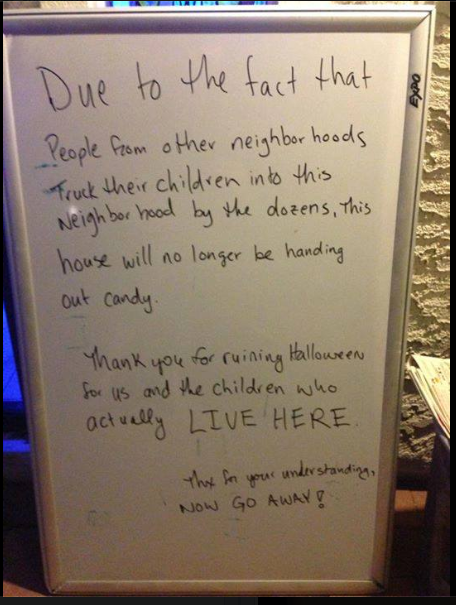
Gentle reader, this is an old post. I wrote it last year and hesitated for whatever reason. I quickly remembered it once I read this letter to the popular advice column Dear Prudence in which the correspondent feels put upon by the obligation of passing out candy to the kids from other neighborhoods. The original inspiration for the post came from this image, collected from my Facebook newsfeed via the reliably righteous Latino Rebels. I no longer have the link it came from (sorry), but my notes say it was first shared by ABC 15 Phoenix.

Kids from other
Continue reading

Writing to become…

(Savage Minds is pleased to post this essay by guest author Sita Vekateswar as part of our Writer’s Workshop seriesSita is a Social Anthropologist at Massey University, Aotearoa/New Zealand. She is Associate Director of the Massey chapter of the recently established New Zealand India Research Institute (NZIRI). Her ethnography Development and Ethnocide: Colonial Practices in the Andaman Islands (2004) is based on her Ph.D. fieldwork in the Andaman Islands and her co-edited book, The Politics of Indigeneity: Dialogues and Reflections on Indigenous Activism (2011) is published by Zed Books. Her current research on the implications of climate change for food production takes a political ecology approach to follow the fortunes of millet cultivation in India.)

I write to become.

Through writing, I accumulate more being since I am more than I was when I materialise the ephemeral.

I wear the traces of various Englishes, strung like so many iridescent pearls within the necklace of language adorning me. The lilting singsong of Anglo-Indian first granted me tongue, irrepressible, undaunted by the pristine elegance of Queen’s English. As I collided with the unabashed assertiveness of American idiom, I learned the discipline of anthropology. I discovered my place in the world from the antipodes, in encounter with the laconic, self-deprecating humour of New Zealand vernacular. A clamour of tongues finds expression through me to constitute the anthropologist I have become. Continue reading

“This brings me to another thing: the danger of kissing on the mouth”

This semester I am at the College of William and Mary completing a practicum in archives and special collections primarily focused on digitization, the whole point of which is to make items such as manuscripts accessible to users online. As is the nature of special collections the material is one of a kind and that means along the way I occasionally find treasures that catch my eye through the blur of metadata creation. I’ve already shared with you the pleasures of huffing nitrous oxide at Yale College in 1821 and today I have a new one, the dangers of letting people kiss your baby.

My current project is the digitization of a collection of romantic correspondence between a young couple in a small Virginia town in the early 20th century. First they are friends, then they are dating and engaged, and once they are married the correspondence stops and the remainder of the collection is Christmas cards. It was here that I found a three page form letter from the Women’s Home Companion Better Babies Bureau dated September 1939.

Initially I interpreted the moniker “Better Babies Bureau” as a play on the WPA alphabet soup of agencies, but according to this encyclopedia entry this series from Women’s Home Companion dates back to 1913 and links the to eugenics movement.
Continue reading

#HanyangTowson

Networking Media Anthropology

Samuel Collins is teaching a seminar at Hanyang University (ERICA campus) as part of his Fulbright grant in South Korea and, as luck would have it, Matthew Durington is doing the same in Baltimore. The two of them resolved to network their courses together using some of the principles they espouse in Networked Anthropology (Routledge, 2014), combined with some new directions for their research. Among other challenges? The 1 day + 13 hour time difference.
Continue reading

Writing Anti-Racism

(Savage Minds is pleased to post this essay by guest author Ghassan Hage as part of our Writer’s Workshop series. Ghassan is the Future Generation Professor of Anthropology and Social Theory at the University of Melbourne. He is author of numerous books include White Nation: Fantasies of White Supremacy in a Multicultural Society (Heibonsha Publishers, 2003), Against Paranoid Nationalism: Searching for Hope in a Shrinking Society (Pluto Press, 2006), Waiting (Melbourne University Press, 2009), and with Robyn Eckersley, Responsibility (Melbourne University Press, 2012). His most recent book is Writings in Multiculturalism, Nationalism and Racism (Australian Society of Authors, 2014) and forthcoming in February 2015 is Alter-Politics: Critical Anthropology and the Radical Imagination (Melbourne University Press).

 To the people of the bus.

In my recent work on racism I have differentiated between the ‘racism of exploitation’ (e.g. towards slaves and migrant workers) and the ‘racism of exterminability’ (e.g. anti-Semitism). I argue that the latter is prevalent in the racist modes of classification of Muslims in/by the non-Muslim West.

Inspired by certain dimensions of Eduardo Viveiros de Castro’s multi-realism, and the teaching of a seminar around Mauss’ The Gift, I have tried to show that the racist experience of the other as exterminable involves the projection of complex layers of affective and existential angst that takes us beyond the dominant domesticating mode of existence in which we live, and where instrumental classification thrives. It invites us to perceive the experience as pertaining to a multiplicity of other realities or human modes of existence. The first is the reciprocal mode of existence classically explored in the work of Marcel Mauss on the gift. I read The Gift as pointing to a whole order of existence where people, animals, plants and objects stand as gifts towards each other. The second is what I will call, after Marshall Sahlins, the mutualist mode of existence. It highlights an order of existence where others are ‘in us’ rather than just outside of us. Central here is Lucien Lévy-Bruhl’s work on ‘participation’: a mode of living and thinking where the life-force of the humans and the non-humans that surround us are felt each to be contributing to the life-force of the other. Continue reading

Strategy of Condescension

中文翻譯 Chinese translation

That Facebook CEO Mark Zuckerberg gave an interview in Chinese was big news this week. You can see the start of the interview here:

http://youtu.be/n_168pH9GJk

As you can hear, Zuckerberg’s performance was greeted with “repeated cheers and applause by the assembled students and faculty members.” I don’t want to pick apart Zuckerberg’s Chinese – he only started learning a few years ago, but still did better than some people I know who have lived in Taiwan for over a decade. Nor do I want to focus on the mixed reactions he got on the internet later on. Rather, I want to engage in a thought experiment. Can you imagine a Western audience cheering and applauding a Chinese CEO for speaking in English?

Pierre Bourdieu uses the term “strategy of condescension”1 to refer to the “act of symbolically negating” the power relationship between two languages. Continue reading

Academic life is a trapeze, and librarians are the safety net: SM is now archived

This open access day I wanted to officially announce some good news — Savage Minds is now being archived at the University of Texas at Austin. Thanks to the initiative of Pat Galloway and her students Brian Douglass, Kathleen O’Connell, Josephine Ragolia, and Rachel Winston, an archive of our blog now lives on UT Austin’s Dspace install(Update: I TOTALLY forgot to give Kerim credit for the incredible amount of work he did communicating with the UT Austin crowd to get the archive set up. In fact, he does ridiculous amounts of work on the back end of the blog all the time which few people (me included, apparently) understand, but that everyone benefits form. So thumbs up to Kerim as well.)

It’s a real mark of accomplishment that someone has taken the time to preserve the blog in a format that ensures that future generations will be able to read our poorly-spelled, hastily written blog entries. In some small sense — and I mean ‘small’, I’m not getting a swelled head here — SM really has become the blog of record for the sociocultural anthropological internetosphere.

The archive itself is just one part of a process to get SM more fully archived both now and in the future… but I’ll leave out details of our future plans since, frankly, they may never materialize.

SM started with no long-range plan for archiving, or indeed for pretty much anything, and over the years we’ve suffered a variety of data loses, ranging from minor to catastrophic. The lesson for open access week is this: back up your data. But at the same time, if you feel the urge to write, write. Start new projects when you feel you have the energy and opportunity to start them, even if all the pieces aren’t in place yet. Archiving is important, but don’t let scholarly apparatus have a chilling effect on your innovation. If academic life is a trapeze, librarians are the safety net. Thanks to UT Austin, Pat, and the whole crew for doing their job so that we can do ours.