It’s been a big year for Savage Minds, so big that the annual blog review didn’t fit in 2015! (Yes, that’s why it was delayed). This year we celebrated our 10th blogiversary with a panel at the AAAs, an executive director’s award, and a rare in-person gathering, which gave us the chance to reflect on our work and how this project has evolved over time.
In this yearly post, we look back on the year in blogging, both for us at Savage Minds and in the anthroblogosphere in general. First, the Minds will share their favorite posts from the year, and then I’ll highlight a few of the posts on other blogs and news sources that struck me as the most important, memorable, or otherwise worth revisiting if you missed them.
For decades, ephemeral layers at archaeological sites have been the bane of my existence. The moment I read, hear, or have to confront it at an excavation, my soul does a smh. How can we reconstruct anything meaningful in this ephemerality? To be honest, that frustration is simply a privileged standpoint of archaeologists who work in ancient cities, towns, or any mostly permanent settled space – which is where my training and research has focused. Ephemerality is a challenge and requires me to contend with materials and surfaces in a way I am only starting to understand.
Writing is a responsibility in the academy. Through our writings we enter into dialogues with one another. From undergraduate thesis to dissertation, scholarly articles and monographs, our writing marks the trajectory of our careers. It forms the basis on which our peers and colleagues evaluate the contributions we make to discipline. But writing is more than a job responsibility of an academic. In writing anthropology, and in my case archaeology, there is an added responsibility to scrutinize how the histories we produce are connected to the lives and futures of the communities we study.
The formation of anthropology as a discipline in North America occurred at the same time as European and American governments dispossessed indigenous nations of their homelands. Coinciding with the closing of the Indian Wars in the late 19th century, the Bureau of Ethnology, later renamed the Bureau of American Ethnology, sponsored ethnographic and linguistic research on Native American communities. These “salvage ethnographies” documented the cultural traditions and lifeways of Native American tribes under the presumption that the combination of assimilationist policies and exposure to American lifeways would cause them to vanish entirely. Archaeologists followed suit, recording ancestral sites and collecting artifacts, as well as human remains in their attempt to document the cultural history of tribes. The objects and ancestors uncovered by archaeologists and others—often through dubious means—became specimens of national history; representations of a past that ceased to exist following the arrival of Europeans and their colonization of the continent. Given this colonial history, how can the work of these disciplines be used to disrupt colonial relations in the present? Continue reading →
Dear readers, this post is late and I apologize for nothing. Send me any links for inclusion here at rebecca.nelson.jacobs@gmail.com.
I hope you’ve been enjoying the glow of lights and the stir of familiar songs that seem to be everywhere these days… with the release of Star Wars: The Force Awakens! The AAA blog featured this post using the movie to explore why movies about humans’ relationships with technology are so popular: Our Movies, Ourselves: Reel Life Vis-á-vis “Real Life”
This time of year seems to bring out a reflective streak in blogs. For example, Struggle Forever listed some of the fiction and non-fiction books worth reading from this year: My Favorite Books of 2015
Allegra also produced a list of books based on a reader survey of the most important and influential books for the discipline and beyond. Unsurprisingly, there’s a bias towards the mid-twentieth century classics, but some newer books were also recognized: The 30 Essential Books in Anthropology
Savage Minds welcomes guest blogger Pablo Figueroa. Pablo is an assistant professor in the Center for International Education at Waseda University in Tokyo. In this position, he teaches courses on globalization, leadership, and disasters. His anthropological research is centered on risk communication, citizen participation, and cultural representations of the Fukushima nuclear catastrophe. His most recent publications are two book chapters, Subversion and Nostalgia in Art Photography of the Fukushima Disaster and Nuclear Risk Governance and the Fukushima Triple Disasters: Lessons Unlearned, both forthcoming in 2016.
Inside the Fukushima Exclusion Zone: Place and Memory after Disaster
by Pablo Figueroa
A street of Namie Town in the Fukushima Exclusion Zone, May 2015.
FROM BEHIND THE WINDSHIELD of the moving car the landscape looks exuberant, unpolluted. Warm morning sunlight bathes the forest to the side of Tomioka highway, a 69 km stretch of pavement also known as National Road 114 that connects Fukushima with the town of Namie. It’s a Sunday morning and few people can be seen. The feeling of emptiness is vast and real. From time to time, large plastic bags appear along the road, neatly stacked one on top of the other. The orderly layout obliterates a much more messy reality: The bags contain highly radioactive soil that was removed from villages and fields during the so-called “cleanup efforts” following the Fukushima nuclear disaster. Their final destination undecided, the ominous recipients are a painful reminder of what happens when trying to decontaminate the environment after a nuclear catastrophe. You can scrape topsoil and wash the surface with pressure hoses as much as you like but Cesium-137, which has a half-life of 30 years, will keep coming down from hills along with other radioactive isotopes, carried by rain and wind, dispersing in manifold and uncontrollable ways. Continue reading →
What if anthropology were to suspend its claims to be a social science, whether of a geisteswissenschaftliche or a positivist variety? What if it were to turn instead to exploring its affinities with art and literature as a mode of engaged creative practice carried forward in a world heterogeneously composed of humans and other-than-humans? I am prompted to reflect on these questions by an encounter from my recent fieldwork.
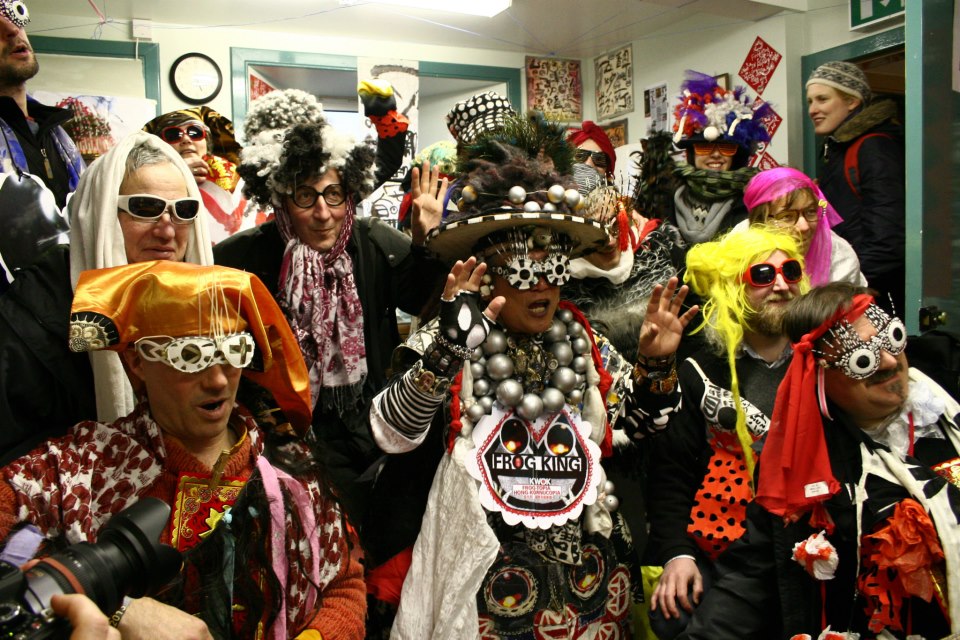
Papa Westray, Orkney, 2013: The Frog King effect. Photograph by Tsz Man Chan.
In February 2013, I participated in Frogtopia. At once no place and multiple places, Frogtopia is the creation of Frog King, who in turn is the creation, or the costumed alter ego of Kwok Mang-ho. Born in Guangdong province in 1947 and educated in Hong Kong, where he now lives, Kwok is recognized today as one of the pioneers of multimedia and performance art in China. His output consists of a proliferation of works in a variety of media: video, photography, ink on paper, costumed performance and found materials such as plastic bags. His approach, typically, is to fill his canvases and exhibition and performance spaces with his characteristic motifs, including calligraphy, inflated plastic bags suspended from strings and the frog image that has played an increasingly conspicuous part in his work. Kwok has stated in interviews that he was drawn to the figure of the frog because of its metamorphic life cycle and its capacity to move between land and water. At the same time the image is meant to evoke a range of other associations, its bulging eyes embodying watchfulness and suggesting too a bridge for exchange and communication between Chinese and Western artistic influences and a sail boat for journeying to new places. Continue reading →
[The following is an invited post by Scott Simon. Scott is Professor in the School of Sociological and Anthropological Studies at the University of Ottawa, Canada. Having conducted research in Taiwan for nearly two decades, he specializes in indigenous rights, hunting life-ways, and human-animal relations. His most recent book is Sadyaq Balae! L’autochtonie formosane dans tous ses états.]
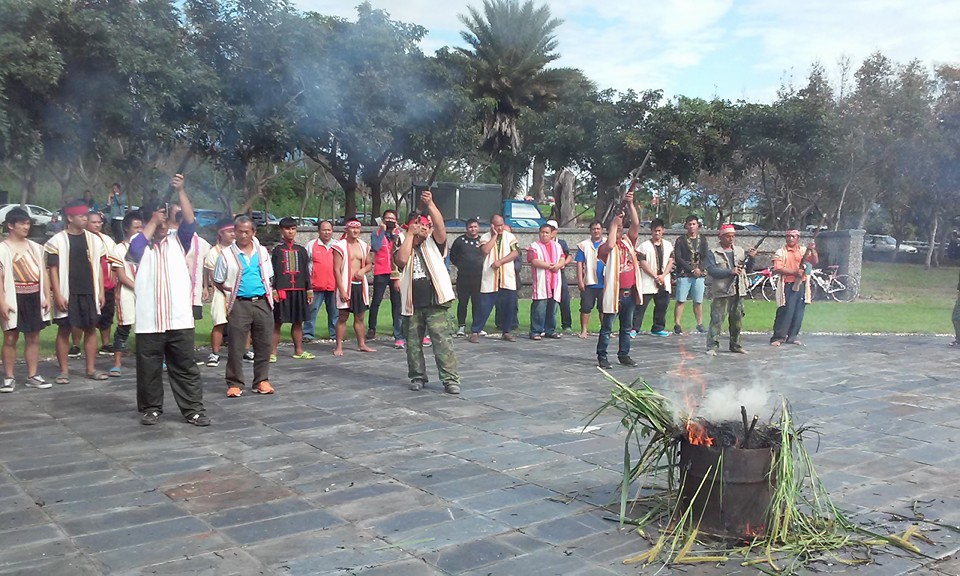
Photo by 林秀玉 (Loking) 2015
In mid-December 2015, indigenous social activists protested across Taiwan with urban demonstrations and lighting of solidarity bonfires in rural communities. They were angry about the case of Tama Talum (Wang Guang-lu), a 56-year-old Bunun man slated to begin a 3.5 year prison sentence on December 15. In July 2013, at the request of his 92-year-old mother who wanted to eat traditional country food, he had hunted one Reeve’s muntjac (a small deer) and Formosan serow (a mountain goat).1 He was arrested and convicted in a Taitung court for illegal weapons possession and poaching. On October 29, 2015, the Supreme Court ruled against his appeal. Tama Talum’s case merits international attention for humanitarian reasons, but also because it reveals deeper human rights issues.
The blog harvest was rich again this week at the Savage Minds ranch. Help me find more blogs by sending me links at rebecca.nelson.jacobs@gmail.com.
HuffPost featured this article in which an anthropologist argues that isolating babies in cribs and sleeping 8 continuous hours a night are Western constructions: My Conversation with Co-Sleeping Expert James McKenna
In this National Geographic post, Jason De León discusses some of the findings in his book, The Land of Open Graves: Living and Dying on the Migrant Trail. He argues that migrant deaths at the border have been deliberately caused and normalized in national media: An Anthropologist Unravels the Mysteries of Mexican Migration
In this episode of the Craft podcast, anthropologist Jeffrey Cohen describes some moments of adaptation in his fieldwork in Mexico: Eating Soup (and Grasshoppers) Without a Spoon with Jeffrey Cohen. The interviewer actually asks how to avoid “changing their civilization.”
Concentric circles of the local to the larger ripple out from a megapolis like New York. The unnatural and natural are tangled in them.
I live across the street from a garment sweatshop. They make ball gowns and on delivery days dresses wrapped in plastic and bound for department stores are sent fluttering on rope down to the street, six floors below. I’d say they look like birds as they fall but they look like nothing I’ve ever seen so that wouldn’t be true. It is strangely beautiful to watch. The workers are all women. Sometimes there is also a cat that will sit on a fire escape. I never see the women arrive or leave. I wonder if they sleep there from the low glimmer of a television late at night. I watch their labor during the day as I work from my desk. At times we catch one another, co-gazing at the Other. The women smile a little when they see me seeing them, which confuses me as I am conditioned to think of a sweatshop as a place of misery. Continue reading →
I will only know what I precisely want to say in this piece once I finish writing it.
This enigmatic sentence is not meant as an alluring opening statement, nor is it a sign for an experimental literary method that I will be employing in this blog. For what it’s worth, this sentence captures my principal insight into the process of writing. It is an insight that I gained after years of experiencing much frustration with writing, after producing endless drafts of the same text, after nights and days spent on trying ‘to get it right’, after struggling not to lose my focus, not to get lost in the texts I tried so hard to write.
Luckily, I do not feel like that any more. But it has been a long ride. Continue reading →
Good grief, the anthroblogosphere was active this week! I usually don’t have to omit too many entries I find interesting but this week you might need to do some searching on your own to catch everything. Send me what you find at rebecca.nelson.jacobs@gmail.com.
This delightful post on Evonomics.com uses Christopher Boehm’s cross-cultural survey of “Late Pleistocene Appropriate” foraging societies to argue that the figure of the self-serving individualist promulgated by Objectivist author Ayn Rand runs counter to human (pre)history. The author illustrates this argument with examples from Colin Turnbull’s classic, The Forest People. Ayn Rand vs. Anthropology. “Who is John Galt? He refused to participate in society and no one has seen him since.”
Institut Pasteur reports on a study that compared populations in different Central African environments to examine the effects of moving to different environments on human epigenetics. Forest-dwelling and sedentary Bantu groups, who have lived in different environments for a relatively short time, exhibited epigenetic changes affecting immunity. By comparison, the genetic differences in immunity between Bantu groups and Pygmy groups, who have inhabited different environments for much longer, have become hereditary: Our Epigenome is Influenced by Our Habitat and Lifestyle
Some of our co-bloggers in this forum rightly suggest that reading precedes and accompanies writing. But then they say that young people today, in this era of attention deficits, are losing the art of reading. When I was young, hope I still am, I usually responded quite stubbornly to this kind of admonishing “wisdom”. Maybe our teachers need to be more inspiring. In writing, we may need to rediscover a richer variety of forms. There was a time, for instance, when scholars primarily wrote not in essays, but in a more difficult and older art of texting, namely, aphorisms.
Let’s not underestimate the new forms of attentiveness that are emerging. On Instagram for instance, which to the surprise of discerning readers creates the possibility of stranger sociality based only on a fellowship of images. Continue reading →
Happy Sunday, readers. Don’t forget to send me links to content I should mention here, at rebecca.nelson.jacobs@gmail.com.
It’s a linguistic link! HuffPost Women characterizes a controversial Jeopardy contestant’s verbal tic as “upspeak” and sketches out the gendered dimensions of how women are penalized for their forms of speech: This ‘Jeopardy’ Contestant’s Voice Has The Internet Freaking Out (I’m hedging because it doesn’t strike me as classic upspeak).
It’s a physical anthropology link! This Nautilus post describes how the low-fiber Western diet seems to be limiting the diversity of microbiomes women pass on to their children at birth: How the Western Diet Has Derailed Our Evolution. The microbes that flourish in the guts of people on a Western diet, specializing in breaking down fats, sugars and protein, are also those that attack the mucus lining of human guts, which can cause chronic inflammation.
Like many of you, I am just back (and not nearly caught up) from pop-art obsessed Denver. Another AAA, another 2000-person business meeting. Just finished converting my nametag holder into a duvet cover. Also: the parlimentarian.
Rex captured some high and low points–ever the participant observer. Carole (the local) can pull rank and can correct us, but I just want to say that Rex didn’t spend nearly enough time on 16th street if he thinks there wasn’t high calorie cheap food available. I won’t say “good”, but the calories were in abundance.
I feel I can judge Denver because I grew up visiting my relatives there: Wax Trax records is still going strong, hallelujah, Elitch’s gardens has moved from the old-school high-liability zone of my youth to a chamber of commerce immagined dead zone of high profit near downtown, and the mountains are still, by an order of magnitude, thee most. Despite the current fame Colorado Springs is experiencing—which puts the state squarely back in the violent middle America most anthros were probably expecting, but narrowly escaped given the unfortunate regularity of the madness, Denver is in fact a distinctive American place. It’s not very diverse racially, to be sure, but it is distinctive: in the blocks around the convention center there was a definite mix of white lower class, middle class marijuana tourism, ostentatious 1%-er development, overdressed anthropologist and bearded hipsters on loan from williamsburg/highland park. Also, did I mention the parliamentarian?
The NGOs and Nonprofits Special Interest Group held its second biennial conference before the AAAs last week. It’s designed to give anthropologists and practitioners working in and with NGOs a chance to engage with each other in a more intimate, focused way before diving into the chaos of the AAAs. Entitled “NGOgraphies,” this year’s conference explored the dual meaning of the term, coined by Steven Sampson and Julie Hemment in 2001, which refers both to critical ethnography of NGOs in general and to analysis of the human geography of NGOs in particular. The conference attracted 112 attendees from 13 countries, and session organizers were encouraged to use alternate formats to engage participants, ranging from workshops to roundtables. Rather than a general report on the conference, this post is a reflection on some of the specific conversations and lines of thought the conference generated for me.
I might have been interested in participating, but will likely be traveling overseas for humanitarian work at the time. I have worked for international NGOs and aid agencies for 30 years, as I do now. However, I must say that the title of the session troubles me. As a long-time member and leader of such organizations, I have never known our community to “fetishize” local knowledge. I think the term is disrespectful to my colleagues and their work and insights. This seems like some sort of construct or perception of research-based academics.