The annual meeting of the American Anthropological Association is now over, as is Thanksgiving. Now that we are over the hump and have a bit of perspective, we can ask: How well did the AAA handle the meetings?
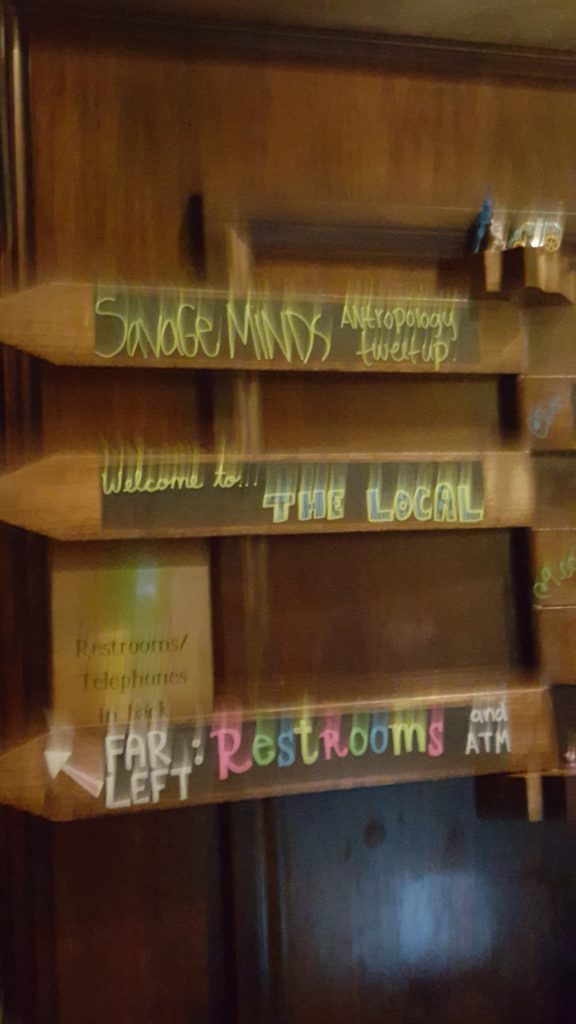
The annual meeting of the American Anthropological Association is now over, as is Thanksgiving. Now that we are over the hump and have a bit of perspective, we can ask: How well did the AAA handle the meetings?
There’s a certain trope that has been going around for years, and it has hit a peak these days as many people express their collective shock and surprise at recent events here in the USA. The narrative uses a family metaphor to talk about the problems of race and racism—and specifically the difficulties of confronting racism.
This was a close election. What impact would every hard conversation you wish you had with close-minded friends & family members have made?
— Hari Kondabolu (@harikondabolu) November 11, 2016
The narratives center upon the figure of the stereotypical family member, like the old racist uncle. This narrative goes something like this: White liberals think of themselves as progressive and they condemn racism, etc. They “get it,” you know, and want to do something about the issue, and are definitely not racist. But, there’s a problem. They have a lot of family members who don’t think this way, and it’s often uncomfortable to deal with them and talk about issues of race and racism. It’s those family members who are the bigoted, racist, 19th century leftovers, and, therefore, the real problem. The racist uncle personifies this conflict:
In Trump’s America, every day is now Thanksgiving at your racist uncle’s house.
— Betty F*ckin’ White (@BettyFckinWhite) November 23, 2016
One response to this trope is that white liberals need to just get over it and confront their collective racist uncles (read: the older generations who still hold onto strong prejudices and hatreds). This is perhaps not a bad starting point. But there’s something deeper to think about here. Another response critiques the whole scenario, arguing that the trope of the old racist uncle is just an excuse people use to avoid talking about and dealing with the broader causes and conditions of racism. That hypothetical family member is a rhetorical device that people use as a point of comparison to say “Hey, at least I’m not like that.” Continue reading
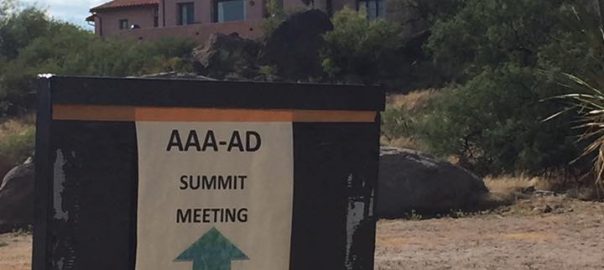
This post is the latest in the November guest blog series by the Archaeology Division of the AAA. This post is by Lynne Goldstein. Lynne Goldstein is a Professor of Anthropology and the Director of the Campus Archaeology Program at Michigan State University. She is the outgoing Publications Director for the Archaeology Division of the AAA.
In this blogging miniseries, some of the officers of the AAA’s Archaeology Division (AD) have been outlining what makes the AD unique and important, as well as some future plans to increase our reach, as well as our member numbers. As noted earlier by both Jane Baxter and Patricia McAnany, the AD may not be the primary organization for most archaeologists, but it is the place where we can best bridge archaeology and other parts of anthropology.
Since 2013, my focus within the Archaeology Division has been on publications. But, as of the AAA meeting last week, I have come to the end of my tenure as Publications Director of the Archaeology Division of the American Anthropological Association. We are back on track, healthy, and publishing some great articles. Our publication – AP3A – is different than most AAA journals: it comes out only once a year, and the articles are submitted as a group with a guest editor. The volume is peer reviewed at several levels, and we don’t accept individually submitted articles. This has been the structure of the journal since its beginnings almost 30 years ago, and because each issue has a specific focus or theme, many scholars use the volumes for both research and teaching. Indeed, articles from AP3A are often also included in other anthropological collections focused on related topics. The journal has relatively small circulation numbers, but it is available in most libraries, and faculty often assign articles in their classes. Now that AnthroSource has been improved and the journal is digital only, anyone with full access to AnthroSource has access to the journal.
Are there ways that the AD can increase the influence and discussion that AP3A volumes produce? If the journal really focuses on broad theoretical and topical issues, shouldn’t more AAA members be interested in its content? If the impact can be increased, it would be to the benefit of the authors, the journal, and the members. Can we leap the divide and encourage other types of anthropologists to read AP3A? Certainly, with AnthroSource, accessibility is easy, but most people are busy and look only at those things they know. How do we get folks to take advantage of their easy accessibility to AP3A, and move us toward better integration of anthropology?
Blogging is one obvious way that we could increase interest in the journal, and we think that it might be a way to keep the issues of the AP3A active and relevant. If we regularly blog about the topics in the issue, more people would become engaged in the discussion, and more people would link back to the original articles.
Although I may be sounding crass, this strategy is not really about numbers – it is a discussion that the AD is having in an attempt to try and make its content more accessible, relevant, and part of larger anthropology conversations.
Many of us are rethinking publications and what they mean. If you work at a university, you are likely being evaluated and measured based on your Google Scholar scores or other such measures. The number of citations you have is seen as a measure of your influence in the profession, and while there are many, many problems with the calculation of such measures and what is included, it is also clear that these so-called “objective” measures will not go away. Universities like to use what they see as objective numbers that someone else calculates, and pushes by faculty to change their use will likely succeed only at the margins.
But I am talking about something else here. We have the technology and capacity to change the way we use and apply publications in our research and teaching. Once something is published, it should not be considered “done.” Why not regularly and actively focus a discussion on the published piece or pieces in a blog related to the publication? Discuss the article(s) and implications for current and/or future research. Highlight things that might be significant or interesting to a broader range of scholars, or to the general public. And, in addition to blogging, promote the discussion in other forms of social media. This is the kind of approach that the AD is discussing to make its work more visible, more accessible, and more relevant to a much broader range of people, whether they ever become members or not. We can have threads that focus on each issue, yet overlap and make broader points, develop arguments for and against specifics, and represent a real discussion of the topics.
What do you think? Would you participate in such discussions? Would it make you rethink your current or former opinion of the AD? Let us know. Of course, we are always open to other ideas too!
By: Caitlyn Brandt, Allison Dudley, Will Lammons, and Aaron Trumbo
The holidays are upon us once again, and soon many of us will engage in those family dynamics that reunite extended family and old acquaintances. This is a time to be thankful for loved ones, but it can also be a reminder that “you choose your friends, but you don’t choose your family.” In many households, clashes over differing politics and ideologies are a holiday tradition. This season, however, passions are running especially high fresh out of a divisive U.S. election cycle. For many of us, the events of recent days have been a disheartening reminder of deep political division within the U.S., and the serious social and environmental injustices that persist. Yet for some, perhaps even members of our own families, the recent election has bolstered views of bigotry and prejudice along with the actionable expression of those beliefs. These deep divisions will be represented at dinner tables across the nation this holiday season. Thus, the question is how, as students and practitioners of anthropology, can we facilitate open discussions that acknowledge opposing views, while refuting bigotry and statements (or denials) that are potentially dangerous and hurtful? How can we turn these conversations into productive moments of solidarity during these celebrations of gratitude and family?
This essay is the result of a discussion on public anthropology in an empire seminar, where a ‘politics of scholarship’ discourse morphed into the ‘politics of Thanksgiving dinner’ discussion. Anxieties over inevitable confrontations about refugees, sexism, border walls, race, climate change, and other divisive issues prompted us to consider our role as public spokespersons of the discipline. The holidays may test our patience and resilience in the face of tough conversations, but they can also be ground for public anthropology. In what follows, we enlist a set of best practices for confronting bigotry and insensitivities among family and friends in a direct, yet compassionate manner.
Continue reading
The 2016 annual meeting of the American Anthropological Association — or #AAA2016 #amanth2016 — just concluded in Minneapolis. I’ve been attending these meetings since 1993, and this was the most politicized, energized one I have experienced. From the opening comments of AAA President Alisse Waterston to panels on “Unapologetic Blackness” and activist sessions on #NoDAPL and more, a sense of urgency, action, and productive anger pervaded the meetings. A commitment to say no to hate, to white supremacy, to destructive policies, and to act on these commitments.
Teaching is part of our commitments.
With this in mind, I continue here the initiative started by my SM colleague Zoë Wool to #teachthedisaster. Starting, I believe, with the #FergusonSyllabus, a new form of activist action is to curate a list of readings to teach about ongoing crises. These come from across the disciplines, and from scholars in and out of academia. I’m sharing all those I could find here. Some glaring absences—in my online searching at least—was anything on immigrant and refugee issues or on Islamophobia. If anyone knows of such syllabi, please do share the links. All contributions welcome. Continue reading
This is the third in a series of guest blogs this November from the AAA Archaeology Division Executive Board detailing ideas generated at retreat at the Amerind Foundation this past June. This post is by outgoing AD Secretary, Jane Eva Baxter.
As thousands of anthropologists make their way to Minneapolis to take part in the AAA Annual Meetings, it is worth thinking about the potential ways this organization might help to foster a more robust and inclusive anthropology that actively embraces all of the subfields in intellectual and not just structural ways. When the Executive Board of the Archaeology Division (AD) of the AAA met at Amerind in June, one of the major areas of discussion was how to leverage the resources available through the AAA to create a unique intellectual space among all the professional organizations available to archaeologists.
It’s important to provide a bit of context for this discussion. Most archaeologists do not seethe AAA as their primary intellectual or professional home, but rather are more actively involved in the Society for American Archaeology, the Society for Historical Archaeology, the Archaeological Institute of America and/or the American Cultural Resources Association. The AAA is a secondary or tertiary membership for most current AAA AD members. The AAA is also the most expensive professional organization among these to join, and as Patricia McAnany noted in last week’s post the intellectual ties between archaeology and anthropology were disrupted significantly in the 1990s. These factors have resulted in a substantial reduction in AAA membership by archaeologists. Most of us who have retained our AAA membership have done so because of an enduring belief in the anthropological nature of archaeological inquiry and practice, and because we still find engaging with anthropology outside of our own subfield to be an enriching and nourishing intellectual experience. Continue reading
Suddenly the night has grown colder.
The god of love preparing to depart.*
The chill of the 2016 US elections is still in my bones. Glued to any and all forms of media, I watched what Van Jones and Judith Butler have called, “whitelash” unfold in graphs, charts, and all forms of measurable outcomes. I watched as the states of my country turned red one by one. This was not the first time I had seen this, but there was something unique about this time. This time, it was not just me and people who looked like me, who felt precarious, but rather I watched as the whitelash was aimed at and betrayed the white Left/Center Left. I watched and felt the hush over the newscasters in the newsroom as they realized the precarity of the first amendment, particularly of free speech and thus, their very existence.
Without intending to, I consumed/embodied that hush. I could not respond or say anything about the election. My inbox was flooded with messages of coping, my social media was a manifest of betrayal, blame, violence, fear, and ultimately action. I was still silent. For me, as a Muslim woman of South Asian descent who has been working for decades on issues of social justice, sometimes through decolonizing anthropology, sometimes through collective action outside the academy, these results were not surprising. I wish they were more surprising. I wish I was surprised by white supremacy in America. I wish my idealism in the human spirit could have learned to forget or misplace that constant in my life. What I found myself wishing instead was that this outrage on my social media feed had coincided with the mapping of police violence, particularly on black bodies. Or the ways in which indigenous people are being arrested and violated for peacefully protesting the Dakota pipeline. Or the rising issue of domestic violence, or really anything, except the reiterating fact that the (white) Left was taken by absolute surprise, and that they did not win. As a person of color in the United States, I have never won. Obama was probably the closest thing to winning I came to, and even he ended up with drone issues (among others).
For some people, the election that just took place might seem like just another choice between the lesser of two evils. One more election that we all learn to deal with, but that won’t fundamentally change much about their daily lives. But this isn’t everyone’s reality. For many people around the country the results of this election, which was fueled by messages of hate, bigotry, racism, and intolerance, has devastating implications. It’s not a matter of if it will affect their lives, but when and how. It is a privileged position to see this as “just another election” that we lament, accept, and endure. Many people here simply do not and will not have this choice.
Shaun King’s Twitter timeline this past week was just one indication of what these election results portend: a surge of racist, bigoted attacks across the country. This election has empowered and emboldened many people to express their contempt, disdain, and hate. According to local news reports, a Muslim woman at San Diego State University was attacked and robbed by two men who made comments “about President-elect Trump and the Muslim community.” This incident took place at 2:30 pm on Wednesday (November 9th). In a separate incident on the same day, a swastika and the words “Heil Trump” were painted on the sidewalk at a UC San Diego bus stop. Continue reading
On Wednesday morning, amid the turbulent mix of feelings that washed across the country and beyond its borders, an anxious existential question took hold of many of us: “what the f***k do we do?” Some seriously considered the need to flee for their lives. Others took to the streets. More than a few folks I know spent the day drunk or in bed. And, by the end of the day, safe spaces for decompression and community care emerged on many college campuses. Part of my own response, one shared by many other faculty, has been: TEACH.
Trump’s victory yesterday was the result of many factors. The politics of academic publishing was hardly an important part of the elections results. Large for-profit publishers like Elsevier and Taylor and Francis did not secretly elevate Trump to victory, nor would the outcome have changed if voters in Florida had access the entire run of Anthropology and Humanism. But this election did raise issues that central to open access as a movement. It was about truth, credibility, and authority. It was about how the same fact pattern can be interpreted in different ways. It was about judging for yourself the quality of partial and possibly biased information. And what comes next is even more relevant to our academic values. In the next four years we will see many people pushing back against accepted truths — that African Americans face discrimination, that the holocaust occurred, that there were no weapons of mass destruction in Iraq, and much much more, I’m sure. Now, than, we academics need to explain what scholarly and scientific knowledge is, why it is important that non-experts should take it seriously, and how open access is central to a vibrant, functioning democracy.
This post is the second in our November guest blogging effort reporting on the AAA Archaeology Division meetings at Amerind that explored the relationship between archaeology and anthropology. In this essay, Patricia McAnany, President of the Archaeology Division, reflects on the historical and contemporary ties than bind these fields of inquiry together. Dr. McAnany is the Kenan Eminent Professor of Anthropology at UNC Chapel Hill.
In 2014, I felt like a marked woman. Time was running out; sooner or later I would be approached to run for President of the Archaeology Division of the American Anthropological Association (AAA-AD). I had been a stalwart member over the years. My graduate training at the University of New Mexico was very anthropological but then I joined the Department of Archaeology at Boston University and began to rub elbows with a diverse group of archaeologists of all stripes and colors. My AAA membership became my tribal affiliation—a gut-level expression of how I deployed method and theory in the practice of archaeology.
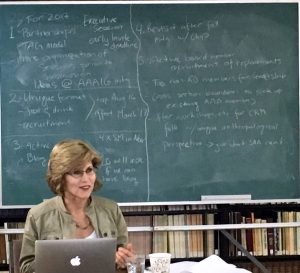
Over the years, more and more of my anthropological-archaeology colleagues declined to renew their AAA-AD membership, citing the expense or the fact that sessions about archaeology don’t dominate the meeting schedule as they do at SAA meetings. I couldn’t believe that archaeologists had become so parochial that they were willing to forego the cross-fertilization that continues to happen when anthropologists of all persuasions are brought together under one roof. But, I admit that I am bothered by the price tag of AAA membership—not exorbitant as professional organizations go but formidable considering the weak job market and plateauing of academic salaries. I suspect that among my fellow archaeologists there also is a feeling of discomfort about the fact that archaeologists are a minority within the AAAs. We often struggle to have our voices heard and to air our perspectives in matters of direct concern to archaeology, such as ethics and heritage.
What are we to do? Should we sunset the AD, chalk it up to a casualty of the increasing specialization that inevitably occurs as a discipline matures? Archaeology has grown in ways not anticipated when the Archaeology Division of the AAAs was formed in 1983. No one anticipated that federal legislation—like NAGPRA—would shake the discipline to its core, or that scientific developments like aDNA would allow mapping of genetic relatedness in a way that would realize some of the pie-in-the-sky goals of processual archaeology—that is, kinship affiliation in the Broken K pueblo study. One can ask—as many are—if archaeologists trained in departments of Anthropology stand to lose anything by cutting the strings that bind us to Anthropology—a discipline birthed in that strange cauldron of nineteenth-century European imperialism laced with insatiable curiosity? Like pieces of a jigsaw puzzle, the four jagged-edge sub-disciplines that fit together to create a holistic study of the human experience have morphed and transformed since their earlier crafting. Continue reading
In my past few walks down the history of anthropology, I’ve tended to focus on white guys being cruel to each other. I thought I’d try to widen my remit a bit in this entry, and look at white guys flattering each other — which involves, in this case, Alfred Kroeber being cruel to himself.
I live in Chicago and the screams of Cubs fans assured me of no sleep for the rest of the night. So here I am bringing you some non-sports readings as my petty retaliation for a late night headache!
As the struggle at Standing Rock continues, most visibly through Facebook where users checked in at Standing Rock in solidarity with activists this week. Teachers and professors will find this syllabus useful in describing the history and context of resistance in Indigenous America.
Speaking of Indigenous life in America, listen to Gastropod explain the growing necessity of Native American foodways in relation to lost knowledge of crops, high rates of diabetes, and food insecurity on reservations due to the history of displacement.
As capitalism continues its march into every facet of daily life, are those who exploit its mysteries and ambiguity “magicians”?
The oldest Chinese laundry in the U.S. closed last week, a reminder of the racialized immigration policy that led thousands of Asian immigrants into the service industries and its aftermath.
With gentrification pushing out residents in Queens, New York City, the Queens accent is now an “endangered species”. Author Tara Clancy details the shift and struggle of code-switching in a less linguistically diverse world.
See you next week (hopefully with sleep)!
This post is an introduction to the November Guest Blogging Effort by Members of the American Anthropological Association Archaeology Division Executive Board. We are looking forward to having engaged dialog with Savage Minds readers on how the relationship between archaeology and anthropology can be rebuilt in the 21st Century! Jane Eva Baxter is coordinating this guest blogging effort and is the outgoing Secretary of the AAA Archaeology Division Executive Board.
American archaeology has long found its home both structurally and intellectually within the four fields of anthropology. The relationship between archaeology and socio-cultural anthropology has deep historical roots based in large part on shared interests in societies considered “pre-modern” or “traditional,” and early scholarship in both subfields mutually informed and enriched one another. The postmodern turn in the 1980s and 1990s created a rift between these sub-fields and this fissure has permeated both disciplinary structures and intellectual inquiry. The historical commonalities between these two areas of inquiry has been strained, and this tension is reflected in a notable decrease in professional and scholarly engagement between practitioners of these subfields Continue reading
By The Black Trowel Collective
An anarchist archaeology embraces considerations of social inequity as a critique of authoritarian forms of power and as a rubric for enabling egalitarian and equitable relationships.
The term anarchism derives from an– (without) + arkhos (ruler), but a better and more active translation of it is perhaps ‘against domination.’ An anarchist archaeology insists on an archaeology that is committed to dismantling single hierarchical models of the past, and in that sense, its core incorporates tenets of a decolonized, indigenous, and feminist archaeology, contesting hegemonic narratives of the past. It is a theory explicitly about human relationships operating without recourse to coercive forms like authoritarianism, hierarchy, or exploitation of other humans. Some anarchists extend this argument further to non-human relationships with objects, other species, and the environment.
In keeping with these principles, there is no orthodox, overarching, uniform version of anarchism. There are multiple approaches to anarchist theory and practice tied together by common threads, and it is these commonalities that inform our anarchist archaeology. Here we outline principles for an anarchist archaeology that can be applied towards studies of the past, toward archaeologically informed examinations of contemporary societies, and to archaeological practices, including professional ethics. We offer this as both a manifesto and as a living document open to constant contextual review and revision.