Ampersand at Alas, a Blog takes on some recent research about obesity and dieting, shredding to pieces some of the myths that persist about the health effects of being fat. Despite all the efforts of the diet industry — a $30 billion a year industry according to NAAFA (the National Association to Advance Fat Acceptance), making it bigger than Hollywood, pro sports, even porn — clinical research repeatedly shows no benefit from dieting (except in specific cases such as diabetes). What’s more, losing weight — any amount of weight, at any time in your life — significantly increases the likelihood of death. In fact, it appears that “healthy” people actually have a higher mortality rate than “unhealthy” fat people — that is, people with lower BMIs (body mass indexes) are more likely to die than even people who are significantly overweight!
Continue reading
Tag Archives: The Other Three Fields
Origins of Dentistry
Archaeology is certainly underrepresented here on Savage Minds, but this discovery is worth a mention:
Stone age people in Pakistan were using dental drills made of flint 9,000 years ago, according to researchers.
Teeth from a Neolithic graveyard in Mehgarh in the country’s Baluchistan province show clear signs of drilling.
Analysis of the teeth shows prehistoric dentists had a go at curing toothache with drills made from flint heads.
Do you think stone age dentists thought they were comedians as well?
The Genetics of Postmodernism
Mankind is genetically predisposed to view the world in concrete terms, according to researchers at the Nebraska Biocultural Research Center. As hunters ranging through the Pleistocene wilderness, our ancestors were under great selective pressure to engage the world as it really is, without questioning the validity of their immediate responses. Prehistoric foragers who engaged in abstract thinking were ill-equipped to deal with the day-to-day necessities of early human life: defending themselves from dangerous predators, responding to changes in the local environment, and securing adequate resources for themselves and their offspring. “Deconstruction,” says NBRC Senior Research Fellow Brian Talagi, “was a luxury our ancestors simply could not afford.”
Continue reading
Erasing the Slate
As Stephen Pinker so persuasively argued, modern evolutionary psychology tells us clear and simple that there is no such thing as a “blank slate.” Humans are born with a set of natural dispositions, endowing them with the basic building blocks of social behavior: language, cognition, desire, etc. However, a recent discovery by genetic researchers in Korea could change all that.
Yesterday, the South Korean research firm Klonaid announced that, in the process of looking for a way to bypass the human body’s natural resistance to cloned embryos, they discovered a way to effectively turn off the set of genetic switches which determine who we are. In other words, using genetic science it is possible to wipe the slate clean, creating babies free of any genetic predispositions.
While real-world implementations remain far off, the possibilities of such tabula rasa babies (TRBs) is already beguiling researchers. Yale scientist Stanley Milgram was quoted as saying:
Freed of their natural wiring, TRBs would allow us to truly observe the effects of socialization for the first time. Whereas before such effects were filtered through each subject’s biological filter, such baggage would be absent in TRBs.
Botox = Genetic Fitness
Botox injections, a personal trainer, and a fashion consultant can help make one more genetically fit!
Don’t believe me? Just read what Razib has to say!
I had better go get a nose job so that I’m not contributing to “random genetic drift”!
Pacific prehistory in ten pages
Man, the beginning of classes has resulted in me being unbelievably swamped. However, I will break radio silence to point out one new article that I found when rennovating my syllabus: “Untangling Oceanic Settlement: The Edge Of The Knowable”:http://www.mun.ca/biology/dinnes/B2900/Articles/T8_18_531.pdf is the best short summary of the state of the art in Pacific prehistory that I have come across. Although Pacific prehistory is not my area of speciality by any means, as someone who has to teach it I am keenly aware how valuable a piece like this is, especially because of its interdisciplinary scope and concision.
William Howells, RIP
The New York Times reports today that “William Howells has passed away”:http://www.nytimes.com/2005/12/30/national/30howells.html. Howells was truly old school — he was the guy who replaced “Earnest Hooton”:http://en.wikipedia.org/wiki/Earnest_Hooton at Harvard. I don’t know enough about physical anthropology or Howells to assess his impact in the field. Uxorial fellow that I am, the most impressive thing about Howells that comes through in his obit is that his marriage lasted 73 years.
Update: Susanne Osthoff Has Been Freed
Susanne Osthoff, the German archaeologist and relief worker kidnapped in Iraq three weeks ago, has been freed and is reportedly in sound health, according to German authorities. Her driver is also expected to be freed shortly. Details are still sketchy — I imagine more will be forthcoming as Osthoff makes her way home to begin her recovery — but for now it’s simply a relief to know she is ok.
Archaeologist Kidnapped in Iraq
Susanne Osthoff, a German archaeologist who has worked since the invasion to document looted and damaged sites in Iraq, and to deliver humanitarian aid for a German relief agency, has been kidnapped, along with her driver. After warnings 6 months ago from American forces that she may be in danger, Osthoff left Iraq, but recently returned to travel to Isin, a site she had worked on before the invasion. Germany currently has no troops operating in Iraq, and Osthoff is the first German national attacked in this way. There is more information aboutthe kidnapping here and here; Saving Antiquities For Everyone (SAFE), with whom Osthoff was working, has a petition/show of support that you can sign onto (in left-hand column).
ASU Turns a Department into a School
ASU’s new School of Human Evolution & Social Change doesn’t have “anthropology” in the title but is, in fact, built upon the previously existing anthropology department. According to their website:
The new School has enriched this anthropological core by broadening its faculty to include members from a wide range of other disciplines from the life sciences, social sciences and humanities in order to introduce and define revolutionary new approaches to long-standing questions that have never been more compelling. We see this significant step as important in transforming anthropology and its role in understanding today’s world and creating a better tomorrow.
As Rob Capriccioso reports, in this Inside Higher Ed piece, it is a radical solution to a long existing problem in the field: the demise of the traditional four-field anthropology department.
Continue reading
Aleph Bet
I recently wrote a post on my other blog pondering how the Devanagari alphabet came to be ordered in such a rational way. So I was excited to read about this exciting archaeological find, described in the New York Times as “the oldest reliably dated example of an abecedary – the letters of the alphabet written out in their traditional sequence.”
Just what language these letters represent is a matter of some debate, as is archaeologist Ron E. Tappy’s literal use of the Bible, but it seems like a spectacularly important discovery nonetheless.
More links over at Language Log where you can also see a picture.
Google Archaeology
Via a newly-discovered blog at Anthropology.net, a newly discovered Roman ruin which was found using Google Earth.
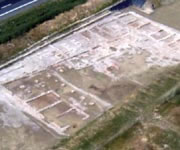
From the Nature.com article:
Using satellite images from Google Maps and Google Earth, an Italian computer programmer has stumbled upon the remains of an ancient villa. Luca Mori was studying maps of the region around his town of Sorbolo, near Parma, when he noticed a prominent, oval, shaded form more than 500 metres long. It was the meander of an ancient river, visible because former watercourses absorb different amounts of moisture from the air than their surroundings do.
His eye was caught by unusual ‘rectangular shadows’ nearby. Curious, he analysed the image further, and concluded that the lines must represent a buried structure of human origin. Eventually, he traced out what looked like the inner courtyards of a villa.
Mori, who describes the finding on his blog, Quellí Della Bassa, contacted archaeologists, including experts at the National Archaeological Museum of Parma. They confirmed the find. At first it was thought to be a Bronze Age village, but an inspection of the site turned up ceramic pieces that indicated it was a Roman villa.
Saving the Great Apes
I have a soft spot for non-human primates, especially gorillas, as they got me interested in primatology and physical anthropology back in high school. This eventually got me to take a college-level anthro course and led me to adopting cultural anthropology as a career. So I’m pleased to see that 20 governments are getting together to try to “save the great apes”:http://news.bbc.co.uk/1/hi/sci/tech/4232174.stm from extinction.
I’d be curious to know if there are actual primatologists on board with the “Great Apes Survival Project”:http://www.unep.org/grasp/, the organism that organised the conference during which the declaration to save the great apes was signed. I would think that they do but I was unable to find the information on GRASP’s website.
Of course, non-human primates co-exist with human primates and GRASP seems to have grasped (I couldn’t resist) the idea that the activities of local populations need to be taken into account. As is indicated in the BBC news article, the agreement proposes that:
The agencies should ‘make it a priority to develop and implement policies which promote ecologically sustainable livelihoods for local and indigenous communities’
I think that this reflects an acknowledgement that government agreement or no government agreement, ultimately it is essential to obtain the cooperation of people who live in areas near our non-human cousins. This cooperation requires that the people in question have the resources that they need to live without having to resort to poaching. I’m hoping that they have at least consulted cultural anthropologists in that area to assess effective ways of carrying out this project while taking local realities into account.
Anthro Daily Widget
The American Museum of Natural History’s Anthropology Division has been very busy vamping up their web site. Among the many things they’ve been doing is scanning in images of the half a million objects in their collection. So far 125,000 of these images are available online.
Unfortunately, their web designer insists on using awful javascript pop-ups on nearly every link in the site. I could barely use the site without first installing this greasemonkey script for Firefox which re-writes all the pop-up scripts to direct links. (Note to developers: Leave it up to the user whether or not to open a link in a new window! And please test your site on browsers which enable pop-up blocking, like Firefox.)
On the plus side, they have written this neat widget that works with Mac OS X 10.4.
Anthro Daily is a Dashboard widget that presents a different object every day from the ethnographic collections of the Anthropology Division of the American Museum of Natural History. The widget updates daily and links to the Anthropology Division’s website where you can research our comprehensive collections database.
The Whole University
When talking about what I do, or about research conducted by someone I know, I often find people saying “I didn’t know you could do that in Anthropology.” I won’t go into all the stereotypes of anthropologists that people have – those have been discussed enough. Instead, I wanted to talk about my response, which usually goes something like this: Virtually any subject you can study in the university you can also study in anthropology. Instead of economics, you can study economic anthropology. There is medical anthropology, linguistic anthropology, political anthropology, historical anthropology, ethnomusicology, visual anthropology, etc.
So, how is it that anthropology has eaten up the whole university curriculum, mirroring virtually every subject within its own disciplinary boundaries? More importantly, what distinguishes what is done in the anthropological doppleganger from its more established twin?
There are several ways of answering these questions. One is to ground anthropology in its methodology. But not all anthropologists are ethnographers. Historical and literary work is perhaps not the norm, but is certainly not uncommon. Moreover, other disciplines increasingly embrace ethnographic fieldwork. Another would be to ground anthropology in a particular moral core. Still another might be to look at anthropology as an institution, tracing the history of the discipline historically and simply defining the field in terms of what anthropologists do.
But I think there is one thing that stands out, and that is anthropologists’ holistic approach. I believe anthropologists are expected to be able to talk knowingly about a wider range of subjects than other academics often are. People who feel constrained by the assumptions of economistic models, or of the narrow focus of epidemiology, or by the narrow definition of language implicit in Chomskyan linguistics, run to anthropology precisely because it eschews such reductionism. Which is not to say that the anthropological approach is necessarily superior to that of these other disciplines, just that it offers an important corrective to all forms of positivism. True, anthropology has its own positivists, eager to reduce the discipline to a set of methodological practices or narrow theoretical models; but these attempts will continue to be marginal to the discipline as a whole.
I see anthropology’s holism as deriving from the ethnographic method, which forces us to look at human behavior in its lived context. I also think that it has a moral component. John Gledhill, in his book Power and its Disguises, defines anthropology
as a social science which attempts to examine social realities in a cross-cultural frame of reference. In striving to transcend a view of the world based solely on the premises of European culture and history, anthropologists are also encouraged to look beneath the world of appearances and taken-for-granted assumptions in social life in general.
This cross-cultural perspective is historical to the discipline and applies even to anthropologists who now study their own culture. One of the central features of the positivism implicit in various other university disciplines is their claim for universality. Now, I think all the disciplines have made great strides in the past few decades, questioning, if not completely shedding, many of their eurocentric and patriarchal assumptions. But it is still a fact, for instance, that Black people seeking medical care are likely to receive less treatment and stay sick for longer. As long as issues of language, health, economics, politics, etc. continue to have a cultural component which cannot easily be reduced to the models used to study those particular phenomenon, there will continue to be a place for anthropology as a discipline.