Tag Archives: Methodology

Going Paperless (Tools We Use)

I’ve been trying to go paperless since graduate school, when I bought my first sheet-feed scanner. It was a slow, noisy, hulk of a machine which would jam half the time. But I’m not the kind of person to let reality get in the way when I know something is possible, even if that possibility is just over the horizon. 2010 is the year that going paperless became truly possible, and not just for those who dream of the future—for everyone. What’s amazing is that all of a sudden there are hundreds of choices depending on your own personal workflow, system preferences, etc. Here’s how I do it:

INPUT: If you aren’t starting with a digital document from JSTOR, you need to scan your paper. My school has a fancy photocopy machine which can chew up an article and spit out a nice small PDF file, but if you don’t have access to that you can get yourself a Fujitsu ScanSnap S1500 (or S1500M for the Mac) which can do the same thing. If you have a smartphone with a good camera you can also simply take a snapshot and use software like JotNot to convert those photos to something resembling a scanned document.

STORAGE: Once you’ve scanned something or downloaded it from the web, what do you do with it? Personally I am a big fan of Evernote which will do OCR on your (English) image and PDF files and which lets you do fulltext search on your entire library. It also can sync between your computer and mobile apps. But for academic texts I need structured metadata. I need to be able to pull out citations and insert them in my bibliography, etc. For that I use Sente. The iPad version of Sente pro finally came out and it is amazing. (See my review of the free version.) Unfortunately, Sente and Evernote still aren’t enough. I have some huge PDF files which aren’t handled well by either app so I also depend on Dropbox to sync those files across computers. And while all of these options have the ability to share with others, I find the easiest way to share files online is with Google Docs so I also use that, especially for teaching.

Continue reading

Anthropology Is…

http://www.youtube.com/watch?v=jBO3eUwPKvs

Rex recently asked for “anthropology creeds” but for the life of me I can’t write one. So instead I’ll write about why I think the task is impossible. An anti-creed if you like.

In short, I think that anthropology, like Christmas, or the island on Lost, is whatever you want it to be. Every discipline in academia also exists as a mirror-self within anthropology: economics, semiotics, medicine, political-science, genetics, religion, history…etc., all have their counterparts in anthropology. And not just one counterpart either. Just looking at economic anthropology, one can take a myriad of different approaches to the subject all of which are called anthropology. Just about the only approach not called anthropology would be that used by economists… and even there I’m sure you can find some anthropologists whose work isn’t too different from what you would find in an economics journal.

Continue reading

EPIC: Ethnographic Praxis in Corporations

One of the most vigilant members of the SM community, John McCreery (PhD Cornell, 1973), just returned from EPIC, Ethnographic Praxis in Corporations, a conference which took place August 29th-September 1, 2010 in downtown Tokyo with this guest blogger report. It was a local event for John who has lived in Japan since 1980. John is a pioneer in the creative application of anthropological training in corporate contexts having first worked as a copywriter and creative director for Hakuhodo Inc. (1983-1996) and later becoming a Partner and Vice-President of The Word Works, Ltd. (www.wordworks.jp). Kochira koso, John, for this excellent look at EPIC. –AF

An EPIC Experience by John McCreery

All is not well in the world of EPIC, Ethnographic Praxis in Corporations. That said, there is much to envy and admire. Having struggled over the last fifteen years to establish ethnography as an essential component in the corporate research toolkit, participants in EPIC 2010, held this week in Tokyo, confront an environment in which economic recession has slashed budgets and shortened projects, while acceptance has led to routinization, erosion of perceived value, and the threat of deskilling. Above all, corporate ethnography, like the survey and focus group, is threatened by the rise of analytics that draw on the Internet for near real-time access to changes in user behavior. There is, however, a notable lack of panic and despair in the EPIC community. These are, after all, people who have faced tough times before and created new roles for themselves.

Continue reading

The Dunning-Kruger Effect

Errol Morris has an intriguing series of posts on the Dunning-Kruger Effect on his NY Times blog. The central question “How do we know what we don’t know?” is something central to both Anthropology as a discipline (How do we know what we don’t know about another culture?) as well as teaching (How do we help students come to realize what it is that they don’t know?). For these reasons I found this exchange between Morris and Dunning quite interesting:

DAVID DUNNING: Here’s a thought. The road to self-insight really runs through other people. So it really depends on what sort of feedback you are getting. Is the world telling you good things? Is the world rewarding you in a way that you would expect a competent person to be rewarded? If you watch other people, you often find there are different ways to do things; there are better ways to do things. I’m not as good as I thought I was, but I have something to work on. Now, the sad part about that is — there’s been a replication of this with medical students — people at the bottom, if you show them what other people do, they don’t get it. They don’t realize that what those other people are doing is superior to what they’re doing. And that’s the troubling thing. So for people at the bottom, that social comparison information is a wonderful piece of information, but they may not be in a position to take advantage of it like other people.

ERROL MORRIS: But wait a second. You’re supposed to benefit from feedback. But the people that you’ve picked are dunderheads. And you lack the ability to discriminate between dunderheads and non-dunderheads, between good advice and bad advice, between that which makes sense and that which makes no sense. So the community does you no damn good!

DAVID DUNNING: You know, I think that is an issue. Those among us who are in the 40th percentile, they’re not the best, but they’re not doing too badly. But people at the bottom, you’re going to have to be open-minded and you’re going to have some special hurdles, internal hurdles you have to get over. If people give you conflicting advice, congratulations, you don’t know how to choose. Yes, it is a tricky part of the problem.

I think this is a central problem for teachers trying to get through to the bottom 40% of a class. Often it seems that these students simply don’t do the work. But I think it isn’t so simple. I believe they don’t see the purpose of doing the work. While they understand that there is some information in the assignments that they are missing, they don’t see this information as adding up to new skills, new ways of thinking about the world which might be of benefit to them. For instance, in a class on documentary film, I had one student who was still, after a whole semester of learning about various approaches to discussing films (structure, form, narrative style, etc.) was unable to compare two films. He kept comparing the events portrayed in the films, but didn’t understand what I wanted when I asked him to focus on the films themselves rather than the events they portrayed. In some important way I failed to convince this student that there was anything of value to learn in my class.

As anthropologists we find ourselves in the opposite situation. We are often in the bottom 40% (or worse) in terms of our understanding of the culture we are trying to study (unless you happen to be working in your own culture). And while we differ from the student in the above example in that we know there is something we don’t know and are very motivated to learn it, we still “don’t get” a lot of what our informants try to tell us. I’ve long felt that there is a certain hubris to anthropological research, in the idea that you can spend ten to eighteen months somewhere and then attempt to speak authoritatively about it. The only thing saving us are our collaborators. As Dunning says: “it really depends on what sort of feedback you are getting.” But also on our ability to listen to that feedback, which I think is much harder than we would like to believe.

Hard Problems in Anthropology

In 1990 [1900], the renowned mathematician David Hilbert laid down a challenge to future generations: 23 hand-picked mathematical problems, all difficult, all important, and all unsolved. Since then, countless mathematicians around the world have struggled to solve the 23 ‘Hilbert Problems’ (ten have been resolved; eleven are partly solved or simply cannot be solved; and two remain at large). Most important, the pursuit of the solutions had a profound and fundamental influence on the roadmap for 20th century mathematics, testament to Hilbert’s foresight.

So begins an announcement about a Harvard symposium aimed at identifying a similar list of problems for the social sciences. I thought it might be interesting to poll our readers about their own ideas for a list of “hard problems in anthropology.” Does it make sense to compile such a list? What would you put on the list? What would it mean for cultural anthropologists to “solve” a problem.Are there any such problems from a previous era that we’ve already solved?

Off the top of my head, I can think of two typical anthropological “problems.” Each posing different challenges to a Hilbertesque approach to defining a list of such problems.

The first might be phrased as “What’s the matter with Kansas?” That is, why do people seem to act contrary to their own class interests? But even asking the problem causes problems. Larry Bartels famously asked: What’s the Matter With ‘What’s the Matter With Kansas?’, which undermined many of the premises of Frank’s book. The difficulties of defining “class interests” in the first place makes this question so much messier than a mathematical problem.

The second is more typical of contemporary anthropology and could be stated thus: “What are the cultural logics that make X actions thinkable, practicable, and desirable?” (Paraphrased from the introduction to Aihwa Ong’s Flexible Citizenship.) Having observed some phenomenon, anthropologists then collect the stories people tell about that problem and interpret them in light of our own understanding of how institutional and cultural practices shape such stories. Here the problem isn’t so much the question, but identifying under what conditions we might consider the problem “solved”? One can’t jump in the same river twice and so each anthropologist who asks such a question will very likely come up with different answers.

So what do our readers think? Does it make sense to compile such a list? If so, what would you put on it? And how would you define a problem as being “solved”? If not, might there be a better way to focus the efforts of cultural anthropology on a set of common problems?

(Hat tip to Ennis for the link.)

Memory, Virtual Archives and Johannes Fabian

This is a long, drafty, and somewhat less review-y version of a review I am writing about Johannes Fabian’s latest projects.

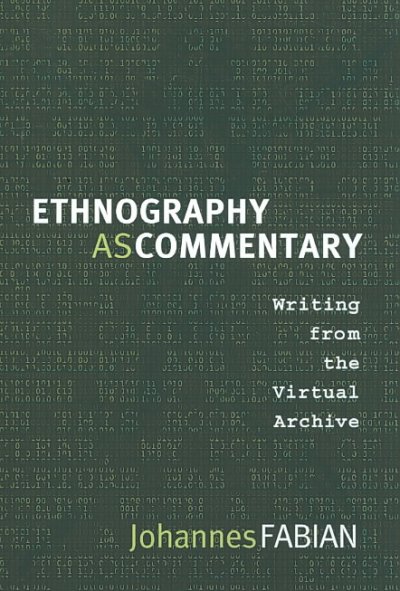
Johannes Fabian, Ethnography as Commentary: Writing from the Virtual Archive, Durham, N.C. Duke University Press, 2008. 140p.

Johannes Fabian, Memory Against Culture: Arguments and Reminders, Durham, N.C. Duke University Press, 2007. 192p.

Johannes Fabian’s contributions to anthropology are distinctive. Depending on where you start, he is an Africanist, a linguistic anthropologist, a partisan and critic of the “Writing Culture” moment in American anthropology, a folklorist and student of popular culture, a historian of drug use by colonial anthropologists, a theorist of time, memory and alterity, and now something of a hacker as well. Two books have been published recently which capture some of his heterogeneously distinctive work. The first, Memory against Culture, collects several recent talks and articles, including one called “Ethnography from the Virtual Archive” which is the germ of the second book Ethnography as Commentary, which is both a meditation on creating a “virtual archive” of ethnographic sources and a “late ethnography” of a popular ritual which Fabian experienced in 1974 in Zaire with a healer named Kahenga.

fabian1

Ethnography as Commentary is a fabulous (and short!) book. It is an excellent introduction to the detailed practice of ethnographic interpretation; it is also a very thought-provoking meditation on the changing possibilities of the ethnographic monograph after the Internet, and of the possibility of ethnography as commentary. Lastly it is an experiment in “late ethnography” in which an explanation of a cultural event (Kahenga’ ritual exclusion and protection of Fabian’s house in the Katanga district) is conducted through memory, notes and sources, contrasted with the practice of writing history and used to shed light on the authority of ethnographies based in contemporary sources.

The core of the experiment proposed by Fabian is the creation of an online resource of materials: The Language and Popular Culture in Africa Archives (LPCA). The PCA includes an online open access journal started in 2001; a collection of heterogeneous transcripts and documents collected, transcribed, translated and annotated, all of which bear some rough thematic connection to popular culture in Central Africa. It includes, for instance, a Boloki perception of a visit to Europe written in 1895-1897; translated and annotated poems from a French collection of Central African songs and poems published around 1930. Several conversations that Fabian has recorded over the years (including the one which is at the center of Ethnography as Commentary). An interview with a Burundi potter discussing the history and local techniques; the “archives of popular culture” which contain letters, a local history of Zaire, a play “Power is Eaten Whole” by the “Troupe Théâtrale Mufwankolo” of Lubumbashi; a vocabulary and other texts; an extensive bibliography of related sources.
Continue reading

Do AAA surveys do any good?

It seems like every few months the AAA sends out another survey (in fact, I’ve probably griped about this before). Here is the latest, on digital publishing. I’ve stopped answering these. I felt the last three I responded to were very poorly constructed and so I’ve come to believe it is a waste of my time to participate in an exercise which seems constructed more to generate the semblance of support for policies the AAA has already decided upon than to genuinely investigate the concerns of its members.

It isn’t just the AAA, my university has also taken to doing surveys of the faculty. My feeling is that such surveys are a very poor substitute for genuine institutional democracy which gives members a voice in shaping policy. But even assuming that these institutions need to conduct this kind of research, surely we social scientists have better tools at our disposal than surveys? How about hiring some applied practicing anthropologists to research these questions?

Maybe the AAA should do a survey on how AAA members feel about surveys?

Learning an Endangered Language (Part 2)

In this post I’d like to elaborate on two issues raised in Part 1 and in the interesting discussion which followed.

The first issue is the tremendous variety of linguistic situations anthropologists find themselves in. By “situation” I also mean to include the language repertoire of the anthropologists themselves. Living and working in East Asia I have many colleagues who conducted fieldwork here in Taiwan. For many of these colleagues it was academic English with which they struggled, having studied abroad for their Ph.D. Americans pursuing advanced graduate degrees here in Taiwan have an easier time, since many of the texts are in English and they can submit their term papers in English. My Taiwanese colleagues were not so lucky and I’m tremendously impressed by their ability to write a Ph.D. dissertation in a foreign language, especially since some of them really struggled with written English.  Yet while some of them claim Hoklo, Hakka, or even an Aborigine language as a “mother tongue,” in many cases their ability to communicate in these languages is sometimes quite limited. This is directly connected to the theme of these posts – the fact that these are endangered languages. I will speak more on that next time, but the reality is that there are very few monolingual speakers of these languages in Taiwan, and one can almost always get by with Taiwanese Mandarin. A lot depends on the context in which one finds oneself, although I imagine that linguistic competence also affects which contexts one ends up in. I might hang out more with 80 year old Amis grandmas if I understood their (often naughty) jokes, but as it is I’m more likely to talk to their grand kids who can’t understand the jokes either.

Zora’s comment on the last post illustrates the nature of this diversity. Zora “did fieldwork in Tonga, in the South Pacific—where, luckily for [her], a history of British colonialism ensured that the intelligentsia spoke English.” She “went to an island in the Ha’apai archipelago” where many young people spoke English, but where (if I understand correctly) much of the older community was monolingual in Tongan, which she learned after a year and a half in the field (plus some tutoring before she had left). Compare that to Taiwan, where the dominant language is not English, but Mandarin Chinese. Although one could conceivably work entirely in the local language spoken at the field site, inability to speak or read Chinese would severely hinder one’s ability to do good quality academic research here. For instance, the textbooks I’ve used for studying both Hoklo and Amis are written in Mandarin. Also, one needs to be able to access scholarship published in Mandarin. (Or at least I should be doing that – I can barely keep up with my English reading list these days…) So while Zora could spend a year and a half learning Tongan, most American or European  scholars who come to Taiwan to do research spend a decade or more learning Chinese, and are at very different levels of progress when they get to the field. (Several colleagues I’ve spoken to who’ve worked in Taiwan or China have confessed to me that they just gave up on literacy and focused on conversational fluency instead.) From what I know about research in Arabic speaking countries the situation is somewhat similar: researchers first learn Classical Arabic, then the local vernacular, and if they have time also try to study a minority language as well, but don’t usually get very far.

This brings me to the second issue, which is that of working in a country with strong diglossia.

Continue reading

Philosophers Discover Lost Tribe in Jungles of Free Will

Lately I’ve been thinking a lot about the concept of responsibility, and this has necessarily entailed (determined even) my encounter with contemporary (mostly American) moral philosophy. It’s not a domain I would ever seek out, being much more comfortable in the idioms of social theory and continental philosophy, but it’s hardly alien. However, a funny thing happened on my way to the agora, which is that I discovered that a small selection of philosophers have recently gone “experimental.”

Apparently, making broad claims about “what a person would naturally think” have finally become so insupportable that even philosophers have started exploring the possibility of actually talking to people. Experiments measuring “folk beliefs” about whether our world is deterministic or not, or whether free will can exist if the world is deterministic, are intended to settle claims that begin “most people believe that…” Settling such claims is necessary in the domain of moral philosophy, because a concept like responsibility is fundamentally tied to what people do in “everyday” circumstances. If it is not possible to start from some kind of claim about whether (to say nothing of why) people make ascriptions of praise and blame in the same way, then, arguments about free will and moral responsibility start to seem like the proverbial and much-maligned mass and extension of angels living on pins.

Burning ArmchairEnter “X-Phi” — a contingent of young whippersnappers bent on making names for themselves by shaking up some methodological verities in their discipline, “trailing blogs of glory” (as K. A. Appiah deligtfully characterized it) and sporting a burning arm-chair as their logo. You can get a T-shirt, here. You can befriend Experimental Philosopher on myspace here (you’ll be in some rocking company). Or read about them in Slate.

Needless to say, and I speak on behalf of all of us here, This Rocks. Continue reading

A parting note on evidence in cultural studies

Soon I’ll wrap up my series of posts on cultural studies and move on to another of anthropology’s interlocutors, Symbolic Interactionism and the ethnographic tradition in sociology. Before I do, however, I wanted to take one last stab at cultural studies and anthropology’s uneasy relationship to it. One of the things that bothers me about contemporary anthropology and cultural studies is the way that, for much of the work in these areas, there is no sense that it is hard to do ethnographic work, or that ethnographic details must be clear and precisely stated. The easy part, in other words, is what is going on. The hard part is how to draw out the theoretical implications.

There are probably many reasons that anthropology is currently in this state, but what about cultural studies? Recently I finished Constance Penley’s “NASA/TREK”:http://www.amazon.com/NASA-Trek-Popular-Science-America/dp/0860916170/ref=pd_bbs_sr_1?ie=UTF8&s=books&qid=1205784297&sr=8-1, a delightful little volume made up of lots of different parts, some of which are better than others, and not all of which hang together so well. The book’s argument is basically that when it comes to space travel, Star Trek is the theory and NASA the practice, and that this NASA/TREK complex has become a central location for Americans to rethink issues of progress, science, and gender relations (race was obviously there, but never really focused on). I was struck by the beginning part of the book which worked, surprisingly convincingly, to convince the reader that NASA and Trek were basically the same thing. Penley does this mostly through detail — that the first shuttle was renamed ‘Enterprise’ after a write-in campaign, that Star Trek cast members were invited to the first launch, that they played the Star Trek theme song as the shuttle was moved out to the launch pad. Equally her discussion of the Challenger explosion and the folklore surrounding it was fascinating to read (and relied on the work of a folklorist — another discipline I should talk about at some point).

At the same time, the second half of the book that deals with slash fiction was much less convincing to me. It wasn’t that I disagreed with Penley’s claim (now, 15 years later, we all know about slash and female fans). But it seemed to rely more on assertion, based on experience, of what slash writers were like and less on the sort of evidence I saw in the first half of the book. The concluding section, on the other hand, which situated slash in the context of American utopian literature by women and interracial mateship (to use a Stralian term) novel was fascinating although, I admit, totally out of my depth.

The point of all of this is just to say that along the way it occurred to me that literary criticism has always (this is going to sound dumb) criticized literature. Its data are works which people have already read and/or are utterly impossible to do justice to in a short period of space. And yet clearly, literary criticism is (or used to be, alas), criticism of literature, not a description of it. A monograph which provided a close description of a novel is simply… a copy of the novel.

This probably sounds extremely naive to someone who knows more about this topic than I do, but I’d hypothesize that the particularities of the subject of the literary criticism (longish text artifacts) has resulted in a particular method of analyzing them, and that this method has carried over, or at least had an effect, in its inheritor disciplines. Make sense?

Beyond Fieldnotes: Lifelogging and FacetMaps

Last year we Fuji talked about a host of new tools one can use to take fieldnotes, but after listening to a recent podcast of On The Media, I think there are some new technologies on the horizon which are going to take fieldnotes to a whole new level.

Gordon Bell is a computer scientist with an eye for detail – every detail, in fact, that he’s accumulated over the course of his life. A senior researcher for Microsoft, Bell is at the vanguard of a movement called “lifelogging,” digitally storing every letter and photo, every phone call, email and video, every conversation, keystroke and scrap of paper, the entire minutiae of his daily routine, onto a hard drive.

He wears a camera around his neck called a SenseCam that takes snapshots every minute, of whatever may be in his path, including you, if you happen to be standing there.

What’s cool is that Bell and his team have created and deployed new tools, such as FacetMaps, to data mine the archive he’s created. You can see video demos here. Its Microsoft, so the GUI sucks, but the potential is there. [It is no longer run by Microsoft.] Of course, there are ethical implications that still have to be worked out. How do you opt-out of someone’s lifelog?

UPDATE: Minor changes for clarity.

UPDATE: 3/28/2014: MyLifeBits has a new home.

Cultural Dynamics in Interrogation: The FBI At Guantanamo

It is easy – commonplace – for anthropologists to have an opinion on “the war” and to think that our opinions are worth hearing. But those opinions are more informed, nuanced, and will carry further if they are shaped by the close, yet open-minded, encounters with ground level realities, and practice, whose importance we, and our disciplinary forbears, have worked so hard to promote.” – p. 327 in Keith Brown and Catherine Lutz, “Grunt Lit: The participant observers of empire.” AE 34:2, 322-328.

For Brown and Lutz, the autobiographical accounts of soldiers provide a window into the messy and chaotic instantiation of empire in war, and are worth submitting to what Lutz calls “[the] discipline’s standard tropes of person-centered, contextualized understanding” (Lutz 2006 in AE, 33:4, p. 593). Along these lines, the interrogation records of the GWOT should be subject to the same ethnographic scrutiny. If nothing else, they reveal that (to paraphrase Clausewitz) interrogation is the extension of war by other means, as a complex ideological conflict is waged discursively in the context of the prison interrogation room.

To make this point, I’ll share a very abbreviated draft of article I’m writing, for which I draw on a subset of roughly 500 pages of documents dealing with FBI interrogation at Guantanamo Bay, Cuba, between February 2002 and July 2004. Within this collection, there are approximately fifty FBI “transcriptions” (which are perhaps better described as summaries of interviews, “interview” being FBI parlance for interrogation). Because many are heavily redacted, it can be hard to discern where one interview ends and another begins. Reading these is akin to listening to a radio broadcast between bursts of heavy static, or watching a movie interrupted by sporadic blackouts. Although the interview transcriptions do use proper names, identifying information is always redacted; and for convenience, I am following FBI convention in referring to the parties as “interviewers” and “detainees.” I use a bracketed ellipsis to denote redactions […], and I quotations to the official document number so that interested readers can look up the source material (e.g., 4042).

Redactions notwithstanding, this collection provides fascinating insight into the manifold ways in which “culture” makes its presence felt. As Robert Rubinstein points out in his forthcoming book, Peacekeeping Under Fire: Culture and Intervention (Paradigm 2008), culture operates at many levels in UN peacekeeping efforts. He identifies three interlocking cultural dynamics that shape the trajectory of these operations: interactions between peacekeepers and local populations; interactions between participating local and national bureaucracies; and in a meta-sense, as international perceptions of “peacekeeping” evolve politically and institutionally.

Similarly, cultural dynamics operate at multiple levels in interrogation. At its most basic, interrogation aims to get specific information for specific purpose: for example, to develop a criminal case, obtain a confession, or provide “actionable intelligence” that can be used in tactical decision-making. That interviewers are seeking such information is apparent when detainees are asked to explain their presence at an Al Qaeda training camp, or shown photos of other detainees and asked to identify co-conspirators (e.g., 3904). However, far more is going on in these FBI interviews than attempts to elicit specific facts from recalcitrant detainees. In the interrogation encounter, detainees and interviewers look at each other across the table and, with the help of a translator (who is always silent in the transcriptions), they dive into a discursive exchange that reaches far beyond the confines of the interrogation room.

For example, interviewer-detainee exchanges shed light on the dynamics of guard-prisoner interactions in detention operations at Guantánamo. Often, the detainees complain to the interviewers about mistreatment by military police: roughing up prisoners, insulting detainees, and disrespecting the Koran are all sore points among the detainee population. But the weak have weapons: in one interview, a detainee gives the interviewers advice for how guards should comport themselves in front of the detainees – and in doing so, hints at vibrant hidden transcript, in which the projection of state power, embodied in the masculine form of the military police guard, is undermined by a simple technology:

Detainees see the guards as babies, especially the “big American guards that fill the doorway.” This is because the guards are supposed to be strong, yet they walk around with a “camel” (a backpack water storage device with a drinking tube attached) on their back sucking on a tube of water all of the time. A strong man is able to go without water for long periods of time. (The detainee) suggested that the water be kept out of sight of the prisoners and have the guards walk to where the water is kept. (3913)

Secondly, the records illustrate how detainees under interrogation challenge the official transcript of GWOT internment with complex counter-narratives about such topics as the war in Afghanistan (e.g., 3906), jihad and September 11 (e.g., 3899, 4080, 3845, 3844, 3850), American imperialism and foreign policy (e.g., 3918-21, 3912, 3913, 3916, 3925, 3842, 3861, 4086), and the fact that the detention operation at Guantanamo violates legal rights guaranteed by the US Constitution (3924). Along the way, the detainees also share their views on Christianity (e.g., 3906), Israel and Judaism (e.g., 4026), popular culture and sexuality (e.g., 3921), proper treatment of the Koran (e.g., 4803, 4024) and privacy of the body and shame (e.g., 3836, 3854, 4061). Sadly, there are also numerous descriptions of physical abuse, mostly beatings, particularly when the detainees are initially arrested either by Northern Alliance (e.g., 3903) or US troops (e.g., 3892).

But just as the detainees challenge the official discourse of the GWOT, we can see the FBI interviewers developing their own counter-narratives of Islam for the purpose of convincing the detainees that they should share what they know about Al Qaeda, terrorism, 9/11, and the Taliban. The manipulation is psychological, playing heavily on old-fashioned self-interest, but is arguably cultural, too, insofar as the manipulation draws on a framework of religious beliefs. For example, in one transcription (4033-4034), the interviewing agents show the interviewee a movie and photographs of people dying in New York and Washington on 9/11. As they do so, they invoke a narrative of Islam that questions the theological basis for mass violence, then point out that the detainee had become involved with a group of people who “…(abused and maligned) the religion, and will feel God’s wrath and anger on judgment day. […] appeared visibly shaken by this realization.” The interviewer then offers the detainee a chance for absolution through cooperating with the FBI. He warns the detainee that his fellows are “out to save their own butt,” and tells him the window of opportunity is closing. The technique, it seems, is emotionally powerful, as illustrated in a surprisingly poignant closing paragraph:

At the conclusion of the interview, the interview team wished […] luck and that God may accept his prayers. After exiting the room, the interview team witnessed […] with his head down on his hands on the table in front of him… […] was crying and sobbing with the tears falling down on the table when he lifted his head” (4033-4034).

Whether or not this individual eventually gave the FBI team what it wanted is not clear.

By now it should be apparent that interrogation does not necessarily involve the forcible elicitation of “facts”. In these transcriptions, interrogation is revealed as a complicated communicative exchange in which participants share, gather, construct, and deploy knowledge as they provoke and/or resist an alien Other. As Alfred McCoy points out (2006), FBI interrogation strategies strongly emphasize rapport-building over coercion; and we can see FBI agents putting this ethos into practice in the interrogations they conduct. The resulting knowledge that emerges in these exchanges is often profoundly cultural, but not necessarily anthropological. Moreover, the headers on these transcriptions indicate that they were shared among the agencies involved in Guantanamo (DHS, DoD, and FBI) and as such, are likely source material for interrogators and intelligence analysts constructing their own model of the Arab/Islamic Other.

This raises another question about culture; namely, the problem of institutional culture and interagency power struggles as three major government bureaucracies – the FBI, DHS and the Department of Defense – each implement their own strategies for eliciting information from detainees. In particular, DoD interviewers frequently take a much more forceful approach to interrogation, something that FBI agents – and indeed, many DoD personnel – find troubling. And that’s the teaser for my next post.
Some general thoughts about anthropology, interrogation, and torture

A few months ago, in a November 2006 post reflecting on the twin Gonzalez-Lin resolutions against the war in Iraq and the use of anthropological knowledge in torture, Rex asked whether anthropologists might be in danger of generating more heat than light. I’ve asked myself the same question. Ever since Sy Hersh published his three-part series on Abu Ghraib in 2004, anthropologists have been worried about the involvement of their counterparts in torture, or the use of ethnographic information in torture. But aside from a lot of people quoting Sy Hersh, over and over and over again, I’ve come across no corroborating evidence of a link between anthropology and Abu Ghraib – or even in plain old GWOT interrogation, for that matter.

As I discuss in an upcoming short piece in Anthropology News (likely to be published in October), I wrote Hersh a letter and asked him to comment on the link between Patai and torture. He actually called me back in July to tell me that he doesn’t think that Patai’s book played a role in Abu Ghraib (yes, you read that right). When I told him that anthropologists took his claims in “The Gray Zone” very much to heart, and that we’d even put forth resolution against the use of anthropological knowledge in torture, Hersh seemed genuinely surprised, and pointed out that he’d never actually written any such thing. Which, strictly speaking, is true. Read the piece here.

So here’s my plea: don’t point to Hersh as evidence of ethnographically informed torture, and when people do point to Hersh’s article as evidence of such, question whether or not there’s anything to corroborate the claim. If you want to go the extra mile, then dig into the documents yourself. There’s plenty of documentation out there that supports research into the problem of ethnographically informed torture. Several organizations, including the Center for Public Integrity, the University of Minnesota Human Rights Library, and the ACLU all maintain extensive electronic archives of FOIA’d documents around interrogation and detention operations involving the DoD, the intelligence community, and the FBI. In 4000-plus pages of reading, I’ve seen no evidence of anthropologists being involved in torture or interrogation. In fact, I’d have to characterize anthropology as conspicuously absent from detention and interrogation operations.

But that doesn’t mean culture isn’t important. Indeed, the Global War on Terrorism constitutes a cultural encounter of some kind – we just haven’t figured out what, precisely, that means. There’s an opportunity for excellent critique, but making our critique relevant requires some new thinking about our own “sources and methods,” to borrow a term from the intelligence community.

In this regard, I liked Keith Brown and Catherine Lutz’s recent article on “grunt lit,” in which they describe soldiers as the “participant-observers of empire” (2007). They argue that anthropologists should pay more attention to soldiers’ memoirs as a window into the confusing and contradictory microdynamics of empire. In doing so, we might learn a lot about the instantiation of empire and the shifting identity of the American nation-state in the post-Cold war, post 9-11 era.

I’ve come to think of the thousands of pages of memos, emails, depositions, forms, reports in the FOIA collections as the electronic precipitates of the Global War on Terrorism. As such, they offer a glimpse into the nature of American empire – which is, among other things, a bewildering conundrum of personnel, agencies, policies, procedures, acronyms, directives, rosters, and the like. In detention and interrogation operations, this Gordian knot of bureaucracy is unleashed on enemy combatants and prisoners of war, most of whom seem to hail from Arabic-speaking regions of Central Asia and the Middle East.

This is where anthropology comes in, but not as instrumentally or formally as many anthropologists seem to have assumed. It’s not that the military-intelligence-security apparatchik systematically sought anthropologists (or even ethnography) to play the role of cultural seer in interrogation. Rather, what’s anthropologically interesting is the way that people within the bureaucracy are actively engaged in making sense of an alien Other, and in doing so, are formulating their own theories and understandings about what makes this Other tick. Moreover, there’s evidence that the Other is engaged in reciprocal effort vis-a-vis guards and interrogators. As such, interrogation itself constitutes a sociocultural encounter of an astoundingly complicated kind. I’ll be writing more about this topic for my next post, using a couple of examples from a collection of FBI observations about detainee treatment at Guantanamo, and talking a bit about Robert Rubinstein’s ideas about culture in peacekeeping operations in a forthcoming book of his.

The methodological sharpening of cultural anthropology

One way to look at the history of (American?) anthropology is through the rise and fall and rise of the four field configuration of subdisciplines. In The Beginning the four fields were easily combined for a number of reasons: each field was not very specialized, which meant that individual anthropologists could learn a bit about all of them while the Boasian predisposition to particularizing research made close study of a phenomenon using multiple approaches seem attractive. Since then (one possible narrative might go) the subfields have split up and specialized and now are ready to be reintegrated into a new Even More Holistic disciplinary configuration.

Of course this narrative is the line ‘the subfields have split up and specialized’. It does not take very long to conjure up images of the methodological advances made by biological anthropology, archaeology, and linguistics over the past century. But… what about cultural anthropology?
Continue reading