Tag Archives: History of Anthropology

Anthropological theory through its dates

As I’ve mentioned in previous posts, anthropological theory has (for better or for worse) a genealogical orientation and I’ve been trying to figure out how this orientation operates because I will probably be teaching a course on ‘anthropological theory’ in the future. One of the ways I’ve been trying to figure out this history of anthropology has been to look years which seem like turning points — or at least pivots — in (US) anthropological theory. Since I am doing ‘contemporary’ theory I have focused less on the pre-WWII period and tried to focus on some moments that seek key to me. I have a big piece of paper where I’ve plotted important books on a timeline. Here are some years that stand out for me just in terms of publishing:

1957/58: The New Ethnography — componential analysis and cognitive linguistics
1966: The year structuralism hit. Savage Mind, etc. etc.
1972: Anthropology Today (Berreman) and Rethinking Anthropology (Dell Hymes) — politicization and relevance
1981/82: Post-Steward Columbians: Europe and the People Without History and Historical Metaphors and Mythical Realities
1986: Objectivity? We don’t need no stinkin’ objectivity: Writing Culture, Anthropology as Cultural Critique
1997: Culture, Power, Place and Anthropological Locations.

One of my professors in grad school once remarked to me there is a bit of an academic rain shadow effect — your professors teach tend not to teach about their professor’s generation (because they are rebelling against it?), so you never learn about it in grad school. Then you learn about it, rebel against your professors, assign your students to read the generation of professors who taught your professors, then your students never read your professor’s work, they graduate… etc. etc…..So I am particularly interested in learning more from y’all about the ‘soft’ spot in my knowledge of the history of anthro between the period now firmly declared ‘classic’ (pre-Kroeber’s textbook Anthropology) and Ortner’s “Theory In Anthropology Since The Sixties” (1984) whose definitive construal of this period I have been struggling to get out from under for the past couple of years.

Any ideas?

The Fate of McFate: Anthropology’s Relationship with the Military Revisited

Back in January, Matthew Stannard at the SF Chronicle, having come across my SM piece Anthropologists as Counter-Insurgents, contacted me about doing an interview for an upcoming profile on Montgomery McFate, the advocate for anthropology in the military whose work I was responding to. The piece is now online, entitled Montgomery McFate’s Mission: Can one anthropologist possibly steer the course in Iraq?. I’m not quite ready to revisit this topic — I’m up to my neck in grading and other work, with the semester’s end a week-and-a-half away, but I thought I’d mention it now while I put together some further thoughts on the matter. It’s a fairly good article, even though I’m only quoted once (Stannard apparently has not been taught the maxim that the more quotes of me a paper has, the better it is). Interestingly, though the interview ranged all over, I’m quoted more in my capacity as historian of anthropology than in my — I think more relevant — role as anthropological ethicist.

History of anthropology, anthropological theory, and Just Plain Theory

One of my jobs in my department is to create a new “theory course” for cultural anthropologists to supplement the core course that we currently have but that doesn’t cover the “hot theorists” that students want to read but which we can’t cram into the one semester of theory we currently offer. As a result I’ve been thinking a lot about what it means to teach “anthropological theory”

Recently I’ve been thinking about theory for a different reason — I picked up a copy of the second volume of The Essential Edmund Leach which features a long final essay which is the closest that the mercurial Leach ever came to sketching out his ‘big picture’ of what anthropology is and ought to be. The essay was disappointing to me. It’s not surprising that a fox doesn’t do very good at playing the hedgehog, but what I didn’t like about the essay was the partial and even distorted way that it addressed the history of anthropological theory.

One thing that I’ve been thinking lately as I’ve thought about both Leach and my own attempts to create a ‘theory syllabus’ revolves around the difference between what I might call ‘history of anthropology’, ‘anthropological theory’, and ‘theory’ in a plain sense.
Continue reading

RIP Jean-Pierre Vernant

I was saddened — and disappointed — to learn recently that “Jean-Pierre Vernant passed away in January”:http://news.independent.co.uk/people/obituaries/article2144035.ece. Saddened at the passing of such a remarkable scholar, and disappointed to learn of it second hand through personal connections. I am not, to be fair, a francophone classicist, so perhaps it is not surprising that I didn’t hear anything. But at the same time there appears to be little in the English-language press about his passing — as far as I can tell the New York Times didn’t even have an obituary.

As the obituary I linked to above indicated, Vernant was an extraordinary person. I think of him as someone who occupied — indeed, created — the space where anthropology, structuralism, and classics meet. Anthropology has always had a connection with classics stretching back to Moses Finley and, I suppose, Henry Sumner Maine. But Vernant, Detienne, Vidal-Naquet and others demonstrate to me how one can undertake a truly rigorous and truly humanistic social science — comparative, imaginative, and saturated with a theoretical sophistication derived from those great French 20th century schools of thought that have been unfairly eclipsed in the popular imagination by poststructuralism: the annee sociologique, the annales, and structuralism (francophones will excuse my lack of accents — my computer is set up to handle Chinese these days, not French).

People who have read of his exploits in the resistance will recognize that Vernant was extraordinary for more than just his scholarship. I had the chance to see him speak once, and I remember him as an extraordinarily powerful speaker — someone with a personal charisma that was more reminiscent of a movie star than a merely interesting professor. I suppose that this is because, as a superstar academic, he was a sort of a celebrity to me. But even setting aside the tendencies of an impressionable graduate student, Vernant had a charisma that couldn’t be denied.

It is interesting to compare Vernant’s passing with that of Baudrillard. Baudrillard became a sort of pop icon in the US while Vernant climbed to the pinnacle of the French academy. Baudrillard became a foundational (is that too strong a word?) figure in the new post-70s disciplines (cultural studies etc.) while Vernant worked in quite literally the oldest disciplines (classics, history). In an earlier post I asked whether anthropologists cared about Baudrillard’s passing — I feel like I already know what people’s answer will be about Vernant. Maybe readers whose curioisty is piqued — or would like to revisit Vernant — will pick up a copy of “Mortals and Immortals”:http://books.google.com/books?vid=ISBN0691019312&id=cAxq_6svnOEC&pg=PP1&lpg=PP1&ots=QEtVv8KRC_&dq=vernant&sig=jGML6e4of06h14E1mxunQBjo4Io&hl=en and take a look at some of his essays. Is this kind of work relevant today? Does it mark the ‘path not taken’ in sociocultural anthropology’s march towards a ‘theory-heavy’ approach?

Mass-Observation

Another BBC video about an anthropologist discovered on YouTube. (See previous post on BBC & Youtube here.) This one, narrated by Sir. David Attenbourgh, is about Tom Harrisson, a rather eccentric figure in the history of anthropology:

He attended Pembroke College, Cambridge, where he neglected his studies in favour of drinking, fighting and walking the streets barefoot with red-painted toenails. Although he left in 1931 without obtaining a degree, he served as ornithologist on Oxford Society expeditions to St Kilda (1930), Norwegian Lapland (1931), Sarawak, (1932), and the New Hebrides (1934), where, rather than returning with the rest of the party, he went on alone to Malekula to spend time with its cannibal inhabitants and write the book Savage Civilisation defending their way of life. Harrisson was now more interested in watching people than birds, and attempted to apply similar ethnological methods to observing the inhabitants of Bolton, working in a mill and asking them questions about their daily lives. Along with Charles Madge and Humphrey Jennings, Harrisson founded Mass Observation, an organisation that attempted to use ethnological methods to study British society – an “anthropology of ourselves”. Soon, a network of volunteer ‘Mass Observers’ was reporting back on ordinary people’s experience of everything from sport and leisure to housing, the Police Force and the 1937 Coronation.

As the film says, Mass-Observation developed many of the techniques used in all market research today. Interestingly, we learn that at the age of 19 he organized a huge team of volunteer observers to study a single species of bird, skills that served him well with the nation-wide polling network he set up in the period before England joined the war. I’m sure Harrison would have loved YouTube.

Harrison is also interesting with regard to another theme we have discussed extensively on Savage Minds, the role of anthropology in wartime:

In 1942, Harrisson joined the Army. By 1945, he was working with the Special Operations Executive, and was parachuted behind Japanese lines into Borneo, where he recruited 1,000 native soldiers armed with blowpipes. This unique army gathered behind-the-lines intelligence, disrupted enemy supply lines and killed or captured some 1,500 Japanese troops in what must stand as one of the most unusual campaigns of World War II.

(Some of those “Japanese troops” were likely Taiwanese Aborigines.) Harrison was also a museum curator, amateur archaeologist, and filmmaker. He seems to have been somewhat patronizing towards those he worked with, both in Borneo and in England, but was nonetheless quite a fascinating character and a good subject for a film. A 1998 biography, The Most Offending Soul Alive: Tom Harrisson and His Remarkable Life, which formed the basis for this documentary, seems like a fun read.

Wartime Anthropological Linguistics

We’ve had a fair bit of discussion, here at Savage Minds, about the role of anthropologists during wartime, an issue which has troubled American anthropologists as far back as Boas. There has also been a lot of discussion as of late about the shortage of Arab speakers in the US military and intelligence community. (The policy on gays in the military makes it unlikely that there will be an American T.E. Lawrence.) So, within this context I’ve been meaning to link to Mark Liberman’s Language Log post on Mary Haas, who had studied with Edward Sapir and gone on to head the Linguistic Society of America.

For Haas, as for most of the other linguists of her generation, the watershed of her career was the onset of the Second World War. In 1940-41, as the United States moved toward entering the war, a cadre of field linguists was recruited to learn and teach the lesser-known languages of the European and Pacific theatres. … Recruited to study Far Eastern languages — and ordered to produce practical handbooks, teaching grammars and vocabularies — were such scholars as William S. Cornyn, who was assigned Burmese; Murray Emeneau, who was channeled into the study of Vietnamese; and Haas, who got Thai. Given the near total lack of teaching materials on Thai in those days, Haas, like Cornyn and Emeneau, had to learn her language from scratch, through direct elicitation from native speakers…

Haas spent 1941-43 at the University of Michigan acquiring a knowledge of Thai phonology and syntax through intensive fieldwork with Thai speakers, one of whom, Heng R. Subhanka, became her second husband. … in 1943 she went to Berkeley where the Army Specialized Training Program had been set up, under the direction of A. L. Kroeber, to teach strategic languages to servicemen.

Liberman, noting without comment the contrast between the eagerness to help with the war effort back then, and the greater suspicion that exists now, wonders whether it was Kroeber himself who organized this effort? (Mark also notes that Kroeber was Ursula K. Le Guin’s father, but fails to mention that he is also from my hometown, Hoboken NJ!)

UPDATE: More here and here.

Responses to comments on cross-disciplinary dimensions of IRB engagement

This is a response to the first five comments on my last post. These concerned a series of interconnected issues relating to the cross-disciplinary dimensions of IRB engagement:(please disregard the strange font size changes below, which aren’t intentional…) [I’ve removed some of the cruftier html to remove the weirdo fonts -Rex]:

#1 on sociocultural anthropology and ethnographic sociology: I strongly recommend Rosalie Wax’s book Doing Fieldwork (U Chicago 1971, reissued around 1986, and still available on Amazon or your college library). It’s a memoir of fieldwork, and contains a wonderful capsule history that moves between conventional anthropological and sociological sources. Park is an important part of the story, but before that (among other folks) Beatrice and Stanley Webb were working in London, contemporary with Boas and part of Malinowski’s environment. Just in U.S. anthropology, it’s my sense that the various subfields and theoretical styles are unevenly aware of ethnographic sociology (that is, we’re not all equally ignorant!).

I agree that there is a lack of reference to qualitative sociology in the recent generation’s revaluation of work “at home”. But anthropologists have always worked at home; indeed, working at home is cheaper (it doesn’t necessitate securing a research fellowship or grant) and was therefore always common. What has happened over the past generation is that working at home has become not only expedient but also sexy. So one question is: what was the relationship between ethnographic sociology and the long tradition of home style anthropology? Lots of other questions certainly (e.g., for example, how is the anthropology/sociology relationship managed in joint departments?)!

#2 on multidisciplinary projects and IRBs: How IRBs handle multidisciplinary projects is an interesting question. I haven’t seen much commentary in the gargantuan IRB literature on this: so, any stories folks? Tom—do you want to describe the HIV study with respect to IRB approval?

In any case, I very much agree that it’s important to improve our understanding of disciplinary differences: much of my work has focused on this (as my own AE paper suggests). I’ve been particularly interested in the partial connections—the reticulum of similarities and differences—among closely related disciplines like those I sketched (e.g., p 483, 484-5, and esp. 485-6) in that essay.

For example, the IRB literature—definitely including that written by folks who are critical of IRB “mission creep”—is full of generalized references to the problems “qualitative” researchers face when their work is evaluated by IRBs. While it is true that there are significant differences between qualitative and quantitative researchers, this distinction doesn’t begin to address the problems of cross-disciplinary communication between researchers and IRBs (and among IRB members). Consider that thoroughly quantitative survey researchers and thoroughly qualitative, interpretive anthropologists both approach potential informants on the latter’s home ground (where consent forms aren’t the most effective ways to ensure informant consent, where informants have considerable power to stop participating); in contrast, oral historians and interpretive anthropologists—both qualitative—have very different conventions with respect to confidentiality!

#3 on inconsistencies and a sneaky plan to heighten the contradictions:  John McCreery raises an excellent question.  It would be nice if consistency ruled: all researchers should face the same constraints, but they don’t. The irony here is that consistency is one of the core values of bureaucratic ethics management.  Consistency is a recurrent refrain on many local IRBs (“…well, if we allow you guys to do away with written informed consent, then we’d have to allow everyone to…”) and it is a key theme at the national level as well.
 

Ironies aside, as I understand it, there’s an important, fatal flaw in your deliciously sneaky consistency argument:  market researchers don’t depend on federal funds to do their work.
 

Strictly speaking, IRB oversight is only required for institutions (like most universities and colleges) that accept federal research funds.  The federal human subject protections regulations (45 Code of Federal Regulations, Pt. 46) were nicknamed “the Common Rule” in 1991 when 17 federal agencies (like NIH) that fund human subjects research all signed on.  Rick Shweder’s contribution to our November 2006 American Ethnologist Forum explains that universities and other institutions that accept federal research funds cannot get those funds unless they sign an “assurance” with the relevant funding agencies, or a general Federal Wide Assurance (FWA): documents that obligate them to have one or more local IRBs to review their employees’ research proposals.    
 

Now, as Shweder’s article also explains, university and college IRBs only need to promise to review federally funded research.  However, it seems that most of our institutions have gone beyond this minimum requirement and have checked a box on the FWA form that obligates them to review all research, not just federally funded research!  (Folks all over the place are looking in to this situation at their institutions: I recommend that you make friends with someone in your institution’s counsel’s office and look in to it too!)  In any case, over the past five or six years of IRB “hypervigilance” (the situation that prompted the AE Forum) boards have been jittery and have tended to review all research regardless of how it is funded, regardless of whether their FWA obligates them to do so or not.    
 

Responding to John’s question about the existence of guidelines parallel to those on which IRBs are founded: I can think of one that, while still being at least partially academic, is interesting nonetheless.  Check out the National Academy of Sciences “On Being a Scientist” booklet (available online at http://bob.nap.edu/readingroom/books/obas/ ), which concerns science research ethics very generally.  This is another example of the inconsistencies mentioned above:  unlike the IRB oversight of research with human participants, these general (mostly non-human participant research) guidelines are completely voluntary even tho the research is very likely to be federally funded!
      
#4  on the roots of the IRB problems in disciplinary ‘cultures of research’:  Another terrific question!  My responses to other folks’ questions contain bits and pieces of an answer to this one (as does my AE Forum paper).  But a fuller response would be the paper I mention in my comment on #5 (below).  My contribution to the Cornell conference was a paper entitled “Comparative ‘Research’: A Modest Proposal Concerning the Regulatory Object” (which I’ll be ready to make available in a few weeks).  In my view, the problems go way, way beyond the IRB context and derive exactly from the “cultures of research” of which IRB members and the rest of us are part.  My own long-term research has been all about disciplinarity and interdisciplinarity—that is, engagements like those cross-disciplinary discussions concerning methodology you mention.  As I explained in my AE paper, IRB discourse is just one of my “fieldsites” (which include other places in which disciplinary practitioners bump up against one another, as well as fractious intra-disciplinary moments of ethical crisis).  But it’s a fieldsite in which everyone is implicated and consequently of great interest.  My AE paper unpacks the Common Rule “definition of research” a bit; and it also begins to address exactly the issues you identify concerning how ethnographic fieldwork is understood by folks from other disciplines (and vice versa).  Check it out.  
  
#5 on the relationship between IRB and intellectual property issues:  If Michael Brown is still out there, what do you think about the relationship between IRB surveillance and the management of intellectual property contradictions? 
 

Different institutional mechanisms are at play with respect to intellectual property and IRB controversies.  For one thing, the IRB system exists outside of (or prior to) legal mechanisms for dealing with accusations about misrepresentation (libel laws), privacy, and the like.  This is a huge issue: several of us refer to it in the AE Forum (and anyone interested in following this might also check out http://irbinfo.blogspot.com/ and follow references to Hamburger’s Supreme Court Review paper).  In a paper that I wrote for a Cornell Law School-hosted conference on “Bureaucracies of Virtue”, I suggested that we’d be better off (and our informants no worse off) if our work were held to account in the same ways that the work of journalists and other writers are.  As I understand the current situation, IRB reviews do not protect us or our institutions from lawsuits (that is, whether or not consent forms are involved, IRB reviews don’t prevent our interlocutors from suing us).  As things stand, many critics see IRB reviews as constituting censorship-like prior review (arguably a kind of “prior restraint”, something that the First Amendment protects against).                
 

IRBs and the ethnography problem: demarcating ‘research’, locating allies

The point of the November 2006 AE Forum I put together, “Anxious borders between life and work in an age of bureaucratic ethics regulation” (follow the link in Tom Strong’s post introducing me), was to identify the distinctive features of ethnography and of the IRB system (so-called ‘human subjects committees’) that set them up for conflict, and to explore the implications.

Demarcating ‘research’:

A key distinctive feature of ethnographic research is the fact that ethnographers–whether they work in Highland Papua New Guinea or New Jersey–typically embed themselves with their interlocutors: that is, both ideally and often enough in practice, ethnographers live where they work. Anthropologists have long recognized that significant ethical dilemmas derive from the fact that research (ethnographic ‘work’) isn’t demarcated from not-research (the rest of the ethnographer’s ‘life’). But it is a fresh headache on account of intensified IRB oversight. This is because the federal human subjects research regulations (what IRBs are set up to enforce) presume a clear distinction: ‘research’ is, after all, the regulatory object. (I’ll discuss this point in another posting.)

To exaggerate this problem so as to make it more visible, the AE Forum focused discussion on unfunded fieldwork. While ethnographic sociology is typically unfunded–a surprise to most of the anthropologists, I suspect–anthropologists who work “at home” (wherever that may be) also often do so without research grants. This may be especially true of research past the dissertation phase: I’m interested in Savage Minds readers’ experiences. We also focused on the necessarily open-ended, exploratory character of ethnographic discovery practices. While this is also obviously not a new insight, viewed as part of the IRB ‘research’ demarcation problem it helps clarify the distinctiveness of ethnographic work. This is because the federal human subjects research regulations are meant to be applied before ‘research’ begins. The rules are designed for ‘research’ understood as a distinct event, not as an emergent process (as is oftent the case in ethnography, and especially when it’s done at home).

Locating allies:

The focus of the AE Forum was on ethnography in the broadest sense of the term–that is, the research style that anthropology shares with several other fields, notably sociology. This is why I invited Jack Katz (a well known ethnographic sociologist from UCLA who has been doing important critical work in IRBs) to be part of this project.

There’s an important strategic point here. Anthropologists are in the habit of telling themselves that they are the inventors of ethnographic fieldwork and that others who adopt the approach are derivative or in some sense inauthentic. This is just not true. Fieldwork–participant observation particularly–was a co-creation of sociologists and anthropologists, whose methodological histories overlapped heavily during the 19th and early 20th centuries. (I’m happy to say more about this, if anyone is interested; for example, look at Rosalie Wax’s fascinating book, Doing Fieldwork.) While there’s no doubt that fieldwork is positioned differently in present-day anthropology (where it’s the default approach) and sociology (where it’s a marginal or minority approach), I think that recognizing this common history may help anthropologists cultivate allies in their IRB struggles. It’s in our strategic interest to make common cause with ethnographers of all sorts both locally (in our respective institutions, on our local IRBs) and nationally, given the expansion and intensification of ethics regulation.

Tales from the Jungle

I couldn’t bear to watch this, but I figure its worth a mention: the BBC’s series “Tales from the Jungle” has been uploaded to YouTube. The entire episodes on Malinowski, Margaret Mead, and Carlos Castaneda are up. There is also a show called “First Contact” in which “Adventurous and high-paying tourists are being offered the chance to make “first contact” with some of the world’s last remaining uncontacted tribes.”

I made it about 10 minutes into the Malinowski film before giving up. Maybe someone else will have greater fortitude.

Notes and Queries on Anthropology

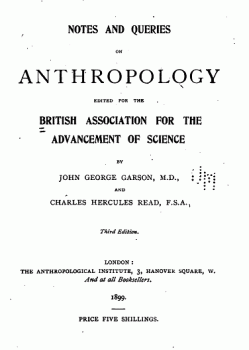
Notes and Queries on AnthropologyGoogle Books now makes it possible to download pdf’s of public domain works, like this copy of our namesake Notes and Queries on Anthropology (1899). Alas, the text — which Google must have a plain-text version of in order to do keyword searching — seems not to be embedded in the pdf file. Here, to the best of my typing ability, is a little taste of “Notes and Queries” to whet your appetite:

It is almost impossible to make a savage in the lower stages of culture understand why the questions are asked, and from the limited range of his vocabulary or of ideas it is often nearly as difficult to put the question before him in such a way as he can comprehend it. The result often is that from timidity, or the desire to please, or from weariness of the questioning, he will give an answer that he thinks will satisfy the inquirer. If time serve, these difficulties can easily be overcome by friendly intercourse, and a careful checking of answers through different individuals (87 – 88).

Needless to say, this work is of historical interest more than practical interest. Still, it’s good to see this history preserved and available; I also downloaded a copy of Franz Boas’ The Mind of Primitive Man (1911), which is of rather more interest to me.

There is no “master list” of downloadable texts, or search flag that will return only results that have pdf’s attached. The trick is to click the “Full View Books” radio button under the search form, and then hope. In “Advanced Book Search”, you can set a date range — I’d think that limiting the publication date to years before 1925 would be a good idea, as current copyright law only covers back to 1926 or so. But, of course, there is public domain work published after 1926 — anything published by the US government, for example — and there is still some material that was published earlier that may not be public domain (e.g. works in translation, where the rights are/were held by various parties and now nobody’s quite sure who owns what).

Imagine if we had some sort of reasonable copyright laws — we could access much more recent scholarly work, most of which is locked up in the storerooms of university libraries where nobody will ever see it.

Ten Canoes

Ten CanoesRadio Australia had a nice feature about the film Ten Canoes last week (unfortunately, I can’t find the program online). It is the first feature film made entirely in an indigenous Australian language. The film is based in large part on the work of Donald Thomson and the program I heard included relatively long readings of Thomson’s ethnography. Ten Canoes won a special jury prize last year at Cannes and is Australia’s entry for ‘Best Foreign Language Film’ at the Academy Awards this year.

The producers maintain a pretty cool website here. The site includes interactive media, press, and background materials that are interesting. I haven’t seen the film but I really look forward to doing so.

Two Styles in the Practice of Theory

In her comment in a “recent post”:/2007/01/06/pop-quiz-who-made-this-diagram/#comment-46735 Lilly Hope mentions the distinction betwee Marshall Sahlins and Michael Silverstein as anthropological theorists. Both of these people served as members of my dissertation committee, and Sahlins was my chair — as a result I have more than a passing acquaintance with both of their works. But Lilly Hope’s comments struck me as a little odd and I think that was because of the fact that we went through the same department, but at different time. I think that comparing Sahlins and Silverstein as theorists can tell us a lot about how anthropological theory is done and some of the main tendencies within it — after all as long-time colleagues Sahlins and Silverstein have influenced each other and their work is in some sense variations on a common theme.

Lilly writes that Sahlins has “a fluid style” and “a more-or-less universal and ahistorical model of how (social) structure happens” while Silverstein has “a more rigorous and richer model” While it does strike me as odd to someone who pioneered the field of historical anthropology ‘ahistorical’, I don’t want to quibble with Lilly’s comment so much as I want to do violence to the comment by wrenching it out of context and using it as a springboard for my own thoughts on the topic… 🙂
Continue reading

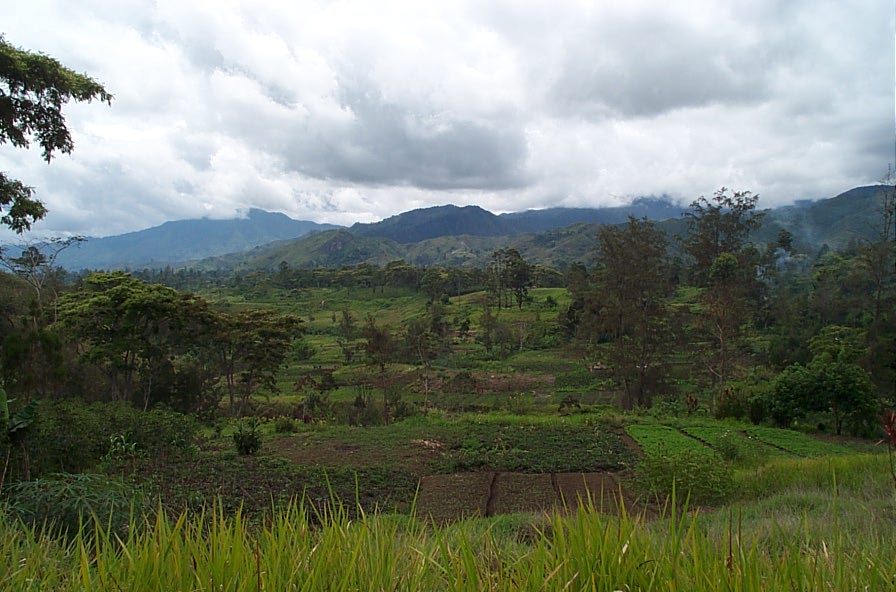
In Papua New Guinea’s Asaro Valley

The Valley

The village I have returned to several times beginning in 1998, Pikosa, seems idyllic, but not because it is quaint or edenic. It is nestled at the base of towering blue mountains, next to a river named Rambanunga, a tributary of the Asaro that eventually joins the waters of the Wahgi, Tua, and Bena rivers as they wind toward the great Purari and thus to the Coral Sea, far to the south. Rambanunga is a small river full of big smooth rocks and deep pools for swimming and fishing – small, but it can become quite rapid with heavy rains, sometimes even impassable, and villagers call their pigs home during such storms for fear that they will be swept away in a rapid current.

Stones

People bathe in the river and wash their clothes there, so it has designated areas for men to use and those for women. Men and boys bathe upstream from women and girls, preserving a chaste and non-pollutive separation of the sexes. Rambanunga’s waters are quite frigid, and though Pikosans find the cold water refreshing, I found it bracing as I shivered through Sunday morning (pre-church) baths to the laughter of those bathing with me. There are spits of gravel and sand that interrupt Rambanunga’s flow, and one of these is a recreational spot for the men of the village. They gather there on occasion to stage small afternoon feasts, washing themselves and their clothes, gambling at cards, sunning themselves on huge stones, smoking marijuana and cigarettes. They call it – in English – “naked beach.” Continue reading

The minor works of Rodney Needham

Somehow, ‘the minor works of Rodney Needham’ is a phrase that has come to symbolize narrow-minded bibliophilia on this blog. Now with Needham having passed on the phrase bears a little more scrutiny.

Most people, I suspect, are not going to take this opportunity to re-evaluate Needham’s work. To be fair, there is much not to like about it — Needham’s scrupulously abstract studies of kinship are exactly the sort of thing that drove kinship studies into the ground (or at least into the arms of political economy). His work could be labeled Cartesian, indulgent, and hermetic. His tendency to dote on the obscure could baffle those who were not interested Hocart, van Cennep, and so forth. If you think The Minor Works Of Rodney Needham are obscure, check out the essays in The Lifegiving Myth

But in retrospect, these drawbacks are out-weighed by what Needham represents. Although his work was nothing if not distinctive, it has deep roots. Needham managed to crystallize a certain Franco-British sensibility that had been floating around his corner of scholarship for some time. Somewhere between Evans-Pritchard, Levi-Strauss, and the Annee Sociologique, Needham managed to create a personal style which, if inimitable, demonstrated the possibility and validity of an elegant and humanistic social science. Leach was ultimately better remembered for epitomizing much of this mood but Needham lacked Leach’s mercurial temperament. He was the hedgehog to Leach’s fox.

Needham also did much to give us our intellectual genealogy. Back in the days before The History of Anthropology, doing ‘theory’ was a much more playful affair. Needham was key in bringing to us the work of scholars like Hertz, Hocart, and van Gennep. And I mean this literally — he somehow managed to get volumes like Imagination and Proof and The Semi-Scholars in print, works that wouldn’t last a cocaine heart beat in today’s publishing environment. Perhaps there is a good reason for this — how widely does Hocart’s essay “On Rotation” need to be read? — but I do think that Needham’s championing of these works was important and wonderful. He gave us so much wonderful work of his own, and of others. Even if it remains ‘minor’ I still look forward to reading it.

Rodney Needham has passed away

More later, but here is the email I received:

Rodney Needham, who died on December 5 aged 83, was one of the most distinguished social anthropologists of the last 50 years; his idea of social anthropology as the great comparative study of the human imagination not only set him apart among English-speaking anthropologists, but gave his work a universal scope going far beyond the limits of a particular academic discipline.

Needham’s extraordinary diligence in getting the facts right, his rigour in analysing them and his powers of demolishing slovenly and inaccurate thinking were also qualities that were appreciated (or at least feared) by his professional colleagues, and were a model for his students.

Continue reading