Tag Archives: History of Anthropology

Taking Anthropology 1, Jared Diamond

In a recent post, Kerim does excellent work tracing the Savage Minds engagement with Jared Diamond, which dates to the establishment of this blog as a scrappy band of Davids taking aim at Goliath.

These days, Diamond gets criticized mostly for not reading or potentially libelous composite misreadings. But I want to dial this back to Diamond’s 1987 article “Worst Mistake in the History of the Human Race,” when Diamond obviously takes anthropology from Richard B. Lee–mongongo nuts with no acknowledgment–and also reproduces Lee and Irven DeVore, again with no credit for what almost any professor would call plagiarism.

Did people challenge Diamond for this taking of anthropology in 1987? Could a more forceful response have cautioned Diamond from appropriating anthropology with impunity and “diluting the brand“? Would Jared Diamond have become… JARED DIAMOND?
Continue reading

The Bongobongo and Open Access

Recent comments on Hau and the opening of ethnographic theory remind me of what I always think of when I hear about the Bongobongo:

The time is gone when anthropologists could find solace in the claim that our main civic duty–and the justification for our public support–was the constant reaffirmation that the Bongobongo are “humans just like us.” Every single term of that phrase is now publicly contested terrain, caught between the politics of identity and the turbulence of global flows. Too many of the Bongobongo are now living next door, and a few of them may even be anthropologists presenting their own vision of their home societies, or studying their North Atlantic neighbors. The North Atlantic natives who reject them do so with a passion. Those who do accept them do not need anthropologists in the welcoming committee.
–Michel-Rolph Trouillot, Global Transformations (2003:137)

Trouillot is then outlining a vision of anthropological duties and risks, include making native voices more full interlocutors, identifying the ultimate targets of anthropological discourse, and publicizing the stakes of anthropological exchange.

To what degree do Open Access efforts–specifically Hau–move us in that direction?
Continue reading

Taking Anthropology, Introduction

Savage Minds welcomes guest blogger Jason Antrosio.

[I realize the irony of prominently citing American Anthropologist during the Open Access debates–I do end with a call to support Rex’s proposal to read and talk about HAU]

These major waves of anthropology’s critical self-examination were the neo-Marxist, feminist, postmodern, and postcolonial autocritiques between roughly the late 1960s and the end of the 20th century. . . . A careful and balanced history of those sequences of anthropological autocritique still remains to be written, but to my mind, one may argue with some justification that each of these critiques in some ways went too far and that none of them fully achieved what its main advocates originally had in mind.

–Andre Gingrich, Transitions: Notes on Sociocultural Anthropology’s Present and Its Transnational Potential, December 2010:555

Our argument is that anthropology departments have not done well when it comes to decolonizing their own practices around race. This is neither true of all departments nor true all of the time–but is still true all too often.

–Karen Brodkin, Sandra Morgen and Janis Hutchinson, Anthropology as White Public Space?, December 2011:545

Continue reading

On detesting Writing Culture at a young age

I’ll be honest: reading Ken Wissoker’s liveblogging of the Writing Culture conference was the first time I’ve ever understood why anyone bothers to live blog, and I’m looking forwarding to reading more of Matt’s coverage of the conference. It’s exactly the sort of ‘high table’ event that a small amount of anthropologists use to reproduce their elite culture and which is unavailable to most people — unless others ‘cover’ it. In this post, I wanted to encourage conversation about this historical moment by discussing how I learned to detest Writing Culture.

When I was growing up (scholarly speaking) Writing Culture and postmodern anthropology were the enemy. The problems were legion: the navel gazing, the narcissistic obsession with one’s own subjectivity, the reduction of the politics of fieldwork to the writing up of ethnography, the neurotic worrying about one’s one epistemological responsibilities that led the authors to the same sort of straining nervousness that you see in overbred show dogs, a pretension to theoretical sophistication that masked a lack of deeper erudition (especially of the actual ethnographic record), and of course the coup de grace: authors obsessed with prose who were themselves terrible writers.

Continue reading

Anthros & Econs: Crossing the chasm

The more I read about political economy and economic anthropology, the more I have wondered about the discipline of economics. What, exactly, are those economists up to, how do they approach their field of study, and why? I have read a good amount about modern economics, and how it differs from anthropology, but I haven’t really read all that much from economists themselves (especially about method and theory). Sure, I read Krugman’s blog, and I follow sites like Calculated Risk, Economist’s View (Mark Thoma), and Economics and Ethics. One of my favorite econ blogs was written by the late Alison Snow Jones (aka “Maxine Udall”). She had a real talent for writing about and exploring the implications of economics in a very personal and fascinating way.* Still, I wonder why there isn’t more of a conversation between anthropologists and economists. Especially considering our overlapping interests.  So why is there such a chasm between the two disciplines?  Is it because our ways of thinking about and analyzing human nature are soooooo different that there is no room for dialog, or what? Continue reading

Anthropological Kerfuffles

OK. This is about as lazy as blogging gets. Below the fold is a four way Twitter conversation I had with Thomas Strong, Ken Wissoker and Carole McGranahan. What started as a funny quote about Patrick Tierney’s Darkness in El Dorado turned into a discussion about which “big debates” in Anthropology get picked up by the mainstream press. But then, when we started trying to think of anthropological debates we would rather see in the press, we all fell short. Take a look at the conversation below and let us know in the comments what big anthropological kerfuffles you think are worthy of more media attention?

Continue reading

Award Winning Anthropological Writing

I just went through the “Section Prizes” page of the AAA website and listed all the award winning books and articles listed there. I limited myself to works published after 2008 which I could find references to online. That means I included books listed in Amazon.com which only received “honorable mentions,” but did not list award winning student essays for which no online link was given. Unfortunately a lot of the links on the AAA site were dead, and many AAA sections don’t properly list their award winners, or haven’t updated their pages since 2007. The list is also missing award winning English language works from other anthropology associations outside the US. I’d love to add such works to the list as well if someone can point me to such lists. Or if you have a Mendeley account, you can add them yourself.

Since I haven’t yet read any of the linked works, I won’t comment on what the list tells us about the state of our discipline, but I imagine a thorough investigation of the listed works might be able to tell us something – especially if we were able to compare it with a similar list from a decade ago. I did notice that about half of the listed ethnographies are available on Amazon Kindle for about $15 which encourages me to think that I might actually read some of them!

Without further ado, here is the list.

I mean, say what you like about the tenets of Critical Anthropology, Dude, at least it’s an ethos

If you are a Real Scientist, I it is reasonable that you believe yourself to be under attack from 1) ‘critical’ or ‘political’ or ‘activist’ anthropologists on the one hand and 2) ‘postmodernists’ on the other. However, it is unreasonable that you consider yourself under attack from ‘activist postmodernists’.

It is easy to see why. Being an activist requires two main ingredients: 1) moral certainty (that something in the world is wrong) and 2) empirical confidence (of the changes necessary to make things better). Postmodernism (to a first approximation) is characterized by 1) a suspicion of foundational moral thinking and 2) not a very robust theory of causation. Postmodernism, in brief, is inimical to intervention.

Intervention in the world by anthropologists — whether it be ‘critical’ or ‘applied’ — is typically grounded by a firm belief that you know what is going on. Indeed, the most famous cases of overreaching political planning (think Robespierre) were a result of too much faith in Science. While Real Scientists can have some sort of beef with ‘critical’ anthropologists, it will have to be a complicated and well-thought out beef about the relationship between scientific knowledge, civic participation, fair dealings with research communities, and ‘broader impacts’ (to use the language of the NSF) over research. But it cannot be a simple one that anthropology ‘ought not get involved’, at least not if one wants to avoid taking the untenable position that urban planners are deeply unethical when they embrace the value judgment that local communities deserve functioning traffic lights and graded roads. Neither can it be an epistemological one that critical anthropologists have no theory of truth, causation, and so forth, since in fact such a theory is necessary (to a first approximation) for any attempt at intervention.

In short, a commitment to positive knowledge unites critical anthropologists and Real Scientists against postmodernism, not the other way around.

A good example of this can be seen in the exchange between Bob Scholte and Steven Tylor in the pages of Critique of Anthropology (volume seven issue one if you want to look it up) in 1987. Scholte is a bit of a forgotten figure in anthropology, a leftist and philosophically-inclined anthropologist who was poised to become a major figure in the field until he passed away unexpectedly at a young age. His review of Writing Culture — a key postmodernist text in anthropology — was thus fairly influential in its time, and was a summary of white the older generation of Marxist scholars who came up in the sixties thought about the newer postmodern trends of the eighties.

For Scholte, postmodernism is not a fellow fighter against Truth and Objectivity, but rather a threat to it. A postmodern approach to the poetics of a text is insufficient to normatively ground anthropological critique. Scholte finds

an exclusive appeal to aesthetics and poetry politically inadequate. On the one hand, there is no guarantee that the ’Mephistophelian urge to power’ cannot also infect the poet. On the other hand, there is no guarantee that poetry by definition generates positive or desirable political consequences.

This is, in fact, not a problem of postmodernism but of the Geertzian interpretive anthropology out of which it grew:

spinning textual tapestries inspired by native designs does not, of course, guarantee a moral center. In fact, the latter threatens to disappear from anthropological praxis altogether. And there is the rub. Politics may become merely academic – literally so. Specifically, the politics of interpretation in the academy threatens to draw a ’cordon sanitaire’ (p. 257) around the interpretation of politics in society. That, I would argue, is the greatest danger of symbolic anthropology and – by implication – its literary turn.

Thus Scholte, like some of the Real Scientists involved in #AAAfail, finds the politics of political correctness and academic posturing — the “politics of interpretation in the academy” — totally unappetizing.

While Scholte’s review — like much of his writing — tends to ramble, Tylor’s response does a much better job of summarizing Scholte’s charge against him than Scholte himself. Scholte, he writes, “faults the book for avoiding politics and praxis, for failing to confront the political realities that make the context of its own Mandarin concerns with literary effect” and being, in essence, “a cowardly retreat into a feckless literary aestheticism”.

Tylor was in 1987 nothing if not a poster boy for the more caricatureable branch of postmodernism, and his response to Scholte does not disappoint. “Where Bob finds these essays unpolitical, or evasive in their politics, or unmindful of political contexts,” he writes, “they strike me as being excessively political, too trapped in the discourse of RAYT – of power, politics, reason, epistemology, praxis, critique, and normative import.”

Tylor continues to use the term RAYT — get it?!? — throughout the review, taking Writing Culture to task because the chapters in it “still spin their tales cocooned by the security of representational discourse. Still unmetamorphased, they do not burgeon into light, nor challenge the dark hegemony of politics and epistemology, but presuppose it even in the ironies that enshroud their purposes.” As a result they “preserves the myth of a privileged discourse that founds or grounds all the others.”

In contrast, “post-modernism grants no priority to any discourse. It aims to deconstruct the divisions that give the illusion of separate, hierarchically ordered discourses… It is a way of using these discourses against themselves neither in order to re-hierarchize them nor even to overcome them, but to realize that parodic potential which is their fullest implication.”

This is clearly not a brief for intervention. In fact, Tylor seems to find the idea of intervention in the world ludicrous: “Who now believes that politics or science works any positive transformation? Anthropology, modem science, and history have all conspired to teach us to disavow this hubris of the modem age,” he writes. Even worse, critical anthropology leads to “boredom” since “those complementary modes of demystification called symbolic anthropology and critical anthropology” leads to a “dialectic that mystifies the past and projects an unreachable future that always escapes final totalization in the clash of conflicting interests – until – by this prattling parabasis lulled into slumber, succumbed to the rhythm of their rupture and continuity we are succussed into some new succession RAYTING still.”

It is not clear what Tylor’s solution is — except perhaps that he is beyond looking for one. It is useful, I think, to be reminded that ‘postmodernism’ can be something more than a term of abuse. And as this exchange makes clear, it is not automatically aligned with ‘critical anthropology’ in the fight against ‘Real Science’. After all, one of the ideas behind many brands of Marxism is that it is ‘science’. Too often we assume that we remember what the alignment of forces were in a debate, or we simply don’t learn the specifics of a debate at all because ‘we all know what someone said’. I think it is important that there is some precision and history is necessary in debates about our discipline.
A Changeling Discipline

Worrying about our status as a science is not a new habit for anthropologists — in fact its one of our perennial concerns. Its useful, therefore, to see how our predecessors have worried the same way we have about the same topics since, a lot of the time, they did it better than us.
One wonderful brief piece of such rumination is Kroeber’s The Personality of Anthropology, available free and open access from the good people of the Kroeber Anthropological Society Papers, along with tons of other great, free and open content. The piece is a speech that Kroeber made in 1958, near the end of his life. These were important questions at the end of the 50s, when ‘science’ was everywhere, funding was rife for it, and a wave of anthropologists were interested in making anthropology more ‘scientific’ whether it be in the form of componential analysis or Stewardian ecologism.
His main concern in the piece is to compare Anthropology’s unique personality and status among the discipline, particularly with comparison to sociology, British social anthropology, and ‘applied’ anthropology. Is anthropology ‘science’? Is it useful? What is unique about anthropology when so much of what it does is also done by other discipline?
“What impulse is it that drives anthropologists as a group to participate in so many fields which are already being cultivated by others?” Wondered Kroeber. The answer, it seemed to him, was
A two-prong impulse to apperceive and cenceive at once empirically and holistically. We constitute one of the smaller learned professions, but we aim to take in perhaps more phenomenal territory than any other discipline Our coverage must of necessity be somewhat thin. Yet it is rarely either vague or abstruse — we start with concrete facts which we sense to carry an interest, and we stick with them. Perhaps our coverage can fairly be called spotty; though without the implication of being random, irrelevant, disconnected. If a whole is steadily envisaged, the relation of its fragments can be significant, provided the parts are specifically known and are specifically located within the totality. So the holistic urge is perhaps what is most characterlistic of us.
For Kroeber, anthropology’s uniqueness is its empiricism, what ie calls “a love of fact, an attachment to phenomena in themselves, to perceiving them through our own senses”:
This taproot we share with the humanities. And we also tend strongly here toward the natural history approach. Sociologists have called us “nature lovers” and “-bird watchers,” Steve Hart says; and from their angle, the epithets stick. There are anthropological museums of tangible objects, but no sociological ones. We are strong on photographs, films, and tapes that reproduce sights and sounds. We write chapters on art in ethnographies and and sometimes offer courses on primitive art. How many sociologists would venture that, or even wish to venture it?…. We insist on field workd as an opportunity, a privelege, and a profesional cachet. We want the face-to-face experience with our sbjects. The anonymity of the sociological questionnare seems to us bloodless.
For Kroeber, it is abstraction that is the mark of a certain type of science which anthropology is constitutionally unable to appreciate. Not because it is not a science, but because its definition of science is different from the fads in social science which Kroeber responds to:
Since personalities are initially determined by their ancestry, it is highly relevant that anthropology was not a social science at all originally. Its father was natural science; its mother, aesthetically tinged humanities. Both parents want to attain reasoned and general conclusions; but they both also want to reach them by way of their senses… anthropology settled down to starting directly from experienced phenomena, with a bare minimum of ready-made abstraction and theory, but with a glowing conviction that it was entering new territory and making discovery. The visions was wide, charged,and stirring.. It may perhaps fairly be called romantic: certainly,it emerged historically about at the point when aesthetic romanticism was intellecturalizing. The pursuit of anthropology must have seemed strange to many people; but no one has ever called it an arid or a dismal science.
Now, maturity has stolen upon us… The times, and utilitarianism, have caught up with us, and we find ourselvres classified and assigned to the social sciences. It is a dimmer atmosphere, with the smog of Jargon sometimes hanging heavy. Generalizations no longer suffice; we are taught to worship Abstraction; sharp sensory outlines have melted into vagueoness.  As our daily bread, we invent hypotheses in order to test them, as we are told is the constant practice of the high tribe of physicists. If at times some of you, like myself, feel ill at ease in the house of social science, do not wonder; we are changelings therein; our true paternity lies elsewhere.
To me, this remarkable piece is immediately relevant to contemporary debates about anthropology’s status as a ‘science’. One of the most interesting is the way it focuses on abstraction — not ‘being about the facts’ or ‘being true’ — as the aspect of ‘science’ that anthropology is most reluctant to embrace. Like a faerie child raised in a human house, anthropologists feel ill at ease with attempts to conform to the (imagined) standards of physcists and other ‘real’ sciences. While others have argued our unwillingness to conform is because we don’t ‘believe in facts’ or ‘that some things are true and others aren’t’ it is rather our commitment to the actual reality of the world — not a ‘postmodern’ attempt to ‘destroy truth’ — which makes us unwilling to become something other than what we truly are.

Science and the Sacred: A Comment from Mary Douglas

Rex elsewhere characterized the discussion around what has unfortunately come to be called #AAAfail as “…between thoughtful people who are aware of the complexities of knowledge production, and those who are for psychological reasons strongly committed to identifying themselves as scientists and everyone else as blasphemers” (emphasis added).  He further called for empirical description and analysis of the social and cultural dynamics structuring this discussion.  Both called to mind Mary Douglas’s ruminations on Durkheim and science, from the preface to the 1975 edition of Implicit Meanings:

Around the beginning of this century Durkheim demonstrated the social factors controlling thought.  He demonstrated it for one portion of humanity only, those tribes whose members were united by mechanical solidarity.  Somehow he managed to be satisfied that his critique did not apply to modern industrial man or to the findings of science.  One may ask why his insights were never fully exploited in philosophical circles… If Durkheim did not push his thoughts on the social determination of knowledge to their full and radical conclusion, the barrier that inhibited him may well have been the same that has stopped others from carrying his programme through.  It seems that he cherished two unquestioned assumptions that blocked him.  One was that he really believed that primitives were utterly different from us.  A week’s fieldwork would have brought correction…[snip] His other assumption allowed him to reserve part of our knowledge from his own sociological theory. This was his belief in objective scientific truth, itself the product of our own kind of society, with its scope for individual diversity of thought. His concern to protect his own cognitive commitment from his own scrutiny prevented him from developing his sociology of knowledge… [snip] Continue reading

Anthropology Is…

http://www.youtube.com/watch?v=jBO3eUwPKvs

Rex recently asked for “anthropology creeds” but for the life of me I can’t write one. So instead I’ll write about why I think the task is impossible. An anti-creed if you like.

In short, I think that anthropology, like Christmas, or the island on Lost, is whatever you want it to be. Every discipline in academia also exists as a mirror-self within anthropology: economics, semiotics, medicine, political-science, genetics, religion, history…etc., all have their counterparts in anthropology. And not just one counterpart either. Just looking at economic anthropology, one can take a myriad of different approaches to the subject all of which are called anthropology. Just about the only approach not called anthropology would be that used by economists… and even there I’m sure you can find some anthropologists whose work isn’t too different from what you would find in an economics journal.

Continue reading

I see your timeline and raise you a timeline

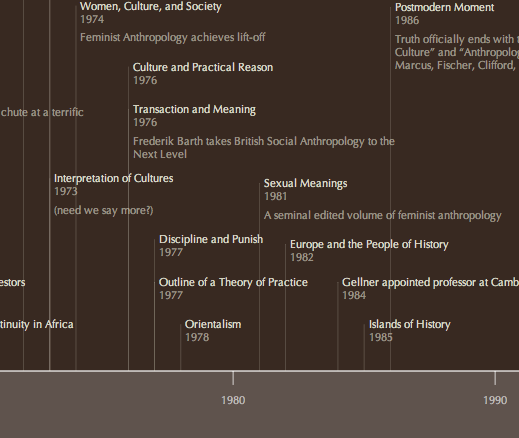
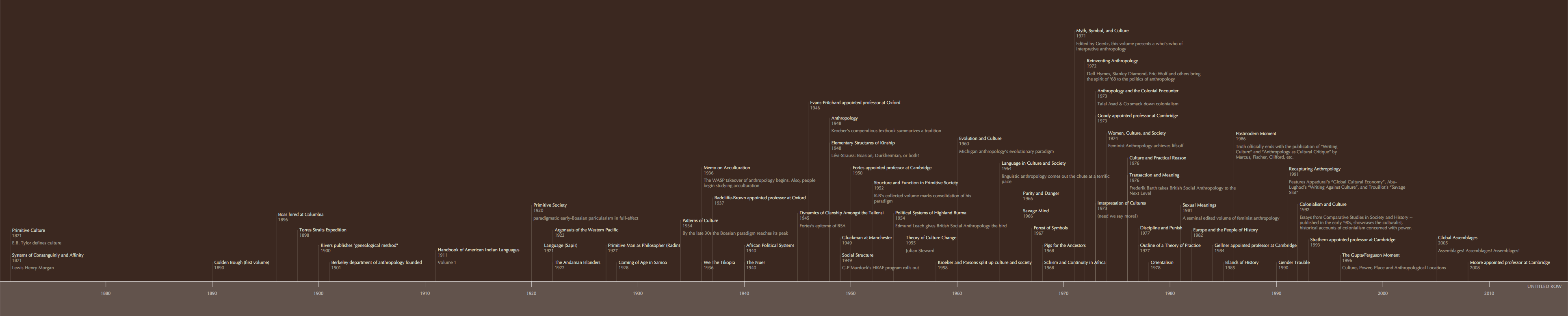
A little bit ago a few tweets crossed my transom about Adam Bohannon’s excellent history of anthropological theory timeline. It’s fun and it looks like it was made with CHNM’s timeline builder. I had actually tried the same tool long ago but then sort of abandoned the project and so inspired by Adam revived my old project (this time using BeeDocs’s Timeline Maker). Here is a sample:

You can get the full version here. It is a totally non-interactive .png file — sorry, Adam beats me on the interactivity front.

Timelines are interesting in the same way that kinship diagrams are: they are analyses of materials pretending to be merely lists of facts. This one was constructed basically off the top of my head based on what I’ve been teaching in anthropological theory courses, and which Wikipedia pages linked to which. Choosing which dates to put up is basically to create a useable genealogy for yourself. Its a fun exercise — among other things, it really made me realize how much of what I thought of as ’80s theory’ was really published in the 70s (77 seems to really be the watershed year here). Any feedback?

Hard Problems in Anthropology

In 1990 [1900], the renowned mathematician David Hilbert laid down a challenge to future generations: 23 hand-picked mathematical problems, all difficult, all important, and all unsolved. Since then, countless mathematicians around the world have struggled to solve the 23 ‘Hilbert Problems’ (ten have been resolved; eleven are partly solved or simply cannot be solved; and two remain at large). Most important, the pursuit of the solutions had a profound and fundamental influence on the roadmap for 20th century mathematics, testament to Hilbert’s foresight.

So begins an announcement about a Harvard symposium aimed at identifying a similar list of problems for the social sciences. I thought it might be interesting to poll our readers about their own ideas for a list of “hard problems in anthropology.” Does it make sense to compile such a list? What would you put on the list? What would it mean for cultural anthropologists to “solve” a problem.Are there any such problems from a previous era that we’ve already solved?

Off the top of my head, I can think of two typical anthropological “problems.” Each posing different challenges to a Hilbertesque approach to defining a list of such problems.

The first might be phrased as “What’s the matter with Kansas?” That is, why do people seem to act contrary to their own class interests? But even asking the problem causes problems. Larry Bartels famously asked: What’s the Matter With ‘What’s the Matter With Kansas?’, which undermined many of the premises of Frank’s book. The difficulties of defining “class interests” in the first place makes this question so much messier than a mathematical problem.

The second is more typical of contemporary anthropology and could be stated thus: “What are the cultural logics that make X actions thinkable, practicable, and desirable?” (Paraphrased from the introduction to Aihwa Ong’s Flexible Citizenship.) Having observed some phenomenon, anthropologists then collect the stories people tell about that problem and interpret them in light of our own understanding of how institutional and cultural practices shape such stories. Here the problem isn’t so much the question, but identifying under what conditions we might consider the problem “solved”? One can’t jump in the same river twice and so each anthropologist who asks such a question will very likely come up with different answers.

So what do our readers think? Does it make sense to compile such a list? If so, what would you put on it? And how would you define a problem as being “solved”? If not, might there be a better way to focus the efforts of cultural anthropology on a set of common problems?

(Hat tip to Ennis for the link.)

The Sideways Glance

Tim Ingold’s 2008 Radcliff-Brown lecture “Anthropology is Not Ethnography” has been mentioned on this blog several times since John Postill posted links to both the full text [PDF] and edited versions of the talk. I finally had a chance to sit down and read it and found it thought provoking enough to deserve its own post. In what follows I will first summarize his arguments as I understand them, and then raise some questions which I hope will provoke further discussion in the comments.

First off, the title is somewhat misleading. Ingold’s purpose is not to distinguish anthropology from ethnography, but to criticize the “the idea of a one-way progression from ethnography to anthropology” in which methodological rigor precedes theoretical generalization. The title really should read: “Anthropological reasoning is not inductive, but dialectical.” He wants to challenge the dichotomy which places ethnographic description on the one side and anthropological theorizing on the other.

We can still recognise today the figure of the ‘social theorist’, sunk in his armchair or more likely peering from behind his computer screen, who presumes to be qualified, by virtue of his standing as an intellectual, to pronounce upon the ways of a world with which he involves himself as little as possible, preferring to interrogate the works of others of his kind. At the other extreme is the lowly ‘ethnographic researcher’, tasked with undertaking structured and semi-structured interviews with a selected sample of informants and analysing their contents with an appropriate software package, who is convinced that the data he collects are ethnographic simply because they are qualitative. These figures are the fossils of an outmoded distinction between empirical data collection and abstract theoretical speculation, and I hope we can all agree that there is no room for either in anthropology.

Against this he juxtaposes a view of anthropology as a craft (a view which Rex has elaborated in a series of posts on this blog).

For it is characteristic of craft that both the practitioner’s knowledge of things, and what he does to them, are grounded in intensive, respectful and intimate relations with the tools and materials of his trade. Indeed, anthropologists have long liked to see themselves as craftsmen among social scientists, priding themselves on the quality of their handiwork by contrast to the mass-produced goods of industrial data-processing turned out by sociologists and others.

As I understand it, the emphasis on craftsmanship is an effort to shift the focus from the tools of the trade — qualitative data collection techniques — to the ethnographer herself. The ethnographer is a researcher who has cultivated in herself an “anthropological attitude”:

The endeavour is essentially comparative, but what it compares are not bounded objects or entities but ways of being. It is the constant awareness of alternative ways of being, and of the ever-present possibility of ‘flipping’ from one to another, that defines the anthropological attitude. It lies in what I would call the ‘sideways glance’.

He defines this “sideways glance” as “a practice of observation grounded in participatory dialog.” Through the course of this dialog anthropologists swing back and forth like a pendulum between anthropological theorizing and ethnographic description.

Continue reading

Anthropology in Nigeria – Extended Version

One could almost use the state of anthropology in Nigeria as a field of study to illustrate the state of the discipline in West Africa, but of course, in Nigeria, it would have a distinctive Nigerian flavour. First of all, parents are mostly the ones who are responsible for their children’s university education, and not many parents are willing to pay for their children to study anthropology. The first considerations are always about whether their child would be able to get a job after completion of the course. The way to sell a degree programme to potential students – and their parents – is by highlighting the job opportunities the programme would open graduates to. Only a few students end up enrolling in programmes that offer degrees in ‘non-professional’ courses, and most of the students are offered those programmes as ‘second options’ after they are refused admission into more attractive degree programmes. Sociology has been able to make itself remain relevant by operating professional masters programmes like Master of Industrial and Personnel Relations and Masters in Project Development and Implementation, and Masters in Industrial and Labour Relations.

One does not need to think of Bohanan’s work among the Tiv of northern Nigeria, or Abner Cohen’s research among Hausa migrants in the southern Nigerian city of Ibadan before one experiences a feeling of nostalgia. There were for instance Nigerians like Angulu Onwujeogwu, Ikenna Nzimora and Victor Uchendu. In Africa at large, efforts were not just expended on doing ‘good’ anthropology and sociology; there were in fact efforts to overcome the Western epistemic assumptions that underpinned much anthropological exercise of the time. I probably don’t need to mention that anthropology was often a tool for colonialists. See, for instance, Bernard Magubane’s criticism of colonial anthropology in this Current Anthropology article. It would also be useful to see Archie Mafeje’s article that is partly a response to Magubane’s article. The point is that there was a lively discussion in anthropology on the continent.

A cursory look at the credentials of many African anthropologists of the 60s and 70s would show that they were largely Western educated, partly because African states, at that point, had a developmental agenda, and that agenda involved awarding scholarships to students to study in Western universities. And when this was not the case, many African got scholarships from Western countries. One could say that even then, with newly independent African states, anthropology was not particularly popular. I think this is linked to the involvement of anthropology in the colonial project. It is arguable that sociology enjoyed a better image than anthropology, especially with its somewhat better image as a discipline that studies ‘more civilised’ societies. That is also probably why there are very few stand-alone anthropology departments in Nigerian universities.

Things became much worse in the 80s when Nigeria’s oil wealth started turning into a curse. Serious balance of payment problems, coupled with a succession of repressive military dictatorships finally encouraged many Nigerian scholars to leave the country, and those who stayed found it increasingly difficult to work. The already unattractive anthropology even became less attractive, and joint anthropology and sociology department started doing much less of anthropology and more of sociology. The fact that many development agencies want statistical data has meant that data provision and generation concentrated in the hands of economists and sociologists. This in turn meant that fewer people got interested in doing graduate degrees in anthropology. I recently visited a Nigerian sociology and anthropology department where there was neither a single lecturer who does anthropological research, nor any graduate student who wanted to do anthropological research.

It is also in this state of the Nigerian economy state that many parents would not be willing to pay for their children to study anthropology in universities. One could also add that a desire to be modern, and therefore to study something modern, is linked to the lack of interest in anthropology, especially as people still seem to associate anthropology with the study of the primitive – in post-colonial studies terms, the Other. There is bound to be a problem for a discipline that studies the Other, when the classical definition of the Other in this context would actually be the self. I know that the experiences of people in African countries are far from uniform, and that there is of course a multiplicity of Others, but those are the fine details that almost always get lost in the quest for modernity. Yes, I throw in that word, because no matter how much we discuss the faults and failings of modernisation as a theory and as a concept, the everyday lives of young Nigerians is modeled after the dream of becoming modern. Of course, I am an anthropologist, and I understood the importance of the kind of knowledge that anthropological methods and methodologies produce, even before I decided to do a Ph.D in anthropology. And of course, there are also other really intelligent anthropologists still in Nigeria. But when one starts framing a discussion in those terms one should realise that one is talking of the exceptions and not the rule.

Some questions of course beg answers. Does Nigeria, and by extension other African countries, have need of the anthropologist’s contribution in its present predicament? Can the problems thrown up in the country be framed in anthropological ways? Are these problems not always being framed in such ways whether or not people realize or admit it, whether or not people study their society, its mental, material and behavioural artefacts, and engage one another, self and other, with the benefit of ethnographic and theoretical training received in university departments of anthropology? At the risk of sounding chauvinistic, I think that it is always anthropology, good or bad—from Huntington to Soyinka.

Any insights from other areas?