Tag Archives: genetics

Ferguson: Anthropologists Speak Out

Race and injustice and anger and fear. All of these and more in the wake of the grand jury decision in the police killing of unarmed teenager Michael Brown in Ferguson, Missouri. What do anthropology and anthropologists have to say about all of this? What can we say? What must we do? We have research and writings, personal and professional experiences to draw upon, we have suggestions to make, students to teach, and together a world to remake into a more racially just society. With all of this in mind, we invited a group of scholars to share their thoughts on Ferguson, Michael Brown’s death, the legal process, police violence, racism, and being present right now as anthropologists. Below are responses from Lee Baker, Whitney Battle-Baptiste, Lynn Bolles, Agustín Fuentes, and Alvaro Jarrin. Thank you all.

Lee D. Baker, “Obama, Race, and Privilege”

On the evening of November 24, 2014 President Barack Obama addressed the nation in the wake of the grand jury decision not to indict Officer Darren Wilson for shooting Michael Brown to death on that fateful evening in Fergusson, Missouri last summer. President Obama had to strike a delicate balance between supporting the legitimacy of the grand jury decision and supporting the legitimacy of the anger and frustration ignited by police brutality that all-too often targets young black men. Continue reading

Anthropology: It’s still white public space–An interview with Karen Brodkin (Part I)

The following is an interview with Karen Brodkin, Professor Emeritus in the UCLA anthropology Department.

Ryan Anderson:  You co-wrote an article back in 2011 with Sandra Morgen and Janis Hutchinson about anthropology as “white public space” (AWPS).  What’s your assessment of the state of anthropology three years later?  If you could add an “update” to this article, what would it be?

Karen Brodkin: The short answer is that anthropology is still white public space, especially in the consistently different ways that white and racialized minority anthropologists see race and racism in anthropology departments and universities. This is my reading of results of the 2013 online survey of the AAA membership (more on that in a minute). What I’ll do here is summarize the findings of the article, and then survey findings that buttress, complicate or contradict them.

AWPS was based on a survey of about 100 anthropologists of color about how they experienced anthropology. We used “white public space,” to sum up attitudes and organizational patterns that told anthropologists of color that they and their ideas were not real anthropology.

The 2013 survey (referred to hereafter as TFRR) was developed by the Task force on Race and Racism appointed by AAA president Leith Mullings (full disclosure, Raymond Codrington and I were its co-chairs). More than 15% of the membership, 1500 people, mostly white, took it. Half were faculty. We reported findings to the AAA Exec Board June 2014. Continue reading

Is the ALS Ice Bucket Challenge about structural inequality?

In case you have been living under a rock (or in the field, either is permissible for an anthro really) you may not have noticed that everyone and their mother is dumping ice water on their head in the name of ALS. Watching this fad unfold has provided Internet observers and other semi-employed persons an extraordinarily rich phenomenon to critique.

First of all, there’s a lot to like about the ALS Ice Bucket Challenge. By means of this fad I have learned that I have friends, Facebook friends, and friends of friends, who have loved ones or have lost someone because of this disease. It’s raised millions of dollars for rare disease research, which is inarguably a good thing. And it has done so by means of a viral marketing campaign that is, in essence, a short video clip of people acting silly. Wins all around.

It’s also interesting how, like the best of the Internet, the Ice Bucket challenge has spawned appropriation, reappropriation, and metacommentary. Here I’m thinking of Orlando Jones pouring a bucket of brass shell casings on his head to protest violence against Black youth in America, Matt Damon pouring toilet water on his head to draw attention to the lack of clean water around the world, and persons in Gaza pouring rubble on their head to draw attention to ongoing violence in Palestine. It’s really cool how the Internet allows people to riff on a theme and permutate established performances into something new.
Continue reading

Boasian Critiques of Race in “The Nation”: SMOPS 12

I’m delighted to feature this, our dozenenth SMOPS, for readers. These papers provide an excellent example of anthropology’s long term commitment to social justice, public outreach, and a critique of incorrect folk theories of heredity and race. The real gems of this paper are not Boas or Herskovits or even Sapir, but the sparkling, penetrating papers by Hendrik Willem Van Loon and, especially, Konrad Bercovici. Read them first.

I’m also delighted that this issue of SMOPS is the first to feature an introduction by someone other than me. I’d like to thank Richard Handler, a distinguished historian of anthropology, for providing a brief introduction to this issue.

The pieces here are reproduced in full. Numbers in brackets indicate page breaks in the original. I hope that this paper, like the others in this series, will help present anthropological theory in a form that is accessible to everyone. There is today a tremendous amount of material which is open access, but it is difficult to find, inconvenient to read, and many people do not know where to start looking for it. By curating a selection of important open access work, I hope to make open access resources better known and to raise awareness of the actual history of anthropological theory.

Who is a rioter?

As the community of Ferguson, Mo. reels from the shooting death of a young Black man, Michael Brown, at the hands of a White police officer it is worth paying attention to how the ensuing social drama that follows forwards conflicting interpretations by means of competing narratives. Shortly after Brown’s death a protest began to congeal, this was immediately met by police control.

The New York Times describes it:

At a candlelight vigil on Sunday evening, the heightened tensions between the police and the African-American community were on display. A crowd estimated in the thousands flooded the streets near the scene of the shooting, some of them chanting “No justice, no peace.” They were met by hundreds of police officers in riot gear, carrying rifles and shields, as well as K-9 units.

The Washington Post elaborates:

His death immediately sparked outrage, with protests and vigils beginning that day and showing no sign of abating on Monday. The reaction took a violent turn on Sunday, as some protesters began looting businesses in the Ferguson area over several hours, leaving a trail of broken glass and burned-out storefronts in their wake.

It sounds like there was a confrontation between protestors and police as well as loss of property later on. Is this a riot?
Continue reading

Geneticists think Nicholas Wade’s “A Troublesome Inheritance” is wrong

Ouch. Just….: Ouch. Over 130 geneticists have signed a letter to the New York Times saying that Nicholas Wade’s book A Troublesome Inheritance is inaccurate and misrepresents their work. This includes the authors of articles that are central to Wade’s argument. When the very scientists your book relies on announce that that book is wrong? Ouch. Read below the fold for the gory details. Continue reading

What happened at the Fuentes-Wade Webinar

On 5 May 2014 The American Anthropological Association hosted a webinar in which Ed Liebow, the Executive Director of the American Anthropological Association, hosted a debate between Augustín Fuentes and Nicholas Wade. Fuentes is a professor of anthropology at Notre Dame, and Wade is a science journalist and author of A Troublesome Inheritance. This post describes what happened there, for people who don’t want to stream the whole thing. Our fearless intern Angela transcribed the webinar, and I double-checked the transcription in key places where the recording was difficult to hear. I’ve occasionally cleaned up speech, but the quotations here are as direct as we could manage — indeed, this post is designed to let people hear the participants speak for themselves. Continue reading

Anthropologists for Hire

[The post below was contributed by guest blogger Deepa S. Reddy, and is part of a series on the relationship between academic precarity and the production of ethnography, introduced here. Read Deepa’s previous post here.]

Note: post updated for clarity

Fieldwork is one of those extraordinarily-difficult-to-bracket experiences, as it blithely ignores any sort of compartmentalization of practical issues, professional demands, family, work, even time. Most conversations I’ve had about the hardship of fieldwork have invariably been cognizant of the sorts of practical-professional-personal negotiations involved—which often can become frustrating, overwhelming. In this post, I consider how such circumstances compel certain sorts of research decisions, serving as the often unspoken frameworks for the questions we ask and the projects we choose.

Fieldwork for my dissertation research followed a fairly classical/conventional trajectory, but for the break I took at the 6-month mark so as not to be away from my husband for a continuous year. India was far, tickets were expensive, but this was workable, still. I lived in Hyderabad, studying women’s activist organizations and their responses to Hindutva. I thoroughly enjoyed the vagrancy that fieldwork in an urban setting demands—and realized it was easiest to do this sort of work when one was away from family, so that it was informants and leads that set my pace and defined my agendas, not the realities of child- or parent-care. But it took the year and much stubbornness and persistence besides to move out of what Geertz has called one’s “ghosthood” into a more recognized position in a network, from which information was more accessible, and fieldwork as an experience much more enjoyable.

Our first baby arrived on the heels of the tenure-track job at a teaching-focused institution with a 3-3 load and neither research money nor any assured sabbaticals, but with research requirements to meet at tenure review nonetheless. Summers were all the dedicated time there was, but summers are hard in India, India was half the world away, childcare was not ever easy to organize, and getting there and back in time to teach again with research planned in between was beginning to sound exhausting, near-impossible, and almost not worthwhile. Continue reading

Human Evolution and Patriarchy

The May 4, 2012, issue of the journal Science includes three briefs from the annual meeting of the American Association of Physical Anthropologists, one of which has a few choice words about telomere lengths. In case you hadn’t heard, studying telomere length is all the rage now as it apparently has some correlation to longevity. I don’t know. The whole thing seems fuzzy to me. Remember when neutrinos were going faster than the speed of light? That didn’t last long now did it?

As these creased and dog-eared magazines get passed back and forth at our family dinner table I had my brilliant wife (a real scientist) on hand for questioning.

“So is this telomere stuff for real?” I asked her.

“Mmm-hmm,” she said with a shrug. “It looks that way.” So there you have it, from the seat of authority.

Let’s refer to the Science journalist here:

Telomeres are repetitive sequences of DNA that prevent the ends of chromosomes from unraveling, much like the plastic tops on the ends of shoelaces. As cells divide and replicate, telomeres get shorter and eventually can no longer prevent the fraying of DNA and the decay of aging. Recent studies have found a link between living to 100 and having a hyperactive version of telomerase, an enyzme that keeps telomeres long.

If you’ve got long telomeres on your chromosomes then genetically speaking this is beneficial and improves your chances at living a long life. But what factors determines telomere length?
Continue reading

Illustrated Man, #3 – The Stuff of Life

In this occasional series, Illustrated Man, I will explore the intersection of anthropology and comic books, graphic novels, comic strips, animation, and other manner of popular drawn art.

A cultural anthropologist, I am frequently called upon to teach biological anthropology. This has always been in the context of introductory level courses: human evolution or general anthropology with an evolution component. After stumbling out of the gate, I have become comfortable wearing the evolution and ecology hat. In particular I find pleasure in arranging the topic of human origins as a narrative. You could say that my approach definitely betrays my bias as one more skilled in the humanistic side of anthropology. Yet I am very cognizant of the fact that many students are drawn to courses like Introduction to Anthropology because it qualifies as a science in their distribution requirements, but does not require math or a lab.

I’m not getting saddled with a blow off class. I’m going to hit ’em hard with evolutionary theory and basic genetics. Evolution I can do because I’ve read Darwin, Dawkins, Gould, and Mayr. But structure and function of DNA isn’t exactly my forte. So I need something challenging for my kids, but not out of my league. That’s why I require The Stuff of Life: A Graphic Guide to Genetics and DNA as supplement to the more usual textbook fare. At just under 150 pages, all illustrated, Stuff can, in an evening or two, easily be digested by anyone who passed high school biology.

There’s also a lot here that will appeal to comic book fans. Author Mark Schultz, writer and illustrator for the venerable Prince Valient strip, brings wit and a snappy pace to otherwise dry material. He did an outstanding interview on NPR Science Friday (which is how I discovered the book) where he talks about the medium of comics and how he approached nonfiction material. Illustrators Zander Cannon and Kevin Cannon are award winners, having taken home two Eisners for their art in Alan Moore’s completely awesome super-hero-crime-procedural Top Ten. Their ink brush lines bring a fun, cartoony look making the book a delight to look at without distracting from the lessons at hand. The book’s greatest strength comes from the aide the Cannon’s art provides to visualizing things like cell division and protein synthesis. Right-brained learners rejoice!

Continue reading

Public Participation in the Life Sciences

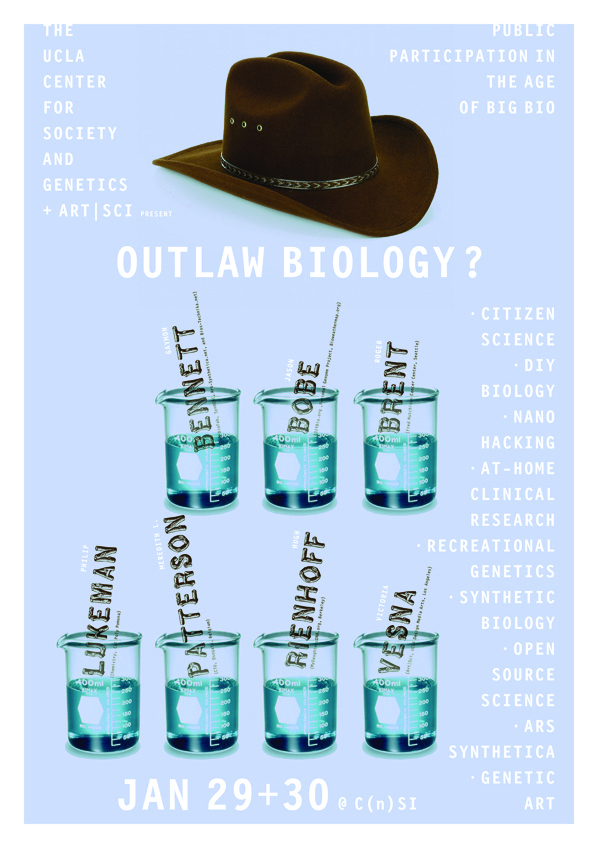
I’ve been spending the last month organizing a symposium at UCLA called “Outlaw Biology” on public participation in the life sciences. There is much to say here about organizing a mini conference (on which see the recent post by G. Downey that Jay directed us to ), especially one that involves an active participatory component, especially when that involves doing biological experiments of some sort.

Outlaw Biology?
Outlaw Biology?
The whole goal of this symposium was to draw attention to the ways public participation is changing what the life sciences are (whether that means DIY Bio, recreational ancestry genetics, patient advocacy, or ‘open source science’). But what I wanted to draw SM reader’s attention to is the strange way that “public participation” is changing too. Publics are being “organization-ified” in new ways. The easier it becomes to constitute new affinity groups, the more difficult it becomes to be an unaffiliated member of the public. I blame FB and Twitter. But I’m a curmudgeon. Regardless… I’ve written an essay about it and am curious what people think.

Commodifying Girls, Harajuku Style

I wanted to avoid writing about Japan in my first post on Savage Minds (because I do that all the time at my own blog), but alas I am a creature of habit. But I hope I will be pardoned: I’m reporting about an anthropologist in a major print publication. And this will be sort of a riff on Kerim’s earlier mention of the clever parody on the African village planned at a German zoo.

Anne Allison, a Professor of Anthropology at Duke University, is mentioned in this week’s the New York Times Magazine in an article titled “Love. Angels. Product. Baby.” The piece is written by Rob Walker, who regularly writes for the magazine about consumerism and the money-centric culture of the capitalist society we live in. His column, “Consumed,” is in the “Way We Live Now” section of the NY Times Magazine).

(By the way, here’s another anthro connection: in this interview, Walker describes his endeavor as a “hybrid business-and-anthropology column.” Hmm…)

Walker writes that popstar Gwen Stefani‘s new album, Love. Angel. Music. Baby, and the entire marketing carnivalesque surrounding it (including an HP digicam branded as “Harajuku Lovers“), can be summed up by this neat phrase: “the commodification of commodification.”

Stefani’s latest album prominently figures “The Harajuku Girls” and is a paean to Harajuku, a section of Tokyo known as a neighborhood where hip youngsters come out dressing up in the strangest mixture of goth, tribal, haut-couture, and seemingly every other trend in the world history of fashion. Along with Shibuya, which has more love hotels and generally feels a bit more “adult,” Harajuku is the testing ground for Japanese marketers trying out their ware: they know that if a product catches on among the young hipsters who loiter there, it will sell well and perhaps conquer the world.

To Stefani, Harajuku Girls are hip. Why does she think this? Walker clues us in:

What is unusual is tha Stefani does not seem drawn to this subculture by ideology, rebelliousness or even a dance style. She seems drawn solely to a group’s apparent skill as shoppers. The song “Harajuku Girls” is a cross between a fashion-magazine trend story and an expositional number from a Broadway musical.

So Stefani, whose earlier persona in her band No Doubt was the punked up bad girl who bansheed around and shouted her head off to ska beats, is now all starry-eyed about shopping for the latest trends. Walker continues:

So what we really have here is not just a pop star endorsing a product but a pop star paying tribute to a consumer tribe. The real star behind the camera is not Stefani, but a specific breed of global hyper-consumer — as translated by Stefani. […] It is the commodification of commodification.

At this point Walker cites Anne Allison as a critical observer of the way Japanese subcultural icons have been swept up by the global mediascape (she examines, for example, Pokémon, in an article in this book), and asks a loaded question: “But […] does that mean that Japan has a real currency now? Or is it just a cool brand?”

Walker’s article is insightful in many ways. But I have a few problem with his interpretation of the Harajuku Girls.

For one, I don’t think Walker addresses the fact that these girls are represented in an exploitatively orientalist manner. When Stefani came out with the Harajuku Girls back in April, the blogosphere was flooded with feminist and Asian-American critiques of how these four dolled up cyber-ghetto-geisha girls have become a harem-like accessory piece of a white girl (much of this criticism launched by a Salon article by MiHi Ahn and reproduced here by Howard French). The poster up top is a photoshopped expression of this critical perspective.

Yet there is another set of stereotypes being evoked here by Stefani, which has to do with Japan as somehow beyond the present, without history, and self-absorbingly capitalist in some techno-utopian state of bliss. This kind of thinking has its roots in Alexandre Kojève‘s oft-noted declaration that Japan is a post-historical society (retracted I think later in his life) and Roland Barthes‘s otherwise great masterpiece, The Empire of the Sign. (I won’t go into details here, and I know I’m reaching a bit if I claim that the following also applies to the Harajuku Girls, but this line of thinking also resonates with 1. Japan’s wartime fascist ideology, which cast Japan as already beyond the West and” post-modern”, and 2. the contemporary triumphalism of neoliberal economics as in Francis Fukuyama’s The End of the History.)

A few years back Japanese critic Toshiya Ueno, writing about Japanimation, called the representation of a technologically utopic Japan as “Techno-orientalism.” In the case of the Harajuku Girls, some “consumer-orientalism” may be at work: a representation of a nation and its people as serious shopaholics to the point where girls would be willing to “whore up.”

Walker, whose sole criterion for judging good products seems to be “about figuring how to remake a subcultural style into something salable on a mass scale” (from the NYT Mag article), joins Stefani and her marketing team in celebrating this “commodification of commodification.” He understands that commodification involves not only buying (such as the act of girls accessorizing) but also selling. Yet he seems unfazed about what it is that they’re actually selling.

Walter Benjamin, in “Paris, Capital of the Nineteenth Century” writes of the prostitute as a figure of pure commodity: “a saleswoman and wares in one” (Reflections, p.157). It is difficult for me to not see these Harajuku girls as a similar figure of the prostitute as commodity, one that mixes racism, sexism, and the technologies of consumption into one bold entertainment package.

Now whenever a blogger debunks exploitative images in mass media, someone has to make a comment that is a variation of the following: “this is only a video/movie/pop song, so don’t take it so seriously.” To this I reply: I am not the one who might take this seriously, but rather the little boys and girls watching Stefani videos and taking in all this stereotyping as reality.

I’m usually not one for identity politics. But the Harakuju Girls is just a bit too over the top for me. So what do y’all think, am I just over-reacting?