Tag Archives: Ethics

Anthropologist Bites Dog

I recently had an opportunity to watch José Padilha’s “Secrets of the Tribe” which purports to put “the field of anthropology… under the magnifying glass in [a] fiery investigation of the seminal research on Yanomamö Indians.” This film has been a big success at festivals, screening at Sundance, Hotdocs, etc. and has also been shown on HBO and the BBC, making it one of the most successful recent films about anthropology, yet it seems to have gotten scant attention from anthropologists.

What attention it has gotten has largely been positive, such as this glowing review in CounterPunch, or this blog post by Louis Proyect. A review in VAR was slightly more critical, but not by much. Still, the following comment from Stephen Broomer’s review gets to the heart of the matter:

Padilha’s contribution to this debate is confined within the limits of documentary form. Secrets of the Tribe is a narrative-driven documentary, and as such it privileges dramatic contrast over the reinforcement of facts or proof.

Indeed, I would go much further. The film struck me as little more than tabloid journalism, reveling in salacious scandals, academic cat fights, and conspiracy theories in the name of discussing research ethics and scientific methodology. It reminded me of one of those local news stories where a reporter exclaims how shocked he is to discover that there is prostitution in his city while the camera indulges in digitally blurred closeups of exposed female flesh.

In comparing this film to tabloid journalism I don’t mean to impute Padilha’s motives. Padilha is clearly someone who cares deeply about Brazil’s indigenous population. He also deserves credit for actually interviewing Yanomami for the film. But Padilha is not an anthropologist. As one review put it: “A student of math and physics, Padilha turned to filmmaking after a brief, unsatisfying career in banking.” (He is most famous for “Bus 174” about a hijacked bus in Rio.) For this reason he seems unable to meaningfully engage with contemporary debates about fieldwork practices or the nature of anthropological research.

I don’t really know which bothered me more: the lumping together of pedophilia accusations against Jacques Lizot and Kenneth Good with Patrick Tierney’s accusations against James Neel and Napoleon Chagnon, the fact that the film completely ignored Tim Asch even as it relies extensively on his footage, or the way it presented anthropological epistemology as a simplistic choice between the hard-science of sociobiology on the one hand and mushy-headed cultural relativism on the other.

What really upsets me is that these are serious issues, which warrant serious discussion. By simplifying the scientific debates and lumping them together with pedophilia accusations, the film missed a unique opportunity to make an important contribution to the popular understanding of anthropology. Too bad.

Dominance and Science: Lessons from Chimpanzees

At the weekend I saw the film Project Nim, a documentary about the chimpanzee at the center of a language learning experiment at Columbia University in the 1970s. It’s a great film for anthropologists. Not only are these misdirected intellectual endeavors an important part of the history of the discipline, the social universe portrayed in the film raises questions still relevant today about power, authorship and inequality in the knowledge sector.

The film is partly the tragic story of the chimpanzee, Nim, brought up as a human baby in a New York brownstone, breast fed by his `foster mother’ and taught sign language by a succession of young, mostly female, research assistants.

As Nim matures into adult chimphood his massive strength and capacity to bite mean that he can no longer be contained in a human environment without posing considerable risk to the research team. He is returned to the primate facility where he was born, a brutal environment where electric cattle prods are used to control the animals, who are eventually sold on to a medical research laboratory. Campaigning by one of his previous carers and the intervention of a lawyer prepared to extend arguments about human rights to animals raised as human leads to Nim’s eventual rescue and he ends his days in an animal sanctuary where he is ultimately reunited with some of the other chimps from the laboratory.

Nim’s problematic behaviour as he grows up is oriented toward his quest for dominance, the natural behaviour of an adult male chimpanzee. Nim’s carers and the research staff assigned to work with him have to become adept at displaying dominance in the right way or risk serious injury.Dominance matters in other ways not restricted to the social universe of chimpanzees. The film presents a visual snapshot of the hierarchies of power and domination which structured academic life in the 1970s through the relationships between the lead scientist and his junior, mostly female, assistants. The assistants undertake the bulk of the day to day work of experimentation and hand on care for the chimpanzee. The professor does, disseminates and takes credit for the `science’, at one point totally altering his own interpretation of the significance of the experiment. In his view, which differed from that of the people who spent their daily lives interacting with the animal, the inability of chimpanzees to structure sentences grammatically was conclusive proof that they lacked the capacity for language.

Of course, the professor’s narrow definition of language as opposed to a wider concept of communication and the divergences of interpretation are of considerable interest, not least in demonstrating the ways in which the framing of a research object determines the scope of what can be considered findings within a particular scientific paradigm, the kind of narrow cause and effect paradigm we face on our forays into Grantlandia’s uncertain territory. But what struck me about this film was its insight into laboratory life in another era, and the ways in which some things change and some things become institutionalized to the point of being foundational.

The institutionalization of ethical review and changes in the legal framework about experiments on animals in many countries mean that what happened to Nim hopefully could not happen again so easily. I am less certain about the imbalance of power between lead scientists and staff, between seniors and juniors. While the gender dimensions of exploitation exposed in the film may be less prevalent today there is no doubt that current mechanisms for funding and employment in Universities in the UK and the US work to promote the silverback and embed this kind of structural hierarchy.

The move towards funding modalities of large projects modeled on the natural sciences system raises questions for anthropologists who have worked as individual scholars, contributing to team endeavors certainly, but not seeking to produce data on which a lead scientist’ can pronounce. In such situations how do we manage the balance between individual contribution andscientific case’? What are the lines of authorship and ownership between the project leader who holds the funding and researcher in the field? To what extent are conventions of multiple authorship coming in to anthropology as these funding relations alter the social organization of our work? Given the climate in Grantlandia is the future for more of us, especially postdocs, jobbing support to other, often interdisciplinary, projects?

The Anthropology of Freedom, Pt. 5

All The Freedoms
(Freedoms, all of them)

I’ll stop with this one, I promise. But it is in some ways where I should begin. That freedom is an interesting problematic obviously has little to do with whether or not anthropologists can wield it as a concept (that’s just me deferring to the putative audience here). Rather it is a simple empirical fact that freedom–both as slogan and as a thing–is relentlessly present in global society–and especially in the domains of high tech science and engineering. The ideological use of the slogan to brand just about anything is (should be) fair game for many different scholars of contemporary discourse (see e.g. Wendy Chun’s work). But as a starting point, consider only the image to the right, which collects 9 pages of logos that use “freedom” to sell something.

These uses come from both the left and the right, and they have a certain visual consistency to them: images of upheld arms, liberated birds, broken chains are nearly ubiquitous. When a logo emphasizes a flag, a gun or an eagle it is more obviously right-leaning, when it uses a sans-serif font, the color green, or a raised fist, it is more likely a left-leaning cause. Revealingly, the same experiment with the word “liberty” is much more uniform in the use of red, white and blue, the statue of liberty (especially her spiky hat… what is that called anyways?) and only occasionally a broken bell. This analysis could all be done much more expertly, I’m certain, though it hasn’t really been. (Though I can’t resist mentioning a smorgasbord of a book by Svetlana Boym which is obliquely engaged in such a project of cultural and visual analysis).

But what such an analysis tells us is that freedom has a particular ideological role in the process of our collective deliberations and arguments in the global media-scape. In it’s most cynical version, Continue reading

The Anthropology of Freedom, pt. 4

I Prefer the Anthropology of Morels of course.  (Much more excellent photo of Morels by: Odalaigh at  http://www.flickr.com/photos/odalaigh/2515458601/)
I Prefer the Anthropology of Morels of course. (Much more excellent photo of Morels by: Odalaigh at http://www.flickr.com/photos/odalaigh/2515458601/)
Recent comments on this series have raised a bunch of great issues that I would love to explore. Conveniently, one of them is the question Rex raised about “Anthropologies Of...” I honestly didn’t mean to signal “The Anthropology of Freedom” as a proposal so much as a query. Because anthropology is so relentlessly ecumenical in its topics and approaches, it should be illuminating to think about what anthropology does not study (or does not allow the study of, in some proscriptive sense, like working for the military). There are some things that we are just silent on, and my hunch is that exploring some of these might sometimes be more illuminating than trying to say what it is anthropology does do. The question of an “Anthropology of Freedom” is at least diagnostic in this sense, if not programmatic. And to be clear, I am not in a programmatic mood here.

But that being said, there are in fact a lot of other “Anthropologies of…” which border very closely on anthropology of freedom, and I want to dwell (at too much length) on one of them here: the anthropology of ethics. There is another one going by the label of an “Anthropology of the Will” which will have to wait until whoever has the book checked out returns it to the library, cause there is no way I will pay $55 for it, thank you very much Stanford University Press. There is also the “Anthropology of Happiness” which insofar as freedom is a means rather than an end might be something anthropologists do study. I’m much too pessimistic for that.

But the anthropology of ethics has finally arrived. This year has seen the publication of two books: Ordinary Ethics, (a semi-reasonable $30, $21.99 on Amazon) ed. by Michael Lambeck, and James Faubion’s An Anthropology of Ethics (ditto). The former is a great collection of essays that includes both anthropologists and philosophers (and includes one from Faubion), the latter is likely to appeal to me, Rex, and like 5 other people, which says nothing about how awesome it is, but rather, indicates a perhaps perverse pleasure in being inside James Faubion’s brain. Nonetheless, both of them lay out some problems and concepts for an anthropology of ethics in rigorous and satisfying ways.

It should be said that the “anthropology of ethics” referenced here probably means many things Continue reading

Information Imperialism?

By the end of the year the US State department will spend $70 million on stealth communications technologies to enable activists to communicate beyond the reach of dictators according to a recent NYT article. Prototypes include a suitcase capable of quickly blanketing a region with a free wifi network, bluetooth devices that can silently share data, software that protects the anonymity of Chinese users, independent cellphone networks in Afghanistan, and underground buried cell phones on the border of North Korea for desperate phone calls to “freedom.” These are political tools deployed to promote the agenda of one nation over that of another. How should we address information imperialism? The use of networked communications tools to subvert so-called regimes exposes a proclivity for digital intervention that likely also includes digital literacy projects to provoke revolutionary actions, propaganda campaigns to make celebrities out of bloggers, and covert code warfare. Let’s review the spectrum of information interventions to ascertain the ways and hows of information imperialism. Continue reading

Photographs and anonymity: keeping faces hidden, or not

Since I am in the middle of working on grants in preparation for upcoming fieldwork, I have a lot of methodological issues on my mind.  I am going to use photography as a primary part of my research plan, and there are some critical questions that keep cropping up: when should research participants remain anonymous?  When does it make sense to show participants’ faces in photographs–and attach names/biographies to those faces?  Many of the ethnographies that I read keep subjects anonymous–in text and in images–almost axiomatically.  This is pretty standard practice for many ethnographers, and considering the ethics and politics of ethnography, I understand why.  However, I am wondering if there are times when it makes more sense (or when it’s the best ethical choice) to actually show faces and attach names/identities to photographs.  More importantly, whose responsibility–or right–is it to make these decisions?

Continue reading

Regarding Japan: On the risks and responsibilities of engagement

The day after the earthquake and tsunami struck Japan’s northeast coast I received a well-intentioned facebook message from a friend I hadn’t spoken with in nearly a decade.  She was checking to see if I and those I care about in Japan were all right.   Although I responded graciously and positively, my own reluctance to participate in the twittering drama filled me with suspicion.  By writing to me, was she trying to claim a little piece of the action, a connection to the disaster?  Would she secretly prefer that I were directly affected so that she could share in the piquant pang of aftershock without having to suffer its enduring losses?

About a week later, as the scale of suffering in Japan became clearer, I became less concerned with everybody else’s questionable investments in the pain of others and more suspicious of my own hesitancy to engage emotionally.

Although I frowned and cried as solicited upon seeing the unavoidable photos of people staggering through muddy ruins, I wasn’t sure how to feel the rest of the time.  Brian Massumi’s claim that

“power is no longer fundamentally normative, like it was in its disciplinary forms—it’s affective”

suggests that stories and images circulate and infiltrate strategically. Even though, as de Certeau reminds us, readers aren’t fools and we employ tactics with which to play and navigate the web of discourse, we’re still stuck inside of it—and it inside of us.  Our critique of media, savvy avoidance of manipulation, and resistance to being told how to feel are themselves already the threads of discourses that have been woven into us.

Part of me wants to believe that some basic feeling for the suffering of others arises before all of this, that there’s a relational web prior and in excess to the discursive one—and that it’s woven more tightly.

But if the mass mediated means through which we gain access to others is always already shaping how we feel for those others, how can we feel without capitulating to the powers that traffic in affect? In the case of catastrophes, which seem to (fairly regularly) punctuate the passage of ordinary life with significance, how do we resist the meaning-making machines while still engaging meaningfully?
Continue reading

Learning About Consent

The Spring semester starts today here in Taiwan, and this semester I will once again be teaching a course on production methods in visual ethnography. One of my requirements each semester, the one which most bothers my students, is that their final work be posted to the internet. This is a problem for them because it is much harder to get consent from your subjects for a student project used for class than it is for a project which will be posted to the internet for anyone to see. But for me, that is the first, and perhaps most important lesson my students will learn from the class.

We spend a lot of time talking about ethnography as a product, and even about the ethical issues involved in “shared anthropology,” but it is almost impossible to teach someone how to gain the trust of their research subjects. There is no one-size-fits-all approach because the obstacles to gaining such consent will vary from project to project. While I can’t offer pre-packaged solutions, I can advise students how to handle such obstacles without giving up. Patience and persistence are skills which many students have yet to learn. There are also techniques they can use in the filmmaking process to work around limitations placed on them by their subjects. There is a tremendous wealth of ethnographic knowledge to be gained from working through these obstacles.

One of my students this semester wants to work with a local hearing impaired community. We were both surprised to learn that the members of this community lack the necessary Chinese literacy to be able to read and understand a consent form. Continue reading

Research Bleg: Collaboration Against Ethnography

For my next paper I’m exploring a case in which the will to do ethnography runs up against the desire to work collaboratively and ethically with one’s informants. It is not uncommon for ethnographers to agree not to talk about certain subjects for fear that doing so might cause their subjects harm, or because the subjects themselves were able to set certain ground rules for the research. Nor is it necessarily a bad thing, as the reasons for the refusal might be even more revealing about the lived experience of the subjects than the topic the anthropologist wanted to write about (or film) in the first place. It does pose some unique problems however, such as how to write about what you can’t write about without writing about it? Because of just this problem I don’t want to go into any more detail about my own paper just yet. But I would like to solicit references to books and articles which discuss this problem in interesting ways. This could mean anything from recent books on the topic of collaborative ethnography or ethnographic film which include discussions of this issue, to specific case studies from researchers who ran into similar problems and dealt with it in interesting ways. Thanks in advance for your suggestions!

Is it unethical to say something about someone that they cannot understand?

Do anthropologists have a moral obligation to make their work accessible to the people they are writing about? The answer, to me, is an obvious ‘yes’. Although as someone who has blogged for almost a decade I seem to think that the public waits with baited breath for a description of my breakfast so I am maybe not the best person to ask. Still, I think most people can agree that anthropologists have a moral obligation to share their research with the community where they worked as well as the public. But how much of our scholarly output should be this sort of work?

Some people argue that anthropology needs to be better written so that it can be more accessible to the general public — this is part of a general sense that anthropologists write in ‘jargon’. I am not particularly happy with this critique of anthropology as ‘jargon’. First, I agree that anthropologists need to write clearly and beautifully and without unnecessary jargon — but this is just to say that many academics are atrocious writers whose style we put up with because we are interested in the content of what we are saying. The most successful academics are those who write clearly and accessibly: the Benedicts and Geertz’s of the world. So it is not just the pubic that deserves some clear writing. (and please note what a kind thing I’ve just said about Geertz’s style!)

That said, I’m often struck by the way people believe anthropologists use jargon ‘unnecessarily’ while they rarely complain about the technical prose of geophysicists or molecular biologists. Granted, some would denounce geophysicists and anthropologists in the name of a thorough-going anti-intellectualism. But for most people the distinction seems to be that geophysicists ‘know something’ while anthropologists simply do not, and therefore hide the relatively common-sense nature of their knowledge in ‘jargon’. This I have less time for.

Beyond some basic stylistic issues there is a deeper question of what genres anthropologists write in. At times it seems like some people (Eric Lassiter I’m looking at you) would argue that all of our output as anthropologists should be written for the communities we work with and, contrariwise, that only way to treat our collaborators in the field is to do our best to turn them into anthropologists like us — a fate that, frankly, I wouldn’t wish on a lot of people.

Am I wrong in thinking that this sort of approach restricts the genres in which anthropologists can write to a very narrow band? And, ironically, when taken to an extreme such an approach could result in the situation which we have now, but in reverse: anthropologists who feel compelled to write only accessible pieces for a general public. Is this the future want? I am genuinely uncertain what most people’s answer would be. Votes for ‘yes’ seem to give up anthropology’s claim to specialist knowledge that requires training and expertise — or, as they might say, perhaps they are just coming clean on what a pipe dream that is. They also seem to be unconcerned with the idea that anthropologists can and should write in several genres, each of which appeal to different audiences.

Let’s return to the jargon issue. I often have students who complain that they must write ‘in jargon’ in order to be taken seriously. Often times, these students mistake obfuscation for alternate genre standards. What is ‘jargon’ on some occasions in ‘beauty’ to others. Need I remind one here of Lévi-Strauss?

So: is it ethical in principle to say things about people that they cannot understand (technical work) or that is written in a genre they don’t care for or ‘get’ (disciplinarily-defined beauty)? Beyond the obvious answers — that we should not only write in these ways, or that there are pragmatic lengths we must go to to make sure people do not misunderstand what we are saying in these specialized works and get made at us — this is a question that anthropologists have not answered. At least as far as I can tell.

My feeling is that the answer is yes, it is ethical in principle. In practice, of course, there are power dynamics, limited time to produce in many genres, and a variety of other factors that shape how we think about our work and our relationship with members of the lifeworlds we describe. But in principle? I think the answer is no yes. But I’d be interested in hearing what others think.

Human Terrain in Oaxaca

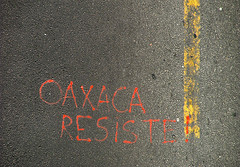
Con Oaxaca, por Brad Will

Image by Libertinus via Flickr

For the past several years, my research has led me further and further into the world of counterinsurgency, military anthropology, human terrain, and other aspects of a military regime of knowledge. What concerns me, most of all, is the way that knowledge generated by social scientists can be used (and, if the past is any indication, will be used) to the disadvantage of the people on, from, and with whom anthropologists and other social scientists generate that knowledge.

This issue is hardly limited to anthropologists, though we have traditionally held a kind of loose monopoly on the world’s most vulnerable peoples. Nowadays, social scientists of every stripe traipse through the same terrain anthropologists once considered their own – and we, of course, have no problem returning the favor.

So when a friend forwarded me a story about geographers in Oaxaca mapping the “cultural terrain”, my disciplinary ears perked up. At issue are many of the same issues at play in debates over anthropologists’ and others’ involvement with HTS in Iraq and Afghanistan, although in many ways I find the situation I’m about to describe more frightening still, as it presages wars or conflicts as yet unfought – even counterinsurgencies to insurgencies yet to surge. Continue reading

The Cultural Capital of New Creative Industries

Adam Fish of UCLA contributed this occasional piece on the relationship of journalism and anthropology. -ck

On May 11, 2009, Roxana Saberi, an Iranian-American journalist once charged with espionage and facing eight years of imprisonment in Iran was released. While anthropologists should celebrate her freedom and the upholding of the freedom of press we should also be deeply troubled that two reporters remain detained in North Korea facing trial for spying. One of them, Laura Ling, a Vanguard Journalist for Current TV, is an important informant for my anthropological research into new media journalism. Her difficult situation sheds light on the limited cultural capital of emergent creative industries in the digital age. As professionals who regularly analyze the power dynamics in the production of media, border issues, and state-to-state conflict, Ling’s case is important. Anthropologists and journalists share many of the same methods, goals, and dangers.

Current TV and North Korea

My research is with new media journalists, the creative industries built around them, and the practice and rhetoric of democracy that these journalists and industries reflect and glorify. As part of my fieldwork, I have worked as a video journalist for Current TV, the Al Gore backed user-generated television and internet creative industry. Current TV supported my work in several conflict zones: the Green Zone of Cyprus, Belfast, a disputed border between China and India, etc. It
was in the course of working with Current TV that I met Laura Ling and her camera-person Mitch Koss. On March 17, Ling, Koss, and Euna Lee were near the Yalu River on the border of China to interview North Korean defectors. Koss escaped and Lee and Ling were
detained by North
Korean border. They are awaiting trial for espionage. Continue reading

Letters from the Front

Just some quick pointers to various military-related materials around the Web.

1147444_bleak_iFirst, Roberto Gonzalez sent me this link to a BBC Radio 4 show on the embedding of anthropologists in military units in Iraq and Afghanistan. The show features Gonzalez, Michael Gilsenan, Hugh Gusterson, Montgomery McFate, Marcus Griffin, and others. Listen quickly, as it appears to only be posted until the end of April.

Next up, Laura Nader speaks about her recent book (with Ugo Mattei) Plunder: When the Rule of Law is Illegal. Any opportunity to hear Nader bring her tremendous mind to bear on the issues that define our lives is not to be missed!

Finally, from the Wired Danger Room comes this odd report about the military’s efforts to reproduce anthropological analysis using computer modeling. Now, I’ve been pretty dismissive of the military’s ability to grapple with the implications of anthropology – there is, I firmly believe (and find borne out over and over in the historical record) a fundamental disconnect between the logic of military action and the logic of anthropological practice. But even I’m a little shocked (and a little amused…) by the justification given for looking into the use of computerized behavioral modeling:

More intriguing about this proposal, however, is the reasoning for why virtual anthros may be better than the real thing: “Today in DoD, this analysis is conducted by anthropological experts, known to carry their own bias, which often leads to faulty recommendations and inaccurate behavioral forecasting.”

Let me know how that works out for ya, guys.

Vengeance is Hers: Rhonda Shearer on Jared Diamond’s ‘Factual Collapse’

Rhonda Shearer, a cofounder of the Arts Science Research Lab and widow of Stephen Jay Gould recently released a long report on ASRL’s website “Stinky Journalism.org”:http://www.stinkyjournalism.org/aboutus.php entitled “Jared Diamond’s Factual Collapse: New Yorker Mag’s Papua New Guinea Revenge Tale Untrue… Tribal Members Angry, Want Justice”:http://www.stinkyjournalism.org/latest-journalism-news-updates-149.php. I have more than a passing interest in this case because I served as a fact-checker for the New Yorker on the piece, have written “my own response to the piece”:http://www.google.com/url?sa=t&source=web&ct=res&cd=1&url=%2F2008%2F05%2F04%2Fvengeance-is-his-jared-diamond-in-the-new-yorker%2F&ei=1EvvSemiGZb8swPs8LHhAQ&usg=AFQjCNEd0-gDpTtootHXezSPeCtHJ7EMUw, and have been in contact with Shearer as she has been working on her response. But this story is far more that just something I am personally interested in — it has already been reported on by the “Huffington Post”:http://www.huffingtonpost.com/2009/04/22/new-guinea-tribe-sues-the_n_189841.html and “Forbes”:http://www.forbes.com/2009/04/21/new-yorker-jared-diamond-business-media-new-yorker.html?feed=rss_business_media shows. Most news coverage will focus on the more spectacular aspects of the case: Diamond publishes a piece in the New Yorker depicting a tribal fight in Papua New Guinea, Shearer produces documentation that his accounts are untrue, and the Papua New Guineans involve sue Diamond for US$10 million.

What I think is truly important about this case – beyond the obvious fact that Wemp deserves justice – is that it represents the fundamental ethical issue that anthropologists will have to face for decades to come. Anthropological collaboration with the army may directly impact more human lives, but collaboration is an old problem that we have talked about for a long time. The great ethical debate prior to HTS was the ‘Yanomami Scandal’ stirred up by Patrick Tierney, a debate that centered on anthropologists (and others) behaving badly in the field, and not being held to account by the powers that be in the metropole. Some people like Rob Borofsky want to fetishize this debate as the issue in anthropological ethics, since it involves what they imagine must be the paradigmatic anthropological situation: powerful white outsiders, (relatively) supine brown people.

I admit that L’affaire Shearer does have a whiff of that dynamic. But overall it is about a relatively new issue which will I think will become increasingly central to anthropological ethics in the future: the radical answerability that researchers increasingly have to the people they depict. While this should always have been important to us, it is a topic we can no longer ignore in a world where their ‘informants’ are more connected than ever before to the flows of media and communication in which ‘we’ depict ‘them’. If the Yanomami controversy was about anthropologists suddenly being held responsible in the metropole for what they did in the field, the Jared Diamond case is about an author suddenly being held responsible in the field for what they did in the metropole.

Shearer’s report is long and detailed and I will not attempt to do more than summarize it here. Basically, Jared Diamond wrote an article in the New Yorker in which he told the story of Daniel Wemp, a man he met in Papua New Guinea who described a tribal fight he had been in which allegedly involved killing dozens of people and paralyzing his enemy in a quest to seek revenge for the death of his uncle. What did Diamond do wrong, according to Shearer? We can summarize as follows:

Poor research and inaccurate facts
Shearer conducted punishingly scrupulous research on Diamond’s story, which included contacting Wemp and having researchers in Papua New Guinea investigate Diamond’s story. It looks like the New Yorker article is a hodge-podge of Diamond’s recollections of the stories Wemp told Diamond when Wemp drove him around the Southern Highlands. The actual history of fighting in the area Wemp describes is quite different — for instance, the man that Diamond says was paralyzed in a wheelchair is photographed standing and walking in Shearer’s piece. Diamond presents what appear to be verbatim quotations from Wemp which are probably Diamond’s reconstruction of the conversation, and so forth. So both the facts and their presentation are problematic.

Poor ethical standards
Separate from the fact that Diamond appears to have gotten the story wrong is the fact that he followed few of the ethical standards which anthropologists (and journalists, apparently) follow in writing about their research subjects. Calling someone a murderer in a venue like the New Yorker is a serious claim indeed. Add to this the fact that Diamond used Wemp’s real name in the story, and that Wemp had no idea that his stories would ever be published, and you have serious ethical problems. There was, in other words, no informed consent and no attempt to provide anonymity for informants.

Shearer’s points here are largely factual and perhaps in the future there will be more delving into the minutiae of this case — as someone who lived in the province just north of Southern Highland and who has visited this area I am extremely impressed with the quality of her research, the experts she has contacted, and her collaboration with Papua New Guinean journalists. But for non specialists the issues of what did or did not happen in 1992 will probably be less important than some of the wider issues raised by this piece:

Let’s hope this doesn’t turn into The Great Counterattack
Many anthropologists dislike Jared Diamond because he has done what they fantasize of doing — writing readable nonfiction for a general audience. One possible outcome of this case is that it turns into The Great Counterattack in which every possible error in Diamond’s reporting is used to trash him by people who care less about Papua New Guinea, geography, steel, collapse, etc. and more about getting the taste of sour grapes out of their mouths. To the extent this becomes a witchhunt, it will get more and more boring and, of course, more and more cruel.

Questions about scholarly competency and institutional licensing
Diamond is like some sort of great Victorian polymath — geographer, ornithologist, anthropologist, historian… in his books it appears there is nothing he can’t do, and to experts in each of these fields it appears that he can’t do any of them. While popular audiences love Diamond’s work, the scholarly consensus on it has been pretty firmly established: much of what the public thinks is Diamond’s original ideas are cribbed from other authors, often with the bare minimum of acknowledgments performed in footnotes to stave off accusations of plagiarism. Overall, what Diamond gets right, he gets from others. What he gets wrong tends to be the stuff he has made up himself.

It is one thing to have Diamond’s book show up on the shelves of airport bookstores, but quite another for it to be described as ‘anthropology’ in the subheading of a story in the New Yorker. Now that Diamond has tried his hand at some ethnographic ‘research’ in a public forum, I think we are beginning to see the differences between avocational anthropology and the real thing. So what is an anthropologist? Is it someone who follows the best practices of our discipline, or do we really feel there must be some sort of institutional licensing in the form of a departmental appointment of degree in order for someone to take up this mantle? Its an interesting question that Diamond’s piece raises.

Could anyone sustain this level of scrutiny?
Shearer takes Diamond to task for not meeting anthropological (and journalistic) standards of evidence, methodology, and ethics. Yet I have to wonder if Diamond is the only person who would be snared in a net as tightly woven as Shearers. After all, anthropologists have a long history of failing to meet their own evidentiary standards. Those of us who work in PNG can think of several authors whose work is not widely taught because we ‘all know’ about the quality of their fieldwork. It is important to hold Diamond to professional standards if he is going to act like a professional. At the same time, we must recognize that he is taking his place in a field where those who have come before him have often failed to distinguish themselves.

Shearer is not reporting the story, Shearer is the story
Anthropologists understand that social life is a constant process of narration and renarration — and I’ve always felt this is particularly true of highlands PNG, somehow. I am not Melanesian (obviously) but looking at this case through a Melanesian lens it seems to me that there is something complex and fascinating about the way Shearer’s report has elicited a whole series of responses from people in PNG and is yet another step in the ongoing reentextualization of events that happened a decade ago in Southern Highlands as it twists and turns into various forms of compensation/litigation.

As I said at the beginning of this piece, the central and most important point of this debate is that it is about what we write at ‘home’ circulating back to the ‘field’. But this is just another way of saying that the line between these two is increasingly porous (as Gupta and Ferguson noted some time ago). Diamond’s case is a cautionary tale for all anthropologists who write in the comfort of their homes imagining their fieldsite is far away. It is answerability that is at stake here — Diamond’s and our own. Answerability is something that journalists have been struggling with longer than anthropologists and I think what they have to teach Diamond offers lessons we ourselves will have to learn in the future (if we haven’t already): get your facts straight, report them fairly, and let people know that you are doing so. It is not only the right thing to do, but in a world where ‘they read what we right’, your audience is also your informants.


Latest AAA Ethics and Human Terrain Roundup

The AAA has taken the lastest steps in revising its ethics code. Although there doesn’t seem to be anything on the website (they might be too busy “migrating AnthroSource content out of AnthroSource and back into AnthroSource”:http://www.aaanet.org/publications/anthrosource/February-2009-AnthroSource-Migration-Update.cfm again, this month) there is coverage at “The Chronicle”:http://chronicle.com/temp/email2.php?id=pqhfrfj6Xm6rjk2qxRqcmqvV5jFQxmwK and “Inside Higher Ed”:http://www.insidehighered.com/news/2009/02/19/anthro. In related news, the Washington Post has a long article on the already well-covered “death of Paula Loyd”:http://www.washingtonpost.com/wp-dyn/content/article/2009/02/17/AR2009021703382.html?referrer=emailarticle and there is a longish op-ed on “The Hows and Whys of HTS”:http://www.insidehighered.com/views/2009/02/19/humanterrain running on Inside Higher Ed today.