Tag Archives: East Asia

AnthroVisions

anthrovisions

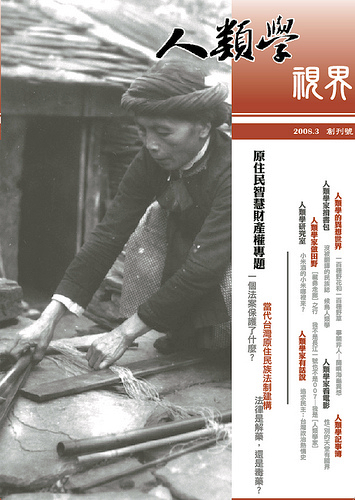
Lately there has been some discussion here on Savage Minds about what an Anthropology magazine for a general audience might look like. There has also been some discussion about how the anthropological blogsphere seemingly perpetuates the hegemony of Euro-American academia. So I’m very happy to announce the first issue of AnthroVisions – a Chinese language magazine about contemporary Taiwanese anthropology, aimed at a broad audience.

In many ways it is the kind of magazine Rex imagines:

What we don’t have is a “it’s great to be an anthropologist! Here are the latest discoveries from anthropology! Learn more about how to do anthropology here!”

I’m a member of the editorial board, but the real work has mostly been done by Pei-yi Guo 郭佩宜 and Shao-hua Liu 劉紹華 at the Institute of Ethnology, Academia Sinica, who deserve credit for all their hard work getting this thing off the ground. I also pleased that my Savage Minds post about the lack of ethnographies in Chinese was translated into Chinese and included [PDF] in this issue.

The Resistance is Dead! Long Live the Resistance!

For five decades, the People’s Republic of China has been proclaiming the death of the Tibetan resistance. In the 1950-60s, they discursively denied the existence of the Tibetan resistance army by referring to them as “high class separatists” and “rebel bandits.” Since then, they have attempted to curb any resistance by immediately putting down protests through arrests, beatings, imprisonments, disappearances (remember the 11th Panchen Lama?), and deaths. The PRC has done everything they can to give the impression that resistance in Tibet—armed or peaceful, coordinated or everyday—is a rare and unwise exception to their benevolent rule, is conducted only by monks or members of the “Dalai clique,” and is not representative of the majority of the Tibetan people who love the Chinese motherland.

Yesterday, therefore, marked a major departure from this stance, perhaps for the first time ever. On Thursday, March 20, 2008, the PRC government acknowledged that Tibetan protest is widespread. That is, it is not just confined to Lhasa or to monks, but is spread throughout Tibetan areas of China and is being committed by Tibetans from all backgrounds—by monks, laypeople, and students, and by men and women, young and old.

Why does this matter?
Continue reading

Carole McGranahan on Tibet

By way of kicking off our “occasional contributors” project, Carole McGranahan has agreed to write something about Tibet for us, which she will shortly post. Carole McGranahan is an assistant professor of anthropology at the University of Colorado. She received a Ph.D. in anthropology and history from the University of Michigan in 2001. Currently, she is revising her book manuscript Once and Future Truths: Tibet, the CIA, and Histories of a Forgotten War for Duke University Press.

I found a number of great articles she’s written about Tibet, which I’m sure she’d be willing to share with anyone who cannot access them.

On behalf of the elite Euro-American gatekeepers of Anthropology here at Savage Minds, I would like to thank Carole for agreeing to mix it up here on this subject.

Garton Ash and Havel on Tibet

The Guardian has two comments, one by Vaclav Havel and one by Timothy Garton Ash on the situation in Tibet. Havel’s, signed with others, is a strong indictment of inaction, and both essentially call for the same thing: allowing the media in, opening dialogue with the Dalai Lama, and otherwise moving towards a path of dialogue. Ash in particular points out (as commentors here did as well) that the issue is not “independence” but autonomy. Whether or not to boycott the Olympics also seems a bit undecided here, especially if things escalate further. The Olympic torch leaves Athens on Monday. It’s still scheduled to stop in Lhasa.

On Tibet

The recent violence in Tibet has been poorly covered by American media, and even more poorly analyzed, if at all. In fact, the only analysis I’ve seen so far is at Boing Boing, where they pay attention to things like this if it involves China blocking traffic to Boing Boing (which is actually probably a pretty good proxy measure of serious human rights abuses). I’ve been looking for anthropologists who have something to say on this, and with any luck, Vincanne Adams of UCSF, who is currently in China, will send us a short analysis on the subject. I and others (including Paul Rabinow, who suggested that we start a discussion here) would like to see this get more sustained, intelligent attention, given how completely dull the US media has been on the subject. I suppose it’s no surprise that the current administration has been silent. However, it’s also demoralizing that the current presidential candidates are, if not silent, weak and ill-informed on the subject (Obama seems to think the Tibetans are angry with the way Beijing is ruling Tibet, not that they are). Clinton, meanwhile, has said next to nothing on the subject.

This is another one of those instances where anthropologists should have something informed to say on this. If anyone has pointers to intelligent analysis, meaningful ways to show solidarity or other ideas, please share.

Interview with an anthropologist

Elise Edwards is Assistant Professor of Anthropology at Butler University in Indiana. Her research interests include issues of gender, sexuality, and national identity in Japan, particularly as they are articulated and disciplined through technologies of sports, recreation, and physical education. She is currently working on a book about soccer, corporate sport, and national identity construction in Japan in the late 1990s and into the present, which is tentatively titled Fields for the Future: Soccer, Nation, and Citizens in Japan at the Turn of the 21st Century. Elise played for three seasons in Japan’s women’s professional L-League in the mid-1990s, and continues to be involved with the sport, serving as the goalkeeping coach for Butler University’s varsity women’s team.

Fuji. One of the reasons I study sports is that in both China and the United States, I’ve found that everyone has something to say about sports – not always positive, which makes it more interesting – and it’s a good way to get a conversation going. Plus, as a teacher, it’s a good way to grab students’ interest and get them to think more critically about their own culture. What motivated you to study sports?

Elise: You’re right, almost everyone has something to say about sports, even if it’s simply that they “hate them,” which is a response that can actually lead to some very productive conversations if that person is willing to expand upon what it is that they hate about sports.

My own interest in studying sports stemmed first and foremost from my own experiences as an athlete. I played a variety of different sports – volleyball, basketball, softball, and soccer – throughout most of my childhood and on into high school. I ended up playing soccer in college for Division I program. In many ways, sports was what I knew best, but not really in any kind of critical, or analytical sense…although now that I think about it, from early on, but only at a rather basic level, I was aware that sport played an important role in structuring gender relations, and that it was both reflective and reaffirming of normative ideas about sexuality. I think that most girls who are labeled “tom boys” – or, boys who are called “sissies” because they skate – are well aware of some of the powerful ways that sports impose meanings on bodies and help maintain a particular gendered order. Personally, I think I felt both frustrated and empowered by various cultural meanings attached to sport, and that long before I began my graduate research I was curious about why and how sport worked the way it did. In addition, I think that some of my early childhood questions about why only boys were supposed to play certain sports, or girls were supposed to be “naturally” better at others fueled my early interest; and, the fact that many people continue to think that way inspires me to continue to teach about the history and anthropology of sport, and to do my research.

I guess I got derailed a little bit with my answer above. Despite my general interests in sports, I did not plan on working on sport issues, and definitely didn’t imagine doing fieldwork on women’s soccer in Japan, before I entered into graduate school. After I finished my undergraduate degree, I actually played soccer for the professional women’s league in Japan that is one of the main focuses of my current work. I spent three seasons with a team in the Tokyo area that was sponsored by what was one of the largest securities firms in the world at that time. The experience was amazing and definitely cemented my conviction that I wanted to go to graduate school to learn more Japanese and a lot more about Japanese history and culture. When I returned to the states to begin my graduate work, my advisor strongly encouraged me to do fieldwork on the league. I’m embarrassed to admit that the idea had never crossed my mind before that point – what can I say, I was young and naive – but I knew it was an excellent one as soon as she said it.

As soon as I began seriously studying sport, my interests rapidly broadened and deepened. I was fascinated, for instance by the ways that physical education and sports were used in the late19th and early twentieth centuries by the newly formed Japanese Meiji state to train new dispositions and forms of discipline that would serve the needs of the rapidly modernizing and industrializing country. Or, the fact that up until the final days of WWII, sports and physical fitness initiatives were central parts of government programs aimed at cultivating male bodies to become strong and regimented soldiers, and female bodies to become strong reproductive vessels that could produce plenty more soldiers for future years. I am fascinated by the ways that the women’s volleyball team that won gold in the 1964 Tokyo Olympics, as well as other teams, were drawn into broader cultural discourses ranging from how to reconcile the pain and suffering endured over more than a decade of wartime hardship, to how to explain the double digit GNP growth and new affluence the country was experiencing in the 1960s and ‘70s. And, arguably, I’m most fascinated (since this is the focus of my own research) by the cultural role of soccer in Japan in the 1990s as a medium through which various commentators – including plenty of sports journalists, coaches, and players – waged debates about the kinds of citizens needed to help Japan overcome its serious recession and make Japan competitive in the “new global market.” It should be added, that many of those same people also saw soccer as the ideal means of training those new “global citizens.”

Fuji:. But Japan already seems so global, what with all the technology, exporting of Japanese culture through Pokemon and anime, and exporting of Japanese people as tourists and businesspeople. Is there something about soccer that makes it seem like a more appropriate medium to making Japanese feel global?

Elise: Well, of course, Japan already is global, and in fact, has been global for quite a long time, in the sense that it has interacted and traded with regions and nations around the world for centuries. I think contemporary commentators’ assertions of the “newness” of current globalization stem from two facts: 1) the common but inaccurate belief held by many in Japan that until recently (literally the last couple decades) the country has been incredibly insular and ethnically homogeneous; and 2) despite the fact that Japan was part of global networks and flows for many centuries, in just the past couple decades the nature of those interactions has changed quite dramatically due to the communicative power of the internet, the liberalization of international financial markets, and so on.

Of course, ultimately, whether Japan – or, the world – is more global is a question worthy of debate, but for my purposes the most important thing is that policymakers, journalists, coaches, and others have felt like it is, and that they point to soccer as both resulting from, and being emblematic of this new global system. Many have drawn comparisons between baseball and soccer, with baseball and its militaristic-style training symbolizing the hardworking, group-oriented, and hyper-disciplined Japan of the past, and soccer representing the rapidly changing, foreign derived, and more individualistic post-industrial economy and culture of the present. In this overdrawn binary, baseball is marked as the “national” or “domestic” sport, in contrast to the “international” game of soccer. This is rather ironic since the two sports were actually both introduced to Japan in the early 1870s. (Of course, baseball, as some of these commentators have pointed out, has no equivalent to soccer’s World Cup Tournament, making it less of a “global sport.”) Other writers have suggested that the skills required of soccer players on the field – as individual decision makers in a complicated web, or network, of 21 other players – are exactly the skills required of workers in the new 21st century economy. Of course, for many soccer represents things other than globalization and its requisite dispositions; players, fans, and plenty of sports writers have characterized soccer as embodying a new found individuality and a spirit of change in the country. In 1993, the year the J-League launched, I remember a forty-year old female friend gesticulating wildly as she explained how these young soccer players expressed the freedom and rebelliousness of youth culture in a way not found in baseball. In her opinion, it was wonderful – to watch and for Japan.

Fuji: Back to your point about gender. One of the common complaints against Title IX is that equal opportunity can never really be attained because men are more interested in sports than women, and there will always be more men than women wanting to play varsity sports. Do you think that’s really true?

Elise: I’m always annoyed when I hear this kind of argument against the legislation. To suggest that men are simply more interested in sports is to mistakenly suggest that this is somehow a natural quality of the male sex and deny the cultural forces behind that interest. I think this is the kind of the question that is easiest for me to comment on from a personal perspective as a player and a coach. I’ve worked with female and male athletes for years, and I’ve never seen anything that’s made me believe that either sex inherently likes sports more than the other. Why they play sports and what they get out of them do at times appear to be different, but this I’m quite sure can be attributed to the power of culture.
Chinese in the Pacific: more ANU open access

One topic of growing interest to me is the role that China — PRC, Taiwan, diaspora, etc. etc. — is playing in the Pacific today. There are many reasons for this: PRC-based companies are growing increasingly active in Papua New Guinea’s mineral industry (which I study), and I’m married to a China scholar and so China/Pacific overlap is a no-brainer as an area for me to be interested in. So I am interested in — and thought you might be interested in — this new open access paper with four chapters by different scholars, entitled “Chinese in the Pacific: where to now?”:http://rspas.anu.edu.au/cscsd/occasional_papers/index.php?issue=01 published by the newly-formed “Center for the Study of the Chinese Southern Diaspora”:http://rspas.anu.edu.au/cscsd/ at the Australian National University. This is the second post in a row where I’ve shilled for ANU, I know, but there is a Savage Minds connections — they credit Savage Minds for hosting an “earlier version”:/2005/12/16/chinese-in-the-pacific-a-bibliography/ of “their expanded bibliography of Chinese in the Pacific”:http://rspas.anu.edu.au/cscsd/occasional_papers/cscsd_op1_8_bibliography.pdf (PDF link). Check it out.

Marriage Today

I have been intending to keep my kinship course moving between contemporary concerns and classic theory. We have been carefully tracking kinship theory from its beginnings in Morgan (19th century) to its apotheosis in a text dedicated to him (Lévi-Strauss’s Elementary Structures). A question remains: How does this stuff relate to debates in the world today?

Our reading this week spotlights concerns that feminist anthropologists have articulated in relation to gender and especially gender inequality. Today, debates the world over swirl around relations between men and women in neoliberal (yep!) and/or postcolonial contexts. For example, ‘kinship’ or ‘domestic relations’ are often seen to be the locus classicus of ‘tradition’ in rapidly modernizing societies. New found freedoms for women often run up against calls to maintain tradition in particular ways, calls that are not infrequently resisted by those who are subject to them. How are women ideologically positioned (often) as embodying tradition?  What do they say about that?

I am highlighting two themes for going forward:

1) “Choice” / “Agency”

Lévi-Strauss’s analysis of alliance challenges ‘enlightenment’ or ‘liberal’ views of the human subject: Is the subject a person who is author of his/her own actions, as one who ‘owns’ oneself? The challenge presented by prescriptive marriage systems for those of us raised in Euro-American cultures is precisely to imagine a version of humanity in which the exercise of agency is not necessarily equated with ‘choice.’ Do people make their social worlds (author them) or are they made by those worlds?

2) “Nature” / “Substance”

Lineage theory relates ‘natural’ relations (genealogy) to political structure. Putatively ancestral relations give form to political disputes and their resolution. In large part, lineage theory was motivated by the attempt to find state-like regulative functions in societies without states. Can this theory and its interests be re-applied to our understandings of government in places like Europe or North America? Segmentation can be abstracted to talk about alliances between political units in broad contexts. More concrete, perhaps, are the ways in which familial metaphors and notions of ancestry give form to the imagination of ‘nations.’ One can think about lineage theory in the context of nationalism and ethnicity for example (and see Horowitz or Lakoff).

These issues come together in contemporary debates about reproductive technologies and reproductive rights. Finland is presently debating legal limits on artificial insemination. To whom should this technology be made available? Single women? Lesbian couples? How are debates about its legality framed? I suggest that ‘nature’ and ‘marriage’ as they are conceived and critiqued in anthropological kinship theory can be brought to bear on these questions. Debates about alternative family forms often rest on notions of what is naturally human, spiraling nature from the question of bodily relations of particular (as modified by technology) kinds up into the domain of the putative structures that allow for the emergence of ‘culture’ (or Culture).

Separately, I am sure that I wasn’t the only one who noticed the recent New York Times piece on minghun marriages in China. Here we have questions of tradition, gender norms, and religious practice played out in an ‘exotic’ context. A link is here.
The ‘modernity of kinship’ (cf. the modernity of witchcraft) is found in debates about ‘ghost marriages.’ Society is reordered. But are the ancestors?

Ask our readers: How do you take reading notes?

The erudition of our readers (and my fellow bloggers) often astounds me. Some people may simply have good memories, but I don’t. I rely on my notes. So I’m curious: how do you take notes?

Over the years I’ve come up with my own system of taking reading notes which works for me, but it is very labor intensive: When reading a book I use small removable stickies to mark sections of text I think are important, then, after I’m done reading, I go back and type the relevant sections into my computer. Sometimes I copy verbatim, other times I just write the page number and make parenthetical comments, and sometimes I do a mix of the two.

This system works because I’m a fast typer, although when writing my dissertation at the New York Public Library I noticed a man who used the same system using the hunt-and-peck method of typing, one finger at a time …

But the real secret to this system is putting all my notes inside software that lets me do full-text search of my own notes. Some people use very structured data, and prefer software that lets them code each note with keywords, etc. but, personally, I’ve found that full-text is better, allowing me to make connections I might not otherwise have noticed.

Since I started teaching, however, my system has been hard to keep up. For one thing, I simply don’t have the time to review my readings so carefully and type them up. Also, I am trying hard to read more Chinese language texts, but the difficulty I face in taking notes often prevents me from getting very far. So I just ordered the IRISPen scanner with Chinese OCR support. It hasn’t come yet, but I hope that when it does it will help me overcome both problems, and return to using the note-taking system I’m comfortable with. I’ve long ago learned that new gadgets rarely live up to the hype, but as I prepare my lecture notes for class tomorrow I find myself wishing I’d ordered it much earlier!

(NOTE: IRIS offers an IRISPen Express with Chinese OCR support via their online store, even though their web page only lists the much more expensive “Executive” version as offering Chinese OCR support. Since I haven’t used the product yet, I can’t vouch for it, although I’ve heard good things from other users.)

UPDATE: Fifty ways to take notes online.

UPDATE: My IRISPen came. I posted my initial reactions here.

Why Chinese Is So Damn Hard and other fulltext goodies

Unlike Kerim, I am just begining the study of Chinese. This is my first semester of Mandarin and let me tell you something, if you think publishing, teaching, and doing committee work is hard, you should try publishing, teaching, doing committee work, and learning a language that involves memorizing tens of thousands of distinct characters. Actually I don’t think the language itself is that difficulty (yet) — it’s really the writing system that is kicking my ass. But then again we’ve mostly been doing the sounds of the language and noun phrases and have yet to hit such sophisticated linguistic concept as, you know, transitive verbs.

Anyhoo, like many neophyte Chinese speakers I recently came across David Moser’s essay “Why Chinese Is So Damn Hard”:http://www.pinyin.info/readings/texts/moser.html. No surprises if you’ve learned a lot of other languages. But what was a surprise — and delight — was that Moser’s essay and the “entire festschrift that it’s from”:http://www.pinyin.info/readings/Schriftfestschrift.html are available online. It just so happens that a good number of the other monographs in the series are also available. They are all part of Victor Mair’s “Sinoplatonic Papers”:http://www.sino-platonic.org/index.html series which is making the transition to open access online publication. They all look wonderful and are a perfect example of the sort of playful occasional papers that perfect for open access: a labor of love that bursts with scholarly energy. Or so I imagine — I haven’t had a chance to read all 172!

Taiwanese Bridal Photography

You might have seen this article in yesterday’s Washington Post. Titled “For Wedding Photos, Chinese Couples Strike a Western Pose” the article focuses on the “Western” garb adorned in Chinese bridal photography:

With names such as Paris, Love in New York and Rome Style Life, the mostly Taiwanese owned studios that dominate one of Beijing’s busiest shopping districts have capitalized on a Chinese obsession with Western-style wedding pictures.

For the equivalent of $375 to $750, packages include at least five costume changes and a trip to pose in front of a nearby Roman Catholic church, even though most couples aren’t Christian. “It fits the Western style of the dress,” said Huang Ling, 23, director of the Miracle Love Marriage studio.

Before we go any further, I encourage everyone to look at some of the photographs online. I bookmarked these for my students when I was teaching Bonnie Adrian’s Framing the Bride: Globalizing Beauty and Romance in Taiwan’s Bridal Industry last year. (Bonnie informed me that she had wanted to include more in her book, but it would have made the cost prohibitive.)

There is no denying that there is something “Western” about these images, just as there is something “Eastern” about Yoga. But women in designer paisley outfits doing yoga at the local gym are as separated from the “Eastern” origins of Yoga as Chinese brides donning dress after dress at Taiwanese run salons. These photographs represent a Taiwanese notion of “glamor” and “romance” that is rooted in the global fashion industry, but takes a very particular East Asian form.

Most importantly, this particular kind of wedding photography is very much a Taiwanese product. Even Taiwanese I know in the United States go back to Taiwan to get their photographs done there because they feel that the Taiwanese industry is more up to date with the latest fashions than Taiwanese-run studios in the States.

It is a competitive industry as well. One of Bonnie’s biggest challenges was convincing her informants that she wasn’t planning on stealing their “secrets”:

Even with Xiao-lan to introduce me as an anthropologist, salon owners and photographers continued to assume that I intended to open a bridal salon of my own once I finished by doctoral degree. many anthropologists have been suspected of being CIA agents, development workers, or missionaries in disguise. That the bridal salon owner’s worst fear is industrial espionage by an American posing as an anthropologist is telling. It speaks to the self-confidence that some people in Taiwan can enjoy in globalizing processes, including the one that this book presents.

I find it unfortunate that Maureen Fan felt it necessary to spin this story as a Chinese obsession with the West, when it is the role of Taiwanese in shaping Chinese popular culture which strikes me as the real story here.

The Tablet Computer and the Native Girl

This wacky Taiwanese computer ad features a Westerner with a tablet computer encountering Aborigines in Taiwan’s forest. My students pointed out that the Aborigines are wearing Tzou inspired outfits, dancing Amis dances, and living in Paiwan houses. But somehow they didn’t think it was strange that the Aborigines are living in the past, while the Westerner has a fancy computer. (And I’m not even getting into the strange sexual narrative.) In fact, my guess is that Taiwan’s Aborigines have more computers and cell phones than your average town in rural America.

Via Wandering to Tamshui, who also has a nice post on the surprising economics of “spirit money” in Taiwan.

The First Formosan in Europe

Sometimes I stumble upon a link that forces me to drop all of my work and shift my focus entirely. Such was the case when after lunch I learned of George Psalmanazar, “the first Formosan to visit Europe.”

In 1704, Psalmanazar published a book An Historical and Geographical Description of Formosa, an Island subject to the Emperor of Japan which revealed a number of strange habits. Formosa was a prosperous country of wealth with capital city called Xternetsa. Men walked naked except for a gold or silver plate to cover their privates. Their main food was a serpent that they hunt with branches. Formosans were polygamous and the husband had a right to eat their wives for infidelity. They executed murderers by hanging them upside down and shooting them full of arrows. Annually they sacrificed the hearts of 18,000 young boys to gods and priest ate the bodies. They also used horses and camels for mass transportation. The book also described the Formosan alphabet.

Of course, it was all a hoax. In fact, I came across it via this Ishbaddidle post linking to the 10 Greatest Impostors in History.
Continue reading

1421

Melanesianists have Jared Diamond. Sinologists have Gavin Menzies. Well, that’s not quite fair. Guns, Germs, and Steel drives a lot of anthropologists nuts (I’m not nearly as critical as some) because for a lot of big-picture reasons of which his reading of Melanesia and Melanesians is only a part. But regardless of what you think of the book, there’s no doubt that Diamond has chops — he has undoubted expertise in Melanesia (at least its birds and insects) and long and distinguished career as a scientist.

Not so with Gavin Menzies. Menzies has qualifications to be sure — as an officer and commander in the British navy he has forgotten more about the sea than I will ever know. And as an auto-didact who has traveled widely and studied deeply he doesn’t deserve to be dismissed out of hand simply because his erudition doesn’t have the three letters ‘Ph.D.’ attached to the end of it. But a trained sinologist or academic he is not — for whatever that is worth.

Many people think it is worth a lot. Menzies’s main claim to fame is his book “1421”:http://www.amazon.com/gp/product/006054094X/sr=8-1/qid=1142651980/ref=pd_bbs_1/002-5846516-4008032?%5Fencoding=UTF8, which claims that a Ming fleet discovered America decades before Columbus. When my fiancee tells people she studies China, she regularly gets people asking her whether she has read the book. His story, a sort of latter-day Heyerdahlism, is incredibly popular and seems determined to turn itself into a movement. Erich von Daniken had In Search Of, but Menzies has the web (ok ok, to be fair, Daniken now also “has the web”:http://www.daniken.com/ and now even a “new TV show”:http://www.chariotsofthegods.com/). Menzies’ site, “1421.tv”:http://www.1421.tv promises to build off of the book’s original premise. It’s an impressive site with a gorgeous display of early “maps”:http://www.1421.tv/maps.asp and a database of evidence of early voyaging to the Americas.

Now to be fair I think Menzies is a much more responsible (and therefore more boring) scholar than von Danniken. But some people would say it’s a close call. “Robert Finlay’s”:http://www.uark.edu/depts/histinfo/history/finlay/finlay.html vicious “review”:http://muse.jhu.edu/journals/journal_of_world_history/v015/15.2finlay.html. A fine example of academic blood sport at its finest, Finlay’s savaging of Menzies manages to combine over-the-top rhetoric with real and detailed empirical refutation. Thus we get lines like “Menzies in fact is less an ‘unlettered Ishmael’ than a Captain Ahab, gripped by a mania to bend everything to his purposes. His White Whale is Eurocentric historiography… The wounded leviathan of Eurocentricism no doubt deserves another harpoon, but 1421 is too leaky a vessel to deliver it” and “the reasoning of 1421 is inexorably circular, its evidence spurious, its research derisory, its borrowings unacknowledged, its citations slipshod, and its assertions preposterous.”

I have not read Menzies’s book, but I doubt it can be more entertaining than Finaly’s demolition. But then again, Menzies claims that the Chinese fleet survived at sea by using trained otters working in pairs to herd fish so maybe I’m wrong. And of course the story of the Ming expeditions is a fantastic one. Still, you would probably be better off reading “Louise Levathes’s book”:http://www.amazon.com/gp/product/0195112075/qid=1142654041/sr=1-1/ref=sr_1_1/002-5846516-4008032?s=books&v=glance&n=283155 rather than Menzies’s. In the end the best way out is the solution to approaching this sort of work is the one that Finlay proposes — teach the work in the context of a discussion about authority, proof, and both how (and how not) to use evidence.

But then again… trained sea otters! That is hard to beat.

(update: Kerim also points out “1421exposed.com”:http://www.1421exposed.com/ which contains additional debunkery)