Tag Archives: dissemination

Dial-an-Anthropologist

Via the Global Poverty blog (where you’ll see our own Dustin Wax has left the first comment), comes news of Worldwise development, a website which “aims to facilitate collaboration between development practitioners and anthropologists.” As they explain:

We believe that anthropologists have a lot to contribute to development work, but that their knowledge and skills are still underrepresented within the industry. The demand for anthropological expertise is growing, but links between the two fields are still weak. While an informal network faciliates collaboration between a small number of anthropologists and development practitioners, most anthropologists are still out of the reach of development agencies, especially academics and those currently conducting field research.

We aim to address these issues with two tools; an interactive map and a discussion forum. We envisage that the interactive map will formalise collaboration between anthropologists and development practitioners. Meanwhile the discussion forum will provide space for both anthropologists and development practitioners to debate the role of anthropology in development. By joining worldwise development you can be involved in shaping how anthropologists collaborate with development practitioners.

Seems like a great idea! I hope it succeeds in its goal. (NOTE: The website is not yet fully active. Right now it is just an announcement of what they plan to do after launch.) But even more than that, this is exactly the kind of thing I have long been arguing the AAA should be doing on-and-off the web…

(Thanks, again, to Ennis)

Anthropology Journalism HOWTO

It’s like public anthropology week here at SM! Joana and Pal are writing fascinating stuff about engaging beyond academia. And just to keep the discussion going, I wanted to re-post a comment offered by Brian P (science journalist) which is like a HOWTO for anthropology journalism. I hope he doesn’t mind my shameless re-purposing, but it’s some truly excellent stuff. AAA publicity folks, please take note. My comments are interleaved.

If the field wants more attention from the press, here are some ideas:

1) Hire good science writers to write and distribute press releases. Believe me, there are plenty of quality science writers looking for work. Journals could easily pay a few of them to write press releases on the top two or three papers per issue. Current Anthropology does this and I’m grateful for the service. Not many journalists (probably almost zero) read the primary anthro journals, let alone secondary journals in the field. We need to be led to the fountain.

  • “good science writers” might include all those anthropology MAs and PhDs who didn’t end up going into academia for whatever reason. There are a lot of people on this blog alone who just enjoy keeping up with anthropology and who might have the skills to do just this. unfortunately, the part about hiring them seems pretty unlikely. Editors of AAA journals aren’t even paid, to say nothing of science writers. So this task falls to us (see #4 below) and if I were editor of a journal, I would make it a priority to find people willing to do this task on a volunteer basis–or maybe for a free subscription if they happen to be unaffiliated? If Current Anthropology can do it, why can’t the AAA?

2) Post those press releases on Eurekalert.org, which is run by AAAS, and on other services science reporters scan for news, such as Newswise.

  • this seems like a no-brainer. But upon looking, the only alerts are from Current Anthropology. In order to post an alert you need to be a “public information officer” for an organization of some kind. Does the AAA even have a “Public Information Officer”? A subscription to Eurekalert? I might be willing to renew my membership to the AAA if I knew some of the money went to hiring science writers to promote our research on sites like Eurekalert.

3) When preparing press releases, try to relate the work to current events. Make it relevant.

  • I would return here again to my point about temporality. Anthropologists work slowly, but that can be an advantage. It means that a longer term sense of what counts as “relevant” and how to connect current problems that seem new to long-standing structural and cultural transformations is a great way to do exactly what Brian suggests. Just because our work analyzes a time and period that is now outside of the current news-cycle attention span does not mean that it cannot be made relevant to what’s going on today. Figuring out how to stake this claim is intellectually challenging work, not just publicity pandering.

4) If you have the aptitude and inclination to write for a popular audience, DO. Write and submit opinion pieces for national newspapers, Nature, Scientific American, and Science. We read these. New Scientist and Scientific American and Scientific American Mind run articles written by researchers (usually they are heavily edited). It’s cheap labor for magazines to do this, and more and more of them are probably heading in that direction.

  • I’m not sure I fully agree with this one. On the one hand, those who can and want to should, and will. On the other hand, maybe it only means talking with someone who does like to write for a popular audience about current research, or sending alerts to those who do like to write such things. If I got an email box full of eurekalerts about recent research in cultural anthro, I might read some and write about some on SM. As it stands, I just have an email box full of requests to review such research, which means I can’t write about it, even if it’s interesting. I’d be happy to trade in half my peer review requests for “publicize it” requests. The fact that very few of the leading lights of cultural anthropology deign to do exactly such a thing cannot be good for our business.

– Prepare for some disappointment. Yes, some journalists will get it wrong. Sometimes you won’t like our pithy language or our need to strip away the caveats and get to the heart of the issue. Well, that’s the price of admission.

  • well said, sir brian. Indeed, if obscurity and widespread public ignorance of anthropology is what we want, we’ve already got that in spades, so we can feel free to ignore these suggestions and happily avoid any disappointment.

– Let me say it again. FIND WAYS TO MAKE YOUR WORK RELEVANT. What does it tell us about something happening now that’s important to large groups of people? What currency does the work have? I once wrote about some studies of infanticide in baboons – and the researcher was willing to draw inferences about human behavior from his work. That made the work newsworthy and interesting.

  • and let me say it again: cultural anthropology has a different temporality than journalism, even though they often cover very similar topics. So the art of “making it relevant” is also the art of seeing cultural change and significance at different scales, connecting the just-forgotten with the all-too-present. A lot of what cultural anthropology has to offer is the re-framing of persistently polarized debates. Ours is not a logic of discovery, but one of assertion and reorientation.

Why is there no Anthropology Journalism?

I feel like I hear a lot these days about anthropology’s need to be more engaged, more accessible, more readable and more relevant. There are obviously many different motives behind these concerns, from seeking attention to raising the prestige of the discipline to creating a public anthropology to being true to the concerns and needs of our subjects and collaborators.

But one thing I don’t hear people say is that we need more “Anthropology Journalism.” I mean that primarily on analogy with (or as a subset of) science journalism. It is a very rare experience to open up the Tuesday NY Times and see an article about recent research in anthropology–to say nothing of rags like scientific american, Wired, Discover or the New Scientist. Of all the “news alerts” I get, or the RSS feeds I browse from journalistic outlets, few to none ever report new findings, controversies, or questions coming out of the discipline. And I get more news alerts and RSS feeds than I could possibly read in ten lifetimes.

Two qualifiers: first, I mean linguistic and cultural anthropology specifically. Archaeology gets some love, though usually only when the findings are narrativized in a story of human origins or change, or when something truly rare is discovered. Biological anthropology gets perhaps a bit less love than archaeology, though certainly more than cultural or linguistic, and only when it is clearly identified with another discipline (evolutionary psychology, behavioral ecology, evolutionary theory, etc). Jared Diamond, it appears, gets the rest of the attention.

Second, it’s not a total lack. A few weeks back the NY Times magazine ran a story about the Americanization of global mental illness. That article had everything good and bad about science journalism going for it: it reported on recent research, digested it and used to to paint a compelling picture, but it also took liberties with the subtlety of the claims to make an overly broad argument in order to be provocative, and to sell more copies of the journalist’s book. A few years back, Dan Everett got a full profile in the New Yorker. Tracy Kidder recently devoted a whole book to Paul Farmer (though interestingly the publicity only refers to him as a doctor, not an anthropologist). And speaking of Haiti, I’ve heard more anthropologists interviewed in the last two weeks than in the whole of 2009. But basically there is no anthropology journalism to speak of. Why not?

There are a few arguments that are always used to explain why there may be science journalism but no anthropology journalism. The harshest of these is that there is simply no interesting (or objective, or reliable, or novel) anthropology to report on. The argument has a Glenn Beck feel to it, suggesting as it does the decline of western civilization and values and the destruction of all that is Good and Right by the scourge of French philosophy, postmodernism and dissolute tenured radicals. Whatever.

Slightly less annoying is the frequent argument that our writing is inaccessible, jargon-laden, pretentious, or needlessly over-written. This argument fails on the simple grounds that most scientific papers are totally inaccessible to a general audience. Science journalism by journalists trained in science is absolutely essential to communicating what the vast majority of things scientists and engineers are up to today. I won’t defend the wealth of bad writing in anthropology, but nor will I defend it in psychology or chemistry or engineering. Have you read a conference paper in computer science lately? Not only is it likely to be totally inscrutable to you non-computer scientists, but it is also very likely to be extremely poorly written, badly punctuated, and generally abusive of the English language–though very prettily formatted using LaTeX

So let me propose three reasons that people don’t usually seem to offer for why there is no anthropology journalism: Continue reading

Twitter Time.es: Anthropology Edition

I’ve mentioned before that I maintain a list of anthropologists on Twitter.* Now that list has become a means of collaboratively editing a constantly updated online newspaper, thanks to the website Twitter Tim.es. I’m relying entirely upon Twitter Tim.es to make this list from our tweets, but I strongly recommend taking a look at Digital Humanities Now which is a very nice website built around a similar concept.

What this means is that if you are on the anthropologists on twitter list and you tweet a link to a news story, you are essentially voting for that story to appear on the front page of the Twitter Tim.es page. Because the list is still small, it only takes a couple of votes, but hopefully as more anthropologists join Twitter it will become even more focused on anthropological topics.

*All are welcome to join the list, but I do ask that at least 1/3rd of your tweets be in English, and that you regularly tweet about matters concerning anthropology. If you’d like to be on the list, just send me a tweet @kerim.

Learning from TED, SFAA and BarCamp

The 2009 SEAA conference was held in Taipei this year and it was a real treat to see so many anthropologists visiting the country I currently call home. I thought the Jurassic Restaurant was a great place for our final dinner! But as much as I enjoyed it, I am always left somewhat disappointed by anthropology conferences, so I thought I’d write a blog post to try to put some of the reasons for that disappointment into words, trying to think aloud about how we might do better.

The first thing I would do, if I had the power to do so, would be to ban the reading of papers. It seems to me that there is often an inverse relationship between how famous an anthropologist is and how boring their presentations are. All too often they simply read aloud seven to nine pages of dense double spaced text extracted from their most recent publication. Thanks, but no thanks. I’d rather read the paper at my own pace, thank you. How about trying to learn from the wonderful TED talks? Although the TED curators seem to be a bit too fond of neoliberal and technocratic solutions to the world’s problems, there is no doubt that the talks one finds on that site are rarely boring.

Secondly, putting all the TED talks up as online video might have something to do with the quality of the talks. Surely this keeps presenters on their toes? The SFAA podcast site is a great example of what anthropologists can do in this regard. This should be standard practice at all anthropology conferences, and included in the conference budget. All too often there are a million talks scheduled at the same time, so it would be great to be able to hear the ones you missed later on. It is a great way to “open access” our conferences.

Third, I’d like to see a little more time devoted to discussion. Lets be honest, fifteen minutes is not enough time to present all your data. It seems to me that anything less than forty minutes is going to be little more than an advertisement for your work, encouraging people to read more if they are interested. So why not keep the papers short, maybe under ten minutes, and open up more time to some real discussion. Make the papers available online for those who want to read them.

Finally, I’ve never been to BarCamp, but it seems to be one of many participant-driven “unconferences” like the citizen journalism one I attended at Wikimania 2007. The entire agenda was determined on the spot, with the second round of topics picking up from where we left off at the end of the first round. I loved how dynamic this approach was, compared with what I’m used to at academic conferences. It would be great to open up the format of anthropology conferences to experiment with these other forms. This could even be extended to after the conference is over. Perhaps there could be some kind of built-in mechanism by which each year’s conference builds on questions raised the previous year?

The New Persistence of Memory: The Language and Popular Culture in Africa Archive

Some readers here may have seen my review of Johannes Fabian’s recent books, which are linked to a site he co-created with Vincent de Rooij called The Language and Popular Culture in Africa Archive. It’s a great small collection of original texts, translations and commentaries, curated with scholarly care, and representing hard to find and valuable resources. What’s more, even though it is a small-scale project, it was one of the first open access publications in anthropology, and could continue in this fashion if there were interested people.

Fabian wrote to me recently concerned about the future of this archive, highlighting several issues that I think we will all face in the near future:

As you may have noticed in my email signature below the address of our LPCA archive has changed (because of some reorganization at the University of Amsterdam). The old address that appeared in publications so far will get you there for a while but probably not forever. One of the vagaries of presence on the net. Also I say “our” archive because it has been a truly collaborative effort with Vincent de Rooij, a former student and a linguist-cum-anthropologists whose dissertation was about Katanga Swahili. He designed, maintained, and edited the website meticulously. And he did this for almost 10 years without any institutional funding or even academic credit, on his own time. This has become untenable for me but, more importantly, he has turned to other subjects and interests, which is of course entirely legitimate. So the sad news is that LPCA, though it can run, as it were, on autopilot for years as long as it keeps its space on the server, is, if not dead, in suspended animation.

I think such projects are the very lifeblood of anthropology today–far more so than the increasingly sterile walled gardens of the academic journals run by the Publishing Borg and its scholarly society minions. So what should we do to keep them alive:

  1. Volunteers? Is there anyone out there with an interest in and focus on popular culture in Africa, african linguistics or swahili who wants to help? This could be an editorial opportunity as well, since there is both the archive and a Journal associated with the project.
  2. How can we improve it, or make it more 2.0-y and social interneterrific without sacrificing what is already there? What’s the right back-end? The journal (Journal of Language and Popular Culture in Africa) could obviously be ported to Open Journal Systems, if someone wanted to do that, whereas the archive materials might be appropriate for Omeka.
  3. How can we make it more “official”– perhaps by assigning DOI numbers (what would a suitable registration agency be?) and so forth to make it findable as a library resource?
  4. Can we leverage the new “open anthropology cooperative” to find people who are interested and committed?
  5. Other suggestions for Johannes and Vincent as to how to make this project survive and grow?

Anthropology 2.0: For Real?

In Clay Shirky’s book Here Comes Everybody he says that “Communications tools don’t get socially interesting until they get technologically boring.” The problem for those of us who are early adopters of new communications tools is that we get caught up in the excitement of new possibilities and lack the patience it requires to wait for the potential to be realized. I remember hooking up my Mac+ to a New York City node of France’s Minitel network via a 300 baud modem sometime in the late 1980s. I could see the possibility, but as late as the mid nineties I still faced angry looks from students when I told them they needed to sign up for an e-mail account if they took my class. Sometimes we forget how unnecessarily complicated all this seems to most people. Especially anthropologists. I have been blogging for nearly eight years now, but it seems like it is only in the past year that I suddenly stopped being able to keep track of every new anthropology blog out there. E-mail is now boring, as are blogging and the social web. And that’s exciting, because it means things are just getting started!

The evidence? If you haven’t already, take a look at the Open Anthropology Cooperative. Back in May I wrote yet-another-post complaining about how the AAA relied upon poorly made user surveys instead of proper qualitative research, or genuine bottom-up democratic decision making. That sparked an interesting discussion on Twitter about what a more open, global, and democratic alternative to the AAA might look like. The discussion soon outgrew the 140 character limit, and so moved over to Kieth Hart’s forum. The discussion there progressed for a while until, at the end of May, Maximilian Forte suggested using Ning, and Kieth Hart set up the Open Anthropology Cooperative.

Continue reading

Dear AAA, can I have my $$$ back?

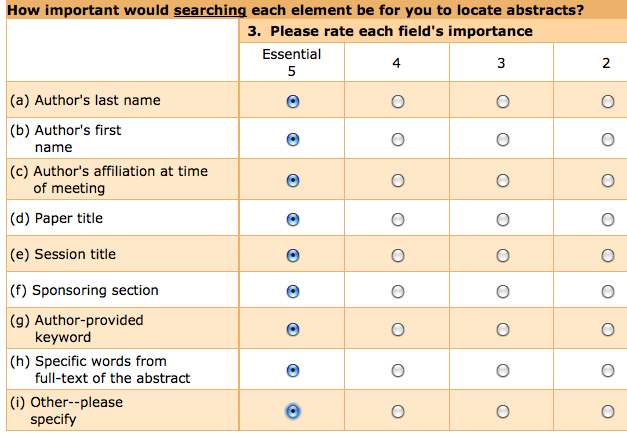
I’m sorry to keep complaining about AAA surveys. But this one is too much… The AAA is now conducting a survey to find out whether or not it would be useful to members to post the AAA Annual Meeting abstracts online. Really? They need a survey to tell them that? But that’s not the worst part, the worst part is that they are using the survey to figure out which fields need to be indexed.

Is there some other professional organization I can join instead?

Anthropology on your iPod

Owning a large dog who needs exercise, I find myself spending a lot of time going for walks, and so I’m always looking for good podcasts and audiobooks I can listen to. Unfortunately, there aren’t many anthropology choices out there. There are some conference and lecture podcasts, such as the SFAA podcasts, but almost no radio shows. Certainly nothing like Radio Lab or On The Media, my two favorite podcasts. Recently, however, I did discover one decent radio show  which frequently interviews anthropologists: the BBC’s Thinking Allowed. For instance this recent episode discussed both biometric security (including its colonial roots), as well as ethical issues in medical ethnography.

On a related note, while they don’t have any other anthropology interviews, this episode of the UC Press Podcast contains an interview with Savage Minds occasional blogger Jonathan Marks about his new book Why I am Not a Scientist: Anthropology and Modern Knowledge.

Anyone know of any other anthropology related podcasts, radio shows, or audiobooks?

YouTube EDU

Google just announced a new YouTube “channel” for academic lectures, talks, and interviews: YouTube EDU. Although there aren’t a lot of anthropology videos, there are some if you look. Also recently announced is Academic Earth, a general hub for the same kind of thing. These sites join already existing online repositories: Free Online Courses from Great Universities, TED, Fora.tv, and iTunes University. These sites seem to miss some great video podcasts by individual academics who have gone edupunk and upload their videos directly to the web without university support, and they are all rather light on anthropology, but still, there is a lot of great stuff out there and it seems to just keep getting better.

Do You HINARI? Can You?

I learned a lot of things at this year’s AAA, but one which is short, simple and important is whether HINARI is working for anthropology. With the move to Wiley-Blackwell this year, part of the formal contractual agreement between the AAA and Wiley-Blackwell is that Anthrosource publications will be available under HINARI and the “Anthrosource Philanthropic Initiative.” If you are outside the US or Europe, please check the list of eligible countries to see if you should have access. If your country is listed, you should be able to get free or low-cost access through your non-profit institution. And if you know you have access to HINARI, we’d be interested to know if you have access to the Anthrosource catalog, and if you don’t let us (and Wiley Blackwell and the AAA know)! Hold these institutions to their promises.

The end of the connoisseur?

I enjoyed Rex’s post about anthropology as connoisseurship, and have been thinking about it a lot. Then today, during the Remixing Anthropology session, Eric Kansa talked about how centralized search services, like Google, are eroding the power and authority of traditional information service providers. He used the tourism industry as an example, highlighting how efforts to control the staging of local culture are undermined by web 2.0 technologies, but I also saw this as a threat to the role of the anthropologist as connoisseur.

Anthropologists traditionally deployed their authority as connoisseurs to shape and contextualize the context within which “we” learned about and encountered “other” cultures. Hell, we even had a role defining how people learned about and encountered anthropological knowledge. But now that carefully cultivated connoisseurship is becoming less and less important as Google algorithms and Web 2.0 recommendation engines become the primary gateways. Sure, to the extent that anthropologists are indexed in Google their authority is still important, but the first hit for a topic might be a corporate site who understand better how to game the system with search engine optimization (SEO).

Of course, it might not be a bad thing if a website run by an indigenous community can outrank anthropologists on google. There is something democratizing about the shift, which allows the producers of culture to outrank the connoisseurs. But, as Eric pointed out, there is something disturbing about the fact that these algorithms are a black box whose rules are determined by a corporate monopoly. How’s wikia search coming along?

Hacking the AAA

Lets face it, a huge conference like the AAA can be overwhelming. Its pretty hard to attend a panel for a single paper, and I find I can’t really stomach more than one or two panels a day. Not to mention socializing, business meetings, looking at the books, and maybe getting out to see a museum exhibit or take in a movie. So how to manage it all without going crazy? If the AAA staff were half-way familiar with this series of tubes called the internet, they might put together a Google calendar version of the schedule. Since they haven’t, I created my own personal calendar just for the conference.

It isn’t exactly my itinerary for the conference, since a lot of events I’m interested in overlap, but it’s a useful way to list any, and every, event which catches my eye, and to then have those listed on my iPhone. Its also handy to figure out when might be a good time to meet up with old friends. Not to mention, it can serve as a useful record of the event after its done.

Looking around the anthro-blog-o-sphere, only Somatosphere had a post up about what they were planning on seeing at the AAA this year. How about you? Are there any must-see panels on your list? Are you presenting a paper this year? Let us know in the comments!