Tag Archives: Books and Articles

Talal Asad On Suicide Bombing

12033798.gifColumbia University Press has posted an online .mp3 interview with Talal Asad to promote his new book, On Suicide Bombing. The introduction to the book is also available online. A brief excerpt:

I look critically at a range of current explanations of suicide terrorism that are now being put forward, and I question the preoccupation by writers on the subject with attributing distinctive motives (as opposed to the manifest intention to kill) to perpetrators of suicide bombing. I say that motives in general are more complicated than is popularly supposed and that the assumption that they are truths to be accessed is mistaken: the motives of suicide bombers in particular are inevitably fictions that justify our responses but that we cannot verify. I then move away from writers attempting to explain the phenomenon of suicide bombings who address larger questions of killing and dying in relation to politics. Drawing on the history of ideas, I emphasize that although liberal thought separates the idea of violence from the idea of politics, mortal violence is integral to liberalism as a political formation.

More on War

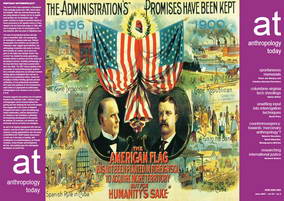
Readers of SM who have followed the many discussions here about the role of anthropologists and anthropological knowledge in war (including the Iraq war) will be especially interested in the June 2007 issue of Anthropology Today.

at0706.jpg

The Editors write: “Everyone supports non-partisan use of academic research for ‘humanity’s sake’. However, since anthropologists cannot research without first gaining and then retaining the trust of the peoples they engage with in the course of fieldwork throughout the world, in open and willing long-lasting relationships, partisan deployment of our research in war constitutes a potentially life-threatening development for the peoples we befriend, for ourselves, our students, our profession and for our family and colleagues. As part of an ongoing engagement with how our research, and that of other social and behavioural sciences, is being appropriated in war, this issue of ANTHROPOLOGY TODAY features discussions on their use in two areas of warfare, with contributions on counterinsurgency, by Roberto González, David Kilcullen and Montgomery McFate, and unwitting input into interrogation techniques, by David Price.”

Hacking Riffs on Rabinow

Ian Hacking has a very nice essay, that you can now download for free here, in the Fall 2006 issue of Daedalus. The essay sketches some recent trends in the new genetics, mostly taking its cue from Rabinow’s coinage of the term ‘biosociality.’

‘Biosocial’ is a new word, but its pedigree, although brief, is the best. Paul Rabinow, the anthropologist of the genome industry, wrote about ‘biosociality’ in 1992. He invented the word partly as a joke, to counter the sociobiology that had been fashionable for some time.

Hacking’s piece is an essay, and something of an exchange (Rabinow has put Hacking’s memorable phrase ‘representation and intervention’ to good use over the years) — so it doesn’t get bogged down in too many details. The main gist is that while sociobiology is out, the social fact of biology is in: reflexive genetic knowledge is more and more shaping the way that people imagine themselves and their relations. He touches on new developments in the science of ‘race,’ developments that my friend Duana Fullwiley calls ‘the molecularization of race.’ And he mentions Beck (‘risk’) and Fukuyama (‘transhumanism’) on the human future. The essay ends with a thought provoking vignette: Continue reading

Shweder on Geertz on Tiger

When Geertz passed away a while back, we linked to numerous obituaries and remembrances and (as I said in a previous entry), including “Lionel Tiger’s harsh assessment of Geertz in The Wall Street Journal”:http://henwood.blogspace.com/?p=4167. Richard Shweder has recently prepared a rebuttal to Tiger’s piece to be published in Common Knowledge and has made a “preprint available on his website”:http://humdev.uchicago.edu/shwederGeertzMemorial.doc. It’s an interesting piece that attempts to locate Geertz intellectually (a difficult if not impossible task, as Shweder admits) and to rebut Tiger’s piece about him (quite easy). Along the way we get some thoughts on tendencies in anthropological thought in recent decades and the Geertz almost (but of course not quite) fits into them. It’s a nice read.

Borat get a bibliography

You heard it here first folks:

“In Defence of Kazakshilik: Kazakhstan’s War on Sacha Baron Cohen”:http://www.informaworld.com/smpp/content~content=a777682602?jumptype=alert&alerttype=new_issue_alert,email
Identities, Volume 14, Issue 3 May 2007 , pages 225 – 255

This article explores the controversy surrounding Borat Sagdiyev – the fictitious Kazakhstani reporter whose foibles mock Kazakhstan in particular and post-Soviet culture in general. With his appearances on Da Ali G Show, Sacha Baron Cohen’s Borat persona long ago became the bête noire of the Kazakhstani government. However, when Borat was selected to host the MTV Europe Music Awards, the dispute over Borat’s authenticity as a Kazakhstani became an international incident. In response to his negative portrayal of Kazakshilik (Kazakhness) through the deterritorialized medium of MTV, the government of President Nazarbayev threatened Baron Cohen with legal action and brought down his web site borat.kz. Baron Cohen immediately responded in character via his new domain (.tv) and defended the actions of Kazakhstan, thus fuelling the controversy. The ongoing feud has prompted an interesting postmodern praxis – one in which a fictional persona and national government can carry on a mass-mediated dialogue. As I document the details of this ongoing conflict on the global and local levels, I seek to explain the changes in the international system which have enabled this intriguing paradox. In doing so, I attempt to draw some larger conclusions on the importance of protecting national identity in the postmodern era, especially from threats (both internal and external) which weaken a country’s global brand.

What anthropology isn’t

Ethnography. Anthropology is not ethnography — its not participant observation followed up by a ‘qualitative’ analysis of the ‘data’. Sure, this is the method that an overwhelming number of sociocultural anthropologists use (but not the only one — think of historical anthropology, for instance) but simply using this method does not produce work that is obviously anthropology.

This point was driven home to me lately when I read Rod Rhodes’s paper “Everyday Life In A Ministry: Public Administration As Anthropology”:http://arp.sagepub.com/cgi/content/abstract/35/1/3. I’ll be doing some fieldwork soon (hopefully!) on what I’m calling ‘policy elites’ and I’ve been reading around in all the disciplines which study them (critical accounting, public administration, sociology, geography and so forth). Rhodes is a very well-known “PA” in Canberra and one of my colleagues recommended the article to me. Its a very good — fascinating in fact. Rhodes managed to shadow British ministers, and his discussion of this research inside British ministries is written with an easy wit and keen insight.

But it is not anthropology. In fact, it is amazing how unanthropological it is. What about it is unanthropological? Its difficult to put your finger on — in fact it’s this nagging but unspecified sense that prompted me to write this. Its got something to do with the way that Rhodes handles his data. Although he engages a lot of classical anthropological dilemmas (“isn’t this just restating the obvious?”) and he has material to work with but somehow… it’s what he does with it that isn’t… anthropological…

This is not a criticism of Rhodes, whose work (like that of Mark Bevir) is one of my happier discoveries in the PA literature. But it did make me reflect on what is distinctive about our discipline — not the fact that we handle ethnographic data but the way we handle it.

J.I. Staley Prize Winner Announced

Charles L. Briggs and Clara Mantini-Briggs are the winners of this year’s J.I. Staley Prize, for their book Stories in the Time of Cholera: Racial Profiling During a Medical Nightmare.

The book recounts the 1992-1993 cholera outbreak that killed some 500 people, mostly indigenous, in eastern Venezuela’s Orinoco River Delta. The disease had been absent from Latin American for nearly a century. Cholera can kill healthy adults in as little as 12 hours and can make a 15-year-old appear geriatric, Briggs and Mantini-Briggs note in the book, but is prevented easily by the provision of uncontaminated food and water and is easily treated.

… The book draws from hundreds of interviews conducted from 1992-1999 with people from a cross-section of ages, occupations, social positions and degrees of bilingualism in the delta region, and the Venezuelan capital of Caracas. The authors recorded the stories of medical personnel, journalists, families of those killed by cholera, disease survivors, community leaders and government officials, traditional healers, missionaries, and others.

… In November 2006, [Charles] Briggs won the Edward Sapir Book Prize, the highest award in linguistic anthropology for co-authoring [with Richard Bauman], Voices of Modernity: Language Ideologies and the Politics of Inequality

Libraries and Indigenous Knowledge

Since open access and indigenous knowledge are both topics which have been discussed extensively on Savage Minds, I’m happy to inform you of a new open access book entitled Libraries and Indigenous Knowledge: A National Forum for Libraries, Archives and Information Services:

This book is an outcome of the Libraries and Indigenous Knowledge Colloquium held at the State Library of New South Wales in December 2004. The editors have taken advantage of the opportunity provided by the substance and scope of the papers presented at the Colloquium, and the degree of professional interest in the issues associated with Indigenous Knowledge in libraries and archives, to put together an edited collection that is accessible to a wider audience. If it is possible to guide the way readers respond to this collection, then perhaps the first thing the authors would like readers to take away would be an appreciation and understanding of the complexities that professionals must engage with in meeting the needs of Indigenous people and the issues associated with managing Indigenous knowledge. From the Indigenous perspective, we can well understand the profession’s desire to have clear prescriptions for practice and practical assistance. However, the path to developing clear and high standards of practice in this area rests on building a strong foundation for understanding what informs the concerns of Indigenous people about the intersection of our knowledge and cultural materials with library and archival systems and practice. This requires a broad sweep across issues of knowledge, culture, history, heritage, law, and information technologies. It requires consideration of articulations between the local/global, the Indigenous/Western, and traditional/contemporary dualities. Most importantly, it requires professional understanding at a level deep enough to generate problem-solving and innovations to practice to overcome the manifold tensions that emerge across all these in a diverse range of situations.

Note: The official permanent URI does not work. I have instead linked to the UTS press URI which does, and filed a report to handle.net.

(via Material World)

Get your Evolution on!

Better than Wikipedia, More Fun than a Speeding Textbook, Able to make puzzling and intriguing connections in a single click… it’s an eyeball, it’s a bodyplan, it’s a rocket ship… no it’s The Real Evolution Debate. This is actually a fantastic article (if somewhat confusing in some of the genealogical details) because of the way it imposes organization on a field that is actually best evoked, recursively, by that tangled bank at the end of Darwin’s Book. Nonetheless, this What is Enlightenment Magazine (!) article has very clear descriptions of some of the fault lines in the existing debate over evolution, from the hardest hard-core Dawkinsonians to the kookiest of the ID camp, with a whole bunch of interesting stuff I’d never heard of in the middle. Just a theory, Indeed!

Justin E. H. Smith Is My Master Now

It is an old formula — I’d call it Borgesian if I knew that was actually how to make an adjective our of Borges’s name and if Borges’s work weren’t already a certain riff on ethnographic exoticism. But Justin E. H. Smith’s “recent work on Yuktun”:http://3quarksdaily.blogs.com/3quarksdaily/2007/03/selected_minor_.html is worth more than the price of admission.

IRB Horror Stories Go Pro

Another Horror Story on IRBs, this one in the New York Times. It’s an uneventful article, I’m not sure what occasioned it, and unfortunately has little of the depth recently devoted to the subject in AE… but the fact that the Times saw fit to cover such a seemingly obscure topic must say something about the affective quality of IRB mission creep… did I mention that I was kicked off of the Rice IRB for making too much trouble? (Well, to be fair, I didn’t protest, I was happy to have one less administrative duty…)

Middle distance scholarship?

The Open Laboratory is a Lulu-published book, after the fashion of celebrity edited “Best X writing of 2007” but consisting of writing culled only from science blogs. It’s the first time I’ve seen this kind of volume, though I am sure there’s plenty of others. It makes me think about the possibility of a “middle distance” in scholarly work, in between the day to day chatter of blogs and discussion, and the longterm, uphill battle of journal article and book writing. I like to think that all this blogging might eventually result in something CV-worthy… if not watertight. I also don’t mind that this particular kind of volume isn’t open access–it’s materials obviously were to begin with, but I think (or at least I would hope) that the editorial work involved is worth the price. Edited by Bora of “blog around the clock.” Best of social science and humanities blogging (2007) anyone?

The bio-cultural imperialism of Sid Meier’s Civilization

Oh yes, you heard me right: The bio-cultural imperialism of Sid Meier’s Civilization.

Say it louder: “The bio-cultural imperialism of Sid Meier”:http://www.focaal.box.nl/previous/Forum%20focaal39.pdf. It had to be written. Somewhere out there in the collective conscience there was an anthropological analysis of Civ and now I have found it. And I rejoice in this knowledge.

Better yet, Kacpar Poblocki’s piece is a lovely cultural-studiesy rant about the Deleuze ‘body without organs’ piece of wet-ware that our bodies become when we exist in the state of “becoming-state” — that is to say, when we play too much Civ. Simply critiquing Civ’s obviously crude teleology would be too simple. No, as Poblocki insists, what we have here is “no blunt propoganda but instead Althusserian unconsciou manifestations of cultura lclaims, of which Meier may well not be aware”. The result is a game in which

Civilization offers an opportunity, literally and in the absolutist sense, to become the state… the state that we become at the same time comes to itself by means of a not always precisely formulated yet salient Hegelian dialectic waltz of thesis, antithesis, synthesis, very much _a la_ Fred Astaire, i.e. up a stairway: e.g. mysticism and the code of laws lead to a more advanced monarchy

There have been other pieces on Civ (including one by David Myers, who has made his “work available for all”:http://www.loyno.edu/%7Edmyers/research_goals.html) but none manage to combine withering post-modern critique with hours and hours of game play like this wonderful little out-of-the-way piece.

Advantages of a Low Sun

Where the sun doesn’t rise until 10 AM, one might worry about mood, and disorders of a seasonally affective kind. You notice the absence of light in winter in places like Helsinki, Finland. Models and scripts are available for how to ‘deal’ with such atmospherics: there is the diagnostic (lack of light makes you depressed, tired) and the folkloric (time for hibernation, winter anticipates rebirth). However, there are advantages to a low sun: perpetual twilight casts beautiful shadows and renders the urban landscape cinematic, warm, golden.

My semester has ended, and so I look forward to future explorations in teaching and knowledge: January will bring new seminars, new lectures, new discussions, new arguments.

Helsinki has hosted some dynamite scholars in the past few months. Among them are: Riwanto Tirtosudarno, Alexander Edmonds, Eva Berglund, Michael F. Brown, and Anna Lowenhaupt Tsing. Among my responsibilities as a junior (read: green) lecturer has been to organize our annual colloquia. I have ‘branded’ our colloquial inquiries this year under the theme “Indigeneity on the Global Scene.” We have been involved in discussions as diverse as: the government of culture (formal [state/economic] recognition of systems of meaning as a mode and means of assuring proper respect and recompense for the marginalized), forms through which indigenous activism appears vis-a-vis the nation-state, the problem of culture loss in the midst of globalization, and the earth itself as the ground on which people create and re-create themselves (as the surface that provides traction, and see Rex here on SM on Tsing).

Dr. Tsing’s visit was dynamite. Among other things, she tracked diverse ways that ‘indigenous voice’ attains recognition on the global scene, as a traveling trope of authenticity, resistance, mobilization. But she also talked about her present work on matsutake mushrooms, transnational migrant communities, the forest. Who could have imagined that mushrooms and humans might have had a remarkably fecund relationship through the ages? SM itself has hosted important discussions of Tsing’s work, which in densely allegorical writing I think illuminates (through the hazy smoke of the global) what social worlds look like today. You might imagine twilight for the native, but you might also imagine a blistery-red ‘carbon sun.’
And Dr. Brown presented his scintillating work on the perils and promises of legal title to symbolic constructs (viz., culture). I hate to sound overly sanguine, but Brown’s work on cultural property I think represents the very best vision of what an anthropology of an already globalized world can and is doing.

Forward: we will be visited soon by Bruce Kapferer, Elizabeth Povinelli, and others. The recent decision regarding entitlement to the Kalahari I hope will provoke further discussion of the forms of recognition and power (cunning as they are) that the “indigenous” enables.

Meanwhile, hibernation (aka, laziness). I prepare syllabi, read papers, and explore new ethnographies.

Among these: Joseph Masco’s utterly transfixing The Nuclear Borderlands. Much like Emily Martin’s The Woman in the Body, Masco’s work crosses the institutional boundaries of science and culture in ways that I find completely inspiring. In part, the world of atomic science that Masco pictures is one that is everywhere (not at all unlike pregnancy) and yet is one that I am largely unfamiliar with. For that reason (and others), it appears as exotic and enticing as Anga insemination rites. Masco mobilizes sophisticated interpretive tools: from Freud’s uncanny to Benjamin’s concern with the anaestheticization of modern life. It is a pleasure to read.

Edward Said and the Oppositional Canon

Gary Kamiya’s article over at Salon entitled “How Edward Said Took Intellectuals For A Ride”:http://www.salon.com/books/feature/2006/12/06/orientalism/ has a nice write up of Robert Irwin’s new book “Dangerous Knowledge: Orientalism And Its Discontents”:http://www.amazon.com/Dangerous-Knowledge-Orientalism-Its-Discontents/dp/158567835X/sr=8-1/qid=1165774790/ref=pd_bbs_sr_1/103-0032906-7355009?ie=UTF8&s=books. As is well known, Irwin’s book has been the focus of an enormous amount of attention after he was stung to death by a sting ray while filming his latest ‘Crocodile Hunter’ special. No just kidding that was Steve Irwin. Robert Irwin’s book caused a stir because it is — or so I’m told — a good book which criticizes Said.

Said, like Derrida and to a lesser extent Foucault, is one of these thinkers that has a lot of lousy critics who seem to be upset more by the way their work challenges their comfortable subject positions than by anything Said said. Irwin shares Said’s substantive politics but takes issue with his analysis. It sounds like an interesting book.

The idea that struck me in Salon was the idea that Said was a keystone of the ‘oppositional canon’. We all know that for every lousy critic of Said there is a uncritical admirer for whom Said is an exemplar of what a non-Haole, leftist, decolonizing academic can and should be. But I’ve never seen a syllabus entitled “The Oppositional Canon: Theoretical Genealogies”.

What else should be on there? What are the classics of the oppositional canon? What are the key articles that people focus on? Fanon? Spivak? Fabian? Do we read Mbembe or Cesaire or both? And which of them? I have a good sense of this for the Pacific (or at least Hawai’i) but not in general. I suppose this is because, subject-position wise, I’m the guy that people are opposing (I checked out “Exemplars”:http://www.amazon.com/Exemplars-Rodney-Needham/dp/0520052005/sr=1-1/qid=1165776136/ref=sr_1_1/103-0032906-7355009?ie=UTF8&s=books from the library to read over the winter break – MWoRN ftw!!!). But as someone who is going to be teaching an “Empire Strikes Backs” section of a grad-level theory course, what do you think I should be teaching?