‘12 Years a Slave’ and the limits of narrative history

How is the narrative constructed, and what is its relationship to history? (DeMallie 1993:524)

Analytical activity by its nature takes us away from the writing of narrative; yet it is fundamental to the writing of history. (Ibid:533)

The 2013 Academy Award winner for Best Picture and the 1853 memoir upon which it is based are excellent demonstrations of the strengths of narrative history. They are both also demonstrations of its limitations.

12 Years a Slave
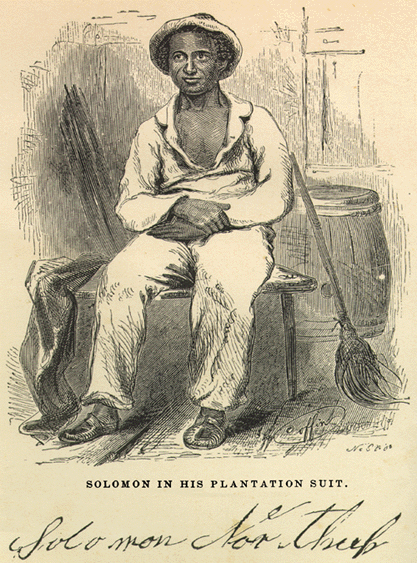
“Solomon in his plantation suit,” frontispiece of Northup’s 1853 memoir.
Continue reading

American Anthropologist now shares peer reviews with all reviewers

I recently did a peer review for American Anthropologist, and was surprised (and delighted) to receive a note for them thanking me for my work and telling me that decision the editor made regarding the manuscript and — this is the new part — attaching all the feedback all the other peer reviewers gave the article as well. I’m familiar with this model, which is widely used in the biosciences, and I think it is great . Peer review is central to what we do but we rarely teach it to our graduate students, and the process itself is wrapped in a secrecy which makes learning on the job difficult.

At times peer review is like some sort of kinky Victorian sex act that Foucault would dissect: secret, unmentionable, but totally central to our academic/libidinal economies. People speak of it in hushed tones, afraid of the terrible secrets that will be disclosed if their behavior ever became public. Opening it up like this will help increase the quality of peer review by making review more transparent. I think it will also encourage peer reviewers to not act like total assholes when they review pieces. Which, let’s be honest, is something that needs to be encouraged.

I was curious about how this change was made so I reached out to Michael Chibnik, the editor of  AA, and asked him how it came about. Thanks to Mike for answering these questions so thoroughly.  Continue reading

Coming of Age in Samoa, open access

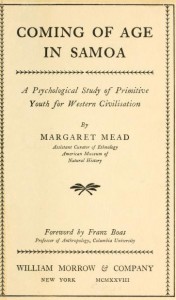
In 1928 Margaret Mead published Coming of Age in Samoa with William Morrow & Company. She did not copyright her book, possibly because copyright was only a few years old in the US and the idea had still not sunk in. However, when it became clear that the book would be a consistent earner, she did copyright it, and it has been locked up tight since then.

Luckily, the good folks are archive.org have a scan of the original 1928 edition without a copyright mark. I am not a lawyer, but it seems to me that this text is essentially now free for all, provided you use and circulate this edition.

Image of the original edition, from Wikimedia.

This is just one example of the many, many important works of anthropology that are legally available for circulation, but which people haven’t located, or done due diligence to make sure that the pieces truly are open access.

So when was the last time you actually sat down and read Coming of Age in Samoa? Why not download it today and try a chapter or two?

Around the Web Digest: Week of April 20

Hello folks. Here’s the news that you might have missed this week, if your 4/20 was as crazy as mine (which is to say, crazy with grocery shopping, house tidying, box packing, and the like. Oh drugs? No. I don’t have time for that.) Lots of news this week, but not a whole lot from the anthro-blogosphere. (We are a couple weeks from the end of the semester, so I imagine people are preoccupied for the moment.) If you have any news or blogs that you want to share with me, please, shoot me an email at richard.powis@gmail.com or hit up on Twitter @dtpowis.

Alright, let’s do this. Continue reading

Copyright strikes Marxists.org

(update: I’ve reworked a couple of paragraphs to reflect updates to this issue.)

It’s a pretty sad day when the copyright holders of the standard English edition of the collected words of Marx and Engels decides to start enforcing their property rights (more over at Crooked Timber). For years and years, marxists.org has been a model of outreach, providing a comprehensive collection of high-quality texts by Marx and Engels, open access and in multiple formats. Every social thinker should be blessed with such a site. 

Apparently nine years ago the publishers of the complete works of Marx and Engels (known as MECW) gave marxists.org permission to reproduce the first ten volumes of MECW on their website. They are now revoking it as part of their plan to market an on-line edition to university libraries. These files will be available until 30th April, or about four days from now. They can be found on the website, or on a couple of otherlinks. So if I were you, I’d get downloading. And while you’re waiting for that massive corpus of righteousness to trickle down the Internetz, why not sign the petition at change.org?

Lawrence & Wishart has published a reply to critics (and marxists.org has replied to the reply), in which they argue that little of the content of marxists.org will be affected by this change; that radical publishers have done this before and they are not therefore betraying their values; that many other editions of Marx and Engels will still be available; and that they need the revenue to keep their tiny, values-driven press afloat.

Its hard not to be sympathetic to a lot of these claims. But at the end of the day I still think Lawrence & Wishart have made the wrong decision. If only a small portion of the collected works are up at marxists.org, then why view this as competition? If most of Marx and Engels’s work is already available online open access, then why bank on selling a new digital edition that will cost more and offer only a little additional material?

I appreciate the need for presses to keep steady earners steady earning, but in this case I suspect that the uni libraries that will buy digital and paper copies of these books would do so regardless of what’s on marxists.org.

At the end of the day, this strategy of enclosure is just going to piss people off and won’t provide substantial additional income. Either the complete edition will stand on its own merits when compared to the public domain/pirated materials or it won’t.

It’s hard to tell small presses that they need to publish the next big thing rather than milk their backlist, but sadly I think that’s true in this case.

By the way, in case anyone was wondering, the pro-capitalist forces are doing well selling editions of Wealth of Nations which is in the public domain.

What the well-dressed fieldworker is wearing this summer (i)

Planning a summer trip to a hot weather field site? Let’s punch up your wardrobe a bit prior to departure.

This is intended as the first in a short series of how-to posts for optimizing your clothing choices for the heat and humidity. The individual posts will be organized around a particular type of garment or gear, such as outwear and footwear. This post will discuss undergarments and headwear and neckwear. Prior to that, a few caveats about the series of posts as a whole:

Continue reading

A continuum of peer review

Open Access venues need a business model and long term planning if they are to achieve sustainability. The perennial question of “Who pays for OA?” can be answered in a variety of ways. Each method of financing OA has its pros and cons, and not every path is equally feasible for every discipline. PLoS was able to grow to world-wide prominence fairly rapidly because it was funded with generous grants at infancy and now it sustains itself with high author-fees (n.b. these can be reduced or waived in some cases).

What worked for PLoS isn’t necessarily going to work for cultural anthropology, generous funding is less abundant in the humanities and social sciences. One option that should be given more thought is library supported publishing as a variety of green OA. I will describe some publishing models from China and Japan that produce publications through a different kind of peer review process. This will be a challenge for some readers who hold that peer review as we know it is the defining quality of serious knowledge production, if something is not peer reviewed than it must be of less value or no value at all. In fact there are shades of peer review, if we see peer review as existing on a continuum new possibilities for OA publication present themselves. Continue reading

Real cash feeds Facebook’s monopoly over your private life

Facebook has been on a shopping spree in 2014. It’s looking to buy a drone company so that it can bring the internet and Facebook to the other 6 billion, and its acquisition of Oculus Rift, a virtual reality headset firm, is aimed at making your friending, liking, stalking and humble bragging more experiential.

Now it seems the company is in discussions to purchase a London start up which has expertise in online payments. And it is this creeping interest in financial technologies that should worry us more than drones or our friends turning our chats into their virtual reality.

If everything goes to plan, Facebook users will apparently be offered the chance to store and transfer money on the site, rather than having to use a service like PayPal.

Facebook reps are said to have been in talks with several London-based peer-to-peer money services that could make Facebook payments a reality. One of these is Transferwise, a company that recently hit a quintessential target for a scaling tech company when it announced that it had processed £1 billion in user payments. Another possible candidate, Dublin-based CurencyFaire, has also hit the billion mark, albeit in dollars.

The convergence of social media and financial services should be seen as a profound shift in how people view, save, use, and are freed of their capital. And Facebook’s interest could mark a tipping point. Social media is being used as agateway drug to get users hooked onto much more pernicious forms of socio-technical circuitry and economic capture.

Why would Facebook sell vague social analytics about our activity to advertisers when it could go directly to our wallets? This is the ultimate “disintermediation” or cutting out of the middleman.

Capitalism requires fluidity – the transformation of static objects into cashable objects. By making money social and digital it becomes more fluid.

And since social media corporations are already learning how to turn individual users into liquid assets, the mix is all the more potent. Fluid money and personal data pools in centralised servers owned by the millionaires and billionaires of Facebook and Google.

Facebook apps for asset management will not be designed for the financial elites whose wealth is already governed by a well-paid professional managerial class. While the discourse is about empowering the working and immigrant poor to be able to send money home without costly fees, it is really about financialising a new market, the formerly private acts that are being unlocked by social media.

The privatisation of our lives is already booming. Visit AirBnB to rent out your home, Girl meets Dress to rent someone else’s high-end clothes, WhipCar to borrow someone’s car, Rent My Items to get your hands on their power tools, or Microworkers to rent minutes of your day to do small time work for menial pay.

This is financialisation masked as the “sharing economy” but at least we get to rent a nice dress or go on holiday as a result.

Facebook has been successful in inviting us to volunteer our free digital labour in producing one of the world’s most valuable companies. Some lovingly call this “participatory culture” while I and others call it exploitation.

Facebook can capture additional users by raining down wifi from drones and by making a scroll through bachelor party pictures more immersive with 3D goggles, but these markets will be small time in comparison to the financial market of online payment and banking.

This is an explicit attempt to transform the means of our digital sociality, our online public sphere and agora into a mall, a bank, a bazaar. If Facebook is successful, users will rarely leave the site. They will forgo the dangers of the wider internet for the safe comforts of our gated virtual community where we are safe to self-promote and shop till we drop.

Or worse, this is an attempt to “gamify” money management. It will be Farmville for personal finance or 3D Candycrush for cash. This sounds stupid because it is. It represents the transformation of a complex system into a simple one. The more our social life is monitored and then digitised, the easier it is to hoard, gamify, and monetise any profitable crumbs.

This will not result in more agency but less. Banking is based on hard-to-understand calculations but it is regulated. Add complex filtering algorithms and financial technological derivatives to the picture and no sane person will understand what is happening to their money.

Online payment isn’t the problem. Facebook, Google, and others who monopolise and monetise our digital lives on closed centralised systems are. The financialisation of our private lives as well as unwarranted, indiscriminate, illegal, bulk surveillance flourish in these spaces where corporations and governments gain direct access to our private lives.

What we need is a social movement to demand an information commons, decentralised servers, and digital literacy along with so-called financial literacy. We don’t need to hand Facebook yet another key to our private spaces.
Around the Web Digest: Week of April 13

Happy Sunday, folks! Here’s a roundup of what you might have missed last week. If you read only one thing, check out Sarah Kendzior’s article on minimum wage workers in St. Louis. I also highly recommend the BORDERLAND website that NPR has put together. As usual, if you have any news or blogs that you want me to share, please send me an email at richard.powis@gmail.com or hit up on Twitter @dtpowis.

Onward! Continue reading

The Empty Tomb and valuing the right questions

The scientific mind does not so much provide the right answers as ask the right questions. – Claude Lévi-Strauss, ‘The Raw and the Cooked’

Easter is my favorite holiday. It’s pretty much the only holiday I care about, really. A big part of that comes from my discovery during my late 20s that the oldest of the Easter accounts, that found in Mark, ends not with the post-resurrection appearance of Jesus but rather at his empty tomb.

Easter morning
Very early on the first day of the week, just after sunrise.

Mark originally ended not at chapter 16, verse 20, but rather at verse 8:

But when they looked up, [the two women] saw that the stone, which was very large, had been rolled away. As they entered the tomb, they saw a young man dressed in a white robe sitting on the right side, and they were alarmed. “Don’t be alarmed,” he said. “You are looking for Jesus the Nazarene, who was crucified. He has risen! He is not here. See the place where they laid him. But go, tell his disciples and Peter, ‘He is going ahead of you into Galilee. There you will see him, just as he told you.’ Trembling and bewildered, the women went out and fled from the tomb. They said nothing to anyone, because they were afraid.

I know that millions and millions of people understand the story of the first Easter as one of bodily resurrection and as the answer. This was more or less what I understood it to be about for most of my life, and as I never found the resurrection to be a particularly compelling part of Christianity, I also failed to find Easter particularly meaningful. But since learning that at least some of the (proto-)Christians understood the story of the first Easter as the source of a bewildering question rather than of a reassuring answer I have been very much taken with the day.

Matthew Timothy Bradley

Open access is organic: on the Journal of Material Culture

Back in December Haidy Geismar, the incoming editor of The Journal of Material Culture (published by Sage), published an editorial mooting the future of JMC as an open access journal and asking readers to weigh in by taking an online survey about the future of the journal.  To date, sixteen people have responded. Sixteen. That’s pretty embarrassing — for Geismar and for the JMC, but also for the open access movement more generally. So after you read this, go take the survey.

The apathy of the JMC’s readership is worth dwelling on because it demonstrates what  is really at stake in debates about open access. Its not about open versus closed access, or for-profit versus non-profit publishing. Its about organic, flourishing publishing tied to vibrant intellectual communities versus mechanical mass production of journals. My use of the term ‘organic’ is intentional: just as consumers and farmers today are increasingly becoming aware of and taking responsibility for the production of the food we eat, so to is open access part of a broader movement to take responsibility for the production of scholarly content.

Continue reading

Elsie Clews Parsons’ loveshack

That a patrician New Yorker was in an open marriage during the early 20th century is an attention grabber, ergo the title of my post. But that is not even among the half dozen most impressive facts of Elsie Clews Parsons’ life, about which more below.

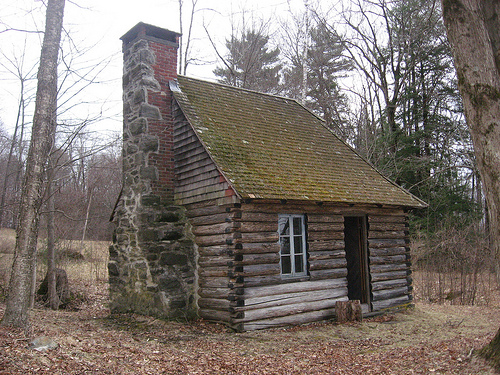
Last spring I had the opportunity to visit her Gilded Age cottage in Lenox, Massachusetts, where she and her husband Herbert Parsons summered. One of the most enjoyable parts of my afternoon was my walk up to the cabin above the cottage. The cabin was designed for Elsie by her paramour C. Grant LaFarge, one of the architects responsible for the design of the Cathedral of St. John the Divine. As I checked out the cabin’s interior, I imagined Elsie sweating through the soupy Southern New England days over the pages she had filled in the desert Southwest.

C. Grant LaFarge
The Lenox, Massachusetts, cabin where Elsie Clews Parsons spent her summers writing up her field notes.
Continue reading

Memory, History, and Xenophobia in Crimea

[This is an invited post by Greta Uehling. Greta is the author of Beyond Memory: The Crimean Tatar Deportation and Return published by Palgrave Macmillan in 2004 as well as a number of articles on the Crimean Tatars. She teaches in the Program on International Studies at the University of Michigan in Ann Arbor.]

As pundits, politicians, and the world’s media wring their hands over Putin’s next move, events in Crimea seem to be fading from attention. Residents of Crimea have noted, correctly I think, that even after annexation, the Autonomous Republic of Crimea remained little more than a square on the board of a geopolitical chess game.

Focusing my attention on that square, the tiny, green, diamond-shaped peninsula hanging in the Black Sea, has been distressing to me over the past weeks. I have conducted anthropological fieldwork in Crimea on and off for almost two decades. Most recently, I have been using Skype calls with friends and colleagues on the peninsula, as well as local television available on the internet, for information. Continue reading

Around the Web Digest: Week of April 6

A day late and a dollar short. I had some trouble getting home from the Central States Anthropological Society meeting in Normal, IL, but I made it! These links still cover the week of April 6th, so nothing has changed there, but this list is shorter than normal. So anyway, if you have any suggestions for articles or blogs, please don’t hesitate to email me at richard.powis@gmail.com or find me on Twitter @dtpowis.

Distract yourself from grading or writing up a final paper; here’s what you (and I) missed last week. Continue reading