All posts by Ryan

Ryan

Ryan Anderson is a cultural and environmental anthropologist. His current research focuses on coastal conservation, sustainability, and development in the Californias. He also writes about politics, economics, and media. You can reach him at ryan AT savageminds dot org or @anthropologia on twitter.

Peggy R. Sanday: “Why don’t some boys see it as rape?”

Anthropologist Peggy R. Sanday has a new article on CNN that discusses rape and (male) youth culture in regards to the ongoing case in Steubenville, OH.  Here’s an excerpt:

The rape case unraveling in Steubenville, Ohio, brought back memories of my own frightening experience. I didn’t know what was happening that day when the four young men began looking at me differently. I only knew that I had to get away as soon as possible.

In the Steubenville case, a girl who was incapacitated by alcohol purportedly passed out and was allegedly sexually assaulted by two young men on the high school football team while others watched.

What strikes me about the incident is that it demonstrates a split in the boy rape-prone sexual culture. Some young men continue to believe that when a girl gets drunk, staging a sexual spectacle for their mates is part of a night’s fun. They don’t think of it as rape. Some of their buddies, however, disagree. In their transition to manhood, they are able to name rape when they see it.

Read the rest of Sanday’s article here.

Opening Anthropology: An interview with Keith Hart (Part 3 of 3)

This interview is part of an ongoing series about open access (OA), publishing, communication, and anthropology.  The first interview in this series was with Jason Baird Jackson (Part 1, Part 2, Part 3).  The second interview, with Tom Boellstorff, is here.  The third installment of this OA series is with Keith Hart.* (See Part 1  here, Part 2 here)

Ryan Anderson: Let’s bring things back to the issue of OA and the academy.  You have said that many OA activists are inhibited from fighting against the privatization of the intellectual commons because they have already “bought into the premises of an academic career”.  Why do you mean by this?

Keith Hart: Intellectual life is intrinsically individualistic. We may like to think of ourselves as social creatures, but unfortunately they only hand out brains one at a time. Collaboration is particularly developed in the hard sciences and the academy has always depended on an informal cultural commons: teaching, seminars, conferences, free sharing of ideas, equal access to libraries and so on. Everyone wants personal recognition, but up to the 1950s, this aspect of academic life took a back seat to the university as a community of scholars, teachers and their students.

The Cold War and the drive to restore home food supplies after the Second World War boosted research on armaments and agriculture. The post-war boom saw lots of public money being directed to universities for research. Private companies also poured money into research on chemicals. Student enrolments took off in the 1960s, so that universities now became big business. We think of them as medieval institutions, but the late twentieth-century university was something unique, a mass production line for workers in bureaucracies and the main research arm of the state. The academics had always ruled their own institutions, but this expansion gave power to administrators. Research came to dominate other academic activities. The humanities and social sciences didn’t have much to offer, but they too jumped onto the research bandwagon. Continue reading

Opening Anthropology: An interview with Keith Hart (Part 2 of 3)

This interview is part of an ongoing series about open access (OA), publishing, communication, and anthropology.  The first interview in this series was with Jason Baird Jackson (Part 1, Part 2, Part 3).  The second interview, with Tom Boellstorff, is here.  The third installment of this OA series is with Keith Hart.(See Part 1  here)

Ryan Anderson: Earlier you referred to OA as “a strategy of resistance to privatization of the commons”.  Can you elaborate on that point?

Keith Hart: I meant that private property is still the great unresolved contradiction of modern society, not least because its ubiquity often makes society invisible. For Rousseau, the invention of private property was the origin of social inequality. The liberal Enlightenment looked to anthropology for the knowledge needed to realize a democratic revolution against the Old Regime. Morgan (followed by Engels) used Rousseau’s framework to make the history of unequal society the main object of a democratic anthropology. More recently, Lévi-Strauss, Wolf and Goody renewed this tradition, each in their own way. Now David Graeber has taken it up again. But the ethnographic turn made this a marginal current in twentieth century anthropology.

I grew up in a working class district of Manchester. The doors of our houses had to be kept open for neighbors to come in and out as they wished. Even inside the house, bedroom and bathroom doors were never closed. Privacy was the opposite of being open to the free flow of solidarity. I thought that spirit had gone forever, but I found it again when I moved to France fifteen years ago. Here the tradition of people occupying the streets (manifestation) is very much alive and the notion of a public sphere that belongs to all is palpable. Continue reading

Opening Anthropology: An interview with Keith Hart (Part 1 of 3)

This interview is part of an ongoing series about open access (OA), publishing, communication, and anthropology.  The first interview in this series was with Jason Baird Jackson (Part 1, Part 2, Part 3).  The second interview, with Tom Boellstorff, is here.  The third installment of this OA series is with Keith Hart.*

Ryan Anderson: Thanks for doing this interview, Keith.  Let’s just jump right in here: What do you think about this whole ‘open access’ conversation going on in anthropology?

Keith Hart: Obviously I am in favor of it. The form that the discussion takes in contemporary anthropology seems to be specifically American, where the contradictions of established practice are most acute. In the most general sense, OA is a strategy of resistance to privatization of the commons, any commons. As such it is central to the intellectual property wars. But here I think we are talking about a much narrower issue of how to make research publications freely available without undermining their role as cultural capital in academic career advancement. This reflects the interests of a mass of unemployed young researchers who can’t afford to pay for information and yet still hope to find academic employment some day. The tension is between maintaining the intellectual commons and conserving ideas as private property. The situation is exacerbated in American anthropology by the peculiarly obdurate policy of the professional association (AAA) which elevates a closed regime of private production for profit above sharing knowledge with the general public. I am reminded of Marx’s early journalism against restriction of peasants’ access to fallen wood in the Westphalian forests. Most OA activists can’t fight privatization with his polemical intensity because they have already bought into the premises of an academic career. I met some anthropology friends on Twitter in 2009 who were as agitated then by the AAA’s restrictive (I am inclined to say “insane”) policies as they are now. We formed the Open Anthropology Cooperative–but we will return to that later. I am still struck by the insularity of American anthropologists who rarely consider if the French, for example, have come up with interesting responses to this general problem. Is OA an issue in Brazil or Scandinavia, in Japan or India? American anthropology isn’t the world and I hope that the OAC’s global membership will discuss these questions fruitfully. But then we run up against the limitations of language. Being able to read and write in English is not universal, yet how often is concern with OA extended to the issue of language barriers?

RA: These are some really important points you bring up.  First of all, let’s talk about the idea that American anthropology “isn’t the world,” as you say.  What do you know about some of the OA-related conversations that are taking place in France, Scandinavia, Brazil and elsewhere?  Where can or should we look to connect with those conversations?  Also, why do you think language barriers are so rarely addressed in OA discussions in the US? Continue reading

Anthropology News: Announcing Open–and then closed again–Anthropology

I was just checking through my ridiculously full gmail inbox when I saw the latest “content alert” from Anthropology News.  One piece really struck my attention: the announcement of a new open access publication called Open Anthropology.  AAA president Leith Mullings writes:

I am very pleased to announce that at its May meeting, the Executive Board (EB) agreed to explore and implement a pilot open access publication. Open Anthropology, the first public, open access digital-only publication of the American Anthropological Association, is expected to launch in 2013.

Wow, that’s some great news.  Here’s more:

In making this decision, the EB considered the extensive transformations taking place in scholarly publishing, as well as the importance of sharing information as widely as possible. In keeping with the AAA Statement of Purpose, Open Anthropology will help promote anthropology and anthropologists and “the dissemination of anthropological knowledge and its use to solve human problems.” We know anthropology has much to offer in this regard

Yes indeed, anthropology does have a lot to offer.  Nice!  This is sounding fantastic.  Almost too good to be true.  More:

By examining the conditions under which various practices and relationships arise, anthropologists have a great deal to say about how and why they change. It is this perspective that makes the discipline potentially applicable to addressing the pressing problems of today’s world.

Yes!  This is really getting good.  Tell me more:

Open Anthropology will be devoted to previously published AAA articles, review articles, book and audiovisual reviews, and reports and comments on topics of interest to the general public, and that may have direct or indirect public policy implications. Content in Open Anthropology will be culled from the full archive of AAA publications, curated into issues, and will be freely available on the internet, permitting any users to read, download, copy, distribute, print, search or link to the full text of these articles.

A really important, exciting idea.  Pretty cool, no?  There must be some kind of catch, right?  Oh wait, this just in: Continue reading

Stop the silence, and some suggested reading (more about the state of academia)

Here is my opening thought: What’s stopping us from rethinking and reshaping academia?

Ideas?

I’ll tell you one thing that’s stopping us: the belief that “nothing can be done” to fix the system.  As long as we all stand by and accept this, surely nothing will change.  That’s one easy way to keep the status quo going: Don’t hold out hope for alternatives.

Silence is another big part of the problem.  Silence, in some cases, because of a certain fear of retribution (loss of funding, or a job, or tenure, or [INSERT YOUR FEAR HERE]).

It’s almost like we really don’t believe any of that stuff we read and quote and talk about all the time.  You know, all the stuff about power and hegemony and social change and so on.

Ya, that stuff.

We anthropologists like to talk a lot about agency and power and other neato ideas, but for some reason when it comes to the internal political issues we face in academia, all of that goes away.  Everything becomes “too complex,” too entrenched, or simply impossible to even think about changing.  What’s with all the fatalism?

Yes, of course I understand the fact that there are certain “structural problems,” and that some issues exist at higher levels.  And I understand that certain things are out of our control.  But, beyond all of the structural determinism, what CAN we do to start dealing with the serious issues that plague the academy?  Anyone?  What things ARE in our control?  What can we change?

One thing is for sure: silence leads us nowhere.

Speaking of no longer remaining silent, please read this post over at Analog/Digital by Fran Barone.  Just read it.  Here’s my favorite quote:

It is almost laughable that I and many others are even vying for positions in this profession. And yet at the close of this blog post I will be applying for two more academic jobs, one research and one teaching. Glutton for punishment? No. The fact is that I love the work that I do when I’m able to do it; I believe in the value and worthwhile impact of my research and the quality of my teaching; and I think a strong academic sphere is essential to the wellbeing of society. Making change from within the system is not nearly as difficult as it is from out here. And it is really not that hard to be respectful, engaged, open and honest. I can’t understand why so many people struggle with it. I’m tired of not saying anything about it for fear of retribution or never getting a job and you should be, too. Maybe I won’t get a job in the future because of this post, but then it probably wouldn’t have been the right environment for me, anyway.

Go read what she has to say.  Then, as Fran says at the end of her post: SAY SOMETHING.


UPDATE 11/26/12: A few related links:

See Erin Taylor’s post “Producing academic scholarship: If universities are failing, where else do we go?” over at the OAC.

And check out Jeff Nall’s Truthout.org piece “Working for Change in Higher Education: The Abysmal State of Adjunct Teacher Pay.”

UPDATE 11/28/12: Check out Paul Stoller’s article on Huffington Post: “Changing Culture in Higher Education.”

Mapping post-election racism

Some folks argue that we are living in post-racial times.  That the days of racism are over.   After the Civil Rights era, it all just evaporated.  And the election of Barack Obama was somehow more proof of the fact that racism is no longer an issue in the U-S-A.  This “racism is no longer a problem” argument is a pretty common narrative these days.  Hmm.  From Gawker.com today:

Some Americans are racist. We know this, though there’s nothing quite like a black guy winning a national election to bring them out of the woodwork. The sheer volume of racist Tweets is disheartening, but can we learn anything from them?

Because this stuff is now nationally broadcast rather than confined to poorly Xeroxed newsletters, there’s data waiting to be mined. Floating Sheep, a group of technologically minded geographers, has attempted to determine just where the racism is coming from.

Read the rest here.  For more check out these links:

The National Monitor

Floating Sheep

Floating Sheep FAQ response

CNET news

A defense of the humanities in these budget-cutting times

University budgets are getting cut left and right.  There’s a debate about this going on at my university right now.  I hear conversations about the lack of funding, the economic crisis, and the need to cut programs.  I also hear conversations where words like “productivity” and “performance” and “economic viability” are being thrown around a lot.  Sure, I understand the fact that we are facing some pretty bad economic times.  And I understand the need to rethink how we are financing the university.  Completely understand.  But, at the same time, when I hear people talking about cutting programs and reshaping the university based primarily upon economic performance…well, that’s when it’s really time to pay attention to what this all means.  If the only ones who survive university budget cuts are those who can demonstrate that they are “making money” for the university, I don’t think that bodes well for the university system as we know it.

Ya, as if that’s something we didn’t already know.

In the spirit of not letting to university go down that road (any more than it already has), please read through this 2010 essay about the importance and value of the humanities: A Faustian bargain, by Gregory A. Petsko.

Anthropology & Democracy III: The stand aside or do something edition

This is Part III of a series of posts on anthropology and democracy.  Part I is here, Part II, here.

In the USA, the spectre of democracy looms.  It is days away.  November 6, when people all across the country will step into a small booth and exercise their right to participate in the democratic system by choosing between representatives from the two dominant political parties (oh, and a slew of others that the vast majority of people have not heard of).  This is democracy at the highest political level.  Democracy at its finest.  The pinnacle.  Right?

Maybe not.  Maybe, as DJ pointed out in his comment, we need to pay attention to the various scales at which democracy operates–and what that means for our understanding(s) of what democratic practices are all about.  In the US, I think it’s both interesting and telling that the presidential elections are often treated as a kind of democratic pinnacle or climax–as if it’s really the most important part of the massive iceberg of political and/or potential democratic action.  What about all of the democracies–or lack thereof–taking place as we trickle on down the various levels of social structure?  Things start to look different, maybe, when they move away from the media pomp and glitz that absolutely drench presidential election hoopla.  And this has me wondering whether all of this focus on “the big event” serves a certain political purpose in its own right.  If everyone is paying attention to the big event, what’s happening everywhere else?

And where does the anthropological project fit within all this?  When I posted the first installment of this series, calling for a collective investigation of anthropology & democracy, Keith Hart wrote this as a reply on Facebook: “Seems like a good idea to me, especially since the origins of anthropology in the 18th century’s revolutionary democratic project has been forgotten by practitioners (honorable exceptions include L.H. Morgan) for over 200 years.”

Which leads me to this question: Is anthropology a democratic project these days?  It is, after all, buried within not-so-democratic institutions (this very question was raised by regular commenter DWP in response to my second post).  Do we strive for anthropology to be democratic, or is that just the kind of politicization that ought best be avoided?  Should anthropologists stand aside and study the various “democracies” around the world in a detached, objective manner, or should anthropology be geared toward fostering democratic practices and institutions?  When it comes to democracy, do we stand outside the fish bowl looking in, or do we jump in and try to manage the currents from within?  Please take these questions and run with them.  Or swim, as it may be…

Anthropology & Democracy II: Democracy in your neck of the woods

So here’s part two in a continuing series of posts about anthropology and democracy.

Here’s what I have in mind for this one: there are a lot of you anthropological folks out there in the world, and I think it might be interesting for some of you to put your skills into practice and see what you can come up with.  This invitation is open to all: grad students who are so busy you can’t even fathom democracy, assistant profs, undergrads, famous anthropologists, and everyone in between.  Let’s see what we got.   Here’s the prompt: What is democracy looking like through your little peepholes into the world?  Where is it and what’s it all about?  Let me know what it’s looking like on your street, at your college, your field site, excavation, lab, or in your neighborhood, city, or community.  Is democracy just some rumor, some fantasy–or is it unmistakeable, concrete, and material?  Is Democracy the local chapter of a political party that’s going door to door trying to rally support for their candidate?  Is it a bunch of signs stuck in lawns?  Or someone driving through town with a megaphone blaring?  Is it some whisper in a restaurant–or graffiti screaming about politics from some freeway overpass?  Let’s hear some details, folks.  I am looking for the good stuff, the real nitty-gritty of democracy as you see it, taste it, feel it, and crash into it like some sharp-edged table in a dark room.  Ya, that stuff.  Don’t over think it all, just post it.  250 words?  500?  100?  Whatever, just post something.

Since it’s my idea, I will be the guinea pig and go first.  Here’s my off-the-cuff response: Continue reading

Violence against women x 2

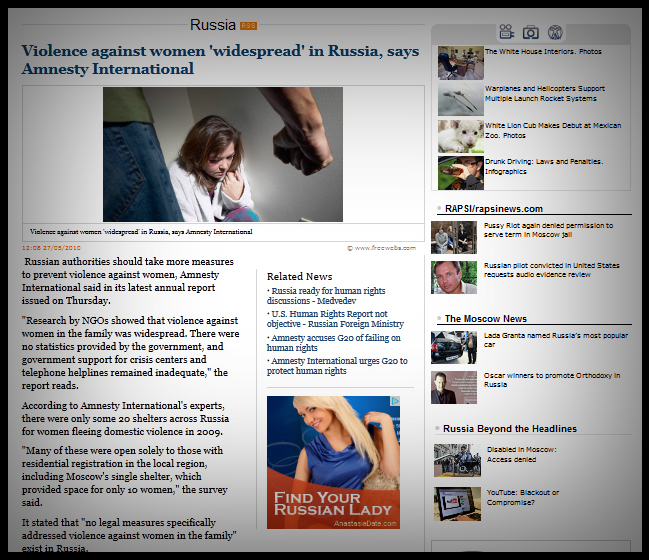
This probably belongs on Sociological Images, but I am going to post it here anyway.  I just read this brief 2010 article about violence against women in Russia, after reading through this fact sheet from the World Health Organization.  Then when I looked back at the article, I noticed something that seemed off.  Here’s a screenshot, see if you can figure it out:

Women as targets of violence, in more ways than one.  Sometimes it’s more overt, sometimes it’s a hidden under the surface–like this ad that just happened to be posted alongside an article about violence against women.  It’s one of those ads that changes every time you refresh the page.  It’s just kind of one of those quotidian digital moments that can bring various strands or currents of our social world together.  Different forms of violence, different layers, coming together in a supposedly coincidental moment.  But sometimes these kinds of moments tell us a lot about larger issues, problems, and pervasive forms of violence.

Anthropology & Democracy: A Project Proposal

With the elections in the US less than three weeks away, the idea of “democracy” has been on my mind a lot.  And, considering recent events like this (which isn’t exactly getting a lot of press coverage), I am thinking a lot about the ideals of democracy versus the actual practice of democracy–here in the US and elsewhere.  There’s certainly a lot underneath and behind all of the rhetoric of democracy–and I think anthropology is a good tool for taking a deeper look into what’s going on.

So here’s my idea: How about doing a bit of a collaborative project about democracy and anthropology?  My idea here is to do a series of posts and open threads here on SM that explore the histories, practices, and meanings of democracy from an anthropological perspective.  My goal is to encourage a lot of participation from the SM readership–and hopefully from others in the anthro-blogosphere.  We can use the upcoming elections in the US as a point of departure, but by no means should this discussion be limited to the USA.

I was reading this post by Jason Antrosio this morning (which is a good example of taking anthropology to discussions about politics), and it made me ask myself: “You know, there are a LOT of anthropologists out there–I wonder what they’re thinking about all of this?”  What are you all thinking about this?  How can we ignite a conversation about the meaning of the d-word?  So I am thinking of a sort of crowd-sourced, participatory, spur-of-the-moment-anthropology-in-the-streets series on democracy.

Maybe we could use this first post to share some links, sources, and readings that cover the theme of anthropology and democracy?  Or feel free to just chime in and give me a yay or nay on this idea.  Please pass this around via Facebook, twitter, etc.  I’d like to see if we can generate some interest here and maybe build up a bit of a collaborative effort.  Maybe we can pull in some folks from the OAC, or Neuroanthropology, or Living Anthropologically, or Ethnography.com, or…???

What do you think, readers of SM?  Are you game?

UPDATE 10/20/12: Check out the discussion about this over at the OAC.

Paul Ryan, economics, and the voice of anthropology

I just read a post over on Daily Kos called “Paul Ryan’s Magical Economic Worldview: The Austrian School.”  First of all, it’s pretty funny.  Second, it brings up some important questions about how we talk about that whole “economics” thing.  Check it out, it’s an entertaining (and irreverent) read with some good points made along the way*.  But that post also left me wondering: Where on earth are the anthropologists in these kinds of debates about human behavior, economics, and policy?  There’s no shortage of conversation about economics among the “general public” around the world, so why is it that we don’t hear all that much from anthropologists?  And by “all that much” I mean basically never.  It’s not like we have a shortage of experience with this stuff.  I mean, Malinowski was talking about economics and human nature and all kinds of good stuff almost 100 years ago.   So what’s the deal here?  Where are the anthropologists?  In the US, for example, we hear a lot from the likes of Paul Krugman, Brad DeLong, the folks at the Von Mises Institute, and a whole slew of other economists and “experts” who find their way into print, radio, TV, and internet discussions.  Many folks even listen to Glenn Beck, of all people, about economics.  No, really: people listen to Glenn Beck.

Where oh where have the anthropologists gone?

So, thinking in a strategic sense, how can anthropologists become a more engaged part of these kinds of discussions?  Seems to me that we have a lot to offer, and have for decades.  So why are the economists getting all the air time?  Is it because they try harder?  Are they better looking?  Do they have better ideas?  Are they paying people off at CNN, Fox, and the New York Times?  Or are we stuck in the proverbial bull pen of public debate because this sort of engagement with wider audiences isn’t really “our thing”?  Are we being shut out of the conversation? (I highly doubt it.)  Is this kind of thing “too political”?  Or are we too busy “counting yams” (a nod to this recent post at the OAC about the passing of Eric Hobsbawm) to participate in these kinds of larger conversations?  What gives?

I’m looking forward to the day when someone trots out the usual “humans are all self-interested rational actors” line and at least one anthropologist is called on as an expert to offer a slightly different take.  And when I say “slightly” I mean something like this.**  So how do we get there?  How, dare I say, shall we step outside the halls of academia to once again engage in public debate?  I’d say it’s about time we regain the public voice we once had in the long past days of Boas, Mead, and Benedict.

Or are we too busy for that sort of thing these days?


*You can also see my plug for anthropology in the comments of the post.

**David Graeber is one of the anthropologists who has done a great job of expanding the discussion beyond academia, closed conferences, and peer reviewed papers.  And he deserves a kudos for that.  I think we need more of that sort of thing.  But it doesn’t mean this is an either/or issue.  I think we can do solid academic work AND engage in these kinds of wider debates, issues, and discussions.  It might help if this sort of thing, along with teaching, “counted” a bit more in how we evaluate up and coming anthropologists.  Just sayin.

OAC Online Seminar: Ted Fischer on “The Good Life”

The Open Anthropology Cooperative (OAC) is a great source for open access content, especially through its publishing arm, the OAC Press.  To me, this is one of the most promising efforts in Open Access anthropology out there–and I think more people need to take note of what’s going on over there.  There is tremendous potential with what they are doing in terms of publishing, disseminating, sharing, and communicating anthropology to wider audiences.  Check out the Interventions Series, Book Reviews, and finally the Working Papers Series.

One of the best parts to me is the online seminar.  Here’s how it all works: basically, when papers are first posted, there is a period of a couple of weeks in which readers are invited to post their thought and comments, and engage in an extended conversation not only with the author of the paper, but also other members of the OAC community and readership.  For me, this is a really valuable way to approach publication and dissemination–readers can post comments and responses directly, and instantly.  I think it makes for a pretty fascinating dynamic, one that is quite different from what we get from traditional print journals.

The latest in the Working Papers Series is Edward F. Fischer’s “The Good Life: Values, Markets, and Wellbeing.”  The online seminar started a couple of days ago, and will run for a couple of weeks.   During this time readers are invited to download Fischer’s paper, give it a read, and then join in the seminar by posting their thoughts and comments.  Here’s a snippet from Huon Wardle’s introduction to the seminar:

Ted Fischer’s paper takes us directly into a topic of increasing importance in development studies and which should be important to anthropologists too. It seems hard to doubt that in every human community there circulate ideas and images of what a good life means. Notions of the good life clearly vary from society to society, from individual to individual and even from moment to moment. Whatever the good life may consist in situationally we can hardly doubt that it is and has always been an object of sustained human thought and aspiration and that what people imagine about it will affect how they act in the world…

The link to the seminar is here.  Fischer’s paper can be downloaded here.  Check it out, take part, comment, chime in with your 2 cents–it’s worth it.  And don’t worry, joining the OAC is free.