All posts by Kerim

Kerim

P. Kerim Friedman is an associate professor in the Department of Ethnic Relations and Cultures at National Dong Hwa University, in Taiwan, where he teaches linguistic and visual anthropology. He is co-director of the film Please Don’t Beat Me, Sir!, winner of the 2011 Jean Rouch Award from the Society of Visual Anthropology. Follow Kerim on Twitter.

After Oak Creek: A Roundup

“On August 5, 2012, a mass shooting took place at a Sikh temple in Oak Creek, Wisconsin, with a single gunman killing six people and wounding four others. The gunman, Wade Michael Page, a white supremacist, shot several people at the temple, including a responding police officer. After being shot in the stomach by another officer, Page fatally shot himself in the head.” [via Wikipedia]

Below I’ve gathered together some of the reactions to the tragic Oak Creek shooting, presented without comment. Feel free to add your own links, or leave comments below. (Respecting our comments policy, of course!)

An American Tragedy, by Naunihal Singh:

The media has treated the shootings in Oak Creek very differently from those that happened just two weeks earlier in Aurora… Sadly, the media has ignored the universal elements of this story, distracted perhaps by the unfamiliar names and thick accents of the victims’ families. They present a narrative more reassuring to their viewers, one which rarely uses the word terrorism and which makes it clear that you have little to worry about if you’re not Sikh or Muslim.

Top Ten differences between White Terrorists and Others, by Juan Cole:

2. White terrorists are “troubled loners.” Other terrorists are always suspected of being part of a global plot, even when they are obviously troubled loners.

Continue reading

What’s an Anthropological Grey Literature Portal?

For a long time now many of us have been arguing that the AAA should have a “grey literature” archive, so I was excited to read on the official AAA blog that they have partnered with the Social Science Resource Network (SSRN) to create a new tool – the Anthropology and Archaeology Resource Network (AARN). Unfortunately the announcement is done as a podcast, so you have to listen to a 12 min interview in order to find out very little beyond what was already announced last April.

I also found the whole style of the podcast very off-putting. The discussion between SSRN President Gregg Gordon and AAA Director of Publishing Oona Schmid is self-congratulatory and sounds like a Hollywood parody of how corporate executives speak at marketing meetings. I’m not saying that this isn’t good news, but learning that “gray is the new black in scholarly literature” isn’t what I expect from an academic podcast. Moreover, the podcast promises that by the time we listen we can go to the SSRN website and click on the AARN link, but I couldn’t find such a link. (The blog post says “AAA members will be able to utilize AARN by this fall” so I assume it isn’t ready yet.)

Given that the podcast isn’t very informative, and there isn’t really anything yet to look at, I thought I’d try to see if I can’t provide a kind of Q&A about this announcement, filling in the answers in this post as I figure them out:

Continue reading

Reading Academic PDFs on the iPad (Tools We Use)

[UPDATE: Sente is currently undergoing major changes in their sync engine; however, they have yet to update their iPad software. Once the iOS version of Sente is updated I will write a new post about the changes. Till then, please be aware that this post is out of date.]

Last December I wrote a post, Reading Fast, Reading Slow, which covered the various tools I use in my digital workflow depending on the kind of reading I’m doing. Today I want to update that with an in-depth look at what I had referred to as “slow” reading, focusing especially on texts which I have available in PDF format. This workflow assumes you have an Apple desktop computer, an iPad and the following software: Sente for OS X, Sente for iOS, Goodreader for iOS, a Dropbox account and an Evernote account. This is not a review of any of these tools, although the strengths and limitations of Sente are discussed in terms of how they help or hinder this specific workflow. I don’t by any means consider this to be an ideal workflow, but after having experimented and researched numerous options based on the tools which are currently available, this is the one that works best for me.

As I’ve explained before, it would be best if one could search and add PDFs to Sente directly from the system’s default browser, as one can do with Zotero or Mendeley, but despite this limitation, I still find Sente to be the best software out there for organising one’s citations. Zotero, for instance, lacks the “status labels” feature of Sente which is so central to the workflow I describe below. Moreover, for this workflow to work, you just need to download the PDF itself from your browser, and Sente will take care of the rest. And the iPad apps currently available for Zotero and Mendeley are sorely lacking compared with what Sente offers. (Other options are Papers and Bookends, but I find Sente compares favourably to those as well.)
Continue reading

Oh the places you’ll go…

Way back in 2001, when blogging was a new thing, and I was crawling around the web to figure out if there were any other anthropologists using this new medium, one man stood out. Oneman actually, or as he is known around here: Dustin. Dustin hasn’t been blogging much lately, but I wanted to take this opportunity to congratulate him on his latest career move. When people ask about graduate school in anthropology I usually tell them that while you might not get an academic job, anthropologists usually find interesting work outside of academia.

Well, I’m happy to announce that Dustin has just been appointed the Executive Director of The Burlesque Hall of Fame in Las Vegas, NV. It may seem a bit of a jump from editing a volume on Anthropology at the Dawn of the Cold War to running a museum of burlesque, but in between he’s been working at the UNLV Marjorie Barrick Museum.

Dustin has written some of our most popular posts on issues of gender and body image. Since he still seems to pop up for about one post a year here on Savage Minds, maybe one day he’ll find the time to write about the anthropology of the burlesque…

Congrats Dustin!

Sunflowers vs. Bougainvillea

While some individual TED talks are interesting and even useful in the classroom (I especially love that many are subtitled in numerous languages), there I totally understand what Nathan Jurgenson is talking about when he says that “TED talks fuse sales-pitch slickness with evangelical intensity” in a way which “necessarily leaves out other groups and other ways of knowing and presenting ideas.” But where Jurgenson merely points out the problem, I thought Nathan Heller’s recent New Yorker piece on the TED conference did a great job of getting at the nub of the problem in a way which highlights some of the underlying issues involved in popularizing academic ideas. Unfortunately the piece is currently hidden behind a paywall, so I’ve taken the liberty of quoting the relevant passages at length:
Continue reading

Les Maîtres du Désordre vs. Les Maîtres Fous

Quai Branly Museum

Ever since it opened in 2006, I’ve wanted to visit the Musée du quai Branly (MQB) in Paris, which “contains the collections of the now-closed Musée national des Arts d’Afrique et d’Océanie and the ethnographic department of the Musée de l’Homme.” With a permanent collection of over 267,000 objects and nearly 3,500 of those on display at any given time, it is one of the most important anthropology museums in the world. The building itself is also an impressive piece of architecture by Jean Nouvel—nicely setting off the collection. So I was happy to be able to finally visit the MQB this past Thursday. It was an awe-inspiring experience and I’m just sorry I didn’t have a week to spend at the museum, since it is truly too much to absorb in a single day. The permanent collection is divided up in to Asia, Oceania, Africa and The Americas. My recommendation would be to only try to visit one section per visit (and Oceania is so huge that it could easily accommodate two visits if you listen to the excellent audio tour).

I want to focus on one of their current special exhibitions: Les Maîtres du Désordre which was the highlight of our visit. Les Maîtres du Désordre reminds me of an MOMA exhibit I visited as a teenager: Primitivism in 20th Century Art: Affinity of the Tribal and the Modern. That exhibit looked at the impact of the very African and Pacific works now housed in the MQB upon the development of modern art. Both are large, ambitious exhibits which seek to draw comparisons across numerous cultures. Both also seek to find affinities between modern art and “primitive” art. So it is worth looking at what James Clifford wrote about the MOMA exhibit before looking at the one at the MQB.

In his essay “Histories of the Tribal and the Modern” Clifford criticized the MOMA show on several grounds: the comparative method used is flawed (they could just as easily have found “primitive” art works which did not resemble Picasso paintings as ones which did), the works they chose are decontextualized and removed from their cultural and historical context, they chose works which are unproblematically “pure” in that they are free of European or other obviously modern influences, and the African and Pacific works are seen primarily in terms of their importance for “our” cultural development from which “they” are excluded. (On the problematic aesthetization of traditional “art” also see Wyatt MacGaffey’s essay “‘Magic, or as we usually say ‘Art’.”)

To what extent is Les Maîtres du Désordre guilty of the same sins as the Primitivism exhibit at MOMA?

Continue reading

A Khan Academy for Anthropology?

So I was down South where I met up with DJ Hatfield over breakfast and we got to talking… I’ve long been thinking about how the plethora of open academic courses and lectures online is making it so that teachers can act more like coaches—assisting students in self-paced exploration rather than acting as a funnel for all the information consumed in the classroom. DJ, in turn, has been thinking about how to break up his own lectures into smaller pre-recorded chunks so that he can act more like a discussion leader—interrogating his own lectures alongside students rather than simply regurgitating content down their beaks. Together we combined these ideas into a proposal for an online database of byte-sized anthropology lectures on various topics in anthropology—a Khan Academy for anthropology if you will.

Let’s say I’m going to give a lecture on the anthropology of money. I do this every year and I think I do a decent job of it, but I’d be a fool not to think that David Graeber, Richard Wilk, or Keith Hart couldn’t do it better. The problem is, even if I could find entire lectures by them online, I probably wouldn’t do so. I’ve never liked using class-length lectures by other scholars in my own classes, even something like Reading Marx’s Capital with David Harvey which I think is great. Class-length lectures from someone else’s syllabus don’t easily fit into my own syllabus unless I work the whole syllabus around those lectures. Nor do I think any of us are comfortable giving our entire class over to pre-recorded lectures. Not only is it boring for students to watch, it just feels lazy.

But imagine that Graeber recorded a five minute lecture on the economic myth of the origins of money, and Richard Wilk recorded a five minute lecture on Polanyi, and Keith Hart gave a five minute lecture on money in West Africa, etc. Each lecture could be used by teachers as the focus of class discussion, or the basis for a collaborative interrogation of those ideas. They could also be used entirely on their own for self-study by students. In any case, they would be a valuable resource for students and teachers alike.

So here’s my suggestion: someone (OAC?, HAU?, Living Anthropologically?) creates a site which allows people to post topics they’d like to see covered, has a searchable index and perhaps some kind of a rating system as well. The lectures themselves could be hosted on Archive.org under a CC license, so people could edit and remix the lectures as they see fit. All that shouldn’t be too hard – it’s just a database. The biggest problem would be getting anthropologists to actually make and submit content. Still, it might be fun to try if someone has the energy to do so. Maybe someone could even set up a room at the AAA to help record scholars who would like to participate but aren’t comfortable around a video camera… I’m just throwing this out there, I don’t have the time to follow through, but if anyone would like to get the ball rolling, feel free to use the comment thread to discuss how such a plan might actually work.

3 Unproductive Idiots

One of the things one often hears is that investment in education is what is needed to boost national productivity. The tremendous explosion of global higher education is explained as a response to this need for better educated and more productive workers. I think there are some good arguments to be made against this position (a lot of new jobs don’t need a college degree, much of the supposed growth in American productivity came from the financial bubble, etc.) but let us take it at face value for now. If there is a demand for a certain type of new worker, few of the world’s institutions of higher education are meeting the demand to produce such a worker.

Take for example this letter from Mohit Chandra, a partner with KPMG, to “India’s Graduating Classes.” Many of his complaints would be just as valid of students I’ve met in Philadelphia as they are of students I’ve met in Ahmedabad or Taipei. It seems to me that there are two possible explanations for this failure. The first is that the institutions of global higher education are particularly unproductive and inefficient at producing the type of students they wish to produce. The second is that they don’t actually wish to produce such students in the first place. I’d like to argue that the latter statement is closer to the truth.

Let us look at the skills that Chandra wishes to find in new employees: “language skills, in thirst for knowledge, in true professionalism and, finally, in thinking creatively and non-hierarchically.” In reading this list I can’t help but think of Bourdieu and Passeron’s argument that education primarily serves to cultivate a

misrecognition of the truth of the legitimate culture as the dominant cultural arbitrary, whose reproduction contributes towards reproducing the power relations.

The skills Chandra lists are elite skills largely cultivated in the home long before arriving at the university. Bourdieu and Passeron argue that schooling exists largely to “inculcate the fait accompli of the legitimacy of the dominant culture” rather than actually training students to cultivate these skills.

Continue reading

How fast to an Anthropology Ph.D.?

It seems universities everywhere are looking to cut down the amount of time it takes to earn a graduate degree. A story in Inside Higher Ed reports on the latest effort:

[Russell Berman] and five other professors at the university have produced a paper that calls for a major rethinking at Stanford — a reduction in the time taken to graduate by Ph.D. candidates in the humanities, and preparing them for careers within and beyond the academy. The professors at Stanford aren’t just talking about shaving a year or so off doctoral education, but cutting it down to four or five years — roughly half the current time for many humanities students.

This includes getting an MA (they suggest a two year review to decide “which students will advance to candidacy, and which will receive a terminal M.A.”). Now I can’t remember where I read it, but I believe that the average time to Ph.D. in anthropology is roughly what they say it is in the humanities: about nine years. How feasible is it that this time could be cut in half?

Continue reading

Special Circumstances vs. The Dorthraki

Rex’s last post reminds me that I’ve been meaning to write about one of the most fascinating science fiction worlds I’ve come across in a long time. I’m talking about The Culture novels of Iain M. Banks, which I want to compare with George R.R. Martin’s Game of Thrones [the TV show – I’ve not read the books].

I want to talk about the role of ethnic difference in narrative, but since Rex brought up the issue of bodies, let me first note that one of the interesting things about The Culture is that unlike the many other “highly advanced alien species” discussed by Rex in his post, bodies are very important to The Culture. In this post-singularity world people can back themselves up or choose to live entirely virtual lives, but most choose to have bodies anyway. These bodies are enhanced, to be sure: they have neural laces to tie them to the co-evolved artificial Minds which run their space ships, and they have extra glands which give them whatever drugs they might like at a mere thought, but they are still bodies. Over their long lifespans they can choose to be male or female at will, and many go through several changes over a lifetime. The Minds too can take on human avatars, and the nature of these avatars is an important reflection of their personalities, although we are frequently reminded that they are not human. For instance, they can eat and defecate, but they don’t have to and the food which is passed through their bodies is still edible since it hasn’t really been digested. We are even told that some humans like to eat avatar-digested food. But then who understands humans? Continue reading

FiRe2 Field Recorder (Learning an Endangered Language Part 7)

[This is the 6th installment in an ongoing series on learning an endangered language. This post also fits in our “Tools We Use” series.]

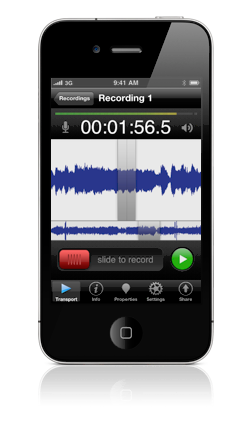
As described in my last post, listening to lots of audio in the target language is a key part of my approach to language learning. For that reason I needed a good field recorder app for my iPhone. I spent a lot of time and (because you can’t demo most apps without buying them) money searching for a workflow which would let me record, edit, and listen to audio within the same application. I wanted it all in one application because I find that I sometimes want to go back and re-edit a file. It is also currently difficult to send files to iTunes without going through the desktop. In the end, I found a wonderful app that did exactly what I wanted: FiRe2 Field Recorder.

Continue reading

How to Learn a Language (Learning an Endangered Language Part 6)

[This is the 5th installment in an ongoing series.]

I am not this guy:

Or this guy:

Then he dived into Russian, Italian, Persian, Swahili, Indonesian, Hindi, Ojibwe, Pashto, Turkish, Hausa, Kurdish, Yiddish, Dutch, Croatian and German, teaching himself mostly from grammar books and flash card applications on his iPhone. This in addition to a more formal study of French, Latin and Mandarin at the Dalton School, where he is a sophomore.

I suspect some people are wired differently, like this RadioLab episode about a ragtime musician who can play four concerts in his head at the same time and keep track of what any instrument in each of the four orchestras is playing at any given time.

This is a post about language learning for the rest of us. But first, a little throat clearing. While I have read a few books summarizing contemporary research on language learning, I don’t claim to be an expert on the subject. That means I make some scientific claims without backing them up. Caveat emptor. Continue reading

Bleg: AAA Bibliography Format for Sente

Since I first reviewed my favorite reference manager on this blog a number of readers have started to use it… and started to notice that it doesn’t have a built-in bibliography format for American Anthropology Association publications [AAA style guide (PDF)]. So I’m posting a bleg for anyone who has made such a format to share it here.

Also worth mentioning here: In the end of January Zotero released version 3.0 of Zotero, which finally introduced a “standalone” version of Zotero that doesn’t require Firefox to run. IMHO, it still has a ways to go before it can catch up to Sente, but there are two areas where it is ahead of the game: (1) It has plugins for Chrome which allow you to save citations directly from your browser. (Sente still awkwardly requires you to open its own browser and copy your link before you can save a webpage.) And (2) it has a AAA format built-in.

Finally, on the iOS front, I still find GoodReader + Dropbox + Evernote to be my best mobile reading workflow. But it is worth mentioning that in addition to Sente’s excellent iOS app which I reviewed earlier, there is now an unofficial iOS app for Zotero. There is also a new iOS app from the makers of Bookends, and a new version of Papers as well.

American Ethnologist To Check Your Facts

Fact checking is all the craze these days. This American Life ran an episode-length retraction of Mike Daisey’s Apple story. Sites like Politifact regularly check politicians on their Truth-o-Meter. Magazines like the New Yorker are proud of their fact checkers, but academic journals rarely bother to check facts. Sure, academics have peer-review, but peer-review is not the same thing as fact checking. An expert on linguistic anthropology who does work in Latin America might be asked to review an article on indexicals in Chinese speech. As peer review goes, there is nothing wrong with this. Said expert will be able to do a good job of evaluating the argument and the relationship of the argument to the data presented in the paper. What they won’t be able to do is to check whether that data is accurate.

With the exception of a few big controversies, such as Margaret Mead or Jared Diamond (who isn’t actually an anthropologist), it is very rare for anyone to go and talk to an informant and ask them if they really said the words attributed to them by the anthropologist. For this reason the American Ethnologist’s recent announcement that they will fact check all articles is truly groundbreaking.

And it raises a number of questions: how will they pay for it? Fact checking anthropology articles is a lot more difficult that fact checking your ordinary piece of journalism. Especially for fieldwork conducted in some of the more remote corners of the earth. Of course, more and more people have internet access these days, and English skills are more widespread so maybe it won’t be as difficult as all that.

Even then, there is still the question of what constitutes a factual claim in anthropology. Will they just be confirming the most obvious statements of fact, or will they ask informants about the interpretation of their words in the text?

And what about privacy? While I trust American Ethnologist not to divulge names, there are serious risks related to divulging name and contact information to anyone, especially those living in countries that might monitor phone calls or email.

Still, I have seen enough questionable research in print that I applaud AE’s efforts to raise the bar beyond mere peer-review. But the details matter and I worry about how the AE fact-checkers will interpret their mandate. It will be interesting to hear reports from the first round of scholars who submit articles under the new regime. If you are one of them, please let us know and we will be happy to publish your account here.

UPDATE: Please note the date of this post.