All posts by Kerim

Kerim

P. Kerim Friedman is an associate professor in the Department of Ethnic Relations and Cultures at National Dong Hwa University, in Taiwan, where he teaches linguistic and visual anthropology. He is co-director of the film Please Don’t Beat Me, Sir!, winner of the 2011 Jean Rouch Award from the Society of Visual Anthropology. Follow Kerim on Twitter.

The Digital Revolution and Anthropological Film

[The following is an invited post by Jay Ruby. Jay has been exploring the relationship between cultures and pictures for the over forty years. His research interests revolve around the application of anthropological insights to the production and comprehension of photographs, film, and television. For the past three decades, he has conducted ethnographic studies of pictorial communication among several U.S. communities.]

I first became interested in documentary and ethnographic film in the 1960s and was a witness to a profound technological change motivated by the need some filmmakers had to create a new cinematic form. It occurred in two places almost simultaneously – France and the U.S. Filmmakers wanted lightweight 16mm cameras with sync sound that needed no lighting and would need only a small crew for location shoots. In 1960, Drew Associates – Bob Drew, Albert Maysles, and D.A. Pennybaker jerry-rigged a fairly lightweight 16mm camera attached to a synced tape recorder and made the first American Direct Cinema film, Primary. (Dave Saunders, Direct Cinema: Observational Documentary and the Politics of the Sixties, London, Wallflower Press 2007) With its grainy, wobbly sometimes out of focus images and often-garbled sound, the film radically altered how some U.S documentarians made movies. While an interest in observational style films was relatively short among U.S. documentarians, some European anthrofilmmakers still consider it the best way to make films (See Anna Grinshaw and Amanda Ravetz’s 2009 Observational Cinema: Film and the Exploration of Social Film, Indiana University Press).
Continue reading

Tweeting Westgate

[The following is an “invited post” by Dr. Sarah Hillewaert. Sarah is an Assistant Professor of Linguistic Anthropology at the University of Toronto. Her works focuses on shifting notions of personhood and the changing linguistic and material practices of youth in (coastal) Kenya.]

On Saturday September 21st 2013, an upscale shopping center in Nairobi, Kenya became the target of a ruthless siege. A group of gunmen, their estimated number ranging between 6 and 15, entered the Westgate Mall and opened fire on bewildered shoppers, indiscriminately killing men, women and children. A few hours into the siege, Al-Shabaab – a Somali Islamist group with ties to Al-Qaeda – claimed the Westgate attack, not through an auspicious video delivered to a major television network, nor through an official statement of Al-Shabaab’s leader, Ahmed Godane, but via a Tweet on the organization’s Twitter account. The militants’ use of social media, and of Twitter in particular, would be featured centrally in the international media’s coverage of the attack. This preoccupation with Al-Shabaab’s use of new media technology, and the concern it was able to create, revealed much more about our apprehension toward the unexpected linkages and similarities social media create than it did about Al-Shabaab’s international reach. The media coverage of the Westgate siege illustrated how we laud the “power” of social media when it generates desirable similarities; unanticipated linkages, however, need to be explained away. A focus on “outliers” or “extremists,” or the identification of practices that answer to our social imaginary then restores the familiar distance between of “us” and “them.” 

Continue reading

Open Access for the Few?

Hardly a day goes buy that I don’t see an email, Facebook post, or Tweet asking for access to some academic PDF or another. I’m all for anything that erodes the awful paywall system that academic publishers have erected in order to preserve a broken model, but it bothers me that the reality of the current system is that a small coterie of academics have the equivalent of open access, while the rest of the world is blocked out. If I really need access to an article right now, I’m pretty sure someone at a major research library would email me a copy, but if someone who isn’t an academic wants that same article they are unlikely to be able to call upon their social network in the same way. What is really absurd about this system is that it is the people least able to pay for access who are the most likely to have to pay.

Getting Reading Done With Sente (Tools We Use)

Some of you may be aware of the productivity cult known as “Getting Things Done” (GTD). Although I find the full-blown GTD approach doesn’t really fit well with an academic lifestyle (what’s the use of using “contexts” when your work follows you everywhere?), reading about GTD taught me a few basic principles that make me feel less stressed out by allowing me to focus better on the work at hand. I mention GTD because I intend to use it as a framework to discuss reference management software, especially Sente for the iPad which recently got a significant upgrade. This review consists of three sections: 1. Applying GTD principles to academic reading with Sente. 2. Some comments about new features and continued limitations in the latest version of Sente for the iPad. And 3. Other options for reading and managing references on the iPad.

Continue reading

The Omniscient Narrator

I’ve spent a lot of time in India, but only briefly visited Mumbai. However, even though I was only there for a few days, I did manage to see enough to get a sense of the different worlds that people inhabit there: from the home of a wealthy patron of the arts near Victoria Terminus, to that of a struggling actor at the other end of the city, whose flat only had running water for ten minutes a day. Getting from one end to the other was an epic journey, and it (along with rides on over-crowded commuter trains, pollution, etc.) left me with a feeling that life in this city was  impossible. Perhaps this sense of impossibility is why so many talented writers have chose to write about Mumbai, and why I keep reading them. Among the more memorable books I’ve read are A Fine Balance, Maximum City, Beautiful Thing, and Katherine Boo’s Behind the Beautiful Forevers, which I just finished last night. There is a lot that could be (and has been) said about these books — about the relationship of writing to geography, about the relationship between journalism and fiction, about the relationship of these authors to the city, etc. — but in this blog post I want to focus on something that struck me in Boo’s writing: the omniscience of the narrator.

Continue reading

Anthropology Co-Citation Graph

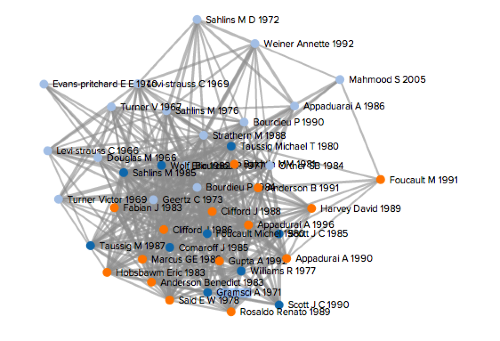
Recently Kieran Healy posted a link on Twitter to a co-citation graph he’d made to try to understand what philosophers “have been talking about for the last two decades?” He also posted a nice poster he made from this data [PDF]. I reposted these and mentioned that it would be great to have something similar for anthropology. The internet being the wonderful place that it is, I shortly had my wish, courtesy of Jonathan Goodwin.

anthropology co-citation graph

This chart isn’t as clean as Kieran’s – and probably has too much data (four journals going back to 1973), but Jonathan has helpfully provided instructions for how he did it in case anyone is interested in pursuing it further. I’d love to be able to create separate charts for each of the various sub-disciplines in anthropology, but that might be harder to do since they often appear in the same journals. Still, hopefully some interesting insights can be gleaned from this kind of data. If you are able to do anything with this, let us know in the comments!

UPDATE: Jonathan made a new, lower-density, chart for just 1998-to-the-present.

UPDATE: And a new one, with a chronological slider.

Anthropology Under the NSA’s Eyes

We now know that living abroad or corresponding with someone outside the US makes you fair game for government surveillance. Last year I wrote about the difficulties faced by anthropologists working in places like China, where there can be no expectation of privacy. We now know (as many long suspected) that nowhere is safe. What does this mean for anthropologists?

High levels of confidentiality may not be important for all types of anthropological fieldwork, but it can be hard to anticipate what statements might get our collaborators in trouble and we have a responsibility to protect their privacy to the best of our ability. As more and more of us are storing data in the cloud and more and more of our collaborators are communicating with us via email and on Facebook, we should be conscious of the fact that we cannot guarantee the confidentiality of anything stored online. Continue reading

AAA President Reflects on Race

AAA President, Leith Mullings, has a must-read post on Anthropology News: Trayvon Martin, Race and Anthropology.

Anthropology is the discipline that fostered and nurtured “scientific racism,” a world view that transforms certain perceived differences into genetically determined inequality and provides a rationale for slavery, colonialism, segregation, eugenics, and terror. Our discipline also has a significant tradition of anti-racism that emerged from the tumult leading to World War II.

What I like about it is it’s self-critical stance, something I felt was missing from all the gushing over Obama’s comments on race. (Maybe he could do something about the “war on drugs“?) Namely, it criticized the AAA’s Race exhibit and racial disparities within the discipline. About the Race exhibit she writes:

Continue reading

Star Trek and the Unfinished Project

I recently watched a “fan episode” of Star Trek which felt so much like the original series that you could easily believe it was directed produced by Gene Roddenberry. This devotional attention to detail got me thinking about the continued appeal of Star Trek. Habermas’ phrase “the unfinished project of modernity” immediately sprung to mind. Whereas in Star Wars modernity is represented by the dreaded Empire, Star Trek’s Federation is a benign force that carefully oversees the social development of lesser species. If the Enterprise encountered Jedi knights they would probably see them as a vestigial form of feudalism oppressing peasant society with their special powers.*

Here’s a confession. I not only grew up watching Star Trek, but I also grew up being spoon-fed that same version of modernity at school. I went to the United Nations International School for both middle school and high school, and I helped organize a series of student-run conferences on development related issues at the UN. But then I became an anthropologist. As an anthropologist, reading the likes of James Ferguson, James Scott and Arturo Escobar, one becomes a little skeptical about modernity’s “unfinished project.” It was for this reason that I found myself watching this nearly flawless recreation of the original Star Trek series and wondering: what’s the point? I loved it and will continue to watch any new episodes, but I also found it disturbing to have this outmoded vision of modernity preserved so uncritically.

It is like someone designing, in 2013, a building in the style of brutalist architecture from the sixties. I can admire some of these buildings and can even see the argument for preserving the greatest examples of brutalism, but would you really want to make a new building in this style? Perhaps the problem is that we still don’t really have a good alternative? It seems that a lot of science fiction these days is dystopian, zombie movies abound, but there there are very few movies or TV shows that see modernity as something positive. I understand the appeal of the enchanted vision of modernity that Star Trek gave us, but rather than forever try to recapture our lost-innocence, to finish a project which can never be finished, maybe it is time to tell a new story about modernity?

  • Star Wars, of course, is set in the past.

Kotahi Mano Kaika, Kotahi Mano Wawata (Learning an Endangered Language Part 9)

In part six eight of this series1 I complained about how Taiwanese indigenous languages are being taught more like dead languages than living ones.

This point was really hit home to me when I was discussing with another student that I would like to have better communicative competence. It took a long time for me to explain what I meant, and it slowly dawned on me that other students really had no expectation of being able to use the language in such a way.

So I was very happy that the Hualien Tribal College and the College of Indigenous Studies at NDHU were able to arrange for two Maori language activists, Hana O’Regan [PDF] and Megan Grace, both affiliated with the center for Māori and Pasifika studies at Christchurch Polytechnic Institute of Technology, to come to Hualien and share their thoughts and experiences. Hana and Megan have a very different approach to language revitalization – one which emphasizes building a living language. For this reason the focus of their work is in homes, not (just) in the classroom.

Continue reading

Faculty Privacy

For some time now, I’ve been meaning to write something about the Harvard email controversy because I think it teaches us something important about how we think about academic labor. First, a brief recap:

Last summer…Harvard was hit with scandal: “College officials [said] around 125 students may have shared answers and plagiarized on a final exam.”

Word about the scandal got to the news media in part thanks to a leaked email.

Here is what Harvard said happened next:

Consequently… a very narrow, careful, and precise subject-line search was conducted by the University’s IT Department. It was limited to the Administrative accounts for the Resident Deans… The search did not involve a review of email content; it was limited to a search of the subject line of the email that had been inappropriately forwarded.

Continue reading

Peer Review and Congressional Oversight – An Invited Post

[The following is an invited post by Megan Tracy.]

About two weeks ago, I received an email from one of the editors of the Science Insider blog. He began: “You’ve probably heard that your NSF grant to study the [Chinese] melamine poisoning scandal was targeted at two House science committee hearings yesterday.” I hadn’t heard and this is the first time my research has become the target of what feels like the never-ending rounds of partisan politics. The original critique of my project and the others being targeted is that they fail to directly benefit the American people. I was, quite frankly, rather surprised to be included as my project examines China’s evolving food regulatory system and has direct relevance for America’s food safety and security. The targeting of particular awards are not (and never are) about their specific content or quality but rather involve broader issues including the allocation of funding, peer review and congressional oversight. (It can, however, certainly feel direct especially when the intellectual merit of your specific grant is questioned and copies of the peer reviews and the program officer’s evaluations are requested in a letter written by the committee’s chairman. As a recent Slate article notes, these attacks appear to be winning. this year, for example, the Coburn amendment successfully limits NSF funding in political science to those that promote national security or the economic interests of the US. The same article argues that with a few exceptions, the social sciences have not been pushing back and are failing to present arguments with much traction in today’s economic and political climate.

Continue reading

Against Signposting

One of the main techniques by which writers create drama is by withholding information from readers. Unfortunately, it is difficult to use this technique in academic writing due to the nature of the peer review process. I frequently deal with reviewers who demand more “signposting.” They want everything to be revealed up front. No surprises. I resist because I believe that overuse of signposting is one of the main reasons so much of academic writing is so boring. Instead, I interpret these demands as a signal that I haven’t done enough to gain the reader’s trust.

Continue reading